


Sudden infant death syndrome

Encyclopedia
Sudden infant death syndrome (SIDS) is marked by the sudden death of an infant
that is unexpected by medical history, and remains unexplained after a thorough forensic autopsy and a detailed death scene investigation. An infant is at the highest risk for SIDS during sleep, which is why it is sometimes referred to by the terms cot death or crib death. The cause of SIDS is unknown, but characteristics associated with the syndrome have been identified. One of these characteristics is sleeping in the prone position
. There are many risk factors and medical causal relationships associated with SIDS. Infants exposed to tobacco smoke are at risk. Infanticide
and child abuse
cases are misdiagnosed as SIDS due to lack of evidence. Accidental suffocations are sometimes misdiagnosed as SIDS. Genetics play a role, as SIDS is more prevalent in males. Safe sleep environments that reduce the risk of SIDS include proper ventilation, and putting infants on their back to sleep
. Pacifiers and tummy time can help reduce known risk factors.
SIDS is a diagnosis of exclusion. It should only be applied to an infant whose death is sudden and unexpected and remains unexplained after the performance of an adequate postmortem investigation including:
Australia and New Zealand are shifting to the term "sudden unexplained death in infancy" (SUDI) for professional, scientific and coronial clarity.
(CDC) has recently suggested that such deaths be called "sudden unexpected infant deaths" (SUID) and that SIDS is a subset of SUID.
Listed below are several risk factors associated with increased probability of the syndrome.
(staph) and Escherichia coli
(E. coli) appear to be a risk factor
in some cases of SIDS. Both bacteria were present at greater-than-usual concentrations in infants who died from SIDS. SIDS cases peak between eight and ten weeks after birth, which is also the time frame in which the antibodies that were passed along from mother to child are starting to disappear and babies have not yet made their own antibodies.
on sleep environment and the risk of SIDS deemed co-sleeping and bed sharing unsafe. One article reports that co-sleeping infants have a greater risk of airway covering than when the same infant sleeps alone in a cot, but came to the conclusion that "Although numerous authors have suggested that bed-sharing infants face risks because of airway covering by bed-clothes or parental bodies, the present trial does not lend support to this hypothesis".
) of underdevelopment of receptors for serotonin
, which help control functions like breathing, blood pressure
and arousal, and abnormalities in serotonin signaling. According to the National Institutes of Health
, this finding was the strongest evidence at that time that structural differences in a specific part of the brain may contribute to the risk of SIDS. This abnormality can continue postpartum until the end of the first year. This could account for there being few SIDS deaths after the first year of infancy and the reason the risk is greater for premature infants. The authors noted that males have fewer serotonin receptors than females, perhaps contributing to the increased incidence of SIDS in males, but their follow-up 2010 paper failed to reconfirm that gender difference.
Another 2006 study showed that a possible cause of SIDS is because parents leave their infants in a position known as the Trendelenburg position
. This position can cause the brain stem to fall, and in a result, the brain becomes "crushed". The proper position for an infant is either Fowler's position
or Sims'.
A 2010 study suggests Interleukin-2, a neuromodulator, as the potential mechanism. Intense neuronal IL-2 immune-reactivity in the SIDS brainstem was found, which could be responsible for decreased cardiorespiratory and arousal responses.
s with unusual neural architecture or signal transduction in central pattern generator
circuits including the pre-Bötzinger complex
.
have been uncovered where the diagnosis was originally SIDS. This has led some researchers to estimate that 5% to 20% of SIDS deaths are infanticides. In 1997 The New York Times
, covering a book called The Death of Innocents: A True Story of Murder, Medicine and High-Stakes Science, wrote:
A pediatrician, Roy Meadow
, from the UK believes that many cases diagnosed as SIDS are really the result of child abuse
on the part of a parent. During the 1990s and early 2000s, a number of mothers of multiple apparent SIDS victims were convicted of homicide
to various extents
, on the basis of Meadow's opinion. In 2003 a number of high-profile acquittal
s brought Meadow's theories into disrepute. Several hundred murder convictions were reviewed, leading to several high-profile cases being re-opened and convictions overturned. Meadow was struck off in 2005. Meadow appealed to the High Court, which ruled in his favour in February 2006. The GMC appealed to the Court of Appeal and in October 2006 by a majority decision, with the Master of the Rolls, Sir Anthony Clarke, dissenting, the Court of Appeal upheld the decision of the High Court in part ruling that Meadow's misconduct was not sufficiently serious to merit the punishment which he had received.
The Royal Statistical Society
issued a media release refuting the expert testimony in one UK case in which the conviction was subsequently overturned.
hypothesis for SIDS and the male excess in infant mortality have shown that the 50% male excess could be related to a dominant X-linked allele
that occurs with a frequency of that is protective of transient cerebral anoxia. An unprotected XY male would occur with a frequency of and an unprotected XX female would occur with a frequency of . The ratio of to is 1.5 to 1 which matches the observed male 50% excess rate of SIDS.
Although many authors have found autosomal and mitochondrial genetic risk factors for SIDS they cannot explain the male excess because such gene loci have the same frequencies for males and females. Supporting evidence for an X-linkage is found by examination of other causes of infant respiratory death, such as suffocation by inhalation of food and other foreign objects. Although food is prepared identically for male and female infants, there is a similar 50% male excess of death from such causes indicating that males are more susceptible to the cerebral anoxia created by such incidents in exactly the same proportion as found in SIDS.
The JAMA 2006 study which indicated that there was a relationship between fewer serotonin binding sites and SIDS noted that the boys "had significantly fewer serotonin binding sites than girls", but the authors could not reproduce it in their 2010 paper. However, such neurological prematurity decreases with age, but the male fraction of approximately 0.61 persists each month throughout the first year of life. Furthermore, this cannot explain the identical male fraction of 0.61 in other respiratory mortality causes such as respiratory distress syndrome or suffocation from inhalation of food or foreign objects cited above, that also exists for all ages 1 to 14 years in the US from 1979 to 2005.
The authors' suggestion for the cause of SIDS is that the deaths are caused by disturbances in respiratory control (other than suffocation). The vestibular apparatus of the inner ear
has been shown to play an important role in respiratory control during sleep. It is speculated that this inner ear damage could be linked to SIDS. It is speculated that the damage occurs during delivery, particularly when prolonged contractions create greater blood pressure in the placenta
. The right ear is directly in the "line of fire" for blood entering the fetus
from the placenta, and thus could be most susceptible to damage. If the findings are relevant, it may be possible to take corrective measures. Researchers are beginning animal studies
to explore the connection.
found that "SIDS may be related to high levels of acute outdoor NO2 exposure during the last day of life." While nitrogen dioxide
(NO2) exposure may be one of many possible risk factors, it is not considered causal, and the report cautioned that further studies were needed to replicate the result.
in mattresses on compounds of phosphorus
, arsenic
and antimony
. These chemicals are frequently used to make mattresses fire-retardant.
Support for this hypothesis was based on the observation that the risk of cot death rises from one sibling to the next. Richardson claimed that parents are more likely to buy new bedding for their first child, and to re-use that bedding for later children. The more frequently used the bedding is, the more chance there will be that fungus has become resident in the material; thus, a higher chance of cot death. A paper by Peter Fleming and Peter Blair references evidence from other studies that both supports and refutes the increasing occurrence of SIDS with mattress sharing and suggests that this is still inconclusive.
Dr. Jim Sprott recommends new parents either buy bedding free of the toxic compounds or to wrap the mattresses in a barrier film to prevent the escape of the gases. Sprott claims that no case of cot death has ever been traced back to a properly manufactured or wrapped mattress.
However, a final report of "The Expert Group to Investigate Cot Death Theories: Toxic Gas Hypothesis", published in May 1998, concluded that "there was no evidence to substantiate the toxic gas hypothesis that antimony- and phosphorus-containing compounds used as fire retardants in PVC and other cot mattress materials are a cause of SIDS. Neither was there any evidence to believe that these chemicals could pose any other health risk to infants." The report also states that "in normal cot-like conditions it is not possible to generate toxic gas from antimony in mattresses" and "babies have also been found to die on wrapped mattresses."
According to Dr. Sprott, as of 2006, the New Zealand government has not reported any SIDS deaths when babies have slept on mattresses wrapped according to his method. While the Limerick report claims that babies have been found to die on wrapped mattresses, Dr. Sprott argues that a chemical analysis of the bedding should be performed. He additionally claims that this part of the report was flawed:
does not increase the risk of SIDS, and may reduce the risk slightly.
According to the US Centers for Disease Control and Prevention
:
were touted as a preventive measure for SIDS, although the claim was controversial even then. Subsequent studies failed to support a preventive role for vitamin C in SIDS. To the contrary, a 2009 study found that high levels of vitamin C were strongly associated with SIDS, possibly through a pro-oxidant interaction with iron.
For example an infant with MCAD deficiency could have died by "classical SIDS" if found swaddled and prone with head covered in an overheated room where parents were smoking
. Genes of susceptibility to MCAD and Long QT syndrome do not protect an infant from dying of classical SIDS. Therefore presence of a susceptibility gene, such as for MCAD, means the infant may have died either from SIDS or from MCAD deficiency. It is impossible for the pathologist to distinguish between them.
A 2010 study looked at 554 autopsies of infants in North Carolina that listed SIDS as the cause of death and suggested that many of these deaths may have been due to accidental suffocation. The study found that 69% of autopsies listed other possible risk factors that could lead to death such us unsafe bedding or sleeping with adults.
, using a fan to circulate air correlates with a lower risk of sudden infant death syndrome. This is plausible because a prone sleeping baby with nose to the sleeping surface could rebreathe some of its exhaled breath which is enriched in CO2 and depleted in oxygen. A fan could increase the mixing of the exhalation into the room air and lessen the risk of SIDS related to infant hypoxia. Researchers took into account other risk factors and found that fan use was associated with a 72% lower risk of SIDS. Only 3% of the babies who died had a fan on in the room during their last sleep, the mothers reported. That compared to 12% of the babies who lived. Using a fan reduced risk most for babies in poor sleeping environments. Author De-Kun li said that "the baby's sleeping environment really matters" and that "this seems to suggest that by improving room ventilation we can further reduce risk."
However, Dr. John Olssen at East Carolina University has pointed out that this study had a number of methodological flaws, such as selection and recall bias, low enrollment numbers, and dissimilar study groups. Olssen argues that although fan use is probably not harmful, it should not be recommended as a means to reduce the risk of SIDS.
Blankets should not be placed over an infant's head. It has been recommended that infants should be covered only up to their chest with their arms exposed. This reduces the chance of the infant shifting the blanket over his or her head.
, which investigated racial disparities in infant mortality in Chicago, found that previously or currently breastfeeding
infants in the study had 1/5 the rate of SIDS compared with non-breastfed infants, but that "it became nonsignificant in the multivariate model that included the other environmental factors". These results are consistent with most published reports and suggest that other factors associated with breastfeeding, rather than breastfeeding itself, are protective." A single more recent study claims to show a significantly reduced incidence of SIDS in breastfed infants.
, the Canadian government's health department, issued an advisory recommending against the use of bumper pads, stating:
According to a 1998 study by British researchers that compared back sleeping infants to stomach sleeping infants there were developmental differences at 6 months of age between the two groups. At 6 months of age the stomach sleeping infants had higher gross motor scores, social skills scores, and total development skills scores than the back sleeping infants. The differences were apparent at the 5% statistical significant level. But, at 18 months the differences were no longer apparent. The researchers deemed the lower development scores of back sleeping infants at 6 months of age to be transient and stated that they do not believe the back sleeping recommendations should be changed. Other scientists have stated that the conclusion that the negative effects of back sleep at 18 months of age is transient is based upon very little evidence and that no long-term randomized trials have been completed.
Other side effects of the back sleeping position include increased rates of shoulder retraction, positional plagiocephaly
, and positional torticollis
. Some scientists dispute that plagiocephaly is a negative side effect. Dr. Peter Fleming, who is co-author of the study that deemed delays at 6 months of age to be transient, has stated that he does not think plagiocephaly is a negative side effect of back sleep. In an interview with the Guardian Dr. Fleming stated "I do not think it is a medical problem—it is more of a cosmetic one. Mothers may feel it is a syndrome and a problem when it really is nonsense." A research study on children with plagiocephaly plus a confounding condition such as premature birth or failure to thrive, found that 26% had mild to severe psychomotor delay. This study also showed that 10% of infants with plagiocephaly had mild to severe mental development delay.
Because of the delays caused by back sleep some medical professionals have suggested that the "normal" ages at which children had previously attained developmental milestones should be pushed back. This would enable medical professionals to consider "normal" children who previously were considered developmentally delayed.
Additional studies have reported that the following negative conditions are associated with the back sleep position: increase in sleep apnea, decrease in sleep duration, strabismus, social skills delays, deformational plagiocephaly, and temporomandibular jaw difficulties. In addition, the following are symptoms that are associated with sleep apnea: growth abnormalities, failure to thrive syndrome in infants, neurocognitive abnormalities, daytime sleepiness, emotional problems, decrease in memory, decrease in learning, and a delay in nonverbal skills. The conditions associated with deformational plagiocephaly include visual impairments, cerebral dysfunction, delays in psychomotor development and decreases in mental functioning. The conditions associated with gross motor milestone delays include speech and language disorders. In addition, it has been hypothesized that delays in motor skills can have a negative impact on the development of social skills. In addition, other studies have reported that the prone position prevents subluxation of the hips, increases psychomotor development, prevents scoliosis, lessens the risk of gastroesophageal reflux, decreases infant screaming periods, causes less fatigue in infants, and increases the relief of infant colic. In addition, prior to the "Back to Sleep" campaign many babies self-treated their own torticollis by turning their heads from one side to the other while sleeping in the prone position. Supine sleeping infants cannot self-treat their own torticollis.
jm
use. According to the American Academy of Pediatrics
, pacifier use seems to reduce the risk of SIDS, although the mechanism by which this happens is unclear. SIDS experts and policy makers haven't recommended the use of pacifiers to reduce the risk of SIDS because of several problems associated with pacifier use, like increased risk of otitis, gastrointestinal infections and oral colonization with Candida species. A 2005 study indicated that use of a pacifier
is associated with up to a 90% reduction in the risk of SIDS depending on the ambient factors, and it reduced the effect of other risk factors. It has been speculated that the raised surface of the pacifier holds the infant's face away from the mattress, reducing the risk of suffocation. If a postmortem investigation does not occur or is insufficient, a suffocated baby may be misdiagnosed with SIDS.
A 2010 study at Monash University suggests pacifiers can prevent SIDS by changing sleep patterns. They believe a pacifier ensures the baby remains in a light sleep and is more easily aroused if they feel uncomfortable. The most recent 2011 study confirms that pacifier usage also reduces SIDS risks from other known SIDS risk factors
and cotinine
(a biological marker for secondhand smoke exposure) in their body fluids than those who die from other causes. Parents who smoke can significantly reduce their children's risk of SIDS by either quitting or smoking only outside and leaving their house completely smoke-free.
The maternal pregnancy smoking rate decreased by 38% between 1990 and 2002.
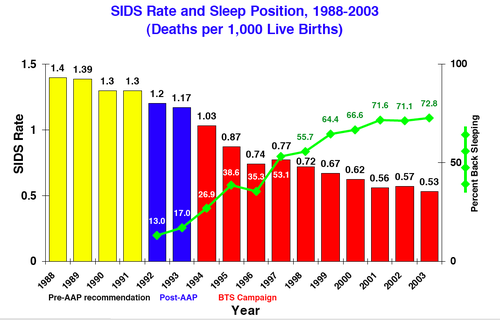 Sleeping on the back has been recommended by (among others) the American Academy of Pediatrics
(starting in 1992) to avoid SIDS, with the catchphrases "Back To Bed" and "Back to Sleep
". The incidence of SIDS has fallen sharply in a number of countries in which the back to bed recommendation has been widely adopted, such as the US and New Zealand. However, the absolute incidence of SIDS prior to the Back to Sleep Campaign was already dropping in the US, from 1.511 per 1000 in 1979 to 1.301 per 1000 in 1991.
Among the theories supporting the Back to Sleep recommendation is the idea that small infants with little or no control of their heads may, while face down, inhale their exhaled breath (high in carbon dioxide) or smother themselves on their bedding—the brain-stem anomaly research (above) suggests that babies with that particular genetic makeup do not react "normally" by moving away from the pooled CO2, and thus smother. Another theory is that babies sleep more soundly when placed on their stomachs, and are unable to rouse themselves when they have an incidence of sleep apnea
, which is thought to be common in infants.
Hospital neonatal-intensive-care-unit (NICU) staff commonly place preterm newborns on their stomach, although they advise parents to place their infants on their backs after going home from the hospital.
SIDS deaths in the US decreased from 4,895 in 1992 to 2,247 in 2004. But, during a similar time period, 1989 to 2004, SIDS being listed as the cause of death for sudden infant death (SID) decreased from 80% to 55%. According to Dr. John Kattwinkel, chairman of the Centers for Disease Control and Prevention (CDC) Special Task Force on SIDS "A lot of us are concerned that the rate (of SIDS) isn't decreasing significantly, but that a lot of it is just code shifting".
A set of 14 epidemiologic characteristics associated with SIDS have been identified:
Infant
A newborn or baby is the very young offspring of a human or other mammal. A newborn is an infant who is within hours, days, or up to a few weeks from birth. In medical contexts, newborn or neonate refers to an infant in the first 28 days after birth...
that is unexpected by medical history, and remains unexplained after a thorough forensic autopsy and a detailed death scene investigation. An infant is at the highest risk for SIDS during sleep, which is why it is sometimes referred to by the terms cot death or crib death. The cause of SIDS is unknown, but characteristics associated with the syndrome have been identified. One of these characteristics is sleeping in the prone position
Prone position
The term means to lie on bed or ground in a position with chest downwards and back upwards.-Etymology :The word "prone," meaning "naturally inclined to something, apt, liable," has been recorded in English since 1382; the meaning "lying face-down" was first recorded in 1578, but is also referred to...
. There are many risk factors and medical causal relationships associated with SIDS. Infants exposed to tobacco smoke are at risk. Infanticide
Infanticide
Infanticide or infant homicide is the killing of a human infant. Neonaticide, a killing within 24 hours of a baby's birth, is most commonly done by the mother.In many past societies, certain forms of infanticide were considered permissible...
and child abuse
Child abuse
Child abuse is the physical, sexual, emotional mistreatment, or neglect of a child. In the United States, the Centers for Disease Control and Prevention and the Department of Children And Families define child maltreatment as any act or series of acts of commission or omission by a parent or...
cases are misdiagnosed as SIDS due to lack of evidence. Accidental suffocations are sometimes misdiagnosed as SIDS. Genetics play a role, as SIDS is more prevalent in males. Safe sleep environments that reduce the risk of SIDS include proper ventilation, and putting infants on their back to sleep
Back to Sleep
Back to Sleep is an initiative backed by the National Institute of Child Health and Human Development at the National Institutes of Health to encourage parents to have their infants sleep on their backs to reduce the risk of Sudden Infant Death Syndrome, or SIDS...
. Pacifiers and tummy time can help reduce known risk factors.
Definition
Typically the infant is found dead after having been put to bed, and exhibits no signs of having suffered.SIDS is a diagnosis of exclusion. It should only be applied to an infant whose death is sudden and unexpected and remains unexplained after the performance of an adequate postmortem investigation including:
- an autopsy (by an experienced pediatric pathologist, if possible);
- investigation of the death scene and circumstances of the death;
- exploration of the medical historyMedical historyThe medical history or anamnesis of a patient is information gained by a physician by asking specific questions, either of the patient or of other people who know the person and can give suitable information , with the aim of obtaining information useful in formulating a diagnosis and providing...
of the infant and family.
Australia and New Zealand are shifting to the term "sudden unexplained death in infancy" (SUDI) for professional, scientific and coronial clarity.
The term SUDI is now often used instead of sudden infant death syndrome (SIDS) because some coroners prefer to use the term 'undetermined' for a death previously considered to be SIDS. This change is causing diagnostic shift in the mortality data.In addition, the U.S. Centers for Disease Control and Prevention
Centers for Disease Control and Prevention
The Centers for Disease Control and Prevention are a United States federal agency under the Department of Health and Human Services headquartered in Druid Hills, unincorporated DeKalb County, Georgia, in Greater Atlanta...
(CDC) has recently suggested that such deaths be called "sudden unexpected infant deaths" (SUID) and that SIDS is a subset of SUID.
Risk factors
The cause of SIDS is unknown. Although studies have identified risk factors for SIDS, such as putting infants to bed on their stomachs, there has been little understanding of the syndrome's biological cause or potential causes. The frequency of SIDS appears to be a strong function of the infant's sex, age and ethnicity, and the education and socio-economic-status of the infant's parents.Listed below are several risk factors associated with increased probability of the syndrome.
Before birth
- teenage mother (SIDS rates decrease with increasing maternal age)
- lack of prenatal carePrenatal carePrenatal care refers to the medical and nursing care recommended for women before and during pregnancy. The aim of good prenatal care is to detect any potential problems early, to prevent them if possible , and to direct the woman to appropriate specialists, hospitals, etc...
(SIDS rates increase with increasing delay in starting pre-natal care) - exposure to nicotine by maternal smoking (SIDS rates are higher for infants of mothers who smoke during pregnancy)
After birth
- mold (can cause bleeding lungs plus a variety of other uncommon conditions leading to a misdiagnosis and death). It is often misdiagnosed as a virus, flu, and/or asthma-like conditions.
- low birth weightBirth weightBirth weight is the body weight of a baby at its birth.There have been numerous studies that have attempted, with varying degrees of success, to show links between birth weight and later-life conditions, including diabetes, obesity, tobacco smoking and intelligence.-Determinants:There are...
(in the US from 1995-1998 the rate for 1000-1499 g was 2.89/1000 and for 3500-3999 g it was 0.51/1000) - exposure to tobaccoTobaccoTobacco is an agricultural product processed from the leaves of plants in the genus Nicotiana. It can be consumed, used as a pesticide and, in the form of nicotine tartrate, used in some medicines...
smoke - prone sleep position (lying on the stomach, see sleep positioning below)
- not breastfeedingBreastfeedingBreastfeeding is the feeding of an infant or young child with breast milk directly from female human breasts rather than from a baby bottle or other container. Babies have a sucking reflex that enables them to suck and swallow milk. It is recommended that mothers breastfeed for six months or...
- elevated or reduced room temperature
- excess bedding, clothing, soft sleep surfaces and stuffed animals
- co-sleeping with parents or other siblings may increase risk for SIDS, but the mechanism remains unclear
- infant's age (incidence rises from zero at birth, is highest from two to four months, and declines towards zero at one year)
- premature birthPremature birthIn humans preterm birth refers to the birth of a baby of less than 37 weeks gestational age. The cause for preterm birth is in many situations elusive and unknown; many factors appear to be associated with the development of preterm birth, making the reduction of preterm birth a challenging...
(increases risk of SIDS death by about four times. In 1995-1998 the US SIDS rate for 37–39 weeks of gestation was 0.73/1000; The SIDS rate for 28–31 weeks of gestation was 2.39/1000) - anemia [NB: per item 6 in the list of epidemiologic characteristics below, extent of anemia cannot be evaluated at autopsy because "total hemoglobin can only be measured in living infants."
Bacterial Infections
In a British study released May 29, 2008 researchers discovered that the common bacterial infections Staphylococcus aureusStaphylococcus aureus
Staphylococcus aureus is a facultative anaerobic Gram-positive coccal bacterium. It is frequently found as part of the normal skin flora on the skin and nasal passages. It is estimated that 20% of the human population are long-term carriers of S. aureus. S. aureus is the most common species of...
(staph) and Escherichia coli
Escherichia coli
Escherichia coli is a Gram-negative, rod-shaped bacterium that is commonly found in the lower intestine of warm-blooded organisms . Most E. coli strains are harmless, but some serotypes can cause serious food poisoning in humans, and are occasionally responsible for product recalls...
(E. coli) appear to be a risk factor
Risk factor
In epidemiology, a risk factor is a variable associated with an increased risk of disease or infection. Sometimes, determinant is also used, being a variable associated with either increased or decreased risk.-Correlation vs causation:...
in some cases of SIDS. Both bacteria were present at greater-than-usual concentrations in infants who died from SIDS. SIDS cases peak between eight and ten weeks after birth, which is also the time frame in which the antibodies that were passed along from mother to child are starting to disappear and babies have not yet made their own antibodies.
Bed Sharing
A 2005 policy statement by the American Academy of PediatricsAmerican Academy of Pediatrics
The American Academy of Pediatrics is the major professional association of pediatricians in the United States. The AAP was founded in 1930 by 35 pediatricians to address pediatric healthcare standards. It currently has 60,000 members in primary care and sub-specialist areas...
on sleep environment and the risk of SIDS deemed co-sleeping and bed sharing unsafe. One article reports that co-sleeping infants have a greater risk of airway covering than when the same infant sleeps alone in a cot, but came to the conclusion that "Although numerous authors have suggested that bed-sharing infants face risks because of airway covering by bed-clothes or parental bodies, the present trial does not lend support to this hypothesis".
Brain disorders
According to a JAMA 2006 study some babies who die of SIDS have abnormalities in the brain stem (the medulla oblongataMedulla oblongata
The medulla oblongata is the lower half of the brainstem. In discussions of neurology and similar contexts where no ambiguity will result, it is often referred to as simply the medulla...
) of underdevelopment of receptors for serotonin
Serotonin
Serotonin or 5-hydroxytryptamine is a monoamine neurotransmitter. Biochemically derived from tryptophan, serotonin is primarily found in the gastrointestinal tract, platelets, and in the central nervous system of animals including humans...
, which help control functions like breathing, blood pressure
Blood pressure
Blood pressure is the pressure exerted by circulating blood upon the walls of blood vessels, and is one of the principal vital signs. When used without further specification, "blood pressure" usually refers to the arterial pressure of the systemic circulation. During each heartbeat, BP varies...
and arousal, and abnormalities in serotonin signaling. According to the National Institutes of Health
National Institutes of Health
The National Institutes of Health are an agency of the United States Department of Health and Human Services and are the primary agency of the United States government responsible for biomedical and health-related research. Its science and engineering counterpart is the National Science Foundation...
, this finding was the strongest evidence at that time that structural differences in a specific part of the brain may contribute to the risk of SIDS. This abnormality can continue postpartum until the end of the first year. This could account for there being few SIDS deaths after the first year of infancy and the reason the risk is greater for premature infants. The authors noted that males have fewer serotonin receptors than females, perhaps contributing to the increased incidence of SIDS in males, but their follow-up 2010 paper failed to reconfirm that gender difference.
Another 2006 study showed that a possible cause of SIDS is because parents leave their infants in a position known as the Trendelenburg position
Trendelenburg position
In the Trendelenburg position the body is laid flat on the back with the feet higher than the head by 15-30 degrees, in contrast to the reverse Trendelenburg position, where the body is tilted in the opposite direction. This is a standard position used in abdominal and gynecological surgery...
. This position can cause the brain stem to fall, and in a result, the brain becomes "crushed". The proper position for an infant is either Fowler's position
Fowler's position
In medicine, Fowler's position is a standard patient position. It is used to relax tension of the abdominal muscles, allowing for improved breathing in immobile patients as it alleviates compression of the chest due to gravity, and to increase comfort during eating and other activities. It is also...
or Sims'.
A 2010 study suggests Interleukin-2, a neuromodulator, as the potential mechanism. Intense neuronal IL-2 immune-reactivity in the SIDS brainstem was found, which could be responsible for decreased cardiorespiratory and arousal responses.
Central respiratory pattern deficiency
There is ongoing research in the pediatric/neonatal community that has begun to associate apnea-like breathing cessations in animal modelAnimal model
An animal model is a living, non-human animal used during the research and investigation of human disease, for the purpose of better understanding the disease without the added risk of causing harm to an actual human being during the process...
s with unusual neural architecture or signal transduction in central pattern generator
Central pattern generator
Central pattern generators are neural networks that produce rhythmic patterned outputs without sensory feedback. CPGs have been shown to produce rhythmic outputs resembling normal "rhythmic motor pattern production" even in isolation from motor and sensory feedback from limbs and other muscle...
circuits including the pre-Bötzinger complex
Pre-Botzinger complex
The Pre-Bötzinger Complex is a cluster of interneurons in the ventrolateral medulla of the brainstem, which is essential to the generation of respiratory rhythm in mammals...
.
Cervical spinal injury from birth trauma
During birth, if the infant's head is traumatically turned side to side, upper cervical spinal injury can result. Difficulty breathing is a classic sign of upper spinal cord and brain-stem injury. When infants with undiagnosed upper cervical spinal cord injury are continually placed on their stomach for sleep, they are forced to turn their head to the side to breathe.Child abuse
Several instances of infanticideInfanticide
Infanticide or infant homicide is the killing of a human infant. Neonaticide, a killing within 24 hours of a baby's birth, is most commonly done by the mother.In many past societies, certain forms of infanticide were considered permissible...
have been uncovered where the diagnosis was originally SIDS. This has led some researchers to estimate that 5% to 20% of SIDS deaths are infanticides. In 1997 The New York Times
The New York Times
The New York Times is an American daily newspaper founded and continuously published in New York City since 1851. The New York Times has won 106 Pulitzer Prizes, the most of any news organization...
, covering a book called The Death of Innocents: A True Story of Murder, Medicine and High-Stakes Science, wrote:
The misdiagnosis of infanticide as SIDS "happens all over," Ms. Talan, a medical reporter at Newsday, said. "A lot of doctors and police don't know how to handle it. They don't take it as seriously as they should." As a result of the book's revelations, people are starting to scrutinize possible cases of this "perfect crime," which involves no physical evidence and no witnesses.
A pediatrician, Roy Meadow
Roy Meadow
Sir Samuel Roy Meadow is a British paediatrician and professor, who rose to initial fame for his 1977 academic paper on the now controversial Munchausen Syndrome by Proxy and his crusade against parents who, he believes, wilfully harm or kill their children. He was knighted for these works...
, from the UK believes that many cases diagnosed as SIDS are really the result of child abuse
Child abuse
Child abuse is the physical, sexual, emotional mistreatment, or neglect of a child. In the United States, the Centers for Disease Control and Prevention and the Department of Children And Families define child maltreatment as any act or series of acts of commission or omission by a parent or...
on the part of a parent. During the 1990s and early 2000s, a number of mothers of multiple apparent SIDS victims were convicted of homicide
Homicide
Homicide refers to the act of a human killing another human. Murder, for example, is a type of homicide. It can also describe a person who has committed such an act, though this use is rare in modern English...
to various extents
Murder in English law
Murder is an offence under the common law of England and Wales. It is considered the most serious form of homicide, in which one person kills another either intending to cause death or intending to cause serious injury .-Actus reus:The definition of the actus reus Murder is an offence under the...
, on the basis of Meadow's opinion. In 2003 a number of high-profile acquittal
Acquittal
In the common law tradition, an acquittal formally certifies the accused is free from the charge of an offense, as far as the criminal law is concerned. This is so even where the prosecution is abandoned nolle prosequi...
s brought Meadow's theories into disrepute. Several hundred murder convictions were reviewed, leading to several high-profile cases being re-opened and convictions overturned. Meadow was struck off in 2005. Meadow appealed to the High Court, which ruled in his favour in February 2006. The GMC appealed to the Court of Appeal and in October 2006 by a majority decision, with the Master of the Rolls, Sir Anthony Clarke, dissenting, the Court of Appeal upheld the decision of the High Court in part ruling that Meadow's misconduct was not sufficiently serious to merit the punishment which he had received.
The Royal Statistical Society
Royal Statistical Society
The Royal Statistical Society is a learned society for statistics and a professional body for statisticians in the UK.-History:It was founded in 1834 as the Statistical Society of London , though a perhaps unrelated London Statistical Society was in existence at least as early as 1824...
issued a media release refuting the expert testimony in one UK case in which the conviction was subsequently overturned.
Genetics
There is a consistent 50% male excess in SIDS per 1000 live births of each sex. Given a 5% male excess birth rate (105 male to 100 female live births) there appear to be 3.15 male SIDS per 2 female SIDS for a male fraction of 0.61. This value of 61% in the US is an average of 57% black male SIDS, 62.2% white male SIDS and 59.4% for all other races combined. Note that when multiracial parentage is involved, infant "race" is arbitrarily assigned to one category or the other; most often it is chosen by the mother. The X-linkageSex linkage
Sex linkage is the phenotypic expression of an allele related to the chromosomal sex of the individual. This mode of inheritance is in contrast to the inheritance of traits on autosomal chromosomes, where both sexes have the same probability of inheritance...
hypothesis for SIDS and the male excess in infant mortality have shown that the 50% male excess could be related to a dominant X-linked allele
Allele
An allele is one of two or more forms of a gene or a genetic locus . "Allel" is an abbreviation of allelomorph. Sometimes, different alleles can result in different observable phenotypic traits, such as different pigmentation...
that occurs with a frequency of that is protective of transient cerebral anoxia. An unprotected XY male would occur with a frequency of and an unprotected XX female would occur with a frequency of . The ratio of to is 1.5 to 1 which matches the observed male 50% excess rate of SIDS.
Although many authors have found autosomal and mitochondrial genetic risk factors for SIDS they cannot explain the male excess because such gene loci have the same frequencies for males and females. Supporting evidence for an X-linkage is found by examination of other causes of infant respiratory death, such as suffocation by inhalation of food and other foreign objects. Although food is prepared identically for male and female infants, there is a similar 50% male excess of death from such causes indicating that males are more susceptible to the cerebral anoxia created by such incidents in exactly the same proportion as found in SIDS.
The JAMA 2006 study which indicated that there was a relationship between fewer serotonin binding sites and SIDS noted that the boys "had significantly fewer serotonin binding sites than girls", but the authors could not reproduce it in their 2010 paper. However, such neurological prematurity decreases with age, but the male fraction of approximately 0.61 persists each month throughout the first year of life. Furthermore, this cannot explain the identical male fraction of 0.61 in other respiratory mortality causes such as respiratory distress syndrome or suffocation from inhalation of food or foreign objects cited above, that also exists for all ages 1 to 14 years in the US from 1979 to 2005.
Inner ear damage
Records of hearing tests (oto-acoustic emissions, OAEs) administered to certain infants show that those who later died of SIDS had differences in the pattern of these tests compared with normal babies. To be specific the OAE signal-to-noise ratio was reduced in the right ear in the SIDS babies (Rubens DD et al. Early Human Development 84, 225-9 (2008)). It should be noted this was a small study (n=31 cases and 31 controls), had serious limitations (several significant factors were not controlled), and has been criticised from various perspectives.The authors' suggestion for the cause of SIDS is that the deaths are caused by disturbances in respiratory control (other than suffocation). The vestibular apparatus of the inner ear
Inner ear
The inner ear is the innermost part of the vertebrate ear. In mammals, it consists of the bony labyrinth, a hollow cavity in the temporal bone of the skull with a system of passages comprising two main functional parts:...
has been shown to play an important role in respiratory control during sleep. It is speculated that this inner ear damage could be linked to SIDS. It is speculated that the damage occurs during delivery, particularly when prolonged contractions create greater blood pressure in the placenta
Placenta
The placenta is an organ that connects the developing fetus to the uterine wall to allow nutrient uptake, waste elimination, and gas exchange via the mother's blood supply. "True" placentas are a defining characteristic of eutherian or "placental" mammals, but are also found in some snakes and...
. The right ear is directly in the "line of fire" for blood entering the fetus
Fetus
A fetus is a developing mammal or other viviparous vertebrate after the embryonic stage and before birth.In humans, the fetal stage of prenatal development starts at the beginning of the 11th week in gestational age, which is the 9th week after fertilization.-Etymology and spelling variations:The...
from the placenta, and thus could be most susceptible to damage. If the findings are relevant, it may be possible to take corrective measures. Researchers are beginning animal studies
Animal studies
Animal studies is a recently recognized field in which animals are studied in a variety of cross-disciplinary ways. Scholars from fields as diverse as: art history, anthropology, biology, film studies, geography, history, psychology, literary studies, museology, philosophy, and sociology; and from...
to explore the connection.
Nitrogen dioxide
A 2005 study by researchers at the University of California, San DiegoUniversity of California, San Diego
The University of California, San Diego, commonly known as UCSD or UC San Diego, is a public research university located in the La Jolla neighborhood of San Diego, California, United States...
found that "SIDS may be related to high levels of acute outdoor NO2 exposure during the last day of life." While nitrogen dioxide
Nitrogen dioxide
Nitrogen dioxide is the chemical compound with the formula it is one of several nitrogen oxides. is an intermediate in the industrial synthesis of nitric acid, millions of tons of which are produced each year. This reddish-brown toxic gas has a characteristic sharp, biting odor and is a prominent...
(NO2) exposure may be one of many possible risk factors, it is not considered causal, and the report cautioned that further studies were needed to replicate the result.
Toxic gases
In 1989, a controversial piece of research by UK Scientist Barry Richardson claimed that all cot deaths were the result of toxic nerve gases being produced through the action of fungusFungus
A fungus is a member of a large group of eukaryotic organisms that includes microorganisms such as yeasts and molds , as well as the more familiar mushrooms. These organisms are classified as a kingdom, Fungi, which is separate from plants, animals, and bacteria...
in mattresses on compounds of phosphorus
Phosphorus
Phosphorus is the chemical element that has the symbol P and atomic number 15. A multivalent nonmetal of the nitrogen group, phosphorus as a mineral is almost always present in its maximally oxidized state, as inorganic phosphate rocks...
, arsenic
Arsenic
Arsenic is a chemical element with the symbol As, atomic number 33 and relative atomic mass 74.92. Arsenic occurs in many minerals, usually in conjunction with sulfur and metals, and also as a pure elemental crystal. It was first documented by Albertus Magnus in 1250.Arsenic is a metalloid...
and antimony
Antimony
Antimony is a toxic chemical element with the symbol Sb and an atomic number of 51. A lustrous grey metalloid, it is found in nature mainly as the sulfide mineral stibnite...
. These chemicals are frequently used to make mattresses fire-retardant.
Support for this hypothesis was based on the observation that the risk of cot death rises from one sibling to the next. Richardson claimed that parents are more likely to buy new bedding for their first child, and to re-use that bedding for later children. The more frequently used the bedding is, the more chance there will be that fungus has become resident in the material; thus, a higher chance of cot death. A paper by Peter Fleming and Peter Blair references evidence from other studies that both supports and refutes the increasing occurrence of SIDS with mattress sharing and suggests that this is still inconclusive.
Dr. Jim Sprott recommends new parents either buy bedding free of the toxic compounds or to wrap the mattresses in a barrier film to prevent the escape of the gases. Sprott claims that no case of cot death has ever been traced back to a properly manufactured or wrapped mattress.
However, a final report of "The Expert Group to Investigate Cot Death Theories: Toxic Gas Hypothesis", published in May 1998, concluded that "there was no evidence to substantiate the toxic gas hypothesis that antimony- and phosphorus-containing compounds used as fire retardants in PVC and other cot mattress materials are a cause of SIDS. Neither was there any evidence to believe that these chemicals could pose any other health risk to infants." The report also states that "in normal cot-like conditions it is not possible to generate toxic gas from antimony in mattresses" and "babies have also been found to die on wrapped mattresses."
According to Dr. Sprott, as of 2006, the New Zealand government has not reported any SIDS deaths when babies have slept on mattresses wrapped according to his method. While the Limerick report claims that babies have been found to die on wrapped mattresses, Dr. Sprott argues that a chemical analysis of the bedding should be performed. He additionally claims that this part of the report was flawed:
In February 2000 Dr Peter Fleming (a co-author of the Limerick Report and principal author of the UK CESDI Report) conceded that the claim that three babies in the United Kingdom had died of cot death on polythene-covered mattresses could not be substantiated.
Vaccination
VaccinationVaccination
Vaccination is the administration of antigenic material to stimulate the immune system of an individual to develop adaptive immunity to a disease. Vaccines can prevent or ameliorate the effects of infection by many pathogens...
does not increase the risk of SIDS, and may reduce the risk slightly.
According to the US Centers for Disease Control and Prevention
Centers for Disease Control and Prevention
The Centers for Disease Control and Prevention are a United States federal agency under the Department of Health and Human Services headquartered in Druid Hills, unincorporated DeKalb County, Georgia, in Greater Atlanta...
:
Vitamin C
In the 1970s, high doses of vitamin CVitamin C
Vitamin C or L-ascorbic acid or L-ascorbate is an essential nutrient for humans and certain other animal species. In living organisms ascorbate acts as an antioxidant by protecting the body against oxidative stress...
were touted as a preventive measure for SIDS, although the claim was controversial even then. Subsequent studies failed to support a preventive role for vitamin C in SIDS. To the contrary, a 2009 study found that high levels of vitamin C were strongly associated with SIDS, possibly through a pro-oxidant interaction with iron.
Differential diagnosis
Some conditions that may be undiagnosed and thus could be alternative diagnoses to SIDS include:- medium-chain acyl-coenzyme A dehydrogenase deficiencyMedium-chain acyl-coenzyme A dehydrogenase deficiencyMedium-chain acyl-coenzyme A dehydrogenase deficiency is a fatty acid oxidation disorder associated with inborn errors of metabolism. It is due to defects in the enzyme complex known as medium-chain acyl dehydrogenase and reduced activity of this complex...
(MCAD deficiency) - infant botulismBotulismBotulism also known as botulinus intoxication is a rare but serious paralytic illness caused by botulinum toxin which is metabolic waste produced under anaerobic conditions by the bacterium Clostridium botulinum, and affecting a wide range of mammals, birds and fish...
- long QT syndromeLong QT syndromeThe long QT syndrome is a rare inborn heart condition in which delayed repolarization of the heart following a heartbeat increases the risk of episodes of torsade de pointes . These episodes may lead to palpitations, fainting and sudden death due to ventricular fibrillation...
(accounting for less than 2% of cases) - infections with the bacterium Helicobacter pyloriHelicobacter pyloriHelicobacter pylori , previously named Campylobacter pyloridis, is a Gram-negative, microaerophilic bacterium found in the stomach. It was identified in 1982 by Barry Marshall and Robin Warren, who found that it was present in patients with chronic gastritis and gastric ulcers, conditions that were...
- shaken baby syndromeShaken baby syndromeShaken baby syndrome is a triad of medical symptoms: subdural hematoma, retinal hemorrhage, and brain swelling from which doctors, consistent with current medical understanding, infer child abuse caused by intentional shaking...
and other forms of child abuseChild abuseChild abuse is the physical, sexual, emotional mistreatment, or neglect of a child. In the United States, the Centers for Disease Control and Prevention and the Department of Children And Families define child maltreatment as any act or series of acts of commission or omission by a parent or... - overlying
For example an infant with MCAD deficiency could have died by "classical SIDS" if found swaddled and prone with head covered in an overheated room where parents were smoking
Smoking and pregnancy
Tobacco smoking and pregnancy is related to many effects on health and reproduction, in addition to the general health effects of tobacco. A number of studies have shown that tobacco use is a significant factor in miscarriages among pregnant smokers, and that it contributes to a number of other...
. Genes of susceptibility to MCAD and Long QT syndrome do not protect an infant from dying of classical SIDS. Therefore presence of a susceptibility gene, such as for MCAD, means the infant may have died either from SIDS or from MCAD deficiency. It is impossible for the pathologist to distinguish between them.
A 2010 study looked at 554 autopsies of infants in North Carolina that listed SIDS as the cause of death and suggested that many of these deaths may have been due to accidental suffocation. The study found that 69% of autopsies listed other possible risk factors that could lead to death such us unsafe bedding or sleeping with adults.
Air circulation with fan use
According to a study of nearly 500 babies published in the October 2008 Archives of Pediatrics & Adolescent MedicineArchives of Pediatrics & Adolescent Medicine
The Archives of Pediatrics & Adolescent Medicine is a monthly peer-reviewed medical journal published by the American Medical Association. It publishes original clinical and basic research articles covering all aspects of pediatric primary care. The journal was established in 1911 as the American...
, using a fan to circulate air correlates with a lower risk of sudden infant death syndrome. This is plausible because a prone sleeping baby with nose to the sleeping surface could rebreathe some of its exhaled breath which is enriched in CO2 and depleted in oxygen. A fan could increase the mixing of the exhalation into the room air and lessen the risk of SIDS related to infant hypoxia. Researchers took into account other risk factors and found that fan use was associated with a 72% lower risk of SIDS. Only 3% of the babies who died had a fan on in the room during their last sleep, the mothers reported. That compared to 12% of the babies who lived. Using a fan reduced risk most for babies in poor sleeping environments. Author De-Kun li said that "the baby's sleeping environment really matters" and that "this seems to suggest that by improving room ventilation we can further reduce risk."
However, Dr. John Olssen at East Carolina University has pointed out that this study had a number of methodological flaws, such as selection and recall bias, low enrollment numbers, and dissimilar study groups. Olssen argues that although fan use is probably not harmful, it should not be recommended as a means to reduce the risk of SIDS.
Bedding
Product safety experts advise against using pillows, sleep positioners, bumper pads, stuffed animals, or fluffy bedding in the crib and recommend instead dressing the child warmly and keeping the crib "naked."Blankets should not be placed over an infant's head. It has been recommended that infants should be covered only up to their chest with their arms exposed. This reduces the chance of the infant shifting the blanket over his or her head.
Breastfeeding
A 2003 study published in PediatricsPediatrics (journal)
Pediatrics is an official peer-reviewed journal of the American Academy of Pediatrics. In the inaugural January 1948 issue, the journal's first editor, Hugh McCulloch, articulated the journal's vision: "The content of the journal is... intended to encompass the needs of the whole child in his...
, which investigated racial disparities in infant mortality in Chicago, found that previously or currently breastfeeding
Breastfeeding
Breastfeeding is the feeding of an infant or young child with breast milk directly from female human breasts rather than from a baby bottle or other container. Babies have a sucking reflex that enables them to suck and swallow milk. It is recommended that mothers breastfeed for six months or...
infants in the study had 1/5 the rate of SIDS compared with non-breastfed infants, but that "it became nonsignificant in the multivariate model that included the other environmental factors". These results are consistent with most published reports and suggest that other factors associated with breastfeeding, rather than breastfeeding itself, are protective." A single more recent study claims to show a significantly reduced incidence of SIDS in breastfed infants.
Bumper pads
Bumper pads may be a contributing factor in SIDS deaths and should be removed. Health CanadaHealth Canada
Health Canada is the department of the government of Canada with responsibility for national public health.The current Minister of Health is Leona Aglukkaq, a Conservative Member of Parliament appointed to the position by Prime Minister Stephen Harper.-Branches, regions and agencies:Health Canada...
, the Canadian government's health department, issued an advisory recommending against the use of bumper pads, stating:
Concerns regarding recommendations
Dr. Rafael Pelayo from Stanford University and a number of other pediatric sleep researchers in the US have stated that they believe that the American Academy of Pediatrics' recommendations regarding cosleeping and pacifier use may have unintended consequences. They have stated that the SIDS prevention strategy of the American Academy of Pediatrics which keeps infants at a low arousal threshold and reduces the time in quiet sleep may be unhealthy for children. They state that slow wave sleep is the most restorative form of sleep and limiting this sleep in the first 12 months of life may have unintended consequences to both the sleep and the infant.According to a 1998 study by British researchers that compared back sleeping infants to stomach sleeping infants there were developmental differences at 6 months of age between the two groups. At 6 months of age the stomach sleeping infants had higher gross motor scores, social skills scores, and total development skills scores than the back sleeping infants. The differences were apparent at the 5% statistical significant level. But, at 18 months the differences were no longer apparent. The researchers deemed the lower development scores of back sleeping infants at 6 months of age to be transient and stated that they do not believe the back sleeping recommendations should be changed. Other scientists have stated that the conclusion that the negative effects of back sleep at 18 months of age is transient is based upon very little evidence and that no long-term randomized trials have been completed.
Other side effects of the back sleeping position include increased rates of shoulder retraction, positional plagiocephaly
Positional plagiocephaly
Positional plagiocephaly, also known as deformational plagiocephaly or flathead syndrome, is a condition most commonly found in infants and is characterized by a flat spot on the back or one side of the head caused by remaining in one position for too long.-Causes:It can be caused by a condition...
, and positional torticollis
Torticollis
Torticollis, or wryneck, is a stiff neck associated with muscle spasm, classically causing lateral flexion contracture of the cervical spine musculature...
. Some scientists dispute that plagiocephaly is a negative side effect. Dr. Peter Fleming, who is co-author of the study that deemed delays at 6 months of age to be transient, has stated that he does not think plagiocephaly is a negative side effect of back sleep. In an interview with the Guardian Dr. Fleming stated "I do not think it is a medical problem—it is more of a cosmetic one. Mothers may feel it is a syndrome and a problem when it really is nonsense." A research study on children with plagiocephaly plus a confounding condition such as premature birth or failure to thrive, found that 26% had mild to severe psychomotor delay. This study also showed that 10% of infants with plagiocephaly had mild to severe mental development delay.
Because of the delays caused by back sleep some medical professionals have suggested that the "normal" ages at which children had previously attained developmental milestones should be pushed back. This would enable medical professionals to consider "normal" children who previously were considered developmentally delayed.
Additional studies have reported that the following negative conditions are associated with the back sleep position: increase in sleep apnea, decrease in sleep duration, strabismus, social skills delays, deformational plagiocephaly, and temporomandibular jaw difficulties. In addition, the following are symptoms that are associated with sleep apnea: growth abnormalities, failure to thrive syndrome in infants, neurocognitive abnormalities, daytime sleepiness, emotional problems, decrease in memory, decrease in learning, and a delay in nonverbal skills. The conditions associated with deformational plagiocephaly include visual impairments, cerebral dysfunction, delays in psychomotor development and decreases in mental functioning. The conditions associated with gross motor milestone delays include speech and language disorders. In addition, it has been hypothesized that delays in motor skills can have a negative impact on the development of social skills. In addition, other studies have reported that the prone position prevents subluxation of the hips, increases psychomotor development, prevents scoliosis, lessens the risk of gastroesophageal reflux, decreases infant screaming periods, causes less fatigue in infants, and increases the relief of infant colic. In addition, prior to the "Back to Sleep" campaign many babies self-treated their own torticollis by turning their heads from one side to the other while sleeping in the prone position. Supine sleeping infants cannot self-treat their own torticollis.
jm
Pacifiers
According to a 2005 meta-analysis, most studies favor pacifierPacifier
A pacifier is a rubber, plastic, or silicone nipple given to an infant or other young child to suck upon. In its standard appearance it has a teat, mouth shield, and handle...
use. According to the American Academy of Pediatrics
American Academy of Pediatrics
The American Academy of Pediatrics is the major professional association of pediatricians in the United States. The AAP was founded in 1930 by 35 pediatricians to address pediatric healthcare standards. It currently has 60,000 members in primary care and sub-specialist areas...
, pacifier use seems to reduce the risk of SIDS, although the mechanism by which this happens is unclear. SIDS experts and policy makers haven't recommended the use of pacifiers to reduce the risk of SIDS because of several problems associated with pacifier use, like increased risk of otitis, gastrointestinal infections and oral colonization with Candida species. A 2005 study indicated that use of a pacifier
Pacifier
A pacifier is a rubber, plastic, or silicone nipple given to an infant or other young child to suck upon. In its standard appearance it has a teat, mouth shield, and handle...
is associated with up to a 90% reduction in the risk of SIDS depending on the ambient factors, and it reduced the effect of other risk factors. It has been speculated that the raised surface of the pacifier holds the infant's face away from the mattress, reducing the risk of suffocation. If a postmortem investigation does not occur or is insufficient, a suffocated baby may be misdiagnosed with SIDS.
A 2010 study at Monash University suggests pacifiers can prevent SIDS by changing sleep patterns. They believe a pacifier ensures the baby remains in a light sleep and is more easily aroused if they feel uncomfortable. The most recent 2011 study confirms that pacifier usage also reduces SIDS risks from other known SIDS risk factors
Secondhand smoke reduction
According to the US Surgeon General's Report, secondhand smoke is connected to SIDS. Infants who die from SIDS tend to have higher concentrations of nicotineNicotine
Nicotine is an alkaloid found in the nightshade family of plants that constitutes approximately 0.6–3.0% of the dry weight of tobacco, with biosynthesis taking place in the roots and accumulation occurring in the leaves...
and cotinine
Cotinine
Cotinine is an alkaloid found in tobacco and is also a metabolite of nicotine. The word "cotinine" is an anagram of "nicotine". Cotinine is used as a biomarker for exposure to tobacco smoke and has also been sold as an antidepressant under the brand name Scotine.Similarly to nicotine, cotinine...
(a biological marker for secondhand smoke exposure) in their body fluids than those who die from other causes. Parents who smoke can significantly reduce their children's risk of SIDS by either quitting or smoking only outside and leaving their house completely smoke-free.
The maternal pregnancy smoking rate decreased by 38% between 1990 and 2002.
Sleep positioning
American Academy of Pediatrics
The American Academy of Pediatrics is the major professional association of pediatricians in the United States. The AAP was founded in 1930 by 35 pediatricians to address pediatric healthcare standards. It currently has 60,000 members in primary care and sub-specialist areas...
(starting in 1992) to avoid SIDS, with the catchphrases "Back To Bed" and "Back to Sleep
Back to Sleep
Back to Sleep is an initiative backed by the National Institute of Child Health and Human Development at the National Institutes of Health to encourage parents to have their infants sleep on their backs to reduce the risk of Sudden Infant Death Syndrome, or SIDS...
". The incidence of SIDS has fallen sharply in a number of countries in which the back to bed recommendation has been widely adopted, such as the US and New Zealand. However, the absolute incidence of SIDS prior to the Back to Sleep Campaign was already dropping in the US, from 1.511 per 1000 in 1979 to 1.301 per 1000 in 1991.
Among the theories supporting the Back to Sleep recommendation is the idea that small infants with little or no control of their heads may, while face down, inhale their exhaled breath (high in carbon dioxide) or smother themselves on their bedding—the brain-stem anomaly research (above) suggests that babies with that particular genetic makeup do not react "normally" by moving away from the pooled CO2, and thus smother. Another theory is that babies sleep more soundly when placed on their stomachs, and are unable to rouse themselves when they have an incidence of sleep apnea
Sleep apnea
Sleep apnea is a sleep disorder characterized by abnormal pauses in breathing or instances of abnormally low breathing, during sleep. Each pause in breathing, called an apnea, can last from a few seconds to minutes, and may occur 5 to 30 times or more an hour. Similarly, each abnormally low...
, which is thought to be common in infants.
Hospital neonatal-intensive-care-unit (NICU) staff commonly place preterm newborns on their stomach, although they advise parents to place their infants on their backs after going home from the hospital.
Sleep sacks
In colder environments where bedding is required to maintain a baby's body temperature, the use of a "baby sleep bag" or "sleep sack" is becoming more popular. This is a soft bag with holes for the baby's arms and head. A zipper allows the bag to be closed around the baby. A study published in the European Journal of Pediatrics in August 1998 has shown the protective effects of a sleep sack as reducing the incidence of turning from back to front during sleep, reinforcing putting a baby to sleep on its back for placement into the sleep sack and preventing bedding from coming up over the face which leads to increased temperature and carbon dioxide rebreathing. They conclude in their study "The use of a sleeping-sack should be particularly promoted for infants with a low birth weight." The American Academy of Pediatrics also recommends them as a type of bedding that warms the baby without covering its head.Epidemiology
SIDS was responsible for 0.543 deaths per 1,000 live births in the US in 2005. It is responsible for far fewer deaths than congenital disorders and disorders related to short gestation, though it is the leading cause of death in healthy infants after one month of age.SIDS deaths in the US decreased from 4,895 in 1992 to 2,247 in 2004. But, during a similar time period, 1989 to 2004, SIDS being listed as the cause of death for sudden infant death (SID) decreased from 80% to 55%. According to Dr. John Kattwinkel, chairman of the Centers for Disease Control and Prevention (CDC) Special Task Force on SIDS "A lot of us are concerned that the rate (of SIDS) isn't decreasing significantly, but that a lot of it is just code shifting".
A set of 14 epidemiologic characteristics associated with SIDS have been identified:
- A characteristic 4-parameter lognormal age distribution;
- Increased risk associated with prone sleep position;
- Prone and supine SIDS have same age and gender distributions;
- Male and female SIDS have same age distribution;
- Total sudden respiratory deaths at home have same age and gender distributions;
- No evidence of cause of death at forensic autopsy and death scene investigation;
- SIDS spares infants at birth[?];
- Seasonality: winter maximum, summer minimum;
- Increasing SIDS rate with Live Birth Order;
- Consistent male excess of approximately 50%;
- Low increased risk of SIDS in subsequent siblings of SIDS;
- Parental smoking is a risk factor for SIDS;
- Acute Life Threatening Events (ALTE) are not a risk factor for subsequent SIDS;
- SIDS risk is greatest during sleep.