


Stage lighting instrument

Encyclopedia


Stage lighting
Modern stage lighting is a flexible tool in the production of theatre, dance, opera and other performance arts. Several different types of stage lighting instruments are used in the pursuit of the various principles or goals of lighting. Stage lighting has grown considerably in recent years...
to illuminate theatrical
Theatre
Theatre is a collaborative form of fine art that uses live performers to present the experience of a real or imagined event before a live audience in a specific place. The performers may communicate this experience to the audience through combinations of gesture, speech, song, music or dance...
productions, concert
Concert
A concert is a live performance before an audience. The performance may be by a single musician, sometimes then called a recital, or by a musical ensemble, such as an orchestra, a choir, or a musical band...
s, and other performance
Performance
A performance, in performing arts, generally comprises an event in which a performer or group of performers behave in a particular way for another group of people, the audience. Choral music and ballet are examples. Usually the performers participate in rehearsals beforehand. Afterwards audience...
s taking place in live performance venues
Theater (structure)
A theater or theatre is a structure where theatrical works or plays are performed or other performances such as musical concerts may be produced. While a theater is not required for performance , a theater serves to define the performance and audience spaces...
. They are also used to light television studio
Television studio
A television studio is an installation in which a video productions take place, either for the recording of live television to video tape, or for the acquisition of raw footage for post-production. The design of a studio is similar to, and derived from, movie studios, with a few amendments for the...
s and sound stage
Sound stage
In common usage, a sound stage is a soundproof, hangar-like structure, building, or room, used for the production of theatrical filmmaking and television production, usually located on a secure movie studio property.-Overview:...
s.
Many stagecraft terms vary between the United States and the United Kingdom. In the USA, lighting fixtures are often called "instruments" or "units". In the UK, they are called "lanterns" or "luminaires". This article mainly uses terms common to the USA.
Components
- See the picture at top right for the physical location of most components.
Stage lighting instruments all have the following components:
Housing
The lamp housing is a metal or plastic container that serves as a body for the entire instrument and prevents light from spilling in unwanted directions. It comprises all of the exterior of the fixture except for the lens or opening. The housing may be designed with specific elements that help reduce heat and increase the efficiency of a lamp. Older instruments were made from rolledRolling (metalworking)
In metalworking, rolling is a metal forming process in which metal stock is passed through a pair of rolls. Rolling is classified according to the temperature of the metal rolled. If the temperature of the metal is above its recrystallization temperature, then the process is termed as hot rolling...
and machined steel or aluminum; however, with the advent of the Source Four
Source four
The Electronic Theatre Controls Source Four is an ellipsoidal reflector spotlight used in stage lighting. First released in 1992, the Source Four features an improved lamp and reflector compared to previous ERS designs, tool-free lamp adjustment, and a rotating, interchangeable shutter barrel...
, many lighting instruments are being made from die cast metal
Die casting
Die casting is a metal casting process that is characterized by forcing molten metal under high pressure into a mold cavity. The mold cavity is created using two hardened tool steel dies which have been machined into shape and work similarly to an injection mold during the process...
. Die casting allows for one single, light-weight body that is more economical to produce and use. Some instruments are made from plastic, such as the Selecon Pacific.
Lens or opening

Light beam
A light beam or beam of light is a narrow projection of light energy radiating from a source into a beam. Sunlight is a natural example of a light beam when filtered through various mediums...
is intended to come. Many fixtures use a lens
Lens (optics)
A lens is an optical device with perfect or approximate axial symmetry which transmits and refracts light, converging or diverging the beam. A simple lens consists of a single optical element...
to help control the beam of light, though some, such as PAR cans
Parabolic aluminized reflector light
A parabolic aluminized reflector lamp is a type of electric lamp that is widely used in commercial, residential, and transportation illumination. Usage includes locomotive headlamps, aircraft landing lights, and residential and commercial recessed lights...
and border or cyclorama
Cyclorama (theater)
A cyclorama is a large curtain or wall, often concave, positioned at the back of the stage area. It was popularized in the German theater of the 19th century and continues in common usage today in theaters throughout the world...
lights, do not have any lenses or optics other than the reflector. The lens and the reflector, along with other beam-altering devices are both considered part of the optics system.
Reflector
The reflector affects the quality and directionality of the light output. A reflector is located behind or around the light source in such a way as to direct more light towards the lens or opening. Each unit has a characteristic reflector, used in conjunction with the lens (or lack thereof) to create the desired effect. An ellipsoidal reflector has a lamp set at one focus point of an ellipsoid-shaped reflector that bounces the light and focuses it at the second focus point of the ellipse. This focuses the beam of light into a tight beam. Ellipsoidal reflectors often are used for tight, focusable spots, although they can be used for floodlights, such as in scoopsScoop (theater)
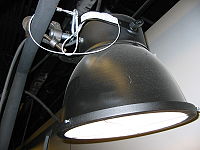
In stage lighting, an ellipsoidal reflector floodlight , better known as a scoop, is a large, simple lighting fixture with a dome-like reflector, large high-wattage lamp and no lens...
(see below). A parabolic reflector has a lamp set at the focus point of a parabola-shaped reflector that bounces the light in parallel beams away from the reflector. There is no point at which the light converges, so the light is unfocusable. Parabolic reflectors are used for lights intended to provide an unfocused wash, such as PAR cans.
Yoke
Most instruments are suspended or supported by a U-shaped yoke, fixed at two points to the sides of the instrument, providing an axis of rotation. The yoke is connected to a pipe or battenBatten (theater)
In theater, batten refers to a long metal pole suspended above the stage or the audience from which lighting fixtures, theatrical scenery, tabs or other curtains may be hung...
by one of the clamps mentioned below. It may also be affixed to the deck with floor mounts, or attached to the set with a stage screw.
Attachment apparatus
C-ClampsC-Clamp (stagecraft)
In stagecraft, a c-clamp can refer to a number of different pieces of hardware, depending on its intended use.-Lighting and sound:In stage lighting and sound a c-clamp, also referred to as a pipe clamp, is used to attach a larger piece of hardware, such as a lighting instrument, a speaker, or a...
and hook clamps that utilize a threaded bolt to attach to a pipe or batten and to hold the instrument secure. Once secured, the fixture can be panned and tilted using adjustment knobs on the yoke and clamp. In addition, safety cables (a loop of aircraft cable terminated with carabiner
Carabiner
A carabiner or karabiner is a metal loop with a sprung or screwed gate that is used to quickly and reversibly connect components in safety-critical systems. The word comes from "Karabinerhaken", meaning "hook for a carbine" in German.-Use:...
s) are used to support the lighting instrument in case the clamp fails.
A side arm is a metal pole bolted to the instrument with a clamp on the end. This enables the instrument to be hung to the side of an electric as opposed to below it.
Lamp or arc source
Most theatrical lampsLamp (electrical component)
A lamp is a replaceable component such as an incandescent light bulb, which is designed to produce light from electricity. These components usually have a base of ceramic, metal, glass or plastic, which makes an electrical connection in the socket of a light fixture. This connection may be made...
are tungsten-halogen
Halogen lamp
A halogen lamp, also known as a tungsten halogen lamp, is an incandescent lamp with a tungsten filament contained within an inert gas and a small amount of a halogen such as iodine or bromine. The chemical halogen cycle redeposits evaporated tungsten back on to the filament, extending the life of...
(or quartz-halogen), an improvement on the original incandescent
Incandescent light bulb
The incandescent light bulb, incandescent lamp or incandescent light globe makes light by heating a metal filament wire to a high temperature until it glows. The hot filament is protected from air by a glass bulb that is filled with inert gas or evacuated. In a halogen lamp, a chemical process...
design that used halogen gas instead of an inert gas. Fluorescent
Fluorescent lamp
A fluorescent lamp or fluorescent tube is a gas-discharge lamp that uses electricity to excite mercury vapor. The excited mercury atoms produce short-wave ultraviolet light that then causes a phosphor to fluoresce, producing visible light. A fluorescent lamp converts electrical power into useful...
lights are rarely used other than as work lights (see below). Although they are far more efficient, they cannot be dimmed
Dimmer
Dimmers are devices used to vary the brightness of a light. By decreasing or increasing the RMS voltage and, hence, the mean power to the lamp, it is possible to vary the intensity of the light output...
(run at less than full power) without using specialized dimmers, cannot dim to very low levels, do not produce light from a single point or easily concentrated area, and have a warm-up period during which they emit no light or do so intermittently. High-intensity discharge lamp
High-intensity discharge lamp
High-intensity discharge lamps are a type of electrical lamp which produces light by means of an electric arc between tungsten electrodes housed inside a translucent or transparent fused quartz or fused alumina arc tube. This tube is filled with both gas and metal salts. The gas facilitates the...
s (or HID lamps) are now common where a very bright light output is required, for example in large follow spots, HMI (hydrargyrum medium-arc iodide
Hydrargyrum medium-arc iodide
Hydrargyrum medium-arc iodide, or HMI, is a Osram brand metal-halide gas discharge medium arc-length lamp manufactured for the film and entertainment industry. Hydrargyrum is Latin for mercury...
) floods, and modern automated fixtures
Intelligent lighting
Intelligent lighting refers to stage lighting that has automated or mechanical abilities beyond those of traditional, stationary illumination. Although the most advanced intelligent lights can produce extraordinarily complex effects, the intelligence lies with the programmer of the show rather...
. Because these types of lamps cannot be electrically dimmed, dimming is done by mechanical dousers or shutters that physically block portions of the lamp to decrease output. Some specially-designed fittings now use light-emitting diodes (LEDs) as a light source. LEDs are ideal where an intense but unfocused light source is required, such as for lighting a cyclorama.
Accessories
Conventional (non-intelligent) fixtures are designed to accept a number of different accessories intended to assist in the modification of the output. The most common, found on almost all stage lights, is the gel frame holder. The gel frame holder is intended to hold gelColor gel
A color gel or color filter , also known as lighting gel or simply gel, is a transparent colored material that is used in theatre, event production, photography, videography and cinematography to color light and for color correction...
, mounted in cardboard or metal gel frames. Other common accessories include gobo
Gobo (lighting)
A gobo derived from "Go Between" or Goes Before Optics -originally used on film sets, is a physical template slotted inside, or placed in front of, a lighting source, used to control the shape of emitted light....
holders or rotators, iris holders, donuts, barn doors and color scroller
Color scroller
A color scroller or color changer is an electro-mechanical lighting accessory used in theater, film, dance and concerts to change the color projected by stage lighting instruments without the need of a person to be in the vicinity of the light...
s.
Types

Light beam
A light beam or beam of light is a narrow projection of light energy radiating from a source into a beam. Sunlight is a natural example of a light beam when filtered through various mediums...
. The distinction has to do with the characteristics of the light produced by the instrument. Spotlights produce a potentially tightly focused light, while floodlights produce a much more diffuse light. Instruments that fall somewhere in the middle of the spectrum can be classified as either a spot or a flood, depending on the type of instrument and how it is used.
PAR lights
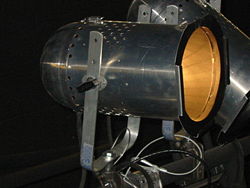
Sealed beam
A sealed beam is a type of lamp that includes a reflector and filament as a single assembly, over which a front cover of clear glass, is permanently attached. Previously, automotive headlamps used a separate small bulb and reflector covered with a ribbed lens to avoid glare from the filament. This...
PAR lamp housed in a simple can-like unit. Like an old-fashioned automotive headlight, the reflector is integral to the lamp and the beam spread of the unit is not adjustable except by changing the lamp. PAR lamps are widely used in architectural lighting and may often be found at hardware stores. PAR lights have seen heavy use in rock and roll
Rock and roll
Rock and roll is a genre of popular music that originated and evolved in the United States during the late 1940s and early 1950s, primarily from a combination of African American blues, country, jazz, and gospel music...
shows, especially those with smaller budgets, due to their low cost, light weight, easy maintenance, high durability, and high output. They are often used in combination with smoke
Fog machine
A fog machine or smoke machine is a device which emits a dense vapour that appears similar to fog or smoke. This artificial fog is most commonly used in professional entertainment applications, but smaller, more affordable fog machines are becoming common for personal use. Fog machines can also be...
or haze machine
Haze machine
Haze machines, or haze generators , are effects machines similar to fog machines, designed to produce an unobtrusive, homogeneous clouds suspended in the air intended primarily to make light beams visible or create a subtle diffusion.-Properties:Unlike theatrical fog, which is typically intended to...
s which make the path of the beam
Light beam
A light beam or beam of light is a narrow projection of light energy radiating from a source into a beam. Sunlight is a natural example of a light beam when filtered through various mediums...
visible. They are also often used as top, back, or side lights in the theater and for special effects.
All PAR lamps except those with narrow or very narrow lenses produce an intense oval
Oval
An oval is any curve resembling an egg or an ellipse, such as a Cassini oval. The term does not have a precise mathematical definition except in one area oval , but it may also refer to:* A sporting arena of oval shape** a cricket field...
pool of light, some with fixed focus and soft edges. In order to adjust the orientation of the oval, the lamp must be rotated. The number associated with a PAR light (e.g.: Par 64, Par 36, Par 16) indicates the diameter of the lamp
Lamp (electrical component)
A lamp is a replaceable component such as an incandescent light bulb, which is designed to produce light from electricity. These components usually have a base of ceramic, metal, glass or plastic, which makes an electrical connection in the socket of a light fixture. This connection may be made...
in eighths of an inch.
Four different beam angles can be obtained on the PAR-64. The beam angle is determined by the lamp. Lamps come in "very narrow" (6° x 12°), "narrow" (7° x 14°), "medium" (12° x 28°), and "wide" (24° x 48°). Each angle has two numerical values since the beams are elliptical rather than circular. PAR 16s are often referred to as "birdies.
PAR-bars are aluminum pipes with par cans permanently attached and circuited through the pipe. Par-bars with 4 instruments are often referred to as 4-bars, and par-bars with 6 instruments are referred to as 6-bars.
In 1995 Electronic Theatre Controls
Electronic Theatre Controls
Electronic Theatre Controls is a privately held corporation with global headquarters in Middleton, Wisconsin, United States. An international manufacturer of entertainment and architectural lighting systems, ETC offers professional lighting fixtures, lighting control consoles, dimming equipment...
(ETC) introduced the Source Four PAR
Source Four PAR
The Source Four PAR is a lighting fixture manufactured by Electronic Theatre Controls as a modern, energy efficient alternative to the traditional Parabolic aluminized reflector fixtures.-Construction:...
as an alternative to PAR cans
. The Source Four PAR uses a lamp separate from the lens and reflector assemblies.
Strip lights
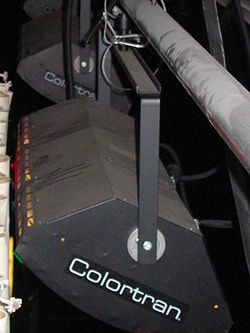
Cyclorama (theater)
A cyclorama is a large curtain or wall, often concave, positioned at the back of the stage area. It was popularized in the German theater of the 19th century and continues in common usage today in theaters throughout the world...
, a curtain at the back of the stage), border lights, and codas (by the brand name), are long housings typically containing multiple lamps arranged along the length of the instrument and emitting light perpendicular to its length. Lamps are often covered with gels
Color gel
A color gel or color filter , also known as lighting gel or simply gel, is a transparent colored material that is used in theatre, event production, photography, videography and cinematography to color light and for color correction...
of multiple colors (often red, green, and blue, which, in theory, allow almost any color to be mixed) with each color controlled by a separate electrical dimmer circuit. Many striplights use round pieces of glass (called roundels) rather than plastic gels for color. Roundels can sustain heavy use for a long time without fading and are often found in more permanent installations.
Scoop lights
House lights and worklights
 |
 |
House lights provide light on the theater's seats and aisles for the audience
Audience
An audience is a group of people who participate in a show or encounter a work of art, literature , theatre, music or academics in any medium...
before and after performances and during intermission
Intermission
An intermission or interval is a recess between parts of a performance or production, such as for a theatrical play, opera, concert, or film screening....
s. They are generally incandescent lights, however fluorescent lights or scoops
Scoop (theater)
In stage lighting, an ellipsoidal reflector floodlight , better known as a scoop, is a large, simple lighting fixture with a dome-like reflector, large high-wattage lamp and no lens...
may be used in some instances. House lights are often controlled by dimmer
Dimmer
Dimmers are devices used to vary the brightness of a light. By decreasing or increasing the RMS voltage and, hence, the mean power to the lamp, it is possible to vary the intensity of the light output...
s, but are sometimes on simple switches. Worklight
Worklight
In theater, a worklight is a high-intensity light fixture which is used to illuminate the stage for the benefit of technicians. Technicians use these lights rather than the stage lights for a number of reasons. Firstly, it take much less technical knowledge to turn on worklights, so even people...
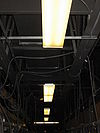
s provide general lighting backstage or in the house, and are often fluorescent fixtures. Work lights are almost always non-dimmed.
House and work lights are usually off during performances but are occasionally included in the lighting design to establish focus or emphasize plot elements. When the house lights are not on a dimmer, the switch is usually under the control of the stage manager.
LED stage lights
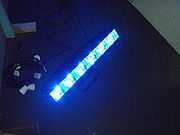
Light-emitting diode
A light-emitting diode is a semiconductor light source. LEDs are used as indicator lamps in many devices and are increasingly used for other lighting...
s (LEDs) as a light source. LED instruments are an alternative to traditional stage lighting instruments which use halogen lamp
Halogen lamp
A halogen lamp, also known as a tungsten halogen lamp, is an incandescent lamp with a tungsten filament contained within an inert gas and a small amount of a halogen such as iodine or bromine. The chemical halogen cycle redeposits evaporated tungsten back on to the filament, extending the life of...
or high-intensity discharge lamp
High-intensity discharge lamp
High-intensity discharge lamps are a type of electrical lamp which produces light by means of an electric arc between tungsten electrodes housed inside a translucent or transparent fused quartz or fused alumina arc tube. This tube is filled with both gas and metal salts. The gas facilitates the...
s. Like other LED instruments, they have high light output with lower power consumption. Most LED fixtures utilize three or more colors (usually red, green, and blue) which can be mixed to hypothetically create any color.
Types
LED stage lights come in three main types. PAR cans
Parabolic aluminized reflector light
A parabolic aluminized reflector lamp is a type of electric lamp that is widely used in commercial, residential, and transportation illumination. Usage includes locomotive headlamps, aircraft landing lights, and residential and commercial recessed lights...
, striplight
Striplight
A striplight is a multi-circuit stage lighting instrument. Striplights are one of the most basic types of lighting fixtures available. They usually consist of row of lamps. A single striplight is usually wired internally into either 3 or 4 circuits. Each internal circuit consists of several...
s, and "moving head" types. In LED PAR cans, a round printed circuit board with LEDs mounted on is used in place of a PAR lamp. Moving head types can either be a bank of LEDs mounted on a yoke or more conventional moving head lights with the bulb replaced with an LED bank.
Uses
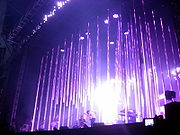
Radiohead
Radiohead are an English rock band from Abingdon, Oxfordshire, formed in 1985. The band consists of Thom Yorke , Jonny Greenwood , Ed O'Brien , Colin Greenwood and Phil Selway .Radiohead released their debut single "Creep" in 1992...
's recent tour, have used only LED lighting instruments. However, most shows use LEDs only for lighting cycloramas
Cyclorama (theater)
A cyclorama is a large curtain or wall, often concave, positioned at the back of the stage area. It was popularized in the German theater of the 19th century and continues in common usage today in theaters throughout the world...
, or as top, side, or back light due to their low throw distance. They can also be used as audience blinders (lights pointed directly at the audience from a low angle).
Spotlights
A spotlight is general term for any lighting instrument used in theater to create a pool of light on the stageStage (theatre)
In theatre or performance arts, the stage is a designated space for the performance productions. The stage serves as a space for actors or performers and a focal point for the members of the audience...
. There are many different types of spotlights which break down into three general areas:
- Fresnel lanternFresnel lanternA Fresnel lantern is a common lantern used in theatre, which employs a Fresnel lens to wash light over an area of the stage. The lens produces a wider, soft-edged beam of light, which is commonly used for back light and top light....
s or Fresnels (US) are small fixtures giving a soft-edged spot or pool of light. Their name comes from the distinctive ridged Fresnel lens used on the front. - Profile spots (UK) or ellipsoidal reflector spotlights (US) tend to be longer fixtures containing convex lenses and having a gate at their focal point which enables the insertion of gobosGobo (lighting)A gobo derived from "Go Between" or Goes Before Optics -originally used on film sets, is a physical template slotted inside, or placed in front of, a lighting source, used to control the shape of emitted light....
or irises to shape the beam of light. They give a hard-edged beam most often associated in the public mind with "spotlights". Large versions are operated by a technicianTheatrical TechnicianA theatrical technician, is a person who operates technical equipment and systems in the Performing arts and Entertainment industry...
as a 'followspotFollowspotA followspot, sometimes known as a spot light, is a powerful stage lighting instrument which projects a bright beam of light onto a performance space. Followspots are controlled by a spotlight operator who follows actors around the stage...
' to follow performers on the stage. - Pebble Convex lanterns (or "PCs") are similar to Fresnels, but use a plano-convex lens with a pebbled effect on the planar (flat) side, resulting in less "spill" outside the main beam. They are used much more widely in Europe than North America.
Fresnel lantern


Fresnel lens
A Fresnel lens is a type of lens originally developed by French physicist Augustin-Jean Fresnel for lighthouses.The design allows the construction of lenses of large aperture and short focal length without the mass and volume of material that would be required by a lens of conventional design...
to wash light over an area of the stage. The lens is named after French physicist Augustin-Jean Fresnel
Augustin-Jean Fresnel
Augustin-Jean Fresnel , was a French engineer who contributed significantly to the establishment of the theory of wave optics. Fresnel studied the behaviour of light both theoretically and experimentally....
, and consequently pronounced with a silent "s". The distinctive lens has a 'stepped' appearance instead of the 'full' or 'smooth' appearance of those used in other lanterns. The resulting beam of light is wide and soft-edged, creating soft shadow
Shadow
A shadow is an area where direct light from a light source cannot reach due to obstruction by an object. It occupies all of the space behind an opaque object with light in front of it. The cross section of a shadow is a two-dimensional silhouette, or reverse projection of the object blocking the...
s, and is commonly used for back light, top light, and side light. Another method of controlling the spread of light is to use either a top hat (also referred to as a snoot), which generally limits the light coming out, or a barn door, whose flaps work as though they were shutters on an ERS (shown on the right). These methods limit light output and keep excess light from spilling into the eyes of audience members or where it is not desired.
Fresnels use a spherical reflector
Curved mirror
A curved mirror is a mirror with a curved reflective surface, which may be either convex or concave . Most curved mirrors have surfaces that are shaped like part of a sphere, but other shapes are sometimes used in optical devices...
, with the lamp at the focus
Focus (optics)
In geometrical optics, a focus, also called an image point, is the point where light rays originating from a point on the object converge. Although the focus is conceptually a point, physically the focus has a spatial extent, called the blur circle. This non-ideal focusing may be caused by...
point. The lamp and reflector remain a fixed unit inside the housing, and are moved forward and back to focus the light. This is accomplished using a slider on the bottom or side of the lantern, or using a worm track. At very tight focus, the lanterns are the least efficient, as the least light can escape the housing. Therefore Fresnels are not good for tight focus on small areas. They are most often used at medium distances from the stage for area lighting.
In 1999, ETC introduced a new lighting fixture, the Source Four PARNel, which combined the design of the PAR fixture with that of the Fresnel. The fixture is more versatile, allowing for a flood or a softer spot.
Ellipsoidal Reflector Spotlight
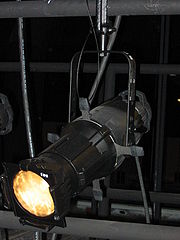
Source four
The Electronic Theatre Controls Source Four is an ellipsoidal reflector spotlight used in stage lighting. First released in 1992, the Source Four features an improved lamp and reflector compared to previous ERS designs, tool-free lamp adjustment, and a rotating, interchangeable shutter barrel...
(a popular lantern from ETC
Electronic Theatre Controls
Electronic Theatre Controls is a privately held corporation with global headquarters in Middleton, Wisconsin, United States. An international manufacturer of entertainment and architectural lighting systems, ETC offers professional lighting fixtures, lighting control consoles, dimming equipment...
) and the Leko (short for Lekolite
Lekolite
A Lekolite is a brand of ellipsoidal reflector spotlight used in stage lighting. Introduced in 1933 , it was developed by Century lighting which eventually became a part of the Strand Lighting Corporation...
, from Strand lighting
Strand Lighting
Strand Lighting is an international theatre and television lighting company founded in 1914 in London's West End that supplies lighting fixtures and controls for the entertainment industry. Strand's products have been used on countless theatre productions and TV shows worldwide.-History:Strand...
).
The major components of an ERS light are the casing in which the internal parts are mounted, an ellipsoidal reflector located in the back of the casing, a lamp mounted to position the filament
Incandescent light bulb
The incandescent light bulb, incandescent lamp or incandescent light globe makes light by heating a metal filament wire to a high temperature until it glows. The hot filament is protected from air by a glass bulb that is filled with inert gas or evacuated. In a halogen lamp, a chemical process...
at the rear focal point of the ellipsoid, a dual plano-convex lens (two plano-convex lenses facing each other in the barrel), and at the front, a gel frame to hold the color gel. The light from the lamp is efficiently gathered by the ellipsoidal reflector and sent forward through the gate, shutters and lens system.

Gobo (lighting)
A gobo derived from "Go Between" or Goes Before Optics -originally used on film sets, is a physical template slotted inside, or placed in front of, a lighting source, used to control the shape of emitted light....
(also known as templates or deckles). These have patterns cut into them, much like a stencil. These patterns are projected onto the stage. An iris can be also be inserted in this position to make the beam smaller in diameter, reducing the light cast without the sharp edges of the shutters. ERS instruments from ETC, Altman, Selecon, and a variety of others have interchangeable lens tubes (or barrels) which can both create a very sharp or very soft beam as well as alter the beam spread. The barrel sizes can range from a narrow, long distance 5- or 10-degree spot to a broad and short-distance 50- or even 90-degree. The first 90-degree profile lantern was developed by Selecon Performance Lighting as part of their "Pacific" range of products. Since its introduction many other manufacturers have introduced their own 90-degree barrels. ERS instruments allow many different lens tubes to be used with the same body. This makes them more versatile, since a venue can purchase varying degrees of barrels without buying as many instruments. Many manufacturers also produce zoom lenses which offer the ability to change the beam angle. However, some zoom ranges have a poorer optical quality making them difficult to use in sharp focus.
Field angle
The field angle of an instrument is the angle of the beam of light where it reaches 10% of the intensity of the center of the beam. Most manufacturers now use field angle to indicate the spread that the fixture has. However, older fixtures are described by the width of the lens x focal length of the instrument. For example, a 6x9 ellipsoidal would have a 6" lens and a focal length of 9" (creating an approximately 37° beam angle). This nomenclature was used because traditionally a larger lens directly equated with more light output. This is no longer necessarily true, so most manufacturers now identify their fixtures by beam angle and light output. As the field angle narrows, the instrument can either be used further from the stage to create a similarly-sized beam as a closer, larger instrument, or it can be used from the same distance to create a smaller beam.
Beam projector
A beam projector is a lensless instrument with very little beam spread. It uses two reflectors. The primary reflector is a parabolic reflector and the secondary reflector is a spherical reflector. The parabolic reflector directs the light into nearly parallel beams, and the spherical reflector is placed in front of the lamp to reflect light from the lamp back to the parabolic reflector, which reduces spill. The result is an intense shaft of light that cannot be easily controlled or modified. The beam projector no longer is used to the extent that it once was, as newer fixtures and PAR lamps have created easier ways to produce the effect.Followspot
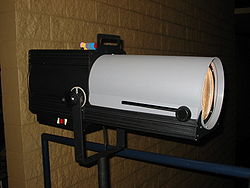
These lighting instruments come in a variety of sizes with light sources ranging from low power incandescent light bulb
Incandescent light bulb
The incandescent light bulb, incandescent lamp or incandescent light globe makes light by heating a metal filament wire to a high temperature until it glows. The hot filament is protected from air by a glass bulb that is filled with inert gas or evacuated. In a halogen lamp, a chemical process...
s to very powerful xenon arc lamp
Xenon arc lamp
A xenon arc lamp is a specialized type of gas discharge lamp, an electric light that produces light by passing electricity through ionized xenon gas at high pressure to produce a bright white light that closely mimics natural sunlight...
s. Carbon arc lamp
Arc lamp
"Arc lamp" or "arc light" is the general term for a class of lamps that produce light by an electric arc . The lamp consists of two electrodes, first made from carbon but typically made today of tungsten, which are separated by a gas...
spots were common until the 1990s, using the arc between carbon rods as their light source. These follow spots required special installations that include high volume ventilation due to the hazardous fumes produced by the carbon arc. The current generation, xenon, has extremely high internal pressure in the lamp and thus has its own safety concerns.
Followspots contain a variety of operator-controlled optical mechanisms. They may include mechanical shutters, which allow the light to be doused without turning off the lamp, lenses to control and focus beam width, and internal color gel
Color gel
A color gel or color filter , also known as lighting gel or simply gel, is a transparent colored material that is used in theatre, event production, photography, videography and cinematography to color light and for color correction...
s, often in a color magazine
Color magazine
A color magazine is a fixture attached to a follow spot that places different color filters in the path of the beam. Instead of working with comparatively cumbersome gel frames, the color magazine allows the spot operator to easily slide color frames in or out of place using a series of levers.The...
.
Intelligent lights
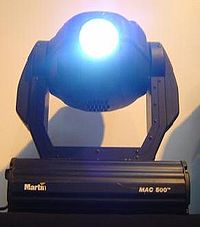
Concert
A concert is a live performance before an audience. The performance may be by a single musician, sometimes then called a recital, or by a musical ensemble, such as an orchestra, a choir, or a musical band...
industry in the early 1980s. As the digital age progressed, the cost of these fixtures reduced, and they are currently used in almost all major theatrical productions.
Their principal feature is the ability to remotely control the movement and characteristics of the output beam of light. This is achieved by either moving a mirror
Mirror
A mirror is an object that reflects light or sound in a way that preserves much of its original quality prior to its contact with the mirror. Some mirrors also filter out some wavelengths, while preserving other wavelengths in the reflection...
which reflects the beam, or by moving the entire fixture, which can pan and tilt by means of a motorized
Electric motor
An electric motor converts electrical energy into mechanical energy.Most electric motors operate through the interaction of magnetic fields and current-carrying conductors to generate force...
yoke. Usually they also contain other controls to shape, texture and color the light, such as gobo
Gobo (lighting)
A gobo derived from "Go Between" or Goes Before Optics -originally used on film sets, is a physical template slotted inside, or placed in front of, a lighting source, used to control the shape of emitted light....
or dichroic
Dichroic filter
A dichroic filter, thin-film filter, or interference filter is a very accurate color filter used to selectively pass light of a small range of colors while reflecting other colors. By comparison, dichroic mirrors and dichroic reflectors tend to be characterized by the color of light that they...
wheels. This ability to precisely, and repeatedly set the position of the fixture allows one light to perform many functions, lighting multiple different areas in different ways. They can also move 'live' (with the lamp on), to achieve many of the effects used in modern productions.
The majority of intelligent fixtures employ arc lamp
Arc lamp
"Arc lamp" or "arc light" is the general term for a class of lamps that produce light by an electric arc . The lamp consists of two electrodes, first made from carbon but typically made today of tungsten, which are separated by a gas...
s as a light source, and therefore use a variety of mechanical methods to achieve the effect of dimming. Some fixtures employ standard halogen lamps. Mechanically, stepper motor
Stepper motor
A stepper motor is a brushless, electric motor that can divide a full rotation into a large number of steps. The motor's position can be controlled precisely without any feedback mechanism , as long as the motor is carefully sized to the application...
s connected to various internal optical devices (such as gobos and color wheels) manipulate the light before it escapes the fixture's front lens.
Moving light programs are often much more complex than that of stationary instruments, requiring use of special lighting consoles and programs to set up. Sometimes this draws on WYSIWYG
WYSIWYG
WYSIWYG is an acronym for What You See Is What You Get. The term is used in computing to describe a system in which content displayed onscreen during editing appears in a form closely corresponding to its appearance when printed or displayed as a finished product...
("what you see is what you get") virtual programs that allow designers to select lights by location rather than channel number.
Intelligent lights are used heavily in shows in very large venues, like events in stadiums, where it is very difficult to reach lighting trusses for manual focusing. Although the fixtures may not be moved during the run of the show, they are focused remotely.