

Home      Discussion      Topics      Dictionary      Almanac
Signup       Login
Rolling (metalworking)

Rolling (metalworking)

Overview
Discussion
Ask a question about 'Rolling (metalworking)'
Start a new discussion about 'Rolling (metalworking)'
Answer questions from other users
Full Discussion Forum
 
Unanswered Questions
Recent Discussions
Encyclopedia

In metalworking
Metalworking
Metalworking is the process of working with metals to create individual parts, assemblies, or large scale structures. The term covers a wide range of work from large ships and bridges to precise engine parts and delicate jewelry. It therefore includes a correspondingly wide range of skills,...

, rolling is a metal forming process in which metal stock is passed through a pair of rolls. Rolling is classified according to the temperature of the metal rolled. If the temperature of the metal is above its recrystallization
Recrystallization (metallurgy)
Recrystallization is a process by which deformed grains are replaced by a new set of undeformed grains that nucleate and grow until the original grains have been entirely consumed. Recrystallization is usually accompanied by a reduction in the strength and hardness of a material and a simultaneous...

 temperature, then the process is termed as hot rolling. If the temperature of the metal is below its recrystallization temperature, the process is termed as cold rolling. In terms of usage, hot rolling processes more tonnage than any other manufacturing process and cold rolling processes the most tonnage out of all cold working processes.

There are many types of rolling processes, including flat rolling, foil rolling, ring rolling, roll bending, roll forming, profile rolling, and controlled rolling.

Iron and steel


The earliest rolling mills were slitting mill
Slitting mill
The slitting mill was a watermill for slitting bars of iron into rods. The rods then were passed to nailers who made the rods into nails, by giving them a point and head....

s, which were introduced from what is now Belgium
Belgium
Belgium , officially the Kingdom of Belgium, is a federal state in Western Europe. It is a founding member of the European Union and hosts the EU's headquarters, and those of several other major international organisations such as NATO.Belgium is also a member of, or affiliated to, many...

 to England
England
England is a country that is part of the United Kingdom. It shares land borders with Scotland to the north and Wales to the west; the Irish Sea is to the north west, the Celtic Sea to the south west, with the North Sea to the east and the English Channel to the south separating it from continental...

 in 1590. These passed flat bars between rolls to form a plate of iron, which was then passed between grooved rolls (slitters) to produce rods of iron. The first experiments at rolling iron for tinplate took place about 1670. In 1697, Major John Hanbury
John Hanbury (1664–1734)
John Hanbury was one of a dynasty of ironmasters responsible for the industrialisation and urbanisation of the eastern valley through which runs the Afon Llwyd in Monmouthshire around Pontypool...

 erected a mill at Pontypool
Pontypool
Pontypool is a town of approximately 36,000 people in the county borough of Torfaen, within the historic boundaries of Monmouthshire in South Wales....

 to roll 'Pontypool plates'—blackplate. Later this began to be rerolled and tinned to make tinplate. The earlier production of plate iron in Europe had been in forges, not rolling mills.

The slitting mill was adapted to producing hoops (for barrels) and iron with a half-round or other sections by means that were the subject of two patents of c. 1679.

Some of the earliest literature on rolling mills can be traced back to Christopher Polhem
Christopher Polhem
Christopher Polhammar , better known as , which he took after his ennoblement, was a Swedish scientist, inventor and industrialist. He made significant contributions to the economic and industrial development of Sweden, particularly mining.-Biography:Polhem was born on the island of Gotland...

 in 1761 in Patriotista Testamente, where he mentions rolling mills for both plate and bar iron. He also explains how rolling mills can save on time and labor because a rolling mill can produce 10 to 20 and still more bars at the same time which is wanted to tilt only one bar with a hammer.

A patent was granted to Thomas Blockley of England in 1759 for the polishing and rolling of metals. Another patent was granted in 1766 to Richard Ford of England for the first tandem mill. A tandem mill is one in which the metal is rolled in successive stands; Ford’s tandem mill was for hot rolling of wire rods.

Other metals


Rolling mills for lead seem to have existed by the late 17th century. Copper and brass were also rolled by the late 18th century.

Modern rolling


Modern rolling practice can be attributed to the pioneering efforts of Henry Cort
Henry Cort
Henry Cort was an English ironmaster. During the Industrial Revolution in England, Cort began refining iron from pig iron to wrought iron using innovative production systems. In 1783 he patented the puddling process for refining iron ore...

 of Fontley Iron Mills, near Fareham, England. In 1783 a patent was issued to Henry Cort for his use of grooved rolls for rolling iron bars. With this new design mills were able to produce 15 times the output per day than with a hammer. Although Cort was not the first to use grooved rolls, he was first to combine the use of many of the best features of various ironmaking and shaping processes known at the time. Thus modern writers have called him “father of modern rolling."

The first rail rolling mill was established by John Birkenshaw in 1820, where he produced fish bellied wrought iron rails in lengths of 15 to 18 feet. With the advancement of technology in rolling mills the size of rolling mills grew rapidly along with the size products being rolled. Example of this was at The Great Exhibition
The Great Exhibition
The Great Exhibition of the Works of Industry of all Nations or The Great Exhibition, sometimes referred to as the Crystal Palace Exhibition in reference to the temporary structure in which it was held, was an international exhibition that took place in Hyde Park, London, from 1 May to 15 October...

 in 1851 a plate 20 feet long, 3 ½ feet wide, and 7/16 of inch thick, weighed 1,125 pounds was exhibited by the Consett Iron Company. Further evolution of the rolling mill came with the introduction of Three-high mills in 1853 used for rolling heavy sections.

Hot rolling


Hot rolling is a metalworking
Metalworking
Metalworking is the process of working with metals to create individual parts, assemblies, or large scale structures. The term covers a wide range of work from large ships and bridges to precise engine parts and delicate jewelry. It therefore includes a correspondingly wide range of skills,...

 process that occurs above the recrystallization temperature of the material. After the grains deform during processing, they recrystallize, which maintains an equiaxed microstructure
Microstructure
Microstructure is defined as the structure of a prepared surface or thin foil of material as revealed by a microscope above 25× magnification...

 and prevents the metal from work hardening. The starting material is usually large pieces of metal, like semi-finished casting products, such as slabs, blooms, and billets. If these products came from a continuous casting
Continuous casting
Continuous casting, also called strand casting, is the process whereby molten metal is solidified into a "semifinished" billet, bloom, or slab for subsequent rolling in the finishing mills. Prior to the introduction of continuous casting in the 1950s, steel was poured into stationary molds to form...

 operation the products are usually fed directly into the rolling mills at the proper temperature. In smaller operations the material starts at room temperature and must be heated. This is done in a gas- or oil-fired soaking pit for larger workpieces and for smaller workpieces induction heating
Induction heating
Induction heating is the process of heating an electrically conducting object by electromagnetic induction, where eddy currents are generated within the metal and resistance leads to Joule heating of the metal...

 is used. As the material is worked the temperature must be monitored to make sure it remains above the recrystallization temperature. To maintain a safety factor a finishing temperature is defined above the recrystallization temperature; this is usually 50 to 100 °C (122 to 212 F) above the recrystallization temperature. If the temperature does drop below this temperature the material must be re-heated before more hot rolling.

Hot rolled metals generally have little directionality in their mechanical properties and deformation induced residual stress
Residual stress
Residual stresses are stresses that remain after the original cause of the stresses has been removed. They remain along a cross section of the component, even without the external cause. Residual stresses occur for a variety of reasons, including inelastic deformations and heat treatment...

es. However, in certain instances non-metallic inclusions
Non-metallic inclusions
Non-metallic inclusions are chemical compounds and nonmetals that are present in steel and alloys. They are the product of chemical reactions, physical effects, and contamination that occurs during the melting and pouring process. These inclusions are categorized by origin as either endogenous or...

 will impart some directionality and workpieces less than 20 mm (0.78740157480315 in) thick often have some directional properties. Also, non-uniformed cooling will induce a lot of residual stresses, which usually occurs in shapes that have a non-uniform cross-section, such as I-beam
I-beam
-beams, also known as H-beams, W-beams , rolled steel joist , or double-T are beams with an - or H-shaped cross-section. The horizontal elements of the "" are flanges, while the vertical element is the web...

s and H-beams. While the finished product is of good quality, the surface is covered in mill scale
Mill scale
Mill scale, often shortened to just scale, is the flaky surface of hot rolled steel, iron oxides consisting of Iron oxide, hematite, and magnetite....

, which is an oxide
Oxide
An oxide is a chemical compound that contains at least one oxygen atom in its chemical formula. Metal oxides typically contain an anion of oxygen in the oxidation state of −2....

 that forms at high-temperatures. It is usually removed via pickling
Pickling (metal)
Tarnision is a metal surface treatment used to remove impurities, such as stains, inorganic contaminants, rust or scale from ferrous metals, copper, and aluminum alloys. A solution called Tarnision liquor, which contains strong acids, is used to remove the surface impurities...

 or the smooth clean surface process, which reveals a smooth surface. Dimensional tolerances are usually 2 to 5% of the overall dimension.

Hot rolled mild steel seems to have a wider tollerance for amount of included carbon than cold rolled, making it a bit more problematic to use as a blacksmith. Also for similar metals, hot rolled seems to typically be more costly.

Hot rolling is used mainly to produce sheet metal
Sheet metal
Sheet metal is simply metal formed into thin and flat pieces. It is one of the fundamental forms used in metalworking, and can be cut and bent into a variety of different shapes. Countless everyday objects are constructed of the material...

 or simple cross sections, such as rail tracks
Rail tracks
The track on a railway or railroad, also known as the permanent way, is the structure consisting of the rails, fasteners, sleepers and ballast , plus the underlying subgrade...

.

Cold rolling


Cold rolling occurs with the metal below its recrystallization temperature (usually at room temperature), which increases the strength
Strength
- Physical ability :*Physical strength, as in people or animals*Superhuman strength, as in fictional characters*A common character attribute in role-playing gamesConflict between persons or groups:*Virtue and moral uprightness...

 via strain hardening up to 20%. It also improves the surface finish
Surface finish
Surface finish, also known as surface texture, is the characteristics of a surface. It has three components: lay, surface roughness, and waviness.-Lay:...

 and holds tighter tolerances. Commonly cold-rolled products include sheets, strips, bars, and rods; these products are usually smaller than the same products that are hot rolled. Because of the smaller size of the workpieces and their greater strength, as compared to hot rolled stock, four-high or cluster mills are used. Cold rolling cannot reduce the thickness of a workpiece as much as hot rolling in a single pass.

Cold-rolled sheets and strips come in various conditions: full-hard, half-hard, quarter-hard, and skin-rolled. Full-hard rolling reduces the thickness by 50%, while the others involve less of a reduction.Skin-rolling, also known as a skin-pass, involves the least amount of reduction: 0.5-1%. It is used to produce a smooth surface, a uniform thickness, and reduce the yield-point phenomenon (by preventing Luder bands from forming in later processing). It locks dislocations at the surface and thereby reduces the possibility of formation of Luders bands. To avoid Luders bands formation it is necessary to create substantial density of unpinned dislocations in ferrite matrix.It is also used to breakup the spangles in galvanized steel. Skin-rolled stock is usually used in subsequent cold-working processes where good ductility is required.

Other shapes can be cold-rolled if the cross-section is relatively uniform and the transverse dimension is relatively small.Cold rolling shapes requires a series of shaping operations, usually along the lines of: sizing, breakdown, roughing, semi-roughing, semi-finishing, and finishing.

If processed by a blacksmith, the smoother, more consistent and lower levels of carbon encapsulated in the steel makes it easier to process, but at the cost of being more costly


Roll bending produces a cylindrical shaped product from plate or steel metal.

Roll forming


Roll forming is a continuous bending operation in which a long strip of metal (typically coiled steel) is passed through consecutive sets of rolls, or stands, each performing only an incremental part of the bend, until the desired cross-section profile is obtained. Roll forming is ideal for producing parts with long lengths or in large quantities.
There are mainly 3 main processes, 4 rollers, 3 rollers and 2 rollers, and have different advantages according to the specifications of the plate (thickness length and diameter) and the shapes.

Also call roll bending or plate rolling process this is used in many fields, Exhaust pipes, Trucks brakes, Pressure Vessel Tanks
Gaz tanks, Components for airbags, Fire extinguishers, Hot water boilers, Drawer rails, Filter housings, Fittings, Fuel filters, Gear components, Gear selector forks, Multi diameter Shells, Pressurized containers, Pumps' shells, Rear axles, Sink mountings, Spinningcompatible tubes, Washing drumbs...

Flat rolling


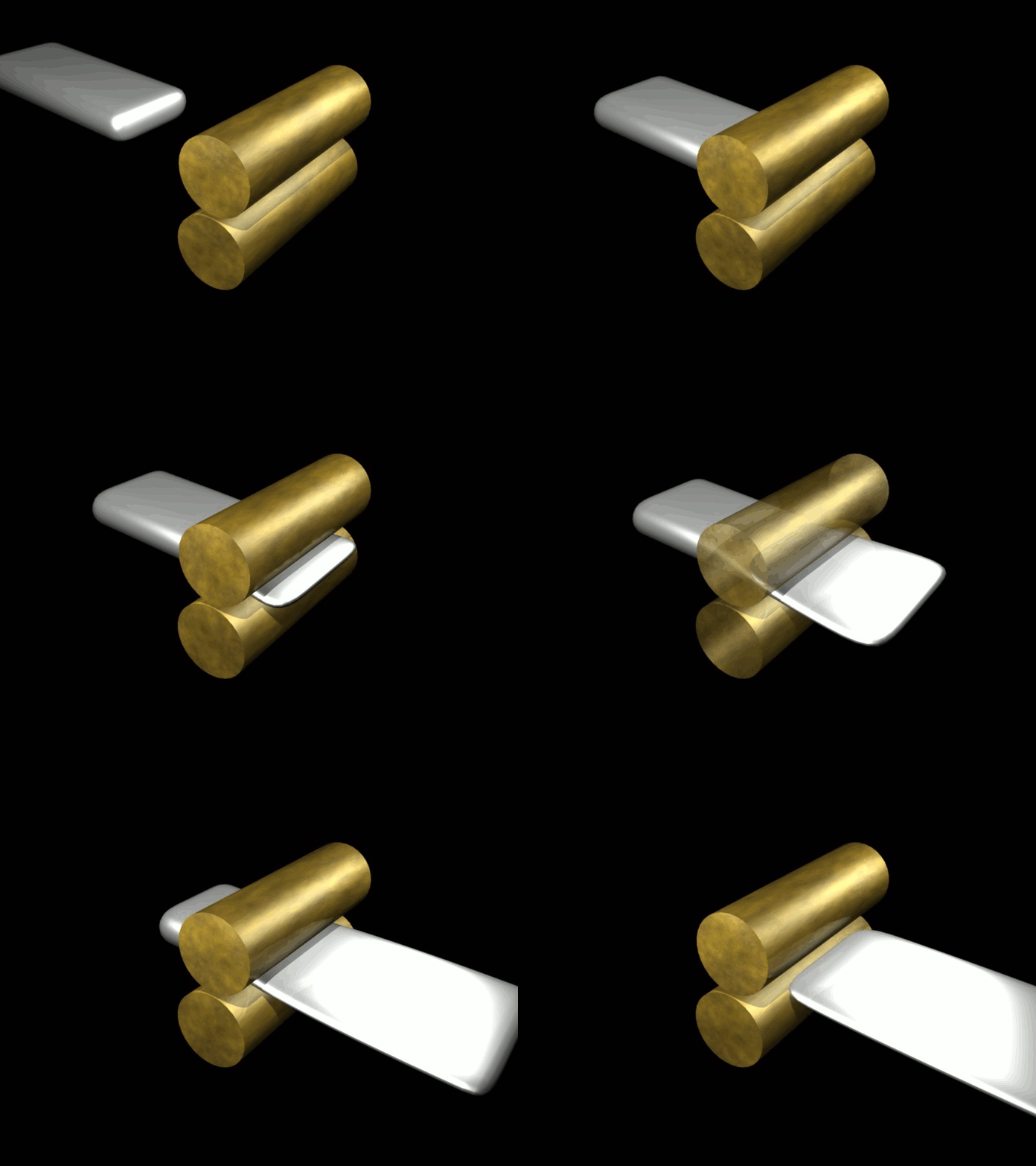
Flat rolling is the most basic form of rolling with the starting and ending material having a rectangular cross-section. The material is fed in between two rollers, called working rolls, that rotate in opposite directions. The gap between the two rolls is less than the thickness of the starting material, which causes it to deform. The decrease in material thickness causes the material to elongate. The friction
Friction
Friction is the force resisting the relative motion of solid surfaces, fluid layers, and/or material elements sliding against each other. There are several types of friction:...

 at the interface between the material and the rolls causes the material to be pushed through. The amount of deformation possible in a single pass is limited by the friction between the rolls; if the change in thickness is too great the rolls just slip over the material and do not draw it in. The final product is either sheet or plate, with the former being less than 6 mm (0.236220472440945 in) thick and the latter greater than; however, heavy plates tend to be formed using a press
Machine press
A machine press, commonly shortened to press, is a machine tool that changes the shape of a workpiece.-Servomechanism:A servomechanism press, also known as a servo press or a electro press, is a press driven by an AC servo motor. The torque produced is converted to a linear force via a ball screw....

, which is termed forming, rather than rolling.

Oftentimes the rolls are heated to assist in the workability of the metal. Lubrication is often used to keep the workpiece from sticking to the rolls. To fine tune the process the speed of the rolls and the temperature of the rollers are adjusted.

Foil rolling


Foil rolling is a specialized type of flat rolling, specifically used to produce foil, which is sheet metal with a thickness less than 200 um. The rolling is done in a cluster mill because the small thickness requires a small diameter rolls. To reduce the need for small rolls pack rolling is used, which rolls multiple sheets together to increase the effective starting thickness. As the foil sheets come through the rollers, they are trimmed and slitted with circular or razor-like knives. Trimming refers to the edges of the foil, while slitting involves cutting it into several sheets. Aluminum foil is the most commonly produced product via pack rolling. This is evident from the two different surface finishes; the shiny side is on the roll side and the dull side is against the other sheet of foil.

Ring rolling


Ring rolling is a specialized type of hot rolling that increases the diameter of a ring. The starting material is a thick-walled ring. This workpiece is placed on an idler roll, while another roll, called the driven roll, presses the ring from the outside. As the rolling occurs the wall thickness decreases as the diameter increases. The rolls may be shaped to form various cross-sectional shapes. The resulting grain structure is circumferential, which gives better mechanical properties. Diameters can be as large as 8 m (26.2 ft) and face heights as tall as 2 m (78.7 in). Common applications include rocket
Rocket
A rocket is a missile, spacecraft, aircraft or other vehicle which obtains thrust from a rocket engine. In all rockets, the exhaust is formed entirely from propellants carried within the rocket before use. Rocket engines work by action and reaction...

s, turbine
Turbine
A turbine is a rotary engine that extracts energy from a fluid flow and converts it into useful work.The simplest turbines have one moving part, a rotor assembly, which is a shaft or drum with blades attached. Moving fluid acts on the blades, or the blades react to the flow, so that they move and...

s, airplanes, pipes
Pipe (material)
A pipe is a tubular section or hollow cylinder, usually but not necessarily of circular cross-section, used mainly to convey substances which can flow — liquids and gases , slurries, powders, masses of small solids...

, and pressure vessel
Pressure vessel
A pressure vessel is a closed container designed to hold gases or liquids at a pressure substantially different from the ambient pressure.The pressure differential is dangerous and many fatal accidents have occurred in the history of their development and operation. Consequently, their design,...

s.

Structural shape rolling


Controlled rolling


Controlled rolling is a type of thermomechanical processing which integrates controlled deformation and heat treating. The heat which brings the workpiece above the recrystallization temperature is also used to perform the heat treatments so that any subsequent heat treating is unnecessary. Types of heat treatments include the production of a fine grain structure; controlling the nature, size, and distribution of various transformation products (such as ferrite
Ferrite (iron)
Ferrite or alpha iron is a materials science term for iron, or a solid solution with iron as the main constituent, with a body centred cubic crystal structure. It is the component which gives steel and cast iron their magnetic properties, and is the classic example of a ferromagnetic material...

, austenite
Austenite
Austenite, also known as gamma phase iron, is a metallic non-magnetic allotrope of iron or a solid solution of iron, with an alloying element. In plain-carbon steel, austenite exists above the critical eutectoid temperature of ; other alloys of steel have different eutectoid temperatures...

, pearlite
Pearlite
Pearlite is often said to be a two-phased, lamellar structure composed of alternating layers of alpha-ferrite and cementite that occurs in some steels and cast irons...

, bainite
Bainite
Bainite is an acicular microstructure that forms in steels at temperatures from approximately 250-550°C . First described by E. S. Davenport and Edgar Bain, it is one of the decomposition products that may form when austenite is cooled past a critical temperature of 727 °C...

, and martensite
Martensite
Martensite, named after the German metallurgist Adolf Martens , most commonly refers to a very hard form of steel crystalline structure, but it can also refer to any crystal structure that is formed by displacive transformation. It includes a class of hard minerals occurring as lath- or...

 in steel); inducing precipitation hardening; and, controlling the toughness
Toughness
In materials science and metallurgy, toughness is the ability of a material to absorb energy and plastically deform without fracturing; Material toughness is defined as the amount of energy per volume that a material can absorb before rupturing...

. In order to achieve this the entire process must be closely monitored and controlled. Common variables in controlled rolling include the starting material composition and structure, deformation levels, temperatures at various stages, and cool-down conditions. The benefits of controlled rolling include better mechanical properties and energy savings.

Mills


A rolling mill, also known as a reduction mill or mill, has a common construction independent of the specific type of rolling being performed:

  • Work rolls
  • Backup rolls - are intended to provide rigid support required by the working rolls to prevent bending under the rolling load
  • Rolling balance system - to ensure that the upper work and back up rolls are maintain in proper position relative to lower rolls
  • Roll changing devices - use of an overhead crane and a unit designed to attach to the neck of the roll to be removed from or inserted into the mill.
  • Mill protection devices - to ensure that forces applied to the backup roll chocks are not of such a magnitude to fracture the roll necks or damage the mill housing
  • Roll cooling and lubrication systems
  • Pinions - gears to divide power between the two spindles, rotating them at the same speed but in different directions
  • Gearing - to establish desired rolling speed
  • Drive motors - rolling narrow foil product to thousands of horsepower
  • Electrical controls - constant and variable voltages applied to the motors
  • Coilers and uncoilers - to unroll and roll up coils of metal


Slabs are the feed material for hot strip mills or plate mills and blooms are rolled to billets in a billet mill or large sections in a structural mill. The output from a strip mill is coiled and, subsequently, used as the feed for a cold rolling mill or used directly by fabricators. Billets, for re-rolling, are subsequently rolled in either a merchant, bar or rod mill. Merchant or bar mills produce a variety of shaped products such as angles, channels, beams, rounds (long or coiled) and hexagons.

Configurations


Mills are designed in different types of configurations, with the most basic being a two-high non-reversing, which means there are two rolls that only turn in one direction. The two-high reversing mill has rolls that can rotate in both directions, but the disadvantage is that the rolls must be stopped, reversed, and then brought back up to rolling speed between each pass. To resolve this, the three-high mill was invented, which uses three rolls that rotate in one direction; the metal is fed through two of the rolls and then returned through the other pair. The disadvantage to this system is the workpiece must be lifted and lowered using an elevator. All of these mills are usually used for primary rolling and the roll diameters range from 60 to 140 cm (23.6 to 55.1 in).

To minimize the roll diameter a four-high or cluster mill is used. A small roll diameter is advantageous because less roll is in contact with the material, which results in a lower force and energy requirement. The problem with a small roll is a reduction of stiffness, which is overcome using backup rolls. These backup rolls are larger and contact the back side of the smaller rolls. A four-high mill has four rolls, two small and two large. A cluster mill has more than 4 rolls, usually in three tiers. These types of mills are commonly used to hot roll wide plates, most cold rolling applications, and to roll foils.

Historically mills were classified by the product produced:
  • Blooming, cogging and slabbing mills, being the preparatory mills to rolling finished rails, shapes or plates, respectively. If reversing, they are from 34 to 48 inches in diameter, and if three-high, from 28 to 42 inches in diameter.
  • Billet mills, three-high, rolls from 24 to 32 inches in diameter, used for the further reduction of blooms down to 1.5x1.5-inch billets, being the preparatory mills for the bar and rod
  • Beam mills, three-high, rolls from 28 to 36 inches in diameter, for the production of heavy beams and channels 12 inches and over.
  • Rail mills with rolls from 26 to 40 inches in diameter.
  • Shape mills with rolls from 20 to 26 inches in diameter, for smaller sizes of beams and channels and other structural shapes.
  • Merchant bar mills with rolls from 16 to 20 inches in diameter.
  • Small merchant bar mills with finishing rolls from 8 to 16 inches in diameter, generally arranged with a larger size roughing stand.
  • Rod and wire mills with finishing rolls from 8 to 12 inches in diameter, always arranged with larger size roughing stands.
  • Hoop and cotton tie mills, similar to small merchant bar mills.
  • Armour plate mills with rolls from 44 to 50 inches in diameter and 140 to 180-inch body.
  • Plate mills with rolls from 28 to 44 inches in diameter.
  • Sheet mills with rolls from 20 to 32 inches in diameter.
  • Universal mills for the production of square-edged or so-called universal plates and various wide flanged shapes by a system of vertical and horizontal rolls.

Tandem mill


A tandem mill is a special type of modern rolling mill where rolling is done in one pass. In a traditional rolling mill rolling is done in several passes, but in tandem mill there are several stands (>=2 stands) and reductions take place successively. The number of stands ranges from 2 to 18. Tandem mills can be either of hot or cold rolling mill types.

Defects


In hot rolling, if the temperature of the workpiece is not uniform the flow of the material will occur more in the warmer parts and less in the cooler. If the temperature difference is great enough cracking and tearing can occur.

Shape


The term shape is used to describe the flatness and the profile of the workpiece. The profile consists of the how the thickness of the workpiece varies across the width of the workpiece and can be measured in units of length. The flatness of the workpiece is based on how the fiber elongation varies across the width of the workpiece and it typically measured in I-Units.

Profile


Profile is made up of the measurements of crown and wedge. Crown is the thickness in the center as compared to the average thickness at the edges of the workpiece. Wedge is a measure of the thickness at one edge as opposed to the other edge. Both may be expressed as absolute measurements or as relative measurements. For instance, one could have 2 mil of crown (the center of the workpiece is 2 mil thicker than the edges), or one could have 2% crown (the center of the workpiece is 2% thicker than the edges).

It is typically desirable to have some crown in the workpiece as this will cause the workpiece to tend to pull to the center of the mill, and thus will run with higher stability.

Flatness


Maintaining a uniform gap between the rolls is difficult because the rolls deflect under the load required to deform the workpiece. The deflection causes the workpiece to be thinner on the edges and thicker in the middle. This can be overcome by using a crowned roller (parabolic crown), however the crowned roller will only compensate for one set of conditions, specifically the material, temperature, and amount of deformation.

Other methods of compensating for roll deformation include continual varying crown (CVC), pair cross rolling, and work roll bending. CVC was developed by SMS and involves grinding a third order polynomial curve into the work rolls and then shifting the work rolls laterally, equally, and opposite to each other. The effect is that the rolls will have a gap between them that is parabolic in shape, and will vary with lateral shift, thus allowing for control of the crown of the rolls dynamically. Pair cross rolling involves using either flat or parabolically crowned rolls, but shifting the ends at an angle so that the gap between the edges of the rolls will increase or decrease, thus allowing for dynamic crown control. Work roll bending involves using hydraulic cylinders at the ends of the rolls to counteract roll deflection.

Another way to overcome defection issues is by decreasing the load on the rolls, which can be done by applying an longitudinal force; this is essentially drawing
Drawing (manufacturing)
Drawing is a metalworking process which uses tensile forces to stretch metal. It is broken up into two types: sheet metal drawing and wire, bar, and tube drawing. The specific definition for sheet metal drawing is that it involves plastic deformation over a curved axis...

. Other method of decreasing roll defection include increasing the elastic modulus
Elastic modulus
An elastic modulus, or modulus of elasticity, is the mathematical description of an object or substance's tendency to be deformed elastically when a force is applied to it...

 of the roll material and adding back-up supports to the rolls.

The different classifications for flatness defects are:
  • Symmetrical edge wave - the edges on both sides of the workpiece are "wavy" due to the material at the edges being longer than the material in the center.
  • Asymmetrical edge wave - one edge is "wavy" due to the material at one side being longer than the other side.
  • Center buckle - The center of the strip is "wavy" due to the strip in the center being longer than the strip at the edges.
  • Quarter buckle - This is a rare defect where the fibers are elongated in the quarter regions (the portion of the strip between the center and the edge). This is normally attributed to using excessive roll bending force since the bending force may not compensate for the roll deflection across the entire length of the roll.


It is important to note that one could have a flatness defect even with the workpiece having the same thickness across the width. Also, one could have fairly high crown or wedge, but still produce material that is flat. In order to produce flat material, the material must be reduced by the same percentage across the width. This is important because mass flow of the material must be preserved, and the more a material is reduced, the more it is elongated. If a material is elongated in the same manner across the width, then the flatness coming into the mill will be preserved at the exit of the mill.

Draft


The difference between the thickness of initial and rolled metal piece is called Draft.
Thus if t0 is initial thickness and tf is final thickness, then the draft(d) is given by
d = t0 - tf
The maximum draft that can be achieved via rollers of radius (R) with coefficient of static friction (f) between the roller and the metal surface is given by:
maximum draft = R*(f^2)
This is the case when the frictional force on the metal from inlet contact matches the negative force from the exit contact.

Surface defects


There are six types of surface defects:

Lap : This type of defect occurs when a corner or fin is folded over and rolled but not welded into the metal. They appear as seams across the surface of the metal.
Mill-shearing : These defects occur as a feather like lap.
Rolled-in scale : This occurs when mill scale
Mill scale
Mill scale, often shortened to just scale, is the flaky surface of hot rolled steel, iron oxides consisting of Iron oxide, hematite, and magnetite....

is rolled into metal.
Scabs : These are long patches of loose metal that have been rolled into the surface of the metal.
Seams : They are open, broken lines that run along the length of the metal and caused by the presence of scale.
Slivers : Prominent surface ruptures.

Further reading

  • Reed-Hill, Robert, et al. "Physical Metallurgy Principles", 3rd Edition, PWS publishing, Boston, 1991. ISBN 978-0534921736.
  • Callister Jr., William D., "Materials Science and Engineering - an Introduction", 6th Edition, John Wiley & Sons, New York, Ny, 2003. ISBN 0-471-13576-3

External links