

.gif)
Theater (structure)

Encyclopedia
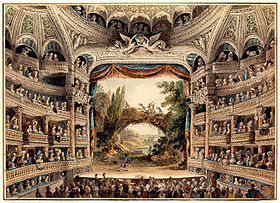
Theatre
Theatre is a collaborative form of fine art that uses live performers to present the experience of a real or imagined event before a live audience in a specific place. The performers may communicate this experience to the audience through combinations of gesture, speech, song, music or dance...
works or plays
Play (theatre)
A play is a form of literature written by a playwright, usually consisting of scripted dialogue between characters, intended for theatrical performance rather than just reading. There are rare dramatists, notably George Bernard Shaw, who have had little preference whether their plays were performed...
are performed or other performances such as musical concert
Concert
A concert is a live performance before an audience. The performance may be by a single musician, sometimes then called a recital, or by a musical ensemble, such as an orchestra, a choir, or a musical band...
s may be produced. While a theater is not required for performance (as in environmental theater or street theater
Street theatre
Street theatre is a form of theatrical performance and presentation in outdoor public spaces without a specific paying audience. These spaces can be anywhere, including shopping centres, car parks, recreational reserves and street corners. They are especially seen in outdoor spaces where there are...
), a theater serves to define the performance and audience
Audience
An audience is a group of people who participate in a show or encounter a work of art, literature , theatre, music or academics in any medium...
spaces. The facility is traditionally organized to provide support areas for performers, the technical crew and the audience members.
There are as many types of theaters as there are types of performance. Theaters may be built specifically for a certain types of productions, they may serve for more general performance needs or they may be adapted or converted for use as a theater. They may range from open-air amphitheaters to ornate, cathedral
Cathedral
A cathedral is a Christian church that contains the seat of a bishop...
-like structures to simple, undecorated rooms or black box theater
Black box theater
The black box theater is a relatively recent innovation, consisting of a simple, somewhat unadorned performance space, usually a large square room with black walls and a flat floor.-History:...
s. Some theaters may have a fixed acting area (in most theaters this is known as the stage
Stage (theatre)
In theatre or performance arts, the stage is a designated space for the performance productions. The stage serves as a space for actors or performers and a focal point for the members of the audience...
), while some theaters such as black box theaters, may not, allowing the director and designers to construct an acting area suitable for the production.
In Australia and New Zealand a small and simple theater, particularly one contained within a larger venue, is called a theatrette. The word originated in 1920s London, for a small-scale music venue.
Basic elements of a theater structure
All theater structures, regardless of type, contain certain basic elements.On and off stage
The most important of these areas is the acting space generally known as the stage. In some theaters, specifically proscenium theaters, arena theaters and amphitheaters, this area is permanent part of the structure. In a blackbox theater the acting area is undefined so that each theater may adapt specifically to a production.In addition to these acting spaces, there may be offstage spaces as well. These include wings on either side of a proscenium stage (called "backstage" or "offstage") where props
Theatrical property
A theatrical property, commonly referred to as a prop, is an object used on stage by actors to further the plot or story line of a theatrical production. Smaller props are referred to as "hand props". Larger props may also be set decoration, such as a chair or table. The difference between a set...
, sets
Set construction
Set construction is the process by which a set designer works in collaboration with the director of a production to create the set for a theatrical, film or television production...
and scenery may be stored as well as a place for actors awaiting an entrance. A Prompter's box may be found backstage. In an amphitheater, an area behind the stage may be designated for such uses while a blackbox theater may have spaces outside of the actual theater designated for such uses.
Often a theater will incorporate other spaces intended for the performers and other personnel. A booth facing the stage may be incorporated into the house where lighting
Lighting
Lighting or illumination is the deliberate application of light to achieve some practical or aesthetic effect. Lighting includes the use of both artificial light sources such as lamps and light fixtures, as well as natural illumination by capturing daylight...
and sound personnel may view the show and run their respective instruments. Other rooms in the building may be used for dressing rooms, rehearsal rooms, spaces for constructing sets, props and costumes, as well as storage.
Seating and audience
All theaters provide a space for an audience. The audience is usually separated from the performers by the proscenium arch. In prosceniumProscenium
A proscenium theatre is a theatre space whose primary feature is a large frame or arch , which is located at or near the front of the stage...
theaters and amphitheaters, the proscenium arch, like the stage, is a permanent feature of the structure. This area is known as the auditorium
Auditorium
An auditorium is a room built to enable an audience to hear and watch performances at venues such as theatres. For movie theaters, the number of auditoriums is expressed as the number of screens.- Etymology :...
or the house. Like the stage in a blackbox theater, this area is also defined by the production.
The seating areas can include some or all of the following:
- Stalls or arena: the lower flat area, usually below or at the same level as the stage. The word parterre (occasionally, parquet) is sometimes used to refer to a particular subset of this area. In North American usage this is usually the rear seating block beneath the gallery in the orchestra stalls whereas Britain it can mean either the area immediately in front of the orchestra, or the whole of the stalls seating area. The term can also refer to the side stalls in some usages. Derived from the gardening term parterreParterreA parterre is a formal garden construction on a level surface consisting of planting beds, edged in stone or tightly clipped hedging, and gravel paths arranged to form a pleasing, usually symmetrical pattern. Parterres need not have any flowers at all...
, the usage refers to the sectioned pattern of both the seats of an auditorium and of the planted beds seen in garden construction. Throughout the eighteenth century the term was also used to refer to the theater audienceParterre (theater audience)The word parterre comes from the French par and terre and literally translated means “on the ground.” Originally, the term was used in the 16th century to refer to a formal ornamental garden, but by the mid-17th century, it was increasingly used to refer both to the ground level of a theater where...
who occupied the parterre. - Balconies or galleries: one or more raised seating platforms towards the rear of the auditorium. In larger theaters, multiple levels are stacked vertically above or behind the stalls. The first level is usually called the dress circle or grand circle. The next level may be the loge, from the French version of loggiaLoggiaLoggia is the name given to an architectural feature, originally of Minoan design. They are often a gallery or corridor at ground level, sometimes higher, on the facade of a building and open to the air on one side, where it is supported by columns or pierced openings in the wall...
. A second tier inserted beneath the main balcony may be the mezzanineMezzanine (architecture)In architecture, a mezzanine or entresol is an intermediate floor between main floors of a building, and therefore typically not counted among the overall floors of a building. Often, a mezzanine is low-ceilinged and projects in the form of a balcony. The term is also used for the lowest balcony in...
. The highest platform, or upper circle is sometimes known as the gods, especially in large opera houses, where the seats can be very high and a long distance from the stage. - Boxes (state box or stage box): typically placed immediately to the front, side and above the level of the stage. They are often separate rooms with an open viewing area which typically seat five people or fewer. These seats are typically considered the most prestigious of the house. A state box or royal box is sometimes provided for dignitaries.
In addition, many theaters may provide areas specifically designated for the comfort of the audience. These areas include a lobby where tickets and concessions may be sold at the box office
Box office
A box office is a place where tickets are sold to the public for admission to an event. Patrons may perform the transaction at a countertop, through an unblocked hole through a wall or window, or at a wicket....
, restrooms, and other areas where the audience may promenade and relax before, in between or after performances. These areas may be known collectively as the "Front of House" or FOH.
History of theater construction
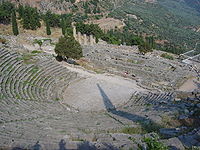
Ancient Greece
Greek theater buildings were called a theatron ('seeing place'). The theaters were large, open-air structures constructed on the slopes of hills. They consisted of three principal elements: the orchestra, the skene, and the audience.The centrepiece of the theater was the orchestra, or "dancing place", a large circular or rectangular area. The orchestra was the site the choral performances, the religious rites, and, possibly, the acting. An altar
Altar
An altar is any structure upon which offerings such as sacrifices are made for religious purposes. Altars are usually found at shrines, and they can be located in temples, churches and other places of worship...
was located in the middle of the orchestra; in Athens, the altar was dedicated to Dionysus.
Behind the orchestra was a large rectangular building called the skene (meaning "tent" or "hut"). It was used as a "backstage" area where actors could change their costumes and masks, but also served to represent the location of the plays, which were usually set in front of a palace or house. Typically, there were two or three doors in the skene that led out onto orchestra, and from which actors could enter and exit. At first, the skene was literally a tent or hut, put up for the religious festival and taken down when it was finished. Later, the skene became a permanent stone structure. These structures were sometimes painted to serve as backdrops, hence the English word scenery.
In front of the skene there may have been a raised acting area called the proskenion, the ancestor of the modern proscenium
Proscenium
A proscenium theatre is a theatre space whose primary feature is a large frame or arch , which is located at or near the front of the stage...
stage. It is possible that the actors (as opposed to the chorus) acted entirely on the proskenion, but this is not certain.
Rising from the circle of the orchestra was the audience. The audience sat on tiers of benches built up on the side of a hill. Greek theaters, then, could only be built on hills that were correctly shaped. A typical theater was enormous, able to seat around 15,000 viewers.

See also: Theatre of Ancient Greece
Theatre of Ancient Greece
The theatre of Ancient Greece, or ancient Greek drama, is a theatrical culture that flourished in ancient Greece between c. 550 and c. 220 BC. The city-state of Athens, which became a significant cultural, political and military power during this period, was its centre, where it was...
Ancient Rome
The RomanAncient Rome
Ancient Rome was a thriving civilization that grew on the Italian Peninsula as early as the 8th century BC. Located along the Mediterranean Sea and centered on the city of Rome, it expanded to one of the largest empires in the ancient world....
s copied the Greek style of building, but tended not to be so concerned about the location, being prepared to build walls and terraces instead of looking for a naturally-occurring site. (See Roman theater
Roman theatre (structure)
The characteristics of Roman to those of the earlier Greek theatres due in large part to its influence on the Roman triumvir Gnaeus Pompeius Magnus. Much of the architectural influence on the Romans came from the Greeks, and theatre structural design was no different from other buildings...
for more.)
Elizabethan England
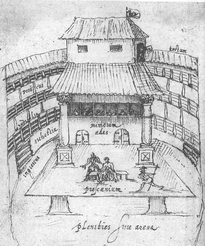
English Renaissance theatre
English Renaissance theatre, also known as early modern English theatre, refers to the theatre of England, largely based in London, which occurred between the Reformation and the closure of the theatres in 1642...
in England
England
England is a country that is part of the United Kingdom. It shares land borders with Scotland to the north and Wales to the west; the Irish Sea is to the north west, the Celtic Sea to the south west, with the North Sea to the east and the English Channel to the south separating it from continental...
, theaters were constructed of wooden framing, infilled with wattle and daub
Wattle and daub
Wattle and daub is a composite building material used for making walls, in which a woven lattice of wooden strips called wattle is daubed with a sticky material usually made of some combination of wet soil, clay, sand, animal dung and straw...
and roofed with thatch. They consisted of several floors of covered galleries surrounding a courtyard which was open to the elements. A large portion of the audience would stand in the yard, directly in front of the stage. This layout is said to derive from the practice of holding plays in the yard of an inn. Archæological excavations of The Rose
The Rose (theatre)
The Rose was an Elizabethan theatre. It was the fourth of the public theatres to be built, after The Theatre , the Curtain , and the theatre at Newington Butts The Rose was an Elizabethan theatre. It was the fourth of the public theatres to be built, after The Theatre (1576), the Curtain (1577),...
theatre at London's Bankside
Bankside
Bankside is a district of London, England, and part of the London Borough of Southwark. Bankside is located on the southern bank of the River Thames, east of Charing Cross, running from a little west of Blackfriars Bridge to just a short distance before London Bridge at St Mary Overie Dock to...
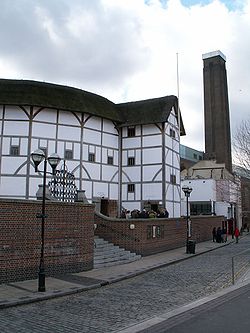
, built 1587, have shown that it had en external diameter of 72 feet (22 metres). The nearby Globe Theatre
Globe Theatre
The Globe Theatre was a theatre in London associated with William Shakespeare. It was built in 1599 by Shakespeare's playing company, the Lord Chamberlain's Men, and was destroyed by fire on 29 June 1613...
(1599) was larger, at 100 feet (30 metres). Other evidence for the round shape is a line in Shakespeare's Henry V which calls the building "this wooden O
Globe Theatre
The Globe Theatre was a theatre in London associated with William Shakespeare. It was built in 1599 by Shakespeare's playing company, the Lord Chamberlain's Men, and was destroyed by fire on 29 June 1613...
", and several rough woodcut illustrations of the city of London.
Green room
In British English and American English show business lexicon, the green room is that space in a theatre, a studio, or a similar venue, which accommodates performers or speakers not yet required on stage...
, a place for actors to wait until required on stage, became common terminology in English theaters.
The Globe has now been rebuilt as a fully working and producing theater near its original site (largely thanks to the efforts of film director Sam Wanamaker
Sam Wanamaker
Samuel Wanamaker was an American film director and actor and is credited as the person most responsible for the modern recreation of Shakespeare's Globe Theatre in London...
) to give modern audiences an idea of the environment for which Shakespeare and other playwrights of the period were writing.
Theaters of the Restoration
Following the Elizabethan period, theaters began to move indoors and to resemble the arrangement we see most frequently today, with a stage separated from the audience by a proscenium arch. This coincided with a growing interest in scenic elements painted in perspective, such as those created by Inigo JonesInigo Jones
Inigo Jones is the first significant British architect of the modern period, and the first to bring Italianate Renaissance architecture to England...
. The perspective of these elements could only be viewed properly from the center back of the auditorium, in the so-called "duke's chair." The higher one's status, the closer they would be seated to this vantage point, and the more the accurately they would be able to see the perspective elements.
German Operatic influence
Richard WagnerRichard Wagner
Wilhelm Richard Wagner was a German composer, conductor, theatre director, philosopher, music theorist, poet, essayist and writer primarily known for his operas...
placed great importance on "mood setting" elements, such as a darkened theater, sound effects, and seating arrangements which focused the attention of audience on the stage, completely immersing them in the imaginary world of the music drama. These concepts were revolutionary at the time, but they have since come to be taken for granted in the modern operatic environment as well as many other types of theatrical endeavors.
Contemporary theaters
Contemporary theaters are often non-traditional, such as very adaptable spaces, or theaters where audience and performers are not separated. A major example of this is the modular theater, (see for example the Walt Disney Modular TheaterWalt Disney Modular Theater
The Walt Disney Modular Theater is an indoor performance space located at the California Institute of the Arts in Valencia, California.Funded by Lillian Disney, who lent support to Walt's venture into education, her gift to the school to remodel a campus theater and rename it the Walt Disney...
). This large theater has floors and walls divided into small movable sections, with the floor sections on adjustable hydraulic pylons, so that the space may be adjusted into any configuration for each individual play. As new styles of theater performance have evolved, so has the desire to improve or recreate performance venues. This applies equally to artistic and presentation techniques, such as stage lighting
Stage lighting
Modern stage lighting is a flexible tool in the production of theatre, dance, opera and other performance arts. Several different types of stage lighting instruments are used in the pursuit of the various principles or goals of lighting. Stage lighting has grown considerably in recent years...
.

Proscenium
A proscenium theatre is a theatre space whose primary feature is a large frame or arch , which is located at or near the front of the stage...
, thrust, black box theater
Black box theater
The black box theater is a relatively recent innovation, consisting of a simple, somewhat unadorned performance space, usually a large square room with black walls and a flat floor.-History:...
, theater in the round
Theatre in the round
Theatre-in-the-round or arena theatre is any theatre space in which the audience surrounds the stage area...
, amphitheater
Amphitheatre
An amphitheatre is an open-air venue used for entertainment and performances.There are two similar, but distinct, types of structure for which the word "amphitheatre" is used: Ancient Roman amphitheatres were large central performance spaces surrounded by ascending seating, and were commonly used...
, and arena
Arena
An arena is an enclosed area, often circular or oval-shaped, designed to showcase theater, musical performances, or sporting events. It is composed of a large open space surrounded on most or all sides by tiered seating for spectators. The key feature of an arena is that the event space is the...
. In the classical Indian dance
Classical Indian dance
Indian classical dance is a relatively new umbrella term for various codified art forms rooted in Natya, the sacred Hindu musical theatre styles, whose theory can be traced back to the Natya Shastra of Bharata Muni .- Definitions :...
, Natya Shastra
Natya Shastra
The Natya Shastra is an ancient Indian treatise on the performing arts, encompassing theatre, dance and music. It was written during the period between 200 BC and 200 AD in classical India and is traditionally attributed to the Sage Bharata.The Natya Shastra is incredibly wide in its scope...
defines three stage types. In Australia and New Zealand a small and simple theater, particularly one contained within a larger venue, is a theatrette. The word originated in 1920s London, for a small-scale music venue.
Theatrical performances can also take place in venues adapted from other purposes, such as train carriages. In recent years the Edinburgh Fringe
Edinburgh Fringe
The Edinburgh Festival Fringe is the world’s largest arts festival. Established in 1947 as an alternative to the Edinburgh International Festival, it takes place annually in Scotland's capital, in the month of August...
has seen performances in a lift (elevator) and a taxi.
See also
- AuditoriumAuditoriumAn auditorium is a room built to enable an audience to hear and watch performances at venues such as theatres. For movie theaters, the number of auditoriums is expressed as the number of screens.- Etymology :...
- List of fictional theatres
- Parterre (theater audience)Parterre (theater audience)The word parterre comes from the French par and terre and literally translated means “on the ground.” Originally, the term was used in the 16th century to refer to a formal ornamental garden, but by the mid-17th century, it was increasingly used to refer both to the ground level of a theater where...
- The Theatre of Small ConvenienceThe Theatre of Small ConvenienceThe Theatre of Small Convenience is a theatre in Malvern, Worcestershire, England. In 2002 it entered the Guinness Book of World Records as the world's smallest commercial theatre, seating up to 12 people. It is less than half the size of the previous record holder, the Piccolo Theatre in Hamburg,...
, the smallest Theatre in the world
External links
- Carthalia - Theatres on Postcards (pictures of theatres)
- Music Hall and Theatre History Contains archive material on hundreds of British Theatre buildings.