


Southern African Large Telescope

Encyclopedia
The Southern African Large Telescope (SALT) is a 66m2 area optical telescope
with a nominally 9.2 meter aperture but up to about 11.1m x ~9.8 m diameter aperture, and designed mainly for spectroscopy. It is located close to the town of Sutherland
in the semi-desert region of the Karoo
, South Africa
. It is a facility of the South African Astronomical Observatory
, the national optical observatory
of South Africa.
SALT is the largest optical telescope in the southern hemisphere
. It will enable imaging, spectroscopic
, and polarimetric
analysis of the radiation from astronomical objects out of reach of northern hemisphere
telescopes. It was originally planned to be a copy of the Hobby-Eberly Telescope
at McDonald Observatory
, but while adapting the construction plans, significant changes were introduced to its design, especially to the spherical aberration
corrector. The main driver for these changes were desired improvements to the telescope's field of view
.
First light with the full mirror was declared on 1 September 2005 with 1 arc second resolution images of globular cluster
47 Tucanae
, open cluster
NGC 6152
, spiral galaxy
NGC 6744
, and the Lagoon Nebula
being obtained. The official opening by President
Thabo Mbeki
took place during the inauguration ceremony on 10 November 2005.
South Africa
contributed about a third of the total of $36 million USD
that will finance SALT for its first 10 years ($20 million for the construction of the telescope, $6 million for instruments, $10 million for operations). The rest was contributed by the other partners - Germany
, Poland
, the United States
, the United Kingdom
and New Zealand
.
370 km (229.9 mi) north-east of Cape Town
, near the small town of Sutherland
. In March 2004, installation of the massive mirror
began. The last of the 91 smaller mirrored hexagon segments was put in place in May 2005.
Korea
and Japan
have telescopes at the site and South Africa has at least five optical telescopes there. The University of Birmingham
has a solar telescope to help monitor the Sun
around the clock.
SALT will probe quasar
s and enable scientists to view stars and galaxies a billion times too faint to be seen by the naked eye
.
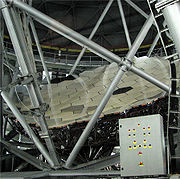 Both SALT and HET have an unusual design for an optical telescope. Similar to the Keck Telescopes, the primary mirror is composed of an array of mirrors designed to act as a single larger mirror; however, the SALT mirrors produce a spherical primary, rather than the paraboloid shape associated with a classical Cassegrain telescope. Each SALT mirror is a 1-meter hexagon, and the array of 91 identical mirrors produces a hexagonal-shaped primary 11 x 9.8 meters in size.
To compensate for the spherical primary, the telescope has a four-mirror spherical aberration corrector (SAC) that provides a corrected, flat focal plane with a field of view of 8 arcminutes at prime focus.
Each of the 91 mirrors is made of low-expansion Sitall
glass and can be adjusted in tip, tilt
and piston
in order to properly align them so as to act as a single mirror. Because the mirror is spherical, light emitted from a position corresponding to the center of curvature of the mirror will be reflected and refocused to the same position. Therefore, the telescope employs a Center of Curvature Alignment Sensor (CCAS) situated at the top of a tall tower adjacent to the dome. Laser light is shone down on all the segments and the position of the reflections from each mirror measured. A process called "stacking" thus allows the telescope operator to optimize the adjustments of the mirrors.
The telescope is also unusual in that during an observation, the mirror remains at a fixed altitude and azimuth, and the image of an astronomical target produced by the telescope is tracked by the "payload", which resides at the position of prime focus and includes the SAC and prime focus instrumentation. This is similar in operation to the Arecibo Radio Telescope. Although this results in only a limited observing window per target, it greatly simplifies the primary mirror mount, when compared to a fully steerable telescope, transferring the complexity to the smaller and lighter payload tracking system, providing for an overall reduction in total telescope construction cost. SALT has a fixed zenith angle
of 37 degrees, optimised for the Magellanic clouds, but because of the full range of azimuths and the celestial rotation, SALT has access to a good fraction of the sky available at the Sutherland site.
Another consequence of this design is that the entrance pupil
varies in size during the tracking of a target.
, Rutgers University, and the SAAO; and a fiber-fed High Resolution Spectrograph (HRS), designed by the University of Canterbury
(New Zealand). SALTICAM was installed in early 2005, while the RSS was installed on 11 October 2005.
David Buckley, Gerald Cecil, Brian Chaboyer, Richard Griffiths, Janusz Kałużny, Michael Albrow, Karen Pollard, Kenneth Nordsieck, Darragh O'Donoghue, Larry Ramsey, Anne Sansom, Pat Cote
In 2007, the following new partners joined the SALT consortium:
(especially X-ray
) is emitted. Scientists used this as an indirect way to locate black holes. Another phenomenon that SALT has helped astronomers investigate is the way that masses build up on some compact stars until supernova explosions blow them apart, which gives scientists a "Type 1a" supernovae used to show that the expansion of the universe is speeding up.
Other note-worthy research the South African Astronomical Observatory has achieved using SALT include the discovery of a class of stars known as "polar", or a pair of stars. The "polar" binary star system, where a compactor star called a "white dwarf" whose volume has shrunk about one millionth of a star like our sun. Studies using SALT concluded that these polar binary star systems take only an hour and a half to complete an orbit. Also, the SALT telescope allows scientists to study the rapid brightness changes in exotic stars.
More research using SALT has aided astronomers to investigate the structure and evolution of our galaxy
, such as quasars, Magellanic clouds
, the galactic structure and stellar astrophysics
. SALT released its first color images, which marked the achievement of the "first light". This also marked the debut of the fully operating SALTICAM, which is a $600,000 digital camera designed and built for SALT. First light with the full mirror was declared on 1 September 2005 with 1 arc second resolution images of globular cluster 47 Tucanae, open cluster NGC 6152, spiral galaxy NGC 6744, and the Lagoon Nebula being obtained.
Optical telescope
An optical telescope is a telescope which is used to gather and focus light mainly from the visible part of the electromagnetic spectrum for directly viewing a magnified image for making a photograph, or collecting data through electronic image sensors....
with a nominally 9.2 meter aperture but up to about 11.1m x ~9.8 m diameter aperture, and designed mainly for spectroscopy. It is located close to the town of Sutherland
Sutherland, Northern Cape
- External links :* * *...
in the semi-desert region of the Karoo
Karoo
The Karoo is a semi-desert region of South Africa. It has two main sub-regions - the Great Karoo in the north and the Little Karoo in the south. The 'High' Karoo is one of the distinct physiographic provinces of the larger South African Platform division.-Great Karoo:The Great Karoo has an area of...
, South Africa
South Africa
The Republic of South Africa is a country in southern Africa. Located at the southern tip of Africa, it is divided into nine provinces, with of coastline on the Atlantic and Indian oceans...
. It is a facility of the South African Astronomical Observatory
South African Astronomical Observatory
South African Astronomical Observatory is the national center for optical and infrared astronomy in South Africa. It was established in 1972. The observatory is run by the National Research Foundation of South Africa. The facility's function is to conduct research in astronomy and astrophysics...
, the national optical observatory
Observatory
An observatory is a location used for observing terrestrial or celestial events. Astronomy, climatology/meteorology, geology, oceanography and volcanology are examples of disciplines for which observatories have been constructed...
of South Africa.
SALT is the largest optical telescope in the southern hemisphere
Southern Hemisphere
The Southern Hemisphere is the part of Earth that lies south of the equator. The word hemisphere literally means 'half ball' or "half sphere"...
. It will enable imaging, spectroscopic
Spectroscopy
Spectroscopy is the study of the interaction between matter and radiated energy. Historically, spectroscopy originated through the study of visible light dispersed according to its wavelength, e.g., by a prism. Later the concept was expanded greatly to comprise any interaction with radiative...
, and polarimetric
Polarimetry
Polarimetry is the measurement and interpretation of the polarization of transverse waves, most notably electromagnetic waves, such as radio or light waves...
analysis of the radiation from astronomical objects out of reach of northern hemisphere
Northern Hemisphere
The Northern Hemisphere is the half of a planet that is north of its equator—the word hemisphere literally means “half sphere”. It is also that half of the celestial sphere north of the celestial equator...
telescopes. It was originally planned to be a copy of the Hobby-Eberly Telescope
Hobby-Eberly Telescope
The Hobby-Eberly Telescope is a 9.2-meter aperture telescope located at the McDonald Observatory. It combines a number of features that differentiate it from most telescope designs, resulting in greatly lowered construction costs...
at McDonald Observatory
McDonald Observatory
The McDonald Observatory is an astronomical observatory located near the unincorporated community of Fort Davis in Jeff Davis County, Texas, United States. The facility is located on Mount Fowlkes and Mount Locke in the Davis Mountains of West Texas...
, but while adapting the construction plans, significant changes were introduced to its design, especially to the spherical aberration
Spherical aberration
thumb|right|Spherical aberration. A perfect lens focuses all incoming rays to a point on the [[Optical axis|optic axis]]. A real lens with spherical surfaces suffers from spherical aberration: it focuses rays more tightly if they enter it far from the optic axis than if they enter closer to the...
corrector. The main driver for these changes were desired improvements to the telescope's field of view
Field of view
The field of view is the extent of the observable world that is seen at any given moment....
.
First light with the full mirror was declared on 1 September 2005 with 1 arc second resolution images of globular cluster
Globular cluster
A globular cluster is a spherical collection of stars that orbits a galactic core as a satellite. Globular clusters are very tightly bound by gravity, which gives them their spherical shapes and relatively high stellar densities toward their centers. The name of this category of star cluster is...
47 Tucanae
47 Tucanae
47 Tucanae or just 47 Tuc is a globular cluster located in the constellation Tucana. It is about 16,700 light years away from Earth, and 120 light years across. It can be seen with the naked eye, with a visual magnitude of 4.0...
, open cluster
Open cluster
An open cluster is a group of up to a few thousand stars that were formed from the same giant molecular cloud and have roughly the same age. More than 1,100 open clusters have been discovered within the Milky Way Galaxy, and many more are thought to exist...
NGC 6152
NGC 6152
NGC 6152 is an open cluster of stars located in the constellation Norma....
, spiral galaxy
Spiral galaxy
A spiral galaxy is a certain kind of galaxy originally described by Edwin Hubble in his 1936 work The Realm of the Nebulae and, as such, forms part of the Hubble sequence. Spiral galaxies consist of a flat, rotating disk containing stars, gas and dust, and a central concentration of stars known as...
NGC 6744
NGC 6744
NGC 6744 is an intermediate spiral galaxy about 30 million light-years away in the constellation Pavo. It is considered one of the most Milky Way-like spiral galaxies in our immediate vicinity, with flocculent arms and an elongated core...
, and the Lagoon Nebula
Lagoon Nebula
The Lagoon Nebula is a giant interstellar cloud in the constellation Sagittarius. It is classified as an emission nebula and as an H II region....
being obtained. The official opening by President
President of South Africa
The President of the Republic of South Africa is the head of state and head of government under South Africa's Constitution. From 1961 to 1994, the head of state was called the State President....
Thabo Mbeki
Thabo Mbeki
Thabo Mvuyelwa Mbeki is a South African politician who served two terms as the second post-apartheid President of South Africa from 14 June 1999 to 24 September 2008. He is also the brother of Moeletsi Mbeki...
took place during the inauguration ceremony on 10 November 2005.
South Africa
South Africa
The Republic of South Africa is a country in southern Africa. Located at the southern tip of Africa, it is divided into nine provinces, with of coastline on the Atlantic and Indian oceans...
contributed about a third of the total of $36 million USD
United States dollar
The United States dollar , also referred to as the American dollar, is the official currency of the United States of America. It is divided into 100 smaller units called cents or pennies....
that will finance SALT for its first 10 years ($20 million for the construction of the telescope, $6 million for instruments, $10 million for operations). The rest was contributed by the other partners - Germany
Germany
Germany , officially the Federal Republic of Germany , is a federal parliamentary republic in Europe. The country consists of 16 states while the capital and largest city is Berlin. Germany covers an area of 357,021 km2 and has a largely temperate seasonal climate...
, Poland
Poland
Poland , officially the Republic of Poland , is a country in Central Europe bordered by Germany to the west; the Czech Republic and Slovakia to the south; Ukraine, Belarus and Lithuania to the east; and the Baltic Sea and Kaliningrad Oblast, a Russian exclave, to the north...
, the United States
United States
The United States of America is a federal constitutional republic comprising fifty states and a federal district...
, the United Kingdom
United Kingdom
The United Kingdom of Great Britain and Northern IrelandIn the United Kingdom and Dependencies, other languages have been officially recognised as legitimate autochthonous languages under the European Charter for Regional or Minority Languages...
and New Zealand
New Zealand
New Zealand is an island country in the south-western Pacific Ocean comprising two main landmasses and numerous smaller islands. The country is situated some east of Australia across the Tasman Sea, and roughly south of the Pacific island nations of New Caledonia, Fiji, and Tonga...
.
General information
SALT is located on a hilltop in a nature reserveNature reserve
A nature reserve is a protected area of importance for wildlife, flora, fauna or features of geological or other special interest, which is reserved and managed for conservation and to provide special opportunities for study or research...
370 km (229.9 mi) north-east of Cape Town
Cape Town
Cape Town is the second-most populous city in South Africa, and the provincial capital and primate city of the Western Cape. As the seat of the National Parliament, it is also the legislative capital of the country. It forms part of the City of Cape Town metropolitan municipality...
, near the small town of Sutherland
Sutherland, Northern Cape
- External links :* * *...
. In March 2004, installation of the massive mirror
Mirror
A mirror is an object that reflects light or sound in a way that preserves much of its original quality prior to its contact with the mirror. Some mirrors also filter out some wavelengths, while preserving other wavelengths in the reflection...
began. The last of the 91 smaller mirrored hexagon segments was put in place in May 2005.
Korea
Korea
Korea ) is an East Asian geographic region that is currently divided into two separate sovereign states — North Korea and South Korea. Located on the Korean Peninsula, Korea is bordered by the People's Republic of China to the northwest, Russia to the northeast, and is separated from Japan to the...
and Japan
Japan
Japan is an island nation in East Asia. Located in the Pacific Ocean, it lies to the east of the Sea of Japan, China, North Korea, South Korea and Russia, stretching from the Sea of Okhotsk in the north to the East China Sea and Taiwan in the south...
have telescopes at the site and South Africa has at least five optical telescopes there. The University of Birmingham
University of Birmingham
The University of Birmingham is a British Redbrick university located in the city of Birmingham, England. It received its royal charter in 1900 as a successor to Birmingham Medical School and Mason Science College . Birmingham was the first Redbrick university to gain a charter and thus...
has a solar telescope to help monitor the Sun
Sun
The Sun is the star at the center of the Solar System. It is almost perfectly spherical and consists of hot plasma interwoven with magnetic fields...
around the clock.
SALT will probe quasar
Quasar
A quasi-stellar radio source is a very energetic and distant active galactic nucleus. Quasars are extremely luminous and were first identified as being high redshift sources of electromagnetic energy, including radio waves and visible light, that were point-like, similar to stars, rather than...
s and enable scientists to view stars and galaxies a billion times too faint to be seen by the naked eye
Naked eye
The naked eye is a figure of speech referring to human visual perception unaided by a magnifying or light-collecting optical device, such as a telescope or microscope. Vision corrected to normal acuity using corrective lenses is considered "naked"...
.
Primary Mirror
To compensate for the spherical primary, the telescope has a four-mirror spherical aberration corrector (SAC) that provides a corrected, flat focal plane with a field of view of 8 arcminutes at prime focus.
Each of the 91 mirrors is made of low-expansion Sitall
Sitall
Sitall aka Sitall CO-115M or Astrositall, is a crystalline glass ceramic material with ultra low coefficient of thermal expansion . It was originally manufactured in the former Soviet Union and was used in the making of primary mirrors for the Russian Maksutov telescopes, but since dissolution has...
glass and can be adjusted in tip, tilt
Tilt (optics)
In optics, tilt is a deviation in the direction a beam of light propagates. Tilt quantifies the average slope in both the X and Y directions of a wavefront or phase profile across the pupil of an optical system...
and piston
Piston (optics)
In optics, piston is the mean value of a wavefront or phase profile across the pupil of an optical system. The piston coefficient is typically expressed in wavelengths of light at a particular wavelength...
in order to properly align them so as to act as a single mirror. Because the mirror is spherical, light emitted from a position corresponding to the center of curvature of the mirror will be reflected and refocused to the same position. Therefore, the telescope employs a Center of Curvature Alignment Sensor (CCAS) situated at the top of a tall tower adjacent to the dome. Laser light is shone down on all the segments and the position of the reflections from each mirror measured. A process called "stacking" thus allows the telescope operator to optimize the adjustments of the mirrors.
The telescope is also unusual in that during an observation, the mirror remains at a fixed altitude and azimuth, and the image of an astronomical target produced by the telescope is tracked by the "payload", which resides at the position of prime focus and includes the SAC and prime focus instrumentation. This is similar in operation to the Arecibo Radio Telescope. Although this results in only a limited observing window per target, it greatly simplifies the primary mirror mount, when compared to a fully steerable telescope, transferring the complexity to the smaller and lighter payload tracking system, providing for an overall reduction in total telescope construction cost. SALT has a fixed zenith angle
Zenith
The zenith is an imaginary point directly "above" a particular location, on the imaginary celestial sphere. "Above" means in the vertical direction opposite to the apparent gravitational force at that location. The opposite direction, i.e...
of 37 degrees, optimised for the Magellanic clouds, but because of the full range of azimuths and the celestial rotation, SALT has access to a good fraction of the sky available at the Sutherland site.
Another consequence of this design is that the entrance pupil
Entrance pupil
In an optical system, the entrance pupil is the optical image of the physical aperture stop, as 'seen' through the front of the lens system. The corresponding image of the aperture as seen through the back of the lens system is called the exit pupil...
varies in size during the tracking of a target.
Instrumentation
The first generation instrumentation for SALT includes the SALT Imaging Camera (SALTICAM), designed and built by the South African Astronomical Observatory (SAAO); the Robert Stobie Spectrograph (RSS) (née Prime Focus Imaging Spectrograph), a multi-purpose longslit and multi-object imaging spectrograph and spectropolarimeter, designed and built by the University of Wisconsin–MadisonUniversity of Wisconsin–Madison
The University of Wisconsin–Madison is a public research university located in Madison, Wisconsin, United States. Founded in 1848, UW–Madison is the flagship campus of the University of Wisconsin System. It became a land-grant institution in 1866...
, Rutgers University, and the SAAO; and a fiber-fed High Resolution Spectrograph (HRS), designed by the University of Canterbury
University of Canterbury
The University of Canterbury , New Zealand's second-oldest university, operates its main campus in the suburb of Ilam in the city of Christchurch, New Zealand...
(New Zealand). SALTICAM was installed in early 2005, while the RSS was installed on 11 October 2005.
Internet connectivity
The telescope has a 4Mbit/s point-to-point internet connection to the SAAO site in Cape Town. From there data is transferred over a 20Mbit/s connection to what is termed the 'Beach-head', from where other institutions can access the data.Science working group
Membership of the SALT Science Working Group :David Buckley, Gerald Cecil, Brian Chaboyer, Richard Griffiths, Janusz Kałużny, Michael Albrow, Karen Pollard, Kenneth Nordsieck, Darragh O'Donoghue, Larry Ramsey, Anne Sansom, Pat Cote
Partners
- Carnegie Mellon UniversityCarnegie Mellon UniversityCarnegie Mellon University is a private research university in Pittsburgh, Pennsylvania, United States....
- Dartmouth CollegeDartmouth CollegeDartmouth College is a private, Ivy League university in Hanover, New Hampshire, United States. The institution comprises a liberal arts college, Dartmouth Medical School, Thayer School of Engineering, and the Tuck School of Business, as well as 19 graduate programs in the arts and sciences...
- Georg-August-Universität Göttingen
- Hobby-Eberly TelescopeHobby-Eberly TelescopeThe Hobby-Eberly Telescope is a 9.2-meter aperture telescope located at the McDonald Observatory. It combines a number of features that differentiate it from most telescope designs, resulting in greatly lowered construction costs...
Board - National Research Foundation of South AfricaNational Research Foundation of South AfricaSouth Africa’s National Research Foundation is the intermediary agency between the policies and strategies of the Government of South Africa and South Africa's research institutions....
- Nicolaus Copernicus Astronomical Centre of the Polish Academy of SciencesPolish Academy of SciencesThe Polish Academy of Sciences, headquartered in Warsaw, is one of two Polish institutions having the nature of an academy of sciences.-History:...
- Rutgers, the State University of New JerseyNew JerseyNew Jersey is a state in the Northeastern and Middle Atlantic regions of the United States. , its population was 8,791,894. It is bordered on the north and east by the state of New York, on the southeast and south by the Atlantic Ocean, on the west by Pennsylvania and on the southwest by Delaware...
- University of Wisconsin–MadisonUniversity of Wisconsin–MadisonThe University of Wisconsin–Madison is a public research university located in Madison, Wisconsin, United States. Founded in 1848, UW–Madison is the flagship campus of the University of Wisconsin System. It became a land-grant institution in 1866...
- University of CanterburyUniversity of CanterburyThe University of Canterbury , New Zealand's second-oldest university, operates its main campus in the suburb of Ilam in the city of Christchurch, New Zealand...
(New Zealand) - University of North Carolina at Chapel HillUniversity of North Carolina at Chapel HillThe University of North Carolina at Chapel Hill is a public research university located in Chapel Hill, North Carolina, United States...
- United Kingdom SALT Consortium (UKSC), comprising:
- Armagh ObservatoryArmagh ObservatoryArmagh Observatory is a modern astronomical research institute with a rich heritage, based in Armagh, Northern Ireland. Around 25 astronomers are actively studying stellar astrophysics, the Sun, Solar System astronomy, and the Earth's climate....
- Keele UniversityKeele UniversityKeele University is a campus university near Newcastle-under-Lyme in Staffordshire, England. Founded in 1949 as an experimental college dedicated to a broad curriculum and interdisciplinary study, Keele is most notable for pioneering the dual honours degree in Britain...
- University of Central LancashireUniversity of Central LancashireThe University of Central Lancashire is a university based in Preston, Lancashire, England.The university has its roots in The Institution For The Diffusion Of Useful Knowledge which was founded in 1828. In 1992 it was granted University status by the Privy Council...
- University of NottinghamUniversity of NottinghamThe University of Nottingham is a public research university based in Nottingham, United Kingdom, with further campuses in Ningbo, China and Kuala Lumpur, Malaysia...
- Open UniversityOpen UniversityThe Open University is a distance learning and research university founded by Royal Charter in the United Kingdom...
- University of SouthamptonUniversity of SouthamptonThe University of Southampton is a British public university located in the city of Southampton, England, a member of the Russell Group. The origins of the university can be dated back to the founding of the Hartley Institution in 1862 by Henry Robertson Hartley. In 1902, the Institution developed...
- Armagh Observatory
In 2007, the following new partners joined the SALT consortium:
- American Museum of Natural History
- Inter-University Centre for Astronomy and Astrophysics (India)
Research
Research using SALT at the South African Astronomical Observatory has led the facility to important discoveries. By using the Southern African Large Telescope, SAAO has the ability to take “snapshots” of stars in very quick succession. It is optimized for wavelengths and observing modes not available on other very large telescopes. As a result, astronomers can study rapidly changing properties of compact stars, primarily as they pull in gas from their companion stars or surroundings. The significance of this discovery allows us to detect black holes.The gravitational field of a compact star commonly pulls in gas from a companion star, thus radiationRadiation
In physics, radiation is a process in which energetic particles or energetic waves travel through a medium or space. There are two distinct types of radiation; ionizing and non-ionizing...
(especially X-ray
X-ray
X-radiation is a form of electromagnetic radiation. X-rays have a wavelength in the range of 0.01 to 10 nanometers, corresponding to frequencies in the range 30 petahertz to 30 exahertz and energies in the range 120 eV to 120 keV. They are shorter in wavelength than UV rays and longer than gamma...
) is emitted. Scientists used this as an indirect way to locate black holes. Another phenomenon that SALT has helped astronomers investigate is the way that masses build up on some compact stars until supernova explosions blow them apart, which gives scientists a "Type 1a" supernovae used to show that the expansion of the universe is speeding up.
Other note-worthy research the South African Astronomical Observatory has achieved using SALT include the discovery of a class of stars known as "polar", or a pair of stars. The "polar" binary star system, where a compactor star called a "white dwarf" whose volume has shrunk about one millionth of a star like our sun. Studies using SALT concluded that these polar binary star systems take only an hour and a half to complete an orbit. Also, the SALT telescope allows scientists to study the rapid brightness changes in exotic stars.
More research using SALT has aided astronomers to investigate the structure and evolution of our galaxy
Galaxy
A galaxy is a massive, gravitationally bound system that consists of stars and stellar remnants, an interstellar medium of gas and dust, and an important but poorly understood component tentatively dubbed dark matter. The word galaxy is derived from the Greek galaxias , literally "milky", a...
, such as quasars, Magellanic clouds
Magellanic Clouds
The two Magellanic Clouds are irregular dwarf galaxies visible in the southern hemisphere, which are members of our Local Group and are orbiting our Milky Way galaxy...
, the galactic structure and stellar astrophysics
Astrophysics
Astrophysics is the branch of astronomy that deals with the physics of the universe, including the physical properties of celestial objects, as well as their interactions and behavior...
. SALT released its first color images, which marked the achievement of the "first light". This also marked the debut of the fully operating SALTICAM, which is a $600,000 digital camera designed and built for SALT. First light with the full mirror was declared on 1 September 2005 with 1 arc second resolution images of globular cluster 47 Tucanae, open cluster NGC 6152, spiral galaxy NGC 6744, and the Lagoon Nebula being obtained.
See also
- South African Astronomical ObservatorySouth African Astronomical ObservatorySouth African Astronomical Observatory is the national center for optical and infrared astronomy in South Africa. It was established in 1972. The observatory is run by the National Research Foundation of South Africa. The facility's function is to conduct research in astronomy and astrophysics...
- List of observatories
- List of optical telescopes
- List of largest optical reflecting telescopes
External links
- SALT - official site.
- Near Earth Object Observations by SALT
- SALT Camera - Live view of SALT.