

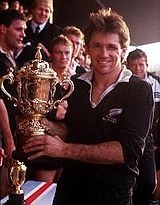
1987 Rugby World Cup

Encyclopedia
The 1987 Rugby World Cup was the first Rugby World Cup
. New Zealand
and Australia
agreed to co-host the first ever tournament with New Zealand
hosting seventeen pool stage matches, two quarter-finals and the final with Australia
being the junior partner hosting seven pool matches, two quarter-finals, both semi-finals and the third place play-off. Satellite tv links were not well developed in the region at the time which ment European audiences were unable to see any of the games "live" on tv. The event was won for the very first time by co-hosts New Zealand who were seen at the time as the strong favourites. Seven of the 16 places were automatically filled by the International Rugby Football Board members—New Zealand, Australia
, England
, Scotland
, Ireland
, Wales
and France
—with South Africa
unable to compete because of the international sports boycott due to apartheid. There was no qualification process to fill the remaining nine spots. Instead invitations were sent out to Argentina
, Fiji
, Italy
, Canada
, Romania
, Tonga
, Japan
, Zimbabwe
and the United States
. This left Western Samoa
controversially excluded, despite their better playing standard than some of the teams invited. The USSR
were to be invited but they refused the invitation on political grounds, allegedly due to the continued IRFB membership of South Africa.
On the whole the tournament witnessed fairly one-sided matches, the seven traditional IRFB members proved too strong for the other teams. Half of the 24 matches across the four pools saw one team score 40 or more points. Despite this only the ‘most points by an individual’ statistic is recorded against this tournament. New Zealand won the final against France at Eden Park
in Auckland 29–9. The New Zealand team was captained by David Kirk
, substituting for the injured Andy Dalton
, and included such rugby greats as Sean Fitzpatrick
, John Kirwan
, Grant Fox
and Michael Jones. The tournament was seen as a major success and proved that the event was here to stay and also led to many countries joining the International Rugby Football Board which in turn led the IRFB to become the true authority for the running of international rugby union.
, with the remaining nine places filled by teams invited by the IRFB.
}
|
|}
The inaugural World Cup was contested by 16 different nations. There was no qualifying tournament to determine the participants, and instead the 16 nations were invited by the International Rugby Football Board to compete. The simple 16 team pool/knock-out format was used with the sixteen nations divided into four pools of four nations, with each nation playing their other pool opponents once, every nation playing three times during the group stages. Nations were awarded 2 points for a win, 1 for a draw and zero for a loss, the top two nations of every pool advanced to the quarter finals. The runners-up of each pool faced the winners of a different pool in the quarter finals. The winners moved on to the semi finals, with the winners then moving onto the final, and the losers of the semi finals contesting a third/fourth place play off.
Points System
The points system that was used in the pool stage was:
A total of 32 matches (24 Pool Stage & 8 Knock-out) were played throughout the tournament over 29 days from Friday 22 May 1987 to Saturday 20 June 1987.
----
----
----
----
----
----
----
----
----
----
Fiji qualified for the highest number of tries (Fiji 6, Italy 5, Argentina 4)
----
----
----
----
----
----
----
----
----
----
----
----
----
Rugby World Cup
The Rugby World Cup is an international rugby union competition organised by the International Rugby Board and held every four years since 1987....
. New Zealand
New Zealand
New Zealand is an island country in the south-western Pacific Ocean comprising two main landmasses and numerous smaller islands. The country is situated some east of Australia across the Tasman Sea, and roughly south of the Pacific island nations of New Caledonia, Fiji, and Tonga...
and Australia
Australia
Australia , officially the Commonwealth of Australia, is a country in the Southern Hemisphere comprising the mainland of the Australian continent, the island of Tasmania, and numerous smaller islands in the Indian and Pacific Oceans. It is the world's sixth-largest country by total area...
agreed to co-host the first ever tournament with New Zealand
New Zealand
New Zealand is an island country in the south-western Pacific Ocean comprising two main landmasses and numerous smaller islands. The country is situated some east of Australia across the Tasman Sea, and roughly south of the Pacific island nations of New Caledonia, Fiji, and Tonga...
hosting seventeen pool stage matches, two quarter-finals and the final with Australia
Australia
Australia , officially the Commonwealth of Australia, is a country in the Southern Hemisphere comprising the mainland of the Australian continent, the island of Tasmania, and numerous smaller islands in the Indian and Pacific Oceans. It is the world's sixth-largest country by total area...
being the junior partner hosting seven pool matches, two quarter-finals, both semi-finals and the third place play-off. Satellite tv links were not well developed in the region at the time which ment European audiences were unable to see any of the games "live" on tv. The event was won for the very first time by co-hosts New Zealand who were seen at the time as the strong favourites. Seven of the 16 places were automatically filled by the International Rugby Football Board members—New Zealand, Australia
Australia national rugby union team
The Australian national rugby union team is the representative side of Australia in rugby union. The national team is nicknamed the Wallabies and competes annually with New Zealand and South Africa in the Tri-Nations Series, in which they also contest the Bledisloe Cup with New Zealand and the...
, England
England national rugby union team
The England national rugby union team represents England in rugby union. They compete in the annual Six Nations Championship with France, Ireland, Scotland, Italy, and Wales. They have won this championship on 26 occasions, 12 times winning the Grand Slam, making them the most successful team in...
, Scotland
Scotland national rugby union team
The Scotland national rugby union team represent Scotland in international rugby union. Rugby union in Scotland is administered by the Scottish Rugby Union. The Scotland rugby union team is currently ranked eighth in the IRB World Rankings as of 19 September 2011...
, Ireland
Ireland national rugby union team
The Ireland national rugby union team represents the island of Ireland in rugby union. The team competes annually in the Six Nations Championship and every four years in the Rugby World Cup, where they reached the quarter-final stage in all but two competitions The Ireland national rugby union...
, Wales
Wales national rugby union team
The Wales national rugby union team represent Wales in international rugby union tournaments. They compete annually in the Six Nations Championship with England, France, Ireland, Italy and Scotland. Wales have won the Six Nations and its predecessors 24 times outright, second only to England with...
and France
France national rugby union team
The France national rugby union team represents France in rugby union. They compete annually against England, Ireland, Italy, Scotland and Wales in the Six Nations Championship. They have won the championship outright sixteen times, shared it a further eight times, and have completed nine grand slams...
—with South Africa
South Africa national rugby union team
The South African national rugby union team are 2009 British and Irish Lions Series winners. They are currently ranked as the fourth best team in the IRB World Rankings and were named 2008 World Team of the Year at the prestigious Laureus World Sports Awards.Although South Africa was instrumental...
unable to compete because of the international sports boycott due to apartheid. There was no qualification process to fill the remaining nine spots. Instead invitations were sent out to Argentina
Argentina national rugby union team
The Argentina national rugby team, nicknamed Los Pumas, represents Argentina in international rugby union matches. The team, which plays in sky blue and white jerseys, is organised by the Argentine Rugby Union .Argentina played its first international rugby match in 1910 against a touring British...
, Fiji
Fiji national rugby union team
The Fiji national rugby union team is a member of the Pacific Islands Rugby Alliance formerly along with Samoa and Tonga. In 2009, Samoa announced their departure from the Pacific Islands Rugby Alliance, leaving just Fiji and Tonga. Fiji are ranked sixteenth in the world by the IRB as of 26...
, Italy
Italy national rugby union team
The Italy national rugby union team represent the nation of Italy in the sport of rugby union. The team is also known as the Azzurri . Italy have been playing international rugby since the late 1920s, and since 2000 compete annually in the Six Nations Championship with England, France, Ireland,...
, Canada
Canada national rugby union team
The Canada national rugby union team represents Canada in international rugby union. They are governed by Rugby Canada, and play in red and black. Canada is classified by the International Rugby Board as a tier two rugby nation. There are ten tier one nations, and seven tier two nations, the...
, Romania
Romania national rugby union team
The Romania national rugby union team , nicknamed The Oaks , is the representative side of Romania in rugby union. Long considered one of the stronger European teams outside the Six Nations, they have participated in all six Rugby World Cups, and currently compete in the first division of the...
, Tonga
Tonga national rugby union team
The Tonga national rugby union team is nicknamed Ikale Tahi . Like their Polynesian neighbours, the Tongans start their matches with a war dance – the Kailao . They are members of the Pacific Islands Rugby Alliance along with Fiji and Samoa...
, Japan
Japan national rugby union team
The Japan national rugby union team represent Japan in international rugby union competitions. Japan is traditionally the strongest rugby union power in Asia but has both enjoyed and endured mixed results against non-Asian teams over the years...
, Zimbabwe
Zimbabwe national rugby union team
The Zimbabwe national rugby union team is the rugby union team representing Zimbabwe. They are considered to be a third tier rugby union nation...
and the United States
United States national rugby union team
USA Rugby's men's national rugby union team, nicknamed the Eagles, represents the United States in the sport of rugby union. The Eagles are currently ranked 17th by the IRB World Rankings. Their highest ranking was from November 2, 2006 – September 10, 2007 at the 14th position...
. This left Western Samoa
Samoa national rugby union team
The Manu Samoa is the men's representative side of the Samoa Rugby Union in both the 15's and the 7's for international competitions. The Samoa Rugby Union is owned by the affiliated rugby unions of Samoa. In Samoa, Manu Samoa is in honour of a famous Samoan warrior. From 1924 to 1997 Samoa was...
controversially excluded, despite their better playing standard than some of the teams invited. The USSR
Soviet Union national rugby union team
The USSR national rugby union team was a sporting side that represented the Soviet Union in rugby union until the early 1990s.-History:Although such tournaments as the Soviet Cup and the Soviet Championship existed, rugby never became a major sport in the USSR...
were to be invited but they refused the invitation on political grounds, allegedly due to the continued IRFB membership of South Africa.
On the whole the tournament witnessed fairly one-sided matches, the seven traditional IRFB members proved too strong for the other teams. Half of the 24 matches across the four pools saw one team score 40 or more points. Despite this only the ‘most points by an individual’ statistic is recorded against this tournament. New Zealand won the final against France at Eden Park
Eden Park
Eden Park is the biggest stadium in Auckland, New Zealand. It is used primarily for rugby union in winter and cricket in summer . The ground also occasionally hostts rugby league matches. To accommodate all three sports, the cricket pitch is removable...
in Auckland 29–9. The New Zealand team was captained by David Kirk
David Kirk
David Edward Kirk, MBE, , is a former New Zealand rugby union player. He is best known for having been the captain of the All Blacks when they won the inaugural Rugby World Cup in 1987....
, substituting for the injured Andy Dalton
Andy Dalton
Andrew Grant Dalton is an ex-All Blacks rugby union player who captained the side 17 times in tests...
, and included such rugby greats as Sean Fitzpatrick
Sean Fitzpatrick
Sean Fitzpatrick MNZM is a former rugby union footballer who represented New Zealand, and is widely regarded as one of the finest players ever to come from that country. He is also the son of former player Brian Fitzpatrick....
, John Kirwan
John Kirwan (rugby player)
John James Patrick Kirwan, ONZM, MBE is a New Zealand rugby union footballer, and former All Black, turned coach. With 35 tries in 63 tests for the All Blacks, Kirwan appears on the list of the highest try scorers in Rugby Union history....
, Grant Fox
Grant Fox
Grant James Fox is a former rugby union player from New Zealand. He was born in New Plymouth. He attended Auckland Grammar school....
and Michael Jones. The tournament was seen as a major success and proved that the event was here to stay and also led to many countries joining the International Rugby Football Board which in turn led the IRFB to become the true authority for the running of international rugby union.
Participating nations
There was no qualification for the inaugural World Cup so the tournament comprised the seven then-members of the IRFBInternational Rugby Board
The International Rugby Board is the governing body for the sport of rugby union. It was founded in 1886 as the International Rugby Football Board by the unions of Scotland, Wales and Ireland. England refused to join until 1890. The International Rugby Football Board changed its name to the...
, with the remaining nine places filled by teams invited by the IRFB.
| IRFB Member Nations | Invited Nations |
|---|---|
- South AfricaSouth AfricaThe Republic of South Africa is a country in southern Africa. Located at the southern tip of Africa, it is divided into nine provinces, with of coastline on the Atlantic and Indian oceans...
was excluded due to its pro apartheid policies. - Soviet UnionSoviet UnionThe Soviet Union , officially the Union of Soviet Socialist Republics , was a constitutionally socialist state that existed in Eurasia between 1922 and 1991....
were to be invited but declined. - Western SamoaSamoaSamoa , officially the Independent State of Samoa, formerly known as Western Samoa is a country encompassing the western part of the Samoan Islands in the South Pacific Ocean. It became independent from New Zealand in 1962. The two main islands of Samoa are Upolu and one of the biggest islands in...
was not invited despite having a better record than some of the other invited nations.
Australia
| City | Stadium | Capacity |
|---|---|---|
| Brisbane Brisbane Brisbane is the capital and most populous city in the Australian state of Queensland and the third most populous city in Australia. Brisbane's metropolitan area has a population of over 2 million, and the South East Queensland urban conurbation, centred around Brisbane, encompasses a population of... |
Ballymore Stadium Ballymore Stadium Ballymore is the name of a rugby union stadium situated in Herston, a suburb of Brisbane, Australia. It was the home of Queensland Rugby Union, and used to be the home ground for the Queensland Reds and the Brisbane Strikers Football Club. The Queensland Reds have since moved to Suncorp Stadium... |
24,000 |
| Sydney | Concord Oval Concord Oval Concord Oval is a rugby stadium in Concord, Australia. It is currently used mostly for rugby union matches and was used for eight matches during the 1987 Rugby World Cup. The stadium is able to hold 20,000 people and opened in 1985.... |
20,000 |
New Zealand
| City | Stadium | Capacity |
|---|---|---|
| Auckland Auckland The Auckland metropolitan area , in the North Island of New Zealand, is the largest and most populous urban area in the country with residents, percent of the country's population. Auckland also has the largest Polynesian population of any city in the world... |
Eden Park Eden Park Eden Park is the biggest stadium in Auckland, New Zealand. It is used primarily for rugby union in winter and cricket in summer . The ground also occasionally hostts rugby league matches. To accommodate all three sports, the cricket pitch is removable... |
45,472 |
| Wellington Wellington Wellington is the capital city and third most populous urban area of New Zealand, although it is likely to have surpassed Christchurch due to the exodus following the Canterbury Earthquake. It is at the southwestern tip of the North Island, between Cook Strait and the Rimutaka Range... |
Athletic Park Athletic Park (Wellington) Athletic Park was a well-known ground used mostly for rugby matches in Wellington, New Zealand. The ground was also the inaugural home of New Zealand's principal knockout football tournament, the Chatham Cup .... |
39,000 |
| Christchurch Christchurch Christchurch is the largest city in the South Island of New Zealand, and the country's second-largest urban area after Auckland. It lies one third of the way down the South Island's east coast, just north of Banks Peninsula which itself, since 2006, lies within the formal limits of... |
Lancaster Park | 36,500 |
| Dunedin Dunedin Dunedin is the second-largest city in the South Island of New Zealand, and the principal city of the Otago Region. It is considered to be one of the four main urban centres of New Zealand for historic, cultural, and geographic reasons. Dunedin was the largest city by territorial land area until... |
Carisbrook Carisbrook Carisbrook was a major sporting venue in Dunedin, New Zealand. The city's main domestic and international rugby union venue, it has also been used for other sports such as cricket, football, rugby league and motocross. Carisbrook has also hosted a Joe Cocker concert and frequently hosted pre-game... |
35,000 |
| Rotorua Rotorua Rotorua is a city on the southern shores of the lake of the same name, in the Bay of Plenty region of the North Island of New Zealand. The city is the seat of the Rotorua District, a territorial authority encompassing the city and several other nearby towns... |
Rotorua International Stadium Rotorua International Stadium Rotorua International Stadium is a multi-purpose stadium located on Devon Street West in Westbrook suburb of Rotorua, New Zealand. It is currently used mostly for rugby union and rugby league matches, being one of two home stadiums for the Bay of Plenty Rugby Union... |
35,000 |
| Napier Napier, New Zealand Napier is a New Zealand city with a seaport, located in Hawke's Bay on the eastern coast of the North Island. The population of Napier is about About 18 kilometres south of Napier is the inland city of Hastings. These two neighboring cities are often called "The Twin Cities" or "The Bay Cities"... |
McLean Park McLean Park McLean Park is a sports ground in Napier, New Zealand. The two main sports played at the ground are cricket and rugby. It is one of the 10 proper cricket grounds of New Zealand.... |
30,000 |
| Hamilton Hamilton, New Zealand Hamilton is the centre of New Zealand's fourth largest urban area, and Hamilton City is the country's fourth largest territorial authority. Hamilton is in the Waikato Region of the North Island, approximately south of Auckland... |
Rugby Park | |
| Invercargill Invercargill Invercargill is the southernmost and westernmost city in New Zealand, and one of the southernmost cities in the world. It is the commercial centre of the Southland region. It lies in the heart of the wide expanse of the Southland Plains on the Oreti or New River some 18 km north of Bluff,... |
Rugby Park Stadium Rugby Park Stadium Rugby Park Stadium is a rugby union venue and home ground for ITM Cup team Southland. Rugby Park Stadium is located on the corner of Elles Road and Tweed Street in Invercargill. It has a capacity of 20,000, although in former incarnations has accommodated up to 30,000 in the 1960s before the... |
17,000 |
| Palmerston North Palmerston North Palmerston North is the main city of the Manawatu-Wanganui region of the North Island of New Zealand. It is an inland city with a population of and is the country's seventh largest city and eighth largest urban area. Palmerston North is located in the eastern Manawatu Plains near the north bank... |
Showgrounds Oval |
Pools and format
| Pool 1 | Pool 2 | Pool 3 | Pool 4 |
|---|---|---|---|
|
|}
- Pool 1 was played in AustraliaAustraliaAustralia , officially the Commonwealth of Australia, is a country in the Southern Hemisphere comprising the mainland of the Australian continent, the island of Tasmania, and numerous smaller islands in the Indian and Pacific Oceans. It is the world's sixth-largest country by total area...
- Pool 2 was played with five matches held in New ZealandNew ZealandNew Zealand is an island country in the south-western Pacific Ocean comprising two main landmasses and numerous smaller islands. The country is situated some east of Australia across the Tasman Sea, and roughly south of the Pacific island nations of New Caledonia, Fiji, and Tonga...
with one match held in AustraliaAustraliaAustralia , officially the Commonwealth of Australia, is a country in the Southern Hemisphere comprising the mainland of the Australian continent, the island of Tasmania, and numerous smaller islands in the Indian and Pacific Oceans. It is the world's sixth-largest country by total area... - Pool 3 was played in New ZealandNew ZealandNew Zealand is an island country in the south-western Pacific Ocean comprising two main landmasses and numerous smaller islands. The country is situated some east of Australia across the Tasman Sea, and roughly south of the Pacific island nations of New Caledonia, Fiji, and Tonga...
- Pool 4 was played in New ZealandNew ZealandNew Zealand is an island country in the south-western Pacific Ocean comprising two main landmasses and numerous smaller islands. The country is situated some east of Australia across the Tasman Sea, and roughly south of the Pacific island nations of New Caledonia, Fiji, and Tonga...
The inaugural World Cup was contested by 16 different nations. There was no qualifying tournament to determine the participants, and instead the 16 nations were invited by the International Rugby Football Board to compete. The simple 16 team pool/knock-out format was used with the sixteen nations divided into four pools of four nations, with each nation playing their other pool opponents once, every nation playing three times during the group stages. Nations were awarded 2 points for a win, 1 for a draw and zero for a loss, the top two nations of every pool advanced to the quarter finals. The runners-up of each pool faced the winners of a different pool in the quarter finals. The winners moved on to the semi finals, with the winners then moving onto the final, and the losers of the semi finals contesting a third/fourth place play off.
Points System
The points system that was used in the pool stage was:
- 2 points for a win
- 1 point for a draw
- 0 points for playing
A total of 32 matches (24 Pool Stage & 8 Knock-out) were played throughout the tournament over 29 days from Friday 22 May 1987 to Saturday 20 June 1987.
Pool 1
| Team | P | W | D | L | PF | PA | Pts |
|---|---|---|---|---|---|---|---|
| 3 | 3 | 0 | 0 | 108 | 41 | 6 | |
| 3 | 2 | 0 | 1 | 100 | 32 | 4 | |
| 3 | 1 | 0 | 2 | 39 | 99 | 2 | |
| 3 | 0 | 0 | 3 | 48 | 123 | 0 |
----
----
----
----
----
Pool 2
| Team | P | W | D | L | PF | PA | Pts |
|---|---|---|---|---|---|---|---|
| 3 | 3 | 0 | 0 | 82 | 31 | 6 | |
| 3 | 2 | 0 | 1 | 84 | 41 | 4 | |
| 3 | 1 | 0 | 2 | 65 | 90 | 2 | |
| 3 | 0 | 0 | 3 | 29 | 98 | 0 |
----
----
----
----
----
Pool 3
| Team | P | W | D | L | PF | PA | Pts |
|---|---|---|---|---|---|---|---|
| 3 | 3 | 0 | 0 | 190 | 34 | 6 | |
| 3 | 1 | 0 | 2 | 56 | 101 | 2 | |
| 3 | 1 | 0 | 2 | 40 | 110 | 2 | |
| 3 | 1 | 0 | 2 | 49 | 90 | 2 |
Fiji qualified for the highest number of tries (Fiji 6, Italy 5, Argentina 4)
----
----
----
----
----
----
Pool 4
| Team | P | W | D | L | PF | PA | Pts |
|---|---|---|---|---|---|---|---|
| 3 | 2 | 1 | 0 | 145 | 44 | 5 | |
| 3 | 2 | 1 | 0 | 135 | 69 | 5 | |
| 3 | 1 | 0 | 2 | 61 | 130 | 2 | |
| 3 | 0 | 0 | 3 | 53 | 151 | 0 |
----
----
----
----
----
Knock-out stage
Quarter-finals
--------
----