

Solifugae

Encyclopedia
Solifugae are an order
of Arachnid
a, known as camel spiders, wind scorpions and sun spiders or solifuges, comprising more than 1,000 described species
in about 153 genera
. They may grow to a length of 300 mm (12 in) including legs, and have a body comprising an opisthosoma
(abdomen) and a prosoma (head) with conspicuously large chelicerae
, which are also used for stridulation
. Most species live in desert
s and feed opportunistically on ground-dwelling arthropod
s and other animals. A number of urban legend
s exaggerate the size and speed of Solifugae, and their potential danger to humans.
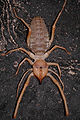 Solifugids are moderately small to large arachnids (a few mm to several cm in body length), with the larger species reaching 15 cm (6 in) in length. This figure however, is not very useful because the relative lengths of the legs of various species differ dramatically and such large figures are quoted for sensational effect; more practical measurements refer to the body length. It is difficult to get solidly supported data because very few sources quote anything but anecdotal, or at best unsupported, claims. One source suggests a body length of up to 7 cm (3 in) Another gives a figure of 10 cm (4 in)http://www.solpugid.com/Introduction.htm
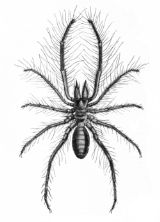
The body is divided into a forward part, cephalothorax
or prosoma, and a ten-segmented abdomen
or opisthosoma
. As is clear from the illustrations, the Solifugid prosoma and opisthosoma are not separated by nearly as clear a constriction as occurs in the spiders. The prosoma comprises the head, the mouthparts and the somite
s containing the legs and the pedipalps. It is divided into a relatively large anterior carapace, including the animal's eyes, and a smaller posterior section.
The most distinctive feature of Solifugae is their large chelicerae
, which are longer than the prosoma. Each of the two chelicerae are composed of two articles forming a powerful pincer; each article bears a variable number of teeth. The chelicerae of many species are surprisingly strong; they are capable of shearing hair or feathers from vertebrate prey or carrion, and of cutting through skin and small bones such as those of birds.
Solifugae stridulate
with their chelicerae, producing a rattling noise.
Although Solifugae appear to have ten legs, they actually have only eight, as other arachnids do. Each true leg has seven segments: coxa, trochanter, femur, patella, tibia, metatarsus, tarsus. The first pair of appendages are not legs, but pedipalp
s; they have only five segments each. The pedipalps of Solifugae function partly as sense organs similar to insects' antennae
, and partly in locomotion, feeding and fighting. In normal locomotion they do not quite touch the ground but are held out to detect obstacles and prey; in that attitude they look like an extra pair of legs. Reflecting the great dependence of Solifugae on their tactile senses, their anterior true legs commonly are smaller and thinner than the posterior three pairs. That smaller anterior pair act largely in a sensory role as a supplement to the pedipalps. At the tips of their pedipalps, Solifugae bear eversible
adhesive organs, which they may use to capture flying prey, and which at least some species certainly use for climbing smooth surfaces.
For the most part only the posterior six legs are used for running.
On the last pair of legs, Solifugae have fan-shaped sensory organs called racquet organs or malleoli. The function of the malleoli is not yet clearly understood. It is suspected that they are sensory organs for detection of vibrations in the soil, perhaps to detect threats and potential prey or mates.
Like pseudoscorpion
s and harvestmen,Solifugae lack book lung
s, having instead a well-developed tracheal system
that takes in air through three pairs of slits on the animal's underside.
In some species there are very large central eyes. They look like simple eyes or ocelli, but they are in fact surprisingly sophisticated. They can recognise forms, and are used in hunting and avoiding enemies. These eyes are remarkable in their internal anatomy; there is a suggestion that they represent the last step in the integration of the aggregate of simple ocelli into a compound eye, and of further integration of a compound eye into a simple eye. Lateral eyes are only rudimentary, if present at all.
Males are usually smaller than females, with relatively longer legs. They also bear a pair of organs, one on each chelicera. The organs are called flagella, meaning whips, referring to their shape. In the accompanying photograph of a male Solifugid, one flagellum is just visible near the tip of each chelicera. The flagella sometimes are called horns, and bend back over the chelicerae. They are believed to have some sexual connection, but their function has not yet been clearly explained.
s and harvestmen
, they belong to a distinct arachnid order. There are about 1065 species of Solifugae known, grouped in about 153 genera and 12 families belonging to the order Solifugae:
The family Protosolpugidae is only known from one fossil species from the Pennsylvanian
.
.
Solifugae are carnivorous
or omnivorous
, with most species feeding on termite
s, darkling beetle
s, and other small ground-dwelling arthropod
s. Solifuges are opportunistic feeders and have been recorded as feeding on snakes, small lizards and rodents; Prey is located with the pedipalps and killed and cut into pieces by the chelicerae. The prey is then liquefied and the liquid ingested through the pharynx. Although they do not normally attack humans, these chelicerae can penetrate human skin, and painful bites have been reported.
transfer; when indirect, the male emits a spermatophore
on the ground and then inserts it with his chelicerae in the female's genital pore. To do this, he flings the female on her back. The female then digs a burrow, into which she lays 50 to 200 eggs. Depending on the species, she guards them until they hatch. Because the female will not feed during this time, she will try to fatten herself beforehand, and a species of 5 cm (2 in) has been observed to eat more than 100 flies during that time in the laboratory. Solifugae undergo a number of stages including, egg, post-embryo, nine to ten nymphal instars, and adults.
, and means "those that flee from the sun". The order is also known by the names Solpugida, Solpugides, Solpugae, Galeodea and Mycetophorae. Their common name
s include camel spider, wind scorpion, jerrymunglum, sun scorpion and sun spider. In southern Africa
they are known by a host of names including red romans, ("hair cutters") and ("beard cutters"), the latter two relating to the belief they use their formidable jaws to clip hair from humans and animals to line their subterranean nests.
recognised that they were distinct from spider
s; spiders were called (arachne) while Solifugae were named (phalangion). In Aelian
's De natura animalium they are mistakenly mentioned, along with scorpion
s, as responsible for the abandoning of a country in Ethiopia
. Anton August Heinrich Lichtenstein
theorised in 1797 that the "mice" which plagued the Philistines
in the Old Testament
were Solifugae. During World War I
, troops stationed in Abū Qīr
, Egypt
would stage fights between captive jerrymanders, as they referred to them, and placed bets on the outcome. Similarly British troops stationed in Libya in World War II
would stage fights between Solifugae and scorpions.
s and exaggerations about their size, speed, behaviour, appetite, and lethality. They are not especially large, the biggest having a leg span of perhaps 12 cm (4.7 in). They are fast on land compared to other invertebrates. The fastest can run perhaps 16 km/h (10 mph) for a short distance, nearly half as fast as the fastest human sprinter. Members of this order of Arachnida apparently have no venom, with the possible exception of one species in India
(Rhagodes nigrocinctus) as suggested in one study, and do not spin webs.
Due to their bizarre appearance many people are startled by or even afraid of them. This fear was sufficient to drive a family from their home when one was discovered in a soldier's house in Colchester, England
and caused the family to blame the death of their pet dog
on the solifugid. The greatest threat they pose to humans, however, is their defensive bite when handled. There is essentially no chance of death directly caused by the bite, but, due to the strong muscles of their chelicerae
, they can produce a large, ragged wound that is prone to infection.
Order (biology)
In scientific classification used in biology, the order is# a taxonomic rank used in the classification of organisms. Other well-known ranks are life, domain, kingdom, phylum, class, family, genus, and species, with order fitting in between class and family...
of Arachnid
Arachnid
Arachnids are a class of joint-legged invertebrate animals in the subphylum Chelicerata. All arachnids have eight legs, although in some species the front pair may convert to a sensory function. The term is derived from the Greek words , meaning "spider".Almost all extant arachnids are terrestrial...
a, known as camel spiders, wind scorpions and sun spiders or solifuges, comprising more than 1,000 described species
Species
In biology, a species is one of the basic units of biological classification and a taxonomic rank. A species is often defined as a group of organisms capable of interbreeding and producing fertile offspring. While in many cases this definition is adequate, more precise or differing measures are...
in about 153 genera
Genus
In biology, a genus is a low-level taxonomic rank used in the biological classification of living and fossil organisms, which is an example of definition by genus and differentia...
. They may grow to a length of 300 mm (12 in) including legs, and have a body comprising an opisthosoma
Opisthosoma
The opisthosoma is the posterior part of the body in some arthropods, behind the prosoma . It is a distinctive feature of the subphylum Chelicerata...
(abdomen) and a prosoma (head) with conspicuously large chelicerae
Chelicerae
The chelicerae are mouthparts of the Chelicerata, an arthropod subphylum that includes arachnids, Merostomata , and Pycnogonida . Chelicerae are pointed appendages which are used to grasp food, and are found in place of the chewing mandibles most other arthropods have...
, which are also used for stridulation
Stridulation
Stridulation is the act of producing sound by rubbing together certain body parts. This behavior is mostly associated with insects, but other animals are known to do this as well, such as a number of species of fishes, snakes and spiders...
. Most species live in desert
Desert
A desert is a landscape or region that receives an extremely low amount of precipitation, less than enough to support growth of most plants. Most deserts have an average annual precipitation of less than...
s and feed opportunistically on ground-dwelling arthropod
Arthropod
An arthropod is an invertebrate animal having an exoskeleton , a segmented body, and jointed appendages. Arthropods are members of the phylum Arthropoda , and include the insects, arachnids, crustaceans, and others...
s and other animals. A number of urban legend
Urban legend
An urban legend, urban myth, urban tale, or contemporary legend, is a form of modern folklore consisting of stories that may or may not have been believed by their tellers to be true...
s exaggerate the size and speed of Solifugae, and their potential danger to humans.
Anatomy
The body is divided into a forward part, cephalothorax
Cephalothorax
The cephalothorax is a tagma of various arthropods, comprising the head and the thorax fused together, as distinct from the abdomen behind. The word cephalothorax is derived from the Greek words for head and thorax...
or prosoma, and a ten-segmented abdomen
Abdomen
In vertebrates such as mammals the abdomen constitutes the part of the body between the thorax and pelvis. The region enclosed by the abdomen is termed the abdominal cavity...
or opisthosoma
Opisthosoma
The opisthosoma is the posterior part of the body in some arthropods, behind the prosoma . It is a distinctive feature of the subphylum Chelicerata...
. As is clear from the illustrations, the Solifugid prosoma and opisthosoma are not separated by nearly as clear a constriction as occurs in the spiders. The prosoma comprises the head, the mouthparts and the somite
Somite
A somite is a division of the body of an animal. In vertebrates this is mainly discernible in the embryo stage; in arthropods it is a characteristic of a hypothetical ancestor.- In vertebrates :...
s containing the legs and the pedipalps. It is divided into a relatively large anterior carapace, including the animal's eyes, and a smaller posterior section.
The most distinctive feature of Solifugae is their large chelicerae
Chelicerae
The chelicerae are mouthparts of the Chelicerata, an arthropod subphylum that includes arachnids, Merostomata , and Pycnogonida . Chelicerae are pointed appendages which are used to grasp food, and are found in place of the chewing mandibles most other arthropods have...
, which are longer than the prosoma. Each of the two chelicerae are composed of two articles forming a powerful pincer; each article bears a variable number of teeth. The chelicerae of many species are surprisingly strong; they are capable of shearing hair or feathers from vertebrate prey or carrion, and of cutting through skin and small bones such as those of birds.
Solifugae stridulate
Stridulation
Stridulation is the act of producing sound by rubbing together certain body parts. This behavior is mostly associated with insects, but other animals are known to do this as well, such as a number of species of fishes, snakes and spiders...
with their chelicerae, producing a rattling noise.
Although Solifugae appear to have ten legs, they actually have only eight, as other arachnids do. Each true leg has seven segments: coxa, trochanter, femur, patella, tibia, metatarsus, tarsus. The first pair of appendages are not legs, but pedipalp
Pedipalp
Pedipalps , are the second pair of appendages of the prosoma in the subphylum Chelicerata. They are traditionally thought to be homologous with mandibles in Crustacea and insects, although more recent studies Pedipalps (commonly shortened to palps or palpi), are the second pair of appendages of the...
s; they have only five segments each. The pedipalps of Solifugae function partly as sense organs similar to insects' antennae
Antenna (biology)
Antennae in biology have historically been paired appendages used for sensing in arthropods. More recently, the term has also been applied to cilium structures present in most cell types of eukaryotes....
, and partly in locomotion, feeding and fighting. In normal locomotion they do not quite touch the ground but are held out to detect obstacles and prey; in that attitude they look like an extra pair of legs. Reflecting the great dependence of Solifugae on their tactile senses, their anterior true legs commonly are smaller and thinner than the posterior three pairs. That smaller anterior pair act largely in a sensory role as a supplement to the pedipalps. At the tips of their pedipalps, Solifugae bear eversible
Eversion
Eversion is a process of turning inside-out. To Evert means to turn inside out. Eversion may refer to:* Eversion , the anatomical term of motion denoting the movement of the sole of the foot away from the median plane...
adhesive organs, which they may use to capture flying prey, and which at least some species certainly use for climbing smooth surfaces.
For the most part only the posterior six legs are used for running.
On the last pair of legs, Solifugae have fan-shaped sensory organs called racquet organs or malleoli. The function of the malleoli is not yet clearly understood. It is suspected that they are sensory organs for detection of vibrations in the soil, perhaps to detect threats and potential prey or mates.
Like pseudoscorpion
Pseudoscorpion
A pseudoscorpion, , is an arachnid belonging to the order Pseudoscorpionida, also known as Pseudoscorpiones or Chelonethida....
s and harvestmen,Solifugae lack book lung
Book lung
A book lung is a type of respiration organ used for atmospheric gas exchange and is found in arachnids, such as scorpions and spiders. Each of these organs is found inside a ventral abdominal cavity and connects with the surroundings through a small opening. Book lungs are not related to the lungs...
s, having instead a well-developed tracheal system
Invertebrate trachea
The invertebrate trachea refers to the open respiratory system composed of spiracles, tracheae, and tracheoles that terrestrial arthropods have to transport metabolic gases to and from tissues....
that takes in air through three pairs of slits on the animal's underside.
In some species there are very large central eyes. They look like simple eyes or ocelli, but they are in fact surprisingly sophisticated. They can recognise forms, and are used in hunting and avoiding enemies. These eyes are remarkable in their internal anatomy; there is a suggestion that they represent the last step in the integration of the aggregate of simple ocelli into a compound eye, and of further integration of a compound eye into a simple eye. Lateral eyes are only rudimentary, if present at all.
Males are usually smaller than females, with relatively longer legs. They also bear a pair of organs, one on each chelicera. The organs are called flagella, meaning whips, referring to their shape. In the accompanying photograph of a male Solifugid, one flagellum is just visible near the tip of each chelicera. The flagella sometimes are called horns, and bend back over the chelicerae. They are believed to have some sexual connection, but their function has not yet been clearly explained.
Classification
Solifugae are not true spiders, which are from a different order, Araneae. Like scorpionScorpion
Scorpions are predatory arthropod animals of the order Scorpiones within the class Arachnida. They have eight legs and are easily recognized by the pair of grasping claws and the narrow, segmented tail, often carried in a characteristic forward curve over the back, ending with a venomous stinger...
s and harvestmen
Opiliones
Opiliones are an order of arachnids commonly known as harvestmen. , over 6,400 species of harvestmen have been discovered worldwide, although the real number of extant species may exceed 10,000. The order Opiliones can be divided into four suborders: Cyphophthalmi, Eupnoi, Dyspnoi and Laniatores...
, they belong to a distinct arachnid order. There are about 1065 species of Solifugae known, grouped in about 153 genera and 12 families belonging to the order Solifugae:
- AmmotrechidaeAmmotrechidaeAmmotrechidae are a family of solifuges distributed in the Americas and the Caribbean Islands. They include 22 described genera and at least 83 species...
- Ceromidae
- DaesiidaeDaesiidaeDaesiidae is a family of solifugids, which are widespread in Africa and the Middle East. Members of the family are also present in India, South America, the Balkans, and the single species Gluvia dorsalis in the Iberian Peninsula. A single fossil species is known from Eocene Baltic amber. Around...
- EremobatidaeEremobatidaeEremobatidae is a family in the arachnid order Solifugae. It includes 187 species in 7 genera, distributed across Central American and western North America....
- Galeodidae
- Gylippidae
- Hexisopodidae
- Karschiidae
- Melanoblossidae
- Mummuciidae
- Rhagodidae
- Solpugidae
The family Protosolpugidae is only known from one fossil species from the Pennsylvanian
Pennsylvanian
The Pennsylvanian is, in the ICS geologic timescale, the younger of two subperiods of the Carboniferous Period. It lasted from roughly . As with most other geochronologic units, the rock beds that define the Pennsylvanian are well identified, but the exact date of the start and end are uncertain...
.
Ecology
Although Solifugae are considered to be endemic indicators of desert biomes, they occur widely in semi-desert and scrub. Some species also live in grassland or forest habitats. Solifugae generally inhabit warm and arid habitats, including virtually all warm deserts and scrublands in all continents excepting Antarctica and AustraliaAustralia
Australia , officially the Commonwealth of Australia, is a country in the Southern Hemisphere comprising the mainland of the Australian continent, the island of Tasmania, and numerous smaller islands in the Indian and Pacific Oceans. It is the world's sixth-largest country by total area...
.
Solifugae are carnivorous
Carnivore
A carnivore meaning 'meat eater' is an organism that derives its energy and nutrient requirements from a diet consisting mainly or exclusively of animal tissue, whether through predation or scavenging...
or omnivorous
Omnivore
Omnivores are species that eat both plants and animals as their primary food source...
, with most species feeding on termite
Termite
Termites are a group of eusocial insects that, until recently, were classified at the taxonomic rank of order Isoptera , but are now accepted as the epifamily Termitoidae, of the cockroach order Blattodea...
s, darkling beetle
Darkling beetle
Darkling beetles are a family of beetles found worldwide, estimated at more than 20,000 species. Many of the beetles have black elytra, leading to their common name...
s, and other small ground-dwelling arthropod
Arthropod
An arthropod is an invertebrate animal having an exoskeleton , a segmented body, and jointed appendages. Arthropods are members of the phylum Arthropoda , and include the insects, arachnids, crustaceans, and others...
s. Solifuges are opportunistic feeders and have been recorded as feeding on snakes, small lizards and rodents; Prey is located with the pedipalps and killed and cut into pieces by the chelicerae. The prey is then liquefied and the liquid ingested through the pharynx. Although they do not normally attack humans, these chelicerae can penetrate human skin, and painful bites have been reported.
Life cycle
Solifugae are typically univoltine. Reproduction can involve direct or indirect spermSperm
The term sperm is derived from the Greek word sperma and refers to the male reproductive cells. In the types of sexual reproduction known as anisogamy and oogamy, there is a marked difference in the size of the gametes with the smaller one being termed the "male" or sperm cell...
transfer; when indirect, the male emits a spermatophore
Spermatophore
A spermatophore or sperm ampulla is a capsule or mass created by males of various animal species, containing spermatozoa and transferred in entirety to the female's ovipore during copulation...
on the ground and then inserts it with his chelicerae in the female's genital pore. To do this, he flings the female on her back. The female then digs a burrow, into which she lays 50 to 200 eggs. Depending on the species, she guards them until they hatch. Because the female will not feed during this time, she will try to fatten herself beforehand, and a species of 5 cm (2 in) has been observed to eat more than 100 flies during that time in the laboratory. Solifugae undergo a number of stages including, egg, post-embryo, nine to ten nymphal instars, and adults.
Etymology
The name Solifugae derives from LatinLatin
Latin is an Italic language originally spoken in Latium and Ancient Rome. It, along with most European languages, is a descendant of the ancient Proto-Indo-European language. Although it is considered a dead language, a number of scholars and members of the Christian clergy speak it fluently, and...
, and means "those that flee from the sun". The order is also known by the names Solpugida, Solpugides, Solpugae, Galeodea and Mycetophorae. Their common name
Common name
A common name of a taxon or organism is a name in general use within a community; it is often contrasted with the scientific name for the same organism...
s include camel spider, wind scorpion, jerrymunglum, sun scorpion and sun spider. In southern Africa
Southern Africa
Southern Africa is the southernmost region of the African continent, variably defined by geography or geopolitics. Within the region are numerous territories, including the Republic of South Africa ; nowadays, the simpler term South Africa is generally reserved for the country in English.-UN...
they are known by a host of names including red romans, ("hair cutters") and ("beard cutters"), the latter two relating to the belief they use their formidable jaws to clip hair from humans and animals to line their subterranean nests.
Solifugids and humans
Solifugids have been recognised as distinct taxa from ancient times. The GreeksAncient Greece
Ancient Greece is a civilization belonging to a period of Greek history that lasted from the Archaic period of the 8th to 6th centuries BC to the end of antiquity. Immediately following this period was the beginning of the Early Middle Ages and the Byzantine era. Included in Ancient Greece is the...
recognised that they were distinct from spider
Spider
Spiders are air-breathing arthropods that have eight legs, and chelicerae with fangs that inject venom. They are the largest order of arachnids and rank seventh in total species diversity among all other groups of organisms...
s; spiders were called (arachne) while Solifugae were named (phalangion). In Aelian
Claudius Aelianus
Claudius Aelianus , often seen as just Aelian, born at Praeneste, was a Roman author and teacher of rhetoric who flourished under Septimius Severus and probably outlived Elagabalus, who died in 222...
's De natura animalium they are mistakenly mentioned, along with scorpion
Scorpion
Scorpions are predatory arthropod animals of the order Scorpiones within the class Arachnida. They have eight legs and are easily recognized by the pair of grasping claws and the narrow, segmented tail, often carried in a characteristic forward curve over the back, ending with a venomous stinger...
s, as responsible for the abandoning of a country in Ethiopia
Ethiopia (mythology)
Aethiopia first appears as a geographical term in classical sources, in reference to the Upper Nile region, as well as all the regions south of the Sahara desert. Its earliest mention is in the works of Homer: twice in the Iliad, and three times in the Odyssey...
. Anton August Heinrich Lichtenstein
Anton August Heinrich Lichtenstein
Anton August Heinrich Lichtenstein was a German zoologist. He was the father of Martin Hinrich Carl Lichtenstein....
theorised in 1797 that the "mice" which plagued the Philistines
Philistines
Philistines , Pleshet or Peleset, were a people who occupied the southern coast of Canaan at the beginning of the Iron Age . According to the Bible, they ruled the five city-states of Gaza, Askelon, Ashdod, Ekron and Gath, from the Wadi Gaza in the south to the Yarqon River in the north, but with...
in the Old Testament
Old Testament
The Old Testament, of which Christians hold different views, is a Christian term for the religious writings of ancient Israel held sacred and inspired by Christians which overlaps with the 24-book canon of the Masoretic Text of Judaism...
were Solifugae. During World War I
World War I
World War I , which was predominantly called the World War or the Great War from its occurrence until 1939, and the First World War or World War I thereafter, was a major war centred in Europe that began on 28 July 1914 and lasted until 11 November 1918...
, troops stationed in Abū Qīr
Abu Qir
Abū Qīr is a village on the Mediterranean coast of Egypt, northeast of Alexandria by rail, containing a castle used as a state prison by Muhammad Ali of Egypt....
, Egypt
Egypt
Egypt , officially the Arab Republic of Egypt, Arabic: , is a country mainly in North Africa, with the Sinai Peninsula forming a land bridge in Southwest Asia. Egypt is thus a transcontinental country, and a major power in Africa, the Mediterranean Basin, the Middle East and the Muslim world...
would stage fights between captive jerrymanders, as they referred to them, and placed bets on the outcome. Similarly British troops stationed in Libya in World War II
World War II
World War II, or the Second World War , was a global conflict lasting from 1939 to 1945, involving most of the world's nations—including all of the great powers—eventually forming two opposing military alliances: the Allies and the Axis...
would stage fights between Solifugae and scorpions.
Urban legends
Solifugae are the subject of many urban legendUrban legend
An urban legend, urban myth, urban tale, or contemporary legend, is a form of modern folklore consisting of stories that may or may not have been believed by their tellers to be true...
s and exaggerations about their size, speed, behaviour, appetite, and lethality. They are not especially large, the biggest having a leg span of perhaps 12 cm (4.7 in). They are fast on land compared to other invertebrates. The fastest can run perhaps 16 km/h (10 mph) for a short distance, nearly half as fast as the fastest human sprinter. Members of this order of Arachnida apparently have no venom, with the possible exception of one species in India
India
India , officially the Republic of India , is a country in South Asia. It is the seventh-largest country by geographical area, the second-most populous country with over 1.2 billion people, and the most populous democracy in the world...
(Rhagodes nigrocinctus) as suggested in one study, and do not spin webs.
Due to their bizarre appearance many people are startled by or even afraid of them. This fear was sufficient to drive a family from their home when one was discovered in a soldier's house in Colchester, England
Colchester
Colchester is an historic town and the largest settlement within the borough of Colchester in Essex, England.At the time of the census in 2001, it had a population of 104,390. However, the population is rapidly increasing, and has been named as one of Britain's fastest growing towns. As the...
and caused the family to blame the death of their pet dog
Dog
The domestic dog is a domesticated form of the gray wolf, a member of the Canidae family of the order Carnivora. The term is used for both feral and pet varieties. The dog may have been the first animal to be domesticated, and has been the most widely kept working, hunting, and companion animal in...
on the solifugid. The greatest threat they pose to humans, however, is their defensive bite when handled. There is essentially no chance of death directly caused by the bite, but, due to the strong muscles of their chelicerae
Chelicerae
The chelicerae are mouthparts of the Chelicerata, an arthropod subphylum that includes arachnids, Merostomata , and Pycnogonida . Chelicerae are pointed appendages which are used to grasp food, and are found in place of the chewing mandibles most other arthropods have...
, they can produce a large, ragged wound that is prone to infection.