


Cephalothorax

Encyclopedia
Tagma (biology)
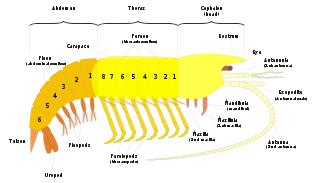
In invertebrate biology, a tagma is a specialized grouping of arthropod segments, such as the head, the thorax, and the abdomen with a common function. The segments of a tagma may be either fused or moveable.-Tagmata:...
of various arthropod
Arthropod
An arthropod is an invertebrate animal having an exoskeleton , a segmented body, and jointed appendages. Arthropods are members of the phylum Arthropoda , and include the insects, arachnids, crustaceans, and others...
s, comprising the head and the thorax fused together, as distinct from the abdomen
Abdomen
In vertebrates such as mammals the abdomen constitutes the part of the body between the thorax and pelvis. The region enclosed by the abdomen is termed the abdominal cavity...
behind. (The terms prosoma and opisthosoma are equivalent to cephalothorax and abdomen in some groups.) The word cephalothorax is derived from the Greek
Greek language
Greek is an independent branch of the Indo-European family of languages. Native to the southern Balkans, it has the longest documented history of any Indo-European language, spanning 34 centuries of written records. Its writing system has been the Greek alphabet for the majority of its history;...
words for head and thorax . This fusion of the head and thorax is seen in chelicerates
Chelicerata
The subphylum Chelicerata constitutes one of the major subdivisions of the phylum Arthropoda, and includes horseshoe crabs, scorpions, spiders and mites...
and crustacean
Crustacean
Crustaceans form a very large group of arthropods, usually treated as a subphylum, which includes such familiar animals as crabs, lobsters, crayfish, shrimp, krill and barnacles. The 50,000 described species range in size from Stygotantulus stocki at , to the Japanese spider crab with a leg span...
s; in other groups, such as the Hexapoda
Hexapoda
The subphylum Hexapoda constitutes the largest grouping of arthropods and includes the insects as well as three much smaller groups of wingless arthropods: Collembola, Protura, and Diplura . The Collembola are very abundant in terrestrial environments...
(including insect
Insect
Insects are a class of living creatures within the arthropods that have a chitinous exoskeleton, a three-part body , three pairs of jointed legs, compound eyes, and two antennae...
s), the head remains free of the thorax. In horseshoe crab
Horseshoe crab
The Atlantic horseshoe crab, Limulus polyphemus, is a marine chelicerate arthropod. Despite its name, it is more closely related to spiders, ticks, and scorpions than to crabs. Horseshoe crabs are most commonly found in the Gulf of Mexico and along the northern Atlantic coast of North America...
s and many crustacean
Crustacean
Crustaceans form a very large group of arthropods, usually treated as a subphylum, which includes such familiar animals as crabs, lobsters, crayfish, shrimp, krill and barnacles. The 50,000 described species range in size from Stygotantulus stocki at , to the Japanese spider crab with a leg span...
s, a hard shell called the carapace
Carapace
A carapace is a dorsal section of the exoskeleton or shell in a number of animal groups, including arthropods such as crustaceans and arachnids, as well as vertebrates such as turtles and tortoises. In turtles and tortoises, the underside is called the plastron.-Crustaceans:In crustaceans, the...
covers the cephalothorax.