


Book lung

Encyclopedia
Respiration organ
Respiratory organs are used by most, or all, animals to exchange the gases necessary for their life function known as respiration...
used for atmospheric gas exchange and is found in arachnid
Arachnid
Arachnids are a class of joint-legged invertebrate animals in the subphylum Chelicerata. All arachnids have eight legs, although in some species the front pair may convert to a sensory function. The term is derived from the Greek words , meaning "spider".Almost all extant arachnids are terrestrial...
s, such as scorpion
Scorpion
Scorpions are predatory arthropod animals of the order Scorpiones within the class Arachnida. They have eight legs and are easily recognized by the pair of grasping claws and the narrow, segmented tail, often carried in a characteristic forward curve over the back, ending with a venomous stinger...
s and spider
Spider
Spiders are air-breathing arthropods that have eight legs, and chelicerae with fangs that inject venom. They are the largest order of arachnids and rank seventh in total species diversity among all other groups of organisms...
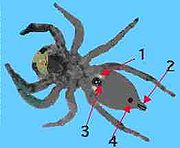
s. Each of these organs is found inside a ventral abdominal cavity and connects with the surroundings through a small opening. Book lungs are not related to the lungs of modern land-dwelling vertebrate
Vertebrate
Vertebrates are animals that are members of the subphylum Vertebrata . Vertebrates are the largest group of chordates, with currently about 58,000 species described. Vertebrates include the jawless fishes, bony fishes, sharks and rays, amphibians, reptiles, mammals, and birds...
s. Their name describes their structure. Stacks of alternating air pockets and hemolymph-filled tissue give them an appearance similar to a "folded" book. Their number varies from just one pair in most spiders to four pairs in scorpions. Sometimes the book lungs can be absent and the gas exchange is performed by the thin walls inside the cavity instead, with its surface area increased by branching into the body as thin tubes called trachea
Invertebrate trachea
The invertebrate trachea refers to the open respiratory system composed of spiracles, tracheae, and tracheoles that terrestrial arthropods have to transport metabolic gases to and from tissues....
e. It is possible that the tracheae have evolved directly from the book lungs, because in some spiders the tracheae have a small number of greatly elongated chambers. Many arachnid
Arachnid
Arachnids are a class of joint-legged invertebrate animals in the subphylum Chelicerata. All arachnids have eight legs, although in some species the front pair may convert to a sensory function. The term is derived from the Greek words , meaning "spider".Almost all extant arachnids are terrestrial...
s, like mite
Mite
Mites, along with ticks, are small arthropods belonging to the subclass Acari and the class Arachnida. The scientific discipline devoted to the study of ticks and mites is called acarology.-Diversity and systematics:...
s and harvestmen (Opiliones
Opiliones
Opiliones are an order of arachnids commonly known as harvestmen. , over 6,400 species of harvestmen have been discovered worldwide, although the real number of extant species may exceed 10,000. The order Opiliones can be divided into four suborders: Cyphophthalmi, Eupnoi, Dyspnoi and Laniatores...
), have no traces of book lungs and breathe through tracheae or through their body surface only.
The unfolded "pages" (plates) of the book lung are filled with hemolymph
Hemolymph
Hemolymph, or haemolymph, is a fluid in the circulatory system of some arthropods and is analogous to the fluids and cells making up both blood and interstitial fluid in vertebrates such as birds and mammals...
(the arthropod
Arthropod
An arthropod is an invertebrate animal having an exoskeleton , a segmented body, and jointed appendages. Arthropods are members of the phylum Arthropoda , and include the insects, arachnids, crustaceans, and others...
blood
Blood
Blood is a specialized bodily fluid in animals that delivers necessary substances such as nutrients and oxygen to the cells and transports metabolic waste products away from those same cells....
). The folds maximize the surface exposed to air, and thereby maximize the amount of gas
Gas
Gas is one of the three classical states of matter . Near absolute zero, a substance exists as a solid. As heat is added to this substance it melts into a liquid at its melting point , boils into a gas at its boiling point, and if heated high enough would enter a plasma state in which the electrons...
exchanged with the environment. In most species
Species
In biology, a species is one of the basic units of biological classification and a taxonomic rank. A species is often defined as a group of organisms capable of interbreeding and producing fertile offspring. While in many cases this definition is adequate, more precise or differing measures are...
, no motion of the plates is required to facilitate this kind of respiration
Respiration (physiology)
'In physiology, respiration is defined as the transport of oxygen from the outside air to the cells within tissues, and the transport of carbon dioxide in the opposite direction...
.
The oldest book lungs have been recovered from extinct trigonotarbid arachnids preserved in the 410-million-year-old Rhynie chert
Rhynie chert
The Rhynie chert is an Early Devonian sedimentary deposit exhibiting extraordinary fossil detail or completeness . It is exposed near the village of Rhynie, Aberdeenshire, Scotland; a second unit, the Windyfield chert, is located some 700 m away...
of Scotland. These Devonian
Devonian
The Devonian is a geologic period and system of the Paleozoic Era spanning from the end of the Silurian Period, about 416.0 ± 2.8 Mya , to the beginning of the Carboniferous Period, about 359.2 ± 2.5 Mya...
fossil lungs are almost indistinguishable from the lungs of modern arachnids.
The absence or presence of book lungs divides the Arachnida into two main groups, the pulmonate arachnids (book lungs present; scorpion
Scorpion
Scorpions are predatory arthropod animals of the order Scorpiones within the class Arachnida. They have eight legs and are easily recognized by the pair of grasping claws and the narrow, segmented tail, often carried in a characteristic forward curve over the back, ending with a venomous stinger...
s and the Tetrapulmonata
Tetrapulmonata
Tetrapulmonata is a non-ranked supra-ordinal group of arachnids. It is composed of Thelyphonida, Schizomida, Amblypygi and Araneae.-Etymology:...
; whip scorpions, Schizomida, Amblypygi, and spider
Spider
Spiders are air-breathing arthropods that have eight legs, and chelicerae with fangs that inject venom. They are the largest order of arachnids and rank seventh in total species diversity among all other groups of organisms...
s), and the apulmonate arachnids (book lungs absent; microwhip scorpions, harvestmen, Acarina
Acarina
Acari are a taxon of arachnids that contains mites and ticks. The diversity of the Acari is extraordinary and its fossil history goes back to at least the early Devonian period. As a result, acarologists have proposed a complex set of taxonomic ranks to classify mites...
, pseudoscorpion
Pseudoscorpion
A pseudoscorpion, , is an arachnid belonging to the order Pseudoscorpionida, also known as Pseudoscorpiones or Chelonethida....
s, Ricinulei
Ricinulei
The Order Ricinulei is a group of arachnids known as hooded tickspiders. In older works they are sometimes referred to as Podogona., 60 extant species of ricinuleids have been described worldwide, all in the single family Ricinoididae. They occur today in west-central Africa and the Neotropical...
and sunspiders
Solifugae
Solifugae are an order of Arachnida, known as camel spiders, wind scorpions and sun spiders or solifuges, comprising more than 1,000 described species in about 153 genera...
). One of the long-running controversies in arachnid evolution is whether the book lung evolved once in the arachnid common ancestor, or whether it evolved in multiple groups of arachnids in parallel as they came onto land.
Book gills

Gill
A gill is a respiratory organ found in many aquatic organisms that extracts dissolved oxygen from water, afterward excreting carbon dioxide. The gills of some species such as hermit crabs have adapted to allow respiration on land provided they are kept moist...
s. Although they have a similar book-like structure, they are found in different locations. Book gills are found externally while book lungs are found internally. Book gills are still found in horseshoe crab
Horseshoe crab
The Atlantic horseshoe crab, Limulus polyphemus, is a marine chelicerate arthropod. Despite its name, it is more closely related to spiders, ticks, and scorpions than to crabs. Horseshoe crabs are most commonly found in the Gulf of Mexico and along the northern Atlantic coast of North America...
s which have five pairs of them, the flap in front of them being the genital operculum which lacks gills. Book gills are flap-like appendages that effect gas exchange within water and seem to have their origin as modified legs. On the inside of each appendage there are attached over 100 thin leaf-like membranes called lamellae which appear as pages in a book, and are the areas of the gill where gas exchange takes place. These appendages move with rhythmic movements to drive blood in and out of the lamellae and to circulate water over them. Respiration being their main purpose, they can also be used for swimming in young individuals. If they are kept moist, the horseshoe crab can live on land for many hours.