


Opisthosoma

Encyclopedia
Arthropod
An arthropod is an invertebrate animal having an exoskeleton , a segmented body, and jointed appendages. Arthropods are members of the phylum Arthropoda , and include the insects, arachnids, crustaceans, and others...
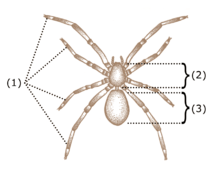
s, behind the prosoma (cephalothorax). It is a distinctive feature of the subphylum Chelicerata
Chelicerata
The subphylum Chelicerata constitutes one of the major subdivisions of the phylum Arthropoda, and includes horseshoe crabs, scorpions, spiders and mites...
(arachnid
Arachnid
Arachnids are a class of joint-legged invertebrate animals in the subphylum Chelicerata. All arachnids have eight legs, although in some species the front pair may convert to a sensory function. The term is derived from the Greek words , meaning "spider".Almost all extant arachnids are terrestrial...
s, horseshoe crab
Horseshoe crab
The Atlantic horseshoe crab, Limulus polyphemus, is a marine chelicerate arthropod. Despite its name, it is more closely related to spiders, ticks, and scorpions than to crabs. Horseshoe crabs are most commonly found in the Gulf of Mexico and along the northern Atlantic coast of North America...
s and others). Although it is similar in most respects to an abdomen
Abdomen
In vertebrates such as mammals the abdomen constitutes the part of the body between the thorax and pelvis. The region enclosed by the abdomen is termed the abdominal cavity...
(and is often referred to as such), the opisthosoma is differentiated by its inclusion of the respiratory organs book lungs and the heart
Heart
The heart is a myogenic muscular organ found in all animals with a circulatory system , that is responsible for pumping blood throughout the blood vessels by repeated, rhythmic contractions...
.
Segments
The number of segments and appendages on the opisthosoma vary. ScorpionScorpion
Scorpions are predatory arthropod animals of the order Scorpiones within the class Arachnida. They have eight legs and are easily recognized by the pair of grasping claws and the narrow, segmented tail, often carried in a characteristic forward curve over the back, ending with a venomous stinger...
s have 13, but the first is only seen during its embryological development. Other arachnids have fewer; harvestmen
Opiliones
Opiliones are an order of arachnids commonly known as harvestmen. , over 6,400 species of harvestmen have been discovered worldwide, although the real number of extant species may exceed 10,000. The order Opiliones can be divided into four suborders: Cyphophthalmi, Eupnoi, Dyspnoi and Laniatores...
, for instance, have only ten. In general, appendages are absent or reduced, although in horseshoe crab
Horseshoe crab
The Atlantic horseshoe crab, Limulus polyphemus, is a marine chelicerate arthropod. Despite its name, it is more closely related to spiders, ticks, and scorpions than to crabs. Horseshoe crabs are most commonly found in the Gulf of Mexico and along the northern Atlantic coast of North America...
s they persist as large plate-like limbs, called opercula or branchiophores, bearing the book gills, and that function in locomotion and gas exchange. In most chelicerates
Chelicerata
The subphylum Chelicerata constitutes one of the major subdivisions of the phylum Arthropoda, and includes horseshoe crabs, scorpions, spiders and mites...
the opisthosomal limbs are greatly reduced and persist only as specialized structures, such as the silk-producing spinnerets of spider
Spider
Spiders are air-breathing arthropods that have eight legs, and chelicerae with fangs that inject venom. They are the largest order of arachnids and rank seventh in total species diversity among all other groups of organisms...
s or the pectines of scorpions. In animals like whip scorpions and whip spiders the first two 'sternites' bearing the book lung
Book lung
A book lung is a type of respiration organ used for atmospheric gas exchange and is found in arachnids, such as scorpions and spiders. Each of these organs is found inside a ventral abdominal cavity and connects with the surroundings through a small opening. Book lungs are not related to the lungs...
s may actually be highly modified opisthosomal limbs.