


Signage

Encyclopedia

Wayfinding
Wayfinding encompasses all of the ways in which people and animals orient themselves in physical space and navigate from place to place.-Historical:...
information in places such as streets or inside/outside of buildings.
History
French language
French is a Romance language spoken as a first language in France, the Romandy region in Switzerland, Wallonia and Brussels in Belgium, Monaco, the regions of Quebec and Acadia in Canada, and by various communities elsewhere. Second-language speakers of French are distributed throughout many parts...
enseigne indicates its essential connection with what is known in English
English language
English is a West Germanic language that arose in the Anglo-Saxon kingdoms of England and spread into what was to become south-east Scotland under the influence of the Anglian medieval kingdom of Northumbria...
as a flag
Flag
A flag is a piece of fabric with a distinctive design that is usually rectangular and used as a symbol, as a signaling device, or decoration. The term flag is also used to refer to the graphic design employed by a flag, or to its depiction in another medium.The first flags were used to assist...
and in France
France
The French Republic , The French Republic , The French Republic , (commonly known as France , is a unitary semi-presidential republic in Western Europe with several overseas territories and islands located on other continents and in the Indian, Pacific, and Atlantic oceans. Metropolitan France...
banners not infrequently took the place of signs or sign boards in the Middle Ages
Middle Ages
The Middle Ages is a periodization of European history from the 5th century to the 15th century. The Middle Ages follows the fall of the Western Roman Empire in 476 and precedes the Early Modern Era. It is the middle period of a three-period division of Western history: Classic, Medieval and Modern...
. Signs, however, are best known in the form of painted or carved advertisements for shops, inns, etc. They are one of various emblematic methods used from time immemorial for publicly calling attention to the place to which they refer.
The ancient Egyptians and Romans were known to use signs. In ancient Rome
Ancient Rome
Ancient Rome was a thriving civilization that grew on the Italian Peninsula as early as the 8th century BC. Located along the Mediterranean Sea and centered on the city of Rome, it expanded to one of the largest empires in the ancient world....
, signboards were usually made from stone
Rock (geology)
In geology, rock or stone is a naturally occurring solid aggregate of minerals and/or mineraloids.The Earth's outer solid layer, the lithosphere, is made of rock. In general rocks are of three types, namely, igneous, sedimentary, and metamorphic...
or terracotta. and Greeks are known to have used signs, and many Roman examples are preserved, among them the widely-recognized bush to indicate a tavern, from which is derived the proverb "Good wine needs no bush". In some cases, such as the bush, or the three balls of pawnbroker
Pawnbroker
A pawnbroker is an individual or business that offers secured loans to people, with items of personal property used as collateral...
s, certain signs became identified with certain trades and some of these later evolved into trademarks. Other signs can be grouped according to their various origins. Thus, at an early period the cross
Christian cross
The Christian cross, seen as a representation of the instrument of the crucifixion of Jesus Christ, is the best-known religious symbol of Christianity...
or other sign of a religious character was used to attract Christian
Christian
A Christian is a person who adheres to Christianity, an Abrahamic, monotheistic religion based on the life and teachings of Jesus of Nazareth as recorded in the Canonical gospels and the letters of the New Testament...
s, whereas the sign of the sun or the moon would serve the same purpose for pagan
Paganism
Paganism is a blanket term, typically used to refer to non-Abrahamic, indigenous polytheistic religious traditions....
s.
In 1389 King Richard III of England
Richard III of England
Richard III was King of England for two years, from 1483 until his death in 1485 during the Battle of Bosworth Field. He was the last king of the House of York and the last of the Plantagenet dynasty...
compelled landlord
Landlord
A landlord is the owner of a house, apartment, condominium, or real estate which is rented or leased to an individual or business, who is called a tenant . When a juristic person is in this position, the term landlord is used. Other terms include lessor and owner...
s to erect signs outside their premises. The legislation stated "Whosoever shall brew ale in the town with intention of selling it must hang out a sign, otherwise he shall forfeit his ale
Ale
Ale is a type of beer brewed from malted barley using a warm fermentation with a strain of brewers' yeast. The yeast will ferment the beer quickly, giving it a sweet, full bodied and fruity taste...
." This was in order make them easily visible to passing inspectors of the quality of the ale they provided (during this period, drinking water
Drinking water
Drinking water or potable water is water pure enough to be consumed or used with low risk of immediate or long term harm. In most developed countries, the water supplied to households, commerce and industry is all of drinking water standard, even though only a very small proportion is actually...
was not always good to drink and ale was the usual replacement). Later, the adaptation of the coats of arms
Coat of arms
A coat of arms is a unique heraldic design on a shield or escutcheon or on a surcoat or tabard used to cover and protect armour and to identify the wearer. Thus the term is often stated as "coat-armour", because it was anciently displayed on the front of a coat of cloth...
or badges of noble families became common. These would be described by the people without consideration of the language of heraldry
Heraldry
Heraldry is the profession, study, or art of creating, granting, and blazoning arms and ruling on questions of rank or protocol, as exercised by an officer of arms. Heraldry comes from Anglo-Norman herald, from the Germanic compound harja-waldaz, "army commander"...
, and thus such signs as the Red Lion, the Green Dragon, etc., have become familiar, especially as pub signs.
Large towns where many practiced the same trade, and especially, as was often the case, where these congregated mainly in the same street, simple signs of a trade signs did not provide sufficient distinction. Thus a variety of devices came into existence; sometimes the trader used a rebus
Rebus
A rebus is an allusional device that uses pictures to represent words or parts of words. It was a favourite form of heraldic expression used in the Middle Ages to denote surnames, for example in its basic form 3 salmon fish to denote the name "Salmon"...
on his own name (e.g. two cocks for the name of Cox); sometimes he adopted a figure of an animal or other object, or portrait of a well-known person, which he considered likely to attract attention. Other signs used the common association of two heterogeneous objects, which (apart from those representing a rebus) were in some cases merely a whimsical combination, but in others arose from a popular misconception of the sign itself (e.g. the combination of the leg and star may have originated in a representation of the insignia of the garter), or from corruption in popular speech (e.g. the combination goat and compasses is said by some to be a corruption of God encompasses).
Whereas the use of signs was generally optional, publicans were on a different footing from other traders in this respect. As early as the 14th century there was a law in England compelling them to exhibit signs, for in 1393 the prosecution of a publican for not doing so is recorded. In France edicts were directed to the same end in 1567 and 1577.
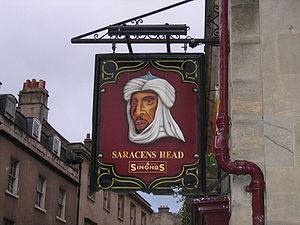
Since the object of sign boards was to attract the public, they were often of an elaborate character. Not only were the signs themselves large and sometimes of great artistic merit (especially in the 16th and 17th centuries, when they reached their greatest vogue) but the posts or metal supports protruding from the houses over the street, from which the signs were swung, were often elaborately worked, and many beautiful examples of wrought-iron supports survive both in England and continental Europe.
The signs were a prominent feature of the streets of London
London
London is the capital city of :England and the :United Kingdom, the largest metropolitan area in the United Kingdom, and the largest urban zone in the European Union by most measures. Located on the River Thames, London has been a major settlement for two millennia, its history going back to its...
at this period. But here and in other large towns they became a danger and a nuisance in the narrow ways. Already in 1669 a royal order had been directed in France against the excessive size of sign boards and their projection too far over the streets. In Paris in 1761 and in London about 1762-1773, laws were introduced which gradually compelled sign boards to be removed or fixed flat against the wall.
For the most part they only survived in connection with inns, for which some of the greatest artists of the time painted sign boards, usually representing the name of the inn. With the gradual abolition of sign boards, the numbering of houses began to be introduced in the early 18th century in London. It had been attempted in Paris as early as 1512, and had become almost universal by the close of the 18th century, though not enforced until 1805. Another important factor was that during the Middle Ages
Middle Ages
The Middle Ages is a periodization of European history from the 5th century to the 15th century. The Middle Ages follows the fall of the Western Roman Empire in 476 and precedes the Early Modern Era. It is the middle period of a three-period division of Western history: Classic, Medieval and Modern...
a large percentage of the population would have been illiterate and so pictures were more useful than words as a means of identifying a public house
Public house
A public house, informally known as a pub, is a drinking establishment fundamental to the culture of Britain, Ireland, Australia and New Zealand. There are approximately 53,500 public houses in the United Kingdom. This number has been declining every year, so that nearly half of the smaller...
. For this reason there was often no reason to write the establishment's name on the sign and inns opened without a formal written name—the name being derived later from the illustration on the public house's sign. In this sense, a pub
Public house
A public house, informally known as a pub, is a drinking establishment fundamental to the culture of Britain, Ireland, Australia and New Zealand. There are approximately 53,500 public houses in the United Kingdom. This number has been declining every year, so that nearly half of the smaller...
sign can be thought of as an early example of visual branding.
During the 19th century, some artists specialized in the painting of signboards, such as the Austro-Hungarian artist Demeter Laccataris
Demeter Laccataris
Demeter Laccataris was an Austro-Hungarian portrait painter of Greek origin. Born in Vienna, he studied at Debrecen and Vienna. He was based at Pest from around 1835 and painted portraits and altarpieces. He painted signboards as well...
. Pending this development, houses which carried on trade at night (e.g. coffee houses, brothel
Brothel
Brothels are business establishments where patrons can engage in sexual activities with prostitutes. Brothels are known under a variety of names, including bordello, cathouse, knocking shop, whorehouse, strumpet house, sporting house, house of ill repute, house of prostitution, and bawdy house...
s, etc.) had various specific arrangements of lights, and these still survive to some extent, as in the case of doctors dispensaries and chemists shops.
Currently, with a 100+ year history, the best known sign in the world is located at One Times Square, New York City and has been featured in countless movies and is the site for the famous New Year's Eve balloon-drop ceremonies. The home of the modern news zipper.
Statutory signage
In signage a pictogram is the image used to convey the message of the sign. In statutory signage pictograms follow a very specific set of colour, shape and sizing rules. In UK and EU signs the width of a sign's pictogram is set at 80% the height of the area it is printed to. In the US, a pictogram that identifies a room or space (such as the gender pictogram on a restroom signs), must follow specific rules. Other pictograms that must comply with rules are the four "Symbols of Accessibility" specified in the ADA Accessibility Guidelines. See the article *ADA SignsADA Signs
The term "ADA Signs" has come into common use in the architectural, construction and signage industries with the advent of the Americans With Disabilities Act, or ADA. Unfortunately, it's a misunderstood term. Most people think it's synonymous with braille signs...
.
For example :
On an A4 Portrait UK / EU statutory sign (210 x 297 mm) using 2/3s of its area to display the pictogram 210 w x 198 H (mm) and 1/3 for its text display, the pictogram would be 158.4 mm wide. (80% of 198 mm).
In the US, the pictogram described above would have to be located within a 6 inches (152.4 mm) clear field, with raised characters and braille located beneath the field.
For a pictogram to work it must be instantly recognizable and understood by all. For this to work the image must be kept consistent. In its purest form a pictogram on a sign should be understood even if there is no text present. Following the standard color and shape rules increase the likelihood of a universally understood pictogram and therefore sign.
According to the book "Discovery-Based Retail," signage falls into three groups: decorative, adding eye-pleasing color; informational; or directional, providing guidance.
Function of signage
The main purpose of signage is communication, to convey information such that its receiver can make cognitive decisions based on the information provided. In general, signage can be classified into the following functions:(a)Information: signs giving information about services and facilities, e.g., maps, directories, instructions for use, etc.
(b)Direction: signs leading to services, facilities, functional spaces and key areas, e.g., sign posts, directional arrows, etc.
(c)Identification: signs indicating services and facilities, e.g., room names & numbers, toilet signs, number of floors, etc.
(d)Safety and Regulatory: signs giving warning or safety instructions, e.g., warning signs, traffic signs, exit signs, rules & regulations, etc.
Use of shape
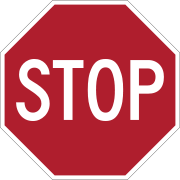
Rectangular signs are used to portray information to an audience. This is found in safe condition signs, public information signs, and fire equipment signs. These signs provide information to an audience. They tell where something is, what something is, and similar information.
In contrast, a circular sign is an instruction that must be followed. Both the mandatory and the prohibition signs provide instructions that cannot be ignored.
WDWQD
Finally, there is the triangle or the warning sign. This is used to convey danger. It can also provide information but its primary purpose it to quickly tell you to be aware and careful.
Sign technologies
Types of signage:- Street signage - signs stamped out of metal with lettering embossed or printed (or both).
- Neon signNeon signNeon signs are made using electrified, luminous tube lights that contain rarefied neon or other gases. They are the most common use for neon lighting, which was first demonstrated in a modern form in December, 1910 by Georges Claude at the Paris Motor Show. While they are used worldwide, neon signs...
age - Electric lighting - Modular signage - A signage system that consists of pre designed elementary units.
- Custom-made signCustom-made signCustom-made signage includes all kinds of signs that are built from scratch to suit a specific requirement presented by a client or a specific project. Custom made signage is not a part of a signage system and therefore it doesn’t consist of pre designed elementary catalogues units. Custom made...
age - Signs that are built from scratch to suit a specific requirement presented by a client or a specific project. - MCFTMCFTModular Curved Frame Technology is a modular manufactured sign system that utilizes pre-manufactured curved frames to connect a variety of graphic and material components parts utilizing tension as a locking mechanism...
(Modular Curved Frame Technology) — A contemporary fusion between custom-made signage and modular sign systems that features a curved profile. - LEDLEdLEd is a TeX/LaTeX editing software working under Microsoft Windows. It is a freeware product....
sign (light-emitting diodes technology) — LED lighting - Architectural Signage/Wayfinding Systems - A unified system of signs for a single facility that aid in wayfinding and identification of specific destinations within the facility. Signs include building and room identification signs, directional and informational signs and regulatory signs. In the US, all such systems must comply with the ADA.
- Aircraft smoke-formed signSkywritingSkywriting is the process of using a small aircraft, able to expel special smoke during flight, to fly in certain patterns to create writing readable by someone on the ground...
(Skywriting) - Aircraft towed sign
- BannerBannerA banner is a flag or other piece of cloth bearing a symbol, logo, slogan or other message. Banner-making is an ancient craft.The word derives from late Latin bandum, a cloth out of which a flag is made...
sign - BillboardBillboard (advertising)A billboard is a large outdoor advertising structure , typically found in high traffic areas such as alongside busy roads. Billboards present large advertisements to passing pedestrians and drivers...
- Painted-blimpBlimpA blimp, or non-rigid airship, is a floating airship without an internal supporting framework or keel. A non-rigid airship differs from a semi-rigid airship and a rigid airship in that it does not have any rigid structure, neither a complete framework nor a partial keel, to help the airbag...
signage - Channel lettersChannel lettersChannel letters are custom-made metal or plastic letters that are commonly used on the buildings of business, churches, and other organizations for exterior signage.-Standard channel letter:...
sign - Complex outdoor sign, neon and lettering
- Complex outdoor sign, sheet metal with lettering
- ConcreteConcreteConcrete is a composite construction material, composed of cement and other cementitious materials such as fly ash and slag cement, aggregate , water and chemical admixtures.The word concrete comes from the Latin word...
and CementCementIn the most general sense of the word, a cement is a binder, a substance that sets and hardens independently, and can bind other materials together. The word "cement" traces to the Romans, who used the term opus caementicium to describe masonry resembling modern concrete that was made from crushed...
sign, reversed impression lettering - Digital signageDigital signageDigital signage is a form of electronic display that shows television programming, menus, information, advertising and other messages. Digital signs can be found in public and private environments, such as retail stores, hotels, restaurants and corporate buildings.Digital signage Displays are most...
on LCD, Plasma, LED or similar forms of display - Distributor advertising sign, metal, lettered
- Distributor advertising sign, neon
- Exterior wall sign, lettered
- FoamPolystyrenePolystyrene ) also known as Thermocole, abbreviated following ISO Standard PS, is an aromatic polymer made from the monomer styrene, a liquid hydrocarbon that is manufactured from petroleum by the chemical industry...
sign, lettered - Handheld sign
- Hanging sign, lettered
- Hanging sign, multi-listing
- Interior wall sign, lettered
- Lettering on glass
- Lettering on glass with goldleafMetal leafMetal leaf, also called composition leaf or schlagmetal, is a thin foil used for decoration. Metal leaf can come in many different shades. Some metal leaf may look like gold leaf but not contain any real gold...
- Lettering on vehicle side(s)
- Magnetic sign, industrial equipment, heavy equipment, and vehicles
- MetalMetalA metal , is an element, compound, or alloy that is a good conductor of both electricity and heat. Metals are usually malleable and shiny, that is they reflect most of incident light...
sign, box, cast, channel letteredChannel lettersChannel letters are custom-made metal or plastic letters that are commonly used on the buildings of business, churches, and other organizations for exterior signage.-Standard channel letter:...
, engravedEngravingEngraving is the practice of incising a design on to a hard, usually flat surface, by cutting grooves into it. The result may be a decorated object in itself, as when silver, gold, steel, or glass are engraved, or may provide an intaglio printing plate, of copper or another metal, for printing... - MuralMuralA mural is any piece of artwork painted or applied directly on a wall, ceiling or other large permanent surface. A particularly distinguishing characteristic of mural painting is that the architectural elements of the given space are harmoniously incorporated into the picture.-History:Murals of...
sign - Oilcloth sign, lettered (similar to banner)
- Painted signSign paintingSign painting is the act of taking a specific kind of brush, and with various kinds of paint, and applying it to a 2 or 3 dimensional surfaces creating letters, forms and/or symbols....
- Paper sign, lettered
- Plastic sign, lettered or engraved on Acrylic, HDPE, High Density PolyurethanePolyurethaneA polyurethane is any polymer composed of a chain of organic units joined by carbamate links. Polyurethane polymers are formed through step-growth polymerization, by reacting a monomer with another monomer in the presence of a catalyst.Polyurethanes are...
, PVCPolyvinyl chloridePolyvinyl chloride, commonly abbreviated PVC, is a thermoplastic polymer. It is a vinyl polymer constructed of repeating vinyl groups having one hydrogen replaced by chloride. Polyvinyl chloride is the third most widely produced plastic, after polyethylene and polypropylene. PVC is widely used in...
, PolycarbonatePolycarbonatePolycarbonatePhysical PropertiesDensity 1.20–1.22 g/cm3Abbe number 34.0Refractive index 1.584–1.586FlammabilityV0-V2Limiting oxygen index25–27%Water absorption – Equilibrium0.16–0.35%Water absorption – over 24 hours0.1%...
, PolypropylenePolypropylenePolypropylene , also known as polypropene, is a thermoplastic polymer used in a wide variety of applications including packaging, textiles , stationery, plastic parts and reusable containers of various types, laboratory equipment, loudspeakers, automotive components, and polymer banknotes...
, Styrene, and other thermoplasticsThermoplasticThermoplastic, also known as a thermosoftening plastic, is a polymer that turns to a liquid when heated and freezes to a very glassy state when cooled sufficiently... - Poster (PrintmakingPrintmakingPrintmaking is the process of making artworks by printing, normally on paper. Printmaking normally covers only the process of creating prints with an element of originality, rather than just being a photographic reproduction of a painting. Except in the case of monotyping, the process is capable...
) - Proprietor sign
- Proprietor sign, hanging
- Rooftop sign
- Sample sign
- Showcard sign, lettered
- Silk screen processed signScreen-printingScreen printing is a printing technique that uses a woven mesh to support an ink-blocking stencil. The attached stencil forms open areas of mesh that transfer ink or other printable materials which can be pressed through the mesh as a sharp-edged image onto a substrate...
- Vacuum formedVacuum formingVacuum forming, commonly known as vacuuforming, is a simplified version of thermoforming, whereby a sheet of plastic is heated to a forming temperature, stretched onto or into a single-surface mold , and held against the mold by applying vacuum between the mold surface and the sheet.The vacuum...
sign - Vinyl sticker lettering
- Wood sign, dimensional: engravedEngravingEngraving is the practice of incising a design on to a hard, usually flat surface, by cutting grooves into it. The result may be a decorated object in itself, as when silver, gold, steel, or glass are engraved, or may provide an intaglio printing plate, of copper or another metal, for printing...
, carvedWood carvingWood carving is a form of working wood by means of a cutting tool in one hand or a chisel by two hands or with one hand on a chisel and one hand on a mallet, resulting in a wooden figure or figurine, or in the sculptural ornamentation of a wooden object...
, or sandblastedAbrasive blastingAbrasive blasting is the operation of forcibly propelling a stream of abrasive material against a surface under high pressure to smooth a rough surface, roughen a smooth surface, shape a surface, or remove surface contaminants. A pressurized fluid, typically air, or a centrifugal wheel is used to... - Wood sign, MDOMedium density overlay panelMedium density overlay panel, or MDO panel, is a paintable surface made of plywood with a weather-resistant resin overlay bonded to the wood by heat and pressure.The overlay, which has 28% resin content, resists water, weather, wear and degradation....
panel lettered or paintedSign paintingSign painting is the act of taking a specific kind of brush, and with various kinds of paint, and applying it to a 2 or 3 dimensional surfaces creating letters, forms and/or symbols.... - Yard sign or Lawn signLawn signLawn signs are used for local advertising. They can be used by business such as real estate and are popular in election campaigns in some countries. They are small signs that can be placed on the property of a business or on the lawns of a candidate's supporters...
, real estateReal estateIn general use, esp. North American, 'real estate' is taken to mean "Property consisting of land and the buildings on it, along with its natural resources such as crops, minerals, or water; immovable property of this nature; an interest vested in this; an item of real property; buildings or...
or political
Neon signs
Neon signs, introduced at the 1910 Paris Expo, are produced by the craft of bending glassGlass
Glass is an amorphous solid material. Glasses are typically brittle and optically transparent.The most familiar type of glass, used for centuries in windows and drinking vessels, is soda-lime glass, composed of about 75% silica plus Na2O, CaO, and several minor additives...
tubing into shapes. A worker skilled in this craft is known as a glass bender, neon or tube bender.
See also
- ADA SignsADA SignsThe term "ADA Signs" has come into common use in the architectural, construction and signage industries with the advent of the Americans With Disabilities Act, or ADA. Unfortunately, it's a misunderstood term. Most people think it's synonymous with braille signs...
- Brand implementationBrand implementationBrand implementation refers to the physical representation and consistent application of brand identity across visual and verbal identity carriers. In visual terms, this can include signage, uniforms, liveries, interior design and branded merchandise...
- Channel lettersChannel lettersChannel letters are custom-made metal or plastic letters that are commonly used on the buildings of business, churches, and other organizations for exterior signage.-Standard channel letter:...
- Commercial signage
- Information signInformation signAn information sign is a very legibly printed and very noticeable placard that informs people of the purpose of an object, or gives them instruction on the use of something. An example is a traffic sign such as a stop sign....
- Signboard
External links
- Reading Signs in English - Interesting Things for ESL Students.
* Function of signage