
All Topics  
Screen-printing

 
Screen Printing

   Email Print
   Bookmark   Link


Screen-printing


Screen printing 1. A printing technique that uses a woven
Woven

A woven is a cloth formed by weaving. It only stretches in the bias directions , unless the threads are elastic. Woven cloth usually frays at the edges, unless measures are taken to counter this, such as the use of pinking shears or hemming....
 mesh
Mesh

Mesh consists of semi-permeable barrier made of connected strands of metal, fiber, or other flexible/ductile material. Mesh is similar to spider web or Net in that it has many attached or woven strands....
 to support an ink blocking stencil
Stencil

A stencil is a wikt:template used to drawing or painting identical Letter , symbols, shapes, or patterns every time it is used. Stencil technique in visual art is also referred to as pochoir....
. The attached stencil forms open areas of mesh that transfer ink as a sharp-edged image onto a substrate
Substrate (materials science)

Substrate is a term used in materials science to describe the base material on which processing is conducted to produce new film or layers of material such as deposited coatings....
. A roller
Roller

The rollers are an Old World family of near passerine birds, related to the kingfishers and bee-eaters. The group gets its name from the aerial acrobatics some of these birds perform during courtship or territorial flights....
 or squeegee
Squeegee

A squeegee or squilgee is an onomatopoeia-named tool with a flat, smooth rubber blade, used to remove or control the flow of liquid on a flat surface....
 is moved across the screen stencil forcing or pumping ink past the threads of the woven mesh in the open areas. 2. A stencil method of print making in which a design is imposed on a screen of silk or other fine mesh, with blank areas coated with an impermeable substance, and ink is forced through the mesh onto the printing surface.


Discussion
Ask a question about 'Screen-printing'
Start a new discussion about 'Screen-printing'
Answer questions from other users
Full Discussion Forum


Encyclopedia


Screen printing 1. A printing technique that uses a woven
Woven

A woven is a cloth formed by weaving. It only stretches in the bias directions , unless the threads are elastic. Woven cloth usually frays at the edges, unless measures are taken to counter this, such as the use of pinking shears or hemming....
 mesh
Mesh

Mesh consists of semi-permeable barrier made of connected strands of metal, fiber, or other flexible/ductile material. Mesh is similar to spider web or Net in that it has many attached or woven strands....
 to support an ink blocking stencil
Stencil

A stencil is a wikt:template used to drawing or painting identical Letter , symbols, shapes, or patterns every time it is used. Stencil technique in visual art is also referred to as pochoir....
. The attached stencil forms open areas of mesh that transfer ink as a sharp-edged image onto a substrate
Substrate (materials science)

Substrate is a term used in materials science to describe the base material on which processing is conducted to produce new film or layers of material such as deposited coatings....
. A roller
Roller

The rollers are an Old World family of near passerine birds, related to the kingfishers and bee-eaters. The group gets its name from the aerial acrobatics some of these birds perform during courtship or territorial flights....
 or squeegee
Squeegee

A squeegee or squilgee is an onomatopoeia-named tool with a flat, smooth rubber blade, used to remove or control the flow of liquid on a flat surface....
 is moved across the screen stencil forcing or pumping ink past the threads of the woven mesh in the open areas. 2. A stencil method of print making in which a design is imposed on a screen of silk or other fine mesh, with blank areas coated with an impermeable substance, and ink is forced through the mesh onto the printing surface. Also known as Silk Screening or Serigraphy.

Taxonomy


There is considerable taxonomic, etymological, and semantic discussion about the process, and techniques known as Screen Printing, Screen-printing, Screenprinting, silkscreen, and serigraph. Much of the current confusion is based on the popular traditional reference to the process of screen printing as silkscreen printing. Almost no professional businesses, artists, or trade organizations use references to silk because of the general abandonment of silk as a viable mesh material after the 1960s.

Traditionally silk was used for screen-printing, that's where the name silk screening comes from. Now a polyester is used to do the printing.

Encyclopedia references, encyclopedias and trade publications also use an array of spellings for this process with the two most often encountered english spellings as, screenprinting spelled as a single undivided word, and the more popular two word title of screen printing without hyphenation.

History


Screen-printing first appeared in a recognizable form in China
China

China is a Culture of China, an ancient civilization, and, depending on perspective, a national or multinational entity extending over a large area in East Asia....
 during the Song Dynasty
Song Dynasty

The Song Dynasty was a ruling Chinese dynasty in China between 960–1279 AD; it succeeded the Five Dynasties and Ten Kingdoms Period, and was followed by the Yuan Dynasty....
 (960–1279 CE). Japan and other Asian countries adopted this method of printing and advanced the craft using it in conjunction with block printing and paints.

Screen-printing was introduced to Western Europe from Asia sometime in the late 1700s, but did not gain large acceptance or use in Europe until silk mesh was more available for trade from the east and a profitable outlet for the medium discovered.

Screen-printing was first patented in England by Samuel Simon in 1907. It was originally used as a popular method to print expensive wall paper, printed on linen, silk, and other fine fabrics. Western screen printers developed reclusive, defensive and exclusionary business policies intended to keep secret their workshops' knowledge and techniques.

Early in the 1910s, several printers experimenting with photo-reactive chemicals used the well-known actinic light
Actinic light

Actinic light is that light that causes change to be recorded on photographic medium. I.e that films or papers are sensitive to. An early definition from 1890 records it as :...
 activated cross linking or hardening traits of potassium, sodium or ammonium bichromate chemicals with glues and gelatin
Gelatin

Gelatin is a translucent, colorless, brittle, nearly tasteless solid, derived from the collagen inside animals' skin and mostly bones. It has been commonly used as a gelling agent in food, pharmaceutical, photography, and cosmetic manufacturing....
 compounds. Roy Beck, Charles Peter and Edward Owens studied and experimented with chromic acid salt sensitized emulsions for photo-reactive stencils. This trio of developers would prove to revolutionize the commercial screen printing industry by introducing photo-imaged stencils to the industry, the acceptance of this method would take many years. Commercial screen printing now uses sensitizers far safer and less toxic than bichromates, currently there are large selections of pre-sensitized and "user mixed" sensitized emulsion chemicals for creating photo-reactive stencils.

Joseph Ulano founded the industry chemical supplier Ulano and in 1928 created a method of applying a lacquer soluble stencil material to a removable base. This stencil material was cut into shapes, the print areas removed and the remaining material adhered to mesh to create a sharp edged screen stencil.

Originally a profitable industrial technology, screen printing was eventually adopted by artists as an expressive and conveniently repeatable medium for duplication well before the 1900s. It is currently popular both in fine arts and in commercial printing, where it is commonly used to print images on T-shirt
T-shirt

A T-shirt is a shirt which is pulled on over the head to cover most of a person's torso. A T-shirt is usually buttonless, collarless, and pocketless, with a round neck and short sleeves....
s, hat
Hat

A hat is a headcovering. It may be worn for protection against the elements, for religious reasons, for safety, or as a fashion accessory. In the past, hats were an indicator of social status....
s, CDs, DVD
DVD

DVD, also known as "Digital Versatile Disc" or "Digital Video Disc,"is a popular optical disc data storage device media format. Its main uses are video and data storage....
s, ceramics, glass, polyethylene, polypropylene, paper, metals, and wood.

A group of artists who later formed the National Serigraphic Society coined the word Serigraphy in the 1930s to differentiate the artistic application of screen printing from the industrial use of the process. "Serigraphy" is a combination word from the Latin word "Seri" (silk) and the Greek word "graphein" (to write or draw).

The Printer's National Environmental Assistance Center says "Screenprinting is arguably the most versatile of all printing processes." Since rudimentary screenprinting materials are so affordable and readily available, it has been used frequently in underground
Underground culture

An underground culture is a subculture that exists under the radar of mainstream massmedia and popular culture. It can be associated to a counterculture or an alternative culture, such as the underground culture that emerged along the hippie movement in the late 1960s and 1970s....
 settings and subcultures, and the non-professional look of such DIY culture
DIY culture

DIY culture is a broad term that refers to a wide range of elements in non-mainstream society, such as; grassroots political and social activism, Independent music, art and film....
 screenprints have become a significant cultural aesthetic seen on movie posters, record album covers, flyers, shirts, commercial fonts in advertising, and elsewhere.

History 1960s to present


Credit is generally given to the artist Andy Warhol
Andy Warhol

Andrew Warhola , more commonly known as Andy Warhol, was an United Statesn Painting, Printmaking, and filmmaker who was a leading figure in the Art movement known as pop art....
 for popularizing screen printing identified as serigraphy, in the United States. Warhol is particularly identified with his 1962 depiction of actress Marilyn Monroe
Marilyn Monroe

Marilyn Monroe was an American actress, singer, model, and a sex symbol.After spending much of her childhood in foster homes, Monroe began a career as a model, which led to a film contract in 1946....
 screen printed in garish colors.

American entrepreneur, artist and inventor Michael Vasilantone would develop and patent a rotary multicolor garment screen printing machine in 1960. The original rotary machine was manufactured to print logos and team information on bowling
Bowling

Bowling is a game in which players attempt to score points by rolling a bowling ball along a flat surface either into objects called Bowling pin or to get close to a target ball....
 garments but soon directed to the new fad of printing on t-shirts. The Vasilantone patent was soon licensed by multiple manufacturers, the resulting production and boom in printed t-shirts made the rotary garment screen printing machine the most popular device for screen printing in the industry. Screen printing on garments currently accounts for over half of the screen printing activity in the United States.

Graphic screenprinting is widely used today to create many mass or large batch produced graphics, such as posters or display stands. Full color prints can be created by printing in CMYK
CMYK color model

CMYK is a subtractive color color model, used in color printing, also used to describe the printing process itself. Though it varies by print house, press operator, press manufacturer and press run, ink is typically applied in the order of the abbreviation....
 (cyan, magenta, yellow and black ('key')). Screenprinting is often preferred over other processes such as dye sublimation or inkjet printing because of its low cost and ability to print on many types of media.

Printing technique

A screen is made of a piece of porous, finely woven fabric called mesh stretched over a frame of aluminum or wood. Originally human hair then silk
Silk

Silk is a natural protein fiber, some forms of which can be weaving into textiles. The best-known type of silk is obtained from Pupa#Cocoons made by the larvae of the mulberry silkworm Bombyx mori reared in captivity ....
 was woven into screen mesh; currently most mesh is made of man-made materials such as steel, nylon
Nylon

Nylon is a generic designation for a family of synthetic polymers known generically as polyamides and first produced on February 28, 1935 by Wallace Carothers at DuPont....
, and polyester
Polyester

Polyester is a category of polymers which contain the ester functional group in their main chain. Although there are many polyesters, the term "polyester" as a specific material most commonly refers to polyethylene terephthalate ....
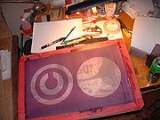
. Areas of the screen are blocked off with a non-permeable material to form a stencil, which is a negative of the image to be printed; that is, the open spaces are where the ink will appear.

The screen is placed atop a substrate such as paper or fabric. Ink is placed on top of the screen, and a fill bar (also known as a floodbar) is used to fill the mesh openings with ink. The operator begins with the fill bar at the rear of the screen and behind a reservoir of ink. The operator lifts the screen to prevent contact with the substrate and then using a slight amount of downward force pulls the fill bar to the front of the screen. This effectively fills the mesh openings with ink and moves the ink reservoir to the front of the screen. The operator then uses a squeegee
Squeegee

A squeegee or squilgee is an onomatopoeia-named tool with a flat, smooth rubber blade, used to remove or control the flow of liquid on a flat surface....
 (rubber blade) to move the mesh down to the substrate and pushes the squeegee to the rear of the screen. The ink that is in the mesh opening is pumped or squeezed by capillary action to the substrate in a controlled and prescribed amount, i.e. the wet ink deposit is equal to the thickness of the mesh and or stencil. As the squeegee moves toward the rear of the screen the tension of the mesh pulls the mesh up away from the substrate (called snap-off) leaving the ink upon the substrate surface.

There are three types of screenprinting presses. The 'flat-bed' (probably the most widely used), 'cylinder', and 'rotary'.

Textile items are printed in multi-color designs using a wet on wet technique, while graphic items are allowed to dry between colors that are then printed with another screen and often in a different color.

The screen can be re-used after cleaning. However if the design is no longer needed, then the screen can be "reclaimed", that is cleared of all emulsion and used again. The reclaiming process involves removing the ink from the screen then spraying on stencil remover to remove all emulsion. Stencil removers come in the form of liquids, gels, or powders. The powdered types have to be mixed with water before use, and so can be considered to belong to the liquid category. After applying the stencil remover the emulsion must be washed out using a pressure washer.

Most screens are ready for recoating at this stage, but sometimes screens will have to undergo a further step in the reclaiming process called dehazing. This additional step removes haze or "ghost images" left behind in the screen once the emulsion has been removed. Ghost images tend to faintly outline the open areas of previous stencils, hence the name. They are the result of ink residue trapped in the mesh, often in the knuckles of the mesh, those points where threads overlap.

While the public thinks of garments in conjunction with screenprinting, the technique is used on tens of thousands of items, decals, clock and watch faces, balloons and many more products. The technique has even been adapted for more advanced uses, such as laying down conductors and resistors in multi-layer circuits using thin ceramic layers as the substrate.

Stenciling techniques

Ssc
There are several ways to create a stencil for screenprinting. An early method was to create it by hand in the desired shape, either by cutting the design from a non-porous material and attaching it to the bottom of the screen, or by painting a negative image directly on the screen with a filler material which became impermeable when it dried. For a more painterly technique, the artist would choose to paint the image with drawing fluid, wait for the image to dry, and then coat
Coating

Coating is a covering that is applied to an object. The aim of applying coatings is to improve surface properties of a bulk material usually referred to as a Substrate ....
 the entire screen with screen filler. After the filler had dried, water was used to spray out the screen, and only the areas that were painted by the drawing fluid would wash away, leaving a stencil around it. This process enabled the artist to incorporate their hand into the process, to stay true to their drawing.

A method that has increased in popularity over the past 70 years and is tremendously popular is the photo emulsion
Photo emulsion

Photo emulsion is a commonly used misnomer for a photosensitive substance used in screen printing that hardens when subjected to ultraviolet light....
 technique:

  1. The original image is created on a transparent overlay such as acetate or tracing paper. The image may be drawn or painted directly on the overlay, photocopied
    Photocopier

    A photocopier is a machine that makes paper copies of documents and other visual images quickly and cheaply. Most current photocopiers use a technology called xerography, a dry process using heat....
    , or printed with a inkjet or laser printer, as long as the areas to be inked are opaque. A black-and-white negative
    Negative (photography)

    In photography, a negative may refer to three different things, although they are all related....
     may also be used (projected on to the screen). However, unlike traditional platemaking, these screens are normally exposed by using film positives.
  2. The overlay is placed over the emulsion-coated screen, and then exposed with a light source containing ultraviolet light in the 350-420 Nanometer spectrum. The UV light passes through the clear areas and create a polymerization (hardening) of the emulsion.
  3. The screen is washed off thoroughly. The areas of emulsion that were not exposed to light dissolve and wash away, leaving a negative stencil of the image on the mesh.


Photographic screens can reproduce images with a high level of detail, and can be reused for tens of thousands of copies. The ease of producing transparent overlays from any black-and-white image makes this the most convenient method for artists who are not familiar with other printmaking techniques. Artists can obtain screens, frames, emulsion, and lights separately; there are also preassembled kits, which are especially popular for printing small items such as greeting cards.

Another advantage of screenprinting is that large quantities can be produced rapidly with new automatic presses (up to 1200 shirts in 1 hour). (The record is over 2000 shirts an hour.)

Screenprinting Materials

Plastisol
Plastisol

Plastisol is a suspension of PVC particles in a plasticizer; it flows as a liquid and can be poured into a heated mold. When heated to around 177 degrees, the plastic and plasticizer mutually dissolve each other....
: the most common ink used in commercial garment decoration. Good color opacity onto dark garments and clear graphic detail with, as the name suggests, a more plasticized texture. This print can be made softer with special additives or heavier by adding extra layers of ink. Plastisol inks require heat (approx. 150°C (300°F) for many inks) to cure the print.

Water-Based inks: these penetrate the fabric more than the plastisol inks and create a much softer feel. Ideal for printing darker inks onto lighter colored garments. Also useful for larger area prints where texture is important. Some inks require heat or an added catalyst to make the print permanent.

PVC/ Phalate Free: relatively new breed of ink and printing with the benefits of plastisol but without the two main toxic components - soft feeling print.

Discharge inks: used to print lighter colours onto dark background fabrics, they work by removing the dye in the garment – this means they leave a much softer texture. They are less graphic in nature than plastisol inks, and exact colours are difficult to control, but especially good for distressed prints and underbasing on dark garments that are to be printed with additional layers of plastisol.

Flocking: consists of a glue printed onto the fabric and then foil (or other special effect) material is applied for a mirror finish.

Glitter/Shimmer: metallic flakes are suspended in the ink base to create this sparkle effect. Usually available in gold or silver but can be mixed to make most colours.

Metallic: similar to glitter, but smaller particles suspended in the ink. A glue is printed onto the fabric then a nanoscale fibers applied on it.

Expanding ink (puff): an additive to plastisol inks which raises the print off the garment, creating a 3D feel.

Caviar beads: again a glue is printed in the shape of the design, to which small plastic beads are then applied – works well with solid block areas creating an interesting tactile surface.

Four color process: artwork is created and then separated into four colors (CMYK) which combine to create the full spectrum of colours needed for photographic prints. This means a large number of colors can be simulated using only 4 screens, reducing costs, time, and set-up. The inks are required to blend and are more translucent, meaning a compromise with vibrancy of color.

Gloss: a clear base laid over previously printed inks to create a shiny finish.

Nylobond: a special ink additive for printing onto technical or waterproof fabrics.

Mirrored silver: Another solvent based ink, but you can almost see your face in it.

Suede Ink: Suede is a milky colored additive that is added to plastisol. With suede additive you can make any color of plastisol have a suede feel. It is actually a puff blowing agent that does not bubble as much as regular puff ink. The directions vary from manufacturer to manufacturer, but generally you can add up to 50% suede additive to your normal plastisol.

Versatility

Screenprinting is more versatile than traditional printing techniques. The surface does not have to be printed under pressure, unlike etching
Etching

Etching is the process of using strong acid or mordant to cut into the unprotected parts of a metal surface to create a design in intaglio in the metal ....
 or lithography
Lithography

Lithography is a method for printing using a stone or a metal plate with a completely smooth surface. By contrast, in intaglio a plate is engraving, etching or mezzotint to make cavities to contain the printing ink, and in woodblock printing and letterpress ink is applied to the raised surfaces of letters or images....
, and it does not have to be planar. Screenprinting inks can be used to work with a variety of materials, such as textiles, ceramics, wood, paper, glass, metal, and plastic. As a result, screenprinting is used in many different industries, including:
  • Clothing
    Clothing

    A feature of all human societies, except perhaps the most primitive, is the wearing of clothing or clothes, especially in public. The primary purpose of clothing is functional, as a protection from the weather....
  • Textile fabric
    Fabric

    A fabric is a textile material.Fabric may also refer to:*a production unit or similar practical organism, such as an ecclestiastical Fabrica Ecclesiae...
  • Product labels
  • Printed electronics
    Printed electronics

    Printed electronics is the term for a relatively new technology that defines the printing of electronics on common media such as paper, plastic, and textile using standard printing processes....
    , including circuit board printing
    Printed circuit board

    A printed circuit board, or PCB, is used to mechanically support and electrically connect electronic components using Conductor pathways, or signal traces, industrial etchinged from copper sheets laminated onto a non-conductive substrate....
  • thick film technology
    Thick film technology

    Thick film technology is used to produce electronic devices such as Surface Mount Devices, hybrid integrated circuits and sensors. The manufacture of such devices typically entails the deposition of several successive layers onto an electrically insulating substrate using a screen-printing process....
  • Balloon
    Balloon

    A balloon is a flexible bag filled with a type of gas, such as helium, hydrogen, nitrous oxide or Earth's atmosphere. Modern balloons can be made from materials such as rubber, latex, polychloroprene, or a nylon fabric, while some early balloons were sometimes made of dried animal urinary bladders....
  • Medical Devices
  • Snowboard Graphics


Semiconducting material

In screen printing, the mesh and buses of silver are printed on the front; furthermore, the buses of silver are printed on the back. Subsequently, aluminum paste is dispensed over the whole surface of the back for passivation
Passivation

Passivation is the process of making a material "passive" in relation to another material prior to using the materials together. For example, prior to storing hydrogen peroxide in an aluminium container, the container can be passivated by rinsing it with a dilute solution of nitric acid and peroxide alternating with deionized water....
 and surface reflection . One of the parameters that can vary and can be controlled in screen printing is the thickness of the print. This makes it useful for some of the techniques of printing solar cells, electronics etc.

Screen printing is one of the most critical processes to maintain high yield. Solar wafers are becoming thinner and larger, so careful printing is required to maintain a lower breakage rate. On the other hand, high throughput at the printing stage improves the throughput of the whole cell production line .

T-Shirt Silk Screening


While traditionally people have used silk screening for placing designs carefully on t-shirts, recently new methods have been adopted such as Digital Printing on shirts using inkjet methods. Silk screening however has remained an attractive source of high quality prints on shirts.

See also

  • Ink jet
  • Multi-layer
    Layer (electronics)

    A layer is the deposition of molecules on a substrate or base .High temperature substrates includes stainless steel and polyimide film and Polyethylene terephthalate ....
  • Printed electronics
    Printed electronics

    Printed electronics is the term for a relatively new technology that defines the printing of electronics on common media such as paper, plastic, and textile using standard printing processes....
  • Roll-to-roll printing.
  • Textile printing
    Textile printing

    Textile printing is the process of applying colour to textile in definite patterns or designs. In properly printing fabrics the colour is bonded with the fiber, so as to resist washing and friction....
  • Dye
    Dye

    A dye can generally be described as a colored substance that has an Chemical affinity to the Wiktionary:substrate to which it is being applied....


External links


  • - The Federation of European Screen Printers Associations
  • SGIA - Specialty Graphic Imaging Association
  • - An animated how-to of screen printing