

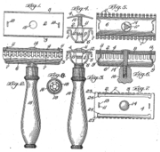
Safety razor

Encyclopedia

Razor
A razor is a bladed tool primarily used in the removal of unwanted body hair through the act of shaving. Kinds of razors include straight razors, disposable razors and electric razors....
that protects the skin from all but the very edge of the blade
Blade
A blade is that portion of a tool, weapon, or machine with a cutting edge and/or a pointed tip that is designed to cut and/or puncture, stab, slash, chop, slice, thrust, or scrape animate or inanimate surfaces or materials...
. These razors reduce the possibility of serious injury, which makes them more forgiving than a straight razor
Straight razor
A straight razor is a razor with a blade that can fold into its handle. They are also called open razors and cut-throat razors.Although straight razors were once the principal method of manual shaving, they have been largely overshadowed by the safety razor, incorporating a disposable blade...
.
Cartridges introduced
An innovation was the replaceable blade cartridge containing the blade which reduced the risk of the user receiving a cut from the unprotected blades used up until then. These took the form of a cartridge, with the blade fixed within a plastic enclosure of the type still in use today. In 1965 Gillette introduced the Techmatic razor which utilized a cartridge with a steel strip that could be wound forward to expose a fresh section of new blade.Twin blades
Circa 1971, Gillette introduced the Trac II, designed by Francis Dorion, which was the first mass-produced multi-blade razor available in the United States. Rather than accepting standard razor blades, this razor was fitted with a proprietary disposable blade cartridge containing two separate blades. The claim is that research shows that twin blades give a closer shave than single, because of hysteresis — the first blade tends to pull the hair, and the hair is unable to retract into the skin before the second blade cuts it, resulting in a closer shave. Whether, or the degree to which this works, is debatable.By controlling patents on the Trac II razor, Gillette was able to assure repeat sales of its multi-blade cartridges for use in its razor. This was a natural extension of the razor-and-blades sales philosophy. Gillette was able to sell these cartridges at a higher price than the single blades, leading to higher profits. Competitors Schick and ASRCO were quick to follow this change, introducing their own multi-blade razors.
Gillette subsequently introduced the Atra twin-blade razors (known as Contour in many parts of the world), which featured a pivoting razor head that the company claimed would more closely follow the shape of the face. The Trac II Plus and Atra Plus blades introduced later incorporated a "lubricating strip" made of polyethylene glycol
Polyethylene glycol
Polyethylene glycol is a polyether compound with many applications from industrial manufacturing to medicine. It has also been known as polyethylene oxide or polyoxyethylene , depending on its molecular weight, and under the tradename Carbowax.-Available forms:PEG, PEO, or POE refers to an...
.
Gillette followed the Atra system with the Sensor system, which featured twin blades that were individually spring-loaded to adjust to the contours of the face. The Sensor system was later modified as the SensorExcel system.
Disposable razor
The next innovation came with the introduction of the BicSociété Bic
Société Bic is a company based in Clichy, France, founded in 1945, by Baron Marcel Bich known for making disposable products including lighters, magnets, ballpoint pens, shaving razors and watersports products. It competes in most markets against Faber-Castell, Global Gillette, Newell Rubbermaid...
disposable razor in 1974. Instead of being a razor with a disposable blade, the entire razor was manufactured to be disposable. Gillette's response was the Good News disposable razor which was launched on the US market in 1976 before the Bic disposable was made available on that market. Shortly thereafter, Gillette modified the Good News construction to add an aloe
Aloe vera
Aloe vera, pronounced , also known as the true aloe or medicinal aloe, is a species of succulent plant in the genus Aloe that is believed to have originated in the Sudan. Aloe vera grows in arid climates and is widely distributed in Africa, India, Nepal and other arid areas.The species is...
strip above the razor, resulting in the Good News Plus. The purported benefit of the aloe strip is to ease any discomfort felt on the face while shaving. Plastic disposable
Disposable
A disposable is a product designed for cheapness and short-term convenience rather than medium to long-term durability, with most products only intended for single use. The term is also sometimes used for products that may last several months to distinguish from similar products that last...
razors and razors with replaceable disposable blade attachments, often with one to three cutting edges (but sometimes with four and as of recently, five cutting edges), are in common use today.
3- and 4-blade cartridges introduced
Multi-blade razors are not generally referred to as safety razors, but rather cartridge razors.Gillette introduced the first triple-blade cartridge razor, the Mach3
Gillette Mach3
The Gillette Mach3 is a line of safety razors produced by Gillette and introduced in 1998 after more than $750 million in research and development costs. The three blade design is marketed by Gillette as allowing for a shave with less pressure to the skin and with fewer strokes, thereby reducing...
, in 1998, and later upgraded the Sensor system by adding a third blade to create Sensor3. This escalated the "arms race" with rival Schick/Wilkinson Sword. The marketing competition for blades in a cartridge has been parodied since the 1970s. The debut episode of Saturday Night Live
Saturday Night Live
Saturday Night Live is a live American late-night television sketch comedy and variety show developed by Lorne Michaels and Dick Ebersol. The show premiered on NBC on October 11, 1975, under the original title of NBC's Saturday Night.The show's sketches often parody contemporary American culture...
in 1975 included a parody advertisement
Parody advertisement
A parody advertisement is a fictional advertisement for a non-existent product, either done within another advertisement for an actual product, or done simply as parody of advertisements—used either as a way of ridiculing or drawing negative attention towards a real advertisement or such an...
for the Triple Trac Razor, shortly after the first two-blade cartridge for men's razors was advertised. In the early 1990s, the (Australian) Late Show skitted a (insert name of popular razor brand) "3000" with 16 blades and 75 lubricating strips as arrived at by working in conjunction with the help of NASA scientists - "The first blade distracts the hair...". In 2004, a satirical article in The Onion
The Onion
The Onion is an American news satire organization. It is an entertainment newspaper and a website featuring satirical articles reporting on international, national, and local news, in addition to a non-satirical entertainment section known as The A.V. Club...
entitled "Fuck Everything, We're Doing Five Blades" predicted the release of five-blade cartridges, two years before their commercial introduction.
Schick/Wilkinson responded to the Mach3 with the Quattro, the first four-blade cartridge razor. These innovations are marketed with the message that they help consumers achieve the best shave as easily as possible. Another impetus for the sale of multiple-blade cartridges is that they have high profit margins. With manufacturers frequently updating their shaving systems, consumers can become locked into buying their proprietary cartridges, for as long as the manufacturer continues to make them. Subsequent to introducing the higher-priced Mach3 in 1998, Gillette's blade sales realized a 50% increase, and profits increased in an otherwise mature market.
Recent developments
The latest razor introduced by Gillette is the Gillette Fusion brand shaving system, which utilizes a five-blade cartridge razor with an additional single blade for trimming. An entire line of shaving products were introduced as part of the Fusion brand system.Gillette has also produced powered variants of the Mach3 (M3Power, M3Power Nitro) and Fusion (Fusion Power and Fusion Power Phantom) razors. These razors accept a single AAA battery which is used to produce vibration in the razor; all of these provide an additional brand alliance
Brand alliances
Brand alliances is a branding strategy used in a business alliance. Brand alliances are divided into three types:-Cobrands:Cobrands are the usage of two or more brands on one certain product...
venue for Gillette to place a battery from sister brand Duracell
Duracell
Duracell is a brand of batteries manufactured by Procter & Gamble.Additionally, Duracell owns the Procell professional-use brand.-Products:Duracell manufactures alkaline batteries in many common sizes, such as AAA, AA, C, D, and 9V...
in Power packages (the reverse is also true for Shick with their powered razors featuring Energizer batteries packed in). This action, as advertised by Gillette, was intended to raise hair up and away from the skin prior to being cut. These claims were ruled in court as "unsubstantiated and inaccurate." Schick also offers a powered version of their Quattro product called the Schick Quattro Power.
In 2008 British company King of Shaves
King of Shaves
The King of Shaves Company, Ltd. is a British toiletries company headquartered in Beaconsfield, Buckinghamshire, England, with an office in New York City, and employing approximately 22 people. The King of Shaves brand was founded in 1993 by Will King. The company was spun off from Knowledge &...
launched in the United Kingdom the 4-blade Azor, a so-called "hybrid synergy system razor" that they claimed to shave as close as rival products. The Azor uses a much simpler two-shot construction method than other system safety razors and the handle is made in the UK. The Azor has a flexible hinge instead of a pivoting head used by other razors. King of Shaves claimed that the number of blades is not strictly important, it is the sharpness and cleanliness of the blades that is important to getting a close shave. The Azor has now been launched in the USA at Duane Reade
Duane Reade
Duane Reade Inc., a subsidiary of the Walgreen Company, is a chain of pharmacy and convenience stores, primarily located in New York City, known for its high volume small store layouts in densely populated Manhattan locations...
by Remington
Remington Products
Remington Products, commonly known as simply Remington, is a worldwide personal care corporation which manufactures razors , epilators, and haircare products for both men and women. It is a subsidiary of Spectrum Brands.-History:...
, which is known more in the market for their electric shaving products.
As of January 2011, the Dutch supermarket chain Albert Heijn
Albert Heijn
Albert Heijn B.V. is a supermarket chain founded in 1887 in Oostzaan, Netherlands. It is named after Albert Heijn, Sr., the founder of the first store in Oostzaan....
sells, under its store brand
Store brand
Store brands are a line of products sold by a retailer under a single marketing identity. They bear a similarity to the concept of House brands, Private label brands in the United States, own brands in the UK, and home brands in Australia and generic brands...
, six-blades razor cartridges.
Women's safety razors
Razors are generally marketed in men's and women's versions; the exact difference between the two varies from color only for most disposable razors to completely different design principles. By and large, men's and women's razor blades and disposable razors are interchangeable; however, there is sometimes a difference in ergonomics; women's razors either have a longer handle for longer reach or a paddle-shaped handle to allow for a lengthwise grip. Specialized handle designs also exist, for shaving such areas as the underarms or the bikini line.Before the first safety razor
Before the invention of the first safety razor, most men used a straight razorStraight razor
A straight razor is a razor with a blade that can fold into its handle. They are also called open razors and cut-throat razors.Although straight razors were once the principal method of manual shaving, they have been largely overshadowed by the safety razor, incorporating a disposable blade...
. These razors are still available from several different manufacturers; but they are not very popular today.
Invention
The first safety razor was invented in the late 18th century by a Frenchman, Jean-Jacques Perret, who was inspired by the joiner's planePlane (tool)
A hand plane is a tool for shaping wood. When powered by electricity, the tool may be called a planer. Planes are used to flatten, reduce the thickness of, and impart a smooth surface to a rough piece of lumber or timber. Planing is used to produce horizontal, vertical, or inclined flat surfaces on...
. As an expert on the subject, he also wrote a book called Pogonotomy or the Art of Learning to Shave Oneself. In the late 1820s, a similar razor was made in Sheffield, England. From the 1870s, a single-edge blade, mounted on a hoe-shaped handle, was available in Britain and Germany. One of the rarest European razors was made by "Comfort" and, while this was not a true safety razor, it remains a landmark in razor design. None of these razors are considered a true safety razor.
Described as a razor in which "a small blade is held in a suitable frame and provided with a guard to prevent the edge of the razor from cutting into the skin", the first American safety razor was patented in 1888 by the Kampfe Brothers. The new razor featured a wire skin-guard along the razor’s edge. Only one edge of the blade is used to shave, and it must be removed often for sharpening.
King Camp Gillette, a traveling hardware salesman of Fond du Lac, Wisconsin
Fond du Lac, Wisconsin
Fond du Lac is a city in Fond du Lac County, Wisconsin, United States. The name is French for bottom of the lake, for it is located at the bottom of Lake Winnebago. The population was 42,203 at the 2000 census...
invented the double-edged, disposable safety razor attached to a re-usable razor handle. Beforehand, dull razors were taken to barbers for sharpening. With Gillette's double-edged and disposable blades, a uniform shave on a man's face could be achieved with a fresh blade and disposed after it was used. Gillette applied for a patent in 1901. It was granted in 1904.
World War I
During World War I, Gillette worked out a deal with the U.S. Armed Forces to provide Gillette safety razors and blades to every enlisted man or officer on his way to Europe as part of his standard-issue gear. By the end of the war, some 3.5 million razors and 32 million blades were put into military hands, thereby converting a substantial portion of young men to the Gillette safety razor.Switch to stainless steel
Gillette manufactured carbon steel blades until the 1960s. These rustRust
Rust is a general term for a series of iron oxides. In colloquial usage, the term is applied to red oxides, formed by the reaction of iron and oxygen in the presence of water or air moisture...
ed quickly and required the user to change blades frequently. In 1965, the British company Wilkinson Sword
Wilkinson Sword
Wilkinson Sword is a brand name for companies that make gardening tools and razors. Wilkinson Sword's origins are in the manufacture of swords. The company was founded in London in 1772. The brand is currently owned by Energizer Holdings. Past product lines have included guns, bayonets, and other...
began to sell blades made of stainless steel
Stainless steel
In metallurgy, stainless steel, also known as inox steel or inox from French "inoxydable", is defined as a steel alloy with a minimum of 10.5 or 11% chromium content by mass....
, which did not rust and could be used repeatedly until blunt. Wilkinson quickly captured the British and European markets, and Gillette was forced to switch its production lines to stainless steel to compete. Today, almost all razor blades are stainless steel. The carbon-steel blade remains available; its modern version does not rust if it is rinsed in alcohol after each shave. Because Gillette held the patent for the stainless blades but had not acted on it, the company was accused of exploiting customers by forcing them to buy the rust-prone blade.
Single-edge razors
A less common variety of the safety razor is the single-edge razor. This razor is so named because the blades have a single edge rather than double edges. These razors, although not in use as much as they were in the 20th century, are still available worldwide. The first successful single-edge safety razor was developed and sold by Schick RazorsSchick (razors)
Schick is a brand of safety razors by Wilkinson Sword, a subsidiary of Energizer Holdings. It was founded in 1926 by Jacob Schick as the Magazine Repeating Razor Company. In 1934, Schick introduced its highly successful single blade safety razor system, that stored ten blades in a steel injector...
. The individual razors were stored in a metal clip injector and pumped into the holder. Injecting a new blade, caused the old blade to move out. It became the common design for almost all other single blade safety razors. The most common of the single-edge razors were made by the American Safety Razor Company under the name Ever-Ready using its "'Radio' Blades"; the company also produced a shaving brush, which it called "The Honest Brush". Another was the Gem Safety Razor Company under the name "Gem Damaskeene Razor". It is possible to use common hardware-store blades for shaving, although most shavers use blades that are made specifically for shaving.