

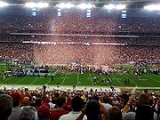
Arizona Cardinals

Encyclopedia
The Arizona Cardinals are a professional American football
team based in Glendale, Arizona
, a suburb of Phoenix
. They are currently members of the Western Division
of the National Football Conference
(NFC) in the National Football League
(NFL). The Cardinals were founded in 1898, and are the oldest continuously run professional American football club in the United States
.
The team was established in Chicago
in 1898 and was a charter member of the NFL in . Along with the Chicago Bears
, the club is one of two NFL charter member franchises still in operation since the league's founding. (The Green Bay Packers
were an independent team until they joined the NFL in 1921). The club moved to St. Louis, Missouri
, in and played in that city through (sometimes referred to as the "Football Cardinals" and / or the "Big Red" to avoid confusion with the Major League Baseball St. Louis Cardinals
). Other less commonly used nicknames were the "Gridbirds" (used only by a local newspaper columnist) or "Cardiac Cards" (used only to refer to the 1975 team) Before the 1988 NFL season
, the team moved to Tempe, Arizona
, a college town suburb of Phoenix, and played their home games for the next 18 years at Arizona State University
's Sun Devil Stadium
. In , the club began playing all home games at the newly constructed University of Phoenix Stadium
in the northwestern suburb of Glendale
.
The franchise has two NFL championships, both while it was based in Chicago. The first occurred in , but is the subject of controversy
, with supporters of the Pottsville Maroons
believing that Pottsville should have gotten the title. Their second title, and the first to be received through a championship game, came in , two decades before the first Super Bowl
game was played. In the six-plus decades since winning the championship in 1947, the team suffered many losing seasons. They have been to the playoffs six times and have won six playoff games, three of which were victories during their run in the 2008-09 NFL Playoffs
. During that season, they reached Super Bowl XLIII
. The team has also won four division titles since their 1947–1948 NFL championship game appearances. In addition, the club won one NFC Championship Game
in 2008.
The Cardinals conduct their annual summer training camp at Northern Arizona University
in Flagstaff.
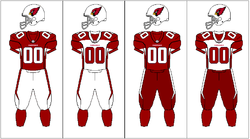
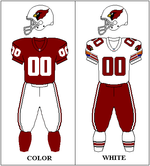
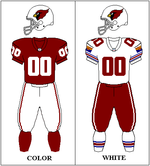 The team has used cardinal red jerseys since Chris O'Brien
bought them for the club in 1898. For most of their history, the Cardinals have used the same basic uniform design of white helmets, white pants with red stripes on the sides, and either red or white jerseys.
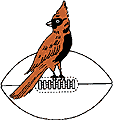 Starting in , the team had a logo of a cardinal bird
perched on the stitches of a football. However, the club did not attach a logo to their helmets until they debuted a cardinal-head logo in , the year the franchise moved from Chicago to St. Louis. The Cardinals moved to Arizona in , and the flag of Arizona
was added to the sleeves the following year. In , the team began wearing red pants with their white jerseys.
In , the Cardinals participated in the NFL's 75th anniversary throwback uniform program. The jerseys were similar to those of the 1920s Chicago Cardinals, with an interlocking "CC" logo and three stripes on each sleeve. The uniform numbers were relocated to the right chest. The pants were khaki to simulate the color and material used in that era. The Cardinals also stripped the logos from their helmets for the two games, at Cleveland (Sept. 18) and home vs. Pittsburgh (Oct. 30).
In , the team unveiled its first major changes in a century. The cardinal-head logo was updated to be a more aggressive version of its predecessor, making it look meaner. Numerous fans had called the previous version a "parakeet
". Black again became an accent color after an eight-year absence, while trim lines were added to the outside shoulders, sleeves, and sides of the jerseys and pants. Both the red and white jerseys have the option of red or white pants.
Hoping to break a six-game losing streak, the Cardinals wore the red pants for the first time on October 29, 2006, in a game at Lambeau Field
against the Green Bay Packers. The Packers won 31–14, and the Cards headed into their bye week with a 1–7 mark. Following the bye week, the Cardinals came out in an all-red combination at home against the Dallas Cowboys and lost, 27–10. Arizona did not wear the red pants for the remainder of the season and won four of their last seven games. However, the following season, in , the Cardinals again wore their red pants for their final 3 home games. They wore red pants with white jerseys in games on the road at the Cincinnati Bengals and Seattle Seahawks. They paired red pants with red jerseys, the all-red combination, for home games against the Detroit Lions, San Francisco 49ers, Cleveland Browns, and St. Louis Rams. The red pants were not worn at all in , but they were used in home games vs. Seattle, Minnesota, and St. Louis in . They have yet to be paired with the white road jerseys since the 2007 game at Seattle.
The Cardinals' first home game in Arizona, in 1988, saw them play in red jerseys. Thereafter, for the next 18 years in Arizona, the Cardinals, like a few other NFL teams in warm climates, wore their white jerseys at home during the first half of the season—forcing opponents to suffer in darker-colored jerseys during Arizona autumns that frequently see temperatures over 100 °F (38 °C). However, this tradition did not continue when the Cardinals moved from Sun Devil Stadium to University of Phoenix Stadium in 2006, as early-season games (and some home games late in the season) were played with the roof closed. With the temperature inside at a comfortable 70°F (21°C), the team opted wear red jerseys at home full-time. The Cardinals wore white jerseys at home for the first time in University of Phoenix Stadium on August 29, 2008, in a preseason game against the Denver Broncos
.
The Cardinals wore white at home for the first time in a regular season game at University of Phoenix Stadium against the Houston Texans
on October 11, . In October 2009, the NFL recognized Breast Cancer Awareness Month, and players wore pink-accented items, including gloves, wristbands, and shoes. The team thought the pink accents looked better with white uniforms than with red.
The season saw the Cardinals debut a new, alternate black jersey. Prior to its introduction, the Cardinals were the only NFL team without an alternate jersey or throwback kit, save for the NFL's 75th anniversary program in 1994.
Passing
Rushing
Receiving
Returns
Kicking
* NFL Record
St. Louis Cardinals
, "ESPN Radio
860." KMVP assumed the broadcast rights in 2006 after many years on KSLX-FM and KDUS
. Dave Pasch
, Ron Wolfley
, and Paul Calvisi handle the radio broadcast. Most preseason games are televised on KNXV, channel 15, the local ABC
affiliate. Rich Cellini and Glenn Parker
are the TV announcers.
On New Year's Day
2007, KMVP began a simulcast of KTAR
, which switched to an all-sports format (the news/talk station became 92.3, KTAR-FM
). For the 2007 season, KTAR was the official flagship station; however, some broadcasts were also heard on 92.3 FM because of conflicts with Arizona Diamondbacks
baseball games on 620 AM.
American football
American football is a sport played between two teams of eleven with the objective of scoring points by advancing the ball into the opposing team's end zone. Known in the United States simply as football, it may also be referred to informally as gridiron football. The ball can be advanced by...
team based in Glendale, Arizona
Glendale, Arizona
Glendale is a city in Maricopa County, Arizona, USA, located about nine miles northwest from Downtown Phoenix. According to 2010 Census Bureau, the population of the city is 226,721....
, a suburb of Phoenix
Phoenix, Arizona
Phoenix is the capital, and largest city, of the U.S. state of Arizona, as well as the sixth most populated city in the United States. Phoenix is home to 1,445,632 people according to the official 2010 U.S. Census Bureau data...
. They are currently members of the Western Division
NFC West
The NFC West is a division of the National Football League's National Football Conference. It currently has four members: Arizona Cardinals, St...
of the National Football Conference
National Football Conference
The National Football Conference is one of the two conferences of the National Football League . This conference and its counterpart, the American Football Conference , currently contain 16 teams each, making up the 32 teams of the NFL.-Current teams:Since 2002, the NFC has comprised 16 teams,...
(NFC) in the National Football League
National Football League
The National Football League is the highest level of professional American football in the United States, and is considered the top professional American football league in the world. It was formed by eleven teams in 1920 as the American Professional Football Association, with the league changing...
(NFL). The Cardinals were founded in 1898, and are the oldest continuously run professional American football club in the United States
United States
The United States of America is a federal constitutional republic comprising fifty states and a federal district...
.
The team was established in Chicago
Chicago
Chicago is the largest city in the US state of Illinois. With nearly 2.7 million residents, it is the most populous city in the Midwestern United States and the third most populous in the US, after New York City and Los Angeles...
in 1898 and was a charter member of the NFL in . Along with the Chicago Bears
Chicago Bears
The Chicago Bears are a professional American football team based in Chicago, Illinois. They are members of the North Division of the National Football Conference in the National Football League...
, the club is one of two NFL charter member franchises still in operation since the league's founding. (The Green Bay Packers
Green Bay Packers
The Green Bay Packers are an American football team based in Green Bay, Wisconsin. They are members of the North Division of the National Football Conference in the National Football League . The Packers are the current NFL champions...
were an independent team until they joined the NFL in 1921). The club moved to St. Louis, Missouri
St. Louis, Missouri
St. Louis is an independent city on the eastern border of Missouri, United States. With a population of 319,294, it was the 58th-largest U.S. city at the 2010 U.S. Census. The Greater St...
, in and played in that city through (sometimes referred to as the "Football Cardinals" and / or the "Big Red" to avoid confusion with the Major League Baseball St. Louis Cardinals
St. Louis Cardinals
The St. Louis Cardinals are a professional baseball team based in St. Louis, Missouri. They are members of the Central Division in the National League of Major League Baseball. The Cardinals have won eleven World Series championships, the most of any National League team, and second overall only to...
). Other less commonly used nicknames were the "Gridbirds" (used only by a local newspaper columnist) or "Cardiac Cards" (used only to refer to the 1975 team) Before the 1988 NFL season
1988 NFL season
The 1988 NFL season was the 69th regular season of the National Football League. The Cardinals relocated from St. Louis, Missouri to the Phoenix, Arizona area becoming the Phoenix Cardinals but remained in the NFC East division....
, the team moved to Tempe, Arizona
Tempe, Arizona
Tempe is a city in Maricopa County, Arizona, USA, with the Census Bureau reporting a 2010 population of 161,719. The city is named after the Vale of Tempe in Greece. Tempe is located in the East Valley section of metropolitan Phoenix; it is bordered by Phoenix and Guadalupe on the west, Scottsdale...
, a college town suburb of Phoenix, and played their home games for the next 18 years at Arizona State University
Arizona State University
Arizona State University is a public research university located in the Phoenix Metropolitan Area of the State of Arizona...
's Sun Devil Stadium
Sun Devil Stadium
Sun Devil Stadium is an outdoor football stadium, located on the campus of Arizona State University, in Tempe, Arizona, United States. The stadium's current seating capacity is 71,706 and the playing surface is natural grass...
. In , the club began playing all home games at the newly constructed University of Phoenix Stadium
University of Phoenix Stadium
University of Phoenix Stadium, opened August 1, 2006, is a multipurpose football stadium located in Glendale, Arizona. It is the home of the Arizona Cardinals of the National Football League and the annual Fiesta Bowl...
in the northwestern suburb of Glendale
Glendale, Arizona
Glendale is a city in Maricopa County, Arizona, USA, located about nine miles northwest from Downtown Phoenix. According to 2010 Census Bureau, the population of the city is 226,721....
.
The franchise has two NFL championships, both while it was based in Chicago. The first occurred in , but is the subject of controversy
1925 NFL Championship controversy
The 1925 National Football League Championship, officially held by the Chicago Cardinals, has been the subject of controversy since it was awarded. The controversy centers around the suspension of the Pottsville Maroons by NFL commissioner Joseph Carr, which prevented them from taking the title.The...
, with supporters of the Pottsville Maroons
Pottsville Maroons
The Pottsville Maroons were an American football team based in Pottsville, Pennsylvania. Founded in 1920, they went on to play in the National Football League for four seasons, from 1925–1928...
believing that Pottsville should have gotten the title. Their second title, and the first to be received through a championship game, came in , two decades before the first Super Bowl
Super Bowl
The Super Bowl is the championship game of the National Football League , the highest level of professional American football in the United States, culminating a season that begins in the late summer of the previous calendar year. The Super Bowl uses Roman numerals to identify each game, rather...
game was played. In the six-plus decades since winning the championship in 1947, the team suffered many losing seasons. They have been to the playoffs six times and have won six playoff games, three of which were victories during their run in the 2008-09 NFL Playoffs
NFL playoffs, 2008–09
The National Football League playoffs for the 2008 season began on January 3, 2009 and led up to Super Bowl XLIII on February 1, 2009 at Raymond James Stadium in Tampa, Florida.-NFC: Arizona Cardinals 30, Atlanta Falcons 24:...
. During that season, they reached Super Bowl XLIII
Super Bowl XLIII
Super Bowl XLIII was an American football game pitting the American Football Conference champion Pittsburgh Steelers against the National Football Conference champion Arizona Cardinals to decide the National Football League champion for the 2008 season. The game was played on February 1, 2009,...
. The team has also won four division titles since their 1947–1948 NFL championship game appearances. In addition, the club won one NFC Championship Game
NFC Championship Game
The National Football Conference Championship Game is one of the two semi-final playoff matches of the National Football League, the largest professional American football league in the United States. The game is played on the penultimate Sunday in January and determines the champion of the...
in 2008.
The Cardinals conduct their annual summer training camp at Northern Arizona University
Northern Arizona University
Northern Arizona University is a public university located in Flagstaff, Arizona, United States. It is accredited by the North Central Association of Colleges and Schools, and has 39 satellite campuses in the state of Arizona. The university offers both undergraduate and graduate degrees.As of...
in Flagstaff.
Logo and uniforms
Chris O'Brien (American football)
Christopher O'Brien, was a painting and decorating contractor as well as a pro football franchise owner. He is mostly known as the owner of the Chicago Cardinals, and is known as the “Father of Professional Football in Chicago,”...
bought them for the club in 1898. For most of their history, the Cardinals have used the same basic uniform design of white helmets, white pants with red stripes on the sides, and either red or white jerseys.
Northern Cardinal
The Northern Cardinal or Redbird or Common Cardinal is a North American bird in the genus Cardinalis. It can be found in southern Canada, through the eastern United States from Maine to Texas and south through Mexico...
perched on the stitches of a football. However, the club did not attach a logo to their helmets until they debuted a cardinal-head logo in , the year the franchise moved from Chicago to St. Louis. The Cardinals moved to Arizona in , and the flag of Arizona
Flag of Arizona
The flag of the state of Arizona consists of 13 rays of red and weld-yellow on the top half, the colors of the flag of Spain, representing the 13 original states. The red and yellow also symbolize Arizona's picturesque sunsets. The copper star represents a once flourishing Copper mining industry in...
was added to the sleeves the following year. In , the team began wearing red pants with their white jerseys.
In , the Cardinals participated in the NFL's 75th anniversary throwback uniform program. The jerseys were similar to those of the 1920s Chicago Cardinals, with an interlocking "CC" logo and three stripes on each sleeve. The uniform numbers were relocated to the right chest. The pants were khaki to simulate the color and material used in that era. The Cardinals also stripped the logos from their helmets for the two games, at Cleveland (Sept. 18) and home vs. Pittsburgh (Oct. 30).
In , the team unveiled its first major changes in a century. The cardinal-head logo was updated to be a more aggressive version of its predecessor, making it look meaner. Numerous fans had called the previous version a "parakeet
Parakeet
Parakeet is a term for any one of a large number of unrelated small to medium sized species of parrot, that generally have long tail feathers...
". Black again became an accent color after an eight-year absence, while trim lines were added to the outside shoulders, sleeves, and sides of the jerseys and pants. Both the red and white jerseys have the option of red or white pants.
Hoping to break a six-game losing streak, the Cardinals wore the red pants for the first time on October 29, 2006, in a game at Lambeau Field
Lambeau Field
Lambeau Field is an outdoor football stadium in Green Bay, Wisconsin, the home of the NFL's Green Bay Packers. Opened in 1957 as City Stadium, it replaced the original City Stadium as the Packers' home field...
against the Green Bay Packers. The Packers won 31–14, and the Cards headed into their bye week with a 1–7 mark. Following the bye week, the Cardinals came out in an all-red combination at home against the Dallas Cowboys and lost, 27–10. Arizona did not wear the red pants for the remainder of the season and won four of their last seven games. However, the following season, in , the Cardinals again wore their red pants for their final 3 home games. They wore red pants with white jerseys in games on the road at the Cincinnati Bengals and Seattle Seahawks. They paired red pants with red jerseys, the all-red combination, for home games against the Detroit Lions, San Francisco 49ers, Cleveland Browns, and St. Louis Rams. The red pants were not worn at all in , but they were used in home games vs. Seattle, Minnesota, and St. Louis in . They have yet to be paired with the white road jerseys since the 2007 game at Seattle.
The Cardinals' first home game in Arizona, in 1988, saw them play in red jerseys. Thereafter, for the next 18 years in Arizona, the Cardinals, like a few other NFL teams in warm climates, wore their white jerseys at home during the first half of the season—forcing opponents to suffer in darker-colored jerseys during Arizona autumns that frequently see temperatures over 100 °F (38 °C). However, this tradition did not continue when the Cardinals moved from Sun Devil Stadium to University of Phoenix Stadium in 2006, as early-season games (and some home games late in the season) were played with the roof closed. With the temperature inside at a comfortable 70°F (21°C), the team opted wear red jerseys at home full-time. The Cardinals wore white jerseys at home for the first time in University of Phoenix Stadium on August 29, 2008, in a preseason game against the Denver Broncos
Denver Broncos
The Denver Broncos are a professional American football team based in Denver, Colorado. They are currently members of the West Division of the American Football Conference in the National Football League...
.
The Cardinals wore white at home for the first time in a regular season game at University of Phoenix Stadium against the Houston Texans
Houston Texans
The Houston Texans are a professional American football team based in Houston, Texas. The team is currently a member of the Southern Division of the American Football Conference in the National Football League...
on October 11, . In October 2009, the NFL recognized Breast Cancer Awareness Month, and players wore pink-accented items, including gloves, wristbands, and shoes. The team thought the pink accents looked better with white uniforms than with red.
The season saw the Cardinals debut a new, alternate black jersey. Prior to its introduction, the Cardinals were the only NFL team without an alternate jersey or throwback kit, save for the NFL's 75th anniversary program in 1994.
Single-season records
Points Scored: 427Passing
- Passing Yards: 4,614 Neil LomaxNeil LomaxNeil Vincent Lomax is a former American football quarterback.-College career:Lomax was a standout college player at Portland State University, going from fifth-string freshman quarterback on partial scholarship to emergency starter to NCAA legend...
- Passing Touchdowns: 30 Kurt WarnerKurt WarnerKurtis Eugene "Kurt" Warner is a retired American football player. He played quarterback for three National Football League teams: the St. Louis Rams, the New York Giants, and the Arizona Cardinals. He was originally signed by the Green Bay Packers as an undrafted free agent in 1994 after playing...
- Passes Completed: 401 Kurt WarnerKurt WarnerKurtis Eugene "Kurt" Warner is a retired American football player. He played quarterback for three National Football League teams: the St. Louis Rams, the New York Giants, and the Arizona Cardinals. He was originally signed by the Green Bay Packers as an undrafted free agent in 1994 after playing...
- Passes Attempted: 598 Kurt WarnerKurt WarnerKurtis Eugene "Kurt" Warner is a retired American football player. He played quarterback for three National Football League teams: the St. Louis Rams, the New York Giants, and the Arizona Cardinals. He was originally signed by the Green Bay Packers as an undrafted free agent in 1994 after playing...
- Longest Completed Pass Thrown: 98 Yards Doug Russell / Ogden Compton / Jim Hart
- Consecutive Games With a Touchdown Pass: 22 Kurt WarnerKurt WarnerKurtis Eugene "Kurt" Warner is a retired American football player. He played quarterback for three National Football League teams: the St. Louis Rams, the New York Giants, and the Arizona Cardinals. He was originally signed by the Green Bay Packers as an undrafted free agent in 1994 after playing...
(–)
Rushing
- Rushing Yards: 1,605 Ottis AndersonOttis AndersonOttis Jerome "O.J." Anderson is a former American football running back. He was named the NFL Offensive Rookie of the Year by the Associated Press with the St. Louis Cardinals in 1979, and the MVP of Super Bowl XXV in 1991 when playing with the New York Giants...
- Rushing Attempts: 337 Edgerrin JamesEdgerrin JamesEdgerrin Tyree James is a former American football running back. He was drafted by the Indianapolis Colts fourth overall in the 1999 NFL Draft. He played college football at the University of Miami....
- Rushing Touchdowns: 14 John David CrowJohn David CrowJohn David Crow was the Heisman Trophy winner and halfback from Texas A&M University in 1957...
- Rushing Touchdowns (Rookie): 10 Tim HightowerTim Hightower-Arizona Cardinals:Hightower scored 10 touchdowns during his rookie season, and another 3 in the post season while averaging a meager 2.8 yards per carry. He would rush for a total amount of 399 yards in 2008. Hightower would then become the only Cardinal rookie running back ever to have scored a...
- Longest Rushing Attempt: 83 yards John David CrowJohn David CrowJohn David Crow was the Heisman Trophy winner and halfback from Texas A&M University in 1957...
- Rushing Yards Per Game: 100.3 yards Ottis AndersonOttis AndersonOttis Jerome "O.J." Anderson is a former American football running back. He was named the NFL Offensive Rookie of the Year by the Associated Press with the St. Louis Cardinals in 1979, and the MVP of Super Bowl XXV in 1991 when playing with the New York Giants...
Receiving
- Receptions: 103 Larry FitzgeraldLarry FitzgeraldLarry Darnell Fitzgerald, Jr. is an American football wide receiver for the Arizona Cardinals of the National Football League, and currently ranks fourth all-time in league history in receiving yards per game for a career , behind Andre Johnson, Torry Holt, and Marvin Harrison...
- Receiving Yards: 1,598 David BostonDavid BostonDavid Byron Boston is a professional football wide receiver who is currently a free agent. He was originally drafted by the Arizona Cardinals eighth overall in the 1999 NFL Draft...
- Receiving Touchdowns: 15 Sonny RandleSonny Randle-References:...
Returns
- Punt Returns in a Season: 44 Vai SikahemaVai SikahemaVai S. Sikahema is a Tongan former American football player. The first Tongan ever to play in the National Football League , he played running back and kickoff returner in the league for eight seasons, from 1986 to 1993. He played college football for the Brigham Young University Cougars, and was...
- Longest Punt Return: 99 yards Patrick PetersonPatrick PetersonPatrick De'mon Peterson is an American football cornerback for the Arizona Cardinals of the National Football League. He was drafted fifth overall by the Cardinals in the 2011 NFL Draft. He played college football at Louisiana State....
(2011) - Longest Kickoff Return: 102 yards Larod Stephens-HowlingLaRod Stephens-HowlingLaRod Stephens-Howling is an American football running back and kickoff returner for the Arizona Cardinals of the National Football League. He was drafted by the Cardinals in the seventh round of the 2009 NFL Draft...
Kicking
- Field Goals: 40* Jay FeelyJay FeelyThomas James "Jay" Feely is an American football placekicker for the Arizona Cardinals of the National Football League. Jay played for the Temple Terrace Spirit Soccer team that won the National Championships when he was 16....
- Extra Points Made: 53 Pat HarderPat HarderMarlin M. "Pat" Harder was a college and professional football player, playing fullback and kicker. He was inducted into the College Football Hall of Fame in 1993....
* NFL Record
Cardinals career records
- Passing Yards: 34,639 Jim Hart (–)
- Passing Touchdowns: 209 Jim Hart (–)
- Rushing Yards: 7,999 Ottis Anderson (–)
- Receptions: 613 Larry Fitzgerald (–)
- Receiving Yards: 8,497 Roy Green (–)
- Pass Interceptions: 52 Larry Wilson (–)
- Field Goals Made: 282 Jim Bakken (–)
- Points: 1,380 Jim Bakken (–)
- Total Touchdowns:larry fitzgerald ( Cardinals nfl season/ 2011)
- Punt Return Average: 13.7 Charley Trippi (–)
- Kickoff Return Average: 28.5 Ollie Matson
- Punting Average: 44.9 Jerry Norton (–)
- Sacks: 66.5 Freddie Joe Nunn (–)
Pro Football Hall of Famers
Chicago Cardinals- Charles BidwillCharles BidwillCharles W. Bidwill , sometimes known as Charley Bidwill, was an owner of the NFL's Chicago Cardinals. He owned the team for 14 seasons from 1933 until 1947. His interest in sports was demonstrated by his two aims in life: to win an NFL Championship and the Kentucky Derby...
, team owner - 1 Jimmy Conzelman, QB-CB, head coach
- 1 John "Paddy" DriscollPaddy DriscollJohn Leo "Paddy" Driscoll was a professional American football quarterback. Driscoll was inducted into the Pro Football Hall of Fame in 1965 and is a member of the NFL 1920s All-Decade Team...
, QB-S-K-P, head coach - 2 Walt KieslingWalt KieslingWalter Andrew Kiesling was an American football player and coach.-Playing career:A native of Saint Paul, Minnesota, Kiesling played both offensive and defensive line at the University of St. Thomas...
, G-DT, head coach - 4 Ernie Nevers, RB-S
- 13 Guy ChamberlinGuy ChamberlinBerlin Guy "Champ" Chamberlin was a professional American football player and coach in the National Football League . He played at Nebraska Wesleyan University and then at the University of Nebraska, where he was a member of Beta Theta Pi fraternity. He graduated from Nebraska in 1916...
, TE-DE - 33 Ollie MatsonOllie MatsonOllie Genoa Matson II was an American Olympic medal winning sprinter and professional American football running back who played in the National Football League, in 1952 and from 1954 to 1966...
, RB - 62 Charley TrippiCharley TrippiCharles Louis Trippi is a former professional American football player for the Chicago Cardinals. He was inducted into the Pro Football Hall of Fame in 1968.Mr. Trippi currently resides in Athens, Georgia...
, RB-QB - 81 Dick "Night Train" Lane, CB
St. Louis Cardinals
- 8 Larry WilsonLarry WilsonLarry Frank Wilson is a former American football free safety who played for the St. Louis Cardinals.Wilson attended Rigby High School, where a plaque now hangs noting his accomplishments...
, S - 22 Roger WehrliRoger WehrliRoger Wehrli is a former National Football League cornerback who played his entire 14-year career with the St. Louis Cardinals from 1969 until 1982. He was a seven-time Pro Bowler after playing college football at the University of Missouri, where he was a consensus All-American and a first-round...
, CB - 72 Dan DierdorfDan DierdorfDaniel Lee "Dan" Dierdorf is a former American football player and current television sportscaster. He played 13 NFL seasons and has worked for ABC's Monday Night Football and CBS as a color commentator since retiring from football....
, OT - 81 Jackie SmithJackie SmithJackie Larue Smith is a former professional American football player in the National Football League. He played tight end for the St. Louis Cardinals and the Dallas Cowboys from 1963 to 1978. He has career marks of 480 receptions, 7,918 yards, and 40 touchdowns...
, TE
Retired numbers
- 8 Larry WilsonLarry WilsonLarry Frank Wilson is a former American football free safety who played for the St. Louis Cardinals.Wilson attended Rigby High School, where a plaque now hangs noting his accomplishments...
(St. Louis) - 40 Pat TillmanPat TillmanCorporal Patrick Daniel "Pat" Tillman Jr. was an American football player who left his professional career and enlisted in the United States Army in June 2002 in the aftermath of the September 11, 2001, attacks. He joined the Army Rangers and served several tours in combat before he died in the...
(Arizona) - 77 Stan MauldinStan MauldinStanley Hubert Mauldin was a professional American football offensive tackle in the National Football League for the Chicago Cardinals. He died of a heart attack after a game against the Philadelphia Eagles in 1948. His number 77 is retired by the Cardinals.-External links:...
(Chicago) - 88 J. V. CainJ. V. CainJames Victor Cain was a tight end in the NFL for the St. Louis Cardinals. He died of congenital heart failure during training camp on his birthday in 1979. His number 88 is retired by the Cardinals....
(St. Louis) - 99 Marshall GoldbergMarshall GoldbergMarshall Goldberg was an American football halfback with the Chicago Cardinals in the National Football League.- Football career :Goldberg was born in Elkins, West Virginia...
(Chicago)
Ring of Honor
The Cardinals' Ring of Honor was started in to mark the opening of University of Phoenix Stadium. It honors former Cardinal greats from all eras of the franchise's history. Following is a list of inductees and the dates that they were inducted.- Charles BidwillCharles BidwillCharles W. Bidwill , sometimes known as Charley Bidwill, was an owner of the NFL's Chicago Cardinals. He owned the team for 14 seasons from 1933 until 1947. His interest in sports was demonstrated by his two aims in life: to win an NFL Championship and the Kentucky Derby...
, Owner (August 12, 2006) - Jimmy Conzelman, Coach (August 12, 2006)
- Dan DierdorfDan DierdorfDaniel Lee "Dan" Dierdorf is a former American football player and current television sportscaster. He played 13 NFL seasons and has worked for ABC's Monday Night Football and CBS as a color commentator since retiring from football....
, T (October 16, 2006) - John "Paddy" DriscollPaddy DriscollJohn Leo "Paddy" Driscoll was a professional American football quarterback. Driscoll was inducted into the Pro Football Hall of Fame in 1965 and is a member of the NFL 1920s All-Decade Team...
, QB (August 12, 2006) - Marshall GoldbergMarshall GoldbergMarshall Goldberg was an American football halfback with the Chicago Cardinals in the National Football League.- Football career :Goldberg was born in Elkins, West Virginia...
, HB (August 12, 2006) - Dick "Night Train" Lane, DB (August 12, 2006)
- Ollie MatsonOllie MatsonOllie Genoa Matson II was an American Olympic medal winning sprinter and professional American football running back who played in the National Football League, in 1952 and from 1954 to 1966...
, HB (August 12, 2006) - Ernie Nevers, FB (August 12, 2006)
- Charley TrippiCharley TrippiCharles Louis Trippi is a former professional American football player for the Chicago Cardinals. He was inducted into the Pro Football Hall of Fame in 1968.Mr. Trippi currently resides in Athens, Georgia...
, HB/QB (August 12, 2006) - Roger WehrliRoger WehrliRoger Wehrli is a former National Football League cornerback who played his entire 14-year career with the St. Louis Cardinals from 1969 until 1982. He was a seven-time Pro Bowler after playing college football at the University of Missouri, where he was a consensus All-American and a first-round...
, CB (October 14, 2007) - Larry WilsonLarry WilsonLarry Frank Wilson is a former American football free safety who played for the St. Louis Cardinals.Wilson attended Rigby High School, where a plaque now hangs noting his accomplishments...
, S (September 10, 2006) - Pat TillmanPat TillmanCorporal Patrick Daniel "Pat" Tillman Jr. was an American football player who left his professional career and enlisted in the United States Army in June 2002 in the aftermath of the September 11, 2001, attacks. He joined the Army Rangers and served several tours in combat before he died in the...
, S (November 12, 2006) - Aeneas WilliamsAeneas WilliamsAeneas Demetrius Williams is a former American football cornerback and free safety, who played with the Arizona Cardinals and the St. Louis Rams. Williams attended Fortier High School, where he played football on a team with three future NFL players. Although he was admitted to Dartmouth College,...
, CB (November 9, 2008)
Radio and television
The Cardinals' flagship radio station was KMVPKMVP
KMVP is the callsign for a radio station in Phoenix, Arizona. KMVP is owned by Bonneville International Corporation.-History:The 860 kHz frequency was occupied by several radio stations in Phoenix. The first station signed on the air as early as 1953 with the call letters KIFN. KIFN was Phoenix's...
, "ESPN Radio
ESPN Radio
ESPN Radio is an American sports radio network. It was launched on January 1, 1992 under the original banner of "SportsRadio ESPN." ESPN Radio is located at ESPN headquarters in Bristol, Connecticut...
860." KMVP assumed the broadcast rights in 2006 after many years on KSLX-FM and KDUS
KDUS
KDUS, also known as "The Fan," or "The Fan AM 1060," is a sports talk radio station broadcasting out of Tempe, Arizona and serving the Phoenix metropolitan radio market...
. Dave Pasch
Dave Pasch
Dave Pasch is an American sportscaster. Pasch works for ESPN, for which he calls play-by-play of college football, college basketball, NBA, WNBA, and Arena football games. He has also been the radio voice for the Arizona Cardinals of the NFL since 2002, teaming with Ron Wolfley. In 2007, Pasch...
, Ron Wolfley
Ron Wolfley
Ronald Paul Wolfley was an American football fullback who played for the St. Louis/Phoenix Cardinals from 1985 to 1991. He was selected four times to the Pro Bowl as a special teams captain. Wolfley played collegiately for the West Virginia Mountaineers...
, and Paul Calvisi handle the radio broadcast. Most preseason games are televised on KNXV, channel 15, the local ABC
American Broadcasting Company
The American Broadcasting Company is an American commercial broadcasting television network. Created in 1943 from the former NBC Blue radio network, ABC is owned by The Walt Disney Company and is part of Disney-ABC Television Group. Its first broadcast on television was in 1948...
affiliate. Rich Cellini and Glenn Parker
Glenn Parker
Glenn Andrew Parker is a former American football offensive lineman in the National Football League who played for the Buffalo Bills, the Kansas City Chiefs, and the New York Giants...
are the TV announcers.
On New Year's Day
New Year's Day
New Year's Day is observed on January 1, the first day of the year on the modern Gregorian calendar as well as the Julian calendar used in ancient Rome...
2007, KMVP began a simulcast of KTAR
KTAR (AM)
KTAR is the callsign for a radio station in Phoenix, Arizona. It airs programming from ESPN Radio, in addition to KTAR-acquired broadcast rights for local teams...
, which switched to an all-sports format (the news/talk station became 92.3, KTAR-FM
KTAR-FM
KTAR-FM is a radio station broadcasting a News/Talk format. Licensed to Glendale, Arizona, USA, the station serves the Phoenix area and is currently owned by Bonneville Holding Company...
). For the 2007 season, KTAR was the official flagship station; however, some broadcasts were also heard on 92.3 FM because of conflicts with Arizona Diamondbacks
Arizona Diamondbacks
The Arizona Diamondbacks are a professional baseball team based in Phoenix. They play in the West Division of Major League Baseball's National League. From 1998 to the present, they have played in Chase Field...
baseball games on 620 AM.
Radio Affiliaties
Cardinals Radio Affiliates| City | Call Sign | Frenquency |
|---|---|---|
| Phoenix, Arizona Phoenix, Arizona Phoenix is the capital, and largest city, of the U.S. state of Arizona, as well as the sixth most populated city in the United States. Phoenix is home to 1,445,632 people according to the official 2010 U.S. Census Bureau data... |
KTAR KTAR (AM) KTAR is the callsign for a radio station in Phoenix, Arizona. It airs programming from ESPN Radio, in addition to KTAR-acquired broadcast rights for local teams... -AM |
620 AM |
| Phoenix, Arizona Phoenix, Arizona Phoenix is the capital, and largest city, of the U.S. state of Arizona, as well as the sixth most populated city in the United States. Phoenix is home to 1,445,632 people according to the official 2010 U.S. Census Bureau data... |
KTAR-FM KTAR-FM KTAR-FM is a radio station broadcasting a News/Talk format. Licensed to Glendale, Arizona, USA, the station serves the Phoenix area and is currently owned by Bonneville Holding Company... |
92.3 FM |
| Safford, Arizona Safford, Arizona - History :Safford was founded by Joshua Eaton Bailey, Hiram Kennedy and Edward Tuttle, who came from Gila Bend, in southwestern Arizona. They left Gila Bend in the winter of 1873-74; their work on canals and dams having been destroyed by high water the previous summer... |
KATO KATO (AM) KATO is a radio station broadcasting a News Talk Information format. Licensed to Safford, Arizona, USA, the station is currently owned by McMurray Communications, Inc., and features programing from ABC Radio and ESPN Radio.... -AM |
1230 AM |
| Sedona, Arizona Sedona, Arizona Sedona is a city that straddles the county line between Coconino and Yavapai counties in the northern Verde Valley region of the U.S. state of Arizona... |
KAZM KAZM KAZM is a radio station broadcasting a mixed format consisting of news, sports, variety talk, classic rock and oldies music, the Wolfman Jack show, and Coast to Coast AM at night. Licensed to Sedona, Arizona, USA. The station is currently owned by Tabback Broadcasting Co... -AM |
780 AM |
| Albuquerque, New Mexico Albuquerque, New Mexico Albuquerque is the largest city in the state of New Mexico, United States. It is the county seat of Bernalillo County and is situated in the central part of the state, straddling the Rio Grande. The city population was 545,852 as of the 2010 Census and ranks as the 32nd-largest city in the U.S. As... |
KDEF KDEF KDEF is a radio station broadcasting a Oldies format. Licensed to Albuquerque, New Mexico, USA, the station serves the Albuquerque area. The station is currently owned by Ramh Corporation and features programing from CNN Radio.-History:... -AM |
1150 AM |
| Lake Havasu City, Arizona Lake Havasu City, Arizona -Demographics:As of the census of 2000, there were 41,938 people, 17,911 households, and 12,716 families residing in the city. The population density was 974.4 people per square mile . There were 23,018 housing units at an average density of 534.8 per square mile... |
KNTR KNTR KNTR is a radio station licensed to serve Lake Havasu City, Arizona, USA. The station is owned by Steven M. Greeley. It airs a News/Talk format.... -AM |
980 AM |
| Prescott, Arizona Prescott, Arizona Prescott is a city in Yavapai County, Arizona, USA. It was designated "Arizona's Christmas City" by Arizona Governor Rose Mofford in the late 1980s.... |
KQNA KQNA KQNA is an American radio station licensed to serve Prescott Valley, Arizona, USA. The station is owned by Arizona's Hometown Radio Group and licensed to Prescott Valley Broadcasting Co. Inc. It airs a News radio format.... -AM |
1130 AM |
| Prescott, Arizona Prescott, Arizona Prescott is a city in Yavapai County, Arizona, USA. It was designated "Arizona's Christmas City" by Arizona Governor Rose Mofford in the late 1980s.... |
KDDL KDDL KDDL is an American radio station licensed to serve Chino Valley, Arizona. The station is owned by Arizona's Hometown Radio Group and licensed to Prescott Valley Broadcasting Co. Inc. It airs a Country music format.... -FM |
94.3 FM |
| Flagstaff, Arizona Flagstaff, Arizona Flagstaff is a city located in northern Arizona, in the southwestern United States. In 2010, the city's population was 65,870. The population of the Metropolitan Statistical Area was at 134,421 in 2010. It is the county seat of Coconino County... |
KVNA KVNA (AM) KVNA is a radio station broadcasting a News Talk Information format. Licensed to Flagstaff, Arizona, USA, the station serves the Flagstaff area. The station is currently owned by Yavapai Broadcasting Corporation and features programing from CBS Radio, ESPN Radio and Westwood One. KVNA's original... -AM |
600 AM |
| Holbrook, Arizona Holbrook, Arizona -Historical events:*During 1881 & 1882, railroad tracks were laid down and a railroad station was built. The community was then named Holbrook after the first engineer of the Atlantic and Pacific Railroad... |
KZUA KZUA KZUA is a commercial radio station in Holbrook, Arizona, USA. It is owned by Petracom of Holbrook, LLC . The station broadcasts a country music format to Northeast Arizona. In January 2011, KZUA began simulcasting on KZUZ... -FM |
92.1 FM |
| Yuma, Arizona Yuma, Arizona Yuma is a city in and the county seat of Yuma County, Arizona, United States. It is located in the southwestern corner of the state, and the population of the city was 77,515 at the 2000 census, with a 2008 Census Bureau estimated population of 90,041.... |
KBLU KBLU KBLU is an American commercial radio station in Yuma, Arizona. It airs a news/talk format which includes syndicated programs such as Dr. Laura, and Coast to Coast AM from Premiere Radio Networks.-History:... -AM |
560 AM |
| Springerville, Arizona Springerville, Arizona Springerville is a town in Apache County, Arizona, United States within the White Mountains. Its postal ZIP code is 85938. According to 2006 Census Bureau estimates, the population of the town is 1,956.Springerville sits at an elevation of 6,974 feet... |
KRVZ KRVZ KRVZ is a radio station broadcasting a News Talk Information format. Licensed to Springerville, Arizona, USA, the station is currently owned by Country Mountain Airwaves, LLC and features programing from Talk Radio Network.... -AM |
1400 AM |
| Miami, Arizona Miami, Arizona Miami is a town in Gila County, Arizona, United States. Miami is a classic Western copper boomtown, though the copper mines are largely dormant now... |
KIKO KIKO (AM) KIKO is a radio station licensed to serve Miami, Arizona, USA. The station is owned by Shoecraft Broadcasting, Inc. It airs a News and Sports plus Oldies music format.... -AM |
1340 AM |
| Tucson, Arizona Tucson, Arizona Tucson is a city in and the county seat of Pima County, Arizona, United States. The city is located 118 miles southeast of Phoenix and 60 miles north of the U.S.-Mexico border. The 2010 United States Census puts the city's population at 520,116 with a metropolitan area population at 1,020,200... |
KCUB KCUB (AM) KCUB is a commercial radio station located in Tucson, Arizona. KCUB airs a sports talk format. KCUB serves as the flagship station for University of Arizona Wildcats football and basketball games via IMG Sports... -AM |
1290 AM |
| Kingman, Arizona Kingman, Arizona Kingman is located in a desert climate on the edge of the Mojave Desert, but its higher elevation and location between the Colorado Plateau and the Lower Colorado River Valley tempers summer high temperatures and contributes to winter cold and rare snowfall. Summer daytime highs reach above 90 °F ... |
KGMN KGMN -External links:*... -FM |
100.1 FM |
Miscellaneous
Due to Phoenix's high temperature and strong sunshine in early September, eight of the team's first 13 home openers in Arizona were held, at earliest, in week three. In 1990 and 1991, the Cardinals opened with three consecutive road games before finally coming home in week four. For the same reason, the team's home opener was a nationally-televised night game (two Monday Night Football games and 12 Sunday Night Football games) from 1988 to 2001. The team hosted ten straight home openers as Sunday Night Football games from 1989 to 1998.Further reading
- Ziemba, Joe (2010). When Football Was Football: The Chicago Cardinals and the Birth of the NFL. Chicago: Triumph Books ISBN 1-57243-317-5