

University of San Francisco

Encyclopedia
The University of San Francisco (USF), is a private, Jesuit/Catholic university
located in San Francisco, California
. Founded in 1855, USF was established as the first university in San Francisco. It is the second oldest institution for higher learning in California and the tenth-oldest university of the Association of Jesuit Colleges and Universities
. USF is the eighth largest Jesuit university
in the United States.
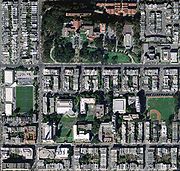
USF's main campus is located on a 50 acres (20.2 ha) setting between the Golden Gate Bridge
and Golden Gate Park
. USF's nickname
is "The Hilltop," appropriately named since the campus is located at the peak of one of San Francisco's major hills. USF's close historical ties with the City and County of San Francisco are reflected in the University's motto
, Pro Urbe et Universitate (For the City and University).
USF's Jesuit-Catholic identity is rooted in the symbolic vision of St. Ignatius of Loyola, the founder of the Jesuit order. Jesuits are characterized by a dedication to both "the life of the mind and the encounter with the world," a mission distinguished by their intellectual and humanitarian activities — notably in the fields of higher education, human rights, and social justice.
USF's inclusive founding mission attracts students and faculty from diverse religious traditions and a broad range of convictions. However, the Jesuit call to justice is evident in work across religious boundaries in community service, reflection retreats, and immersion programs both on campus and abroad.
USF's 8,772-member student body is composed of students from seventy-five countries, all fifty states (including Washington, D.C.
, Puerto Rico
and Guam
), and is ranked in the top 15 national universities for student diversity and international student enrollment. The University is known for its public service efforts (McCarthy Center), its world-renowned Center for the Pacific Rim (Asian and American Studies) and its nationally recognized graduate programs in the fields of law, education, business, nursing, and environmental management.
Academy by the Italian
Jesuits Rev. Anthony Maraschi
, Rev. Joseph Bixio, and Rev. Michael Accolti, USF started in a building along Market Street
in what later became downtown San Francisco. St. Ignatius Academy received its charter on April 30, 1859 from the State of California signed by governor John B. Weller
(the document survived the 1906 fire and earthquake) and changed its name to St. Ignatius College. The original curriculum included Greek
, Spanish
, Latin
, English, French
, Italian
, algebra
, arithmetic, history
, geography
, elocution
, and bookkeeping
. Father Maraschi was not only the college's first president, but also a professor, the college's treasurer, and first pastor
of Saint Ignatius Church.
 A new building was constructed in 1862 to replace the first frame building.
In June 1863, the university awarded its first bachelor of arts
degree.
In 1880, the college moved from Market Street to a new site on the corner of Hayes Street and Van Ness Avenue
(currently occupied by the Davies Symphony Hall). The third St. Ignatius College received little to moderate damage in the 1906 San Francisco earthquake
, but was completely destroyed in the ensuing fire. The campus moved west, to the corner of Hayes and Shrader Streets, close to Golden Gate Park
, where it occupied a hastily constructed structure known as The Shirt Factory (for its resemblance to similar manufacturing buildings of the era) for the next 20+ years. The college moved to its present site on the south slope of Lone Mountain in 1927. The college was built on the site of the former Odd Fellows
, Mount Olivet and Masonic
Cemeteries. In 1913, the city enacted a law prohibiting more burials in the City and County of San Francisco. The remains were transferred to Colma, California
To celebrate its diamond jubilee
in 1930, St. Ignatius College changed its name to the University of San Francisco. According to USF history professor Father John B. Mc Gloin, S.J., the change from college to university was sought by long-time San Francisco Mayor James Rolph Jr.. at the time, running for Governor of California
.
A male-only school for most of its history, USF became fully coeducational in 1964. In 1969, the high school
division, already wholly separate from the university, moved to the western part of San Francisco and became St. Ignatius College Preparatory
. In 1978, the university acquired Lone Mountain College
Today USF is organized into five academic divisions with 8,772 students and 506 faculty members.
In the name of academic freedom
the Jesuit university invites speakers who espouse views at odds with Catholic doctrine.
Conservative Catholics sometimes criticize this practice.
In 2004, Bishop Allen Henry Vigneron
of the Diocese of Oakland forbade the Catholic Voice newspaper to print an advertisement for a seminar called "Imaging the Future Church," sponsored by a group of Catholic lay people who have called for church reforms. Also in 2004, the Cardinal Newman Society
protested the university's selection of Mayor Gavin Newsom
as speaker for the business school's annual commencement ceremony, for his views on abortion
and gay-rights.
October 2005 marked the 150th anniversary of the university's founding.
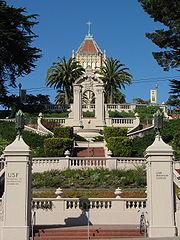
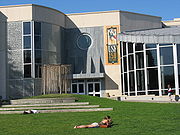

Construction on the building began on May 15, 1949 and was completed on December 3, 1950. At the dedication of the building, USF President William Dunne, S.J. delivered an address commemorating the building as the "first unit in the overall plan for a Greater University of San Francisco." The Geschke Learning Resource Center addition was constructed in 1997. Named for USF Board of Trustees chairmen Charles and his wife Nancy Geschke, it was the first new building constructed on the campus since 1973.
The William Monihan, S.J. Atrium, a 5000 square feet (464.5 m²) open-space study area open to students twenty four hours a day, was included in the addition. An inscription explains the dedication of the space to Fr. Monihan; “Reverend William J. Monihan, S.J. 1914-1996. Jesuit, University Librarian, Bibliophile, San Franciscan, Caring Friend to Many.” Fr. Monihan also was key in the development of the Donohue Rare Book Room, which contains the university’s extraordinarily special collections including rare books, prints and literary and historical manuscripts.
This building houses the Thacher Gallery, a gift of Mary and Carter Thacher. Each year the gallery presents exhibitions diverse in subject and material, including an annual student showcase.” The first exhibit was mounted in the winter of 1998 and the gallery continues to feature up to five exhibits a year with art from students as well as local and international artists.
The Koret Center is named after Joseph and Susan Koret of the Koret Foundation
, a San Francisco philanthropic group that was the primary donor to the construction of the center. The Koret Center sports an Olympic-sized swimming pool, four basketball courts, seven volleyball courts, one racquetball courts, numerous cardiovascular machines, a 3200 square feet (297.3 m²) weight room with an array of high-performance resistance-training machines and free weights, dance studio, aerobics studio, combatives room, student lounge with a flatscreen plasma television and ping pong and billiards tables, equipment rental desk, and fully equipped men's and women's locker rooms. There are many free weekly classes, such as spinning, yoga, pilates, "abs & glutes," and self-defense, and for extra fees, the Koret Center offers personal training, massages, CPR classes, and swimming lessons. The Koret Center is also home to the USF intramural sports department, and hosts games for intramural basketball, volleyball, and indoor soccer. The building has photovoltaic panels that, along with the panels on other buildings around campus, contribute 16 percent of the lower campus' peak electricity needs.
The Koret Center is regarded as one of the finest athletic training centers in San Francisco, and in 2001 it won the "Best Gym and Pool" award from SF Weekly magazine. Besides serving the USF student and faculty communities, the Koret Center sells memberships to residents in surrounding neighborhoods. It also rents gym space to local youth and high school basketball and volleyball teams, and is willing to volunteer its space and services to some outside groups. For example, it hosted the swimming, basketball, and volleyball competitions for the 2008 International Children's Games that were held in San Francisco.

, the University of San Francisco has made an effort to encourage an environmentally conscious student body as well as making changes towards a more sustainable campus. Throughout the university’s campus, students and faculty are involved in multiple clubs and organizations that are dedicated to minimizing the campus’s environmental impact including The Green Team, Back to da Roots, Envision, The Garden Project and Trust the Tap. These groups have brought several changes to the campus including the consumption of fair trade coffee, the creation of organic gardens, composting and the encouragement of re-usable containers for tap water.
In the Fall of 2007, the Garden Project (a Living Learning Community) was formed based around the creating and maintaining of the Campus’ first Organic Garden. Initially headed by Media Studies Professor, Filmmaker, and Organic Gardner Melinda Stone and Architecture Professor Seth Watchel, the Garden houses fruits, vegetables, and herbs with the help and continuous care provided by students and community members, alike.
In 2005, USF installed approximately 12000 square feet (1,114.8 m²) of solar panels to the top of Gleeson Library. In addition to energy-saving windows, high-efficiency lighting, energy efficient skylights, and insulated outer walls, the University has spent $375,000 on solar panels for the recently renovated Kalmanovitz Hall. Combined with Cowell Hall, Gleeson Library, Koret Health and Recreation Center, and the University Center, the added solar panels to Kalmanovitz Hall has boosted USF’s energy production from 71 kilowatt hours to nearly 420 kilowatt hours. USF’s carbon footprint has subsequently been reduced by 330 tons a year, says Everette Ersery, the assistant director of facilities. Ersery was quoted in the USF Magazine saying “it has significantly reduced our carbon footprint and electrical bill, while reducing the amount of energy we and PG&E use.” The solar panels produce 16 percent of the lower campus’s energy needs. The assistant vice president of facilities management said that solar heated rooftop water pipes heat 50 percent of the water used in residence halls.
University of San Francisco ranked fifth out of 200 schools in a nationwide recycling competition in the category of targeted material- Service Organics. The University has also established a composting program that began in September 2008. The new program composts food waste from the kitchen and cafeteria. Through the composting program the University of San Francisco has managed to prevent about 36 tons of material per month from being thrown out.
 University of San Francisco is chartered as a non-profit organization and is governed by a privately-appointed board of trustees, along with the University President, the University Chancellor
, the University Provost
and Vice-presidents, and the Dean
s. The board consists of a maximum of 45 voting members who serve three year terms and is currently chaired by Claudio M. Chiuchiarelli. The trustees serve without compensation. The board of trustees delegates its power by appointing a President to serve as the chief executive of the university. The current president (since 2000) is Rev. Stephen A. Privett, S. J.
The President, according to USF Bylaws, is specifically responsible for articulating and advancing the Jesuit Catholic character of the university. USF possesses an endowment
of $225 million (as of August 2008)
USF's academics are organized into five schools which offer courses of study at the graduate
and undergraduate level, with two more being primarily focused on graduate education, while offering select opportunities for undergraduate students. USF offers over 50 degrees in several departments. The university also operates four regional campuses in Sacramento
, San Ramon
, Santa Rosa
, and Cupertino. USF is accredited by the Western Association of Schools and Colleges
, and the School of Business and Professional Studies (BPS) is accredited by the AACSB.
Undergraduate tuition at USF is $37,040 for the 2011-2012 school year. The University is organized as follows:
's College and University rankings scored USF as a top tier (Tier I), National University. USF is known for its emphasis on service learning and its public service efforts through its Leo T. McCarthy Center for Public Service and the Common Good. These values are reflected in the university's core curriculum and various clubs and academic programs, such as the student-developed campaign funding site whosfundingwhom.org and USF's Performing Arts and Social Justice major, which is the only undergraduate program of its kind in the nation. The Fromm Institute for Lifelong Learning
offers noncredit courses with no assignments or grades for adults age 50 and over.
Academically, several of the University's programs have received notable rankings over the years. According to the Princeton Review, USF’s McLaren School of Business is a top 50 business school. The USF MBA program is consistently ranked in the top ten in the nation for business schools with the greatest opportunities for minority students, and is currently ranked 6th. In 2005, the MBA Entrepreneurship Program is ranked 25th in the nation. In 2009, USNWR ranked USF's School of Nursing 54th in the country.
The School of Law maintains its own exchange programs with Trinity College
in Dublin, Ireland
and Charles University in Prague
, Czech Republic
. Relevant international coursework includes the study of European Community Law, International Business Transactions, and European Constitutionalism. The latter has been taught by Vojtech Cepl, the principal drafter of the post-communist Constitution of the Czech Republic.
Associated Students of the University of San Francisco (ASUSF) Senate is the student body governance organization responsible for organizing major campus events, voicing student concern and reviewing the ASUSF budget.
USF's professional and academic organizations include chapters of many national and international groups including the Lambda Iota Tau
English Honor Society Sigma Tau Delta
, Jesuit Honor Society Alpha Sigma Nu
, the National Society of Collegiate Scholars
, National Political Science Honor Society Pi Sigma Alpha
, Biological Honor Society Tri Beta
, Accounting and Finance Honor Society Beta Alpha Psi
and Psychology Honor Society Psi Chi
. Professional organizations include the Family Business Association, USF Pre-Dental Society, Hospitality Management Association, the Nursing Students Association and the Entrepreneurship Club.
Religious and spiritual organizations on campus include the Muslim Student Union, the USF chapter of InterVarsity Christian Fellowship
and the USF Hillel: The Foundation for Jewish Campus Life
.
USF leisure and hobby organizations include a chapter of national organization Best Buddies as well as Outdoors and Environmental Education Club, USF Queer Alliance, San Quentin TRUST Alliance, Knitting for Neighbors, Back to the Roots, Surf and Skate Club, and the Animation Comics and Video Games (ACV) Club.
Cultural and multicultural organizations around campus serve international students, Indian students, Black students, Latin American students and Hawaiian Students. There are also groups specifically for women of color and Latina women.
Social justice clubs on campus include chapters of Amnesty International
, School of the Americas Watch
, Up 'til Dawn
and Invisible Children
. There is also a Politics Society, Philosophy Club, Women in Media Club and Women in Science Club.
is the official student weekly newspaper of the University of San Francisco and is sponsored by the Associated Students of the University of San Francisco (ASUSF). The Foghorn was founded in 1926, and was first called "The Ignatian". In the 1930s, members of The Ignation changed its name to "San Francisco Foghorn" to reflect the University's decision to change its name from St.Ignatius College to University of San Francisco. The Foghorn has played a significant role on campus throughout the years, and has some notable alumni—from the likes of Pierre Salinger
, editor of the San Francisco Chronicle and Press Secretary for President John F. Kennedy
, to well known author and historian Kevin Starr
, who was a one-time California Lieutenant Governor. The Foghorn gained national recognition in 1961, when the American Newspaper Publishers Association awarded it with a "Pacemaker Award". The Foghorn has been honored by the Associated Collegiate Press
which deemed it "College Paper of the Year" in 1998.
USF has a radio station, KUSF
which broadcasts online. The station had broadcasted on radio frequency 90.3 FM since 1977, until the station's license was sold by the University on January 18, 2011. The University announced that they had sold KUSF's license to a Southern California based classical radio station for $3.75 million; the next day, a protest was held by student and community DJs and supporters against the newly proposed online-only format. KUSF has garnered international attention for its diverse musical programming, which varies from rock to hip hop to world music. KUSF is the recipient of numerous awards, including many public service awards for the station's long-running weekly community service series. USF's other radio station, KDNZ, is student-run and-programmed.
The University of San Francisco has one television station, USFtv http://youtube.com/usftv, which is broadcast on Channel 35 in the dormitories and around campus. The station was founded in 2006, and is entirely student-run. The station features a variety of content, including news, sports, cultural programming. In 2008 USFtv students collaborated with Wyclef Jean
to create a music video for his song "If I Was President."
The Ignatian is USF's annual "literary magazine" that is published every spring. It has traditionally printed a wide array of different content, running from philosophical pieces to personal essays, short fiction, poetry, and photography. Its most recent volume (volume 21) was released on May 2, 2009.
The College Players, founded in 1863, is the oldest student-run theater group west of the Mississippi and the second oldest in the United States. Their annual production of The Vagina Monologues, distributes 100 percent of the show's proceeds to women charities around the Bay Area.
ASUSF voices is a collaboration between the associated students of USF and the Performing Arts Department. It contains a variety of choral ensembles including jazz and other popular vocal styles.
The USF Contemporary Mass Ensemble is a group of collective USF alumni, either vocal or instrumental, that perform during Mass every Sunday in St. Ignatius Church.
The USF dance program is affiliated with the Performing Arts and Social Justice Major. Students can enroll in tradition and modern dance classes. Students are allowed to participate in the USF Dance Ensemble, which provides the opportunity for students to work with professional and student choreographers.
, Alpha Phi Omega
, Alpha Sigma Nu
, Beta Alpha Psi
, Delta Lambda Phi
Interest Group, Delta Sigma Pi
, Lambda Theta Phi
, Omicron Theta Chi, Psi Chi
, Sigma Alpha Epsilon
, Theta Alpha Kappa
and Tri-Beta. USF also has four sororities: Delta Zeta
, Lambda Sigma Gamma
, Omicron Theta Chi, Delta Sigma Theta
, Tri-Gamma and Kappa Alpha Theta
. All of the sororities and fraternities that wish to be recognized by the University must participate in Greek Council. The purpose of Greek Council is to aid in the development of the university’s recognized Greek organizations and their individual members. Every year chapters participate in some of the same activities such as; mixers and socials, Thanksgiving potluck, Christmas clothing drive, Homecoming, USF Idol, and Greek Games.
The University of San Francisco enrolled 5,278 undergraduates, 2,518 graduate students, and 738 law students in Fall 2007. Women made up 61.9% of the student body and students originated from all fifty states and sixty-nine foreign countries. 43.5% of students are Roman Catholic, 6.8% are Protestant, 6.3% are irreligious
, 2.2% are Jewish
, 2.1% are Buddhist, and 0.8% are Hindu
and Muslim
respectively. 82.4% of students matriculated after their first year, the 4-year graduation rate is 49%, and the 6-year graduation rate is 65%.
In the 1800s, USF's diversity (then St. Ignatius College) was mostly a reflection of the diversity inherent in San Francisco. For example, when German and French
migrants came to San Francisco, the population of European students in USF increased as well. USF's student population diversity has increased throughout the last century. Filipinos
started attending the university in the 1920s, after the United State's annexation of Philippines
. In 1960s, Mexicans, African Americans, Chinese
, Norwegians
came to USF. The 1970s marked the start of students from Hong Kong
, Japan
and Indonesia
, coming to USF. In 1964, 473 women enrolled as full-time undergraduates marking the first time women attended USF.
A school census of Fall 1993 undergraduate freshmen indicated 42.66% Whites, 23% Asian Americans, 11% International students, 10% Hispanic
/Latinos. 5% African Americans, 0.34% Native Americans
and 8% of students in the census chose not to specify. Enrollment in Fall 1993 was a total of 7,662 students, 62.5% of whom were undergraduates. In 2002, a plan was developed by the university to increase the diversity of the USF student population. This plan was enacted by university officials, who also enlisted the help of USF alumni to "assemble a mix of students that will help USF achieve its vision: to educate leaders who will fashion a more humane and just world." In 2002, 64.4% of undergraduates were female and 35.6% were male. The plan sought to address concerns of the gender ratio and increase the percentage of international students at USF from 9.4% to around 15%. A statement made by USF President, Stephen A. Privett
, S.J. (2000 to present) in an interview by USF Magazine highlighted the importance the university placed on the diversity of its student population. The USF President also clarified the scope of diversity to include "ethnicity, gender and life experiences." In December 2006, USF was awarded a $500,000 grant by the Lumina Foundation for Education to examine "how best to recruit and retain low-income, first-generation, and ethnic minority students at Jesuit universities."
Surveys show that USF students consistently value diversity at USF. A survey conducted for graduating students on 24 May 2007 by USF's Office of Student Enrichment Programs indicated that 86% felt that individual ethnicity, religion, race and other differences were valued at USF. The same survey records that 70% of the graduating students agreed that their appreciation of those differences increased while they were at USF. The result was consistent with past surveys conducted on graduating students, where over the period from May 1997 to December 1999, the result ranged from 78% to 84% for students valued the mentioned differences and 63% to 72% for those who "felt their appreciation of differences increased while at USF." In 2004, a survey by UCLA's Higher Education Research Institute
indicated that 80% of USF students "considered it essential or very important that their undergraduate experience" developed their personal values. This statistic was higher than the national average sampling of 67%.
The University of San Francisco actively recruits and enrolls over 700 international students from over 70 countries, including: Kenya, Nigeria, Ethiopia, China, Indonesia, Taiwan, Thailand, India, Costa Rica, El Salvador, Brazil, Argentina, Chile, Canada, Mexico, Russia, Moldova, Kazakhstan, France, Norway, Austria, United Kingdom, Saudi Arabia, Kuwait, Israel, Australia, and New Zealand, among others. USF also hosts J-1 exchange and Intensive English Program student participants.
The University of San Francisco attracted 783 international students (9.0% of the student body) in 2007. International students have a dedicated orientation period and a variety of internationally-oriented student groups like the International Student Association, Global Living Community, an International Advisory Council, and an International Network Program. USF sponsors an annual International Education Week with an international fair featuring consulates in the San Francisco area, storytelling opportunities, educational speakers, and a performance event called Culturescape.
, USF is classified as a more selective university. As of 2006, nine admissions counselors were in charge of selecting students for entry. In an article published in a Fall 2006 issue of the USF Magazine, Sandoval, an admissions counselor revealed certain factors that the university used to filter its applicants. The factors mentioned were: high school GPAs, involvement in extra curricular activities, languages spoken, "first in family to go to college", letters of recommendation, test scores and in particular, the students' essays. Sandoval also mentioned in the article that the best essays were "specific, genuine, honest, and personal. "
In Fall 2008, 67% of freshman undergraduates who applied were admitted. USF enrolled 4,869 undergraduate students. The admitted freshman class had an average combined SAT score of 1270, an average composite ACT score of 25, and an average high school GPA of 3.5.
support. For the same year, 64.2% of graduate students received some form of financial aid.
The increase of financial aid given by the university to students have generally exceed the rate of growth of USF's tuition fees. Over 10 years from 1993 to 2003, annual tuition fees grew by 65% but financial aid experienced 160% growth. Annual tuition in '93/94 was $13,200 and total financial aid was $12.9 million. By '02/03, annual tuition had increased to $21,700 but financial aid experienced a larger increase to $33.6 million. However, in a USF student guide published by The College Prowler in 2006 , USF students rated high tuition fees as one of "the ten worst things about USF."
 USF competes in the NCAA's Division I and is a charter member of the West Coast Conference
, along with local rivals Santa Clara University
and Saint Mary's College of California
. Sports offered are men’s and women’s basketball
, cross country
, golf
, soccer, tennis
, track and field
, as well as men’s baseball
and women's volleyball
. USF has won 12 NCAA championships, 1 NIT championships, and 42 WCC championships. USF’s mascot is the Don
and its colors are green
and gold
.
, S.J. organized ball games as recreation for the first students. However, intercollegiate competition only dates back to 1907, when then-St. Ignatius College began playing organized baseball
, basketball
, and rugby
against other local colleges and high schools. Rivalries with neighboring Santa Clara University
and Saint Mary's College of California
have their origins in this early period.
, Gino Marchetti
, Bob St. Clair
, Dick Stanfel
, Ed Brown
, Lou Stephens, Burl Toler
, Joe Scudero
, Roy Barni
, Mike Mergen, Merrill Peacock, and Ralph Thomas
). Five became NFL Pro-Bowlers, and Gino Marchetti
, Ollie Matson
, and Bob St. Clair
later were inducted into the NFL Hall of Fame—a record for one college team. The team also had another first; Burl Toler became the first African American official in the NFL.
Even the future NFL Commissioner, Pete Rozelle, played a role as the Dons' Athletic Publicist. At the height of their success, the team experienced one of the greatest snubs in college football history.
Due to the team having two African-American star players, Ollie Matson and Burl Toler, they were not invited to play in any of the college football bowl games hosted by the SEC (Southern Conference
). This resulted in the team being invited to the Orange Bowl without Toler and Matson. Outraged, the team refused the invitation saying, “ ‘No, we’re not going to leave ‘em at home,’ said guard Dick Columbini. ‘We’re going to play with ‘em or we’re not going to play’”. As a result of the team's refusal to play in the Orange Bowl, the USF Athletic Department was forced to drop its football program in 1952, due to a deficit in department funds.
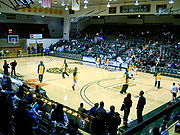
USF is best known for its men's basketball program
. The men's team won three national championships: the 1949 NIT Championship, with Don Lofgran
as MVP, and the 1955 and 1956 NCAA National Championships, going undefeated in the 1956 season. Led by NBA Hall of Famers Bill Russell
and K.C. Jones, the 1956 Dons became the first undefeated team to win a national championship, winning a then-record 60 games in a row from 1954 to 1956 before losing an exhibition game to the USA Men's Olympic Basketball team. Also of note, the 1954-1955 USF basketball teams became the first major college or university basketball team to win a national title with three African American starters (Russell, Jones, and Hal Perry
).
On December 26, 2007, the university hired 798-win coach Eddie Sutton
to replace Jessie Evans
. Sutton got his 800th career win as a college basketball head coach when the Dons beat Pepperdine, 85-82.
On April 18, 2008, USF announced the hiring of Rex Walters
, former coach of Florida Atlantic University
, as the new men's basketball coach, succeeding Eddie Sutton. Walters is an NBA veteran, originally the 16th overall pick by the New Jersey Nets
in the 1993 NBA Draft
.
, cofounder of Starbucks
, philanthropist Gordon Getty
, President and CEO of Intel Paul S. Otellini, former NFL commissioner Pete Rozelle
, Pierre Salinger
, a United States senator and press secretary for President John F. Kennedy
, and Alejandro Toledo
, the 46th president of Peru.
Notable faculty members include Academy Award nominee Sam Green
, director of The Weather Underground
and Biology professor Paul Chien
, known for his research in physiology
and ecology
. Also, the University has awarded a number of people with honorary degrees. Some of the recipients include the 14th Dalai Lama
, former South Korean president Kim Dae-Jung, former Philippine president Gloria Macapagal-Arroyo
, Iranian human rights activist Shirin Ebadi
, and President of Ireland Mary McAleese
.
Association of Jesuit Colleges and Universities
The Association of Jesuit Colleges and Universities is a consortium of the 28 Jesuit colleges and universities and two theological centers in the United States committed to advancing academic excellence by promoting and coordinating collaborative activities, sharing resources, and advocating and...
located in San Francisco, California
San Francisco, California
San Francisco , officially the City and County of San Francisco, is the financial, cultural, and transportation center of the San Francisco Bay Area, a region of 7.15 million people which includes San Jose and Oakland...
. Founded in 1855, USF was established as the first university in San Francisco. It is the second oldest institution for higher learning in California and the tenth-oldest university of the Association of Jesuit Colleges and Universities
Association of Jesuit Colleges and Universities
The Association of Jesuit Colleges and Universities is a consortium of the 28 Jesuit colleges and universities and two theological centers in the United States committed to advancing academic excellence by promoting and coordinating collaborative activities, sharing resources, and advocating and...
. USF is the eighth largest Jesuit university
Association of Jesuit Colleges and Universities
The Association of Jesuit Colleges and Universities is a consortium of the 28 Jesuit colleges and universities and two theological centers in the United States committed to advancing academic excellence by promoting and coordinating collaborative activities, sharing resources, and advocating and...
in the United States.
USF's main campus is located on a 50 acres (20.2 ha) setting between the Golden Gate Bridge
Golden Gate Bridge
The Golden Gate Bridge is a suspension bridge spanning the Golden Gate, the opening of the San Francisco Bay into the Pacific Ocean. As part of both U.S. Route 101 and California State Route 1, the structure links the city of San Francisco, on the northern tip of the San Francisco Peninsula, to...
and Golden Gate Park
Golden Gate Park
Golden Gate Park, located in San Francisco, California, is a large urban park consisting of of public grounds. Configured as a rectangle, it is similar in shape but 20% larger than Central Park in New York, to which it is often compared. It is over three miles long east to west, and about half a...
. USF's nickname
Nickname
A nickname is "a usually familiar or humorous but sometimes pointed or cruel name given to a person or place, as a supposedly appropriate replacement for or addition to the proper name.", or a name similar in origin and pronunciation from the original name....
is "The Hilltop," appropriately named since the campus is located at the peak of one of San Francisco's major hills. USF's close historical ties with the City and County of San Francisco are reflected in the University's motto
Motto
A motto is a phrase meant to formally summarize the general motivation or intention of a social group or organization. A motto may be in any language, but Latin is the most used. The local language is usual in the mottoes of governments...
, Pro Urbe et Universitate (For the City and University).
USF's Jesuit-Catholic identity is rooted in the symbolic vision of St. Ignatius of Loyola, the founder of the Jesuit order. Jesuits are characterized by a dedication to both "the life of the mind and the encounter with the world," a mission distinguished by their intellectual and humanitarian activities — notably in the fields of higher education, human rights, and social justice.
USF's inclusive founding mission attracts students and faculty from diverse religious traditions and a broad range of convictions. However, the Jesuit call to justice is evident in work across religious boundaries in community service, reflection retreats, and immersion programs both on campus and abroad.
USF's 8,772-member student body is composed of students from seventy-five countries, all fifty states (including Washington, D.C.
Washington, D.C.
Washington, D.C., formally the District of Columbia and commonly referred to as Washington, "the District", or simply D.C., is the capital of the United States. On July 16, 1790, the United States Congress approved the creation of a permanent national capital as permitted by the U.S. Constitution....
, Puerto Rico
Puerto Rico
Puerto Rico , officially the Commonwealth of Puerto Rico , is an unincorporated territory of the United States, located in the northeastern Caribbean, east of the Dominican Republic and west of both the United States Virgin Islands and the British Virgin Islands.Puerto Rico comprises an...
and Guam
Guam
Guam is an organized, unincorporated territory of the United States located in the western Pacific Ocean. It is one of five U.S. territories with an established civilian government. Guam is listed as one of 16 Non-Self-Governing Territories by the Special Committee on Decolonization of the United...
), and is ranked in the top 15 national universities for student diversity and international student enrollment. The University is known for its public service efforts (McCarthy Center), its world-renowned Center for the Pacific Rim (Asian and American Studies) and its nationally recognized graduate programs in the fields of law, education, business, nursing, and environmental management.
History
Founded in 1855 as Saint IgnatiusIgnatius of Loyola
Ignatius of Loyola was a Spanish knight from a Basque noble family, hermit, priest since 1537, and theologian, who founded the Society of Jesus and was its first Superior General. Ignatius emerged as a religious leader during the Counter-Reformation...
Academy by the Italian
Italy
Italy , officially the Italian Republic languages]] under the European Charter for Regional or Minority Languages. In each of these, Italy's official name is as follows:;;;;;;;;), is a unitary parliamentary republic in South-Central Europe. To the north it borders France, Switzerland, Austria and...
Jesuits Rev. Anthony Maraschi
Anthony Maraschi
The Reverend Anthony Maraschi, S.J. was an Italian-born priest of the Society of Jesus. He was a founder of the University of San Francisco and Saint Ignatius College Preparatory as well as the first pastor of Saint Ignatius Church in San Francisco, California.Born in Piedmont, Italy in 1820,...
, Rev. Joseph Bixio, and Rev. Michael Accolti, USF started in a building along Market Street
Market Street (San Francisco)
Market Street is an important thoroughfare in San Francisco, California. It begins at The Embarcadero in front of the Ferry Building at the northeastern edge of the city and runs southwest through downtown, passing the Civic Center and the Castro District, to the intersection with Corbett Avenue in...
in what later became downtown San Francisco. St. Ignatius Academy received its charter on April 30, 1859 from the State of California signed by governor John B. Weller
John B. Weller
John B. Weller was the fifth Governor of California from January 8, 1858 to January 9, 1860 and a Congressman from Ohio, U.S. senator from California, and minister to Mexico.-Life:...
(the document survived the 1906 fire and earthquake) and changed its name to St. Ignatius College. The original curriculum included Greek
Greek language
Greek is an independent branch of the Indo-European family of languages. Native to the southern Balkans, it has the longest documented history of any Indo-European language, spanning 34 centuries of written records. Its writing system has been the Greek alphabet for the majority of its history;...
, Spanish
Spanish language
Spanish , also known as Castilian , is a Romance language in the Ibero-Romance group that evolved from several languages and dialects in central-northern Iberia around the 9th century and gradually spread with the expansion of the Kingdom of Castile into central and southern Iberia during the...
, Latin
Latin
Latin is an Italic language originally spoken in Latium and Ancient Rome. It, along with most European languages, is a descendant of the ancient Proto-Indo-European language. Although it is considered a dead language, a number of scholars and members of the Christian clergy speak it fluently, and...
, English, French
French language
French is a Romance language spoken as a first language in France, the Romandy region in Switzerland, Wallonia and Brussels in Belgium, Monaco, the regions of Quebec and Acadia in Canada, and by various communities elsewhere. Second-language speakers of French are distributed throughout many parts...
, Italian
Italian language
Italian is a Romance language spoken mainly in Europe: Italy, Switzerland, San Marino, Vatican City, by minorities in Malta, Monaco, Croatia, Slovenia, France, Libya, Eritrea, and Somalia, and by immigrant communities in the Americas and Australia...
, algebra
Algebra
Algebra is the branch of mathematics concerning the study of the rules of operations and relations, and the constructions and concepts arising from them, including terms, polynomials, equations and algebraic structures...
, arithmetic, history
History
History is the discovery, collection, organization, and presentation of information about past events. History can also mean the period of time after writing was invented. Scholars who write about history are called historians...
, geography
Geography
Geography is the science that studies the lands, features, inhabitants, and phenomena of Earth. A literal translation would be "to describe or write about the Earth". The first person to use the word "geography" was Eratosthenes...
, elocution
Elocution
Elocution is the study of formal speaking in pronunciation, grammar, style, and tone.-History:In Western classical rhetoric, elocution was one of the five core disciplines of pronunciation, which was the art of delivering speeches. Orators were trained not only on proper diction, but on the proper...
, and bookkeeping
Bookkeeping
Bookkeeping is the recording of financial transactions. Transactions include sales, purchases, income, receipts and payments by an individual or organization. Bookkeeping is usually performed by a bookkeeper. Bookkeeping should not be confused with accounting. The accounting process is usually...
. Father Maraschi was not only the college's first president, but also a professor, the college's treasurer, and first pastor
Pastor
The word pastor usually refers to an ordained leader of a Christian congregation. When used as an ecclesiastical styling or title, this role may be abbreviated to "Pr." or often "Ps"....
of Saint Ignatius Church.
In June 1863, the university awarded its first bachelor of arts
Bachelor of Arts
A Bachelor of Arts , from the Latin artium baccalaureus, is a bachelor's degree awarded for an undergraduate course or program in either the liberal arts, the sciences, or both...
degree.
In 1880, the college moved from Market Street to a new site on the corner of Hayes Street and Van Ness Avenue
Van Ness Avenue (San Francisco)
Van Ness Avenue is a north-south thoroughfare in San Francisco, California, running from Market St north to the Bay. Originally named Marlette Street, the street was renamed Van Ness Avenue in honor of the city's seventh mayor, James Van Ness. Van Ness Avenue begins at Market Street near the Civic...
(currently occupied by the Davies Symphony Hall). The third St. Ignatius College received little to moderate damage in the 1906 San Francisco earthquake
1906 San Francisco earthquake
The San Francisco earthquake of 1906 was a major earthquake that struck San Francisco, California, and the coast of Northern California at 5:12 a.m. on Wednesday, April 18, 1906. The most widely accepted estimate for the magnitude of the earthquake is a moment magnitude of 7.9; however, other...
, but was completely destroyed in the ensuing fire. The campus moved west, to the corner of Hayes and Shrader Streets, close to Golden Gate Park
Golden Gate Park
Golden Gate Park, located in San Francisco, California, is a large urban park consisting of of public grounds. Configured as a rectangle, it is similar in shape but 20% larger than Central Park in New York, to which it is often compared. It is over three miles long east to west, and about half a...
, where it occupied a hastily constructed structure known as The Shirt Factory (for its resemblance to similar manufacturing buildings of the era) for the next 20+ years. The college moved to its present site on the south slope of Lone Mountain in 1927. The college was built on the site of the former Odd Fellows
Odd Fellows
Odd Fellows is a name broadly referring to any of a large number of friendly societies, fraternal and service organizations and/or Lodges.-Societies using the name "Odd Fellows" or variations:...
, Mount Olivet and Masonic
Freemasonry
Freemasonry is a fraternal organisation that arose from obscure origins in the late 16th to early 17th century. Freemasonry now exists in various forms all over the world, with a membership estimated at around six million, including approximately 150,000 under the jurisdictions of the Grand Lodge...
Cemeteries. In 1913, the city enacted a law prohibiting more burials in the City and County of San Francisco. The remains were transferred to Colma, California
To celebrate its diamond jubilee
Diamond Jubilee
A Diamond Jubilee is a celebration held to mark a 60th anniversary in the case of a person or a 75th anniversary in the case of an event.- Thailand :...
in 1930, St. Ignatius College changed its name to the University of San Francisco. According to USF history professor Father John B. Mc Gloin, S.J., the change from college to university was sought by long-time San Francisco Mayor James Rolph Jr.. at the time, running for Governor of California
Governor of California
The Governor of California is the chief executive of the California state government, whose responsibilities include making annual State of the State addresses to the California State Legislature, submitting the budget, and ensuring that state laws are enforced...
.
A male-only school for most of its history, USF became fully coeducational in 1964. In 1969, the high school
High school
High school is a term used in parts of the English speaking world to describe institutions which provide all or part of secondary education. The term is often incorporated into the name of such institutions....
division, already wholly separate from the university, moved to the western part of San Francisco and became St. Ignatius College Preparatory
St. Ignatius College Preparatory
St. Ignatius College Preparatory is a preparatory school in the Jesuit tradition serving the San Francisco Bay Area since 1855. Located in the Roman Catholic Archdiocese of San Francisco, in the Sunset District of San Francisco, St. Ignatius is one of the oldest secondary schools in the U.S. state...
. In 1978, the university acquired Lone Mountain College
Lone Mountain College
Lone Mountain College was a college acquired by the University of San Francisco in 1978. It was founded by the Religious of the Sacred Heart as Sacred Heart Academy in Menlo Park, California in 1898 and became College of the Sacred Heart in 1921...
Today USF is organized into five academic divisions with 8,772 students and 506 faculty members.
In the name of academic freedom
Academic freedom
Academic freedom is the belief that the freedom of inquiry by students and faculty members is essential to the mission of the academy, and that scholars should have freedom to teach or communicate ideas or facts without being targeted for repression, job loss, or imprisonment.Academic freedom is a...
the Jesuit university invites speakers who espouse views at odds with Catholic doctrine.
Conservative Catholics sometimes criticize this practice.
In 2004, Bishop Allen Henry Vigneron
Allen Henry Vigneron
-References:-External links:[Oakland Diocese Biography http://www.oakdiocese.org/notes.htm]...
of the Diocese of Oakland forbade the Catholic Voice newspaper to print an advertisement for a seminar called "Imaging the Future Church," sponsored by a group of Catholic lay people who have called for church reforms. Also in 2004, the Cardinal Newman Society
Cardinal Newman Society
The Cardinal Newman Society is a 501 tax-exempt, nonprofit organization founded in 1993 and dedicated to what it calls the renewal of Catholic identity on the campuses of colleges and universities in the United States...
protested the university's selection of Mayor Gavin Newsom
Gavin Newsom
Gavin Christopher Newsom is an American politician who is the 49th and current Lieutenant Governor of California. Previously, he was the 42nd Mayor of San Francisco, and was elected in 2003 to succeed Willie Brown, becoming San Francisco's youngest mayor in 100 years. Newsom was re-elected in 2007...
as speaker for the business school's annual commencement ceremony, for his views on abortion
Abortion
Abortion is defined as the termination of pregnancy by the removal or expulsion from the uterus of a fetus or embryo prior to viability. An abortion can occur spontaneously, in which case it is usually called a miscarriage, or it can be purposely induced...
and gay-rights.
October 2005 marked the 150th anniversary of the university's founding.
Campus
Academic buildings
- Professional Studies (PS) - Formerly Lincoln University, the University acquired the building in 1999 and houses the Professional Studies division of the School of Business and Professional Studies.
- Cowell Hall (CO) - Named after San Francisco philanthropistPhilanthropistA philanthropist is someone who engages in philanthropy; that is, someone who donates his or her time, money, and/or reputation to charitable causes...
Samuel Cowell, Cowell Hall houses offices and classrooms for the University of San Francisco School of NursingUniversity of San Francisco School of NursingThe University of San Francisco School of Nursing is a private nursing school located in San Francisco, California. First established in 1954, the school has approximately 800 students.-Campus:...
and other departments. It's also home to the school's Learning and Writing Center. - Harney Science Center (HR) - Harney houses classrooms, the offices of the College of Arts and Sciences and the departmental and faculty offices of the Sciences department.
- Kalmanovitz Hall (KA) - This building houses faculty offices, classrooms, conference rooms and writing, media, language and psychology laboratories. Once named Campion Hall after the EnglishEnglandEngland is a country that is part of the United Kingdom. It shares land borders with Scotland to the north and Wales to the west; the Irish Sea is to the north west, the Celtic Sea to the south west, with the North Sea to the east and the English Channel to the south separating it from continental...
Jesuit martyrMartyrA martyr is somebody who suffers persecution and death for refusing to renounce, or accept, a belief or cause, usually religious.-Meaning:...
Saint Edmund CampionEdmund CampionSaint Edmund Campion, S.J. was an English Roman Catholic martyr and Jesuit priest. While conducting an underground ministry in officially Protestant England, Campion was arrested by priest hunters. Convicted of high treason by a kangaroo court, he was hanged, drawn and quartered at Tyburn...
, the building undertook extensive renovation in the Summer of 2008. The renovation is now complete and the building is renamed Kalmanovitz Hall, named after brewing magnate Paul KalmanovitzPaul KalmanovitzPaul Kalmanovitz was a millionaire brewing and real estate magnate best known for owning all or part of several national breweries and their products, including Falstaff Brewing Company and Pabst Brewing Company. Most of the Kalmanovitz Estate was left to create a charitable foundation for...
. Next to the hall is Ovila Amphitheater featuring a RenaissanceRenaissanceThe Renaissance was a cultural movement that spanned roughly the 14th to the 17th century, beginning in Italy in the Late Middle Ages and later spreading to the rest of Europe. The term is also used more loosely to refer to the historical era, but since the changes of the Renaissance were not...
-era church portal from Santa Maria de OvilaSanta Maria de OvilaSanta María de Óvila is a former Cistercian monastery built in Spain in the 13th century on the Tagus River near Trillo, Guadalajara; about northeast of Madrid. During prosperous times over the next four centuries, construction projects expanded and improved the monastery...
, a monastery in Spain. - Koret Law Center - Koret is home of USF's School of Law, containing both the Dorainne Zief Law Library (ZL) and Kendrick Hall (KN), the original law school building.
- Lone Mountain (LM) - Formerly San Francisco College for Women or Lone Mountain CollegeLone Mountain CollegeLone Mountain College was a college acquired by the University of San Francisco in 1978. It was founded by the Religious of the Sacred Heart as Sacred Heart Academy in Menlo Park, California in 1898 and became College of the Sacred Heart in 1921...
, the Lone Mountain campus now houses faculty offices, classrooms, and housing for 180 students. It also houses the offices of the University President and Vice-Presidents. - McLaren Conference Center (MC) – Part of Phelan Hall's west wing, McLaren houses offices and classrooms for the School of Business and Professional Studies (BPS). McLaren Center also includes Malloy Hall (MH).
- School of Education (ED) - The Education Building houses the administrative offices of the School of Education as well as classrooms and Presentation Theater (PT). It was formerly Presentation High School until it was purchased by USF.
- University Center (UC) - The University Center houses departmental and faculty offices, as well as ASUSF offices and facilities like the Career Services Center and the main student cafeteria, and was completely renovated during the summer of 2010.
- John Lo Schiavo, S.J., Center for Science and Innovation (CSI) - The 59,000-gross-square-foot project will create gathering and study space for the entire campus community, with particular aims to push the growing links between the sciences and other disciplines, from nursing and health promotion, to business and entrepreneurship. Ground was broken on December 10, 2010.
Gleeson Library and the Geschke Learning Resource Center
The Richard A. Gleeson, S.J. Library is located in the center of the lower campus of University of San Francisco. As of 2005, the library held more than 680,000 books, 130,000 journals, 2,200 periodical subscriptions and 900,000 other materials including microforms, government documents, CD-ROMS, videos and audios. The building includes the Geschke Learning Resource Center, the library, The Thacher Gallery, The Donohue Rare Book Room and the William Monihan, S.J. Atrium.Construction on the building began on May 15, 1949 and was completed on December 3, 1950. At the dedication of the building, USF President William Dunne, S.J. delivered an address commemorating the building as the "first unit in the overall plan for a Greater University of San Francisco." The Geschke Learning Resource Center addition was constructed in 1997. Named for USF Board of Trustees chairmen Charles and his wife Nancy Geschke, it was the first new building constructed on the campus since 1973.
The William Monihan, S.J. Atrium, a 5000 square feet (464.5 m²) open-space study area open to students twenty four hours a day, was included in the addition. An inscription explains the dedication of the space to Fr. Monihan; “Reverend William J. Monihan, S.J. 1914-1996. Jesuit, University Librarian, Bibliophile, San Franciscan, Caring Friend to Many.” Fr. Monihan also was key in the development of the Donohue Rare Book Room, which contains the university’s extraordinarily special collections including rare books, prints and literary and historical manuscripts.
This building houses the Thacher Gallery, a gift of Mary and Carter Thacher. Each year the gallery presents exhibitions diverse in subject and material, including an annual student showcase.” The first exhibit was mounted in the winter of 1998 and the gallery continues to feature up to five exhibits a year with art from students as well as local and international artists.
Athletic facilities
Koret Health and Recreation Center (KO) - The Koret Health and Recreation Center (called "the Koret Center" by students and staff) is a full-service, state of the art athletic facility serving USF students, staff, and residents of the surrounding community. Construction on the Koret Center began in 1987 on the former site of Saint Ignatius High School. When Saint Ignatius High School departed in 1969; the University renamed the building Loyola Hall. The Koret Center opened in 1989, with final construction costs totalling 22 million dollars. Many colleges and universities across the nation have recently followed suit by building expensive, brand new athletic facilities to keep up with increasing demand for such facilities from incoming students and student-athletes.The Koret Center is named after Joseph and Susan Koret of the Koret Foundation
Koret Foundation
The Koret Foundation, along with the Koret Fund, is a private foundation based in San Francisco, California. The foundation was organized in 1978 by Joseph and Stephanie Koret, along with Tad Taube, their family friend and Chief Executive Officer of their women's sportswear company, Korett of...
, a San Francisco philanthropic group that was the primary donor to the construction of the center. The Koret Center sports an Olympic-sized swimming pool, four basketball courts, seven volleyball courts, one racquetball courts, numerous cardiovascular machines, a 3200 square feet (297.3 m²) weight room with an array of high-performance resistance-training machines and free weights, dance studio, aerobics studio, combatives room, student lounge with a flatscreen plasma television and ping pong and billiards tables, equipment rental desk, and fully equipped men's and women's locker rooms. There are many free weekly classes, such as spinning, yoga, pilates, "abs & glutes," and self-defense, and for extra fees, the Koret Center offers personal training, massages, CPR classes, and swimming lessons. The Koret Center is also home to the USF intramural sports department, and hosts games for intramural basketball, volleyball, and indoor soccer. The building has photovoltaic panels that, along with the panels on other buildings around campus, contribute 16 percent of the lower campus' peak electricity needs.
The Koret Center is regarded as one of the finest athletic training centers in San Francisco, and in 2001 it won the "Best Gym and Pool" award from SF Weekly magazine. Besides serving the USF student and faculty communities, the Koret Center sells memberships to residents in surrounding neighborhoods. It also rents gym space to local youth and high school basketball and volleyball teams, and is willing to volunteer its space and services to some outside groups. For example, it hosted the swimming, basketball, and volleyball competitions for the 2008 International Children's Games that were held in San Francisco.
- Negoesco StadiumNegoesco StadiumNegoesco Stadium is a 3,000 seat soccer stadium located in San Francisco, California, on the campus of University of San Francisco. Named for legendary USF Soccer Coach Steve Negoesco. It is the home field for the men's and women's soccer teams. Negoesco is also the primary home field for the San...
(NS) - Named after alumnus Steve Negoesco, who coached four championship men's soccer teams. It is USF's soccer stadium. - Ulrich Field (UL) - This athletic field was named in honor of Max Ulrich who left his estate to the school. It contains Dante Benedetti Diamond at Max Ulrich FieldDante Benedetti Diamond at Max Ulrich FieldDante Benedetti Diamond at Max Ulrich Field is a baseball venue in San Francisco, California, USA. It is home to the San Francisco Dons college baseball team of the NCAA's Division I West Coast Conference. Built in 1953, the facility has a capacity of 2,000 spectators.The venue was originally...
, home field for USF's baseballBaseballBaseball is a bat-and-ball sport played between two teams of nine players each. The aim is to score runs by hitting a thrown ball with a bat and touching a series of four bases arranged at the corners of a ninety-foot diamond...
team. - War Memorial GymnasiumWar Memorial GymnasiumThe War Memorial Gymnasium in San Francisco, California is an athletic venue on the University of San Francisco campus. It currently serves as home for the USF men's and women's basketball teams as well as the women's volleyball team. It also houses athletic department offices and training...
(MG) - Home court for the volleyball and men and women's basketball teams. Also houses the athletic department offices and training facilities. Dedicated to USF students and faculty killed in action in various wars.
Religious buildings
- Loyola House (LH) - Residence for the 24 members of the USF Jesuit Community. It was completed in 1999 and is located on Lone Mountain. The house was named after Saint Ignatius of Loyola, the founder of the Jesuits (the Society of Jesus).
- Saint Ignatius ChurchSaint Ignatius Church (San Francisco)Saint Ignatius Church is a church on the campus of the University of San Francisco in San Francisco, California, USA. The church serves a parish of the Catholic Archdiocese of San Francisco and is the university's chapel...
(SI) - Often mistaken as San Francisco's Roman Catholic cathedralCathedralA cathedral is a Christian church that contains the seat of a bishop...
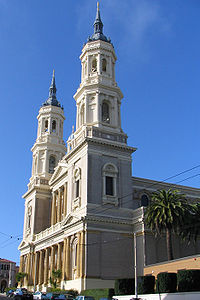
, was designed by architect Charles J. I. Devlin in 1909, as the fifth Saint Ignatius Church in San Francisco. When Saint Ignatius was completed in 1914, with its two towers visible from all parts of the city, it became not only a landmark to the University itself but also to the City of San Francisco. It is the University's spiritual home as well as a parish church for the surrounding community.
Residence life
The University of San Francisco provides on-campus housing for freshmen and sophomores, with independent living options for upper-division students. All residence halls, except for Fulton House and Fulton House Cottage, are secured with a 24-hour front desk.Residence halls
More Information- Fromm Hall (FR) - Xavier Hall, which was once the Jesuit residence on the University's main campus, was renamed on October 24, 2003 for the beneficiaries Alfred and Hanna Fromm as the Alfred and Hanna Fromm Lifelong Learning Center. The building now houses the Fromm Residence Hall. It is currently an all female residence hall.
- Gillson (GI) - Gillson Hall was built in 1965 with funding provided by George Gillson. It originally housed 325 men and women. It is now a co-ed residence hall, housing first-year students.
- Hayes-Healy (HH) - Hayes-Healy was constructed in 1966 as a memorial to the parents of John and Ramona Hayes-Healy. Located on the University of San Francisco's main campus, it was once a female-only residence hall, originally built to house 350 University of San Francisco women.
- Lone Mountain Hall (LM) -Lone Mountain Hall is located on the northern side of the Lone Mountain campus, which was once part of a 23 acres (9.3 ha) cemetery. The residence hall houses both male and female sophomore students.
- Pedro-Arrupe (PA)- Pedro Arrupe Hall, once a nurses' residence, was acquired by the university in 2000. It is located 0.5 mile (0.80467 km) northwest of campus, housing upperclassmen and graduate students.
- Phelan Hall (PH) - Phelan Hall, dedicated to James Phelan on October 23, 1955, was the university's first student residence hall. The seven-story co-ed residence hall is located in the center of the university's main campus.
Independent living
- Fulton House (FH) - Fulton House, acquired by the university in the 1970s, is located behind Phelan Hall on the university's main campus. The residential facility consists of two buildings (Fulton House and Fulton House Cottage), which houses approximately 12 upper-division students.
- Loyola Village (LV) - The university once lacked sufficient housing units for faculty and staff, and therefore, opened Loyola Village in 2002, which currently houses upper-division students as well as staff. It is a 136-unit independent living residence, located on the northern outskirt of campus.
Sustainability
Fueled by memories of the 1970s energy crisis1970s energy crisis
The 1970s energy crisis was a period in which the major industrial countries of the world, particularly the United States, faced substantial shortages, both perceived and real, of petroleum...
, the University of San Francisco has made an effort to encourage an environmentally conscious student body as well as making changes towards a more sustainable campus. Throughout the university’s campus, students and faculty are involved in multiple clubs and organizations that are dedicated to minimizing the campus’s environmental impact including The Green Team, Back to da Roots, Envision, The Garden Project and Trust the Tap. These groups have brought several changes to the campus including the consumption of fair trade coffee, the creation of organic gardens, composting and the encouragement of re-usable containers for tap water.
In the Fall of 2007, the Garden Project (a Living Learning Community) was formed based around the creating and maintaining of the Campus’ first Organic Garden. Initially headed by Media Studies Professor, Filmmaker, and Organic Gardner Melinda Stone and Architecture Professor Seth Watchel, the Garden houses fruits, vegetables, and herbs with the help and continuous care provided by students and community members, alike.
In 2005, USF installed approximately 12000 square feet (1,114.8 m²) of solar panels to the top of Gleeson Library. In addition to energy-saving windows, high-efficiency lighting, energy efficient skylights, and insulated outer walls, the University has spent $375,000 on solar panels for the recently renovated Kalmanovitz Hall. Combined with Cowell Hall, Gleeson Library, Koret Health and Recreation Center, and the University Center, the added solar panels to Kalmanovitz Hall has boosted USF’s energy production from 71 kilowatt hours to nearly 420 kilowatt hours. USF’s carbon footprint has subsequently been reduced by 330 tons a year, says Everette Ersery, the assistant director of facilities. Ersery was quoted in the USF Magazine saying “it has significantly reduced our carbon footprint and electrical bill, while reducing the amount of energy we and PG&E use.” The solar panels produce 16 percent of the lower campus’s energy needs. The assistant vice president of facilities management said that solar heated rooftop water pipes heat 50 percent of the water used in residence halls.
University of San Francisco ranked fifth out of 200 schools in a nationwide recycling competition in the category of targeted material- Service Organics. The University has also established a composting program that began in September 2008. The new program composts food waste from the kitchen and cafeteria. Through the composting program the University of San Francisco has managed to prevent about 36 tons of material per month from being thrown out.
Organization and administration
Chancellor (education)
A chancellor or vice-chancellor is the chief executive of a university. Other titles are sometimes used, such as president or rector....
, the University Provost
Provost (education)
A provost is the senior academic administrator at many institutions of higher education in the United States, Canada and Australia, the equivalent of a pro-vice-chancellor at some institutions in the United Kingdom and Ireland....
and Vice-presidents, and the Dean
Dean (education)
In academic administration, a dean is a person with significant authority over a specific academic unit, or over a specific area of concern, or both...
s. The board consists of a maximum of 45 voting members who serve three year terms and is currently chaired by Claudio M. Chiuchiarelli. The trustees serve without compensation. The board of trustees delegates its power by appointing a President to serve as the chief executive of the university. The current president (since 2000) is Rev. Stephen A. Privett, S. J.
The President, according to USF Bylaws, is specifically responsible for articulating and advancing the Jesuit Catholic character of the university. USF possesses an endowment
Financial endowment
A financial endowment is a transfer of money or property donated to an institution. The total value of an institution's investments is often referred to as the institution's endowment and is typically organized as a public charity, private foundation, or trust....
of $225 million (as of August 2008)
USF's academics are organized into five schools which offer courses of study at the graduate
Graduate school
A graduate school is a school that awards advanced academic degrees with the general requirement that students must have earned a previous undergraduate degree...
and undergraduate level, with two more being primarily focused on graduate education, while offering select opportunities for undergraduate students. USF offers over 50 degrees in several departments. The university also operates four regional campuses in Sacramento
Sacramento, California
Sacramento is the capital city of the U.S. state of California and the county seat of Sacramento County. It is located at the confluence of the Sacramento River and the American River in the northern portion of California's expansive Central Valley. With a population of 466,488 at the 2010 census,...
, San Ramon
San Ramon, California
-2010 census:The 2010 United States Census reported that San Ramon had a population of 72,148. The population density was 3,991.1 people per square mile...
, Santa Rosa
Santa Rosa, California
Santa Rosa is the county seat of Sonoma County, California, United States. The 2010 census reported a population of 167,815. Santa Rosa is the largest city in California's Wine Country and fifth largest city in the San Francisco Bay Area, after San Jose, San Francisco, Oakland, and Fremont and 26th...
, and Cupertino. USF is accredited by the Western Association of Schools and Colleges
Western Association of Schools and Colleges
The Western Association of Schools and Colleges is one of six official academic bodies responsible for the accreditation of public and private universities, colleges, secondary and elementary schools in the United States and foreign institutions of American origin. The Western Association of...
, and the School of Business and Professional Studies (BPS) is accredited by the AACSB.
Undergraduate tuition at USF is $37,040 for the 2011-2012 school year. The University is organized as follows:
Undergraduate and Graduate Schools
|
Academics
In 2010-11, U.S. News & World ReportU.S. News & World Report
U.S. News & World Report is an American news magazine published from Washington, D.C. Along with Time and Newsweek it was for many years a leading news weekly, focusing more than its counterparts on political, economic, health and education stories...
's College and University rankings scored USF as a top tier (Tier I), National University. USF is known for its emphasis on service learning and its public service efforts through its Leo T. McCarthy Center for Public Service and the Common Good. These values are reflected in the university's core curriculum and various clubs and academic programs, such as the student-developed campaign funding site whosfundingwhom.org and USF's Performing Arts and Social Justice major, which is the only undergraduate program of its kind in the nation. The Fromm Institute for Lifelong Learning
Fromm Institute for Lifelong Learning
The Fromm Institute for Lifelong Learning at the University of San Francisco offers noncredit courses with no assignments or grades for adults age 50 and over with no other objective than the love of learning...
offers noncredit courses with no assignments or grades for adults age 50 and over.
Rankings
Washington Monthly's 2011 rankings put USF at 48th in the nation. In the 2011 edition of US News and World Report (USNWR), USF ranked 98th among national universities. USF is ranked 15th in the Nation for Diverse Student Population, 11th in the nation for Best College Town. and in the top 100 national universities by their benefit to society. The Undergraduate Business Program is in the Top 100 nationwide. USF is deemed one of only 60 universities with the status of an “Engaged University”. The University also received recognition for its community involvement when it was awarded the Fr. Alfred Boeddeker Award by the St. Anthony Foundation in 2007. The award was given in recognition of "the strong relationship" between USF and St. Anthony's as well as the active involvement of the USF Faculty and Students with several St. Anthony's projectsAcademically, several of the University's programs have received notable rankings over the years. According to the Princeton Review, USF’s McLaren School of Business is a top 50 business school. The USF MBA program is consistently ranked in the top ten in the nation for business schools with the greatest opportunities for minority students, and is currently ranked 6th. In 2005, the MBA Entrepreneurship Program is ranked 25th in the nation. In 2009, USNWR ranked USF's School of Nursing 54th in the country.
Student exchange programs
USF offers sponsored semester programs to Argentina, Australia, Belgium, Brazil, Chile, China, El Salvador, England, Finland, France, Germany, Hungary, Ireland, Italy, Japan, Korea, Morocco, Mexico, Nicaragua, Philippines, Poland, Scotland, South Africa, Singapore, Spain, and Uruguay. Because USF has signed agreements with these overseas universities, students receive full transfer credit on their transcripts. There are also internship programs available in France, Ecuador, London, Australia, Ireland, Northern Ireland, Scandinavia which integrate a working internship along with related course work at a university. [The School of Law maintains its own exchange programs with Trinity College
Trinity College, Dublin
Trinity College, Dublin , formally known as the College of the Holy and Undivided Trinity of Queen Elizabeth near Dublin, was founded in 1592 by letters patent from Queen Elizabeth I as the "mother of a university", Extracts from Letters Patent of Elizabeth I, 1592: "...we...found and...
in Dublin, Ireland
Ireland
Ireland is an island to the northwest of continental Europe. It is the third-largest island in Europe and the twentieth-largest island on Earth...
and Charles University in Prague
Prague
Prague is the capital and largest city of the Czech Republic. Situated in the north-west of the country on the Vltava river, the city is home to about 1.3 million people, while its metropolitan area is estimated to have a population of over 2.3 million...
, Czech Republic
Czech Republic
The Czech Republic is a landlocked country in Central Europe. The country is bordered by Poland to the northeast, Slovakia to the east, Austria to the south, and Germany to the west and northwest....
. Relevant international coursework includes the study of European Community Law, International Business Transactions, and European Constitutionalism. The latter has been taught by Vojtech Cepl, the principal drafter of the post-communist Constitution of the Czech Republic.
Reserve Officer Training Corps (ROTC)
USF has hosted an Army ROTC program and an Air Force ROTC program since 1936. ROTC is an elective curriculum taken along with the required college classes and can also pay for a cadet's college tuition. ROTC currently operates on campus under the command of the Military Science Department.Student clubs and organizations
The University of San Francisco is home to over 90 clubs and organizations. The wide variety of clubs includes academic/professional, governance, cultural, service, social, political, athletic and special interest. The missions and goals of USF's student clubs and organizations are to provide programs and services that support students' leadership development and promote student engagement in co-curricular activities.Associated Students of the University of San Francisco (ASUSF) Senate is the student body governance organization responsible for organizing major campus events, voicing student concern and reviewing the ASUSF budget.
USF's professional and academic organizations include chapters of many national and international groups including the Lambda Iota Tau
Lambda Iota Tau
Lambda Iota Tau is an American international honor society for literature, whose purpose is to recognize and promote excellence in the study of literature in all languages...
English Honor Society Sigma Tau Delta
Sigma Tau Delta
Sigma Tau Delta is an international collegiate honor society for students of English. It presently has over 800 active chapters located in Europe, the Caribbean, the United States, and 1 chapter in the Middle East , with more than 1,000 faculty sponsors...
, Jesuit Honor Society Alpha Sigma Nu
Alpha Sigma Nu
Alpha Sigma Nu was founded at Marquette University in 1915 by John Danihy, S.J., Dean of Journalism. In his travels and reading, Father Danihy had encountered and admired honor societies...
, the National Society of Collegiate Scholars
National Society of Collegiate Scholars
The National Society of Collegiate Scholars is a national nonprofit academic honor society for college students in the United States. NSCS has active chapters at more than 280 colleges and universities in the United States, including in the District of Columbia, and in Puerto Rico, consisting of a...
, National Political Science Honor Society Pi Sigma Alpha
Pi sigma alpha
Pi Sigma Alpha , the National Political Science Honor Society, is the only honor society for college and university students of political science in the United States. Its purpose is to recognize and promote high academic achievement in the field of political science...
, Biological Honor Society Tri Beta
Tri Beta
Beta Beta Beta, also called TriBeta, is an honor society for students of biological sciences, particularly undergraduates, dedicated to improving the understanding and appreciation of biological study and extending boundaries of human knowledge through scientific research...
, Accounting and Finance Honor Society Beta Alpha Psi
Beta Alpha Psi
ΒΑΨ is a national honors business organization for highly successful accounting, finance and information systems students and professionals. It was founded on February 12, 1919 at the University of Illinois at Urbana-Champaign and is currently headquartered in Durham, North Carolina...
and Psychology Honor Society Psi Chi
Psi Chi
Psi Chi is the International Honor Society in Psychology, founded in 1929 for the purposes of encouraging, stimulating, and maintaining excellence in scholarship, and advancing the science of psychology. With over 1,050 chapters, Psi Chi is one of the largest honor societies in the United States...
. Professional organizations include the Family Business Association, USF Pre-Dental Society, Hospitality Management Association, the Nursing Students Association and the Entrepreneurship Club.
Religious and spiritual organizations on campus include the Muslim Student Union, the USF chapter of InterVarsity Christian Fellowship
InterVarsity Christian Fellowship
InterVarsity Christian Fellowship/USA is an inter-denominational, evangelical Christian, student-led ministry which for the past 70 years has been dedicated to establishing witnessing communities on U.S. college and university campuses...
and the USF Hillel: The Foundation for Jewish Campus Life
Hillel: The Foundation for Jewish Campus Life
Hillel: The Foundation for Jewish Campus Life is the largest Jewish campus organization in the world, working with thousands of college students globally...
.
USF leisure and hobby organizations include a chapter of national organization Best Buddies as well as Outdoors and Environmental Education Club, USF Queer Alliance, San Quentin TRUST Alliance, Knitting for Neighbors, Back to the Roots, Surf and Skate Club, and the Animation Comics and Video Games (ACV) Club.
Cultural and multicultural organizations around campus serve international students, Indian students, Black students, Latin American students and Hawaiian Students. There are also groups specifically for women of color and Latina women.
Social justice clubs on campus include chapters of Amnesty International
Amnesty International
Amnesty International is an international non-governmental organisation whose stated mission is "to conduct research and generate action to prevent and end grave abuses of human rights, and to demand justice for those whose rights have been violated."Following a publication of Peter Benenson's...
, School of the Americas Watch
School of the Americas Watch
School of the Americas Watch is an advocacy organization founded by Maryknoll Father Roy Bourgeois and a small group of supporters in 1990 to protest the training of mainly Latin American military officers, by the United States Department of Defense, at the School of the Americas...
, Up 'til Dawn
Up 'til Dawn
Up 'til Dawn is a nationwide student-led, student-run program in which college students raise funds for and awareness of St. Jude Children's Research Hospital...
and Invisible Children
Invisible Children
Invisible Children: Rough Cut is a 2003 American documentary film. Its subject is the abduction and forced enlistment of children by the sectarian Lord's Resistance Army in Uganda.-Synopsis:...
. There is also a Politics Society, Philosophy Club, Women in Media Club and Women in Science Club.
Student-produced media
The San Francisco FoghornSan Francisco Foghorn
The San Francisco Foghorn is the official student newspaper of the University of San Francisco.Originally founded in 1903 as The Saint Ignatius, the newspaper changed its name to the San Francisco Foghorn in August 1928, making it one of the oldest collegiate newspapers on the West Coast...
is the official student weekly newspaper of the University of San Francisco and is sponsored by the Associated Students of the University of San Francisco (ASUSF). The Foghorn was founded in 1926, and was first called "The Ignatian". In the 1930s, members of The Ignation changed its name to "San Francisco Foghorn" to reflect the University's decision to change its name from St.Ignatius College to University of San Francisco. The Foghorn has played a significant role on campus throughout the years, and has some notable alumni—from the likes of Pierre Salinger
Pierre Salinger
Pierre Emil George Salinger was a White House Press Secretary to U.S. Presidents John F. Kennedy and Lyndon B. Johnson...
, editor of the San Francisco Chronicle and Press Secretary for President John F. Kennedy
John F. Kennedy
John Fitzgerald "Jack" Kennedy , often referred to by his initials JFK, was the 35th President of the United States, serving from 1961 until his assassination in 1963....
, to well known author and historian Kevin Starr
Kevin Starr
Kevin Starr is an American historian, best known for his multi-volume series on the history of California, collectively called "Americans and the California Dream."-Life:Kevin Starr was born in San Francisco, California....
, who was a one-time California Lieutenant Governor. The Foghorn gained national recognition in 1961, when the American Newspaper Publishers Association awarded it with a "Pacemaker Award". The Foghorn has been honored by the Associated Collegiate Press
Associated Collegiate Press
The Associated Collegiate Press is the largest and oldest national membership organization for college student media in the United States. The ACP is a division of the National Scholastic Press Association...
which deemed it "College Paper of the Year" in 1998.
USF has a radio station, KUSF
KUSF
KUSF was a non-commercial radio station licensed to San Francisco, California and owned by the University of San Francisco. From 1963 until 2011, the station broadcast at 90.3 FM MHz....
which broadcasts online. The station had broadcasted on radio frequency 90.3 FM since 1977, until the station's license was sold by the University on January 18, 2011. The University announced that they had sold KUSF's license to a Southern California based classical radio station for $3.75 million; the next day, a protest was held by student and community DJs and supporters against the newly proposed online-only format. KUSF has garnered international attention for its diverse musical programming, which varies from rock to hip hop to world music. KUSF is the recipient of numerous awards, including many public service awards for the station's long-running weekly community service series. USF's other radio station, KDNZ, is student-run and-programmed.
The University of San Francisco has one television station, USFtv http://youtube.com/usftv, which is broadcast on Channel 35 in the dormitories and around campus. The station was founded in 2006, and is entirely student-run. The station features a variety of content, including news, sports, cultural programming. In 2008 USFtv students collaborated with Wyclef Jean
Wyclef Jean
Wyclef Jean is a Haitian musician, record producer, and politician. At age nine, Jean moved to the United States with his family and has spent much of his life in the country...
to create a music video for his song "If I Was President."
The Ignatian is USF's annual "literary magazine" that is published every spring. It has traditionally printed a wide array of different content, running from philosophical pieces to personal essays, short fiction, poetry, and photography. Its most recent volume (volume 21) was released on May 2, 2009.
Performing arts
USF has numerous student clubs for performing arts including a theater group (College Players), improvisational team (Awkward Silence), choir (ASUSF voices), contemporary mass ensemble and dance program that entails social justice.The College Players, founded in 1863, is the oldest student-run theater group west of the Mississippi and the second oldest in the United States. Their annual production of The Vagina Monologues, distributes 100 percent of the show's proceeds to women charities around the Bay Area.
ASUSF voices is a collaboration between the associated students of USF and the Performing Arts Department. It contains a variety of choral ensembles including jazz and other popular vocal styles.
The USF Contemporary Mass Ensemble is a group of collective USF alumni, either vocal or instrumental, that perform during Mass every Sunday in St. Ignatius Church.
The USF dance program is affiliated with the Performing Arts and Social Justice Major. Students can enroll in tradition and modern dance classes. Students are allowed to participate in the USF Dance Ensemble, which provides the opportunity for students to work with professional and student choreographers.
Greek life
There are currently thirteen fraternities on campus: Chi Upsilon Zeta (social justice fraternity), Alpha Epsilon PiAlpha Epsilon Pi
Alpha Epsilon Pi , the Global Jewish college fraternity, has 155 active chapters in the United States, Canada, United Kingdom and Israel with a membership of over 9,000 undergraduates...
, Alpha Phi Omega
Alpha Phi Omega
Alpha Phi Omega is the largest collegiate fraternity in the United States, with chapters at over 350 campuses, an active membership of approximately 17,000 students, and over 350,000 alumni members...
, Alpha Sigma Nu
Alpha Sigma Nu
Alpha Sigma Nu was founded at Marquette University in 1915 by John Danihy, S.J., Dean of Journalism. In his travels and reading, Father Danihy had encountered and admired honor societies...
, Beta Alpha Psi
Beta Alpha Psi
ΒΑΨ is a national honors business organization for highly successful accounting, finance and information systems students and professionals. It was founded on February 12, 1919 at the University of Illinois at Urbana-Champaign and is currently headquartered in Durham, North Carolina...
, Delta Lambda Phi
Delta Lambda Phi
Delta Lambda Phi is a national social fraternity for gay, bisexual, and progressive men. It offers a social environment and structure similar to other Greek-model college fraternities. Delta Lambda Phi was founded on October 15, 1986 by Vernon L. Strickland III in Washington, D.C. and incorporated...
Interest Group, Delta Sigma Pi
Delta Sigma Pi
ΔΣΠ ' is one of the largest co-ed professional business fraternities. Delta Sigma Pi was founded on November 7, 1907 at the School of Commerce, Accounts and Finance, New York University, New York, New York and is currently headquartered in Oxford, Ohio...
, Lambda Theta Phi
Lambda Theta Phi
Lambda Theta Phi is a non-profit social fraternity in the United States. It was founded on December 1, 1975 at Kean College in Union, New Jersey. It emphasizes Latin unity and the celebration of the Latin culture. In 1992 Lambda Theta Phi was accepted into the North-American Interfraternity...
, Omicron Theta Chi, Psi Chi
Psi Chi
Psi Chi is the International Honor Society in Psychology, founded in 1929 for the purposes of encouraging, stimulating, and maintaining excellence in scholarship, and advancing the science of psychology. With over 1,050 chapters, Psi Chi is one of the largest honor societies in the United States...
, Sigma Alpha Epsilon
Sigma Alpha Epsilon
Sigma Alpha Epsilon is a North American Greek-letter social college fraternity founded at the University of Alabama on March 9, 1856. Of all existing national social fraternities today, Sigma Alpha Epsilon is the only one founded in the Antebellum South...
, Theta Alpha Kappa
Theta Alpha Kappa
Theta Alpha Kappa is the national honor society for Religious Studies and Theology. It was founded in 1976 at Manhattan College in Riverdale , New York for the purpose of recognizing the academic achievements of religion and theology students...
and Tri-Beta. USF also has four sororities: Delta Zeta
Delta Zeta
Delta Zeta is an international college sorority founded on October 24, 1902, at Miami University in Oxford, Ohio. Today, Delta Zeta has 158 collegiate chapters in the United States and over 200 alumnae chapters in the United States, the United Kingdom, and Canada...
, Lambda Sigma Gamma
Lambda Sigma Gamma
-History:Lambda Sigma Gamma Sorority, Incorporated was founded on the campus of the Alpha chapter, California State University, Sacramento, in 1986. The founders realized that their campus did not offer an organization that met the needs of women from minority backgrounds...
, Omicron Theta Chi, Delta Sigma Theta
Delta Sigma Theta
Delta Sigma Theta is a non-profit Greek-lettered sorority of college-educated women who perform public service and place emphasis on the African American community. Delta Sigma Theta Sorority was founded on January 13, 1913 by twenty-two collegiate women at Howard University...
, Tri-Gamma and Kappa Alpha Theta
Kappa Alpha Theta
Kappa Alpha Theta , also known as Theta, is an international fraternity for women founded on January 27, 1870 at DePauw University, formerly Indiana Asbury...
. All of the sororities and fraternities that wish to be recognized by the University must participate in Greek Council. The purpose of Greek Council is to aid in the development of the university’s recognized Greek organizations and their individual members. Every year chapters participate in some of the same activities such as; mixers and socials, Thanksgiving potluck, Christmas clothing drive, Homecoming, USF Idol, and Greek Games.
Fraternities
- Chi Upsilon Zeta (XYZ): was founded at the University of San Francisco to enrich the lives of men of all creeds through an understanding of social justice and multiculturalism based on mind, body and soul.
- Alpha Phi Omega: a national coeducational service fraternity founded on the cardinal principles of leadership, friendship and service
- Beta Alpha Psi: encourages professional excellence in accounting, finance, or information systems
- Beta Beta Beta: biological honor society, functions as a support group for students majoring in biological sciences
- Delta Lambda Phi Interest Group: creates a brotherhood of gay and gay-friendly men to help establish new friendships
- Delta Sigma Pi: professional fraternity that promotes closer affiliation between commercial world and students of commerce
- Omicron Theta Chi: organized to stimulate higherintellectual achievement as well as offering a socially active environment
- Sigma Alpha Epsilon: offers an exciting social life with many socials and theme parties throughout the year
Sororities
- Delta Zeta:founded on the principle of learning and participating in philanthropy benefitting the speech and hearing impaired
- Gamma Gamma Gamma: USF's first organization for women and a nursing sorority
- Lambda Sigma Gamma: mulicultural sorority that encourages diverse cultures, majors, and beliefs
- Omicron Theta Chi: pre-professional honor society with sisters preparing for a career as a health professional
- Delta Sigma Theta Sorority, Inc. Tau Tau Chapter was charted on March 19, 2005. This organization is dedicated to promote academic excellence; to provide scholarships; to provide support to the underserved; educate and stimulate participation in the establishment of positive public policy; and to highlight issues and provide solutions for problems in their communities.
Student body
| Undergraduate | Total | California | U.S. Census | |
|---|---|---|---|---|
| Asian American Asian American Asian Americans are Americans of Asian descent. The U.S. Census Bureau definition of Asians as "Asian” refers to a person having origins in any of the original peoples of the Far East, Southeast Asia, or the Indian subcontinent, including, for example, Cambodia, China, India, Indonesia, Japan,... and Pacific Islander Pacific Islander American Pacific Islander Americans, also known as Oceanian Americans, are residents of the United States with original ancestry from Oceania. They represent the smallest racial group counted in the United States census of 2000. They numbered 874,000 people or 0.3 percent of the United States population... |
23.6% | 19.5% | 12.3% | 4.3% |
| African American African American African Americans are citizens or residents of the United States who have at least partial ancestry from any of the native populations of Sub-Saharan Africa and are the direct descendants of enslaved Africans within the boundaries of the present United States... |
4.8% | 5.5% | 6.2% | 12.1% |
| Hispanic American | 13.3% | 11.6% | 35.9% | 14.5% |
| Native American Native Americans in the United States Native Americans in the United States are the indigenous peoples in North America within the boundaries of the present-day continental United States, parts of Alaska, and the island state of Hawaii. They are composed of numerous, distinct tribes, states, and ethnic groups, many of which survive as... |
0.8% | 0.7% | 0.7% | 0.9% |
| Caucasian White people White people is a term which usually refers to human beings characterized, at least in part, by the light pigmentation of their skin... |
38.3% | 39.7% | 59.8% | 65.8% |
| International student International student According to Organization of Economic Cooperation and Development , international students are those who travel to a country different from their own for the purpose of tertiary study. Despite that, the definition of international students varies in each country in accordance to their own national... |
7.5% | 9.0% | N/A | N/A |
| Multiracial Multiracial The terms multiracial and mixed-race describe people whose ancestries come from multiple races. Unlike the term biracial, which often is only used to refer to having parents or grandparents of two different races, the term multiracial may encompass biracial people but can also include people with... |
3.1% | 2.6% | 5% | 2.4% |
The University of San Francisco enrolled 5,278 undergraduates, 2,518 graduate students, and 738 law students in Fall 2007. Women made up 61.9% of the student body and students originated from all fifty states and sixty-nine foreign countries. 43.5% of students are Roman Catholic, 6.8% are Protestant, 6.3% are irreligious
Irreligion
Irreligion is defined as an absence of religion or an indifference towards religion. Sometimes it may also be defined more narrowly as hostility towards religion. When characterized as hostility to religion, it includes antitheism, anticlericalism and antireligion. When characterized as...
, 2.2% are Jewish
Judaism
Judaism ) is the "religion, philosophy, and way of life" of the Jewish people...
, 2.1% are Buddhist, and 0.8% are Hindu
Hinduism
Hinduism is the predominant and indigenous religious tradition of the Indian Subcontinent. Hinduism is known to its followers as , amongst many other expressions...
and Muslim
Islam
Islam . The most common are and . : Arabic pronunciation varies regionally. The first vowel ranges from ~~. The second vowel ranges from ~~~...
respectively. 82.4% of students matriculated after their first year, the 4-year graduation rate is 49%, and the 6-year graduation rate is 65%.
In the 1800s, USF's diversity (then St. Ignatius College) was mostly a reflection of the diversity inherent in San Francisco. For example, when German and French
French people
The French are a nation that share a common French culture and speak the French language as a mother tongue. Historically, the French population are descended from peoples of Celtic, Latin and Germanic origin, and are today a mixture of several ethnic groups...
migrants came to San Francisco, the population of European students in USF increased as well. USF's student population diversity has increased throughout the last century. Filipinos
Filipino people
The Filipino people or Filipinos are an Austronesian ethnic group native to the islands of the Philippines. There are about 92 million Filipinos in the Philippines, and about 11 million living outside the Philippines ....
started attending the university in the 1920s, after the United State's annexation of Philippines
Philippines
The Philippines , officially known as the Republic of the Philippines , is a country in Southeast Asia in the western Pacific Ocean. To its north across the Luzon Strait lies Taiwan. West across the South China Sea sits Vietnam...
. In 1960s, Mexicans, African Americans, Chinese
Chinese people
The term Chinese people may refer to any of the following:*People with Han Chinese ethnicity ....
, Norwegians
Norwegians
Norwegians constitute both a nation and an ethnic group native to Norway. They share a common culture and speak the Norwegian language. Norwegian people and their descendants are found in migrant communities worldwide, notably in United States, Canada and Brazil.-History:Towards the end of the 3rd...
came to USF. The 1970s marked the start of students from Hong Kong
Hong Kong
Hong Kong is one of two Special Administrative Regions of the People's Republic of China , the other being Macau. A city-state situated on China's south coast and enclosed by the Pearl River Delta and South China Sea, it is renowned for its expansive skyline and deep natural harbour...
, Japan
Japan
Japan is an island nation in East Asia. Located in the Pacific Ocean, it lies to the east of the Sea of Japan, China, North Korea, South Korea and Russia, stretching from the Sea of Okhotsk in the north to the East China Sea and Taiwan in the south...
and Indonesia
Indonesia
Indonesia , officially the Republic of Indonesia , is a country in Southeast Asia and Oceania. Indonesia is an archipelago comprising approximately 13,000 islands. It has 33 provinces with over 238 million people, and is the world's fourth most populous country. Indonesia is a republic, with an...
, coming to USF. In 1964, 473 women enrolled as full-time undergraduates marking the first time women attended USF.
A school census of Fall 1993 undergraduate freshmen indicated 42.66% Whites, 23% Asian Americans, 11% International students, 10% Hispanic
Hispanic
Hispanic is a term that originally denoted a relationship to Hispania, which is to say the Iberian Peninsula: Andorra, Gibraltar, Portugal and Spain. During the Modern Era, Hispanic sometimes takes on a more limited meaning, particularly in the United States, where the term means a person of ...
/Latinos. 5% African Americans, 0.34% Native Americans
Native Americans in the United States
Native Americans in the United States are the indigenous peoples in North America within the boundaries of the present-day continental United States, parts of Alaska, and the island state of Hawaii. They are composed of numerous, distinct tribes, states, and ethnic groups, many of which survive as...
and 8% of students in the census chose not to specify. Enrollment in Fall 1993 was a total of 7,662 students, 62.5% of whom were undergraduates. In 2002, a plan was developed by the university to increase the diversity of the USF student population. This plan was enacted by university officials, who also enlisted the help of USF alumni to "assemble a mix of students that will help USF achieve its vision: to educate leaders who will fashion a more humane and just world." In 2002, 64.4% of undergraduates were female and 35.6% were male. The plan sought to address concerns of the gender ratio and increase the percentage of international students at USF from 9.4% to around 15%. A statement made by USF President, Stephen A. Privett
Stephen Privett
The Reverend Stephen Arena Privett, S.J. is a Roman Catholic priest and member of the Society of Jesus. Father Privett is the 27th and current president of the University of San Francisco....
, S.J. (2000 to present) in an interview by USF Magazine highlighted the importance the university placed on the diversity of its student population. The USF President also clarified the scope of diversity to include "ethnicity, gender and life experiences." In December 2006, USF was awarded a $500,000 grant by the Lumina Foundation for Education to examine "how best to recruit and retain low-income, first-generation, and ethnic minority students at Jesuit universities."
Surveys show that USF students consistently value diversity at USF. A survey conducted for graduating students on 24 May 2007 by USF's Office of Student Enrichment Programs indicated that 86% felt that individual ethnicity, religion, race and other differences were valued at USF. The same survey records that 70% of the graduating students agreed that their appreciation of those differences increased while they were at USF. The result was consistent with past surveys conducted on graduating students, where over the period from May 1997 to December 1999, the result ranged from 78% to 84% for students valued the mentioned differences and 63% to 72% for those who "felt their appreciation of differences increased while at USF." In 2004, a survey by UCLA's Higher Education Research Institute
Higher Education Research Institute
The Higher Education Research Institute serves as an interdisciplinary center for research, evaluation, information, policy studies, and research training in postsecondary education. HERI is housed in the Graduate School of Education & Information Studies at the University of California, Los...
indicated that 80% of USF students "considered it essential or very important that their undergraduate experience" developed their personal values. This statistic was higher than the national average sampling of 67%.
The University of San Francisco actively recruits and enrolls over 700 international students from over 70 countries, including: Kenya, Nigeria, Ethiopia, China, Indonesia, Taiwan, Thailand, India, Costa Rica, El Salvador, Brazil, Argentina, Chile, Canada, Mexico, Russia, Moldova, Kazakhstan, France, Norway, Austria, United Kingdom, Saudi Arabia, Kuwait, Israel, Australia, and New Zealand, among others. USF also hosts J-1 exchange and Intensive English Program student participants.
The University of San Francisco attracted 783 international students (9.0% of the student body) in 2007. International students have a dedicated orientation period and a variety of internationally-oriented student groups like the International Student Association, Global Living Community, an International Advisory Council, and an International Network Program. USF sponsors an annual International Education Week with an international fair featuring consulates in the San Francisco area, storytelling opportunities, educational speakers, and a performance event called Culturescape.
Admissions
According to U.S. News & World ReportU.S. News & World Report
U.S. News & World Report is an American news magazine published from Washington, D.C. Along with Time and Newsweek it was for many years a leading news weekly, focusing more than its counterparts on political, economic, health and education stories...
, USF is classified as a more selective university. As of 2006, nine admissions counselors were in charge of selecting students for entry. In an article published in a Fall 2006 issue of the USF Magazine, Sandoval, an admissions counselor revealed certain factors that the university used to filter its applicants. The factors mentioned were: high school GPAs, involvement in extra curricular activities, languages spoken, "first in family to go to college", letters of recommendation, test scores and in particular, the students' essays. Sandoval also mentioned in the article that the best essays were "specific, genuine, honest, and personal. "
In Fall 2008, 67% of freshman undergraduates who applied were admitted. USF enrolled 4,869 undergraduate students. The admitted freshman class had an average combined SAT score of 1270, an average composite ACT score of 25, and an average high school GPA of 3.5.
- Of the freshmen admitted in 2007, 47% came from public high schools, 34% came from Catholic/parochial high schools, 9% came from non-parochial private high schools, and 10% were not identified with any of the above categories. 29% of the freshman class are from out-of-state and 6% are international students.
- The average age of freshman undergraduate is 18 years old and the average age of all undergraduates is 21 years old.
- The most popular majors and the percentage of undergrads in each major are: business/marketing 29%, communication/journalism 7%, computer/info sciences 6%, health sciences 8%, psychology 8%, social sciences 14%, visual/performing arts 6%.
- To apply students must take either the SAT or the ACT, have a minimum of 20 units based on high school courses, write and admissions essay, and have a minimum GPA of 3.0.
- As of 2008, USF has about 8,772 undergraduate and graduate students, representing nearly every state and over 80 countries.
- Other schools with the greatest overlap of applicants are San Francisco State University, Santa Clara University, Stanford University, UC Berkeley, and UC Santa Cruz.
- In an average class 1% graduate in three years or less, 45% graduate in four years or less, 62% graduate in five years or less, 65% graduate in 6 years or less.
- In September 2005 USF admitted 161 students from Loyola University New OrleansLoyola University New OrleansLoyola University New Orleans is a private, co-educational and Jesuit university located in New Orleans, Louisiana, United States. Originally established as Loyola College in 1904, the institution was chartered as a university in 1912. It bears the name of the Jesuit patron, Saint Ignatius of Loyola...
, Xavier University of LouisianaXavier University of LouisianaXavier University of Louisiana , located in New Orleans, Louisiana, in the United States, is a private, coeducational, liberal arts college with the distinction of being the only historically black Roman Catholic institution of higher education...
, Tulane UniversityTulane UniversityTulane University is a private, nonsectarian research university located in New Orleans, Louisiana, United States...
, Dillard UniversityDillard UniversityDillard University is a private, historically black liberal arts college in New Orleans, Louisiana. Founded in 1930 incorporating earlier institutions that went back to 1869, it is affiliated with the United Church of Christ and the United Methodist Church....
, University of New OrleansUniversity of New OrleansThe University of New Orleans, often referred to locally as UNO, is a medium-sized public urban university located on the New Orleans Lakefront within New Orleans, Louisiana, United States. It is a member of the LSU System and the Urban 13 association. Currently UNO is without a proper chancellor...
, and University of Southern Mississippi who were displaced by Hurricane KatrinaHurricane KatrinaHurricane Katrina of the 2005 Atlantic hurricane season was a powerful Atlantic hurricane. It is the costliest natural disaster, as well as one of the five deadliest hurricanes, in the history of the United States. Among recorded Atlantic hurricanes, it was the sixth strongest overall...
, housing "approximately 90 on campus." The students came from universities that were closed as a result of the massive city flooding after Hurricane Katrina. In an email addressed to the USF community, USF President Stephen A. Privett, S.JStephen PrivettThe Reverend Stephen Arena Privett, S.J. is a Roman Catholic priest and member of the Society of Jesus. Father Privett is the 27th and current president of the University of San Francisco....
wrote, "Our policy is to accept as many qualified students as we can accommodate and work out the details later when we and they have more information. " Some of the Hurricane Katrina victims also received scholarships. One such recipient was Stace McRaney, whose home and workplace was destroyed by the hurricane. Stace McRaney was the first recipient of the Lone Mountain Legacy Scholarship, funded by alumnae of the San Francisco College for WomenLone Mountain CollegeLone Mountain College was a college acquired by the University of San Francisco in 1978. It was founded by the Religious of the Sacred Heart as Sacred Heart Academy in Menlo Park, California in 1898 and became College of the Sacred Heart in 1921...
.
Financial aid
For the 2006-2007 academic year, 66.0% of USF's undergraduates received some form of financial aid, 52.6% received institutional aid/grants, and 21.0% received federal Pell GrantPell Grant
A Pell Grant is money the federal government provides for students who need it to pay for college. Federal Pell Grants are limited to students with financial need, who have not earned their first bachelor's degree or who are not enrolled in certain post-baccalaureate programs, through participating...
support. For the same year, 64.2% of graduate students received some form of financial aid.
The increase of financial aid given by the university to students have generally exceed the rate of growth of USF's tuition fees. Over 10 years from 1993 to 2003, annual tuition fees grew by 65% but financial aid experienced 160% growth. Annual tuition in '93/94 was $13,200 and total financial aid was $12.9 million. By '02/03, annual tuition had increased to $21,700 but financial aid experienced a larger increase to $33.6 million. However, in a USF student guide published by The College Prowler in 2006 , USF students rated high tuition fees as one of "the ten worst things about USF."
Campus dining
USF's dining options span multiple locations around the campus:- Market Café - The Market Café, the main campus' cafeteria, is located on the second floor of the University Center.
- Crossroads Café - Crossroads Café is a student-run dining facility, located on the first floor of the University Center building. The café originally started as a commuter students' lounge in the basement of the former Campion Hall, now Kalmanovitz Hall, in 1931. The lounge was moved to the University Center Building when it was constructed in the Fall of 1966. At the time, it was called the Green and Gold Room. Today, Crossroads is a popular spot for dining and socializing. It also hosts live entertainment events, such as open mike nights, games, performances, and crafts. Office hours are often held in Crossroads, where students can consult and get advice from their teachers.
- Outtakes Café - The Outtakes Café, also known as the Wolf and Kettle, is located on USF's Lone Mountain campus. Outtakes has two sections: a dining center, similar to a smaller cafeteria structure of tables, booths and chairs, and a “small retail convenience store, offering a wide variety of grocery items, fresh food and produce, and all the essentials."
- Kendrick Café - The Kendrick Café is located on the School of Law Campus.
- Club Ed Café - The Club Ed Café is located on the bottom floor of USF's School of Education building.
- Outtahere - The newest addition to the campus' dining facilities, replacing Jamba Juice. Similar to Outtakes, it provides a small dining area that serves breakfast all day and a small convenience store that sells primarily organic foods. This facility is open until 2 A.M. to students of USF.
Athletics
West Coast Conference
The West Coast Conference is an NCAA collegiate athletics conference consisting of nine member schools across the states of California, Oregon, Utah and Washington....
, along with local rivals Santa Clara University
Santa Clara University
Santa Clara University is a private, not-for-profit, Jesuit-affiliated university located in Santa Clara, California, United States. Chartered by the state of California and accredited by the Western Association of Schools and Colleges, it operates in collaboration with the Society of Jesus , whose...
and Saint Mary's College of California
Saint Mary's College of California
Saint Mary's College of California is a private, coeducational college located in Moraga, California, United States, a small suburban community about east of Oakland and 20 miles east of San Francisco. It has a 420-acre campus in the Moraga hills. It is affiliated with the Roman Catholic Church...
. Sports offered are men’s and women’s basketball
Basketball
Basketball is a team sport in which two teams of five players try to score points by throwing or "shooting" a ball through the top of a basketball hoop while following a set of rules...
, cross country
Cross country running
Cross country running is a sport in which people run a race on open-air courses over natural terrain. The course, typically long, may include surfaces of grass and earth, pass through woodlands and open country, and include hills, flat ground and sometimes gravel road...
, golf
Golf
Golf is a precision club and ball sport, in which competing players use many types of clubs to hit balls into a series of holes on a golf course using the fewest number of strokes....
, soccer, tennis
Tennis
Tennis is a sport usually played between two players or between two teams of two players each . Each player uses a racket that is strung to strike a hollow rubber ball covered with felt over a net into the opponent's court. Tennis is an Olympic sport and is played at all levels of society at all...
, track and field
Track and field
Track and field is a sport comprising various competitive athletic contests based around the activities of running, jumping and throwing. The name of the sport derives from the venue for the competitions: a stadium which features an oval running track surrounding a grassy area...
, as well as men’s baseball
Baseball
Baseball is a bat-and-ball sport played between two teams of nine players each. The aim is to score runs by hitting a thrown ball with a bat and touching a series of four bases arranged at the corners of a ninety-foot diamond...
and women's volleyball
Volleyball
Volleyball is a team sport in which two teams of six players are separated by a net. Each team tries to score points by grounding a ball on the other team's court under organized rules.The complete rules are extensive...
. USF has won 12 NCAA championships, 1 NIT championships, and 42 WCC championships. USF’s mascot is the Don
Don (honorific)
Don, from Latin dominus, is an honorific in Spanish , Portuguese , and Italian . The female equivalent is Doña , Dona , and Donna , abbreviated "Dª" or simply "D."-Usage:...
and its colors are green
Green
Green is a color, the perception of which is evoked by light having a spectrum dominated by energy with a wavelength of roughly 520–570 nanometres. In the subtractive color system, it is not a primary color, but is created out of a mixture of yellow and blue, or yellow and cyan; it is considered...
and gold
Gold (color)
Gold, also called golden, is one of a variety of orange-yellow color blends used to give the impression of the color of the element gold....
.
History
Athletics at USF dates back to its founding in 1855, when founder Anthony MaraschiAnthony Maraschi
The Reverend Anthony Maraschi, S.J. was an Italian-born priest of the Society of Jesus. He was a founder of the University of San Francisco and Saint Ignatius College Preparatory as well as the first pastor of Saint Ignatius Church in San Francisco, California.Born in Piedmont, Italy in 1820,...
, S.J. organized ball games as recreation for the first students. However, intercollegiate competition only dates back to 1907, when then-St. Ignatius College began playing organized baseball
Baseball
Baseball is a bat-and-ball sport played between two teams of nine players each. The aim is to score runs by hitting a thrown ball with a bat and touching a series of four bases arranged at the corners of a ninety-foot diamond...
, basketball
Basketball
Basketball is a team sport in which two teams of five players try to score points by throwing or "shooting" a ball through the top of a basketball hoop while following a set of rules...
, and rugby
Rugby football
Rugby football is a style of football named after Rugby School in the United Kingdom. It is seen most prominently in two current sports, rugby league and rugby union.-History:...
against other local colleges and high schools. Rivalries with neighboring Santa Clara University
Santa Clara University
Santa Clara University is a private, not-for-profit, Jesuit-affiliated university located in Santa Clara, California, United States. Chartered by the state of California and accredited by the Western Association of Schools and Colleges, it operates in collaboration with the Society of Jesus , whose...
and Saint Mary's College of California
Saint Mary's College of California
Saint Mary's College of California is a private, coeducational college located in Moraga, California, United States, a small suburban community about east of Oakland and 20 miles east of San Francisco. It has a 420-acre campus in the Moraga hills. It is affiliated with the Roman Catholic Church...
have their origins in this early period.
1951 USF Dons Football Team
The 1951 University of San Francisco Dons football team,coached by Joe Kuharich, went undefeated, with a record of 9-0, and the team produced ten future NFL players (Ollie MatsonOllie Matson
Ollie Genoa Matson II was an American Olympic medal winning sprinter and professional American football running back who played in the National Football League, in 1952 and from 1954 to 1966...
, Gino Marchetti
Gino Marchetti
Gino John Marchetti is a former professional American football player in the National Football League. A defensive end, he played in 1952 for the Dallas Texans and from 1953 to 1966 for the Baltimore Colts.-Early years:...
, Bob St. Clair
Bob St. Clair
Robert Bruce St. Clair, nicknamed "The Geek" is a former San Francisco American football player known for fine play and eating raw beef. Because of his eccentricities, his teammates nicknamed him "The Geek".St...
, Dick Stanfel
Dick Stanfel
Richard Anthony "Dick" Stanfel is a former American football offensive lineman in the National Football League for the Detroit Lions and the Washington Redskins. He played college football at the University of San Francisco and was drafted in the second round of the 1951 NFL Draft...
, Ed Brown
Ed Brown (quarterback)
Charles Edward Brown was an American football quarterback and punter in the National Football League.-Prior to the NFL:...
, Lou Stephens, Burl Toler
Burl Toler
Burl Abron Toler, Sr. was an American football official in the National Football League for 24 seasons from 1965 to 1989. He served as a field judge and head linesman throughout his career and is most notable for being the first African-American official in the NFL...
, Joe Scudero
Joe Scudero
Joseph Andrew Scudero is a former American football safety in the National Football League for the Washington Redskins and Pittsburgh Steelers. He played college football at the University of San Francisco....
, Roy Barni
Roy Barni
Roy Bruno Barni was an American football defensive back in the National Football League for the Chicago Cardinals, Philadelphia Eagles, and the Washington Redskins. He played college football at the University of San Francisco.He intercepted 11 passes during his career including six when playing...
, Mike Mergen, Merrill Peacock, and Ralph Thomas
Ralph Thomas (American football)
Ralph Werner Thomas is a former American football end in the National Football League for the Washington Redskins and the Chicago Cardinals. He attended the University of San Francisco....
). Five became NFL Pro-Bowlers, and Gino Marchetti
Gino Marchetti
Gino John Marchetti is a former professional American football player in the National Football League. A defensive end, he played in 1952 for the Dallas Texans and from 1953 to 1966 for the Baltimore Colts.-Early years:...
, Ollie Matson
Ollie Matson
Ollie Genoa Matson II was an American Olympic medal winning sprinter and professional American football running back who played in the National Football League, in 1952 and from 1954 to 1966...
, and Bob St. Clair
Bob St. Clair
Robert Bruce St. Clair, nicknamed "The Geek" is a former San Francisco American football player known for fine play and eating raw beef. Because of his eccentricities, his teammates nicknamed him "The Geek".St...
later were inducted into the NFL Hall of Fame—a record for one college team. The team also had another first; Burl Toler became the first African American official in the NFL.
Even the future NFL Commissioner, Pete Rozelle, played a role as the Dons' Athletic Publicist. At the height of their success, the team experienced one of the greatest snubs in college football history.
Due to the team having two African-American star players, Ollie Matson and Burl Toler, they were not invited to play in any of the college football bowl games hosted by the SEC (Southern Conference
Southern Conference
The Southern Conference is a Division I college athletic conference affiliated with the National Collegiate Athletic Association . Southern Conference football teams compete in the Football Championship Subdivision . Member institutions are located in the states of Alabama, Georgia, North...
). This resulted in the team being invited to the Orange Bowl without Toler and Matson. Outraged, the team refused the invitation saying, “ ‘No, we’re not going to leave ‘em at home,’ said guard Dick Columbini. ‘We’re going to play with ‘em or we’re not going to play’”. As a result of the team's refusal to play in the Orange Bowl, the USF Athletic Department was forced to drop its football program in 1952, due to a deficit in department funds.
Basketball
USF is best known for its men's basketball program
San Francisco Dons men's basketball
The San Francisco Dons basketball team represents the University of San Francisco in National Collegiate Athletic Association Division I men's college basketball. The Dons compete in the West Coast Conference, in which they have won sixteen regular season and one conference tournament...
. The men's team won three national championships: the 1949 NIT Championship, with Don Lofgran
Don Lofgran
Donald "Don" Lofgran was an American basketball player who was a Consensus Second Team All-American in 1950 while at the University of San Francisco...
as MVP, and the 1955 and 1956 NCAA National Championships, going undefeated in the 1956 season. Led by NBA Hall of Famers Bill Russell
Bill Russell
William Felton "Bill" Russell is a retired American professional basketball player who played center for the Boston Celtics of the National Basketball Association...
and K.C. Jones, the 1956 Dons became the first undefeated team to win a national championship, winning a then-record 60 games in a row from 1954 to 1956 before losing an exhibition game to the USA Men's Olympic Basketball team. Also of note, the 1954-1955 USF basketball teams became the first major college or university basketball team to win a national title with three African American starters (Russell, Jones, and Hal Perry
Hal Perry
Harold L. "Hal" Perry was an American basketball player and attorney famous for being a starter on the University of San Francisco back to back NCAA championship teams of 1955 and 1956....
).
On December 26, 2007, the university hired 798-win coach Eddie Sutton
Eddie Sutton
Eddie Sutton is an American former college head coach with 36 years of Division I basketball coaching experience at Creighton, Arkansas, Kentucky, Oklahoma State , and the University of San Francisco...
to replace Jessie Evans
Jessie Evans
Jessie Evans is the former head men's basketball coach at the University of San Francisco. He was replaced by Eddie Sutton on December 26, 2007. He previously held the same position at the University of Louisiana at Lafayette.-References:...
. Sutton got his 800th career win as a college basketball head coach when the Dons beat Pepperdine, 85-82.
On April 18, 2008, USF announced the hiring of Rex Walters
Rex Walters
-External links:...
, former coach of Florida Atlantic University
Florida Atlantic University
Florida Atlantic University, also referred to as FAU or Florida Atlantic, is a public, coeducational, research university located in , United States. The university has six satellite campuses located in the Florida cities of Dania Beach, Davie, Fort Lauderdale, Jupiter, Port St. Lucie, and in Fort...
, as the new men's basketball coach, succeeding Eddie Sutton. Walters is an NBA veteran, originally the 16th overall pick by the New Jersey Nets
New Jersey Nets
The New Jersey Nets are a professional basketball team based in Newark, New Jersey. They are members of the Atlantic Division of the Eastern Conference in the National Basketball Association...
in the 1993 NBA Draft
1993 NBA Draft
The 1993 NBA Draft took place on June 30, 1993 in Auburn Hills, Michigan. The draft had some talented players at the top, but injuries and personal problems hurt many of them. Anfernee Hardaway, Allan Houston, and Jamal Mashburn all looked like possible Hall of Famers until their careers were cut...
.
Soccer
The soccer program began at USF in 1931, from the beginning it has been a successful program, winning five titles from 1932–1936, much of this was because of the All-American team captain Gus Donoghue who later returned to the University as the head coach in 1946, he won several titles, including a co-championship with Penn State in 1949. After his retirement in 1960 the programs successes went on under alumnus, All American and Holocaust survivor Stephen Negoesco, who played under Donoghue in the 50's. He coached the team from 1962 to 2000 and led the team to 540 wins and four national championships (1966, 1975, 1976, 1980). Negoesco was later inducted into the National Soccer Hall of Fame in 2003 after having won more victories with his team than any other coach in the history of intercollegiate soccer competition in the United States. Under Negoesco's successor, alumnus Erik Visser, the men's team earned the 2004, 2005 and 2008 WCC titles.Notable alumni and faculty
Notable alumni include Gordon BowkerGordon Bowker
Gordon Bowker is an American entrepreneur. He began as a writer and went on to co-found Starbucks along with Jerry Baldwin and Zev Siegl. He was later a co-owner of Peet's Coffee & Tea and Redhook Ale Brewery...
, cofounder of Starbucks
Starbucks
Starbucks Corporation is an international coffee and coffeehouse chain based in Seattle, Washington. Starbucks is the largest coffeehouse company in the world, with 17,009 stores in 55 countries, including over 11,000 in the United States, over 1,000 in Canada, over 700 in the United Kingdom, and...
, philanthropist Gordon Getty
Gordon Getty
Gordon Peter Getty was born on December 20, 1934. He is the fourth child of oil tycoon J. Paul Getty. His mother, Ann Rork, was his father's third wife. When his father died in 1976, Gordon assumed control of Getty's US$2 billion trust...
, President and CEO of Intel Paul S. Otellini, former NFL commissioner Pete Rozelle
Pete Rozelle
Alvin Ray "Pete" Rozelle was the commissioner of the National Football League from January 1960 to November 1989, when he retired from office. Rozelle is credited with making the NFL into one of the most successful sports leagues in the world....
, Pierre Salinger
Pierre Salinger
Pierre Emil George Salinger was a White House Press Secretary to U.S. Presidents John F. Kennedy and Lyndon B. Johnson...
, a United States senator and press secretary for President John F. Kennedy
John F. Kennedy
John Fitzgerald "Jack" Kennedy , often referred to by his initials JFK, was the 35th President of the United States, serving from 1961 until his assassination in 1963....
, and Alejandro Toledo
Alejandro Toledo
Alejandro Celestino Toledo Manrique is a politician who was President of Peru from 2001 to 2006. He was elected in April 2001, defeating former President Alan García...
, the 46th president of Peru.
Notable faculty members include Academy Award nominee Sam Green
Sam Green
Sam Green is a San Francisco-based documentary filmmaker. His film, The Weather Underground, was nominated for an Academy Award in 2004, broadcast nationally on PBS, and included in the Whitney Biennial.- Life :...
, director of The Weather Underground
The Weather Underground
The Weather Underground is a 2002 documentary film based on the rise and fall of the American radical organization The Weathermen. Using much archive footage from the time as well as interviews with the Weathermen today, the film constructs a linear narrative of the militant organization.The film,...
and Biology professor Paul Chien
Paul Chien
Paul Kwan Chien is a Chinese-American biologist known for his research on the physiology and ecology of intertidal organisms and his support for intelligent design and creationism.-Biography:...
, known for his research in physiology
Physiology
Physiology is the science of the function of living systems. This includes how organisms, organ systems, organs, cells, and bio-molecules carry out the chemical or physical functions that exist in a living system. The highest honor awarded in physiology is the Nobel Prize in Physiology or...
and ecology
Ecology
Ecology is the scientific study of the relations that living organisms have with respect to each other and their natural environment. Variables of interest to ecologists include the composition, distribution, amount , number, and changing states of organisms within and among ecosystems...
. Also, the University has awarded a number of people with honorary degrees. Some of the recipients include the 14th Dalai Lama
14th Dalai Lama
The 14th Dalai Lama is the 14th and current Dalai Lama. Dalai Lamas are the most influential figures in the Gelugpa lineage of Tibetan Buddhism, although the 14th has consolidated control over the other lineages in recent years...
, former South Korean president Kim Dae-Jung, former Philippine president Gloria Macapagal-Arroyo
Gloria Macapagal-Arroyo
Gloria Macapagal-Arroyo is a Filipino politician who served as the 14th President of the Philippines from 2001 to 2010, as the 12th Vice President of the Philippines from 1998 to 2001, and is currently a member of the House of Representatives representing the 2nd District of Pampanga...
, Iranian human rights activist Shirin Ebadi
Shirin Ebadi
Shirin Ebadi is an Iranian lawyer, a former judge and human rights activist and founder of Defenders of Human Rights Center in Iran. On 10 October 2003, Ebadi was awarded the Nobel Peace Prize for her significant and pioneering efforts for democracy and human rights, especially women's,...
, and President of Ireland Mary McAleese
Mary McAleese
Mary Patricia McAleese served as the eighth President of Ireland from 1997 to 2011. She was the second female president and was first elected in 1997 succeeding Mary Robinson, making McAleese the world's first woman to succeed another as president. She was re-elected unopposed for a second term in...
.