

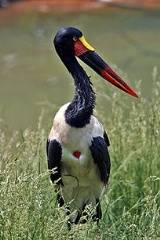
Saddle-billed Stork

Encyclopedia
The Saddle-billed Stork (Ephippiorhynchus senegalensis) is a large wading bird in the stork
family, Ciconiidae. It is a widespread species which is a resident breeder in sub-Saharan Africa
from Sudan
, Ethiopia
and Kenya
south to South Africa
, and in The Gambia
, Senegal
, Côte d'Ivoire
and Chad
in west Africa
.
This is a close relative of the widespread Asian Black-necked Stork
, the only other member of the genus Ephippiorhynchus.
s (though not the heaviest), due in no small part to it extremely long legs (tarsus length is up to 36.5 cm (14.4 in)). The long bill measures from 27.3 to 36 cm (10.7 to 14.2 in). The sexes can be readily distinguished by the golden yellow iris
es of the female and the brown irises of the male.
It is spectacularly plumage
d, identical
in male and female. The head, neck, back, wings, and tail are iridescent black, with the rest of the body and the primary flight feathers being white. Juveniles are browner grey in plumage. The massive bill is red with a black band and a yellow frontal shield (the “saddle”). The legs and feet are black with pink knees. On the chest is a bare red patch of skin, whose colour darkens during breeding season
.
; in flight, the large heavy bill is kept drooping somewhat below belly height, giving these birds a very unusual appearance to those who see them for the first time (see here for photo). To experienced birdwatchers on the other hand, this makes them easily recognizable even if seen from a distance. It has been suggested that due to the large size and unusual appearance in flight, this species is the basis for the "Big Bird" and Kongamato
cryptid
s.
weighing about 146g each. It does not form breeding colonies, and is usually found alone or in pairs. The incubation period is 30–35 days, with another 70 – 100 days before the chicks fledge.
, frog
s and crab
s, but also on small birds and reptiles . They move in a deliberate and stately manner as they hunt, in a similar way to the larger herons.
ian hieroglyph (Gardiner
G29) that had the phonetic value "ba":G29
Its description is often erroneously given as "jabiru
", which is actually this species' Latin America
n relative. The Third Dynasty
pharaoh
Khaba
incorporated this hieroglyph in his name (Jiménez Serrano 2002).
Stork
Storks are large, long-legged, long-necked wading birds with long, stout bills. They belong to the family Ciconiidae. They are the only family in the biological order Ciconiiformes, which was once much larger and held a number of families....
family, Ciconiidae. It is a widespread species which is a resident breeder in sub-Saharan Africa
Africa
Africa is the world's second largest and second most populous continent, after Asia. At about 30.2 million km² including adjacent islands, it covers 6% of the Earth's total surface area and 20.4% of the total land area...
from Sudan
Sudan
Sudan , officially the Republic of the Sudan , is a country in North Africa, sometimes considered part of the Middle East politically. It is bordered by Egypt to the north, the Red Sea to the northeast, Eritrea and Ethiopia to the east, South Sudan to the south, the Central African Republic to the...
, Ethiopia
Ethiopia
Ethiopia , officially known as the Federal Democratic Republic of Ethiopia, is a country located in the Horn of Africa. It is the second-most populous nation in Africa, with over 82 million inhabitants, and the tenth-largest by area, occupying 1,100,000 km2...
and Kenya
Kenya
Kenya , officially known as the Republic of Kenya, is a country in East Africa that lies on the equator, with the Indian Ocean to its south-east...
south to South Africa
South Africa
The Republic of South Africa is a country in southern Africa. Located at the southern tip of Africa, it is divided into nine provinces, with of coastline on the Atlantic and Indian oceans...
, and in The Gambia
The Gambia
The Republic of The Gambia, commonly referred to as The Gambia, or Gambia , is a country in West Africa. Gambia is the smallest country on mainland Africa, surrounded by Senegal except for a short coastline on the Atlantic Ocean in the west....
, Senegal
Senegal
Senegal , officially the Republic of Senegal , is a country in western Africa. It owes its name to the Sénégal River that borders it to the east and north...
, Côte d'Ivoire
Côte d'Ivoire
The Republic of Côte d'Ivoire or Ivory Coast is a country in West Africa. It has an area of , and borders the countries Liberia, Guinea, Mali, Burkina Faso and Ghana; its southern boundary is along the Gulf of Guinea. The country's population was 15,366,672 in 1998 and was estimated to be...
and Chad
Chad
Chad , officially known as the Republic of Chad, is a landlocked country in Central Africa. It is bordered by Libya to the north, Sudan to the east, the Central African Republic to the south, Cameroon and Nigeria to the southwest, and Niger to the west...
in west Africa
Africa
Africa is the world's second largest and second most populous continent, after Asia. At about 30.2 million km² including adjacent islands, it covers 6% of the Earth's total surface area and 20.4% of the total land area...
.
This is a close relative of the widespread Asian Black-necked Stork
Black-necked Stork
The Black-necked Stork is a tall long-necked wading bird in the stork family. It is a resident species across South and Southeast Asia with a disjunct population in Australia. It lives in wetland habitats to forage for a wide range of animal prey...
, the only other member of the genus Ephippiorhynchus.
Description
This is a huge bird that regularly attains a height of 150 cm (59.1 in), a length of 142 cm (55.9 in) and a 2.4–2.7 m (7.9–8.9 ft) wingspan. The male is larger and heavier than the female, with a range of 5.1–7.5 kg (11.2–16.5 lb). The female is usually between 5 and 7 kg (11 and 15.4 lb). It is probably the tallest of the storkStork
Storks are large, long-legged, long-necked wading birds with long, stout bills. They belong to the family Ciconiidae. They are the only family in the biological order Ciconiiformes, which was once much larger and held a number of families....
s (though not the heaviest), due in no small part to it extremely long legs (tarsus length is up to 36.5 cm (14.4 in)). The long bill measures from 27.3 to 36 cm (10.7 to 14.2 in). The sexes can be readily distinguished by the golden yellow iris
Iris (anatomy)
The iris is a thin, circular structure in the eye, responsible for controlling the diameter and size of the pupils and thus the amount of light reaching the retina. "Eye color" is the color of the iris, which can be green, blue, or brown. In some cases it can be hazel , grey, violet, or even pink...
es of the female and the brown irises of the male.
It is spectacularly plumage
Plumage
Plumage refers both to the layer of feathers that cover a bird and the pattern, colour, and arrangement of those feathers. The pattern and colours of plumage vary between species and subspecies and can also vary between different age classes, sexes, and season. Within species there can also be a...
d, identical
Sexual dimorphism
Sexual dimorphism is a phenotypic difference between males and females of the same species. Examples of such differences include differences in morphology, ornamentation, and behavior.-Examples:-Ornamentation / coloration:...
in male and female. The head, neck, back, wings, and tail are iridescent black, with the rest of the body and the primary flight feathers being white. Juveniles are browner grey in plumage. The massive bill is red with a black band and a yellow frontal shield (the “saddle”). The legs and feet are black with pink knees. On the chest is a bare red patch of skin, whose colour darkens during breeding season
Breeding season
The breeding season is the most suitable season, usually with favourable conditions and abundant food and water, for breeding among some wild animals and birds . Species with a breeding season have naturally evolved to have sexual intercourse during a certain time of year in order to achieve the...
.
Behaviour
They are silent except for bill-clattering at the nest. Like most storks, these fly with the neck outstretched, not retracted like a heronHeron
The herons are long-legged freshwater and coastal birds in the family Ardeidae. There are 64 recognised species in this family. Some are called "egrets" or "bitterns" instead of "heron"....
; in flight, the large heavy bill is kept drooping somewhat below belly height, giving these birds a very unusual appearance to those who see them for the first time (see here for photo). To experienced birdwatchers on the other hand, this makes them easily recognizable even if seen from a distance. It has been suggested that due to the large size and unusual appearance in flight, this species is the basis for the "Big Bird" and Kongamato
Kongamato
The Kongamato is a reported pterosaur-like creature said to have been seen by natives and explorers in the Mwinilunga district's Jiundu swamps of Western Zambia, Angola and Congo...
cryptid
Cryptid
In cryptozoology and sometimes in cryptobotany, a cryptid is a creature or plant whose existence has been suggested but is unrecognized by scientific consensus and often regarded as highly unlikely. Famous examples include the Yeti in the Himalayas and the Loch Ness Monster in...
s.
Breeding
The Saddle-billed Stork breeds in forested waterlands and other floodlands in tropical lowland. It builds a large, deep stick nest in a tree, laying one or two white eggsEgg (biology)
An egg is an organic vessel in which an embryo first begins to develop. In most birds, reptiles, insects, molluscs, fish, and monotremes, an egg is the zygote, resulting from fertilization of the ovum, which is expelled from the body and permitted to develop outside the body until the developing...
weighing about 146g each. It does not form breeding colonies, and is usually found alone or in pairs. The incubation period is 30–35 days, with another 70 – 100 days before the chicks fledge.
Food and feeding
The Saddle-billed Stork, like most of its relatives, feeds mainly on fishFish
Fish are a paraphyletic group of organisms that consist of all gill-bearing aquatic vertebrate animals that lack limbs with digits. Included in this definition are the living hagfish, lampreys, and cartilaginous and bony fish, as well as various extinct related groups...
, frog
Frog
Frogs are amphibians in the order Anura , formerly referred to as Salientia . Most frogs are characterized by a short body, webbed digits , protruding eyes and the absence of a tail...
s and crab
Crab
True crabs are decapod crustaceans of the infraorder Brachyura, which typically have a very short projecting "tail" , or where the reduced abdomen is entirely hidden under the thorax...
s, but also on small birds and reptiles . They move in a deliberate and stately manner as they hunt, in a similar way to the larger herons.
Relation to Ancient Egyptian culture
This bird is represented in an Ancient EgyptAncient Egypt
Ancient Egypt was an ancient civilization of Northeastern Africa, concentrated along the lower reaches of the Nile River in what is now the modern country of Egypt. Egyptian civilization coalesced around 3150 BC with the political unification of Upper and Lower Egypt under the first pharaoh...
ian hieroglyph (Gardiner
Gardiner's Sign List
Gardiner's Sign List is a list of common Egyptian hieroglyphs compiled by Sir Alan Gardiner. It is considered a standard reference in the study of Ancient Egyptian hieroglyphs....
G29) that had the phonetic value "ba":
Its description is often erroneously given as "jabiru
Jabiru
The Jabiru is a large stork found in the Americas from Mexico to Argentina, except west of the Andes. It is most common in the Pantanal region of Brazil and the Eastern Chaco region of Paraguay. It is the only member of the genus Jabiru...
", which is actually this species' Latin America
Latin America
Latin America is a region of the Americas where Romance languages – particularly Spanish and Portuguese, and variably French – are primarily spoken. Latin America has an area of approximately 21,069,500 km² , almost 3.9% of the Earth's surface or 14.1% of its land surface area...
n relative. The Third Dynasty
Third dynasty of Egypt
For the Sumerian Renaissance, see Third Dynasty of Ur.The Third Dynasty of ancient Egypt is the first dynasty of the Old Kingdom. Other dynasties of the Old Kingdom include the Fourth, Fifth and Sixth...
pharaoh
Pharaoh
Pharaoh is a title used in many modern discussions of the ancient Egyptian rulers of all periods. The title originates in the term "pr-aa" which means "great house" and describes the royal palace...
Khaba
Khaba
Khaba was a Pharaoh of Ancient Egypt's Old Kingdom and is generally considered to have reigned near the end of the Third Dynasty. He was successor to Sekhemkhet, and he was probably a son of Sekhemkhet...
incorporated this hieroglyph in his name (Jiménez Serrano 2002).