

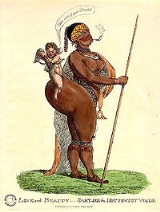
Saartjie Baartman

Encyclopedia
Sarah "Saartjie" Baartman (before 1790 – 29 December 1815) (also spelled Bartman, Bartmann, Baartmen) was the most famous of at least two Khoikhoi
women who were exhibited as freak show
attractions in 19th century Europe under the name Hottentot Venus—"Hottentot" as the then-current name for the Khoi people, now considered an offensive term, and "Venus" in reference to the Roman goddess of love
.
family in the vicinity of the Gamtoos River
in what is now the Eastern Cape
of South Africa
. She was orphaned in a commando
raid. Saartjie, pronounced "Sahr-kee", is the diminutive
form of her name; in Afrikaans
the use of the diminutive form commonly indicates familiarity or endearment rather than a literally short stature. Her birth name is unknown.
Baartman was a slave
of Dutch farmers near Cape Town
when Hendrick Cezar, the brother of her slave owner, suggested that she travel to England for exhibition, promising her that she would become wealthy. Lord Caledon
, governor of the Cape, gave permission for the trip, but later regretted it after he fully learned its purpose. She left for London in 1810.
) and the elongated labia
of some Khoisan women. To quote historian of science
Stephen Jay Gould
, "The labia minora
, or inner lips, of the ordinary female genitalia are greatly enlarged in Khoi-San women, and may hang down three or four inches below the vulva
when women stand, thus giving the impression of a separate and enveloping curtain of skin". Baartman never allowed this trait to be exhibited while she was alive, and an account of her appearance in London in 1810 makes it clear that she was wearing a garment, although apparently a tight-fitting one.
Her exhibition in London, scant years after the passing of the Slave Trade Act 1807, created a scandal. An abolitionist
benevolent society called the African Association
– the equivalent of a charity or pressure group – petitioned for her release. On November 24, 1810 at the Court of King's Bench the Attorney-General began the attempt 'to give her liberty to say whether she was exhibited by her own consent'. In support he produced two affidavits in court. The first, from a Mr Bullock of Liverpool Museum, was intended to show Baartman had been brought to Britain by persons who referred to her as if she were property. The second, by the Secretary of the African Association, described the degrading conditions under which she was exhibited and also gave evidence of coercion. Baartman was questioned before a court in Dutch
, in which she was fluent, and stated that she was not under restraint and understood perfectly that she was guaranteed half of the profits. The conditions under which she made these statements are suspect, because it directly contradicts accounts of her exhibitions made by Zachary Macaulay
of the African Institution
and other eyewitnesses. On December 1, 1811 Baartman was christened at Manchester Cathedral.
, Regu, exhibited her under more pressured conditions for fifteen months. French naturalists
, among them Georges Cuvier
, head keeper of the menagerie
at the Muséum national d'Histoire naturelle
, visited her. She was the subject of several scientific paintings at the Jardin du Roi, where she was examined in March 1815: as Saint-Hilaire and Frédéric Cuvier
, a younger brother of Georges, reported, "she was obliging enough to undress and to allow herself to be painted in the nude." Once her novelty had worn thin with Parisians, she began to drink heavily and support herself with prostitution.
, while other sources suggest she contracted syphilis
, or pneumonia
. An autopsy
was conducted, and published by French anatomist Henri Marie Ducrotay de Blainville
in 1816 and republished by French naturalist Georges Cuvier
in the Memoires du Museum d'Histoire Naturelle in 1817. Cuvier notes in his monograph
that Baartman was an intelligent woman who had an excellent memory and spoke Dutch fluently. Her skeleton
, preserved genitals and brain
were placed on display in Paris' Musée de l'Homme
until 1974, when they were removed from public view and stored out of sight; a molded casting was still shown for the following two years.
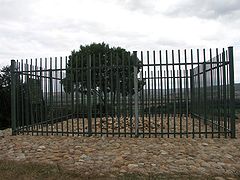 There were sporadic calls for the return of her remains, beginning in the 1940s, but the case became prominent only after Stephen Jay Gould wrote The Hottentot Venus in the 1980s. After the victory of the African National Congress
in the South African general election, 1994
, President Nelson Mandela
formally requested that France return the remains. After much legal wrangling and debates in the French National Assembly
, France acceded to the request on 6 March 2002. Her remains were repatriated to her homeland, the Gamtoos Valley, on 6 May 2002 and they were buried on 9 August 2002 on Vergaderingskop, a hill in the town of Hankey
over 200 years after her birth.
Baartman became an icon in South Africa as representative of many aspects of the nation's history
. The Saartjie Baartman Centre for Women and Children, a refuge for survivors of domestic violence
, opened in Cape Town in 1999. South Africa's first offshore environmental protection vessel, the Sarah Baartman, is also named after her.

Khoikhoi
The Khoikhoi or Khoi, in standardised Khoekhoe/Nama orthography spelled Khoekhoe, are a historical division of the Khoisan ethnic group, the native people of southwestern Africa, closely related to the Bushmen . They had lived in southern Africa since the 5th century AD...
women who were exhibited as freak show
Freak show
A freak show is an exhibition of biological rarities, referred to as "freaks of nature". Typical features would be physically unusual humans, such as those uncommonly large or small, those with both male and female secondary sexual characteristics, people with other extraordinary diseases and...
attractions in 19th century Europe under the name Hottentot Venus—"Hottentot" as the then-current name for the Khoi people, now considered an offensive term, and "Venus" in reference to the Roman goddess of love
Venus (mythology)
Venus is a Roman goddess principally associated with love, beauty, sex,sexual seduction and fertility, who played a key role in many Roman religious festivals and myths...
.
Southern Africa
Sarah Baartman was born to a KhoisanKhoisan
Khoisan is a unifying name for two ethnic groups of Southern Africa, who share physical and putative linguistic characteristics distinct from the Bantu majority of the region. Culturally, the Khoisan are divided into the foraging San and the pastoral Khoi...
family in the vicinity of the Gamtoos River
Gamtoos River
Gamtoos River formed by the Kouga and the Groot is situated in the Eastern Cape Province of South Africa and is approximately 645 km long with a catchment area of 34,635 km²...
in what is now the Eastern Cape
Eastern Cape
The Eastern Cape is a province of South Africa. Its capital is Bhisho, but its two largest cities are Port Elizabeth and East London. It was formed in 1994 out of the "independent" Xhosa homelands of Transkei and Ciskei, together with the eastern portion of the Cape Province...
of South Africa
South Africa
The Republic of South Africa is a country in southern Africa. Located at the southern tip of Africa, it is divided into nine provinces, with of coastline on the Atlantic and Indian oceans...
. She was orphaned in a commando
Boer Commando
The Boer commando was the basic unit of organisation of the militia of the Boer people of South Africa. The term came into English usage during the Second Boer War.-History:...
raid. Saartjie, pronounced "Sahr-kee", is the diminutive
Diminutive
In language structure, a diminutive, or diminutive form , is a formation of a word used to convey a slight degree of the root meaning, smallness of the object or quality named, encapsulation, intimacy, or endearment...
form of her name; in Afrikaans
Afrikaans
Afrikaans is a West Germanic language, spoken natively in South Africa and Namibia. It is a daughter language of Dutch, originating in its 17th century dialects, collectively referred to as Cape Dutch .Afrikaans is a daughter language of Dutch; see , , , , , .Afrikaans was historically called Cape...
the use of the diminutive form commonly indicates familiarity or endearment rather than a literally short stature. Her birth name is unknown.
Baartman was a slave
Slavery
Slavery is a system under which people are treated as property to be bought and sold, and are forced to work. Slaves can be held against their will from the time of their capture, purchase or birth, and deprived of the right to leave, to refuse to work, or to demand compensation...
of Dutch farmers near Cape Town
Cape Town
Cape Town is the second-most populous city in South Africa, and the provincial capital and primate city of the Western Cape. As the seat of the National Parliament, it is also the legislative capital of the country. It forms part of the City of Cape Town metropolitan municipality...
when Hendrick Cezar, the brother of her slave owner, suggested that she travel to England for exhibition, promising her that she would become wealthy. Lord Caledon
Du Pre Alexander, 2nd Earl of Caledon
Du Pré Alexander, 2nd Earl of Caledon KP , styled The Honourable from 1790 to 1800 and then Viscount Alexander to 1802, was an Irish peer, landlord and colonial administrator, and was the second child and only son of James Alexander, 1st Earl of Caledon.-Education and Inheritance:He was educated...
, governor of the Cape, gave permission for the trip, but later regretted it after he fully learned its purpose. She left for London in 1810.
Great Britain
Baartman was exhibited around Britain, entertaining people by showing what were thought of as highly unusual bodily features. She had large buttocks (steatopygiaSteatopygia
Steatopygia is a high degree of fat accumulation in and around the buttocks. The deposit of fat is not confined to the gluteal regions, but extends to the outside and front of the thighs, forming a thick layer reaching sometimes to the knee.- History :...
) and the elongated labia
Elongated labia
Elongated labia is an possibly genetic feature of certain Khoisan groups, whose female members develop relatively elongated labia minora, hanging up to four inches outside their vulva when they are standing in an upright position...
of some Khoisan women. To quote historian of science
History of science
The history of science is the study of the historical development of human understandings of the natural world and the domains of the social sciences....
Stephen Jay Gould
Stephen Jay Gould
Stephen Jay Gould was an American paleontologist, evolutionary biologist, and historian of science. He was also one of the most influential and widely read writers of popular science of his generation....
, "The labia minora
Labia minora
The labia minora , also known as the inner labia, inner lips, or nymphae, are two flaps of skin on either side of the human vaginal opening, situated between the labia majora...
, or inner lips, of the ordinary female genitalia are greatly enlarged in Khoi-San women, and may hang down three or four inches below the vulva
Vulva
The vulva consists of the external genital organs of the female mammal. This article deals with the vulva of the human being, although the structures are similar for other mammals....
when women stand, thus giving the impression of a separate and enveloping curtain of skin". Baartman never allowed this trait to be exhibited while she was alive, and an account of her appearance in London in 1810 makes it clear that she was wearing a garment, although apparently a tight-fitting one.
Her exhibition in London, scant years after the passing of the Slave Trade Act 1807, created a scandal. An abolitionist
Abolitionism
Abolitionism is a movement to end slavery.In western Europe and the Americas abolitionism was a movement to end the slave trade and set slaves free. At the behest of Dominican priest Bartolomé de las Casas who was shocked at the treatment of natives in the New World, Spain enacted the first...
benevolent society called the African Association
African Association
The Association for Promoting the Discovery of the Interior Parts of Africa , founded in London on June 9, 1788, was a British club dedicated to the exploration of West Africa, with the mission of discovering the origin and course of the Niger River and the location of Timbuktu, the "lost city" of...
– the equivalent of a charity or pressure group – petitioned for her release. On November 24, 1810 at the Court of King's Bench the Attorney-General began the attempt 'to give her liberty to say whether she was exhibited by her own consent'. In support he produced two affidavits in court. The first, from a Mr Bullock of Liverpool Museum, was intended to show Baartman had been brought to Britain by persons who referred to her as if she were property. The second, by the Secretary of the African Association, described the degrading conditions under which she was exhibited and also gave evidence of coercion. Baartman was questioned before a court in Dutch
Dutch language
Dutch is a West Germanic language and the native language of the majority of the population of the Netherlands, Belgium, and Suriname, the three member states of the Dutch Language Union. Most speakers live in the European Union, where it is a first language for about 23 million and a second...
, in which she was fluent, and stated that she was not under restraint and understood perfectly that she was guaranteed half of the profits. The conditions under which she made these statements are suspect, because it directly contradicts accounts of her exhibitions made by Zachary Macaulay
Zachary Macaulay
Zachary Macaulay was a slavery abolitionist and campaigner.-Early life:Macaulay was born in Inveraray, Scotland, the son of the Rev. John Macaulay Zachary Macaulay (2 May 1768 – 13 May 1838) was a slavery abolitionist and campaigner.-Early life:Macaulay was born in Inveraray, Scotland, the son of...
of the African Institution
African Institution
The African Institution in 1807 after Britain abolitionists succeeded in ending slavery in Great Britain. The Institution was formed to succeed where the former Sierra Leone Company had failed - to create a viable, civilized refuge for freed slaves in Sierra Leone, Africa...
and other eyewitnesses. On December 1, 1811 Baartman was christened at Manchester Cathedral.
France
Baartman was sold to a Frenchman, who took her to his country. An animal trainerAnimal training
Animal training refers to teaching animals specific responses to specific conditions or stimuli. Training may be for the purpose of companionship, detection, protection, entertainment or all of the above....
, Regu, exhibited her under more pressured conditions for fifteen months. French naturalists
Natural history
Natural history is the scientific research of plants or animals, leaning more towards observational rather than experimental methods of study, and encompasses more research published in magazines than in academic journals. Grouped among the natural sciences, natural history is the systematic study...
, among them Georges Cuvier
Georges Cuvier
Georges Chrétien Léopold Dagobert Cuvier or Jean Léopold Nicolas Frédéric Cuvier , known as Georges Cuvier, was a French naturalist and zoologist...
, head keeper of the menagerie
Menagerie
A menagerie is/was a form of keeping common and exotic animals in captivity that preceded the modern zoological garden. The term was first used in seventeenth century France in reference to the management of household or domestic stock. Later, it came to be used primarily in reference to...
at the Muséum national d'Histoire naturelle
Muséum national d'histoire naturelle
The Muséum national d'Histoire naturelle is the National Museum of Natural History in Paris, France.- History :The museum was formally founded on 10 June 1793, during the French Revolution...
, visited her. She was the subject of several scientific paintings at the Jardin du Roi, where she was examined in March 1815: as Saint-Hilaire and Frédéric Cuvier
Frédéric Cuvier
Frédéric Cuvier was a French zoologist. He was the younger brother of noted naturalist and zoologist Georges Cuvier....
, a younger brother of Georges, reported, "she was obliging enough to undress and to allow herself to be painted in the nude." Once her novelty had worn thin with Parisians, she began to drink heavily and support herself with prostitution.
Death and legacy
She died on 29 December 1815 of an indetermined inflammatory ailment, possibly smallpoxSmallpox
Smallpox was an infectious disease unique to humans, caused by either of two virus variants, Variola major and Variola minor. The disease is also known by the Latin names Variola or Variola vera, which is a derivative of the Latin varius, meaning "spotted", or varus, meaning "pimple"...
, while other sources suggest she contracted syphilis
Syphilis
Syphilis is a sexually transmitted infection caused by the spirochete bacterium Treponema pallidum subspecies pallidum. The primary route of transmission is through sexual contact; however, it may also be transmitted from mother to fetus during pregnancy or at birth, resulting in congenital syphilis...
, or pneumonia
Pneumonia
Pneumonia is an inflammatory condition of the lung—especially affecting the microscopic air sacs —associated with fever, chest symptoms, and a lack of air space on a chest X-ray. Pneumonia is typically caused by an infection but there are a number of other causes...
. An autopsy
Autopsy
An autopsy—also known as a post-mortem examination, necropsy , autopsia cadaverum, or obduction—is a highly specialized surgical procedure that consists of a thorough examination of a corpse to determine the cause and manner of death and to evaluate any disease or injury that may be present...
was conducted, and published by French anatomist Henri Marie Ducrotay de Blainville
Henri Marie Ducrotay de Blainville
Henri Marie Ducrotay de Blainville was a French zoologist and anatomist.Blainville was born at Arques, near Dieppe. In about 1796 he went to Paris to study painting, but he ultimately devoted himself to natural history, and attracted the attention of Georges Cuvier, for whom he occasionally...
in 1816 and republished by French naturalist Georges Cuvier
Georges Cuvier
Georges Chrétien Léopold Dagobert Cuvier or Jean Léopold Nicolas Frédéric Cuvier , known as Georges Cuvier, was a French naturalist and zoologist...
in the Memoires du Museum d'Histoire Naturelle in 1817. Cuvier notes in his monograph
Monograph
A monograph is a work of writing upon a single subject, usually by a single author.It is often a scholarly essay or learned treatise, and may be released in the manner of a book or journal article. It is by definition a single document that forms a complete text in itself...
that Baartman was an intelligent woman who had an excellent memory and spoke Dutch fluently. Her skeleton
Skeleton
The skeleton is the body part that forms the supporting structure of an organism. There are two different skeletal types: the exoskeleton, which is the stable outer shell of an organism, and the endoskeleton, which forms the support structure inside the body.In a figurative sense, skeleton can...
, preserved genitals and brain
Brain
The brain is the center of the nervous system in all vertebrate and most invertebrate animals—only a few primitive invertebrates such as sponges, jellyfish, sea squirts and starfishes do not have one. It is located in the head, usually close to primary sensory apparatus such as vision, hearing,...
were placed on display in Paris' Musée de l'Homme
Musée de l'Homme
The Musée de l'Homme was created in 1937 by Paul Rivet for the 1937 Exposition Internationale des Arts et Techniques dans la Vie Moderne. It is the descendant of the Musée d'Ethnographie du Trocadéro, founded in 1878...
until 1974, when they were removed from public view and stored out of sight; a molded casting was still shown for the following two years.
African National Congress
The African National Congress is South Africa's governing Africanist political party, supported by its tripartite alliance with the Congress of South African Trade Unions and the South African Communist Party , since the establishment of non-racial democracy in April 1994. It defines itself as a...
in the South African general election, 1994
South African general election, 1994
The South African general election of 1994 was an election held in South Africa to mark the end of apartheid, therefore also the first held with universal adult suffrage. The election was conducted under the direction of the Independent Electoral Commission .Millions queued in lines over a three...
, President Nelson Mandela
Nelson Mandela
Nelson Rolihlahla Mandela served as President of South Africa from 1994 to 1999, and was the first South African president to be elected in a fully representative democratic election. Before his presidency, Mandela was an anti-apartheid activist, and the leader of Umkhonto we Sizwe, the armed wing...
formally requested that France return the remains. After much legal wrangling and debates in the French National Assembly
French National Assembly
The French National Assembly is the lower house of the bicameral Parliament of France under the Fifth Republic. The upper house is the Senate ....
, France acceded to the request on 6 March 2002. Her remains were repatriated to her homeland, the Gamtoos Valley, on 6 May 2002 and they were buried on 9 August 2002 on Vergaderingskop, a hill in the town of Hankey
Hankey
Hankey is a small town on the confluence of the Klein and Gamtoos rivers in South Africa. It is part of the Kouga Local Municipality of the Cacadu District in the Eastern Cape.- History :...
over 200 years after her birth.
Baartman became an icon in South Africa as representative of many aspects of the nation's history
History of South Africa
South African history has been dominated by the interaction and conflict of several diverse ethnic groups. The aboriginal Khoisan people have lived in the region for millennia. Most of the population, however, trace their history to immigration since...
. The Saartjie Baartman Centre for Women and Children, a refuge for survivors of domestic violence
Domestic violence
Domestic violence, also known as domestic abuse, spousal abuse, battering, family violence, and intimate partner violence , is broadly defined as a pattern of abusive behaviors by one or both partners in an intimate relationship such as marriage, dating, family, or cohabitation...
, opened in Cape Town in 1999. South Africa's first offshore environmental protection vessel, the Sarah Baartman, is also named after her.
Cultural references
- On January 10, 1811 at the New Theatre, London, a pantomime called 'The Hottentot Venus' featured at the end of the evening's entertainment.
- In his 1847 novel Vanity Fair, William Makepeace ThackerayWilliam Makepeace ThackerayWilliam Makepeace Thackeray was an English novelist of the 19th century. He was famous for his satirical works, particularly Vanity Fair, a panoramic portrait of English society.-Biography:...
referred to the Hottentot Venus, explaining George's aversion to marrying a woman of color. - Dame Edith Sitwell referred to her allusively in "Hornpipe", a poem in the satirical collection "Façade".
- Poet Elizabeth AlexanderElizabeth Alexander (poet)Elizabeth Alexander is an American poet, essayist, playwright, and a university professor.-Early life:Alexander was born in Harlem, New York City and grew up in Washington D.C. She is the daughter of former United States Secretary of the Army and Equal Employment Opportunity Commission Chairman...
explores her story in a 1987 poem and 1990 book, both entitled The Venus Hottentot. - Diana Ferrus, a South African poet of Khoisan descent, wrote "A Poem for Sarah Baartman" while studying in Europe. It includes the desire "to wrench [her] away-/ away from the poking eyes... ."
- Poet M. K. Asante wrote "Ghetto Booty: The Hottentot Remix" for Saartjie Baartman in his 2005 book Beautiful. And Ugly Too. The poem tells Baartman's story and warns the hip hopHip hopHip hop is a form of musical expression and artistic culture that originated in African-American and Latino communities during the 1970s in New York City, specifically the Bronx. DJ Afrika Bambaataa outlined the four pillars of hip hop culture: MCing, DJing, breaking and graffiti writing...
generation not to repeat racist cycles of black female exploitation. - The science fictionScience fictionScience fiction is a genre of fiction dealing with imaginary but more or less plausible content such as future settings, futuristic science and technology, space travel, aliens, and paranormal abilities...
author Paul Di FilippoPaul Di FilippoPaul Di Filippo is an American science fiction writer. He has been published in Postscripts...
used her story as the basis for the second novel of his SteampunkSteampunkSteampunk is a sub-genre of science fiction, fantasy, alternate history, and speculative fiction that came into prominence during the 1980s and early 1990s. Steampunk involves a setting where steam power is still widely used—usually Victorian era Britain or "Wild West"-era United...
Trilogy. - Barbara Chase-RiboudBarbara Chase-RiboudBarbara Chase-Riboud is an American novelist, poet, sculptor and visual artist, perhaps best known for her historical fiction. Much of her work has explored themes related to slavery and exploitation of women....
wrote a fictional biography entitled Hottentot Venus. - Her life features in the 2007 AfrikaansAfrikaansAfrikaans is a West Germanic language, spoken natively in South Africa and Namibia. It is a daughter language of Dutch, originating in its 17th century dialects, collectively referred to as Cape Dutch .Afrikaans is a daughter language of Dutch; see , , , , , .Afrikaans was historically called Cape...
romantic novel Frats by Chris Karsten. - Playwright Suzan-Lori ParksSuzan-Lori ParksSuzan-Lori Parks is an African American playwright and screenwriter. She received the MacArthur Foundation "Genius" Grant in 2001, and the 2002 Pulitzer Prize for Drama for her play, Topdog/Underdog.-Early years:...
fictionalizes her story in Venus. - Playwright Lydia R. DiamondLydia R. DiamondLydia R. Diamond is an American playwright. Her plays include Here I Am...See Can You Handle It, The Inside adapted from the poems of Nikki Giovanni, Stage Black, The Gift Horse, Stick Fly, Voyeurs de Venus, The Bluest Eye, an adaptation from Toni Morrison's novel and Harriet Jacobs' Incidents...
's play "Voyeurs de Venus" also examines her story through the eyes of a 20th-century author. - In 2006, a feminist artist and filmmaker adopted the name Venus Hottentot to direct an independent film with erotic content called Afrodite SuperstarAfrodite SuperstarAfrodite Superstar is an American independent art film shot in New York City in 2006. The film has also been referred to as erotica. The director also refers to the film as an experimental film as the characters break the fourth wall, and there is a blend of satire. Afrodite Superstar was...
with the intention of reclaiming the strength and voice of Sarah Baartman as a sexually-exploited woman of color. - Canadian performance artPerformance artIn art, performance art is a performance presented to an audience, traditionally interdisciplinary. Performance may be either scripted or unscripted, random or carefully orchestrated; spontaneous or otherwise carefully planned with or without audience participation. The performance can be live or...
ist Mara Verna created a web-based project and travelling exhibition cataloguing her story. - Novelist Joyce Carol OatesJoyce Carol OatesJoyce Carol Oates is an American author. Oates published her first book in 1963 and has since published over fifty novels, as well as many volumes of short stories, poetry, and nonfiction...
uses the image and the story of the Hottentot Venus in her 2006 novel Black Girl/White Girl. - The Saartjie Project is a collection of artists and activists using theatrical productions including song, dance, visual arts, spoken word and drama to explore the continued fascination with the black female form; to create dialogue; and to promote healing across communities.
- A movie entitled Black VenusBlack Venus (film)Black Venus is a 2010 French drama film directed by Abdellatif Kechiche. It is based on the life of Sarah Baartman, a Khoikhoi woman who in the early 19th century was exhibited in Europe under the name "Hottentot Venus"...
, directed by Abdellatif Kechiche and starring Yahima Torres as Sarah, was released in 2010. - Composer Hendrik HofmeyrHendrik HofmeyrHendrik Pienaar Hofmeyr is among the younger generation of South African composers. Born in Cape Town, he furthered his studies in Italy during 10 years of self-imposed exile as a conscientious objector. While there, he won the South African Opera Competition with The Fall of the House of Usher...
composed a 20 minute opera entitled Saartjie which will be premiered by Cape Town OperaCape Town OperaCape Town Opera is a professional opera company located in Cape Town, South Africa. CTO was founded in 1999 by the management and staff of the former South Africa Arts Council Opera...
in November 2010.
See also
- Human zooHuman zooHuman zoos were 19th- and 20th-century public exhibits of humans, usually in a so-called natural or primitive state. The displays often emphasized the cultural differences between Europeans of Western civilisation and non-European peoples...
- Ota BengaOta BengaOta Benga was a Congolese Mbuti pygmy known for being featured in a controversial human zoo exhibit at New York City's Bronx Zoo in 1906. Benga came to the United States through the action of businessman and missionary Samuel Phillips Verner...
- Racism in EuropeRacism in EuropeThe article describes the state of race relations and racism in Europe. Racism of various forms is found in every country on Earth. Racism is widely condemned throughout the world, with 170 states signatories of the International Convention on the Elimination of All Forms of Racial Discrimination...