


Ota Benga

Encyclopedia
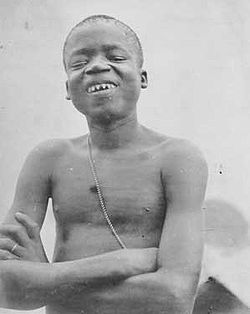
Democratic Republic of the Congo
The Democratic Republic of the Congo is a state located in Central Africa. It is the second largest country in Africa by area and the eleventh largest in the world...
Mbuti pygmy known for being featured in a controversial human zoo
Human zoo
Human zoos were 19th- and 20th-century public exhibits of humans, usually in a so-called natural or primitive state. The displays often emphasized the cultural differences between Europeans of Western civilisation and non-European peoples...
exhibit at New York City
New York City
New York is the most populous city in the United States and the center of the New York Metropolitan Area, one of the most populous metropolitan areas in the world. New York exerts a significant impact upon global commerce, finance, media, art, fashion, research, technology, education, and...
's Bronx Zoo
Bronx Zoo
The Bronx Zoo is located in the Bronx borough of New York City, within Bronx Park. It is the largest metropolitan zoo in the United States, comprising of park lands and naturalistic habitats, through which the Bronx River flows....
in 1906. Benga came to the United States through the action of businessman and missionary
Missionary
A missionary is a member of a religious group sent into an area to do evangelism or ministries of service, such as education, literacy, social justice, health care and economic development. The word "mission" originates from 1598 when the Jesuits sent members abroad, derived from the Latin...
Samuel Phillips Verner. Under contract from the Louisiana Purchase Exposition
Louisiana Purchase Exposition
The Louisiana Purchase Exposition, informally known as the Saint Louis World's Fair, was an international exposition held in St. Louis, Missouri, United States in 1904.- Background :...
, Verner negotiated Benga's release from slave traders in 1904. He had been captured by slavers after the Force Publique
Force Publique
The Force Publique , French for "Public Force", was both a gendarmerie and a military force in what is now the Democratic Republic of the Congo from 1885, , through the period of direct Belgian colonial rule...
attacked his village, killing his wife and two children. Benga was featured in an anthropology display at the Louisiana Purchase Exposition later in 1904. After he had nearly two years of travel, including a return trip to Africa, Benga was later to be caged at the Bronx Zoo where he came to be "exhibited" in the zoo's Monkey House as part of a display intended to promote the concepts of human evolution
Human evolution
Human evolution refers to the evolutionary history of the genus Homo, including the emergence of Homo sapiens as a distinct species and as a unique category of hominids and mammals...
and scientific racism
Scientific racism
Scientific racism is the use of scientific techniques and hypotheses to sanction the belief in racial superiority or racism.This is not the same as using scientific findings and the scientific method to investigate differences among the humans and argue that there are races...
.
The St. Louis Republic newspaper reported on the exhibit on March 6, 1904 stating that "[he] represented the lowest form of human development." Newspapers wrote sensationalized articles in order to attract zoo goers to the "exhibit". On May 5, the Republic reported that a leader of the expedition narrowly escaped being eaten alive by cannibals. Ota Benga was encouraged to carry an orangutan around the cage like a father holding a small child. "Benga", one newspaper reporter wrote, "was not much taller than the orangutan...Their heads are much alike, and both grin the same way when pleased." African American newspapers around the nation editorialized against Benga's treatment. Dr. R.S. MacArthur, the spokesperson for a delegation of black churches petitioned the mayor for his release. The mayor initially ignored the protest then eventually released Benga from the cage and made him a ward at the Howard Colored Orphan Asylum in Brooklyn. After learning that he would not be repatriated as promised, he committed suicide in 1916 at the age of 32.
Early life
A member of the MbutiMbuti
Mbuti or Bambuti are one of several indigenous pygmy groups in the Congo region of Africa. Their languages belong to the Central Sudanic and also to Bantu languages.-Overview:...
people, Ota Benga lived in equatorial forests near the Kasai River
Kasai River
The Kasai River is a tributary of the Congo River, located in central Africa. The river begins in Angola and serves as the border between Angola and the Democratic Republic of the Congo , then flows into the DRC, where it joins the Congo northeast of Kinshasa. The Kasai's tributaries include the...
in what was then the Belgian Congo
Belgian Congo
The Belgian Congo was the formal title of present-day Democratic Republic of the Congo between King Leopold II's formal relinquishment of his personal control over the state to Belgium on 15 November 1908, and Congolese independence on 30 June 1960.-Congo Free State, 1884–1908:Until the latter...
. His people lived in harmony with local villagers, maintaining amicable if cautious relations. When King Leopold II of Belgium
Leopold II of Belgium
Leopold II was the second king of the Belgians. Born in Brussels the second son of Leopold I and Louise-Marie of Orléans, he succeeded his father to the throne on 17 December 1865 and remained king until his death.Leopold is chiefly remembered as the founder and sole owner of the Congo Free...
created the Force Publique
Force Publique
The Force Publique , French for "Public Force", was both a gendarmerie and a military force in what is now the Democratic Republic of the Congo from 1885, , through the period of direct Belgian colonial rule...
to exploit the large supply of rubber
Rubber
Natural rubber, also called India rubber or caoutchouc, is an elastomer that was originally derived from latex, a milky colloid produced by some plants. The plants would be ‘tapped’, that is, an incision made into the bark of the tree and the sticky, milk colored latex sap collected and refined...
in the Congo, his agents killed Benga's people. He lost his wife and two children, surviving only because he was away on a hunting expedition at the time they were killed, but was later captured by slavers.
American businessman and missionary Samuel Phillips Verner was sent to Africa in 1904 under contract from the Louisiana Purchase Exposition
Louisiana Purchase Exposition
The Louisiana Purchase Exposition, informally known as the Saint Louis World's Fair, was an international exposition held in St. Louis, Missouri, United States in 1904.- Background :...
(St. Louis World Fair) to bring back an assortment of pygmies to perform in an exhibition. Noted scientist W. J. McGee, to demonstrate the fledgling discipline of anthropology
Anthropology
Anthropology is the study of humanity. It has origins in the humanities, the natural sciences, and the social sciences. The term "anthropology" is from the Greek anthrōpos , "man", understood to mean mankind or humanity, and -logia , "discourse" or "study", and was first used in 1501 by German...
, intended to display "representatives of all the world's peoples, ranging from smallest pygmies to the most gigantic peoples, from the darkest blacks to the dominant whites" to show a sort of cultural evolution
Scientific racism
Scientific racism is the use of scientific techniques and hypotheses to sanction the belief in racial superiority or racism.This is not the same as using scientific findings and the scientific method to investigate differences among the humans and argue that there are races...
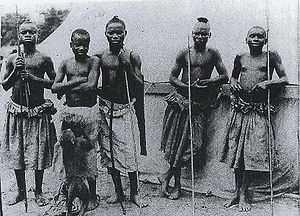
. Verner discovered Ota Benga while en route to a Batwa village he had visited previously and negotiated Benga's release for a pound of salt and a bolt of cloth. The two spent several weeks together before reaching the village, where the abuses of King Leopold's forces had instilled mistrust for the muzungu (white man). Verner was unable to persuade any villagers to join him until Benga spoke of how the muzungu had saved his life, the bond that had grown between them, and his own curiosity about the world Verner came from. Four Batwa, all male, ultimately accompanied them; five non-pygmies from the Bakuba
Kuba Kingdom
The Kuba Kingdom was a pre-colonial Central African state bordered by the Sankuru, Lulua, and Kasai rivers in the southeast of what is today the Democratic Republic of the Congo...
(including the son of King Ndombe, ruler of the Bakuba) and related peoples – "Red Africans" as they were collectively labeled by contemporary anthropologists – came as well.
St. Louis
St. Louis, Missouri
St. Louis is an independent city on the eastern border of Missouri, United States. With a population of 319,294, it was the 58th-largest U.S. city at the 2010 U.S. Census. The Greater St...
, without Verner (who had been taken ill with malaria
Malaria
Malaria is a mosquito-borne infectious disease of humans and other animals caused by eukaryotic protists of the genus Plasmodium. The disease results from the multiplication of Plasmodium parasites within red blood cells, causing symptoms that typically include fever and headache, in severe cases...
), in late June when the Louisiana Purchase Exposition had already begun. They immediately became the center of attention; referred to variously by the press as Artiba, Autobank, Ota Bang, and Otabenga, Ota Benga was particularly popular. In addition to his having an amicable personality, visitors were eager to see his teeth, which had been filed to sharp points as ritual decoration in his early youth. As he and the others had learned to charge for photographs and performances, one newspaper account, promoting him as "the only genuine African cannibal in America", claimed "[his teeth were] worth the five cents he charges for showing them to visitors".
When Verner arrived a month later, he realized the pygmies were more prisoners than performers. Their attempts to congregate peacefully in the forest on Sundays were thwarted by the crowds' fascination with them, as were McGee's attempts to present a "serious" scientific exhibit. On a July 28, their performing to the crowd's preconceived notion that they were "savages" resulted in the First Illinois Regiment being called in to control the mob. Benga and the other Africans eventually performed in a military-style fashion, imitating that of the Indians
Native Americans in the United States
Native Americans in the United States are the indigenous peoples in North America within the boundaries of the present-day continental United States, parts of Alaska, and the island state of Hawaii. They are composed of numerous, distinct tribes, states, and ethnic groups, many of which survive as...
at the Exhibition. The Indian chief Geronimo
Geronimo
Geronimo was a prominent Native American leader of the Chiricahua Apache who fought against Mexico and the United States for their expansion into Apache tribal lands for several decades during the Apache Wars. Allegedly, "Geronimo" was the name given to him during a Mexican incident...
(featured as "The Human Tyger" – with special dispensation from the Department of War
United States Department of War
The United States Department of War, also called the War Department , was the United States Cabinet department originally responsible for the operation and maintenance of the United States Army...
) came to admire Benga and gave him one of his famed arrowhead
Arrowhead
An arrowhead is a tip, usually sharpened, added to an arrow to make it more deadly or to fulfill some special purpose. Historically arrowheads were made of stone and of organic materials; as human civilization progressed other materials were used...
s. For his efforts, Verner was awarded the gold medal in anthropology at the Exposition's close.
Museum of Natural History
Benga accompanied Verner when he returned the other Africans, and briefly lived amongst the Batwa while continuing to accompany Verner on his African adventures. He married a Batwa woman who later died of snakebite, and little is known of his second marriage. Not feeling that he belonged with the Batwa, Benga chose to return with Verner to the United States.Verner eventually arranged for Benga to stay in a spare room at the American Museum of Natural History
American Museum of Natural History
The American Museum of Natural History , located on the Upper West Side of Manhattan in New York City, United States, is one of the largest and most celebrated museums in the world...
in New York City while tending to other business. Verner negotiated with curator Henry Bumpus over the presentation of his acquisitions from Africa and potential employment. While Bumpus was put off by Verner's request of the prohibitively high salary of $175 a month and was not impressed with the man's credentials, he was interested in Benga. Wearing a Southern-style linen suit to entertain visitors, Benga initially enjoyed his time at the museum. He became homesick, however:
What at first held his attention now made him want to flee. It was maddening to be inside – to be swallowed whole – so long. He had an image of himself, stuffed, behind glass, but somehow still alive, crouching over a fake campfire, feeding meat to a lifeless child. Museum silence became a source of torment, a kind of noise; he needed birdsong, breezes, trees.
The disaffected Benga attempted to find relief by exploiting his employers' presentation of him as a 'savage'. He tried to slip past the guards as a large crowd was leaving the premises; when asked on one occasion to seat a wealthy donor's wife, he pretended to misunderstand, instead hurling the chair across the room, just missing the woman's head. Meanwhile, Verner was struggling financially and had made little progress in his negotiations with the museum. He soon found another home for the pygmy.
Bronx Zoo
At the suggestion of Bumpus, Verner took Benga to the Bronx ZooBronx Zoo
The Bronx Zoo is located in the Bronx borough of New York City, within Bronx Park. It is the largest metropolitan zoo in the United States, comprising of park lands and naturalistic habitats, through which the Bronx River flows....
in 1906. There he was allowed to roam the grounds freely, and he became fond of an orangutan
Orangutan
Orangutans are the only exclusively Asian genus of extant great ape. The largest living arboreal animals, they have proportionally longer arms than the other, more terrestrial, great apes. They are among the most intelligent primates and use a variety of sophisticated tools, also making sleeping...
named Dohong, "the presiding genius of the Monkey House", who had been taught to perform tricks and imitate human behavior. The events leading to his "exhibition" alongside Dohong were gradual: Benga spent some of his time in the Monkey House exhibit, and the zoo encouraged him to hang his hammock
Hammock
A hammock is a sling made of fabric, rope, or netting, suspended between two points, used for swinging, sleeping, or resting. It normally consists of one or more cloth panels, or a woven network of twine or thin rope stretched with ropes between two firm anchor points such as trees or posts....
there, and to shoot his bow and arrow at a target. On the first day of the exhibit, September 8, 1906, visitors found Benga in the Monkey House. Soon, a sign on the exhibit read:
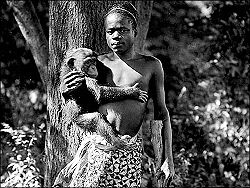
The African Pigmy, "Ota Benga."
Age, 23 years. Height, 4 feet 11 inches.
Weight, 103 pounds. Brought from the
Kasai River, Congo Free State, South Cen-
tral Africa, by Dr. Samuel P. Verner. Ex-
hibited each afternoon during September.
Bronx Zoo director William Hornaday
William Temple Hornaday
William Temple Hornaday, Sc.D. was an American zoologist, realtor, conservationist, author, poet and songwriter...
saw the exhibit as a valuable spectacle for his visitors, and was encouraged by Madison Grant
Madison Grant
Madison Grant was an American lawyer, historian and physical anthropologist, known primarily for his work as a eugenicist and conservationist...
. A decade later, Grant became prominent as a racial anthropologist
Scientific racism
Scientific racism is the use of scientific techniques and hypotheses to sanction the belief in racial superiority or racism.This is not the same as using scientific findings and the scientific method to investigate differences among the humans and argue that there are races...
and eugenicist
Eugenics
Eugenics is the "applied science or the bio-social movement which advocates the use of practices aimed at improving the genetic composition of a population", usually referring to human populations. The origins of the concept of eugenics began with certain interpretations of Mendelian inheritance,...
. African-American clergymen immediately protested to zoo officials about the exhibit. Said James H. Gordon, "Our race, we think, is depressed enough, without exhibiting one of us with the apes ... We think we are worthy of being considered human beings, with souls."
Gordon thought the exhibit was hostile to Christianity for its promotion of Darwinism
Darwinism
Darwinism is a set of movements and concepts related to ideas of transmutation of species or of evolution, including some ideas with no connection to the work of Charles Darwin....
: "The Darwinian theory is absolutely opposed to Christianity, and a public demonstration in its favor should not be permitted." A number of clergymen backed Gordon. In defense of the depiction of Benga as a lesser human, an editorial in The New York Times
The New York Times
The New York Times is an American daily newspaper founded and continuously published in New York City since 1851. The New York Times has won 106 Pulitzer Prizes, the most of any news organization...
suggested:
We do not quite understand all the emotion which others are expressing in the matter ... It is absurd to make moan over the imagined humiliation and degradation Benga is suffering. The pygmies ... are very low in the human scale, and the suggestion that Benga should be in a school instead of a cage ignores the high probability that school would be a place ... from which he could draw no advantage whatever. The idea that men are all much alike except as they have had or lacked opportunities for getting an education out of books is now far out of date.
After the controversy, Benga was allowed to roam the grounds of the zoo as a live exhibit. In response to the situation, as well as verbal and physical prods from the crowds, he became more mischievous and then somewhat violent. Around this time, an article in The New York Times stated, "It is too bad that there is not some society like the Society for the Prevention of Cruelty to Children. We send our missionaries to Africa to Christianize the people, and then we bring one here to brutalize him."
The zoo finally removed Benga from the grounds. Verner was unsuccessful in his continued search for employment, but he occasionally spoke to Benga. The two had agreed that it was in Benga's best interests to remain in the United States despite the unwelcome spotlight at the zoo. Toward the end of 1906, Benga was released into Reverend Gordon's custody.
Later life
Gordon placed Benga in the Howard Colored Orphan Asylum, a church-sponsored orphanageOrphanage
An orphanage is a residential institution devoted to the care of orphans – children whose parents are deceased or otherwise unable or unwilling to care for them...
of which Gordon was the superintendent. As the unwelcome press attention continued, in January 1910, Gordon arranged for Benga's relocation to Lynchburg
Lynchburg, Virginia
Lynchburg is an independent city in the Commonwealth of Virginia. The population was 75,568 as of 2010. Located in the foothills of the Blue Ridge Mountains along the banks of the James River, Lynchburg is known as the "City of Seven Hills" or "The Hill City." Lynchburg was the only major city in...
, Virginia
Virginia
The Commonwealth of Virginia , is a U.S. state on the Atlantic Coast of the Southern United States. Virginia is nicknamed the "Old Dominion" and sometimes the "Mother of Presidents" after the eight U.S. presidents born there...
. He arranged for Benga's teeth to be capped and for him to dress in American-style clothes so that he could be part of local society. Tutored by Lynchburg poet Anne Spencer
Anne Spencer
Annie Bethel Spencer was an American Black poet and active participant in the New Negro Movement and Harlem Renaissance period....
, Benga could improve his English, and he began to attend elementary school at the Baptist Seminary in Lynchburg.
Once he felt his English had improved sufficiently, Benga discontinued his formal education and began working at a Lynchburg tobacco
Tobacco
Tobacco is an agricultural product processed from the leaves of plants in the genus Nicotiana. It can be consumed, used as a pesticide and, in the form of nicotine tartrate, used in some medicines...
factory. Despite his small size, he proved a valuable employee because he could climb up the poles to get the tobacco leaves without having to use a ladder. His fellow workers called him "Bingo", and he would tell his life story in exchange for sandwiches and root beer. He began to plan a return to Africa.
When the Great War
World War I
World War I , which was predominantly called the World War or the Great War from its occurrence until 1939, and the First World War or World War I thereafter, was a major war centred in Europe that began on 28 July 1914 and lasted until 11 November 1918...
broke out, a return to the Congo became impossible, and Benga became depressed as his hopes for a return to the Congo faded. On March 20, 1916, at the age of 32, he built a ceremonial fire, chipped off the caps on his teeth and shot himself in the heart with a stolen pistol.
He was buried in an unmarked grave in the black section of the Old City Cemetery, near his benefactor, Gregory Hayes. At some point, however, the remains of both men went missing. Local oral history indicates that Hayes and Ota Benga were eventually moved from the Old Cemetery to White Rock Cemetery, a burial ground that later fell into disrepair.
Legacy
Phillips Verner Bradford, the grandson of Samuel Phillips Verner, wrote a book on the Congolese entitled Ota Benga: The Pygmy in the Zoo (1992). During his research for the book, he visited the American Museum of Natural HistoryAmerican Museum of Natural History
The American Museum of Natural History , located on the Upper West Side of Manhattan in New York City, United States, is one of the largest and most celebrated museums in the world...
in New York, which holds a life mask and body cast of Ota Benga. The display is still labeled "Pygmy", rather than indicating Benga's name, despite objections that began almost a century ago from Verner.
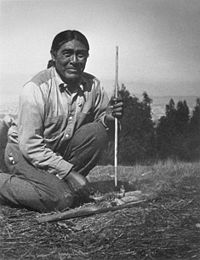
Ishi
Ishi was the last member of the Yahi, the last surviving group of the Yana people of the U.S. state of California. Ishi is believed to have been the last Native American in Northern California to have lived most of his life completely outside the European American culture...
, the sole remaining member of a Native American
Native Americans in the United States
Native Americans in the United States are the indigenous peoples in North America within the boundaries of the present-day continental United States, parts of Alaska, and the island state of Hawaii. They are composed of numerous, distinct tribes, states, and ethnic groups, many of which survive as...
tribe who was displayed in California
California
California is a state located on the West Coast of the United States. It is by far the most populous U.S. state, and the third-largest by land area...
around the same period – including the subsequent publication of a book on the subject by the descendants of the scientist involved – have been observed. Adams (2001) argues that, rather than "mak[ing] racial, national, and species differences culturally intelligible" as the exhibits' creators intended, "the spectators came to question their own place within the hierarchy of human races and the narratives of progress on which that hierarchy relied". Rather than simply exposing the racism of the American public (as members of Ota and Ishi's respective races perceived them), the incidents served to humanize the cultures being displayed. Coincidentally, Ishi died on March 25, 1916, five days after Ota.
In popular culture
- Ota Benga was the subject of a short film in 2002 directed by the Brazilian Alfeu França. França recovered and used original movies recorded by Verner in the early 20th century to create the documentary Ota Benga: A Pygmy in America. In Brazil the film was shown at the festival É Tudo Verdade ("It's All True").
- The Brooklyn-based band PinatalandPiñatalandPiñataland is a Brooklyn-based musical group created by David Wechsler and Doug Stone. Their songs are often about obscure historical events and people, including, among others:*The pygmy Ota Benga...
have a song titled "Ota Benga's Name" on their album Songs from the Forgotten Future Volume 1, which tells the story of Ota Benga. The bridge of the song is a poem from M.E. Buhler that appeared in The New York Times.
- The play Ota Benga, Elegy for the Elephant was written by Dr. Ben B. Halm and staged at Fairfield University in 1997.
- A highly fictionalized version of Ota Benga appeared as a character in the 2006 fantasy film The FallThe Fall (2006 film)The Fall is a 2006 adventure fantasy film directed by Tarsem Singh, starring Lee Pace, Catinca Untaru, and Justine Waddell. It is based on the screenplay of the 1981 Bulgarian film Yo Ho Ho by Valeri Petrov. The film earned $3.2 million worldwide. The film was released to theaters in 2008...
.
- Benga inspired the character of Ngunda Oti in the 2008 film The Curious Case of Benjamin ButtonThe Curious Case of Benjamin Button (film)The Curious Case of Benjamin Button is a 2008 American fantasy-drama film directed by David Fincher. The screenplay by Eric Roth and Robin Swicord is loosely based on the 1922 short story of the same name by F. Scott Fitzgerald...
.
- Ota Benga Under My Mother's Roof, a collection of poems by writer Carrie Allen McCrayCarrie Allen McCrayCarrie Allen McCray was an African-American writer born in Lynchburg, Virginia, whose published works include Ajös Means Goodbye , The Black Woman and Family Roles , and her first-person memoir, Freedom’s Child: The Life of a Confederate General’s Black Daughter...
and edited by Kevin Simmonds, was published by the University of South Carolina Press.
- A theatrical adaptation of the work debuted at the Columbia Museum of Art in 2006 (with McCray as narrator and original music by Kevin Simmonds).
External links
- Are Pygmies really human? from The Straight Dope with a discussion of Ota Benga
- From the Belgian Congo to the Bronx Zoo at National Public Radio
- Ota Benga Alliance
- Ota Benga: The man who was put on display in the zoo!
- Ota Benga a play by John Strand, produced in 1994 by Signature Theater in Arlington, Virginia
- Ota Benga (1881-1916) at Find a Grave
- Ota Benga Folk Opera 2010 recording of a suite of songs based on the life of Ota Benga and the history of Congo