


Boer Commando

Encyclopedia
Militia
The term militia is commonly used today to refer to a military force composed of ordinary citizens to provide defense, emergency law enforcement, or paramilitary service, in times of emergency without being paid a regular salary or committed to a fixed term of service. It is a polyseme with...
of the Boer
Boer
Boer is the Dutch and Afrikaans word for farmer, which came to denote the descendants of the Dutch-speaking settlers of the eastern Cape frontier in Southern Africa during the 18th century, as well as those who left the Cape Colony during the 19th century to settle in the Orange Free State,...
people of South Africa
South Africa
The Republic of South Africa is a country in southern Africa. Located at the southern tip of Africa, it is divided into nine provinces, with of coastline on the Atlantic and Indian oceans...
. The term came into English usage during the Second Boer War
Second Boer War
The Second Boer War was fought from 11 October 1899 until 31 May 1902 between the British Empire and the Afrikaans-speaking Dutch settlers of two independent Boer republics, the South African Republic and the Orange Free State...
.
History
In 1658, war erupted between the Dutch settlers at Cape ColonyCape Colony
The Cape Colony, part of modern South Africa, was established by the Dutch East India Company in 1652, with the founding of Cape Town. It was subsequently occupied by the British in 1795 when the Netherlands were occupied by revolutionary France, so that the French revolutionaries could not take...
and the Khoi-khoi. In order to protect the settlement, all able bodied men were conscripted. After the conclusion of this war, all men in the colony were liable for military service
Military service
Military service, in its simplest sense, is service by an individual or group in an army or other militia, whether as a chosen job or as a result of an involuntary draft . Some nations require a specific amount of military service from every citizen...
and were expected to be ready on short notice. This method of defence was not a new idea, and has been used successfully in Europe and America.
By 1700, the size of the colony had increased immensely and it was divided into districts. The small military garrison stationed at the Castle de Goede Hoop couldn't be counted on to react swiftly in the border districts, therefore the commando system was expanded and formalized. Each district had a Kommandant who was charged with calling up all burghers in times of need. In 1795, with the First British Occupation
Battle of Muizenberg
The Battle of Muizenberg was a small but significant military engagement which took place near Muizenberg, South Africa in 1795; it led to the capture of the Cape Colony by Kingdom of Great Britain.- Background :...
and again in 1806 with the Second British Occupation
Battle of Blaauwberg
The Battle of Blaauwberg, also known as the Battle of Cape Town, fought near Cape Town on 8 January 1806, was a small but significant military engagement. It established British rule in South Africa, which was to have many ramifications during the nineteenth and twentieth centuries...
, the commandos were called up to defend the Cape Colony. At the Battle of Blaauwberg
Battle of Blaauwberg
The Battle of Blaauwberg, also known as the Battle of Cape Town, fought near Cape Town on 8 January 1806, was a small but significant military engagement. It established British rule in South Africa, which was to have many ramifications during the nineteenth and twentieth centuries...
( 6 January 1806), the Swellendam Commando held the British off long enough for the rest of the Batavian army to retreat to safety.
During the Great Trek
Great Trek
The Great Trek was an eastward and north-eastward migration away from British control in the Cape Colony during the 1830s and 1840s by Boers . The migrants were descended from settlers from western mainland Europe, most notably from the Netherlands, northwest Germany and French Huguenots...
, this system was used and remained in use in the Boer republics
Boer Republics
The Boer Republics were independent self-governed republics created by the northeastern frontier branch of the Dutch-speaking inhabitants of the north eastern Cape Province and their descendants in mainly the northern and eastern parts of what is now the country of...
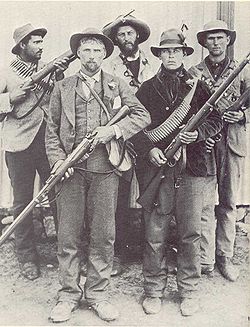
. Both republics issued commando laws, making commando service mandatory in times of need for all male citizens between the ages of 16 and 60. During the Anglo-Boer War ( 1899–1902) the Boer commando formed the backbone of the Boer forces.
After the declaration of peace in 1902, the commandos were disbanded. They did reform themselves in clandestine "shooting clubs". In 1912, the commandos were reformed as an Active Citizen Force in the Union Defence Force
Union Defence Force
The Union Defence Force may refer to a former or current military organization:* the South African Army from 1912 to 1957* the military of the United Arab Emirates...
. This system was in operation until 2005, when all commandos were disbanded again.
Structure
Each commando was attached to a town, after which it was named (e.g. Bloemfontein Commando). Each town was responsible for a district, divided into wards. The commando was commanded by a kommandant and each ward by a veldkornet or field cornet (equivalent of a senior NCOOfficer (armed forces)
An officer is a member of an armed force or uniformed service who holds a position of authority. Commissioned officers derive authority directly from a sovereign power and, as such, hold a commission charging them with the duties and responsibilities of a specific office or position...
rank)
The veldkornet was responsible not only for calling up the burghers, but also for policing his ward, collecting taxes, issuing firearms and other material in times of war. Theoretically, a ward was divided into corporalships. A corporalship was usually made up of about 20 burghers. Sometimes entire families (fathers, sons, uncles, cousins) filled a corporalship.
The veldkornet was responsible to the kommandant, who in turn was responsible to a general. In theory, a general was responsible for four commandos. He in turn was responsible to the commander-in-chief of the republic. In the Transvaal, the C-in-C was called the Commandant-General
Commandant-General
Commandant-General is a rank in several counties and is generally equivalent to that of Commandant.-Italy:Comandante generale , in Fascist Italy's MVSN, was the title of the head of the Blackshirts, held by Benito Mussolini from 1922 to 1943.Nowadays, is the title held by the commander of the...
and in the Free State the Hoofdkommandant (Chief Commandant). The C-in-C was responsible to the president.
Other auxiliary ranks were created in war time, such as vleiskorporaal ("meat corporal"), responsible for issuing rations.
The commando was made up of volunteers, all officers were appointed by the members of the commando, and not by the government. This gave a chance for some commanders to appear, such as General Koos de la Rey
Koos de la Rey
General Jacobus Herculaas de la Rey , known as Koos de la Rey, was a Boer general during the Second Boer War and is widely regarded as being one of the strongest military leaders during that conflict....
and General C. R. de Wet
Christiaan De Wet
Christiaan Rudolf de Wet was a Boer general, rebel leader and politician.He was born on the Leeuwkop farm, in the district of Smithfield in the Boer Republic of the Orange Free State...
, but also had the disadvantage of sometimes putting inept commanders in charge. Discipline was also a problem, as there was no real way of enforcing it.
The various Boer republics did not all have the same command structure.
Weaponry
From the early days the commandos were issued with firearms by the government of the day. The burghers were obliged to keep these firearms serviceable and ready at all times. In the Anglo-Boer War, most burghers were issued with the modern, clip-loading MauserMauser
Mauser was a German arms manufacturer of a line of bolt-action rifles and pistols from the 1870s to 1995. Mauser designs were built for the German armed forces...
rifle.
Before the Boer War
Second Boer War
The Second Boer War was fought from 11 October 1899 until 31 May 1902 between the British Empire and the Afrikaans-speaking Dutch settlers of two independent Boer republics, the South African Republic and the Orange Free State...
, the two Boer republics had permanent artillery units (eg the Transvaalse Staatsartillerie
Transvaalse Staatsartillerie
The Transvaalse Staatsartillerie is an artillery regiment of the South African Army. As a reserve unit, it has a status roughly equivalent to that of a British Territorial Army or United States Army National Guard unit...
), equipped with Krupp or Creusot artillery.