


STS-93

Encyclopedia
STS-93 marked the 95th launch of the Space Shuttle
, the 26th launch of Columbia
, and the 21st night launch of a Space Shuttle. Eileen Collins
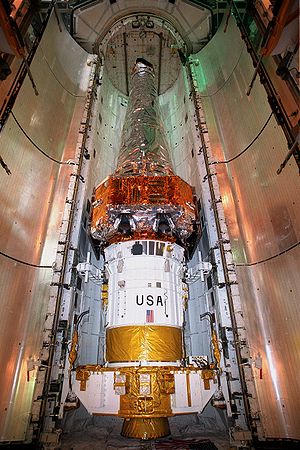
became the first female shuttle Commander on this flight. Its primary payload was the Chandra X-ray Observatory
. It would also be the last mission of Columbia until March 2002. During the interim, Columbia would be out of service for upgrading, and would not fly again until STS-109
. The launch was originally scheduled for 20 July but the launch was aborted at T-7 seconds. The successful launch of the flight occurred three days later.
Five seconds after liftoff, an electrical short disabled one primary and one secondary controller on two of the three main engines
. In this event, the engines automatically switched to their backup controllers. The short was later discovered to have been caused by poorly routed wiring which had rubbed on an exposed screw head. This wiring issue led to a program-wide inspection of the wiring in all orbiters. Concurrently, an oxidizer post, which had been intentionally plugged, came loose inside one of the main engine's main injector and impacted the engine nozzle inner surface rupturing a hydrogen cooling line allowing a small leak. Because of the leak, the engine's controller saw an increase in use rate of hydrogen. The controller assumed the extra hydrogen was being burned in the engine (rather than being leaked overboard as it actually was) and increased the oxidizer flow to maintain the presumptive mixture ratio, resulting in a premature engine shutdown near the end of the projected burn due to low liquid oxygen level. Despite the premature shutdown, the vehicle safely achieved a slightly lower orbit and was able to complete the mission as planned. This incident brought on a maintenance practice change which required damaged oxidizer posts to be removed and replaced as opposed to being intentionally plugged, as was the practice beforehand.
(formerly the Advanced X-ray Astrophysics Facility) with its Inertial Upper Stage
booster. At its launch, Chandra was the most sophisticated X-ray
observatory ever built. It is designed to observe X-rays from high energy regions of the universe, such as hot gas in the remnants of exploded stars.
Other payloads on STS-93 included the Midcourse Space Experiment (MSX), the Shuttle Ionospheric Modification with Pulsed Local Exhaust (SIMPLEX), the Southwest Ultraviolet Imaging System (SWUIS), the Gelation of Sols: Applied Microgravity Research (GOSAMR) experiment, the Space Tissue Loss – B (STL-B) experiment, a Light Weight Flexible Solar Array Hinge (LFSAH), the Cell Culture Module (CCM), the Shuttle Amateur Radio Experiment – II (SAREX – II), EarthKAM, Plant Growth Investigations in Microgravity (PGIM), the Commercial Generic Bioprocessing Apparatus (CGBA), the Micro-Electrical Mechanical System (MEMS), and the Biological Research in Canisters (BRIC).
The Shuttle Ionespheric Modification with Pulsed Local Exhaust (SIMPLEX) payload activity researched the source of Very High Frequency (VHF) radar
echoes caused by the orbiter and its OMS engine firings. The Principal Investigator (PI) used the collected data to examine the effects of orbital kinetic energy
on ionospheric
irregularities and to understand the processes that take place with the venting of exhaust materials.
 The Southwest Ultraviolet Imaging system (SWUIS) was based around a Maksutov-design ultraviolet
(UV) telescope and a UV-sensitive, image-intensified Charge-Coupled Device (CCD) camera that frames at video frame rates. Scientists can obtain sensitive photometric
measurements of astronomical
targets.
The objective Gelation of Sols: Applied Microgravity Research (GOSAMR) experiment was to investigate the influence of microgravity on the processing of gelled sols
. In particular, the purpose was to demonstrate that composite ceramic
precursors composed of large particulates and small colloidal sols can be produced in space with more structural uniformity.
The focus of the Space Tissue Loss – B (STL-B) experiment was direct video observation of cells in culture through the use of a video microscope
imaging system with the objective of demonstrating near real-time interactive operations to detect and induce cellular responses.
The Light Weight Flexible Solar Array Hinge (LFSAH) payload consists of several hinges fabricated from shape memory alloy
s. Shape memory deployment hinges offered controlled shockless deployment of solar arrays and other spacecraft appendages. LFSAH demonstrated this deployment capability for a number of hinge configurations.
The objectives of the Cell Culture Module (CCM) were to validate models for muscle
, bone
, and endothelial cell biochemical
and functional loss induced by microgravity stress; to evaluate cytoskeleton
, metabolism
, membrane integrity and protease
activity in target cells; and to test tissue loss medications.
The Shuttle Amateur Radio Experiment
(SAREX-II) demonstrated the feasibility of amateur short-wave radio contacts between the shuttle and ground-based amateur radio operators. SAREX also served as an educational opportunity for schools around the world to learn about space by speaking directly to astronauts aboard the shuttle via amateur radio
.
The EarthKAM payload conducted Earth observations using the Electronic Still Camera (ESC) installed in the overhead starboard window of the Aft Flight Deck.
The Plant Growth Investigations in Microgravity (PGIM) payload experiment used plants to monitor the space flight environment for stressful conditions that affect plant growth. Because plants cannot move away from stressful conditions, they have developed mechanisms that monitor their environment and direct effective physiological responses to harmful conditions.
The Commercial Generic Bioprocessing Apparatus (CGBA) payload hardware allows for sample processing and stowage functions. The Generic Bioprocessing Apparatus – Isothermal Containment Module (GBA-ICM) is temperature controlled to maintain a preset temperature environment, controls the activation and termination of the experiment samples, and provides an interface for crew interaction, control and data transfer.
The Micro-Electrical Mechanical System (MEMS) payload examines the performance, under launch, microgravity, and reentry conditions of a suite of MEMS devices. These devices include accelerometers, gyroscope
s, and environmental and chemical sensors. The MEMS payload is self-contained and requires activation and deactivation only.
The Biological Research in Canisters (BRIC) payload was designed to investigate the effects of space flight on small arthropod
animals and plant specimens. The flight crew was available at regular intervals to monitor and control payload/experiment operations.
Columbias landing at Kennedy Space Center marked the twelfth night landing in the Shuttle program's history. Five had been at Edwards Air Force Base
in California and the rest KSC. To date, there had been 19 consecutive landings at KSC and 25 of the last 26 had been there.
Twenty-seven were soon melted and the remaining 12 were on board Space Shuttle Columbia for the July 1999 STS-93 mission. Two examples then popped up at two separate events; one during a Private Congressional Dinner in August 1999, and another example at the Official First-Strike ceremonies in November. The coins remained at Mint Headquarters under lock and key until they were transferred in 2001 to Fort Knox. The strikes are considered to be illegal due to the Coinage regulations in place.
In 2007, the Mint announced [1
. Each track was specially chosen, sometimes by their families, and usually had a special meaning to an individual member of the crew, or was applicable to their daily activities.
Space Shuttle
The Space Shuttle was a manned orbital rocket and spacecraft system operated by NASA on 135 missions from 1981 to 2011. The system combined rocket launch, orbital spacecraft, and re-entry spaceplane with modular add-ons...
, the 26th launch of Columbia
Space Shuttle Columbia
Space Shuttle Columbia was the first spaceworthy Space Shuttle in NASA's orbital fleet. First launched on the STS-1 mission, the first of the Space Shuttle program, it completed 27 missions before being destroyed during re-entry on February 1, 2003 near the end of its 28th, STS-107. All seven crew...
, and the 21st night launch of a Space Shuttle. Eileen Collins
Eileen Collins
Eileen Marie Collins is a retired American astronaut and a retired U.S. Air Force Colonel. A former military instructor and test pilot, Collins was the first female pilot and first female commander of a Space Shuttle. She was awarded several medals for her work. Col. Collins has logged 38 days 8...
became the first female shuttle Commander on this flight. Its primary payload was the Chandra X-ray Observatory
Chandra X-ray Observatory
The Chandra X-ray Observatory is a satellite launched on STS-93 by NASA on July 23, 1999. It was named in honor of Indian-American physicist Subrahmanyan Chandrasekhar who is known for determining the maximum mass for white dwarfs. "Chandra" also means "moon" or "luminous" in Sanskrit.Chandra...
. It would also be the last mission of Columbia until March 2002. During the interim, Columbia would be out of service for upgrading, and would not fly again until STS-109
STS-109
STS-109 was a Space Shuttle mission that launched from the Kennedy Space Center on 1 March 2002. It was the 108th mission of the Space Shuttle program, the 27th flight of the orbiter Columbia and the fourth servicing of the Hubble Space Telescope...
. The launch was originally scheduled for 20 July but the launch was aborted at T-7 seconds. The successful launch of the flight occurred three days later.
Five seconds after liftoff, an electrical short disabled one primary and one secondary controller on two of the three main engines
Space Shuttle main engine
The RS-25, otherwise known as the Space Shuttle Main Engine , is a reusable liquid-fuel rocket engine built by Pratt & Whitney Rocketdyne for the Space Shuttle, running on liquid hydrogen and oxygen. Each Space Shuttle was propelled by three SSMEs mated to one powerhead...
. In this event, the engines automatically switched to their backup controllers. The short was later discovered to have been caused by poorly routed wiring which had rubbed on an exposed screw head. This wiring issue led to a program-wide inspection of the wiring in all orbiters. Concurrently, an oxidizer post, which had been intentionally plugged, came loose inside one of the main engine's main injector and impacted the engine nozzle inner surface rupturing a hydrogen cooling line allowing a small leak. Because of the leak, the engine's controller saw an increase in use rate of hydrogen. The controller assumed the extra hydrogen was being burned in the engine (rather than being leaked overboard as it actually was) and increased the oxidizer flow to maintain the presumptive mixture ratio, resulting in a premature engine shutdown near the end of the projected burn due to low liquid oxygen level. Despite the premature shutdown, the vehicle safely achieved a slightly lower orbit and was able to complete the mission as planned. This incident brought on a maintenance practice change which required damaged oxidizer posts to be removed and replaced as opposed to being intentionally plugged, as was the practice beforehand.
Crew
Mission parameters
- MassMassMass can be defined as a quantitive measure of the resistance an object has to change in its velocity.In physics, mass commonly refers to any of the following three properties of matter, which have been shown experimentally to be equivalent:...
:- Orbiter Liftoff: 122536 kilograms (270,145.6 lb)
- Orbiter Landing: 99783 kilograms (219,983.9 lb)
- Payload: 22781 kilograms (50,223.5 lb)
- PerigeePerigeePerigee is the point at which an object makes its closest approach to the Earth.. Often the term is used in a broader sense to define the point in an orbit where the orbiting body is closest to the body it orbits. The opposite is the apogee, the farthest or highest point.The Greek prefix "peri"...
: 260 kilometres (161.6 mi) - Apogee: 280 kilometres (174 mi)
- InclinationInclinationInclination in general is the angle between a reference plane and another plane or axis of direction.-Orbits:The inclination is one of the six orbital parameters describing the shape and orientation of a celestial orbit...
: 28.5° - PeriodOrbital periodThe orbital period is the time taken for a given object to make one complete orbit about another object.When mentioned without further qualification in astronomy this refers to the sidereal period of an astronomical object, which is calculated with respect to the stars.There are several kinds of...
: 90 min
Mission objectives
The primary objective of the STS-93 mission was to deploy the Chandra X-ray ObservatoryChandra X-ray Observatory
The Chandra X-ray Observatory is a satellite launched on STS-93 by NASA on July 23, 1999. It was named in honor of Indian-American physicist Subrahmanyan Chandrasekhar who is known for determining the maximum mass for white dwarfs. "Chandra" also means "moon" or "luminous" in Sanskrit.Chandra...
(formerly the Advanced X-ray Astrophysics Facility) with its Inertial Upper Stage
Inertial Upper Stage
The Inertial Upper Stage , originally known as the Interim Upper Stage, is a two-stage solid-fueled booster rocket developed by the U.S...
booster. At its launch, Chandra was the most sophisticated X-ray
X-ray
X-radiation is a form of electromagnetic radiation. X-rays have a wavelength in the range of 0.01 to 10 nanometers, corresponding to frequencies in the range 30 petahertz to 30 exahertz and energies in the range 120 eV to 120 keV. They are shorter in wavelength than UV rays and longer than gamma...
observatory ever built. It is designed to observe X-rays from high energy regions of the universe, such as hot gas in the remnants of exploded stars.
Other payloads on STS-93 included the Midcourse Space Experiment (MSX), the Shuttle Ionospheric Modification with Pulsed Local Exhaust (SIMPLEX), the Southwest Ultraviolet Imaging System (SWUIS), the Gelation of Sols: Applied Microgravity Research (GOSAMR) experiment, the Space Tissue Loss – B (STL-B) experiment, a Light Weight Flexible Solar Array Hinge (LFSAH), the Cell Culture Module (CCM), the Shuttle Amateur Radio Experiment – II (SAREX – II), EarthKAM, Plant Growth Investigations in Microgravity (PGIM), the Commercial Generic Bioprocessing Apparatus (CGBA), the Micro-Electrical Mechanical System (MEMS), and the Biological Research in Canisters (BRIC).
The Shuttle Ionespheric Modification with Pulsed Local Exhaust (SIMPLEX) payload activity researched the source of Very High Frequency (VHF) radar
Radar
Radar is an object-detection system which uses radio waves to determine the range, altitude, direction, or speed of objects. It can be used to detect aircraft, ships, spacecraft, guided missiles, motor vehicles, weather formations, and terrain. The radar dish or antenna transmits pulses of radio...
echoes caused by the orbiter and its OMS engine firings. The Principal Investigator (PI) used the collected data to examine the effects of orbital kinetic energy
Kinetic energy
The kinetic energy of an object is the energy which it possesses due to its motion.It is defined as the work needed to accelerate a body of a given mass from rest to its stated velocity. Having gained this energy during its acceleration, the body maintains this kinetic energy unless its speed changes...
on ionospheric
Ionosphere
The ionosphere is a part of the upper atmosphere, comprising portions of the mesosphere, thermosphere and exosphere, distinguished because it is ionized by solar radiation. It plays an important part in atmospheric electricity and forms the inner edge of the magnetosphere...
irregularities and to understand the processes that take place with the venting of exhaust materials.
Ultraviolet
Ultraviolet light is electromagnetic radiation with a wavelength shorter than that of visible light, but longer than X-rays, in the range 10 nm to 400 nm, and energies from 3 eV to 124 eV...
(UV) telescope and a UV-sensitive, image-intensified Charge-Coupled Device (CCD) camera that frames at video frame rates. Scientists can obtain sensitive photometric
Photometry (astronomy)
Photometry is a technique of astronomy concerned with measuring the flux, or intensity of an astronomical object's electromagnetic radiation...
measurements of astronomical
Astronomy
Astronomy is a natural science that deals with the study of celestial objects and phenomena that originate outside the atmosphere of Earth...
targets.
The objective Gelation of Sols: Applied Microgravity Research (GOSAMR) experiment was to investigate the influence of microgravity on the processing of gelled sols
Sol (colloid)
A sol is a colloidal suspension of very small solid particles in a continuous liquid medium. They are quite stable and show the Tyndall effect. Examples include blood, pigmented ink, and paint....
. In particular, the purpose was to demonstrate that composite ceramic
Ceramic
A ceramic is an inorganic, nonmetallic solid prepared by the action of heat and subsequent cooling. Ceramic materials may have a crystalline or partly crystalline structure, or may be amorphous...
precursors composed of large particulates and small colloidal sols can be produced in space with more structural uniformity.
The focus of the Space Tissue Loss – B (STL-B) experiment was direct video observation of cells in culture through the use of a video microscope
Microscope
A microscope is an instrument used to see objects that are too small for the naked eye. The science of investigating small objects using such an instrument is called microscopy...
imaging system with the objective of demonstrating near real-time interactive operations to detect and induce cellular responses.
The Light Weight Flexible Solar Array Hinge (LFSAH) payload consists of several hinges fabricated from shape memory alloy
Shape memory alloy
A shape-memory alloy is an alloy that "remembers" its original, cold-forged shape: returning the pre-deformed shape by heating. This material is a lightweight, solid-state alternative to conventional actuators such as hydraulic, pneumatic, and motor-based systems...
s. Shape memory deployment hinges offered controlled shockless deployment of solar arrays and other spacecraft appendages. LFSAH demonstrated this deployment capability for a number of hinge configurations.
The objectives of the Cell Culture Module (CCM) were to validate models for muscle
Muscle
Muscle is a contractile tissue of animals and is derived from the mesodermal layer of embryonic germ cells. Muscle cells contain contractile filaments that move past each other and change the size of the cell. They are classified as skeletal, cardiac, or smooth muscles. Their function is to...
, bone
Bone
Bones are rigid organs that constitute part of the endoskeleton of vertebrates. They support, and protect the various organs of the body, produce red and white blood cells and store minerals. Bone tissue is a type of dense connective tissue...
, and endothelial cell biochemical
Biochemistry
Biochemistry, sometimes called biological chemistry, is the study of chemical processes in living organisms, including, but not limited to, living matter. Biochemistry governs all living organisms and living processes...
and functional loss induced by microgravity stress; to evaluate cytoskeleton
Cytoskeleton
The cytoskeleton is a cellular "scaffolding" or "skeleton" contained within a cell's cytoplasm and is made out of protein. The cytoskeleton is present in all cells; it was once thought to be unique to eukaryotes, but recent research has identified the prokaryotic cytoskeleton...
, metabolism
Metabolism
Metabolism is the set of chemical reactions that happen in the cells of living organisms to sustain life. These processes allow organisms to grow and reproduce, maintain their structures, and respond to their environments. Metabolism is usually divided into two categories...
, membrane integrity and protease
Protease
A protease is any enzyme that conducts proteolysis, that is, begins protein catabolism by hydrolysis of the peptide bonds that link amino acids together in the polypeptide chain forming the protein....
activity in target cells; and to test tissue loss medications.
The Shuttle Amateur Radio Experiment
Shuttle Amateur Radio Experiment
The Shuttle Amateur Radio Experiment , later called the Space Amateur Radio Experiment, was a program that promoted and supported the use of amateur radio by astronauts in low earth orbit aboard the United States Space Shuttle to communicate with other amateur radio stations around the world...
(SAREX-II) demonstrated the feasibility of amateur short-wave radio contacts between the shuttle and ground-based amateur radio operators. SAREX also served as an educational opportunity for schools around the world to learn about space by speaking directly to astronauts aboard the shuttle via amateur radio
Amateur radio
Amateur radio is the use of designated radio frequency spectrum for purposes of private recreation, non-commercial exchange of messages, wireless experimentation, self-training, and emergency communication...
.
The EarthKAM payload conducted Earth observations using the Electronic Still Camera (ESC) installed in the overhead starboard window of the Aft Flight Deck.
The Plant Growth Investigations in Microgravity (PGIM) payload experiment used plants to monitor the space flight environment for stressful conditions that affect plant growth. Because plants cannot move away from stressful conditions, they have developed mechanisms that monitor their environment and direct effective physiological responses to harmful conditions.
The Commercial Generic Bioprocessing Apparatus (CGBA) payload hardware allows for sample processing and stowage functions. The Generic Bioprocessing Apparatus – Isothermal Containment Module (GBA-ICM) is temperature controlled to maintain a preset temperature environment, controls the activation and termination of the experiment samples, and provides an interface for crew interaction, control and data transfer.
The Micro-Electrical Mechanical System (MEMS) payload examines the performance, under launch, microgravity, and reentry conditions of a suite of MEMS devices. These devices include accelerometers, gyroscope
Gyroscope
A gyroscope is a device for measuring or maintaining orientation, based on the principles of angular momentum. In essence, a mechanical gyroscope is a spinning wheel or disk whose axle is free to take any orientation...
s, and environmental and chemical sensors. The MEMS payload is self-contained and requires activation and deactivation only.
The Biological Research in Canisters (BRIC) payload was designed to investigate the effects of space flight on small arthropod
Arthropod
An arthropod is an invertebrate animal having an exoskeleton , a segmented body, and jointed appendages. Arthropods are members of the phylum Arthropoda , and include the insects, arachnids, crustaceans, and others...
animals and plant specimens. The flight crew was available at regular intervals to monitor and control payload/experiment operations.
Columbias landing at Kennedy Space Center marked the twelfth night landing in the Shuttle program's history. Five had been at Edwards Air Force Base
Edwards Air Force Base
Edwards Air Force Base is a United States Air Force base located on the border of Kern County, Los Angeles County, and San Bernardino County, California, in the Antelope Valley. It is southwest of the central business district of North Edwards, California and due east of Rosamond.It is named in...
in California and the rest KSC. To date, there had been 19 consecutive landings at KSC and 25 of the last 26 had been there.
Special cargo
In 2001, Coin World reported the revelation (via a FOIA document request) that the Mint had struck 39 examples of the 2000 Sacagawea dollar in gold in June 1999 at the West Point Mint. The planchets came from specially prepared ½ troy-oz $25 American Gold Eagle Bullion Planchets. Why they were struck is not known; speculation is that this was an attempt by the mint to offer "Premium" collectibles in conjunction with the newly released Sacagawea dollar in 2000.Twenty-seven were soon melted and the remaining 12 were on board Space Shuttle Columbia for the July 1999 STS-93 mission. Two examples then popped up at two separate events; one during a Private Congressional Dinner in August 1999, and another example at the Official First-Strike ceremonies in November. The coins remained at Mint Headquarters under lock and key until they were transferred in 2001 to Fort Knox. The strikes are considered to be illegal due to the Coinage regulations in place.
In 2007, the Mint announced [1
Wake-up calls
Sleeping shuttle astronauts were often awakened with a short piece of music, a tradition that apparently began during Apollo 15Apollo 15
Apollo 15 was the ninth manned mission in the American Apollo space program, the fourth to land on the Moon and the eighth successful manned mission. It was the first of what were termed "J missions", long duration stays on the Moon with a greater focus on science than had been possible on previous...
. Each track was specially chosen, sometimes by their families, and usually had a special meaning to an individual member of the crew, or was applicable to their daily activities.
| Flight Day | Song | Artist/Composer | Links |
|---|---|---|---|
| Day 2 | "Beep Beep" | Louis Prima Louis Prima Louis Prima was a Sicilian American singer, actor, songwriter, and trumpeter. Prima rode the musical trends of his time, starting with his seven-piece New Orleans style jazz band in the 1920s, then successively leading a swing combo in the 1930s, a big band in the 1940s, a Vegas lounge act in the... |
wav mp3 Transcript |
| Day 3 | "Brave New Girls" | Teresa Teresa Teresa, Theresa, and Therese are feminine given names. The name is thought to be derived from the Greek verb θήρίζεἰν therizein, meaning to harvest.... |
wav mp3 Transcript |
| Day 4 | "Someday Soon Someday Soon (Ian Tyson song) "Someday Soon" is the title of a song composed by Canadian singer Ian Tyson. He recorded the song with his wife, Sylvia Tyson, as the duo Ian & Sylvia in 1964. Although this version was not released as a single, the song has been covered by Judy Collins, Moe Bandy and Suzy Bogguss, all of whom had... " |
Suzy Bogguss Suzy Bogguss Susan Kay "Suzy" Bogguss is an American country music singer. In the 1980s and 90s she released one platinum and three gold albums and charted six top ten singles, winning the Academy of Country Music's award for Top New Female Vocalist and the Country Music Association's Horizon Award.After... |
wav mp3 Transcript |
| Day 5 | "The Sound of Silence The Sound of Silence "The Sound of Silence" is the song that propelled the 1960s folk music duo Simon & Garfunkel to popularity. It was written in February 1964 by Paul Simon in the aftermath of the 1963 assassination of John F. Kennedy. An initial version preferred by the band was remixed and sweetened, and has become... " |
Simon and Garfunkel Simon and Garfunkel Simon & Garfunkel are an American duo consisting of singer-songwriter Paul Simon and singer Art Garfunkel. They formed the group Tom & Jerry in 1957 and had their first success with the minor hit "Hey, Schoolgirl". As Simon & Garfunkel, the duo rose to fame in 1965, largely on the strength of the... |
wav mp3 Transcript |
| Day 6 | "A Little Traveling Music" | Barry Manilow Barry Manilow Barry Manilow is an American singer-songwriter, musician, arranger, producer, conductor, and performer, best known for such recordings as "Could It Be Magic", "Mandy", "Can't Smile Without You", and "Copacabana ."... |
wav mp3 Transcript |
External links
- NASA PAO page about STS-93
- STS-93 Archives
- STS-93 Video Highlights
- "US Mint to show unseen gold space coins". collectSPACE. http://www.collectspace.com/news/news-071407a.html. Retrieved 2007-07-16.]http://www.collectspace.com/news/news-071407a.html