
All Topics  
Space Shuttle main engine


   Email Print
   Bookmark   Link


Space Shuttle main engine


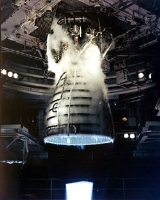
The Space Shuttle Main Engines (SSMEs) are the three main engines on the Space ShuttleSpace Shuttle Summary

NASA's Space Shuttle, officially called Space Transportation System , is the United States government's current manned...
 orbiter. They are constructed by Pratt & WhitneyFacts About Pratt & Whitney

Pratt & Whitney is an American aircraft engine manufacturer whose products are widely used in both civil and military aircra...
's RocketdyneRocketdyne

Rocketdyne is the premier liquid rocket engine design and production company in the United States....
 Division. The SSME is also designated as the RS-24 for engineering purposes.

Introduction

The Space Shuttle main engines are very sophisticated power plants that burn liquid hydrogenLiquid hydrogen

Liquid hydrogen is the element hydrogen, in the liquid state....
 and liquid oxygenLiquid oxygen

Liquid Oxygen has an expansion ratio of 860:1, and because of this, is used in commercial and military aircraft today....
 from the Space Shuttle external tankSpace Shuttle external tank

The Space Shuttle External Tank contains the liquid hydrogen fuel and liquid oxygen oxidizer and supplies them under pressur...
. They are used for propulsion during its ascent, in addition to the two more powerful Solid Rocket BoostersSpace Shuttle Solid Rocket Booster Summary

The Space Shuttle Solid Rocket Booster is the rocket that provides 83% of liftoff thrust for the Space Shuttle....
 and sometimes the Orbital Maneuvering SystemOrbital Maneuvering System

The Orbital Maneuvering System, or OMS, is a system of rocket engines used on the Space Shuttle for orbital injection ...
. Each engine can generate almost 1.8 MN (MegaNewtonNewton

The newton is the SI unit of force....
) or 400,000 lbfPound-force

A pound-force is a unit of force. One pound-force is the force equivalent to that exerted on a mass of one avoirdupois pound...
  of thrustThrust

Thrust is a reaction force described quantitatively by Newton's Second and Third Laws....
 at liftoff. The engines are capable of generating a specific impulseSpecific impulse

The specific impulse of a propulsion system is the impulse per unit of propellant....
 (Isp) of 453 seconds in a vacuum, or 363 seconds at sea level. Overall, a space shuttle main engine weighs approximately 3.2 t (7,000 lbPound (mass)

The pound is the name of a unit of mass in a number of different systems, including various systems of units of mass that f...
). The engines are removed after every flight and taken to the Space Shuttle Main Engine Processing Facility (SSMEPF) for inspection and replacement of any necessary components.

The Space Shuttle's rocket engineRocket engine Summary

A rocket engine is a reaction engine that can be used for spacecraft propulsion as well as terrestrial uses, such as missile...
s are capable of operating at extreme temperatures. The liquid hydrogen fuel is stored at -253 degrees CelsiusCelsius

The Celsius scale is a temperature scale named after the Swedish astronomer Anders Celsius , who first proposed a similar sy...
 (-423 degrees FahrenheitFahrenheit

Fahrenheit is a temperature scale named after the German physicist Gabriel Fahrenheit , who proposed it in 1724....
). However, when burned with liquid oxygen, the temperature in the combustion chamber reaches 3,300 °C (6,000 °F), higher than the boiling pointBoiling point

The boiling point of a substance is the temperature at which it can change its state from a liquid to a gas throughout the b...
 of ironIron

Iron is a chemical element with the symbol Fe and atomic number 26....
. If the main engines pumped water instead of liquid oxygen and liquid hydrogen, an average family-sized swimming poolSwimming pool Overview

A swimming pool, swimming bath, or wading pool is an artificially enclosed body of water intended for recreation...
 could be drained in 25 seconds.

Apart from the three main engines, the orbiter has 44 smaller rockets around its surface, which are part of the Orbital Maneuvering SystemOrbital Maneuvering System

The Orbital Maneuvering System, or OMS, is a system of rocket engines used on the Space Shuttle for orbital injection ...
 and Reaction Control SystemReaction control system

A reaction control system is a subsystem of a spacecraft....
, used to provide steering, pointing, and altitude adjustment capability while in orbit.

The engines perform as follows: FuelFuel

Fuel is any material that is capable of releasing energy when its chemical or physical structure is changed or converted....
 and oxidizer from the external tank enters the orbiter at the orbiter/external tank umbilicalUmbilical cable

An umbilical cable or umbilical is a cable which supplies necessary requirements to an apparatus....
 disconnect and then the orbiter's main propulsion system feed lines. There the fuel and oxidizer each branch out into three parallel paths, to each engine. In each branch, prevalves must be opened to permit flow to the low-pressure fuel or oxidizer turbopumpTurbopump

As the name suggests, a turbopump comprises basically two main components: a pump driven by a turbine, both mounted on the s...
.

Oxidizer system

The Low Pressure Oxidizer Turbopump (LPOTP) is an axial-flow pump driven by a six-stage turbineTurbine

A turbine is a rotary engine that extracts energy from a fluid flow....
 powered by liquid oxygen. It boosts the liquid oxygen's pressure from 0.7 to 2.9 MPa (100 to 422 psiaPound-force per square inch

The pound-force per square inch is a non-SI unit of pressure based on avoirdupois units....
). The flow from the LPOTP is supplied to the High-Pressure Oxidizer Turbopump (HPOTP). During engine operation, the pressure boost permits the High Pressure Oxidizer Turbine to operate at high speeds without cavitatingCavitation

Cavitation is a general term used to describe the behaviour of voids or bubbles in a liquid....
. The LPOTP operates at approximately 5,150 rpm. The LPOTP, which is approximately 450 by 450 mm (18 by 18 inchInch

An inch is the name of a unit of length in a number of different systems, including English units, Imperial units, and Unit...
es) , is connected to the vehicle propellant ducting and supported in a fixed position by the orbiter structure.

The HPOTP consists of two single-stage centrifugal pumps (a main pump and a preburner pump) mounted on a common shaft and driven by a two-stage, hot-gas turbine. The main pump boosts the liquid oxygen's pressure from 2.9 to 30 MPa (422 to 4,300 psiPound-force per square inch

The pound-force per square inch is a non-SI unit of pressure based on avoirdupois units....
) while operating at approximately 28,120 rpm. The HPOTP discharge flow splits into several paths, one of which is routed to drive the LPOTP turbine. Another path is routed to and through the main oxidizer valveValve

A valve is a device that regulates the flow of fluids by opening, closing, or partially obstructing various passageways....
 and enters into the main combustionCombustion

Combustion or burning is a complex sequence of chemical reactions between a fuel and an oxidant accompanied by the pro...
 chamber. Another small flow path is tapped off and sent to the oxidizer heat exchangerHeat exchanger

A heat exchanger is a device built for efficient heat transfer from one fluid to another, whether the fluids are separated b...
. The liquid oxygen flows through an anti-flood valve that prevents it from entering the heat exchanger until sufficient heat is present to convert the liquid oxygen to gas. The heat exchanger utilizes the heat contained in the discharge gases from the HPOTP turbine to convert the liquid oxygen to gas. The gas is sent to a manifold and is then routed to the external tank to pressurize the liquid oxygen tank. Another path enters the HPOT second-stage preburner pump to boost the liquid oxygen's pressure from 30 to 51 MPa (4,300 psia to 7,420 psia). It passes through the oxidizer preburner oxidizer valve into the oxidizer preburner and through the fuel preburner oxidizer valve into the fuel preburner. The HPOTP is approximately 600 by 900 mm (24 by 36 inches). It is attached by flanges to the hot-gas manifold.

The HPOTP turbine and HPOTP pumps are mounted on a common shaft. Mixing of the fuel-rich hot gas in the turbine section and the liquid oxygen in the main pump could create a hazard. To prevent this, the two sections are separated by a cavity that is continuously purged by the MPS engine helium supply during engine operation. Two seals minimize leakage into the cavity. One seal is located between the turbine section and the cavity, and the other is between the pump section and cavity. Loss of helium pressure in this cavity results in an automatic engine shutdown.

Hydrogen fuel system

FuelFuel

Fuel is any material that is capable of releasing energy when its chemical or physical structure is changed or converted....
 enters the orbiter at the liquid hydrogen feed line disconnect valve, then flows into the orbiter liquid hydrogen feed line manifold and branches out into three parallel paths to each engine. In each liquid hydrogen branch, a prevalve permits liquid hydrogen to flow to the low-pressure fuel turbopump when the prevalve is open.

The Low Pressure Fuel Turbopump (LPFTP) is an axial-flow pump driven by a two-stage turbine powered by gaseous hydrogen. It boosts the pressure of the liquid hydrogen from 30 to 276 psia (0.2 to 1.9 MPa) and supplies it to the High-Pressure Fuel Turbopump (HPFTP). During engine operation, the pressure boost provided by the LPFTP permits the HPFTP to operate at high speeds without cavitating. The LPFTP operates at approximately 16,185 rpm. The LPFTP is approximately 450 by 600 mm (18 by 24 inches). It is connected to the vehicle propellant ducting and is supported in a fixed position by the orbiter structure 180 degrees from the LPOTP.

The HPFTP is a three-stage centrifugal pump driven by a two-stage, hot-gas turbine. It boosts the pressure of the liquid hydrogen from 1.9 to 45 MPa (276 to 6,515 psia). The HPFTP operates at approximately 35,360 rpm. The discharge flow from the turbopump is routed to and through the main valve and then splits into three flow paths. One path is through the jacket of the main combustion chamber, where the hydrogen is used to cool the chamber walls. It is then routed from the main combustion chamber to the LPFTP, where it is used to drive the LPFTP turbine. A small portion of the flow from the LPFTP is then directed to a common manifold from all three engines to form a single path to the external tank to maintain liquid hydrogen tank pressurization. The remaining hydrogen passes between the inner and outer walls to cool the hot-gas manifold and is discharged into the main combustion chamber. The second hydrogen flow path from the main fuel valve is through the engine nozzle (to cool the nozzle). It then joins the third flow path from the chamber coolant valve. The combined flow is then directed to the fuel and oxidizer preburners. The HPFTP is approximately 550 by 1100 mm (22 by 44 inches). It is attached by flanges to the hot-gas manifold.

Pre-burners and thrust control system

The oxidizer and fuel preburners are welded to the hot-gasGas

A gas is one of the four main phases of matter , that subsequently appear as a solid material is subjected to increasingly h...
 manifoldManifold (disambiguation)

Manifold may refer to:*Manifold, an abstract mathematical space which, in a close-up view, resembles the spaces described b...
. The fuel and oxidizer enter the preburners and are mixed so that efficient combustion can occur. The augmented sparkElectric arc

An electric arc is an electrical breakdown of a gas which produces an ongoing plasma discharge, similar to the instant spark...
 igniter is a small combination chamber located in the center of the injector of each preburner. The two dual-redundant spark igniters, which are activated by the engine controller, are used during the engine start sequence to initiate combustion in each preburner. They are turned off after approximately three seconds because the combustion process is then self-sustaining. The preburners produce the fuel-rich hot gas that passes through the turbines to generate the power to operate the high-pressure turbopumps. The oxidizer preburner's outflow drives a turbine that is connected to the HPOTP and the oxidizer preburner pump. The fuel preburner's outflow drives a turbine that is connected to the HPFTP.

The speed of the HPOTP and HPFTP turbines depends on the position of the corresponding oxidizer and fuel preburner oxidizer valves. These valves are positioned by the engine controller, which uses them to throttle the flow of liquid oxygen to the preburners and, thus, control engine thrust. The oxidizer and fuel preburner oxidizer valves increase or decrease the liquid oxygen flow, thus increasing or decreasing preburner chamber pressure, HPOTP and HPFTP turbine speed, and liquid oxygen and gaseous hydrogen flow into the main combustion chamber, which increases or decreases engine thrust, thus throttling the engine. The oxidizer and fuel preburner valves operate together to throttle the engine and maintain a constant 6-1 propellant mixture ratio.

The main oxidizer valve and the main fuel valve control the flow of liquid oxygen and liquid hydrogen into the engine and are controlled by each engine controller. When an engine is operating, the main valves are fully open.

Cooling control system

A coolantCoolant

A coolant, or heat transfer fluid, is a fluid which flows through a device in order to prevent its overheating, transf...
 control valve is mounted on the combustion chamber coolant bypass duct of each engine. The engine controller regulates the amount of gaseous hydrogen allowed to bypass the nozzle coolant loop, thus controlling its temperature. The chamber coolant valve is 100 % open before engine start. During engine operation, it will be 100 % open for throttle settings of 100 to 109 % for maximum cooling. For throttle settings between 65 to 100 %, its position will range from 66.4 to 100 % open for reduced cooling.

Combustion chamber and nozzle

Each engine main combustion chamber receives fuel-rich hot gas from a hot-gas manifold cooling circuit. The gaseous hydrogen and liquid oxygen enter the chamber at the injector, which mixes the propellants. A small augmented spark igniter chamber is located in the center of the injector. The dual-redundant igniter is used during the engine start sequence to initiate combustion. The igniters are turned off after approximately three seconds because the combustion process is self-sustaining. The main injector and dome assembly is welded to the hot-gas manifold. The main combustion chamber also is bolted to the hot-gas manifold.

The inner surface of each combustion chamber, as well as the inner surface of each nozzle, is cooled by liquid hydrogen flowing through brazedBrazing Summary

Brazing is a joining process whereby a non-ferrous filler metal or alloy are heated to melting temperature and distributed b...
 stainless steel tube-wall coolant passages. The nozzle assembly is a bell-shaped extension bolted to the main combustion chamber. The nozzle is 2.9 m (113 inches) long, and the outside diameter of the exit is 2.4 m (94 inches). A support ring welded to the forward end of the nozzle is the engine attach point to the orbiter-supplied heat shield. Thermal protection is necessary because of the exposure portions of the nozzles experience during the launch, ascent, on-orbit and entry phases of a mission. The insulation consists of four layers of metallic batting covered with a metallic foil and screening.

For a nozzle able to run at sea level, the SSME nozzle has an unusually large expansion ratio (about 77) for the chamber pressure. A nozzle that large would normally undergo flow separation of the jet from the nozzle which would cause control difficulties and could even mechanically damage the vehicle. Instead the Rocketdyne engineers varied the angle of the nozzle, reducing it near the exit. This raises the pressure just around the rim to between 4.6 and 5.7 psi, and prevents flow separation. The inner part of the flow is at much lower pressure, around 2 psi or less.

Main valves

The five propellant valves on each engine (oxidizer preburner oxidizer, fuel preburner oxidizer, main oxidizer, main fuel, and chamber coolant) are hydraulically actuated and controlled by electrical signals from the engine controller. They can be fully closed by using the MPS engine helium supply system as a backup actuation system.

The main oxidizer valve and fuel bleed valve are used after shutdown. The main oxidizer valve is opened during a propellant dump to allow residual liquid oxygen to be dumped overboard through the engine, and the fuel bleed valve is opened to allow residual liquid hydrogen to be dumped through the liquid hydrogen fill and drain valves overboard. After the dump is completed, the valves close and remain closed for the remainder of the mission.

Gimbal

The gimbalGimbal

A gimbal is a mechanical device that allows the rotation of an object in multiple dimensions....
 bearingBearing (mechanical)

A bearing is a device to permit constrained relative motion between two parts, typically rotation or linear movement....
 is bolted to the main injector and dome assembly and is the thrust interface between the engine and orbiter. The bearing assembly is approximately 290 by 360 mm (11.3 by 14 inches).

The low-pressure oxygen and low-pressure fuel turbopumps are mounted 180 degrees apart on the orbiter's aft fuselage thrust structure. The lines from the low-pressure turbopumps to the high-pressure turbopumps contain flexible bellows that enable the low-pressure turbopumps to remain stationary while the rest of the engine is gimbaled for thrust vector control. The liquid hydrogen line from the LPFTP to the HPFTP is insulated to prevent the formation of liquid air.

SSME thrust specifications

SSME thrust (or power level) can be throttled between 67 to 109% of rated thrust. Current launches use 104.5%, with 106 or 109% available for abort contingenciesSpace Shuttle abort modes

A space shuttle abort is an emergency procedure due to equipment failure, most commonly during ascent....
. Thrust can be specified as sea level or vacuum thrust. Vacuum thrust will be higher due to the absence of atmospheric effects.

  • 100% thrust (sea level / vacuum): 1670 kN / 2090 kN (375,000 lbf / 470,000 lbf)
  • 104.5% thrust (sea level / vacuum): 1750 kN / 2170 kN (393,800 lbf / 488,800 lbf)
  • 109% thrust (sea level / vacuum): 1860 kN / 2280 kN (417,300 lbf / 513,250 lbf)


Specifying power levels over 100% may seem confusing, but there is a logic behind it. The 100% level does not mean the maximum physical power level attainable. Rather it is a specification, decided on early during SSME development, for the "normal" rated power level. Later studies indicated the engine could operate safely at levels above 100%, which is now the norm. Maintaining the original relationship of power level to physical thrust helps reduce confusion. It creates an unvarying fixed relationship, so that test data, or operational data from past or future missions can be easily compared. If each time the power level was increased, that value was made 100%, then all previous data and documentation would either require changing, or cross-checking against what physical thrust corresponded to 100% power level on that date.

SSME power level affects engine reliability. Studies indicate the probability of an engine failure increases rapidly with power levels over 104.5%, which is why those are retained for contingency use only.

The SSME after the Shuttle era

Originally, the SSME was to see service in the post-Shuttle era as the main engines for the unmanned Ares VAres V

The Ares V Cargo Launch Vehicle is the proposed unmanned version of the Shuttle Derived Launch Vehicle family that will supp...
 cargo-launch vehicle and as a second-stage engine for the manned-rated Ares IFacts About Ares I

The Ares I is the vehicle that will launch the proposed Orion spacecraft after the end of the Space Shuttle flight program i...
 crew-launch vehicle. Although the use of the SSME seemed good on paper, as it would use current Shuttle technology after the Shuttle's retirement in 2010, it had several drawbacks:

  • It would not be reusable, as they would be permanently attached to the discarded stage(s).
  • It would have to undergo a flight-readiness firing (FRF) before installation – the so-called "Main Engine Test" that NASA conducted with each new Orbiter and prior to the STS-26STS-26

    colspan="2" cellspacing="0" cellpadding="2">...
     flight.
  • It would be expensive and time-consuming to convert the ground-started SSME to an air-started version for the Ares I second stage.


With several design changes to the Ares I and Ares V rockets, the SSME will be replaced with a single J-2XJ-2 (rocket engine)

Rocketdyne's J-2 was America's largest production liquid hydrogen fueled rocket engine before the Space Shuttle main engines...
 engine for the Ares I second stage. The Ares V will use six modified RS-68RS-68 (rocket engine)

The Rocketdyne RS-68 is the largest existing liquid hydrogen / liquid oxygen engine, producing a thrust of 650,000 lbf at se...
 engines (which is based on both the SSME and Apollo-era J-2 engine) for its core stage. Hence the SSMEs will be retired along with the Shuttle fleet.

Specifications

  • Design Altitude = 60,000 feet
  • Nozzle Mach Number = 5.05 (calculated)
  • Throat Area = 93 square inches
  • Nozzle Area = 50.265 square feet
  • Chamber Pressure = 2747 psi at 100% power
  • Exit Pressure = 1.049 psi (calculated)
  • Burn Time = 520 seconds
  • Vacuum Isp = 452.5 seconds
  • Vacuum Thrust per Engine = 490,850 pounds at 104.5% of Design Thrust

See also

  • MPTA-098MPTA-098

    The Main Propulsion Test Article was built by Rockwell International as a testbed for the definitive propulsion and fuel del...
     - the SSME test article used in Shuttle development
  • SSME energy and power relationshipsSSME energy and power relationships

    The Space Shuttle main engines are rockets that use liquid hydrogen and oxygen propellants....