


STS-109

Encyclopedia
STS-109 was a Space Shuttle
mission that launched from the Kennedy Space Center
on 1 March 2002. It was the 108th mission of the Space Shuttle program
, the 27th flight of the orbiter Columbia
and the fourth servicing of the Hubble Space Telescope
. It was also the last successful mission of the orbiter Columbia before the ill-fated STS-107
mission, which culminated in the Columbia Disaster
.
The Hubble Space Telescope (HST) was placed in orbit during mission STS-31
on 25 April 1990. Initially designed to operate for 15 years, plans for periodic service and refurbishment were incorporated into its mission from the start. After the successful completion of the second planned service mission (SM2) by the crew of STS-82
in February 1997, three of HST's six gyroscope
s failed. NASA
decided to split the third planned service mission into two parts, SM3A and SM3B. A fifth and final servicing mission, STS-125
(SM4) launched 11 May 2009 The work performed during SM4 is expected to keep HST in operation through 2014. Further plans for servicing after SM4 are ambiguous as NASA is planning to launch HST's successor, the James Webb Space Telescope
in 2014.
 The purpose of STS-109 was to service the Hubble Space Telescope
(HST). It was Columbia's
first flight following an extensive two and a half year modification period (its most recent mission being STS-93
). During the mission they installed a new science instrument, the Advanced Camera for Surveys
(ACS), new rigid Solar Arrays (SA3), new Power Control Unit (PCU) and a new Cryocooler for the Near Infrared Camera and Multi-Object Spectrometer
(NICMOS). STS-109 also reboosted HST to a higher orbit.
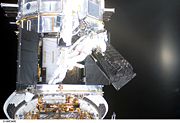 The STS-109 astronauts performed a total of five spacewalks in five consecutive days to service and upgrade the Hubble Space Telescope. The spacewalkers received assistance from their crewmates inside Columbia. Currie operated the Shuttle's robot arm while Altman was her backup. Carey and Altman documented the EVA activities with video and still images.
Accomplishments of the spacewalks included the installation of new solar arrays, a new camera, a new Power Control Unit, a Reaction Wheel Assembly and an experimental cooling system for the NICMOS unit. STS-109 accumulated a total of 35 hours, 55 minutes of EVA time. Following STS-109, a total of 18 spacewalks had been conducted during four Space Shuttle missions to service Hubble (the others being STS-61
, STS-82
, STS-103
and STS-125
) for a total of 129 hours, 10 minutes by 14 different astronauts.
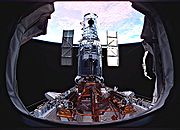 It was also the last successful flight of the Columbia orbiter, as on its next mission, STS-107
, it disintegrated on re-entry
, killing all on board.
STS-109 is considered a night launch, as sunrise
was at 6:47 am, and Columbia launched at 6:22 am EST, 25 minutes before sunrise.
Space Shuttle
The Space Shuttle was a manned orbital rocket and spacecraft system operated by NASA on 135 missions from 1981 to 2011. The system combined rocket launch, orbital spacecraft, and re-entry spaceplane with modular add-ons...
mission that launched from the Kennedy Space Center
Kennedy Space Center
The John F. Kennedy Space Center is the NASA installation that has been the launch site for every United States human space flight since 1968. Although such flights are currently on hiatus, KSC continues to manage and operate unmanned rocket launch facilities for America's civilian space program...
on 1 March 2002. It was the 108th mission of the Space Shuttle program
Space Shuttle program
NASA's Space Shuttle program, officially called Space Transportation System , was the United States government's manned launch vehicle program from 1981 to 2011...
, the 27th flight of the orbiter Columbia
Space Shuttle Columbia
Space Shuttle Columbia was the first spaceworthy Space Shuttle in NASA's orbital fleet. First launched on the STS-1 mission, the first of the Space Shuttle program, it completed 27 missions before being destroyed during re-entry on February 1, 2003 near the end of its 28th, STS-107. All seven crew...
and the fourth servicing of the Hubble Space Telescope
Hubble Space Telescope
The Hubble Space Telescope is a space telescope that was carried into orbit by a Space Shuttle in 1990 and remains in operation. A 2.4 meter aperture telescope in low Earth orbit, Hubble's four main instruments observe in the near ultraviolet, visible, and near infrared...
. It was also the last successful mission of the orbiter Columbia before the ill-fated STS-107
STS-107
-Mission parameters:*Mass:**Orbiter Liftoff: **Orbiter Landing: **Payload: *Perigee: *Apogee: *Inclination: 39.0°*Period: 90.1 min- Insignia :...
mission, which culminated in the Columbia Disaster
Space Shuttle Columbia disaster
The Space Shuttle Columbia disaster occurred on February 1, 2003, when shortly before it was scheduled to conclude its 28th mission, STS-107, the Space Shuttle Columbia disintegrated over Texas and Louisiana during re-entry into the Earth's atmosphere, resulting in the death of all seven crew members...
.
The Hubble Space Telescope (HST) was placed in orbit during mission STS-31
STS-31
STS-31 was the thirty-fifth mission of the American Space Shuttle program, which launched the Hubble Space Telescope astronomical observatory into Earth orbit...
on 25 April 1990. Initially designed to operate for 15 years, plans for periodic service and refurbishment were incorporated into its mission from the start. After the successful completion of the second planned service mission (SM2) by the crew of STS-82
STS-82
STS-82 was a Hubble Space Telescope servicing mission by Space Shuttle Discovery. The mission launched from Kennedy Space Center, Florida, on 11 February 1997 and returned to earth on 21 February 1997 at Kennedy Space Center.-Crew:...
in February 1997, three of HST's six gyroscope
Gyroscope
A gyroscope is a device for measuring or maintaining orientation, based on the principles of angular momentum. In essence, a mechanical gyroscope is a spinning wheel or disk whose axle is free to take any orientation...
s failed. NASA
NASA
The National Aeronautics and Space Administration is the agency of the United States government that is responsible for the nation's civilian space program and for aeronautics and aerospace research...
decided to split the third planned service mission into two parts, SM3A and SM3B. A fifth and final servicing mission, STS-125
STS-125
STS-125, or HST-SM4 , was the fifth and final space shuttle servicing mission to the Hubble Space Telescope .Launch occurred on 11 May 2009 at 2:01 pm EDT...
(SM4) launched 11 May 2009 The work performed during SM4 is expected to keep HST in operation through 2014. Further plans for servicing after SM4 are ambiguous as NASA is planning to launch HST's successor, the James Webb Space Telescope
James Webb Space Telescope
The James Webb Space Telescope , previously known as Next Generation Space Telescope , is a planned next-generation space telescope, optimized for observations in the infrared. The main technical features are a large and very cold 6.5 meter diameter mirror, an observing position far from Earth,...
in 2014.
Crew
Mission parameters
- MassMassMass can be defined as a quantitive measure of the resistance an object has to change in its velocity.In physics, mass commonly refers to any of the following three properties of matter, which have been shown experimentally to be equivalent:...
:- Orbiter liftoff: 116989 kg (257,916.6 lb)
- Orbiter landing: 100564 kg (221,705.7 lb)
- PerigeePerigeePerigee is the point at which an object makes its closest approach to the Earth.. Often the term is used in a broader sense to define the point in an orbit where the orbiting body is closest to the body it orbits. The opposite is the apogee, the farthest or highest point.The Greek prefix "peri"...
: 486 km (302 mi) - Apogee: 578 km (359.2 mi)
- InclinationInclinationInclination in general is the angle between a reference plane and another plane or axis of direction.-Orbits:The inclination is one of the six orbital parameters describing the shape and orientation of a celestial orbit...
: 28.5° - PeriodOrbital periodThe orbital period is the time taken for a given object to make one complete orbit about another object.When mentioned without further qualification in astronomy this refers to the sidereal period of an astronomical object, which is calculated with respect to the stars.There are several kinds of...
: 95.3 min
Spacewalks
| EVA | Team | Start – UTC | End – UTC | Duration |
|---|---|---|---|---|
| 1 | Grunsfeld Linnehan |
4 March 2002, 06:37 | 4 March 2002, 13:38 | 7:01 |
| 2 | Newman Massimino |
5 March 2002, 06:40 | 5 March 2002, 13:56 | 7:16 |
| 3 | Grunsfeld Linnehan |
6 March 2002, 08:28 | 6 March 2002, 15:16 | 6:48 |
| 4 | Newman Massimino |
7 March 2002, 09:00 | 7 March 2002, 16:18 | 7:18 |
| 5 | Grunsfeld Linnehan |
8 March 2002, 08:46 | 8 March 2002, 16:18 | 7:32 |
Mission highlights
Hubble Space Telescope
The Hubble Space Telescope is a space telescope that was carried into orbit by a Space Shuttle in 1990 and remains in operation. A 2.4 meter aperture telescope in low Earth orbit, Hubble's four main instruments observe in the near ultraviolet, visible, and near infrared...
(HST). It was Columbia's
Space Shuttle Columbia
Space Shuttle Columbia was the first spaceworthy Space Shuttle in NASA's orbital fleet. First launched on the STS-1 mission, the first of the Space Shuttle program, it completed 27 missions before being destroyed during re-entry on February 1, 2003 near the end of its 28th, STS-107. All seven crew...
first flight following an extensive two and a half year modification period (its most recent mission being STS-93
STS-93
STS-93 marked the 95th launch of the Space Shuttle, the 26th launch of Columbia, and the 21st night launch of a Space Shuttle. Eileen Collins became the first female shuttle Commander on this flight. Its primary payload was the Chandra X-ray Observatory. It would also be the last mission of...
). During the mission they installed a new science instrument, the Advanced Camera for Surveys
Advanced Camera for Surveys
The Advanced Camera for Surveys is a third generation axial instrument aboard the Hubble Space Telescope . The initial design and scientific capabilities of ACS were defined by a team based at Johns Hopkins University. ACS was assembled and tested extensively at Ball Aerospace & Technologies Corp...
(ACS), new rigid Solar Arrays (SA3), new Power Control Unit (PCU) and a new Cryocooler for the Near Infrared Camera and Multi-Object Spectrometer
Near Infrared Camera and Multi-Object Spectrometer
The Near Infrared Camera and Multi-Object Spectrometer is a scientific instrument for infrared astronomy, installed on the Hubble Space Telescope , operating from 1997 to 1999, and from 2002 to 2008...
(NICMOS). STS-109 also reboosted HST to a higher orbit.
Accomplishments of the spacewalks included the installation of new solar arrays, a new camera, a new Power Control Unit, a Reaction Wheel Assembly and an experimental cooling system for the NICMOS unit. STS-109 accumulated a total of 35 hours, 55 minutes of EVA time. Following STS-109, a total of 18 spacewalks had been conducted during four Space Shuttle missions to service Hubble (the others being STS-61
STS-61
STS-61 was the first Hubble Space Telescope servicing mission, and the fifth flight of the Space Shuttle Endeavour. The mission launched on 2 December 1993 from Kennedy Space Center in Florida. The mission restored the spaceborne observatory's vision, marred by spherical aberration, with the...
, STS-82
STS-82
STS-82 was a Hubble Space Telescope servicing mission by Space Shuttle Discovery. The mission launched from Kennedy Space Center, Florida, on 11 February 1997 and returned to earth on 21 February 1997 at Kennedy Space Center.-Crew:...
, STS-103
STS-103
STS-103 was a Hubble Space Telescope servicing mission by Space Shuttle Discovery. The mission launched from Kennedy Space Center, Florida, on 19 December 1999 and returned on 27 December 1999.-Crew:-Mission parameters:*Mass:...
and STS-125
STS-125
STS-125, or HST-SM4 , was the fifth and final space shuttle servicing mission to the Hubble Space Telescope .Launch occurred on 11 May 2009 at 2:01 pm EDT...
) for a total of 129 hours, 10 minutes by 14 different astronauts.
STS-107
-Mission parameters:*Mass:**Orbiter Liftoff: **Orbiter Landing: **Payload: *Perigee: *Apogee: *Inclination: 39.0°*Period: 90.1 min- Insignia :...
, it disintegrated on re-entry
Space Shuttle Columbia disaster
The Space Shuttle Columbia disaster occurred on February 1, 2003, when shortly before it was scheduled to conclude its 28th mission, STS-107, the Space Shuttle Columbia disintegrated over Texas and Louisiana during re-entry into the Earth's atmosphere, resulting in the death of all seven crew members...
, killing all on board.
STS-109 is considered a night launch, as sunrise
Sunrise
Sunrise is the instant at which the upper edge of the Sun appears above the horizon in the east. Sunrise should not be confused with dawn, which is the point at which the sky begins to lighten, some time before the sun itself appears, ending twilight...
was at 6:47 am, and Columbia launched at 6:22 am EST, 25 minutes before sunrise.
See also
- Space scienceSpace scienceThe term space science may mean:* The study of issues specifically related to space travel and space exploration, including space medicine.* Science performed in outer space ....
- Space ShuttleSpace ShuttleThe Space Shuttle was a manned orbital rocket and spacecraft system operated by NASA on 135 missions from 1981 to 2011. The system combined rocket launch, orbital spacecraft, and re-entry spaceplane with modular add-ons...
- List of space shuttle missions
- List of human spaceflights chronologically
External links
- Status reports – Detailed NASANASAThe National Aeronautics and Space Administration is the agency of the United States government that is responsible for the nation's civilian space program and for aeronautics and aerospace research...
status reports for each day of the mission. - NASA mission summary
- STS-109 reentry pictures
- ESA/Hubble mission summary
- STS-109 Video Highlights