


Rover P6

Encyclopedia
The first P6 used a 2.0 L (1978 cc/120 in³) engine designed specifically for the P6. Although it was announced towards the end of 1963, the car had been in "pilot production" since the beginning of the year, therefore deliveries were able to begin immediately. Original output was in the order of 104 bhp. At the time the engine was unusual in having an overhead camshaft
layout. The cylinder head had a perfectly flat surface, and the combustion chambers were cast into the piston crowns (sometimes known as a Heron head).
Rover later developed a derivative of the engine by fitting twin SU carburettors and a re-designed top end and marketed the revised specification vehicles as the 2000TC. The 2000TC was launched in March 1966 for export markets in North America and continental Europe. Limited availability of the redesigned induction manifold needed for the twin-carburetter engine was given as one reason for restricting the 2000TC to overseas sales. The manufacturers also stated pointedly that the UK's recently introduced blanket 70 mph (113 km/h) speed limit would make the extra speed of the new car superfluous on the domestic market. Fortunately for performance-oriented UK buyers, supplies of the redesigned inlet manifold must have improved and the company relented in time for the London Motor Show in October 1966 when the 2000 TC became available for the UK market. The 2000 TC prototypes had run in the Rally of Great Britain as part of their test programme. It featured a bigger starter motor and tachometer as standard and was identifiable by "TC" initials on the bodywork. The power output of the 2000TC engine was around 124 bhp. The standard specification engines continued in production in vehicles designated as 2000SC models. These featured the original single SU.
's compact 3.5 L (3528 cc/215 in³) V8 from the Buick Special
as a way to differentiate the P6 from its chief rival, the Triumph 2000
. They purchased the rights to the innovative aluminium engine, and, once improved for production by Rover's own engineers, it became an instant hit. The Rover V8 engine
, as it became known, outlived its original host by more than three decades (its original host being the P5B, not the P6).
The 3500 was introduced in April 1968 (one year after the Rover
company was purchased by Triumph's owner, Leyland
) and continued to be offered until 1977. The manufacturer asserted that the light metal V8 engine weighed the same as the four cylinder unit of the Rover 2000, and the more powerful car's maximum speed of 114 mph (183 km/h) as well as its 10.5 second acceleration time from 0–60 mph (97 km/h) were considered impressive, and usefully faster than most of the cars with which, on the UK market, the car competed on price and specifications. (The glaring exception was the Jaguar 340
, substantially quicker and, in terms of manufacturers' recommended prices, 15 percent cheaper than the Rover 3500, the Jaguar representing exceptional value as a "run-out" model, shortly to be replaced by the Jaguar XJ6.)
It was necessary to modify the under-bonnet space in order to squeeze the V8 engine into the P6 engine bay: the front suspension cross-member had to be relocated forward, while a more visible change was an extra air intake beneath the front bumper to accommodate the larger radiator. There was no longer space under the bonnet/hood for the car's battery, which in the 3500 retreated to a position on the right side of the boot/trunk. Nevertheless, the overall length and width of the body were unchanged when compared with the smaller-engined original P6.
Having invested heavily in the car's engine and running gear, the manufacturer left most other aspects of the car unchanged. However, the new Rover 3500 could be readily distinguished from the 2000 thanks to various prominent V8 badges on the outside and beneath the radio. The 3500 was also delivered with a black vinyl covering on the C-pillar, although this decoration later appeared also on the car's four-cylinder siblings.
A 3-speed Borg Warner 35
automatic
was the only transmission option until the 1971 addition of a four-speed manual 3500S model, fitted with a modified version of the gearbox used in the 2000/2200. The letter "S" did not denote "Sport", it was chosen because it stood for something specific on those cars: "Synchromesh".
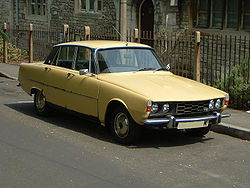
 The Series II, or Mark II as it was actually named by Rover, involved a number of revisions to all Rover P6 variants and was launched in 1970. It included new exterior fixtures such as a plastic front air intake (to replace the alloy version), new bonnet pressings (with V8 blips even for the 4-cylinder engined cars) and new rear lights. The interior of the 3500, and 2000TC versions was updated with new instrumentation with circular gauges and rotary switches. The old-style instrumentation with a linear speedometer and toggle switches continued on the 2000SC versions. The battery was moved to the boot for all Series II versions.
The final years of the Rover P6 coincided with production problems at British Leyland. This was highlighted in August 1975 when Drive, the magazine of the British Automobile Association
awarded a trophy to a Rover 3500 as the worst new car in England. It reported that a Rover 3500 purchased in 1974 had covered 6,000 miles (9,600 kilometers) during its first six months, during which period it had consumed three engines, two gear boxes, two clutch housings and needed a complete new set of electrical cables. The car had spent 114 of its first 165 days in a workshop. The runner-up prize in this rogue's gallery was awarded to an Austin Allegro
with forty faults reported over ten months, and a Triumph Stag
came in third. The story was picked up and reported in other publications not just domestically, but also in Germany, at the time Europe's largest national car market and an important target export market for the company. Further evidence of poor quality control on the 3500 assembly line at the Solihull plant appeared in a report in Autocar
magazine in October 1976, surveying the experiences of company car fleet managers with the model, although the report also suggested, apparently wishing to appear even-handed, that at least part of the problem might have arisen from excessively optimistic expectations of the model.
cars were strengthened to cope with claimed power increases to 98 bhp and 115 bhp for the SC (single carburettor) and TC (twin carburettor) versions respectively, along with the improved torque.
The last 2200 came off the production line on 19 March 1977, a left-hand drive export version that was converted to right-hand drive by Tourist Trophy Garage, Farnham.
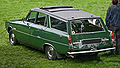
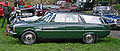 While Triumph
enjoyed considerable success with the estate version of their 2000 saloon
, Rover seemed happy to leave that sector of the market entirely open to their old rival. However, Battersea
-based coachbuilders FLM Panelcraft picked up Rover's dropped ball and produced their own estate conversion of the P6, called the Estoura. The name is presumably a contraction of the words 'estate' and 'tourer'. Between 160 and 170 were produced (although the Rover P6 Club database shows 187 Estouras as of Dec 2010). The first estate was not an approved conversion, but from 1970 onwards the car was marketed (with the factory's blessing) by BL dealers HR Owen Limited and therefore factory warranties
were carried forward.
The conversions were completed by H.R. Owen
and Crayford Engineering
, with bodywork executed by FLM Panelcraft. According to P6 archivist John Windwood, Crayford's involvement in the project was limited to the interior of the car, and the company had no bearing on the external design of the estate conversion. Nonetheless Crayford badged them as Crayfords for a while (implying that they built them) and only stopped after FLM threatened legal action. Conversions could be carried out at any time in the car's life. Most conversions appear to have been carried out when the cars were 12 months old or older because if a car was converted when new, the conversion would be liable for Purchase Tax like the car itself.
Due to the cost of the conversion (about GB£
800) it would appear that most were carried out on the 3500 rather than on the 2000, with even fewer 2200s made. In comparison with the Triumph 2000
estate, the Rover Estoura was of limited practicality. The quality of the conversion also left a great deal to be desired. According to John Windwood:
/2500, Jaguar XJ6 (Series 1 and 2) and Land Rover
(Series 3). A notable factor about the Rover 3500 was that it was an export car for New Zealand
– 2,400 were shipped to Australia for sale there.
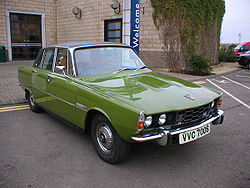 The last Rover P6 off the production line, registered VVC 700S, was built on 19 March 1977, a year after its successor - the Rover SD1
- went into production.
This car was first sent in August 1977, to the Leyland Historic Vehicle collection, then at Donington Park
until 1980, when it was moved to Syon Park along with the rest of the collection, which became the British Motor Industry Heritage Trust Collection. It remained an exhibit at Syon until 1990, when the collection moved to Studley Castle
(then owned by Rover) and went into storage until 1993.
In 1993, the collection then moved to its new home, The British Motor Industry Heritage Trust site at Gaydon
, now known as the Heritage Motor Centre
. VVC 700S was on display until 2003 when it sold at the Bonhams sale of Rover-owned items.
In 2006 the car revisited Gaydon for the first time since the sale and is still in original condition having never been restored. The car came out of the collection having only ever covered 12300 miles (19,794.9 km). "Graham" as the car is affectionately known by its current owner Mark Gray, (Editor of Driving Force the magazine of The Rover P6 Club), had a Corgi Vanguard model commissioned of it in 2006, which was released in 2007 to celebrate the 30th anniversary of the end of production.
VVC 700S is a base model car with just power steering and the spare wheel kit, from the optional extras range and was never fitted with a radio.
, on the Basse Corniche to Monaco
from their country home, Princess Grace
suffered a stroke
, which caused her to drive her Rover P6 off the road. Grace was pulled alive from the wreckage, but had suffered serious injuries and was unconscious
. She died the following day at the Monaco Hospital (renamed Centre Hospitalier Princesse GraceThe Princess Grace Hospital Centre
in Englishin 1985), having never regained consciousness. It was initially reported that Princess Stéphanie suffered only minor bruising, although it later emerged that she had suffered a serious cervical fracture. It was rumoured that Kelly had been driving on the same stretch of highway that had been featured in her 1955 movie To Catch a Thief
, but her son has always denied it. The section where she died has subsequently been renamed in her honour.
Overhead camshaft
Overhead cam valvetrain configurations place the engine camshaft within the cylinder heads, above the combustion chambers, and drive the valves or lifters in a more direct manner compared to overhead valves and pushrods...
layout. The cylinder head had a perfectly flat surface, and the combustion chambers were cast into the piston crowns (sometimes known as a Heron head).
Rover later developed a derivative of the engine by fitting twin SU carburettors and a re-designed top end and marketed the revised specification vehicles as the 2000TC. The 2000TC was launched in March 1966 for export markets in North America and continental Europe. Limited availability of the redesigned induction manifold needed for the twin-carburetter engine was given as one reason for restricting the 2000TC to overseas sales. The manufacturers also stated pointedly that the UK's recently introduced blanket 70 mph (113 km/h) speed limit would make the extra speed of the new car superfluous on the domestic market. Fortunately for performance-oriented UK buyers, supplies of the redesigned inlet manifold must have improved and the company relented in time for the London Motor Show in October 1966 when the 2000 TC became available for the UK market. The 2000 TC prototypes had run in the Rally of Great Britain as part of their test programme. It featured a bigger starter motor and tachometer as standard and was identifiable by "TC" initials on the bodywork. The power output of the 2000TC engine was around 124 bhp. The standard specification engines continued in production in vehicles designated as 2000SC models. These featured the original single SU.
3500
Rover saw BuickBuick
Buick is a premium brand of General Motors . Buick models are sold in the United States, Canada, Mexico, China, Taiwan, and Israel, with China being its largest market. Buick holds the distinction as the oldest active American make...
's compact 3.5 L (3528 cc/215 in³) V8 from the Buick Special
Buick Special
In 1962, the Special was the first American car to use a V6 engine in volume production; it earned Motor Trends Car of the Year for 1962. This 198 in³ Fireball was engineered down from the 215 and used many of the same design parameters, but was cast in iron. Output was 135 hp at...
as a way to differentiate the P6 from its chief rival, the Triumph 2000
Triumph 2000
The Triumph 2000 is a mid-sized, rear wheel drive automobile which was produced in Coventry by the Triumph Motor Company between 1963 and 1977. Larger-engined models, known as the Triumph 2.5 PI and Triumph 2500 were also produced.-Engine:...
. They purchased the rights to the innovative aluminium engine, and, once improved for production by Rover's own engineers, it became an instant hit. The Rover V8 engine
Rover V8 engine
The Rover V8 engine is a compact V8 internal combustion engine with aluminium cylinder heads and cylinder block, originally designed by General Motors and later re-designed and produced by Rover in the United Kingdom...
, as it became known, outlived its original host by more than three decades (its original host being the P5B, not the P6).
The 3500 was introduced in April 1968 (one year after the Rover
Rover (car)
The Rover Company is a former British car manufacturing company founded as Starley & Sutton Co. of Coventry in 1878. After developing the template for the modern bicycle with its Rover Safety Bicycle of 1885, the company moved into the automotive industry...
company was purchased by Triumph's owner, Leyland
British Leyland Motor Corporation
British Leyland was a vehicle manufacturing company formed in the United Kingdom in 1968 as British Leyland Motor Corporation Ltd . It was partly nationalised in 1975 with the government creating a new holding company called British Leyland Ltd which became BL Ltd in 1978...
) and continued to be offered until 1977. The manufacturer asserted that the light metal V8 engine weighed the same as the four cylinder unit of the Rover 2000, and the more powerful car's maximum speed of 114 mph (183 km/h) as well as its 10.5 second acceleration time from 0–60 mph (97 km/h) were considered impressive, and usefully faster than most of the cars with which, on the UK market, the car competed on price and specifications. (The glaring exception was the Jaguar 340
Jaguar Mark 2
The Jaguar Mark 2 is a medium sized saloon car built from 1959 to 1967 by the Jaguar company in Coventry, England, as successors to the Jaguar 2.4 and 3.4 models, manufactured between 1957 and 1959...
, substantially quicker and, in terms of manufacturers' recommended prices, 15 percent cheaper than the Rover 3500, the Jaguar representing exceptional value as a "run-out" model, shortly to be replaced by the Jaguar XJ6.)
It was necessary to modify the under-bonnet space in order to squeeze the V8 engine into the P6 engine bay: the front suspension cross-member had to be relocated forward, while a more visible change was an extra air intake beneath the front bumper to accommodate the larger radiator. There was no longer space under the bonnet/hood for the car's battery, which in the 3500 retreated to a position on the right side of the boot/trunk. Nevertheless, the overall length and width of the body were unchanged when compared with the smaller-engined original P6.
Having invested heavily in the car's engine and running gear, the manufacturer left most other aspects of the car unchanged. However, the new Rover 3500 could be readily distinguished from the 2000 thanks to various prominent V8 badges on the outside and beneath the radio. The 3500 was also delivered with a black vinyl covering on the C-pillar, although this decoration later appeared also on the car's four-cylinder siblings.
A 3-speed Borg Warner 35
Borg-Warner 35 transmission
The Borg-Warner 35 transmission is an automatic transmission produced by the BorgWarner company.It has three forward and one reverse gears. The selector lever follows a quadrant which has six stations...
automatic
Automatic transmission
An automatic transmission is one type of motor vehicle transmission that can automatically change gear ratios as the vehicle moves, freeing the driver from having to shift gears manually...
was the only transmission option until the 1971 addition of a four-speed manual 3500S model, fitted with a modified version of the gearbox used in the 2000/2200. The letter "S" did not denote "Sport", it was chosen because it stood for something specific on those cars: "Synchromesh".
Series II
The final years of the Rover P6 coincided with production problems at British Leyland. This was highlighted in August 1975 when Drive, the magazine of the British Automobile Association
The Automobile Association
The Automobile Association , a British motoring association founded in 1905 was demutualised in 1999 to become a private limited company which currently provides car insurance, driving lessons, breakdown cover, loans and motoring advice, and other services...
awarded a trophy to a Rover 3500 as the worst new car in England. It reported that a Rover 3500 purchased in 1974 had covered 6,000 miles (9,600 kilometers) during its first six months, during which period it had consumed three engines, two gear boxes, two clutch housings and needed a complete new set of electrical cables. The car had spent 114 of its first 165 days in a workshop. The runner-up prize in this rogue's gallery was awarded to an Austin Allegro
Austin Allegro
The Austin Allegro is a small family car manufactured by British Leyland under the Austin name from 1973 until 1983. The same vehicle was built in Italy by Innocenti between 1974 and 1975 and sold as the Innocenti Regent...
with forty faults reported over ten months, and a Triumph Stag
Triumph Stag
The Triumph Stag is a British car that was sold between 1970 and 1978 by the Triumph Motor Company, styled by the Italian designer Giovanni Michelotti.-Design and styling:...
came in third. The story was picked up and reported in other publications not just domestically, but also in Germany, at the time Europe's largest national car market and an important target export market for the company. Further evidence of poor quality control on the 3500 assembly line at the Solihull plant appeared in a report in Autocar
Autocar
Autocar is a weekly British automobile magazine published by Haymarket Motoring Publications Ltd. It refers to itself as "The World's oldest car magazine".-History:...
magazine in October 1976, surveying the experiences of company car fleet managers with the model, although the report also suggested, apparently wishing to appear even-handed, that at least part of the problem might have arisen from excessively optimistic expectations of the model.
2200
The 2200SC and 2200TC replaced the 2000 and 2000TC. Announced in October 1973 and produced through to the early part of 1977, it used a 2.2 L (2205 cc/134 in³), version of 2000s engine with the bore increased from 85.7 mm (3.4 in) to 90.5 mm (3.6 in): the stroke was unchanged at 85.7 mm. Gear boxes on the manual transmissionManual transmission
A manual transmission, also known as a manual gearbox or standard transmission is a type of transmission used in motor vehicle applications...
cars were strengthened to cope with claimed power increases to 98 bhp and 115 bhp for the SC (single carburettor) and TC (twin carburettor) versions respectively, along with the improved torque.
The last 2200 came off the production line on 19 March 1977, a left-hand drive export version that was converted to right-hand drive by Tourist Trophy Garage, Farnham.
Estates
Triumph Motor Company
The Triumph Motor Company was a British car and motor manufacturing company. The Triumph marque is owned currently by BMW. The marque had its origins in 1885 when Siegfried Bettmann of Nuremberg initiated S. Bettmann & Co and started importing bicycles from Europe and selling them with his own...
enjoyed considerable success with the estate version of their 2000 saloon
Triumph 2000
The Triumph 2000 is a mid-sized, rear wheel drive automobile which was produced in Coventry by the Triumph Motor Company between 1963 and 1977. Larger-engined models, known as the Triumph 2.5 PI and Triumph 2500 were also produced.-Engine:...
, Rover seemed happy to leave that sector of the market entirely open to their old rival. However, Battersea
Battersea
Battersea is an area of the London Borough of Wandsworth, England. It is an inner-city district of South London, situated on the south side of the River Thames, 2.9 miles south-west of Charing Cross. Battersea spans from Fairfield in the west to Queenstown in the east...
-based coachbuilders FLM Panelcraft picked up Rover's dropped ball and produced their own estate conversion of the P6, called the Estoura. The name is presumably a contraction of the words 'estate' and 'tourer'. Between 160 and 170 were produced (although the Rover P6 Club database shows 187 Estouras as of Dec 2010). The first estate was not an approved conversion, but from 1970 onwards the car was marketed (with the factory's blessing) by BL dealers HR Owen Limited and therefore factory warranties
Warranty
In business and legal transactions, a warranty is an assurance by one party to the other party that specific facts or conditions are true or will happen; the other party is permitted to rely on that assurance and seek some type of remedy if it is not true or followed.In real estate transactions, a...
were carried forward.
The conversions were completed by H.R. Owen
H.R. Owen
H.R. Owen is Britain's leading luxury motor dealer, and the world's largest retailer in Rolls-Royce, Bentley, Lamborghini and Bugatti brands.-Background:...
and Crayford Engineering
Crayford Engineering
Crayford Engineering was an automobile coachbuilder based in Westerham, Kent, England and formed in 1962 by David McMullan and Jeffrey Smith. In the 1970s, a subdivision within the company, called Crayford Auto Developments, Ltd., was established for automobiles...
, with bodywork executed by FLM Panelcraft. According to P6 archivist John Windwood, Crayford's involvement in the project was limited to the interior of the car, and the company had no bearing on the external design of the estate conversion. Nonetheless Crayford badged them as Crayfords for a while (implying that they built them) and only stopped after FLM threatened legal action. Conversions could be carried out at any time in the car's life. Most conversions appear to have been carried out when the cars were 12 months old or older because if a car was converted when new, the conversion would be liable for Purchase Tax like the car itself.
Due to the cost of the conversion (about GB£
Pound sterling
The pound sterling , commonly called the pound, is the official currency of the United Kingdom, its Crown Dependencies and the British Overseas Territories of South Georgia and the South Sandwich Islands, British Antarctic Territory and Tristan da Cunha. It is subdivided into 100 pence...
800) it would appear that most were carried out on the 3500 rather than on the 2000, with even fewer 2200s made. In comparison with the Triumph 2000
Triumph 2000
The Triumph 2000 is a mid-sized, rear wheel drive automobile which was produced in Coventry by the Triumph Motor Company between 1963 and 1977. Larger-engined models, known as the Triumph 2.5 PI and Triumph 2500 were also produced.-Engine:...
estate, the Rover Estoura was of limited practicality. The quality of the conversion also left a great deal to be desired. According to John Windwood:
NADA models
Rover made an attempt to break into the North American market with the P6, beginning with the Rover 2000 TC. One version of the P6 that was exported was the NADA (North American Dollar Area) model, equipped to a higher standard than UK cars. These are also often referred to today as being "Federal Specification". Notable differences outside the car were wraparound bumpers, three air scoops on the top of the bonnet, front and rear wing reflectors and the "Icelert" on the front grill. The "Icelert" was a sensor which warned the driver of falling outside temperatures and the possibility of ice forming on the road. Inside, depending on the location, the US 3500S was also equipped with electric windows, power steering and air conditioning all of which are extremely unusual in UK market P6 cars. The NADA P6 introduced features which would later appear on the UK Mark II car including a new instrument cluster and seat piping. Despite being badged as "3500S" cars, the export models were all fitted with the Borg Warner 35 automatic transmission. The cars were not popular with American buyers, but were sold in Europe instead as they were already converted to left-hand drive. In true British Leyland fashion, several UK cars also ended up with single scoops on their bonnets in an attempt to use up the surplus parts from the now defunct export models. Rover discontinued selling the P6 in North America in 1971: in that year the US had taken fewer than 1,500 Rovers. The company told their US dealers that modifying their cars to meet new US federal safety and pollution requirements would be prohibitively expensive, while experience elsewhere suggests that the Rover four-cylinder engine was particularly hard to adapt for reduced octane lead-free fuels without an unacceptable reduction in the car's (already mediocre) performance.New Zealand production
The Rover 3500 was assembled in New Zealand from 1971 to 1976, at New Zealand Motor Corporation's assembly plant in Stoke, Nelson, alongside the Triumph 2000Triumph 2000
The Triumph 2000 is a mid-sized, rear wheel drive automobile which was produced in Coventry by the Triumph Motor Company between 1963 and 1977. Larger-engined models, known as the Triumph 2.5 PI and Triumph 2500 were also produced.-Engine:...
/2500, Jaguar XJ6 (Series 1 and 2) and Land Rover
Land Rover
Land Rover is a British car manufacturer with its headquarters in Gaydon, Warwickshire, United Kingdom which specialises in four-wheel-drive vehicles. It is owned by the Indian company Tata Motors, forming part of their Jaguar Land Rover group...
(Series 3). A notable factor about the Rover 3500 was that it was an export car for New Zealand
New Zealand
New Zealand is an island country in the south-western Pacific Ocean comprising two main landmasses and numerous smaller islands. The country is situated some east of Australia across the Tasman Sea, and roughly south of the Pacific island nations of New Caledonia, Fiji, and Tonga...
– 2,400 were shipped to Australia for sale there.
Last production model
Rover SD1
Rover SD1 is both the code name and eventual production name given to a series of large executive cars made by British Leyland or BL through its Specialist, Rover Triumph and Austin Rover divisions from 1976 until 1986....
- went into production.
This car was first sent in August 1977, to the Leyland Historic Vehicle collection, then at Donington Park
Donington Park
Donington Park is a motorsport circuit near Castle Donington in Leicestershire, England.Originally part of the Donington Hall estate, it was created as a racing circuit during the pre-war period when the German Silver Arrows were battling for the European Championship...
until 1980, when it was moved to Syon Park along with the rest of the collection, which became the British Motor Industry Heritage Trust Collection. It remained an exhibit at Syon until 1990, when the collection moved to Studley Castle
Studley Castle
Studley Castle is a 19th century country house at Studley , Warwickshire which is now occupied as a hotel. It is a Grade II* listed building.The manor of Studley was owned by the Lyttleton family and was bequeathed by Philip Lyttleton to his niece Dorothy, who married Francis Holyoake...
(then owned by Rover) and went into storage until 1993.
In 1993, the collection then moved to its new home, The British Motor Industry Heritage Trust site at Gaydon
Gaydon
Gaydon is a parish and village in Warwickshire, England, close to Leamington Spa. In the 2001 census, the parish had a population of 376.The village is at the junction of the B4100 and B4451 roads, a mile from Junction 12 of the M40 motorway, and is two miles north-east of Kineton.-Motor...
, now known as the Heritage Motor Centre
Heritage Motor Centre
The Heritage Motor Centre is a British motor museum and research centre, located adjacent to the Jaguar Land Rover Gaydon Centre near Gaydon in Warwickshire, England. The centre is open to the public, and houses a collection of important vehicles, celebrating Britain's motoring heritage...
. VVC 700S was on display until 2003 when it sold at the Bonhams sale of Rover-owned items.
In 2006 the car revisited Gaydon for the first time since the sale and is still in original condition having never been restored. The car came out of the collection having only ever covered 12300 miles (19,794.9 km). "Graham" as the car is affectionately known by its current owner Mark Gray, (Editor of Driving Force the magazine of The Rover P6 Club), had a Corgi Vanguard model commissioned of it in 2006, which was released in 2007 to celebrate the 30th anniversary of the end of production.
VVC 700S is a base model car with just power steering and the spare wheel kit, from the optional extras range and was never fitted with a radio.
Death of Grace Kelly
On September 13, 1982, while driving with her daughter, StéphaniePrincess Stéphanie of Monaco
Princess Stéphanie of Monaco, Countess of Polignac is a member of the princely family of Monaco. She is the youngest child of Grace, Princess of Monaco and Rainier III of Monaco, and the sister of Albert II of Monaco and Princess Caroline...
, on the Basse Corniche to Monaco
Monaco
Monaco , officially the Principality of Monaco , is a sovereign city state on the French Riviera. It is bordered on three sides by its neighbour, France, and its centre is about from Italy. Its area is with a population of 35,986 as of 2011 and is the most densely populated country in the...
from their country home, Princess Grace
Grace Kelly
Grace Patricia Kelly was an American actress who, in April 1956, married Rainier III, Prince of Monaco, to become Princess consort of Monaco, styled as Her Serene Highness The Princess of Monaco, and commonly referred to as Princess Grace.After embarking on an acting career in 1950, at the age of...
suffered a stroke
Stroke
A stroke, previously known medically as a cerebrovascular accident , is the rapidly developing loss of brain function due to disturbance in the blood supply to the brain. This can be due to ischemia caused by blockage , or a hemorrhage...
, which caused her to drive her Rover P6 off the road. Grace was pulled alive from the wreckage, but had suffered serious injuries and was unconscious
Coma
In medicine, a coma is a state of unconsciousness, lasting more than 6 hours in which a person cannot be awakened, fails to respond normally to painful stimuli, light or sound, lacks a normal sleep-wake cycle and does not initiate voluntary actions. A person in a state of coma is described as...
. She died the following day at the Monaco Hospital (renamed Centre Hospitalier Princesse GraceThe Princess Grace Hospital Centre
The Princess Grace Hospital Centre
-History:By 1818 there were no hospitals or charitable institution in Monaco, the Prince Honoré V had the idea of building a modern hospital in the west part of Monaco, in the district of The Salines....
in Englishin 1985), having never regained consciousness. It was initially reported that Princess Stéphanie suffered only minor bruising, although it later emerged that she had suffered a serious cervical fracture. It was rumoured that Kelly had been driving on the same stretch of highway that had been featured in her 1955 movie To Catch a Thief
To Catch a Thief
To Catch a Thief is a 1952 thriller novel by David Dodge. John Robie is a retired American jewel thief, formerly known as Le Chat , who now spends his time tending to the rose garden in his villa on the Côte d'Azur. Following a series of recent jewel robberies on the Riviera that resemble his...
, but her son has always denied it. The section where she died has subsequently been renamed in her honour.