
Home      Discussion      Topics      Dictionary      Almanac
Signup       Login
Jaguar Mark 2

Jaguar Mark 2

Overview
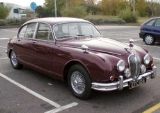
The Jaguar Mark 2 is a medium sized saloon car built from 1959 to 1967 by the Jaguar company in Coventry, England, as successors to the Jaguar 2.4 and 3.4 models, manufactured between 1957 and 1959. These retrospectively became known as the Jaguar Mark 1 following the release of the Mark 2 in 1959.
Discussion
Ask a question about 'Jaguar Mark 2'
Start a new discussion about 'Jaguar Mark 2'
Answer questions from other users
Full Discussion Forum
 
Recent Discussions
Encyclopedia
The Jaguar Mark 2 is a medium sized saloon car built from 1959 to 1967 by the Jaguar company in Coventry, England, as successors to the Jaguar 2.4 and 3.4 models, manufactured between 1957 and 1959. These retrospectively became known as the Jaguar Mark 1 following the release of the Mark 2 in 1959.

History


Adhering to Sir William Lyons
William Lyons
Sir William Lyons , known as "Mr. Jaguar", was with fellow motorcycle enthusiast William Walmsley, the co-founder in 1922 of the Swallow Sidecar Company, which became Jaguar Cars Limited after the Second World War....

' maxim of "grace, pace and space", the Mark 2 was a beautiful, fast and capable saloon. It came with a 120 bhp 2.4 L, 210 bhp 3.4 L or 220 bhp 3.8 L Jaguar XK engine. The 3.8 is similar to the unit used in the 3.8 E-Type (called XKE in the USA)
Jaguar E-type
The Jaguar E-Type or XK-E is a British automobile, manufactured by Jaguar between 1961 and 1975. Its combination of good looks, high performance, and competitive pricing established the marque as an icon of 1960s motoring...

, having the same block, crank, connecting rods and pistons but different inlet manifold and carburation (two SU
SU Carburetter
SU Carburetters were a brand of carburetter usually of the sidedraught type but downdraught variants were used on some pre-war cars....

s versus three on the E-Type in Europe) and therefore 30 bhp less. The head of the six cylinder engine in the Mark 2 had curved ports compared to the straight ports of the E-Type configuration. For markets other than the US the 3.4 was fitted with twin SU carburettors and the 2.4 with twin Solex
Solex
Solex was a French manufacturer of carburetors and the powered bicycle VéloSoleX.The Solex company was founded by Marcel Mennesson and Maurice Goudard to manufacture vehicle radiators...

es, but three Solexes were used in US spec 3.4s and 3.8s.

The Daimler 2.5 litre engine
Daimler 2.5 & 4.5 litre
The Daimler 2.5 & 4.5 litre V-8 engines were designed by Edward Turner in 1959 and used in several of the cars made by the British Daimler company in the 1950s and 1960s...

 was fitted to the Daimler 250
Daimler 250
The 2.5-V8/V8-250 was the last Daimler car to feature a Daimler engine after the marque was acquired by Jaguar Cars in 1960. The engine is the hemispherical head V8 designed by Edward Turner and first used in the Daimler SP250 sports car.-Daimler 2.5-V8:...

 derivative of the Mark 2 (In European markets known as the Daimler 2.5-V8 then Daimler V8-250), having first been used in the Daimler SP250
Daimler SP250
The Daimler Dart was a sports car built by British manufacturer Daimler in Coventry.It was launched at the 1959 New York Motor Show, and its greatest success was in the North American market. It had a fibreglass body, four-wheel Girling disc brakes, and a 2.5-litre Hemi-head V8 engine designed by...

 sports car (the SP250 was originally known as the Daimler Dart but "Dart" was a trademark of Dodge and had to be dropped by Daimler under threat of legal action.) The aluminium alloy Daimler engine was lighter than the cast iron block Jaguar sixes, therefore reducing the mass over the front wheels and hence reducing understeer compared to the XK-powered versions under hard cornering. These models were recognisable by the characteristic Daimler wavy fluting incorporated in the chrome grille instead of the Jaguar badge and figurine.

The Mark 2 was discontinued in September 1967 and replaced by the 240 and 340, so named to distinguish them from the old 2.4 and 3.4 which, as noted above, became known as the Mark 1 following the introduction of the Mark 2 in 1959. The Jaguar 240 and 340 were interim models to fill the gap until the introduction of the XJ6 in September 1968. The 340 was discontinued immediately but the 240 continued as a budget priced model until April 1969; its price of £1364 was only £20 more than the first 2.4 in 1956.

The economies of the new 240 and 340 models came at a cost – the leather upholstery was replaced by "Ambla" leather-like material and slimmer, more economical front and rear bumpers were introduced. Other changes included the replacement of the front fog lamps with circular vents and optional fog lamps for the UK market. The sales price was reduced to compete with the Rover 2000 TC
Rover P6
The first P6 used a 2.0 L engine designed specifically for the P6. Although it was announced towards the end of 1963, the car had been in "pilot production" since the beginning of the year, therefore deliveries were able to begin immediately. Original output was in the order of . At the...

.

The 240's performance was improved over the old 2.4 model by upgrading the 2.4's cylinder head and twin Solex carburettors to the straight port 'E-Type' head and twin SU carburettors. For the first time the 2.4-litre model could exceed 100 mph, resulting in a slight sales resurgence.

Production


Mark 2, 1959 to 1967 83,976 Mark 2s were built, split as follows:
2.4 – 25,173
3.4 – 28,666
3.8 – 30,141


240 and 340 series, 1967 to 1969 total production 7,246 as follows:
240 – 4,446
340 – 2,788
380 – 12 (not a standard production option)


Jaguar replaced the 240 and 340 with the XJ6 in September 1968.

Performance


A 3.4 litre car with automatic transmission tested by The Motor magazine in 1961 had a top speed of 119.9 mph (193 km/h) and could accelerate from 0-60 mph (96.6 km/h) in 11.9 seconds. A touring fuel consumption of 19 mpgimp was recorded. The test car cost £1951 including taxes of £614.

A 3.8 litre car with the 220 bhp engine was capable of accelerating from 0-60 mph (96.6 km/h) in 8.5 seconds and could reach a top speed of 125 mph (201.2 km/h).

Influence on modern Jaguars


The Mark 2's body lines, derived from the Mark 1, and overall layout proved sufficiently popular over time to provide an inspiration for both the Jaguar S-Type
Jaguar S-Type
The Jaguar S-Type was a mid-size luxury/executive car that debuted at the 1998 Birmingham Motor Show and went on sale in spring 1999. The name is a revival of a previous Jaguar model, the S-Type introduced in 1963.-Overview:...

 introduced in 1999 and the smaller X-Type
Jaguar X-Type
The X-Type is a compact executive car manufactured and marketed for model years 2001-2009 by Jaguar Cars. The smallest of the Jaguar model range, the X-type was marketed in saloon and wagon variants and was the only estate ever manufactured in series production by the company...

 debuted in 2001.

Portrayal in media


The Mark 2 gained a reputation as a capable car among criminals and law enforcement alike; the 3.8 Litre model being particularly fast with its 220 bhp (164 kW) engine driving the car from 0-60 mph (96.6 km/h) in 8.5 seconds and to a top speed of 125 mph (201.2 km/h) with enough room for five adults. Popular as getaway cars, they were also employed by the Police to patrol British motorways.

The Mark 2 is also well known as the car driven by fictional TV detective Inspector Morse
Inspector Morse
Inspector Morse is a fictional character in the eponymous series of detective novels by British author Colin Dexter, as well as the 33-episode 1987–2000 television adaptation of the same name, in which the character was portrayed by John Thaw. Morse is a senior CID officer with the Thames Valley...

played by John Thaw
John Thaw
John Edward Thaw, CBE was an English actor, who appeared in a range of television, stage and cinema roles, his most popular being police and legal dramas such as Redcap, The Sweeney, Inspector Morse and Kavanagh QC.-Early life:Thaw came from a working class background, having been born in Gorton,...

, although Morse's car was the least desirable version (with its 2.4 L engine, steel wheels and Everflex
Everflex
Everflex is a British fabric used as a roof covering on cars, and is a type of vinyl roofEverflex is used on both hardtops and convertibles....

 vinyl roof). It was often pushed into scenes with engine noises dubbed onto the soundtrack in post-production. In November 2005, the car used in the television series sold for more than £100,000 following a total ground-up rebuild (prior to this, in its recommissioned state in 2002 after coming out of storage, it had made £53,000 at auction – some £45,000 more than an equivalent without the history). In the original novels by Colin Dexter
Colin Dexter
Norman Colin Dexter, OBE, is an English crime writer, known for his Inspector Morse novels which were written between 1975 and 1999 and adapted as a television series from 1987 to 2000.-Early life and career:...

, Morse had driven a Lancia
Lancia
Lancia Automobiles S.p.A. is an Italian automobile manufacturer founded in 1906 by Vincenzo Lancia and which became part of the Fiat Group in 1969. The company has a long history of producing distinctive cars and also has a strong rally heritage. Some modern Lancias are seen as presenting a more...

but Thaw insisted on his character driving a British car in the television series.

John Thaw stated in one interview that the Jaguar was "an absolute arse to drive".

External links