
All Topics  
Overhead camshaft

 
Overhead Camshaft

   Email Print
   Bookmark   Link


Overhead camshaft


Overhead camshaft, commonly abbreviated to OHC, valvetrain
Valvetrain

A traditional reciprocating internal combustion engine uses valves to control air and fuel flow into and out of the cylinders, facilitating combustion....
 configurations place the engine camshaft
Camshaft

The camshaft is an apparatus often used in piston engines to operate poppet valves. It consists of a cylindrical rod running the length of the cylinder bank with a number of oblong lobes or cams protruding from it, one for each valve....
 within the cylinder head
Cylinder head

In an internal combustion engine, the cylinder head sits above the Cylinder and consists of a platform containing part of the combustion chamber and the location of the poppet valves and spark plugs....
s, above the combustion chamber
Combustion chamber

A combustion chamber is the part of an engine in which fuel is burned....
s, and drive the valves
Poppet valve

A poppet valve is a valve consisting of a hole, usually round or oval, and a tapered plug, usually a disk shape on the end of a shaft also called a valve stem....
 or lifter
Tappet

A tappet in mechanical engineering is a projection which imparts a linear motion to some other component within an assembly. Properly speaking, a tappet is only that part of a rocker arm which makes contact with an intake or exhaust poppet valve stem above the cylinder head of an internal combustion engine....
s in a more direct manner compared to overhead valve
Overhead valve

An overhead valve engine, also called pushrod engine or I-head engine is a type of piston engine that places the camshaft in the cylinder block and uses pushrods or rods to actuate rocker arm above the cylinder head to actuate the poppet valve....
s (OHV) and pushrods.

Compared to OHV pushrod (or I-Head) systems with the same number of valves the reciprocating components of the OHC system are fewer and have a lower total mass.


Discussion
Ask a question about 'Overhead camshaft'
Start a new discussion about 'Overhead camshaft'
Answer questions from other users
Full Discussion Forum


Encyclopedia


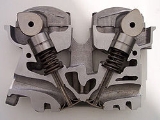
Dohc Zylinderkopf Schnitt
Overhead camshaft, commonly abbreviated to OHC, valvetrain
Valvetrain

A traditional reciprocating internal combustion engine uses valves to control air and fuel flow into and out of the cylinders, facilitating combustion....
 configurations place the engine camshaft
Camshaft

The camshaft is an apparatus often used in piston engines to operate poppet valves. It consists of a cylindrical rod running the length of the cylinder bank with a number of oblong lobes or cams protruding from it, one for each valve....
 within the cylinder head
Cylinder head

In an internal combustion engine, the cylinder head sits above the Cylinder and consists of a platform containing part of the combustion chamber and the location of the poppet valves and spark plugs....
s, above the combustion chamber
Combustion chamber

A combustion chamber is the part of an engine in which fuel is burned....
s, and drive the valves
Poppet valve

A poppet valve is a valve consisting of a hole, usually round or oval, and a tapered plug, usually a disk shape on the end of a shaft also called a valve stem....
 or lifter
Tappet

A tappet in mechanical engineering is a projection which imparts a linear motion to some other component within an assembly. Properly speaking, a tappet is only that part of a rocker arm which makes contact with an intake or exhaust poppet valve stem above the cylinder head of an internal combustion engine....
s in a more direct manner compared to overhead valve
Overhead valve

An overhead valve engine, also called pushrod engine or I-head engine is a type of piston engine that places the camshaft in the cylinder block and uses pushrods or rods to actuate rocker arm above the cylinder head to actuate the poppet valve....
s (OHV) and pushrods.

Compared to OHV pushrod (or I-Head) systems with the same number of valves the reciprocating components of the OHC system are fewer and have a lower total mass. Though the system that drives the cams may become more complex, most engine manufacturers easily accept that added complexity in trade for better engine performance and greater design flexibility. Another performance advantage is gained as a result of the better optimized port configurations made possible with overhead camshaft designs. With no intrusive pushrods the overhead camshaft cylinder head design can use straighter ports of more advantageous crossection and length.

The OHC system can be driven using the same methods as an OHV system, which include using a rubber/kevlar toothed timing belt
Timing belt

A timing belt, timing chain or cam belt is connected to the block of the engine and is a part of an internal combustion engine that controls the timing of the engine's poppet valve....
, chain
Roller chain

Roller chain or bush roller chain is the type of chain most commonly used for transmission of Power_transmission#Mechanical_power on bicycles, motorcycles, and in industrial and agricultural machinery....
, or in less common cases, gears.

Many OHC engines today employ variable valve timing
Variable valve timing

Variable valve timing, or VVT, is a generic term for an automobile piston engine technology. VVT allows the lift, duration or timing of the intake or exhaust Poppet valve to be changed while the engine is in operation....
 and multiple valves
Multi-valve

In automotive engineering, an engine is referred to as multi-valve when each cylinder has more than two poppet valve. Such designs have been around since at least 1912 and perhaps earlier....
 to improve efficiency and power. OHC also inherently allows for greater engine speeds over comparable cam-in-block designs.

There are two overhead camshaft layouts:
  • Single overhead camshaft - or SOHC
  • Dual overhead camshaft - or DOHC


Single overhead camshaft

Single overhead camshaft (SOHC) is a design in which one camshaft is placed within the cylinder head
Cylinder head

In an internal combustion engine, the cylinder head sits above the Cylinder and consists of a platform containing part of the combustion chamber and the location of the poppet valves and spark plugs....
. In an inline engine this means there is one camshaft in the head, while in a V engine
V engine

A V engine is a common engine configuration for an internal combustion engine. The Cylinder_%28engine%29 and pistons are aligned, in two separate planes, so that they appear to be in a "V" when viewed along the axis of the crankshaft....
 or a horizontally-opposed engine (boxer; flat engine
Flat engine

A flat engine is an internal combustion engine with pistons that are all relatively horizontal. A straight engine canted 90 degrees from straight up is a flat engine, as is one in which the cylinder s are arranged in two banks on either side of a single crankshaft....
) there are two camshafts: one per cylinder bank.

The SOHC design has less reciprocating mass than a comparable pushrod design. This allows for higher engine speeds, which in turn will increase power output for a given torque
Torque

Torque is the tendency of a force to rotate an object about an axis . Just as a force is a push or a pull, a torque can be thought of as a twist....
. The cam operates the valves directly or through a rocker arm
Rocker arm

Generally referred to within the internal combustion engine of automotive, marine, motorcycle and reciprocating aviation engines, the rocker arm is a reciprocating lever that conveys radial movement from the cam lobe into linear movement at the poppet valve to open it....
, as opposed to overhead valve pushrod engines which have tappets, long pushrods, and rocker arms to transfer the movement of the lobes on the camshaft in the engine block to the valves in the cylinder head
Cylinder head

In an internal combustion engine, the cylinder head sits above the Cylinder and consists of a platform containing part of the combustion chamber and the location of the poppet valves and spark plugs....
.

SOHC designs offer reduced complexity compared to pushrod designs when used for multi-valve heads in which each cylinder has more than two valves. An example of a SOHC design using shim and bucket valve adjustment was the engine installed in the Hillman Imp
Hillman Imp

The Hillman Imp is a compact, rear-engined sedan that was manufactured under the Hillman marque by the Rootes from 1963 to 1976. An estate version known as the Hillman Husky was produced from 1967....
 (4 cylinder, 8 valve); a small, early 1960s 2-door saloon car with a rear mounted alloy engine based on the Coventry Climax FWMA
Coventry Climax

Coventry Climax was a United Kingdom Forklift, fire pump, and speciality engine manufacturer....
 race engines. Exhaust and inlet manifolds were both on the same side of the engine block (thus not a crossflow cylinder head
Crossflow cylinder head

A crossflow cylinder head is a cylinder head that features the intake manifold and exhaust manifold ports on opposite sides. The gases can be thought to flow across the head....
 design). This did, however, offer excellent access to the spark plugs.

In the early 1980s, Toyota and Volkswagen
Volkswagen

Volkswagen Passenger Cars, also known as VW, is an automobile manufacturer based in Wolfsburg, Germany and is the original as well as the largest brand by sales volume within the Volkswagen Group....
 also used a directly actuated, SOHC parallel valve configuration with two valves for each cylinder. The Toyota system used hydraulic tappet
Tappet

A tappet in mechanical engineering is a projection which imparts a linear motion to some other component within an assembly. Properly speaking, a tappet is only that part of a rocker arm which makes contact with an intake or exhaust poppet valve stem above the cylinder head of an internal combustion engine....
s while the Volkswagen system used bucket tappet
Tappet

A tappet in mechanical engineering is a projection which imparts a linear motion to some other component within an assembly. Properly speaking, a tappet is only that part of a rocker arm which makes contact with an intake or exhaust poppet valve stem above the cylinder head of an internal combustion engine....
s with shims for valve lash adjustment. Of all valvetrain systems, this is the least complex configuration possible.

Dual overhead camshaft

Suzuki Gs550 Dohc
A double overhead camshaft valve train layout is characterized by two camshafts located within the cylinder head, one operating the inlet valves and one operating the exhaust valves. Some engines have more than one bank of cylinder heads (V8 and flat-four being two well-known examples) and these have more than two camshafts in total, but they remain DOHC. The term "twin cam" is imprecise, but will normally refer to DOHC engine valves, but are necessary for more than two valves that are directly actuated (though still usually via tappets). Not all DOHC engines are multivalve engines—DOHC was common in two valve per cylinder heads for decades before multivalve heads appeared. Today, however, DOHC is synonymous with multi-valve heads since almost all DOHC engines have between three and five valves per cylinder.

History

1933 Bugatti Type 59 Grand Prix Engine
Among the early pioneers of DOHC were Isotta Fraschini's Giustino Cattaneo, Austro-Daimler
Austro-Daimler

Austro-Daimler was an Austrian automaker company, from 1899 until 1934. It was subsidiary of the Germany Daimler Motoren Gesellschaft ....
's Ferdinand Porsche
Ferdinand Porsche

Prof. Dr. Ing h.c. Ferdinand Porsche was an Austria-Hungary automotive engineering. He is best known for creating the Volkswagen Beetle as well as the first of many Porsche automobiles, and for his contributions to advanced German tank designs: Tiger I, Tiger II and the Elefant....
 Stephen Tomczak (in the Prinz Heinrich), and W. O. Bentley
W. O. Bentley

Walter Owen Bentley Order of the British Empire was the founder of Bentley. He was often known as W. O. Bentley or just "W.O."...
 (in 1919); Sunbeam
Sunbeam Car Company

Sunbeam was a marque registered by John Marston Co. Ltd of Wolverhampton, England, in 1888. The company first made bicycles, then motorcycles and cars from the late 19th century to circa 1936, and applied the marque to all three forms of transportation....
 built small numbers between 1921 and 1923. The first DOHC engines were two- or four-valve per cylinder designs from companies like Fiat
Fiat

Fiat S.p.A. Fiat based cars are constructed all around the world?the largest concern outside Italy is in Brazil . It also has factories in Argentina and Poland....
 (1912), Peugeot
Peugeot

Peugeot is a major France automobile brand, part of PSA Peugeot Citro?n. Its parent company PSA Peugeot Citro?n is the second largest carmaker in Europe, behind Volkswagen....
 Grand Prix (1913, 4 valve), Alfa Romeo
Alfa Romeo

Alfa Romeo Automobiles S.p.A. is an Italian automaker founded on 24 June 1910 in Milan. Alfa Romeo has been a part of the Fiat Group since 1986....
 GP
Alfa Romeo Grand Prix

A.L.F.A. 40/60 GP or GP was a fully working early racing car prototype made by the company now called Alfa Romeo. Only one example was built in 1914, which was later modified in 1921....
 (1914, 4 valve) and 6C
Alfa Romeo 6C

The Alfa Romeo 6C name was used on road, race and sports cars made between 1925?1954 by Alfa Romeo. 6C refers to a straight 6 engine. Bodies to these cars were made by coachbuilders such as James Young , Zagato, Carrozzeria Touring, Carrozzeria Castagna, and Pininfarina....
 (1925), Maserati
Maserati

Maserati is an Italy manufacturer of automobile racing and sports cars, established on December 1, 1914, in Bologna. The company's headquarters are now in Modena, and its emblem is a trident....
 Tipo 26 (1926), Bugatti
Bugatti

Bugatti was founded in Molsheim, France, as a car maker by Ettore Bugatti, an Italian people man described as an eccentric genius.The original company is legendary for producing some of the most exclusive cars in the world as well as some of the fastest....
 Type 51
Bugatti Type 51

The Type 51 series succeeded the famous Bugatti Type 35 as Bugatti's premier racing car for the 1930s. Unlike the dominant Type 35s of the prior decade, the Type 51 were unable to compete with the government-supported Germany and Italy offerings....
 (1931), and Audi
Audi

AUDI AG, is a Germany car manufacturer which produces cars under the Audi brand, . The name Audi is based on a latin translation of the last name of the founder August "Horch", itself the German word for ?hear." Another explanation for the origin of the name is as an acronym for ?Auto Union Deutschland Ingolstadt."...
. Most Ferrari
Ferrari

Ferrari S.p.A. is an Italian sports car manufacturer based in Maranello, Italy. Founded by Enzo Ferrari in 1928 as Scuderia Ferrari, the company sponsored drivers and manufactured race cars before moving into production of street-legal vehicles in 1947 as Ferrari Joint stock company....
s used two-valve DOHC engines as well.

When DOHC technology was introduced in mainstream vehicles, it was common for it to be heavily advertised. While used at first in limited production and sports cars, Fiat
Fiat

Fiat S.p.A. Fiat based cars are constructed all around the world?the largest concern outside Italy is in Brazil . It also has factories in Argentina and Poland....
 is credited as the first car company to use a belt-driven DOHC engine across their complete product line, in the mid-1960s., although Jaguar's XK6 DOHC engine was displayed in the Jaguar XK120 at the London Motor Show in 1948 and used across the whole Jaguar range through the late 1940s, 1950 and 1960s.

More than two overhead camshafts are not known to have been tried in a production engine. However MotoCzysz
Motoczysz

MotoCzysz is a Portland, Oregon, based motorcycle company that intends to compete in the MotoGP. The C1 prototype has an engine with perfect balance that did not need to make use of a balance shaft....
 has designed a motorcycle engine with a triple overhead camshaft configuration with the intake ports descending through the head to two central intake ports between two outside exhaust camshafts actuating one of two exhaust valve per cylinder each.

See also

  • Valvetrain
    Valvetrain

    A traditional reciprocating internal combustion engine uses valves to control air and fuel flow into and out of the cylinders, facilitating combustion....
  • Overhead valve
    Overhead valve

    An overhead valve engine, also called pushrod engine or I-head engine is a type of piston engine that places the camshaft in the cylinder block and uses pushrods or rods to actuate rocker arm above the cylinder head to actuate the poppet valve....
  • Cam-in-block
    Cam-in-block

    The cam-in-block valvetrain layout of piston engines is one where the camshaft is placed within the cylinder block, usually beside and slightly above the crankshaft in a straight engine or directly above the crankshaft in the V of a V engine....
  • Camless
    Camless

    Most piston engines today employ a camshaft to operate poppet valves. This normally consists of one or more camshaft parallel to the crankshaft with a number of oblong lobes or cams protruding from it, one for each valve....


External links