
All Topics  
Manual transmission

 
Manual Transmission

   Email Print
   Bookmark   Link


Manual transmission


A manual transmission (also known as a stick shift, 'manual', 'stick', 'straight drive', or standard transmission) is a type of transmission
Transmission (mechanics)

Using the principle of mechanical advantage, transmissions provide a speed-torque conversion from a higher speed motor to a slower but more forceful output or vice-versa....
 used in automotive applications. It generally utilizes a driver-operated clutch
Clutch

A clutch is a mechanism for transmitting rotation, which can be engaged and disengaged. Clutches are useful in devices that have two rotating shafts....
 operated by a pedal or lever, for regulating torque transfer from the engine to the transmission, and a gear-shift either operated by hand (as on a car) or by foot (as on a motorcycle).


Discussion
Ask a question about 'Manual transmission'
Start a new discussion about 'Manual transmission'
Answer questions from other users
Full Discussion Forum


Encyclopedia


A manual transmission (also known as a stick shift, 'manual', 'stick', 'straight drive', or standard transmission) is a type of transmission
Transmission (mechanics)

Using the principle of mechanical advantage, transmissions provide a speed-torque conversion from a higher speed motor to a slower but more forceful output or vice-versa....
 used in automotive applications. It generally utilizes a driver-operated clutch
Clutch

A clutch is a mechanism for transmitting rotation, which can be engaged and disengaged. Clutches are useful in devices that have two rotating shafts....
 operated by a pedal or lever, for regulating torque transfer from the engine to the transmission, and a gear-shift either operated by hand (as on a car) or by foot (as on a motorcycle). Other types of transmission in mainstream automotive use are the automatic transmission
Automatic transmission

An automatic transmission is an automobile gearbox that can change gear ratios automatically as the vehicle moves, freeing the driver from having to shift gears manual transmission....
, semi-automatic transmission
Semi-automatic transmission

A semi-automatic transmission is a system which uses electronic sensors, processors and actuators to do gear shifts on the command of the driving....
, and the continuously variable transmission
Continuously variable transmission

A continuously variable transmission is a Transmission which can change steplessly through an infinite number of effective gear ratios between maximum and minimum values....
.

Overview


Manual transmissions often feature a driver
Driving

Driving is the controlled operation of a land vehicle, such as a automobile, truck or bus. Although direct operation of a bicycle, a mounted animal or a motorcycle is commonly called riding, such operators are usually legally considered to be drivers and are required to obey the rules of the road which apply to all drivers....
-operated clutch
Clutch

A clutch is a mechanism for transmitting rotation, which can be engaged and disengaged. Clutches are useful in devices that have two rotating shafts....
 and a movable gear selector. Most automobile manual transmissions allow the driver to select any forward gear at any time, but some, such as those commonly mounted on motorcycle
Motorcycle

A motorcycle is a Single track, two-wheeled motor vehicle powered by an Motorcycle engine. Motorcycles vary considerably depending on the task for which they are designed, such as Touring motorcycle travel, navigating Naked bike, Cruiser , Motorcycle sport and Motorbike racing, or off-road conditions....
s and some types of racing cars, only allow the driver to select the next-higher or next-lower gear ratio
Gear ratio

The gear ratio is the relationship between the number of teeth on two gears that are meshed or two sprockets connected with a common roller chain, or the circumferences of two pulleys connected with a drive belt ....
. This second type of transmission is sometimes called a sequential manual transmission
Sequential manual transmission

A sequential manual transmission is a type of manual transmission used on motorcycles and high-performance cars or auto racing, where gears are selected in order, and direct access to specific gears is not possible....
.

Manual transmissions are characterized by gear ratios that are selectable by locking selected gear pairs to the output shaft inside the transmission. Conversely, most automatic transmission
Automatic transmission

An automatic transmission is an automobile gearbox that can change gear ratios automatically as the vehicle moves, freeing the driver from having to shift gears manual transmission....
s feature epicyclic
Epicyclic gearing

Epicyclic gearing or planetary gearing is a gear system that consists of one or more outer gears, or planet gears, revolving about a central, or sun gear....
 (planetary
Epicyclic gearing

Epicyclic gearing or planetary gearing is a gear system that consists of one or more outer gears, or planet gears, revolving about a central, or sun gear....
) gearing controlled by brake bands and/or clutch packs to select gear ratio. Automatic transmission
Automatic transmission

An automatic transmission is an automobile gearbox that can change gear ratios automatically as the vehicle moves, freeing the driver from having to shift gears manual transmission....
s that allow the driver to manually select the current gear are called semi-automatic transmission
Semi-automatic transmission

A semi-automatic transmission is a system which uses electronic sensors, processors and actuators to do gear shifts on the command of the driving....
s.

Contemporary automotive manual transmissions are generally available with four to six forward gears and one reverse gear, although manual transmissions have been built with as few as two and as many as eight gears. Tractor unit
Tractor unit

A tractor unit, traction unit, road tractor or prime mover is a heavy-duty vehicle, usually with a large diesel engine and several axles....
s have at least 10 gears and as many as 24. Some manuals are referred to by the number of forward gears they offer (e.g., 5-speed) as a way of distinguishing between automatic or other available manual transmissions. Similarly, a 5-speed automatic transmission is referred to as a 5-speed automatic.

Unsynchronized transmission


The earliest form of the manual transmission is thought to have been invented by Louis-René Panhard and Emile Levassor in the late 19th century. This type of transmission offered multiple gear ratios and, in most cases, reverse. The gears were engaged by sliding them (or dog clutch
Dog clutch

A dog clutch is a type of clutch that couples two rotating shafts or other rotating components not by friction but by interference. The two parts of the clutch are designed such that one will push the other, causing both to rotate at the same speed and will never slip....
es) on their shafts—hence the term "shifting gears," which required a lot of careful timing and throttle
Throttle

A throttle is the mechanism by which the flow of a fluid is managed by constriction or obstruction. An engine's power can be increased or decreased by the restriction of inlet gases ....
 manipulation when shifting, so that the gears would be spinning at roughly the same speed when engaged; otherwise, the teeth would refuse to mesh.

When upshifting, the speed of the gear driven by the engine had to drop to match the speed of the next gear; as this happened naturally when the clutch
Clutch

A clutch is a mechanism for transmitting rotation, which can be engaged and disengaged. Clutches are useful in devices that have two rotating shafts....
 was depressed or disengaged, it was just a matter of skill and experience to hear and feel when the gears managed to mesh. However, when downshifting, the gear driven by the engine had to be sped up to mesh with the output gear, requiring letting the clutch up (engagement) for the engine to speed up the gears. Double-clutching
Double clutch

A double clutch is a driving procedure primarily used for vehicles with an manual transmission#Unsynchronized transmission.In a gearbox with neutral between each gear, a typical shift actually involves two gear changes, once into neutral, and again into the next gear....
, that is, shifting once to neutral to speed up the gears and again to the lower gear, is sometimes needed. In fact, such transmissions are often easier to shift without using the clutch at all. When using this method, the driver has to time the shift with relative precision to avoid grinding the gears. The clutch, in these cases, is only used for starting from a standstill. This procedure is common in racing vehicles and most production motorcycles.

Even though automotive transmissions are now almost universally synchronised, heavy truck
Truck

File:Red truck USA.JPGA truck is a type of motor vehicle commonly used for carrying goods and materials. Some light trucks are relatively small, similar in size to a passenger automobile....
s and machinery as well as dedicated racing transmissions are usually not; such transmissions are colloquially referred to as "crashboxes." Non-synchronized designs are used for several reasons. The friction material, such as brass
Brass

Brass is any alloy of copper and zinc; the proportions of zinc and copper can be varied to create a range of brasses with varying properties. In comparison, bronze is principally an alloy of copper and tin....
, in synchronizers is more prone to wear and breakage than gears, which are forged steel, and the simplicity of the mechanism improves reliability and reduces cost. In addition, the process of shifting a synchromesh transmission is slower than that of shifting a non-synchromesh transmission. For racing of production-based transmissions, sometimes half the teeth (or "dogs
Dog (engineering)

A dog is a tool that prevents movement or imparts movement by offering physical obstruction or engagement of some kind. It may hold another object in place by blocking it, clamping it, or otherwise obstructing its movement....
") on the synchros are removed to speed the shifting process, at the expense of greater wear.

Heavy duty trucks utilize unsynchronized transmissions in the interest of saving weight. Military edition trucks, which do not have to obey weight laws, usually have a synchronized transmission. Highway use heavy-duty trucks in the United States are limited to 80,000 pounds GVWR, and the lighter the curb weight for the truck, the more cargo can be carried, and with a synchronizer adding weight to a truck that could otherwise be used to carry cargo, most drivers are simply taught how to double clutch, initially, and then most eventually gravitate to shifting without the clutch.

Similarly, most modern motorcycles still utilize unsynchronized transmissions as synchronizers are generally not necessary or desirable. Their low gear inertias and higher strengths mean that forcing the gears to alter speed is not damaging, and the selector method on modern motorcycles (pedal operated) is not conducive to having the long shift time
Shift time

Shift time refers to the time interval between gear changes in a transmission during which Motive power delivery is interrupted. This is usually in reference to motor vehicles but can apply to any gearbox....
 of a synchronized gearbox. Because of this, it is still necessary to synchronize gear speeds by blipping the throttle when shifting into a lower gear on a motorcycle.

Synchronized transmission


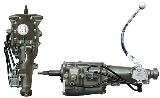
Ford Design 3 Speed Od Transmission W
Modern gearboxes are constant mesh, i.e., all input and drive gears are always in mesh. Only one of these meshed pairs of gears is locked to the shaft on which it is mounted at any one time, while the others are allowed to rotate freely. This greatly reduces the skill required to shift gears.

Most modern cars are fitted with a synchronized gear box, although it is entirely possible to construct a constant mesh gearbox without a synchromesh, as found in a motorcycle, for example. In a constant mesh gearbox, the transmission gears are always in mesh and rotating, but the gears are not rigidly connected to the shafts on which they rotate. Instead, the gears can freely rotate or be locked to the shaft on which they are carried. The locking mechanism for any individual gear consists of a collar (or "dog collar
Dog clutch

A dog clutch is a type of clutch that couples two rotating shafts or other rotating components not by friction but by interference. The two parts of the clutch are designed such that one will push the other, causing both to rotate at the same speed and will never slip....
") on the shaft which is able to slide sideways so that teeth (or "dogs") on its inner surface bridge two circular rings with teeth on their outer circumference: one attached to the gear, one to the shaft (one collar typically serves for two gears; sliding in one direction selects one transmission speed, in the other direction selects the other). When the rings are bridged by the collar, that particular gear is rotationally locked to the shaft and determines the output speed of the transmission.

In a synchromesh gearbox, to correctly match the speed of the gear to that of the shaft as the gear is engaged, the collar initially applies a force to a cone-shaped brass clutch attached to the gear, which brings the speeds to match prior to the collar locking into place. The collar is prevented from bridging the locking rings when the speeds are mismatched by synchro rings (also called blocker rings or balk rings, the latter being spelled "baulk" in the UK). The gearshift lever manipulates the collars using a set of linkage
Linkage

Linkage generally means "the manner or style of being united", and can refer to:*Genetic linkage*Linkage *Linkage *Linkage *Linkage *Linkage ...
s, so arranged so that one collar may be permitted to lock only one gear at any one time; when "shifting gears," the locking collar from one gear is disengaged and that of another engaged. In a modern gearbox, the action of all of these components is so smooth and fast it is hardly noticed.

The modern cone system was developed by Porsche
Porsche

Porsche SE or Porsche is a Germany automotive industry of luxury vehicle automobiles, which is majority-owned by the Porsche family and Pi?ch families....
 and introduced in the 1952 Porsche 356
Porsche 356

The Porsche 356 was the company's first production automobile. It was a lightweight and nimble handling rear-engine rear-wheel-drive 2 door sports car available in hardtop and convertible configurations....
; cone synchronizers were called "Porsche-type" for many years after this. In the early 1950s only the second-third shift was synchromesh in most cars, requiring only a single synchro and a simple linkage; drivers' manuals in cars suggested that if the driver needed to shift from second to first, it was best to come to a complete stop then shift into first and start up again. With continuing sophistication of mechanical development, however, fully synchromesh transmissions with three speeds, then four speeds, and then five speeds, became universal by the 1980s. Many modern manual transmission cars, especially sports cars, now offer six speeds.

Reverse gear, however, is usually not synchromesh, as there is only one reverse gear in the normal automotive transmission and changing gears while moving into reverse is not required. (The obvious exception to this is in cars made by Lamborghini
Lamborghini

Automobili Lamborghini S.p.A., commonly referred to as Lamborghini, is an Italy manufacturer of sports cars, based in the small Italian village of Sant'Agata Bolognese, near Bologna....
, almost all of whose models have synchromesh on reverse gear) Another car that has synchromesh in reverse is the Mercedes 190 2.3-16.

Internals


Shafts

Like other transmissions, a manual transmission has several shafts with various gears and other components attached to them. Typically, a rear-wheel-drive transmission has three shafts: an input shaft, a countershaft and an output shaft. The countershaft is sometimes called a layshaft.

In a rear-wheel-drive transmission, the input and output shaft lie along the same line, and may in fact be combined into a single shaft within the transmission. This single shaft is called a mainshaft. The input and output ends of this combined shaft rotate independently, at different speeds, which is possible because one piece slides into a hollow bore in the other piece, where it is supported by a bearing. Sometimes the term mainshaft refers to just the input shaft or just the output shaft, rather than the entire assembly.

In some transmissions, it's possible for the input and output components of the mainshaft to be locked together to create a 1:1 gear ratio, causing the power flow to bypass the countershaft. The mainshaft then behaves like a single, solid shaft, a situation referred to as direct drive.

Even in transmissions that do not feature direct drive, it's an advantage for the input and output to lie along the same line, because this reduces the amount of torsion
Torsion (mechanics)

In solid mechanics, torsion is the twisting of an object due to an applied torque. In circular sections, the resultant shear stress is perpendicular to the radius....
 that the transmission case has to bear.

Under one possible design, the transmission's input shaft has just one pinion gear, which drives the countershaft. Along the countershaft are mounted gears of various sizes, which rotate when the input shaft rotates. These gears correspond to the forward speeds and reverse. Each of the forward gears on the countershaft is permanently meshed with a corresponding gear on the output shaft. However, these driven gears are not rigidly attached to the output shaft: although the shaft runs through them, they spin independently of it, which is made possible by bearings in their hubs. Reverse is typically implemented differently, see the section on Reverse
Manual transmission

A manual transmission is a type of Transmission used in automotive applications. It generally utilizes a driver-operated clutch operated by a pedal or lever, for regulating torque transfer from the engine to the transmission, and a gear-shift either operated by hand or by foot ....
.

Most front-wheel-drive transmissions for transverse engine mounting are designed differently. For one thing, they have an integral final drive and differential. For another, they usually have only two shafts; input and countershaft, sometimes called input and output. The input shaft runs the whole length of the gearbox, and there is no separate input pinion. At the end of the second (counter/output) shaft is a pinion gear that mates with the ring gear on the differential.

Front-wheel and rear-wheel-drive transmissions operate similarly. When the transmission is in neutral, and the clutch is disengaged, the input shaft, clutch disk and countershaft can continue to rotate under their own inertia. In this state, the engine, the input shaft and clutch, and the output shaft all rotate independently.

Dog clutch

The gear selector does not engage or disengage the actual gear teeth which are permanently meshed. Rather, the action of the gear selector is to lock one of the freely spinning gears to the shaft that runs through its hub. The shaft then spins together with that gear. The output shaft's speed relative to the countershaft is determined by the ratio of the two gears: the one permanently attached to the countershaft, and that gear's mate which is now locked to the output shaft.

Locking the output shaft with a gear is achieved by means of a dog clutch
Dog clutch

A dog clutch is a type of clutch that couples two rotating shafts or other rotating components not by friction but by interference. The two parts of the clutch are designed such that one will push the other, causing both to rotate at the same speed and will never slip....
 selector. The dog clutch is a sliding selector mechanism which is splined to the output shaft, meaning that its hub has teeth that fit into slots (splines) on the shaft, forcing it to rotate with that shaft. However, the splines allow the selector to move back and forth on the shaft, which happens when it is pushed by a selector fork that is linked to the gear lever. The fork does not rotate, so it is attached to a collar bearing on the selector. The selector is typically symmetric: it slides between two gears and has a synchromesh and teeth on each side in order to lock either gear to the shaft.the gear selector

Synchromesh

If the teeth, the so-called dog teeth, make contact with the gear, but the two parts are spinning at different speeds, the teeth will fail to engage and a loud grinding sound will be heard as they clatter together. For this reason, a modern dog clutch in an automobile has a synchronizer mechanism or synchromesh, which consists of a cone clutch and blocking ring. Before the teeth can engage, the cone clutch
Cone clutch

A cone clutch serves the same purpose as a disk or plate clutch. However, instead of mating two spinning disks, the cone clutch uses two conical surfaces to transmit torque by friction....
 engages first which brings the selector and gear to the same speed using friction. Moreover, until synchronization occurs, the teeth are prevented from making contact, because further motion of the selector is prevented by a blocker (or "baulk") ring. When synchronization occurs, friction on the blocker ring is relieved and it twists slightly, bringing into alignment certain grooves and notches that allow further passage of the selector which brings the teeth together. Of course, the exact design of the synchronizer varies from manufacturer to manufacturer.

The synchronizer has to change the momentum of the entire input shaft and clutch disk. Additionally, it can be abused by exposure to the momentum and power of the engine itself, which is what happens when attempts are made to select a gear without fully disengaging the clutch. This causes extra wear on the rings and sleeves, reducing their service life. When an experimenting driver tries to "match the revs" on a synchronized transmission and force it into gear without using the clutch, the synchronizer will make up for any discrepancy in RPM. The success in engaging the gear without clutching can deceive the driver into thinking that the RPM of the layshaft and transmission were actually exactly matched. Nevertheless, approximate "rev-matching" with clutching can decrease the general delta between layshaft and transmission and decrease synchro wear.

Reverse

The previous discussion normally applies only to the forward gears. The implementation of the reverse gear is usually different, implemented in the following way to reduce the cost of the transmission. Reverse is also a pair of gears: one gear on the countershaft and one on the output shaft. However, whereas all the forward gears are always meshed together, there is a gap between the reverse gears. Moreover, they are both attached to their shafts: neither one rotates freely about the shaft. What happens when reverse is selected is that a small gear, called an idler gear
Gear ratio

The gear ratio is the relationship between the number of teeth on two gears that are meshed or two sprockets connected with a common roller chain, or the circumferences of two pulleys connected with a drive belt ....
 or reverse idler, is slid between them. The idler has teeth which mesh with both gears, and thus it couples these gears together and reverses the direction of rotation without changing the gear ratio.

Thus, in other words, when reverse gear is selected, in fact it is actual gear teeth that are being meshed, with no aid from a synchronization mechanism. For this reason, the output shaft must not be rotating when reverse is selected: the car must be stopped. In order that reverse can be selected without grinding even if the input shaft is spinning inertially, there may be a mechanism to stop the input shaft from spinning. The driver brings the vehicle to a stop, and selects reverse. As that selection is made, some mechanism in the transmission stops the input shaft. Both gears are stopped and the idler can be inserted between them. There is a clear description of such a mechanism in the Honda Civic
Honda Civic

The Honda Civic is a line of subcompact car/compact cars manufactured by Honda. In the United States of America, the Civic is the second-longest continuously-running nameplate from a Japanese manufacturer; only the Toyota Corolla, introduced in 1968, has been in production longer....
 1996-1998 Service Manual, which refers to it as a "noise reduction system":

Whenever the clutch pedal
Automobile pedal

An automobile may have two to four foot pedals. The arrangement is the same for both right- and left-hand traffic. From left to right* normally operated by the left foot:...
 is depressed to shift into reverse, the mainshaft continues to rotate because of its inertia. The resulting speed difference between mainshaft and reverse idler gear produces gear noise [grinding]. The reverse gear noise reduction system employs a cam plate which was added to the reverse shift holder. When shifting into reverse, the 5th/reverse shift piece, connected to the shift lever, rotates the cam plate. This causes the 5th synchro set to stop the rotating mainshaft. (13-4)


A reverse gear implemented this way makes a loud whining sound, which is not heard in the forward gears. The teeth on the forward gears of consumer automobiles are helically cut. When helical gears
Gear

A gear is a component within a Transmission device that transmits rotational force to another gear or device. A gear is different from a pulley in that a gear is a round wheel that has linkages that mesh with other gear teeth, allowing force to be fully transferred without slippage....
 rotate, their teeth slide together, which results in quiet operation. In spite of all forward gears being always meshed, they do not make a sound that can be easily heard above the engine noise. By contrast, reverse gears are spur gear
Gear

A gear is a component within a Transmission device that transmits rotational force to another gear or device. A gear is different from a pulley in that a gear is a round wheel that has linkages that mesh with other gear teeth, allowing force to be fully transferred without slippage....
s, meaning that they have straight teeth, in order to allow for the sliding engagement of the idler, which would not be possible with helical gears. The teeth of spur gears clatter together when the gears spin, generating a characteristic whine.

It is clear that the spur gear design of reverse gear represents some compromises—less robust, unsynchronized engagement and loud noise—which are acceptable due to the relatively small amount of driving that takes place in reverse. However, many modern transmissions now include a reverse gear synchronizer and helical gearing.

Design variations


Gear variety
Manual transmissions in passenger vehicles are often equipped with 4, 5, or more recently 6 forward gears in conventional manual transmissions with a gear stick, and up to 7 forward gears in semi-automatic transmissions. Nearly all have one reverse gear. In three or four speed transmissions, in most cases, the topmost gear is "direct", i.e., a 1:1 ratio. For five speed or higher transmissions, the highest gear is usually an overdrive
Overdrive (mechanics)

Overdrive can refer to two different things.An overdrive is a device which was commonly used in automobiles to allow the choice of an extra-high overall gear ratio for high speed cruising, thus fuel efficiency, at the cost of less torque....
 gear, with a ratio of less than 1:1. Older cars were generally equipped with 3-speed transmissions, or 4-speed transmissions for high performance models and 5-speeds for the most sophisticated of automobiles; in the 1970s, 5-speed transmissions began to appear in low priced mass market automobiles and even compact pickup trucks, pioneered by Toyota (who advertised the fact by giving each model the suffix SR5 as it acquired the fifth speed). Today, mass market automotive manual transmissions are essentially all 5-speeds, with 6-speed transmissions beginning to emerge in high performance vehicles in the early 1990s, and recently beginning to be offered on some high-efficiency and conventional passenger cars. A very small number of 7-speed 'manual-derived' transmissions are offered on high-end performance cars, such as the Bugatti Veyron 16.4, or the BMW M5. Both of these cars feature a paddle shifter".

External overdrive
On earlier models with three or four forward speeds, the lack of an overdrive ratio for relaxed and fuel-efficient highway cruising was often filled by incorporating a separate overdrive
Overdrive (mechanics)

Overdrive can refer to two different things.An overdrive is a device which was commonly used in automobiles to allow the choice of an extra-high overall gear ratio for high speed cruising, thus fuel efficiency, at the cost of less torque....
 unit in the rear housing of the transmission. This unit was separately actuated by a knob or button, often incorporated into the gearshift knob.

Shaft and gear configuration
The input shaft need not turn a pinion which rotates the countershaft. Another possibility is that gears are mounted on the input shaft itself, meshed with gears on the countershaft, in which case the countershaft then turns the output shaft. In other words, it's a matter of design on which shaft the driven and driving gears reside.

The distribution of the shifters is also a matter of design; it need not be the case that all of the free-rotating gears with selectors are on one shaft, and the permanently splined gears on the other. For instance a five speed transmission might have the first-to-second selectors on the countershaft, but the third-to-fourth selector and the fifth selector on the mainshaft, which is the configuration in the 1998 Honda Civic
Honda Civic

The Honda Civic is a line of subcompact car/compact cars manufactured by Honda. In the United States of America, the Civic is the second-longest continuously-running nameplate from a Japanese manufacturer; only the Toyota Corolla, introduced in 1968, has been in production longer....
. This means that when the car is stopped and idling in neutral with the clutch engaged input shaft spinning, the third, fourth and fifth gear pairs do not rotate.

In some transmission designs (Volvo 850 and V/S70 series, for example) there are actually two countershafts, both driving an output pinion meshing with the front-wheel-drive transaxle's ring gear. This allows the transmission designer to make the transmission narrower, since each countershaft need only be half as long as a traditional countershaft with four gears and two shifters.

Clutch

In all vehicles using a transmission (virtually all modern vehicles), a coupling device is used to separate the engine and transmission when necessary. The clutch
Clutch

A clutch is a mechanism for transmitting rotation, which can be engaged and disengaged. Clutches are useful in devices that have two rotating shafts....
 accomplishes this in manual transmissions. Without it, the engine and tires would at all times be inextricably linked, and any time the vehicle stopped the engine would stall. Without the clutch, changing gears would be very difficult, even with the vehicle moving already: deselecting a gear while the transmission is under load requires considerable force, and selecting a gear requires the revolution speed of the engine to be held at a very precise value which depends on the vehicle speed and desired gear. In a car the clutch is usually operated by a pedal
Automobile pedal

An automobile may have two to four foot pedals. The arrangement is the same for both right- and left-hand traffic. From left to right:* normally operated by the left foot:...
; on a motorcycle, a lever on the left handlebar serves the purpose.

  • When the clutch pedal is fully depressed, the clutch is fully disengaged, and no torque
    Torque

    Torque is the tendency of a force to rotate an object about an axis . Just as a force is a push or a pull, a torque can be thought of as a twist....
     is transferred from the engine to the transmission (and by extension to the drive wheels). In this uncoupled state it is possible to select gears or to stop the car without stopping the engine.
  • When the clutch pedal is fully released, the clutch is fully engaged, and practically all of the engine's torque is transferred. In this coupled state, the clutch does not slip, but rather acts as rigid coupling, and power is transmitted to the wheels with minimal practical waste heat.
  • Between these extremes of engagement and disengagement the clutch slips to varying degrees. When the clutch slips it still transmits torque despite the difference in speeds between the engine crankshaft and the transmission input. Because this torque is transmitted by means of friction rather than direct mechanical contact, considerable power is wasted as heat (which is dissipated by the clutch). Properly applied, slip allows the vehicle to be started from a standstill, and when it is already moving, allows the engine rotation to gradually adjust to a newly selected gear ratio.
  • Learning to use the clutch efficiently requires the development of muscle memory
    Muscle memory

    Muscle memory is a common term for neuromuscular facilitation, which is the process of the neuromuscular system memorizing motor skills....
     and a level of coordination analogous to that required to learn a musical instrument or to play a sport.
  • A rider of a highly-tuned motocross or off-road motorcycle may "hit" or "fan" the clutch when exiting corners to assist the engine in revving to the point where it delivers the most power.
  • Note: Automatic transmissions also use a coupling device; however, a clutch is not present. In these kinds of vehicles, the torque converter
    Torque converter

    A torque converter is a modified form of fluid coupling that is used to transfer rotating power from a Wiktionary:prime mover, such as an internal combustion engine or electric motor, to a rotating driven load....
     is used to separate the engine and transmission.


Gear selection


Floor-mounted shifter


Shift Stick
In most modern passenger cars, gears are selected by manipulating a lever connected to the transmission via linkage or cables and mounted on the floor of the automobile. This is called a gear stick, shift stick, gearshift, gear lever, gear selector, or shifter. Moving the lever forward, backward, left, and right into specific positions selects particular gears.

A sample layout of a four-speed transmission is shown below. N marks neutral, the position wherein no gears are engaged and the engine is decoupled from the vehicle's drive wheels. In reality, the entire horizontal line is a neutral position, although the shifter is usually equipped with springs so that it will return to the N position if not moved to another gear. The R marks reverse, the gear position used for moving the vehicle rearward.

This layout is called the shift pattern. Because of the shift quadrants, the basic arrangement is often called an H-pattern. The shift pattern is usually molded or printed on or near the gear knob. While the layout for gears one through four is nearly universal, the location of reverse is not. Depending on the particular transmission design, reverse may be located at the upper left extent of the shift pattern, at the lower left, at the lower right, or at the upper right. There is usually a mechanism that only allows selection of reverse from the neutral position, or a reverse blockout that must be released by depressing the spring-loaded gear knob or lifting a spring-loaded collar on the shift stick, to reduce the likelihood that reverse will be inadvertently selected by the driver.

This is the most common five-speed shift pattern:

This layout is reasonably intuitive because it starts at the upper left and works top to bottom, left to right, with reverse at the end of the sequence and toward the rear of the car.

This is another five-speed shift pattern, which can be found in BMWs, some Audis, and Volkswagens:

Dog-leg first shift patterns are used on many race cars and on older road vehicles with three-speed transmissions:

The name derives from the up-and-over path between first and second gears. Its use is common in race cars and sports cars, but is diminishing as six speed and sequential gearboxes are becoming more common. Having first gear across the dog leg is beneficial as first gear is traditionally only used for getting the car moving and hence it allows second and third gears to be aligned fore and aft of each other, which facilitates shifting between the two. As most of the gearboxes are non-syncromesh there is no appreciable delay when upshifting from first through the dog leg into second.

This gear pattern can also be found on some heavy vehicles in which first gear is an extra-low ratio for use in extreme standing-start conditions, and would see little use in normal driving.

This is a typical shift pattern for a six-speed transmission:

Though eight-speed transmissions do exist, six forward speeds is widely considered to be the maximum that can be contained within a variation of the "H" shift pattern. In such a case, Reverse is placed outside of the "H", with a canted shift path, to prevent the shift lever from intruding too far into the driver's space (in left-hand drive
Driving on the left or right

Right-hand traffic and left-hand traffic mean regulations requiring all traffic to keep either to the left or the right side of the road....
 cars) when reverse is selected. This is the most common layout for a six-speed manual transmission.

Most front-engined, rear-wheel drive cars have a transmission that sits between the driver and the front passenger seat. Floor-mounted shifters are often connected directly to the transmission. Front-wheel drive
FF layout

In automotive design, a FF, or Front-engine design, Front-wheel drive layout places both the Internal combustion engine and driven wheels at the front of the vehicle....
 and rear-engined
RR layout

In automotive design, a RR, or Rear-engine design, Rear-wheel drive layout is one which places both the Internal combustion engine and drive wheels at the rear of the vehicle....
 cars often require a mechanical linkage to connect the shifter to the transmission.

Historically, four-speed floor shifters were sometimes referred to as "Four on the floor", when steering column mounted shifters were more common.

Column-mounted shifter

Some cars have a gear lever mounted on the steering column of the car. It was common in the past but is no longer common today. However, many automatic transmissions still use this placement.

Column shifters are mechanically similar to floor shifters, although shifting occurs in a vertical plane instead of a horizontal one. Column shifters also generally involve additional linkages to connect the shifter with the transmission. Also, the pattern is not "intuitive," as the shifter has to be moved backward and upward into R to make the car go backward.

A 3-speed column shifter, nicknamed "Three on the Tree" began appearing in America in the late 1930s and became common during the 1940s and '50s. Its layout is as shown below:

First gear in a 3-speed is often called "low," while third is usually called "high." There is, of course, no overdrive. Later, European and Japanese models began to have 4-speed column shifter and some of these made their way to the USA. Its layout is shown here:

However, the column manual shifter disappeared in North America by the mid 1980s, last appearing in the 1986 Ford F-150. But in the rest of the world, the column mounted shifter remained in production, and was in fact common in some places. For example, all Toyota Crown
Toyota Crown

The Crown has evolved into a line of full-size luxury car by Toyota. The range was primarily available in Japan and some other Asian countries, originally designed to serve as a taxi....
 and Nissan Cedric
Nissan Cedric

The Nissan Cedric is a large automobile produced by Nissan Motors since 1960. It was developed to provide upscale transportation, competing with the Prince Skyline and Prince Gloria which were later merged into the Nissan family....
 taxis in Hong Kong
Taxicabs of Hong Kong

Taxicabs of Hong Kong provide a taxicab system. Most taxis are independently owned and operated, but some are owned by taxi companies, and the drivers are employees....
 had the 4-speed column shift until 1999 when automatic began to be offered. Since the late 1980s or early 1990s, 5-speed column shifter has been made in some vans sold in Asia and Europe, such as Toyota Hiace
Toyota Hiace

The Toyota Hiace is a automobile produced by the Japanese manufacturer Toyota. First launched in 1967, the Hiace has since been available in a wide range of configurations, including minivan and minibus, van, pick-up, taxicab, ambulance and motorhome....
 and Mitsubishi L400
Mitsubishi Delica

The Mitsubishi Delica is a range of multi-purpose vehicles built by Mitsubishi Motors since 1969. It was originally based on a small pickup truck introduced the previous year, also called the Delica, its name derived from the English "DELIvery CAr"....
.

Sequential manual

Some transmissions do not allow the driver to arbitrarily select any gear. Instead, the driver may only ever select the next-lowest or next-highest gear ratio. These transmissions often provide clutch control, but the clutch is only necessary when selecting first or reverse gear from neutral. Most gear changes can be performed without the clutch.

Sequential transmissions are generally controlled by a forward-backward lever, foot pedal, or set of paddles mounted behind the steering wheel. In some cases, these are connected mechanically to the transmission. In many modern examples, these controls are attached to sensors which instruct a transmission computer to perform a shift—many of these systems can be switched into an automatic mode, where the computer controls the timing of shifts, much like an automatic transmission
Automatic transmission

An automatic transmission is an automobile gearbox that can change gear ratios automatically as the vehicle moves, freeing the driver from having to shift gears manual transmission....
.

Motorcycles typically employ sequential transmissions, although the shift pattern is modified slightly for safety reasons. In a motorcycle the gears are usually shifted with the left foot pedal, the layout being this:

            6          5 +       4 +     3 +   2 + N 1

The pedal goes one step - both up and down - from the center, before it reaches its limit and has to be allowed to move back to the center position. Thus, changing multiple gears in one direction is accomplished by repeatedly pumping the pedal, either up or down. Although neutral is listed as being between first and second gears for this type of transmission, it "feels" more like first and second gear are just "further away" from each other than any other two sequential gears. Because this can lead to difficulty in finding neutral for inexperienced riders most motorcycles have a neutral indicator light on the instrument panel to help find neutral. The reason neutral does not actually have its own spot in the sequence is to make it quicker to shift from first to second when moving. You will not accidentally shift into neutral. The reason for having neutral between the first and second gears instead of at the bottom is that when stopped, the rider can just click down repeatedly and know that they will end up in first and not neutral. This may also help on a steep hill on which high torque is required. It could be disadvantageous or even dangerous to attempt to be in first without realizing it, then try for a lower gear, only to get neutral.

On motorcycles used on race tracks, the shifting pattern is often reversed, that is, the rider clicks down to upshift. This usage pattern increases the ground clearance by placing the riders foot above the shift lever when the rider is most likely to need it, namely when leaning over and exiting a tight turn.

The shift pattern for most underbone
Underbone

Underbones or Underbone Motorcycles are a class of small motorcycles based on a singular tube frame, the 'underbone' supporting the vehicle....
 motorcycles with an automatic centrifugal clutch
Centrifugal clutch

A centrifugal clutch is a clutch that uses centrifugal force to connect two concentric shafts, with the driving shaft nested inside the driven shaft....
 is also modified for two key reasons - to enable the less-experienced riders to shift the gears without problems of "finding" neutral, and also due to the greater force needed to "lift" the gearshift lever (because the gearshift pedal of an underbone motorcycle also operates the clutch). The gearshift lever of an underbone motorcycle has two ends. The rider clicks down the front end with the left toe all the way to the top gear and clicks down the rear end with the heel all the way down to neutral. Some underbone models such as the Honda Wave
Honda Wave series

Honda Wave series, also known as Honda NF series, Honda Innova , and Honda Supra is a series of small motorcycle models manufactured by Honda as a successor of the world's most popular motorcycle model, Honda Super Cub....
 have a "rotary" shift pattern, which means that the rider can shift directly to neutral from the top gear, but this is only possible when the motorcycle is stationary for safety reasons. Some models also have gear position indicators for all gear positions at the instrument panel.

Semi-manual

Some new transmissions (Alfa Romeo
Alfa Romeo

Alfa Romeo Automobiles S.p.A. is an Italian automaker founded on 24 June 1910 in Milan. Alfa Romeo has been a part of the Fiat Group since 1986....
's Selespeed gearbox and BMW
BMW

, is an independent German automotive industry founded in 1916. It also produces BMW Motorrad, is the owner of the MINI brand and is the parent company of Rolls-Royce Motor Cars....
's Sequential Manual Gearbox (SMG) for example) are conventional manual transmissions with a computerized control mechanism. These transmissions feature independently selectable gears but do not have a clutch
Clutch

A clutch is a mechanism for transmitting rotation, which can be engaged and disengaged. Clutches are useful in devices that have two rotating shafts....
 pedal. Instead, the transmission computer controls a servo
Servo

Servo may refer to:* Servomechanism, or servo, a device used to provide control of a desired operation through the use of feedback* Servo drive, a special electric amplifier used to power electric servo motors...
 which disengages the clutch when necessary.

These transmissions vary from sequential transmissions in that they still allow nonsequential shifts: BMWs SMG system, for example, can shift from 6th gear directly to 4th gear when decelerating from high speeds.

Benefits and drawbacks


Benefits

Manual transmissions generally offer better fuel economy than automatics, however the disparity has been somewhat offset with the introduction of locking torque converters on automatic transmissions. Increased fuel economy with a properly operated manual transmission vehicle versus an equivalent automatic transmission vehicle can range from 5% to about 15% depending on driving conditions and style of driving. Manual transmissions don't require active cooling, and generally weigh less than comparable automatics. The manual transmission couples the engine to the transmission with a rigid clutch instead of a torque converter
Torque converter

A torque converter is a modified form of fluid coupling that is used to transfer rotating power from a Wiktionary:prime mover, such as an internal combustion engine or electric motor, to a rotating driven load....
 which slips by nature. Manual transmissions also lack the parasitic power consumption of the automatic transmission's hydraulic pump.

Manual transmissions also generally offer a higher selection of gear ratios. Many vehicles offers a 5-speed or 6-speed manual, whereas the automatic option was a 3-speed, or (more recently) a 4-speed all the way up to an 8-speed. The higher selection of gears allowed for more uses of the engine's power band, allowing for higher fuel economy and power output. This is generally due to the space available inside of a manual transmission versus an automatic since the latter required extra equipment needed self-shifting, such as torque converters and pumps.

Manual transmissions are more efficient than conventional automatics and belt-driven continuously-variable transmissions. The driver has more direct control over the car with a manual than with an automatic, which can be employed by an experienced, knowledgeable driver who knows the correct procedure for executing a driving maneuver, and wants the vehicle to realize his or her intentions exactly and instantly. When starting forward, for example, the driver can control how much torque goes to the tires, which is useful on slippery surfaces such as ice, snow or mud. This can be done with clutch finesse, or by starting in second gear instead of first. An engine coupled with a manual transmission can often be started even if the starter
Automobile self starter

An automobile self-starter is an electric motor that initiates rotational motion in an internal combustion engine before it can power itself....
 is inoperable or defunct by the method of push start
Push start

Push starting refers to a method of starting a vehicle with an internal combustion engine by engaging the manual transmission through the motion of the vehicle....
ing. Likewise, a vehicle with a manual transmission and no clutch/starter interlock switch can be moved, if necessary, by putting it in gear and cranking the starter. This is useful when the vehicle will not start, but must be immediately moved e.g. off the road in the event of a breakdown, or in extreme off-roading cases such as an engine that has stalled due to being in too deep of water.

Drawbacks

Manual transmissions place slightly more workload on the driver in heavy traffic situations, when the driver must often operate the clutch pedal. In comparison, automatic transmissions merely require moving the foot from the accelerator pedal to the brake pedal, and vice versa. Manual transmissions require the driver to remove one hand periodically from the steering wheel while the vehicle is in motion. The smoothness and correct timing of gear shifts are wholly dependent on the driver's experience and skill; because the driver selects each gear, it is also possible to select the wrong gear. Attempting to select reverse while the vehicle is moving causes severe gear wear, and choosing a low gear with the car moving at speed can overspeed and damage the engine. There is a learning curve
Learning Curve

A learning curve in this context is a relationship of the duration or the degree of effort invested in learning and experience with the resulting progress, considered as an exploratory discovery process....
 with a manual transmission; the driver must develop a feel for properly engaging the clutch, especially when starting forward on a steep road or when parking on an incline.

Automatic transmissions can shift ratios faster than a manual gear change can be accomplished, due to the time required for the driver to push the clutch pedal to the floor and move the shifter from one position to another.

Applications and popularity

Many types of automobiles are equipped with manual transmissions. Small economy cars predominantly feature manual transmissions because they are relatively cheap and efficient, although many are or may be optionally equipped with automatics. Economy cars are also often powered by very small engines, and automatic transmissions can make them comparatively very slow, while a manual transmission makes much more efficient use of the power produced.

Sports cars are also often equipped with manual transmissions because they offer more direct driver involvement and better performance. Off-road vehicles and trucks often feature manual transmissions because they allow direct gear selection and are often more rugged than their automatic counterparts.

Conversely, manual transmissions are no longer popular in many classes of cars sold in North America and Asia, although they remain dominant in Europe. Nearly all cars are available with an automatic transmission option, and family cars and large trucks sold in the US are predominantly fitted with automatics. In Europe most cars are sold with manual transmissions. Most luxury cars are only available with an automatic transmission. In situations where automatics and manual transmissions are sold side-by-side, the manual transmission is the base equipment, and the automatic is optional—although the automatic is sometimes available at no extra cost. Some cars, such as rental cars and taxi
Taxicab

A taxicab, also taxi or cab, is a type of public transport for a single passenger, or small group of passengers, typically for a non-shared ride....
s, are nearly universally equipped with automatic transmissions in countries such as the US, but the opposite is true in Europe
Europe

Europe is, conventionally, one of the world's seven continents. Comprising the westernmost peninsula of Eurasia, Europe is generally divided from Asia to its east by the water divide of the Ural Mountains, the Ural , the Caspian Sea, and by the Caucasus Mountains to the southeast....
.. As of 2008, 75.2% of vehicles made in Western Europe were equipped with manual transmission, versus 16.1% with automatic and 8.7% with other.

In some countries, when a driver takes the licensing road test using an automatic transmission
Automatic transmission

An automatic transmission is an automobile gearbox that can change gear ratios automatically as the vehicle moves, freeing the driver from having to shift gears manual transmission....
, the resulting license is restricted to the use of automatic transmissions. This treatment of the manual transmission skill seems to maintain the widespread use of the manual transmission, as many new drivers worry that their restricted license will become an obstacle for them where most cars have manual transmissions, so they make the effort to learn with manual transmissions and obtain full licenses. Some other countries (such as Pakistan
Pakistan

Pakistan , officially the Islamic Republic of Pakistan, is a country located in South Asia and borders Central Asia and the Middle East. It has a 1,046 kilometre coastline along the Arabian Sea and Gulf of Oman in the south, and is bordered by Afghanistan and Iran in the west, India in the east and People's Republic of China in th...
 and Finland
Finland

Finland , officially the Republic of Finland , is a Nordic countries situated in the Fennoscandian region of northern Europe. It borders Sweden on the west, Russia on the east, and Norway on the north, while Estonia lies to its south across the Gulf of Finland....
) go even further, whereby the license is granted only when a test is passed on a manual transmission.

Truck transmissions


Very heavy trucks often use manual transmissions because they are efficient and, more importantly, can withstand the severe stress encountered in hauling heavy loads. Some trucks have transmissions that look and behave like ordinary car transmissions - these transmissions are used on smaller trucks and typically have up to 6 gears. Then there are range, splitter and range-splitter transmissions for larger trucks which need more gears:

  • Range transmissions work like ordinary car transmissions but have a range selector to switch between high and low range using the fingers while the palm rests on the gear lever. An 8-speed range transmission, for example, has an H shift pattern with four gears. The first through fourth gears are accessed when low range is selected. To access the fifth through eighth gears, the clutch is released, the selector moved to high range, and the gear lever again shifted through the first through fourth gear positions. In high range, the first gear position becomes fifth, the second gear position becomes sixth, and so on.


  • Splitter transmissions work similarly to range transmissions, but their range selector splits each sequential gear position in two: First gear is in first position/low range, and second gear is in first position/high range; third gear is in second position/low range, and fourth gear is in second position/high range, and so on.


  • Range-Splitter transmissions combine the range-splitting of a range transmission with the gear-splitting of a splitter transmission. This allows even more gear ratios. Both a range selector and a splitter selector are provided.


Most companies with fleets of large trucks use 10 speed non-synchronized manual transmissions, but automated manual and semi-automatic transmissions are becoming more common on heavy vehicles, particularly in the European market.

Maintenance

Because clutches use changes in friction
Friction

File:Friction alt.svgFriction is the force resisting the relative lateral motion of solid surfaces, fluid layers, or material elements in contact....
 to modulate the transfer of torque between engine and transmission, they are subject to wear in everyday use. A very good clutch, when used by an expert driver, can last hundreds of thousands of kilometres (or miles). Weak clutches, abrupt downshifting, inexperienced drivers, and aggressive driving can lead to more frequent repair or replacement.

Manual transmissions are lubricated with gear oil or engine oil in some cars, which must be changed periodically in some cars, although not as frequently as the automatic transmission fluid in a vehicle so equipped. (Some manufacturers specify that changing the gear oil is never necessary except after transmission work or to rectify a leak.)

Gear oil has a characteristic aroma due to the addition of molybdenum disulfide
Molybdenum disulfide

Molybdenum disulfide is the inorganic chemistry with the chemical formula MoS2. This black crystalline sulfide of molybdenum occurs as the mineral molybdenite....
 compounds. These compounds are used to reduce the high sliding friction by the helical gear cut of the teeth (this cut eliminates the characteristic whine of straight cut spur gears). On motorcycles with "wet" clutches (clutch is bathed in engine oil), there is usually nothing separating the lower part of the engine from the transmission, so the same oil lubricates both the engine and transmission.

See also

  • Non-synchronous transmission
    Non-synchronous transmission

    A non-synchronous transmission is a form of Transmission based on gears that do not use Synchromesh#Synchronized transmission. They are found commonly in various types of tractor, Semi-trailer truck, high performance race cars, and military vehicles....
  • Transmission (mechanics)
    Transmission (mechanics)

    Using the principle of mechanical advantage, transmissions provide a speed-torque conversion from a higher speed motor to a slower but more forceful output or vice-versa....
  • Toploader Transmission
    Toploader Transmission

    A Toploader transmission is a manually shifted three and four speed gearbox introduced in 1964 by Ford Motor Company to replace the BorgWarner T-10....
  • Freewheel
    Freewheel

    In mechanical engineering or automotive engineering, a freewheel or overrunning clutch is a device in a transmission that disengages the driveshaft from the driven shaft when the driven shaft rotates faster than the driveshaft....
  • Gear ratio
    Gear ratio

    The gear ratio is the relationship between the number of teeth on two gears that are meshed or two sprockets connected with a common roller chain, or the circumferences of two pulleys connected with a drive belt ....
  • Borg-Warner T-56
    Borg-Warner T-56

    The T-56 six speed manual transmission has been used in a wide range of vehicles from General Motors Corporation, Dodge, and Ford Motor Company....
  • Automatic transmission
    Automatic transmission

    An automatic transmission is an automobile gearbox that can change gear ratios automatically as the vehicle moves, freeing the driver from having to shift gears manual transmission....


External links

  • Manual transmission community site