

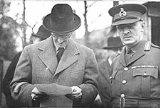
Robert Gascoyne-Cecil, 5th Marquess of Salisbury

Encyclopedia
Robert Arthur James Gascoyne-Cecil, 5th Marquess of Salisbury, KG
, PC (27 August 1893 – 23 February 1972), known as Viscount Cranborne from 1903 to 1947, was a British Conservative
politician.
, by his wife Lady Cicely, daughter of Arthur Gore, 5th Earl of Arran
. He was the grandson of Prime Minister Robert Gascoyne-Cecil, 3rd Marquess of Salisbury
.
(MP) for South Dorset in 1929, and served as Joint Parliamentary Under-Secretary of State for Foreign Affairs from 1935 to 1938, as Paymaster-General
in 1940 and as Secretary of State for Dominion Affairs
from 1940 to 1942. In 1941 he was summoned to the House of Lords
through a writ of acceleration
in his father's junior title of Baron Cecil. He was Secretary of State for the Colonies
in 1942, Lord Privy Seal
between 1942 and 1943, Leader of the House of Lords
between 1942 and 1945 and again Secretary of State for Dominion Affairs between 1943 and 1945. In 1947 he succeeded his father in the marquessate.
During the 1950s he held office under successively Winston Churchill
, Anthony Eden
, and Harold Macmillan
as Lord Privy Seal from 1951 to 1952, Leader of the House of Lords from 1951 to 1957, Secretary of State for Commonwealth Relations
in 1952 and Lord President of the Council
from 1952 to 1957.
In January 1957, Eden resigned as prime minister, and did not give advice to Queen Elizabeth II
as to who should succeed him. The two candidates were Rab Butler
and Harold Macmillan
. The Queen took advice from senior Ministers, as well as Winston Churchill
(who backed Macmillan), Edward Heath
(who as Chief Whip
was aware of backbench opinion) and from Salisbury, who interviewed the Cabinet one by one and with his famous speech impediment asked each one whether he was for "Wab or Hawold" (it is thought that only between one and three were for "Wab"). The advice was overwhelmingly to appoint Macmillan as Prime Minister instead of Butler. The media were taken by surprise by this choice, but Butler himself later confessed in his memoirs that while there was a sizeable anti-Butler faction on the backbenches, there was no such anti-Macmillan faction.
Salisbury was known as a hardline imperialist
. In 1952, as Secretary of State for Commonwealth Relations
, he tried to make permanent the exile of Seretse Khama
, kgosi of the Bamangwato
people in Bechuanaland, for marrying a white British woman. During the 1960s, Lord Salisbury continued to be a staunch defender of the white-dominated governments in South Africa
and in Southern Rhodesia
(now Zimbabwe
). He was also a fierce opponent of liberal-left attempts to reform the House of Lords, yet he created what is known as the Salisbury Convention
, whereby the House of Lords
will not oppose the second or third reading of any government legislation promised in its election manifesto. In 1961 he became the first president of the Conservative Monday Club
, a post he held until his death.
from 1951 until 1971. In 1970, students at the university staged an occupation at Senate House to demand his removal, over his support for apartheid and similarly reactionary views. He was also Chancellor of the Order of the Garter
between 1960 and 1972.
Lord Salisbury died in February 1972, aged 78, and was succeeded by his eldest and only surviving son, Robert
. Lady Salisbury died in 1982.
Order of the Garter
The Most Noble Order of the Garter, founded in 1348, is the highest order of chivalry, or knighthood, existing in England. The order is dedicated to the image and arms of St...
, PC (27 August 1893 – 23 February 1972), known as Viscount Cranborne from 1903 to 1947, was a British Conservative
Conservative Party (UK)
The Conservative Party, formally the Conservative and Unionist Party, is a centre-right political party in the United Kingdom that adheres to the philosophies of conservatism and British unionism. It is the largest political party in the UK, and is currently the largest single party in the House...
politician.
Background
Nicknamed "Bobbety", Salisbury was the eldest son of James Gascoyne-Cecil, 4th Marquess of SalisburyJames Gascoyne-Cecil, 4th Marquess of Salisbury
James Edward Hubert Gascoyne-Cecil, 4th Marquess of Salisbury, KG, GCVO, CB, PC , known as Viscount Cranborne from 1868 to 1903, was a British statesman.-Background and education:...
, by his wife Lady Cicely, daughter of Arthur Gore, 5th Earl of Arran
Arthur Gore, 5th Earl of Arran
Arthur Saunders Gore, 5th Earl of Arran KP , known as Viscount Sudley from 1839 to 1884, was an Anglo-Irish peer and diplomat....
. He was the grandson of Prime Minister Robert Gascoyne-Cecil, 3rd Marquess of Salisbury
Robert Gascoyne-Cecil, 3rd Marquess of Salisbury
Robert Arthur Talbot Gascoyne-Cecil, 3rd Marquess of Salisbury, KG, GCVO, PC , styled Lord Robert Cecil before 1865 and Viscount Cranborne from June 1865 until April 1868, was a British Conservative statesman and thrice Prime Minister, serving for a total of over 13 years...
.
Political career
Salisbury was elected to the House of Commons as Member of ParliamentMember of Parliament
A Member of Parliament is a representative of the voters to a :parliament. In many countries with bicameral parliaments, the term applies specifically to members of the lower house, as upper houses often have a different title, such as senate, and thus also have different titles for its members,...
(MP) for South Dorset in 1929, and served as Joint Parliamentary Under-Secretary of State for Foreign Affairs from 1935 to 1938, as Paymaster-General
Paymaster-General
HM Paymaster General is a ministerial position in the United Kingdom. The Paymaster General is in charge of the Office of HM Paymaster General , which held accounts at the Bank of England on behalf of Government departments and selected other public bodies...
in 1940 and as Secretary of State for Dominion Affairs
Secretary of State for Dominion Affairs
The position of Secretary of State for Dominion Affairs was a British cabinet level position created in 1925 responsible for British relations with the Dominions — Canada, Australia, New Zealand, South Africa, Newfoundland, and the Irish Free State, as well as the self-governing colony of...
from 1940 to 1942. In 1941 he was summoned to the House of Lords
House of Lords
The House of Lords is the upper house of the Parliament of the United Kingdom. Like the House of Commons, it meets in the Palace of Westminster....
through a writ of acceleration
Writ of acceleration
A writ in acceleration, commonly called a writ of acceleration, was a type of writ of summons to the British House of Lords that enabled the eldest son and heir apparent of a peer with multiple peerage titles to attend the British House of Lords or Irish House of Lords, using one of his father's...
in his father's junior title of Baron Cecil. He was Secretary of State for the Colonies
Secretary of State for the Colonies
The Secretary of State for the Colonies or Colonial Secretary was the British Cabinet minister in charge of managing the United Kingdom's various colonial dependencies....
in 1942, Lord Privy Seal
Lord Privy Seal
The Lord Privy Seal is the fifth of the Great Officers of State in the United Kingdom, ranking beneath the Lord President of the Council and above the Lord Great Chamberlain. The office is one of the traditional sinecure offices of state...
between 1942 and 1943, Leader of the House of Lords
Leader of the House of Lords
The Leader of the House of Lords is a member of the Cabinet of the United Kingdom who is responsible for arranging government business in the House of Lords. The role is always held in combination with a formal Cabinet position, usually one of the sinecure offices of Lord President of the Council,...
between 1942 and 1945 and again Secretary of State for Dominion Affairs between 1943 and 1945. In 1947 he succeeded his father in the marquessate.
During the 1950s he held office under successively Winston Churchill
Winston Churchill
Sir Winston Leonard Spencer-Churchill, was a predominantly Conservative British politician and statesman known for his leadership of the United Kingdom during the Second World War. He is widely regarded as one of the greatest wartime leaders of the century and served as Prime Minister twice...
, Anthony Eden
Anthony Eden
Robert Anthony Eden, 1st Earl of Avon, KG, MC, PC was a British Conservative politician, who was Prime Minister from 1955 to 1957...
, and Harold Macmillan
Harold Macmillan
Maurice Harold Macmillan, 1st Earl of Stockton, OM, PC was Conservative Prime Minister of the United Kingdom from 10 January 1957 to 18 October 1963....
as Lord Privy Seal from 1951 to 1952, Leader of the House of Lords from 1951 to 1957, Secretary of State for Commonwealth Relations
Secretary of State for Commonwealth Relations
The Secretary of State for Commonwealth Relations was a British Cabinet office existing between 1947 and 1966, responsible for dealing with British relationship with members of the Commonwealth of Nations . The position was created out of the old position of Secretary of State for Dominion Affairs...
in 1952 and Lord President of the Council
Lord President of the Council
The Lord President of the Council is the fourth of the Great Officers of State of the United Kingdom, ranking beneath the Lord High Treasurer and above the Lord Privy Seal. The Lord President usually attends each meeting of the Privy Council, presenting business for the monarch's approval...
from 1952 to 1957.
In January 1957, Eden resigned as prime minister, and did not give advice to Queen Elizabeth II
Elizabeth II of the United Kingdom
Elizabeth II is the constitutional monarch of 16 sovereign states known as the Commonwealth realms: the United Kingdom, Canada, Australia, New Zealand, Jamaica, Barbados, the Bahamas, Grenada, Papua New Guinea, the Solomon Islands, Tuvalu, Saint Lucia, Saint Vincent and the Grenadines, Belize,...
as to who should succeed him. The two candidates were Rab Butler
Rab Butler
Richard Austen Butler, Baron Butler of Saffron Walden, KG CH DL PC , who invariably signed his name R. A. Butler and was familiarly known as Rab, was a British Conservative politician...
and Harold Macmillan
Harold Macmillan
Maurice Harold Macmillan, 1st Earl of Stockton, OM, PC was Conservative Prime Minister of the United Kingdom from 10 January 1957 to 18 October 1963....
. The Queen took advice from senior Ministers, as well as Winston Churchill
Winston Churchill
Sir Winston Leonard Spencer-Churchill, was a predominantly Conservative British politician and statesman known for his leadership of the United Kingdom during the Second World War. He is widely regarded as one of the greatest wartime leaders of the century and served as Prime Minister twice...
(who backed Macmillan), Edward Heath
Edward Heath
Sir Edward Richard George "Ted" Heath, KG, MBE, PC was a British Conservative politician who served as Prime Minister of the United Kingdom and as Leader of the Conservative Party ....
(who as Chief Whip
Chief Whip
The Chief Whip is a political office in some legislatures assigned to an elected member whose task is to administer the whipping system that ensures that members of the party attend and vote as the party leadership desires.-The Whips Office:...
was aware of backbench opinion) and from Salisbury, who interviewed the Cabinet one by one and with his famous speech impediment asked each one whether he was for "Wab or Hawold" (it is thought that only between one and three were for "Wab"). The advice was overwhelmingly to appoint Macmillan as Prime Minister instead of Butler. The media were taken by surprise by this choice, but Butler himself later confessed in his memoirs that while there was a sizeable anti-Butler faction on the backbenches, there was no such anti-Macmillan faction.
Salisbury was known as a hardline imperialist
Imperialism
Imperialism, as defined by Dictionary of Human Geography, is "the creation and/or maintenance of an unequal economic, cultural, and territorial relationships, usually between states and often in the form of an empire, based on domination and subordination." The imperialism of the last 500 years,...
. In 1952, as Secretary of State for Commonwealth Relations
Secretary of State for Commonwealth Relations
The Secretary of State for Commonwealth Relations was a British Cabinet office existing between 1947 and 1966, responsible for dealing with British relationship with members of the Commonwealth of Nations . The position was created out of the old position of Secretary of State for Dominion Affairs...
, he tried to make permanent the exile of Seretse Khama
Seretse Khama
Sir Seretse Khama, KBE was a statesman from Botswana. Born into one of the more powerful of the royal families of what was then the British Protectorate of Bechuanaland, and educated abroad in neighbouring South Africa and in the United Kingdom, he returned home—with a popular but controversial...
, kgosi of the Bamangwato
Bamangwato
The Bamangwato can be said to be one of the eight 'principal' Tswana tribes of Botswana, and just like any other Tswana tribe in Botswana, constitutes a small percent in the central district even in their capital serowe. They ruled over majority Bakalangaand other tribes such as the san,bitwa and...
people in Bechuanaland, for marrying a white British woman. During the 1960s, Lord Salisbury continued to be a staunch defender of the white-dominated governments in South Africa
South Africa
The Republic of South Africa is a country in southern Africa. Located at the southern tip of Africa, it is divided into nine provinces, with of coastline on the Atlantic and Indian oceans...
and in Southern Rhodesia
Southern Rhodesia
Southern Rhodesia was the name of the British colony situated north of the Limpopo River and the Union of South Africa. From its independence in 1965 until its extinction in 1980, it was known as Rhodesia...
(now Zimbabwe
Zimbabwe
Zimbabwe is a landlocked country located in the southern part of the African continent, between the Zambezi and Limpopo rivers. It is bordered by South Africa to the south, Botswana to the southwest, Zambia and a tip of Namibia to the northwest and Mozambique to the east. Zimbabwe has three...
). He was also a fierce opponent of liberal-left attempts to reform the House of Lords, yet he created what is known as the Salisbury Convention
Salisbury Convention
The Salisbury Convention is a constitutional convention in the United Kingdom which puts forward that the House of Lords will not oppose the second or third reading of any government legislation promised in its election manifesto.Following a landslide Labour general election victory in...
, whereby the House of Lords
House of Lords
The House of Lords is the upper house of the Parliament of the United Kingdom. Like the House of Commons, it meets in the Palace of Westminster....
will not oppose the second or third reading of any government legislation promised in its election manifesto. In 1961 he became the first president of the Conservative Monday Club
Conservative Monday Club
The Conservative Monday Club is a British pressure group "on the right-wing" of the Conservative Party.-Overview:...
, a post he held until his death.
Other public appointments
Apart from his political career Salisbury was Chancellor of the University of LiverpoolUniversity of Liverpool
The University of Liverpool is a teaching and research university in the city of Liverpool, England. It is a member of the Russell Group of large research-intensive universities and the N8 Group for research collaboration. Founded in 1881 , it is also one of the six original "red brick" civic...
from 1951 until 1971. In 1970, students at the university staged an occupation at Senate House to demand his removal, over his support for apartheid and similarly reactionary views. He was also Chancellor of the Order of the Garter
Order of the Garter
The Most Noble Order of the Garter, founded in 1348, is the highest order of chivalry, or knighthood, existing in England. The order is dedicated to the image and arms of St...
between 1960 and 1972.
Family
Lord Salisbury married Elizabeth Vere Cavendish, daughter of Lord Richard Cavendish, in 1915. They had three sons. The second son, the Hon. Michael Charles James Cecil (1918-1934) died as an adolescent while the third son the Hon. Richard Hugh Cecil (1924-1944) was killed in the Second World War.Lord Salisbury died in February 1972, aged 78, and was succeeded by his eldest and only surviving son, Robert
Robert Gascoyne-Cecil, 6th Marquess of Salisbury
Robert Edward Peter Gascoyne-Cecil, 6th Marquess of Salisbury , styled Viscount Cranborne from 1947 to 1972, was a British landowner and Conservative politician....
. Lady Salisbury died in 1982.