

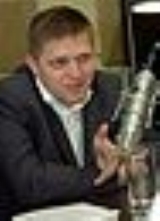
Robert Fico

Encyclopedia
Robert Fico served as the Prime Minister of Slovakia from July 4, 2006 to July 8, 2010.
He is the leader of the left-wing party Direction – Social Democracy (Slovak
: SMER – Sociálna demokracia). The party won the parliamentary elections in 2006
, receiving approximately 30 percent of the cast votes. After the victory he created a coalition with the Slovak National Party an extremist nationalist party led by Ján Slota
and with the People's Party - Movement for a Democratic Slovakia
led by Vladimír Mečiar
.
. His father was a forklift operator and his mother worked in a shoe store. Fico has two siblings, brother Ladislav and a sister Lucia. He is married to his wife, Svetlana they have a son together.
Fico acquired his legal education during the communist rule in then-Czechoslovakia
. He graduated from the Law Faculty of the Comenius University at Bratislava
and later worked for the Institute of State and Law of the Slovak Academy of Sciences
, a communist take on a think-tank body. Fico joined the Communist Party of Czechoslovakia
in 1987.
After the Velvet Revolution
of 1989, following the collapse of the communist regime in Czechoslovakia, Fico joined the Party of the Democratic Left
(SDL), a successor of the Communist Party of Slovakia. From 1994 to 2000 Fico as a political appointee represented Slovakia as its legal counsel at the European Court of Human Rights
. During this time Fico lost all 14 cases he handled.
In 1999 Fico left his SDL party whose support had meanwhile dropped below the threshold required to get into parliament. Subsequently he founded a new party called Direction – Social Democracy (SMER). Although at first presented as a centrist party, it gradually evolved into a social democratic party.
Fico soon became one of the most popular opposition politicians in Slovakia. His rhetoric was most often aimed at the ongoing reforms being carried out at the time by the right wing government of Mikuláš Dzurinda
. Although praised by international politicians, business elites, and right-wing economists, Dzurinda’s reforms’ short-term negative impacts increased the appeal and popularity of Fico's populist rhetoric, particularly among the countryside population, elderly, lower social classes, and voters with a lower level of education, which to this day make up the majority of his electorate.
In the parliamentary elections of 2002, Fico's SMER received 13.46% of the votes and became the third largest party. The result was much lower than the pre-election estimates and Fico openly called it a failure. In the following four years Fico continued with his sharp anti-reform and populist rhetoric, gradually increasing his party's numbers in opinion polls.
SMER won with 29.1% of the votes and formed a coalition government with Vladimír Mečiar
's People's Party – Movement for a Democratic Slovakia (HZDS) and Ján Slota
's Slovak National Party (SNS).
In addition to Mečiar's and Slota's controversial political past, Slota and his nationalist and anti-Hungarian SNS party presented a problem of its own, especially in light of Fico's SMER party's attempt to present itself as a modern, socialist and pro-European party. Ján Slota has been known for his frequent vulgar, defamatory and hatred-inciting anti-gypsy and anti-Hungarian remarks, including a drunken public speech in which he called for Slovaks to "get in tanks and level Budapest
to the ground".
As a result of Fico's decision to form government with Slota’s extremist SNS, the EU-wide Party of European Socialists
(PES) suspended Fico's party application to join them. In late February 2008 however the Assembly of PES partially reversed this decision, conditionally reinstating the application after both SMER and SNS sent the PES a signed letter, committing themselves to respect minority rights. Slota’s numerous nationalist and hate inciting remarks made since have gone largely ignored by the PES and have not effected SMER’s application.
Fico himself has never publicly criticized or condemned Slota's remarks and speeches and as an obvious result of Ján Slota's conduct the government-level relations between Slovakia and the neighbouring Hungary deteriorated to an unprecedented level. Several meetings between two countries' prime ministers were abruptly canceled and those few that did take place resulted in little progress or improvement of
relations.
carried the news about the recording in great detail, however Fico dismmissed it as forgery. Fico also attacked the media sources that published information about the recording, saying "Should I go over there and give you a smack because you are scoundrels? What you are doing is unheard of. You are masturbating on the prime minister every day." Fico has since been questioned on the matter, SME announced. Daniel Lipsic
told the press he handed the recording to the general attorney office.
In the election, Fico's SMER remained the biggest party in Parliament, with 62 seats. However, his coalition partners were decimated, with the HZDS being completely shut out. Unable to find a partner willing to given him the 14 seats he needed to stay in office, Fico resigned. He said he "respects the election result" and expressed his desire to lead a resolute opposition after his narrow loss.
, the World Bank
or the OECD, however they negatively affected certain segments of the population, particularly low wage earners, the unemployed, and welfare and other social assistance recipients.
While in opposition, and primarily during the election campaign, Fico vowed to reverse and cancel the majority of the reforms, however upon taking the office he adopted a substantially more cautious approach. Fico inherited a growing economy, with growth attributed by some to the said reforms. The country was achieving a record-high GDP growth and it was starting to fulfill the Maastricht criteria required for the Euro currency adoption, for which the country was aspiring at the time (Slovakia eventually adopted the euro currency on January 1, 2009 as third of the former Soviet-block countries).
In the end, contrary to his numerous pre-election promises and declarations, Fico implemented only a few changes that were deemed mainly cosmetic and did not substantially change any of the reforms. Right-wing analysts attribute Fico's turnaround to the realization of the catastrophic consequences the cancellation of the reforms would have on the economy. Critics on the left have accused Fico of bowing to pressure from Smer's supporters in the business and international financial community (see various articles, for example, in www.jetotak.sk).
The most successful reform Fico did introduce was in establishing some reasonable standards in how many times employees may be kept on as temporary workers instead of being given permanent contracts. Under the one-sided, pro-employer legislation of the Mikulas Dzurinda
government an employer could (and many did) keep new staff as temps and create a two-tier workforce. Generally Slovak labour regulation is in tune with most other EU states.
One of few modifications Fico's government did implement was a slight modification to the unusual flat tax
system introduced by the previous government in a way that slightly decreased or eradicated a tax-free part of income for higher income earners. Presented as a millionaire tax to Fico's electorate, the tax change essentially impacted everyone earning over €1200 a month, yet had minimal or no impact on those earning over €3000 a month. A lower value added tax
was imposed on medications and books, though in spite of his election promises Fico failed to extend this onto a wider group of products such as groceries. The Economic crisis of 2008–9 seems to have stopped efforts for more progressivity in the tax system.
Among the more radical measures were controversial legislative changes which effectively banned private health insurance companies from generating profit. As a result Slovakia is being sued by several foreign shareholders of local health insurers through international arbitrations.
In health care, Fico abolished fees that people had to pay when visiting a doctor or a hospital, introduced by the previous government.
In 2007, Fico unsuccessfully tried to regulate retail food prices, an unprecedented effort in a generally free market European union. His legislative measures however failed.
In August 2008, Fico threatened the foreign shareholders of a local gas distributor SPP, the French Gaz de France and the German E.ON, with nationalization and seizure of their ownership shares in a dispute over retail gas price.
Fico is an active proponent of nuclear energy.
In 2010 Fico faced large scale protests and a blockade of major cities by truckers upset by badly implemented toll on first class highways. Truckers demanded that the price of fuel be reduced to compensate for the toll. Fico first refused to speak with representatives of the truckers, saying "he won't be blackmailed", a few days later he capitulated giving in to the demands. The tax cut given to truckers will amount to about 100 million EUR.
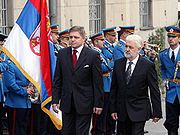 In foreign policy, Fico and his government have faced substantial difficulties in achieving political acceptance abroad, mainly due to his coalition with the controversial and internationally isolated parties of Vladimír Mečiar
and Jan Slota
.
Fico himself created several controversies, for example having attended a reception organized by the Cuban Embassy in Bratislava commemorating an anniversary of Castro's revolution, or announcing that one of his first foreign trips would include Libya, China or Venezuela.
Compensating his lack of close political allies within the EU (head of the Czech social democrats Jiri Paroubek being a notable exception), Fico has been actively strengthening relations with several non-EU countries such as Serbia or Russia. For example Slovakia modernized Russian MiG-fighters in Russia and did not buy new NATO-standard jets in the West. Additionally Fico condemned Georgia in 2008 for the aggression against South Ossetia
.
Fico is an opponent of the planned construction of new US anti-ballistic missile
and radar
systems in military bases in the neighbouring Czech Republic
and Poland
(also criticized by Russia
) and one of the first steps upon taking the office was a military pullout from Iraq.
Robert Fico has strongly opposed unilateral declaration of independence of Kosovo
, as a result of which Slovakia has not recognized Kosovo as a sovereign state.
and helped bring down the Soviet rule in all of Eastern Europe. He has been quoted saying as “not having noticed it (the revolution) due to being busy at work” (at the communist ministry of justice) and he has referred to the Velvet Revolution as “an ordinary coup that did not influence his life in any visible way."
Fico has often defended the communist regime as being more social than the capitalist one. Fico has remained unapologetic about his membership in the Communist Party of Czechoslovakia prior to the regime's collapse. He also mentioned in a radio talkshow that he has not noticed a significant progress since the Velvet Revolution
.
from Bratislava Zoo
.
Fico often sues media for libel. Although most of his lawsuits are aimed at tabloids, he has also sued broadsheet dailies (SME, Pravda) as well as an economic weekly Trend. He has won several of the lawsuits, while others have been dismissed. As of March 2009 Fico has more than 10 pending libel lawsuits with a tabloid weekly Plus 7 Days alone. Some of Fico's lawsuits are based solely on a headline, or a satiric cartoon. Several of the court judgments have raised serious concerns about the freedom of press in Slovakia, especially in the cases when besides an apology Fico had also been awarded substantial financial compensatory damages.
Since taking up the office as a prime minister, Fico has granted only one press media interview, to tabloid daily Novy Cas. Although a frequent participant in televised political debates prior to the elections, since then he has only attended televised shows with no political opponents present.
In his ongoing feud with the media, Fico has often been quoted as suggesting that the government should own and operate its own media outlets to assure "objective" information about the government.
Fico often tells the media what they should cover and subsequently taunts them when they do not cover what he suggests. Fico on at least one occasion issued an apology to a foreign politician whose visit of Slovakia Fico felt was largely ignored by the media. When Russian prime minister Zubkov visited in April 2008, most media did not consider the visit of the virtually unknown Zubkov substantially newsworthy. To make matters worse, during the press conference the journalists were not allowed to ask any questions. Subsequently Fico sent Zubkov a letter of apology where he apologized for the Slovak media's lack of interest in his visit.
He is the leader of the left-wing party Direction – Social Democracy (Slovak
Slovak language
Slovak , is an Indo-European language that belongs to the West Slavic languages .Slovak is the official language of Slovakia, where it is spoken by 5 million people...
: SMER – Sociálna demokracia). The party won the parliamentary elections in 2006
Slovak parliamentary election, 2006
The 2006 parliamentary elections in Slovakia took place on Saturday June 17, 2006. The voters selected 150 representatives for the National Council of the Slovak Republic. The highest number of seats, 50, was won by left-wing party Direction - Social Democracy led by Robert Fico. In total, six...
, receiving approximately 30 percent of the cast votes. After the victory he created a coalition with the Slovak National Party an extremist nationalist party led by Ján Slota
Ján Slota
Ján Slota is the co-founder and President of the Slovak National Party, an extremist nationalist party. Slota as the leader of SNS entered into a coalition with Robert Fico's Smer in 2006...
and with the People's Party - Movement for a Democratic Slovakia
People's Party - Movement for a Democratic Slovakia
The People's Party – Movement for a Democratic Slovakia , abbreviated to ĽS-HZDS or usually HZDS, is a national conservative political party in Slovakia...
led by Vladimír Mečiar
Vladimír Meciar
Vladimír Mečiar is a Slovak politician who was Prime Minister of Slovakia from 1990 to 1991, from 1992 to 1994, and from 1994 to 1998. He is the leader of the People's Party - Movement for a Democratic Slovakia...
.
Life and career
Fico was born in a working class family on September 15, 1964, in the town of TopoľčanyTopolcany
Topoľčany .The name Topoľčany was assumed to be derived from topoľ, Slovak for poplar tree. Groves of these trees were once abundant on the banks of the Nitra River...
. His father was a forklift operator and his mother worked in a shoe store. Fico has two siblings, brother Ladislav and a sister Lucia. He is married to his wife, Svetlana they have a son together.
Fico acquired his legal education during the communist rule in then-Czechoslovakia
Czechoslovakia
Czechoslovakia or Czecho-Slovakia was a sovereign state in Central Europe which existed from October 1918, when it declared its independence from the Austro-Hungarian Empire, until 1992...
. He graduated from the Law Faculty of the Comenius University at Bratislava
Bratislava
Bratislava is the capital of Slovakia and, with a population of about 431,000, also the country's largest city. Bratislava is in southwestern Slovakia on both banks of the Danube River. Bordering Austria and Hungary, it is the only national capital that borders two independent countries.Bratislava...
and later worked for the Institute of State and Law of the Slovak Academy of Sciences
Slovak Academy of Sciences
The Slovak Academy of Sciences SAV is the main scientific and research institution in Slovakia fostering basic and strategic basic research...
, a communist take on a think-tank body. Fico joined the Communist Party of Czechoslovakia
Communist Party of Czechoslovakia
The Communist Party of Czechoslovakia, in Czech and in Slovak: Komunistická strana Československa was a Communist and Marxist-Leninist political party in Czechoslovakia that existed between 1921 and 1992....
in 1987.
After the Velvet Revolution
Velvet Revolution
The Velvet Revolution or Gentle Revolution was a non-violent revolution in Czechoslovakia that took place from November 17 – December 29, 1989...
of 1989, following the collapse of the communist regime in Czechoslovakia, Fico joined the Party of the Democratic Left
Party of the Democratic Left (Slovakia)
The Party of the Democratic Left was a social-democratic political party in Slovakia from 1990 to 2004.It was founded in 1990, out of the Communist Party of Slovakia....
(SDL), a successor of the Communist Party of Slovakia. From 1994 to 2000 Fico as a political appointee represented Slovakia as its legal counsel at the European Court of Human Rights
European Court of Human Rights
The European Court of Human Rights in Strasbourg is a supra-national court established by the European Convention on Human Rights and hears complaints that a contracting state has violated the human rights enshrined in the Convention and its protocols. Complaints can be brought by individuals or...
. During this time Fico lost all 14 cases he handled.
In 1999 Fico left his SDL party whose support had meanwhile dropped below the threshold required to get into parliament. Subsequently he founded a new party called Direction – Social Democracy (SMER). Although at first presented as a centrist party, it gradually evolved into a social democratic party.
Fico soon became one of the most popular opposition politicians in Slovakia. His rhetoric was most often aimed at the ongoing reforms being carried out at the time by the right wing government of Mikuláš Dzurinda
Mikuláš Dzurinda
Mikuláš Dzurinda is a Slovak politician who was Prime Minister of Slovakia from 30 October 1998 to 4 July 2006. He was a founder and leader of the Slovak Democratic Coalition and the Slovak Democratic and Christian Union...
. Although praised by international politicians, business elites, and right-wing economists, Dzurinda’s reforms’ short-term negative impacts increased the appeal and popularity of Fico's populist rhetoric, particularly among the countryside population, elderly, lower social classes, and voters with a lower level of education, which to this day make up the majority of his electorate.
In the parliamentary elections of 2002, Fico's SMER received 13.46% of the votes and became the third largest party. The result was much lower than the pre-election estimates and Fico openly called it a failure. In the following four years Fico continued with his sharp anti-reform and populist rhetoric, gradually increasing his party's numbers in opinion polls.
2006 government coalition
In the elections in 2006Slovak parliamentary election, 2006
The 2006 parliamentary elections in Slovakia took place on Saturday June 17, 2006. The voters selected 150 representatives for the National Council of the Slovak Republic. The highest number of seats, 50, was won by left-wing party Direction - Social Democracy led by Robert Fico. In total, six...
SMER won with 29.1% of the votes and formed a coalition government with Vladimír Mečiar
Vladimír Meciar
Vladimír Mečiar is a Slovak politician who was Prime Minister of Slovakia from 1990 to 1991, from 1992 to 1994, and from 1994 to 1998. He is the leader of the People's Party - Movement for a Democratic Slovakia...
's People's Party – Movement for a Democratic Slovakia (HZDS) and Ján Slota
Ján Slota
Ján Slota is the co-founder and President of the Slovak National Party, an extremist nationalist party. Slota as the leader of SNS entered into a coalition with Robert Fico's Smer in 2006...
's Slovak National Party (SNS).
In addition to Mečiar's and Slota's controversial political past, Slota and his nationalist and anti-Hungarian SNS party presented a problem of its own, especially in light of Fico's SMER party's attempt to present itself as a modern, socialist and pro-European party. Ján Slota has been known for his frequent vulgar, defamatory and hatred-inciting anti-gypsy and anti-Hungarian remarks, including a drunken public speech in which he called for Slovaks to "get in tanks and level Budapest
Budapest
Budapest is the capital of Hungary. As the largest city of Hungary, it is the country's principal political, cultural, commercial, industrial, and transportation centre. In 2011, Budapest had 1,733,685 inhabitants, down from its 1989 peak of 2,113,645 due to suburbanization. The Budapest Commuter...
to the ground".
As a result of Fico's decision to form government with Slota’s extremist SNS, the EU-wide Party of European Socialists
Party of European Socialists
The Party of European Socialists is a European political party led by Sergei Stanishev, former Prime Minister of Bulgaria. The PES comprises social-democratic national-level political parties primarily from Member state of the European Union, as well as other nations of the European continent. The...
(PES) suspended Fico's party application to join them. In late February 2008 however the Assembly of PES partially reversed this decision, conditionally reinstating the application after both SMER and SNS sent the PES a signed letter, committing themselves to respect minority rights. Slota’s numerous nationalist and hate inciting remarks made since have gone largely ignored by the PES and have not effected SMER’s application.
Fico himself has never publicly criticized or condemned Slota's remarks and speeches and as an obvious result of Ján Slota's conduct the government-level relations between Slovakia and the neighbouring Hungary deteriorated to an unprecedented level. Several meetings between two countries' prime ministers were abruptly canceled and those few that did take place resulted in little progress or improvement of
relations.
2010 election campaign
Before the 2010 elections, Fico's party, seeking reelection was in a relatively strong position according to several polls. However just before the election a political scandal broke out, described as one of the gravest in the country's 17-year history. A voice recording surfaced in which a voice strongly resembling Fico's claims that he raised several million euros in undeclared funds for the 2002 election as well as calling for a "parallel financial structure" to be created for the financing of Smer's election campaign. Slovak media sources such as SMESME (newspaper)
SME or Denník SME is the most widely read and very influential mainstream broadsheet in Slovakia.Its target group is very wide, but officially it focuses on readers in bigger cities and agglomerations. Its circulation in December 2006 was 76 590. It appears 6 times a week. It is issued by Petit...
carried the news about the recording in great detail, however Fico dismmissed it as forgery. Fico also attacked the media sources that published information about the recording, saying "Should I go over there and give you a smack because you are scoundrels? What you are doing is unheard of. You are masturbating on the prime minister every day." Fico has since been questioned on the matter, SME announced. Daniel Lipsic
Daniel Lipšic
JUDr. Daniel Lipšic, LL.M. is a Slovak politician who currently serves as the Interior Minister of Slovakia. He previously served as Minister of Justice of Slovakia from 2002 to 2006.. , The New York Times He is a member of the Christian Democratic Movement, a party currently in the governing...
told the press he handed the recording to the general attorney office.
In the election, Fico's SMER remained the biggest party in Parliament, with 62 seats. However, his coalition partners were decimated, with the HZDS being completely shut out. Unable to find a partner willing to given him the 14 seats he needed to stay in office, Fico resigned. He said he "respects the election result" and expressed his desire to lead a resolute opposition after his narrow loss.
Domestic policy
A large part of Fico’s election victory was largely attributed to his loud criticism of the previous right-wing government’s economic, tax, social, pension and legislative reforms. The reforms were generally perceived as very positive and successful by such international bodies as the International Monetary FundInternational Monetary Fund
The International Monetary Fund is an organization of 187 countries, working to foster global monetary cooperation, secure financial stability, facilitate international trade, promote high employment and sustainable economic growth, and reduce poverty around the world...
, the World Bank
World Bank
The World Bank is an international financial institution that provides loans to developing countries for capital programmes.The World Bank's official goal is the reduction of poverty...
or the OECD, however they negatively affected certain segments of the population, particularly low wage earners, the unemployed, and welfare and other social assistance recipients.
While in opposition, and primarily during the election campaign, Fico vowed to reverse and cancel the majority of the reforms, however upon taking the office he adopted a substantially more cautious approach. Fico inherited a growing economy, with growth attributed by some to the said reforms. The country was achieving a record-high GDP growth and it was starting to fulfill the Maastricht criteria required for the Euro currency adoption, for which the country was aspiring at the time (Slovakia eventually adopted the euro currency on January 1, 2009 as third of the former Soviet-block countries).
In the end, contrary to his numerous pre-election promises and declarations, Fico implemented only a few changes that were deemed mainly cosmetic and did not substantially change any of the reforms. Right-wing analysts attribute Fico's turnaround to the realization of the catastrophic consequences the cancellation of the reforms would have on the economy. Critics on the left have accused Fico of bowing to pressure from Smer's supporters in the business and international financial community (see various articles, for example, in www.jetotak.sk).
The most successful reform Fico did introduce was in establishing some reasonable standards in how many times employees may be kept on as temporary workers instead of being given permanent contracts. Under the one-sided, pro-employer legislation of the Mikulas Dzurinda
Mikuláš Dzurinda
Mikuláš Dzurinda is a Slovak politician who was Prime Minister of Slovakia from 30 October 1998 to 4 July 2006. He was a founder and leader of the Slovak Democratic Coalition and the Slovak Democratic and Christian Union...
government an employer could (and many did) keep new staff as temps and create a two-tier workforce. Generally Slovak labour regulation is in tune with most other EU states.
One of few modifications Fico's government did implement was a slight modification to the unusual flat tax
Flat tax
A flat tax is a tax system with a constant marginal tax rate. Typically the term flat tax is applied in the context of an individual or corporate income that will be taxed at one marginal rate...
system introduced by the previous government in a way that slightly decreased or eradicated a tax-free part of income for higher income earners. Presented as a millionaire tax to Fico's electorate, the tax change essentially impacted everyone earning over €1200 a month, yet had minimal or no impact on those earning over €3000 a month. A lower value added tax
Value added tax
A value added tax or value-added tax is a form of consumption tax. From the perspective of the buyer, it is a tax on the purchase price. From that of the seller, it is a tax only on the "value added" to a product, material or service, from an accounting point of view, by this stage of its...
was imposed on medications and books, though in spite of his election promises Fico failed to extend this onto a wider group of products such as groceries. The Economic crisis of 2008–9 seems to have stopped efforts for more progressivity in the tax system.
Among the more radical measures were controversial legislative changes which effectively banned private health insurance companies from generating profit. As a result Slovakia is being sued by several foreign shareholders of local health insurers through international arbitrations.
In health care, Fico abolished fees that people had to pay when visiting a doctor or a hospital, introduced by the previous government.
In 2007, Fico unsuccessfully tried to regulate retail food prices, an unprecedented effort in a generally free market European union. His legislative measures however failed.
In August 2008, Fico threatened the foreign shareholders of a local gas distributor SPP, the French Gaz de France and the German E.ON, with nationalization and seizure of their ownership shares in a dispute over retail gas price.
Fico is an active proponent of nuclear energy.
In 2010 Fico faced large scale protests and a blockade of major cities by truckers upset by badly implemented toll on first class highways. Truckers demanded that the price of fuel be reduced to compensate for the toll. Fico first refused to speak with representatives of the truckers, saying "he won't be blackmailed", a few days later he capitulated giving in to the demands. The tax cut given to truckers will amount to about 100 million EUR.
Foreign policy
Vladimír Meciar
Vladimír Mečiar is a Slovak politician who was Prime Minister of Slovakia from 1990 to 1991, from 1992 to 1994, and from 1994 to 1998. He is the leader of the People's Party - Movement for a Democratic Slovakia...
and Jan Slota
Ján Slota
Ján Slota is the co-founder and President of the Slovak National Party, an extremist nationalist party. Slota as the leader of SNS entered into a coalition with Robert Fico's Smer in 2006...
.
Fico himself created several controversies, for example having attended a reception organized by the Cuban Embassy in Bratislava commemorating an anniversary of Castro's revolution, or announcing that one of his first foreign trips would include Libya, China or Venezuela.
Compensating his lack of close political allies within the EU (head of the Czech social democrats Jiri Paroubek being a notable exception), Fico has been actively strengthening relations with several non-EU countries such as Serbia or Russia. For example Slovakia modernized Russian MiG-fighters in Russia and did not buy new NATO-standard jets in the West. Additionally Fico condemned Georgia in 2008 for the aggression against South Ossetia
South Ossetia
South Ossetia or Tskhinvali Region is a disputed region and partly recognized state in the South Caucasus, located in the territory of the South Ossetian Autonomous Oblast within the former Georgian Soviet Socialist Republic....
.
Fico is an opponent of the planned construction of new US anti-ballistic missile
Anti-ballistic missile
An anti-ballistic missile is a missile designed to counter ballistic missiles .A ballistic missile is used to deliver nuclear, chemical, biological or conventional warheads in a ballistic flight trajectory. The term "anti-ballistic missile" describes any antimissile system designed to counter...
and radar
Radar
Radar is an object-detection system which uses radio waves to determine the range, altitude, direction, or speed of objects. It can be used to detect aircraft, ships, spacecraft, guided missiles, motor vehicles, weather formations, and terrain. The radar dish or antenna transmits pulses of radio...
systems in military bases in the neighbouring Czech Republic
Czech Republic
The Czech Republic is a landlocked country in Central Europe. The country is bordered by Poland to the northeast, Slovakia to the east, Austria to the south, and Germany to the west and northwest....
and Poland
Poland
Poland , officially the Republic of Poland , is a country in Central Europe bordered by Germany to the west; the Czech Republic and Slovakia to the south; Ukraine, Belarus and Lithuania to the east; and the Baltic Sea and Kaliningrad Oblast, a Russian exclave, to the north...
(also criticized by Russia
Russia
Russia or , officially known as both Russia and the Russian Federation , is a country in northern Eurasia. It is a federal semi-presidential republic, comprising 83 federal subjects...
) and one of the first steps upon taking the office was a military pullout from Iraq.
Robert Fico has strongly opposed unilateral declaration of independence of Kosovo
Kosovo
Kosovo is a region in southeastern Europe. Part of the Ottoman Empire for more than five centuries, later the Autonomous Province of Kosovo and Metohija within Serbia...
, as a result of which Slovakia has not recognized Kosovo as a sovereign state.
Fico’s views on communism
One of Fico’s famous remarks is his comment on his perception of the 1989 Velvet Revolution, which peacefully brought down the communist regime in CzechoslovakiaCzechoslovakia
Czechoslovakia or Czecho-Slovakia was a sovereign state in Central Europe which existed from October 1918, when it declared its independence from the Austro-Hungarian Empire, until 1992...
and helped bring down the Soviet rule in all of Eastern Europe. He has been quoted saying as “not having noticed it (the revolution) due to being busy at work” (at the communist ministry of justice) and he has referred to the Velvet Revolution as “an ordinary coup that did not influence his life in any visible way."
Fico has often defended the communist regime as being more social than the capitalist one. Fico has remained unapologetic about his membership in the Communist Party of Czechoslovakia prior to the regime's collapse. He also mentioned in a radio talkshow that he has not noticed a significant progress since the Velvet Revolution
Velvet Revolution
The Velvet Revolution or Gentle Revolution was a non-violent revolution in Czechoslovakia that took place from November 17 – December 29, 1989...
.
Fico and the media
Fico is known for his hostile and often bumpy relationship with the media. During his press conferences he often verbally attacks, lectures and taunts the present journalists, often accusing them of bias and attacks on his government. On several occasions he has openly and on record used profanities against specific journalists (“idiots”, “pricks”). After characterising journalists as “hyenas”, the broadsheet Pravda adopted a hyenaHyena
Hyenas or Hyaenas are the animals of the family Hyaenidae of suborder feliforms of the Carnivora. It is the fourth smallest biological family in the Carnivora , and one of the smallest in the mammalia...
from Bratislava Zoo
Bratislava Zoo
The ZOO Bratislava is a zoo in Bratislava, Slovakia, in the borough of Karlova Ves. It lies in the Little Carpathians forest. As of 2007, the zoo has an area of , and is home to 1307 specimens of 152 animal species. In 2006, the zoo received 203,000 visitors....
.
Fico often sues media for libel. Although most of his lawsuits are aimed at tabloids, he has also sued broadsheet dailies (SME, Pravda) as well as an economic weekly Trend. He has won several of the lawsuits, while others have been dismissed. As of March 2009 Fico has more than 10 pending libel lawsuits with a tabloid weekly Plus 7 Days alone. Some of Fico's lawsuits are based solely on a headline, or a satiric cartoon. Several of the court judgments have raised serious concerns about the freedom of press in Slovakia, especially in the cases when besides an apology Fico had also been awarded substantial financial compensatory damages.
Since taking up the office as a prime minister, Fico has granted only one press media interview, to tabloid daily Novy Cas. Although a frequent participant in televised political debates prior to the elections, since then he has only attended televised shows with no political opponents present.
In his ongoing feud with the media, Fico has often been quoted as suggesting that the government should own and operate its own media outlets to assure "objective" information about the government.
Fico often tells the media what they should cover and subsequently taunts them when they do not cover what he suggests. Fico on at least one occasion issued an apology to a foreign politician whose visit of Slovakia Fico felt was largely ignored by the media. When Russian prime minister Zubkov visited in April 2008, most media did not consider the visit of the virtually unknown Zubkov substantially newsworthy. To make matters worse, during the press conference the journalists were not allowed to ask any questions. Subsequently Fico sent Zubkov a letter of apology where he apologized for the Slovak media's lack of interest in his visit.
External links
- The Fico Threat, by Martin M. Simecka essay, March 2009
- Short biography on government website