


Road train

Encyclopedia
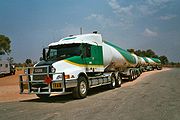
Truck
A truck or lorry is a motor vehicle designed to transport cargo. Trucks vary greatly in size, power, and configuration, with the smallest being mechanically similar to an automobile...
ing concept used in remote areas of Argentina
Argentina
Argentina , officially the Argentine Republic , is the second largest country in South America by land area, after Brazil. It is constituted as a federation of 23 provinces and an autonomous city, Buenos Aires...
, Australia
Australia
Australia , officially the Commonwealth of Australia, is a country in the Southern Hemisphere comprising the mainland of the Australian continent, the island of Tasmania, and numerous smaller islands in the Indian and Pacific Oceans. It is the world's sixth-largest country by total area...
, Mexico
Mexico
The United Mexican States , commonly known as Mexico , is a federal constitutional republic in North America. It is bordered on the north by the United States; on the south and west by the Pacific Ocean; on the southeast by Guatemala, Belize, and the Caribbean Sea; and on the east by the Gulf of...
, the United States
United States
The United States of America is a federal constitutional republic comprising fifty states and a federal district...
and Canada
Canada
Canada is a North American country consisting of ten provinces and three territories. Located in the northern part of the continent, it extends from the Atlantic Ocean in the east to the Pacific Ocean in the west, and northward into the Arctic Ocean...
to move freight efficiently. The term "road train" is most often used in Australia. In the U.S. and Canada the terms "triples," "turnpike doubles" and "Rocky Mountain
Rocky Mountains
The Rocky Mountains are a major mountain range in western North America. The Rocky Mountains stretch more than from the northernmost part of British Columbia, in western Canada, to New Mexico, in the southwestern United States...
doubles" are commonly used for longer combination vehicles (LCVs). A road train consists of a relatively conventional tractor unit
Tractor unit
A tractor unit, prime mover , road tractor, or traction unit is a heavy-duty commercial vehicle within the large goods vehicle category, usually with a large displacement diesel engine, and several axles. The tractor unit serves as a method of moving trailers...
, but instead of pulling one trailer or semi-trailer
Semi-trailer
A semi-trailer is a trailer without a front axle. A large proportion of its weight is supported by a road tractor, a detachable front axle assembly known as a dolly, or the tail of another trailer...
, the road train pulls two or more of them.
History
There is an earlier road train built by its inventor in the United Kingdom it is shown in No 320 (No. 8. Vol. 12. February 23ed, 1907. Edition of "The Auto" Title: The Renard Road Train. Page 242.In the 1940s, the Government of South Australia operated a fleet of AEC 8x8
Eight-wheel drive
Eight-wheel drive, 8WD, or 8x8 is an eight-wheeled vehicle with a drivetrain that allows all eight wheels to receive power from the engine simultaneously.Some severe/extreme duty semi tractors may have this configuration...
military trucks to transport freight and supplies into the Northern Territory, replacing the Afghan
Afghan (Australia)
The Afghans or Ghans were camel drivers who worked in outback Australia from the 1860s to the 1930s. While called Afghans, not all of them were from Afghanistan; some came from the northern regions of British India, areas that now constitute modern-day Pakistan...
camel
Camel
A camel is an even-toed ungulate within the genus Camelus, bearing distinctive fatty deposits known as humps on its back. There are two species of camels: the dromedary or Arabian camel has a single hump, and the bactrian has two humps. Dromedaries are native to the dry desert areas of West Asia,...
trains that had been trekking through the deserts since the late 19th century. These trucks pulled two or three 6 metre Dyson four-axle self tracking trailers. With 130 hp, the AECs were grossly underpowered by today's standards, and drivers and offsiders routinely froze in winter and sweltered in summer due to the truck's open cab design and the position of the engine radiator, with its 1.5 metre cooling fan, behind the seats.
Australian Kurt Johansson is recognised as the inventor of the modern road train. After transporting stud bulls 200 mi (321.9 km) to an outback
Outback
The Outback is the vast, remote, arid area of Australia, term colloquially can refer to any lands outside the main urban areas. The term "the outback" is generally used to refer to locations that are comparatively more remote than those areas named "the bush".-Overview:The outback is home to a...
property, Johansson was challenged to build a truck to carry 100 head of cattle
Cattle
Cattle are the most common type of large domesticated ungulates. They are a prominent modern member of the subfamily Bovinae, are the most widespread species of the genus Bos, and are most commonly classified collectively as Bos primigenius...
instead of the original load of 20. Provided with financing of a couple of thousand pound
Australian pound
The pound was the currency of Australia from 1910 until 13 February 1966, when it was replaced by the Australian dollar. It was subdivided into 20 shillings, each of 12 pence.- Earlier Australian currencies :...
s and inspired by the tracking abilities of the Government roadtrain, Johansson began construction. Two years later his first road train was running.
Johansson's first road train consisted of a U.S. Army
United States Army
The United States Army is the main branch of the United States Armed Forces responsible for land-based military operations. It is the largest and oldest established branch of the U.S. military, and is one of seven U.S. uniformed services...
World War II surplus Diamond-T tank carrier
Diamond T Tank Transporter
The Diamond T Tank Transporter was a heavy tank transporter, used in World War II and the following years.Designed as a heavy prime mover for tank transporting, the Diamond T 980 was the product of the Diamond T Company in Chicago...
, nicknamed "Bertha", and two home-built self tracking trailers. Both wheel sets on each trailer could steer, and therefore could negotiate the tight and narrow tracks and creek crossings that existed throughout Central Australia
Central Australia
Central Australia/Alice Springs Region is one of the five regions in the Northern Territory. The term Central Australia is used to describe an area centred on Alice Springs in Australia. It is sometimes referred to as Centralia; likewise the people of the area are sometimes called Centralians...
in the earlier part of last century. Freighter Trailers in Australia viewed this improved invention and went on to build self-tracking trailers for Kurt and other customers, and went on to become innovators in transport machinery for Australia.
This first example of the modern road train, along with the AEC Government Roadtrain, forms part of the huge collection at the National Road Transport Hall of Fame
National Road Transport Hall of Fame
The National Road Transport Hall of Fame is a transport museum based in Alice Springs, Northern Territory.- See also :* Old Ghan Heritage Railway and Museum is next door.* List of transport museums...
in Alice Springs, Northern Territory
Northern Territory
The Northern Territory is a federal territory of Australia, occupying much of the centre of the mainland continent, as well as the central northern regions...
.
Australia
Australia has the largest and heaviest road-legal vehicles in the world, with some configurations topping out at close to 200 t (197 LT; 220 ST). The majority are between 80 t (78.7 LT; 88.2 ST).Double (two-trailer) road train combinations are allowed in most areas of Australia, and within the environs (albeit limited) of Adelaide
Adelaide
Adelaide is the capital city of South Australia and the fifth-largest city in Australia. Adelaide has an estimated population of more than 1.2 million...
, South Australia
South Australia
South Australia is a state of Australia in the southern central part of the country. It covers some of the most arid parts of the continent; with a total land area of , it is the fourth largest of Australia's six states and two territories.South Australia shares borders with all of the mainland...
and Perth
Perth, Western Australia
Perth is the capital and largest city of the Australian state of Western Australia and the fourth most populous city in Australia. The Perth metropolitan area has an estimated population of almost 1,700,000....
, Western Australia
Western Australia
Western Australia is a state of Australia, occupying the entire western third of the Australian continent. It is bounded by the Indian Ocean to the north and west, the Great Australian Bight and Indian Ocean to the south, the Northern Territory to the north-east and South Australia to the south-east...
. A double road train should not be confused with a B-double, which are allowed access to most of the country and in all major cities.
Triple (three trailer) road trains operate in western New South Wales
New South Wales
New South Wales is a state of :Australia, located in the east of the country. It is bordered by Queensland, Victoria and South Australia to the north, south and west respectively. To the east, the state is bordered by the Tasman Sea, which forms part of the Pacific Ocean. New South Wales...
, western Queensland
Queensland
Queensland is a state of Australia, occupying the north-eastern section of the mainland continent. It is bordered by the Northern Territory, South Australia and New South Wales to the west, south-west and south respectively. To the east, Queensland is bordered by the Coral Sea and Pacific Ocean...
, South Australia, Western Australia and the Northern Territory
Northern Territory
The Northern Territory is a federal territory of Australia, occupying much of the centre of the mainland continent, as well as the central northern regions...
, with the last three states also allowing AB-Quads (3.5 trailers). Darwin
Darwin, Northern Territory
Darwin is the capital city of the Northern Territory, Australia. Situated on the Timor Sea, Darwin has a population of 127,500, making it by far the largest and most populated city in the sparsely populated Northern Territory, but the least populous of all Australia's capital cities...
is the only capital city in the world that triples and quads are allowed to within 1 km (0.621372736649807 mi) of the central business district
Central business district
A central business district is the commercial and often geographic heart of a city. In North America this part of a city is commonly referred to as "downtown" or "city center"...
(CBD). Tasmania
Tasmania
Tasmania is an Australian island and state. It is south of the continent, separated by Bass Strait. The state includes the island of Tasmania—the 26th largest island in the world—and the surrounding islands. The state has a population of 507,626 , of whom almost half reside in the greater Hobart...
and Victoria
Victoria (Australia)
Victoria is the second most populous state in Australia. Geographically the smallest mainland state, Victoria is bordered by New South Wales, South Australia, and Tasmania on Boundary Islet to the north, west and south respectively....
do not allow the operation of roadtrains on any of their roads. Victoria have previously allowed double road trains to operate around Mildura for the vintage grape harvest.
Strict regulations regarding licensing, registration, weights and experience apply to all operators of road trains throughout Australia.
Road trains are used for transporting all manner of materials; common examples are livestock
Livestock
Livestock refers to one or more domesticated animals raised in an agricultural setting to produce commodities such as food, fiber and labor. The term "livestock" as used in this article does not include poultry or farmed fish; however the inclusion of these, especially poultry, within the meaning...
, fuel
Fuel
Fuel is any material that stores energy that can later be extracted to perform mechanical work in a controlled manner. Most fuels used by humans undergo combustion, a redox reaction in which a combustible substance releases energy after it ignites and reacts with the oxygen in the air...
, mineral ore
Ore
An ore is a type of rock that contains minerals with important elements including metals. The ores are extracted through mining; these are then refined to extract the valuable element....
s, and general freight. Their cost-effective transport has played a significant part in the economic development of remote areas; some communities are totally reliant on regular service.
The multiple dog-trailers (defined below) are unhooked, the dollys
Dolly (trailer)
A dolly is a small trailer that can be coupled to a truck or trailer so as to support a semi-trailer. The dolly is equipped with a fifth wheel to which the semi-trailer is coupled...
removed and then connected individually to multiple trucks at "assembly" yards when the road train gets close to populated areas.
When the flat-top trailers of a road train need to be transported empty, it is common practice to stack them. This is commonly referred to as "doubled-up" or "doubling-up."See illustration. Sometimes, if many trailers are required to be moved at the one time, they will be tripled stacked, or "tripled-up."
Higher Mass Limits (HML) Schemes are now piloting in all jurisdiction in Australia, allowing trucks to carry additional weight.
Canada
In Canada, road trains are more commonly referred to as Long Combination Vehicles (LCVs), as Extended Length Vehicles (ELVs), or Energy Efficient Motor Vehicles (EEMVs).Four types of LCV are permitted; turnpike doubles, triples, rocky mountain doubles, and queen city triples.
Turnpike doubles consist of a tractor unit pulling a semi-trailer (up to 53 feet (16.2 m) long). An A-type or C-type converter is connected to the rear of the trailer, and carries a second trailer. Alternatively, the lead trailer may have a hideaway fifth wheel, which enables direct coupling of the second trailer without a converter. The total permissible length is 38 m (124.7 ft).
Triples may be up to 35 m (114.8 ft) in length when using A or C converters, or 38 m (124.7 ft) in B-train configuration.
Rocky mountain doubles are limited to 31 m (101.7 ft) in overall length, but have the advantage of being legal on two-lane, undivided roads. A, B and C-train variants are used. Other LCVs may only be used on divided highways.
Queen city triples consist of a tractor unit pulling one semi-trailer up to 53 feet (16.2 m) long and two shorter "pup" trailers up to 32 feet (9.8 m) long. Queen city triples are only permitted between the cities of Saskatoon and Regina Saskatchewan. These are the longest combinations allowed in North America on public highways.
Western Canada
British ColumbiaBritish Columbia
British Columbia is the westernmost of Canada's provinces and is known for its natural beauty, as reflected in its Latin motto, Splendor sine occasu . Its name was chosen by Queen Victoria in 1858...
restricts LCV operation to the Coquihalla Highway (formerly a toll road) between Hope
Hope, British Columbia
Hope is a district municipality located at the confluence of the Fraser and Coquihalla rivers in the province of British Columbia, Canada. Hope is at the eastern end of both the Fraser Valley and the Lower Mainland region, and is at the southern end of the Fraser Canyon...
and Merritt
Merritt, British Columbia
Merritt is a city in the Nicola Valley of the south-central Interior of British Columbia, Canada. Situated at the confluence of the Nicola and Coldwater rivers, it is the first major community encountered after travelling along Phase One of the Coquihalla Highway and acts as the gateway to all...
, with the exception of B-doubles (mainly used for hauling wood chips).
Alberta
Alberta
Alberta is a province of Canada. It had an estimated population of 3.7 million in 2010 making it the most populous of Canada's three prairie provinces...
allows LCV operation on most major highways. The Queen Elizabeth II Highway between Calgary
Calgary
Calgary is a city in the Province of Alberta, Canada. It is located in the south of the province, in an area of foothills and prairie, approximately east of the front ranges of the Canadian Rockies...
and Edmonton
Edmonton
Edmonton is the capital of the Canadian province of Alberta and is the province's second-largest city. Edmonton is located on the North Saskatchewan River and is the centre of the Edmonton Capital Region, which is surrounded by the central region of the province.The city and its census...
carries the majority of turnpike doubles and triples. Theoretically, these vehicles could be used on Highway 16 as far west as Hinton
Hinton, Alberta
Hinton is a town in west-central Alberta, Canada.It is located in Yellowhead County, northeast of Jasper and about west of Alberta's capital city, Edmonton, at the intersection of Yellowhead and Bighorn Highway, in the Athabasca River valley.-History:...
and Highway 43 as far north as Valleyview
Valleyview, Alberta
-History:*Late 1800s: The first visitors to the area arrived, seeking natives to exchange goods for furs. The trading was good and a Hudson’s Bay post was established on Sturgeon Lake...
, but are rarely used on these routes. LCV operation north and west of Edmonton is limited to rocky mountain doubles, since the road is undivided north of Valleyview. The destination of most rocky mountain doubles is Yellowknife in the Northwest Territories
Northwest Territories
The Northwest Territories is a federal territory of Canada.Located in northern Canada, the territory borders Canada's two other territories, Yukon to the west and Nunavut to the east, and three provinces: British Columbia to the southwest, and Alberta and Saskatchewan to the south...
.
The Northwest Territories allows LCVs of up to 31 m (101.7 ft) in length. These vehicles are restricted to specific destinations in Hay River
Hay River
-Rivers:* Hay River * Hay River , a river in Alberta and Northwest Territories, Canada* Hay River , a river in south-western Australia...
and Yellowknife. LCVs do not operate north of Yellowknife.
Saskatchewan
Saskatchewan
Saskatchewan is a prairie province in Canada, which has an area of . Saskatchewan is bordered on the west by Alberta, on the north by the Northwest Territories, on the east by Manitoba, and on the south by the U.S. states of Montana and North Dakota....
restricts LCVs to divided highways, but appears to allow them to use undivided sections of those highways.
Licensing of LCV drivers
(Information restricted to Alberta and NWT.) Prospective LCV drivers must have held a licence for legal length articulated vehicles for two years (five years in the North West Territories.). They may have no more than two moving offences recorded within three years and may not have any vehicle-related criminal code violations. They are required to pass a PDIC (professional driver improvement course) every four years. They are required to pull an LCV at least once a year in order to keep their LCV licence.U.S.A.
In the United States, trucks on public roads are limited to two trailers (two 28 ft (8.5 m) + a dolly to connect; the limit is 63 ft (19.2 m) end to end). Some states allow three trailers, although triples are usually restricted to less populous states such as Idaho, Oregon and Montana. Triples are used for long-distance less-than-truckloadLess than truckload
Less than truckload shipping is the transportation of relatively small freight. The alternatives to LTL carriers are parcel carriers or full truckload carriers. Parcel carriers usually handle small packages and freight that can be broken down in to units less than . Full truckload carriers move...
(LTL) freight hauling (in which case the trailers are shorter than a typical single-unit trailer) or resource hauling in the interior west (such as ore
Ore
An ore is a type of rock that contains minerals with important elements including metals. The ores are extracted through mining; these are then refined to extract the valuable element....
or aggregate
Construction Aggregate
Construction aggregate, or simply "aggregate", is a broad category of coarse particulate material used in construction, including sand, gravel, crushed stone, slag, recycled concrete and geosynthetic aggregates. Aggregates are the most mined material in the world...
). Triples are typically marked with "LONG LOAD" banners both front and rear. The term "road train" is not commonly used in the US.
Europe
In Finland, Sweden, Germany, the Netherlands, Denmark and some selected roads in Norway, (for a period of three years commencing November 24, 2008), trucks with trailers are allowed to be 25.25 m (82.8 ft) long. Elsewhere in the European Union, the limit is 18.75 m (61.5 ft) (Norway (19.5 m or 64 ft). The trucks are of a cab-over-engine design, that is with a flat front, a high floor about 1.2 m (3.9 ft) above ground with the engine below. The Scandinavian countries are less densely populated than the rest of the EU countries and distances, especially in Finland and Sweden, are vast. Until the late 1960s, vehicle length was unlimited, giving rise to long vehicles to handle goods cost effectively. As traffic increased, lengths became more of a concern and they were limited, albeit at a more generous level than in the rest of Europe. In the United KingdomUnited Kingdom
The United Kingdom of Great Britain and Northern IrelandIn the United Kingdom and Dependencies, other languages have been officially recognised as legitimate autochthonous languages under the European Charter for Regional or Minority Languages...
in 2009, a two year desk study of Longer Heavier Vehicle
Longer Heavier Vehicle
Longer Heavier Vehicles , also called super lorries, is a classification of large goods vehicle in the United Kingdom...
s (LHVs) including options up to 11-axle, 34 metres (111.5 ft) long, 82 t (80.7 LT; 90.4 ST) combinations, ruled out all road train type vehicles for the foreseeable future.
Sweden is currently (2010) performing tests on log hauling trucks, weighing up to 90 t (88.6 LT; 99.2 ST) and measuring 30 metres (98.4 ft) and haulers for two 40 ft containers, measuring 32 metres (105 ft) in total.
Mexico
Mexico allows LCV's consisting of double trailers around 12.5 m (41 ft) in length. They must display a sign reading "Precaucion: Doble Semi-remolque" (Caution: Double Semi Trailer) on the rear, indicating that it is a double length trailer in use. Mexico does not place special road restrictions on LCV's other than those already in place for conventional tractor-trailers.B-double
A B-double (B-TrainB-Train
In the simplest terms a B-Train consists of two trailers linked together by a fifth wheel, and are up to 26 m long. The fifth wheel coupling is located at the rear of the lead, or first trailer and is mounted on a "tail" section commonly located immediately above the lead trailer axles...
) consists of a prime mover towing a specialised lead trailer that has a fifth-wheel
Fifth wheel coupling
The fifth wheel coupling provides the link between a semi-trailer and the towing truck, tractor unit, leading trailer or dolly. Some recreational vehicles use a fifth wheel configuration, requiring the coupling to be installed in the bed of a pickup truck as a towing vehicle...
mounted on the rear towing another semi-trailer, resulting in two articulation points
Articulated vehicle
An articulated vehicle is a vehicle which has a permanent or semi-permanent pivoting joint in its construction, allowing the vehicle to turn more sharply. There are many kinds of articulated vehicles, from heavy equipment to buses, trams and trains...
. Around container ports in Australia there may also have what is known as a super B-double, these being a B-double that has a quad axle lead trailer capable of holding one 40-foot shipping container or two 20-foot shipping containers, and the rear trailer being capable of the same with either a tri or quad rear axle set. However, because of their large length and low accessibility into narrow streets, these vehicles are restricted in where they can go and are generally used for terminal-to-terminal work, i.e., wharf to container holding park or wharf-to-wharf. The rear axle on each trailer can also pivot slightly whilst turning to prevent scrubbing out the edges of the tyres due to the heavy loads placed on them.

B-triple
Same as a B-double but with an additional lead trailer behind the prime mover. These are run in most states of Australia where double road trains are allowed. There is one exception to that rule: B-Triples are operated in Victoria, but by one operator, under a strict permit and on a dedicated route, between the Ford plants at Geelong and CampbellfieldAB Triple
An AB triple consists of a prime mover, a semi-trailer, a converter dollyDolly (trailer)
A dolly is a small trailer that can be coupled to a truck or trailer so as to support a semi-trailer. The dolly is equipped with a fifth wheel to which the semi-trailer is coupled...
, then a B-double.
C-train
A C-train is a semi-trailer attached to a fifth-wheelFifth wheel coupling
The fifth wheel coupling provides the link between a semi-trailer and the towing truck, tractor unit, leading trailer or dolly. Some recreational vehicles use a fifth wheel configuration, requiring the coupling to be installed in the bed of a pickup truck as a towing vehicle...
on a C-dolly
Dolly (trailer)
A dolly is a small trailer that can be coupled to a truck or trailer so as to support a semi-trailer. The dolly is equipped with a fifth wheel to which the semi-trailer is coupled...
. The C-dolly is connected to the tractor or another trailer in front of it with two draw-bars
Drawbar (haulage)
A drawbar is a solid coupling between a hauling vehicle and its hauled load. Drawbars are in common use with rail transport, road trailers, both large and small, industrial and recreational, and with agricultural equipment.-Agriculture:...
, thus eliminating the drawbar connection as an articulation point. One of the axle
Axle
An axle is a central shaft for a rotating wheel or gear. On wheeled vehicles, the axle may be fixed to the wheels, rotating with them, or fixed to its surroundings, with the wheels rotating around the axle. In the former case, bearings or bushings are provided at the mounting points where the axle...
s on a C-dolly is self-steerable to prevent tire scrubbing. C-dollies are not permit in Australia, due to the lack of articulation.
Dog-trailer (Pup trailer)
A dog-trailer (also called a pup) is any trailer that is hooked to a converter dollyDolly (trailer)
A dolly is a small trailer that can be coupled to a truck or trailer so as to support a semi-trailer. The dolly is equipped with a fifth wheel to which the semi-trailer is coupled...
, with a single A-frame drawbar that fits into the Ringfeder
Ringfeder
Ringfeder is the trading name of a German company based in Krefeld. The company manufactures automatic bolt coupling devices. While they are not the sole manufacturer of these devices, their name has become the universal term. Ringfeder are part of the large Swedish company, VBG, also a...
or pintle hook on the rear of the trailer in front, giving the whole unit 3-5 articulation points and very little roll stiffness.
Rules and regulations
A is a B-double.B is a B-triple.
C is a double road train. A "Pocket road train" is similar, but with shorter trailers and dolly drawbar.
D is an AB-triple.
E is a BAB Quad.
F is an ABB Quad.
G is triple road train.
H is a 2AB Quad.
K represents the largest road trains operating in Australia, and therefore, the world. Called a "Powertrain" or a "Body and six", these machines operate at The Granites Gold Mine in the western Northern Territory, and are used in place of 200 t (197 LT; 220 ST) dump trucks, because of the distances involved on the haul run. A 600 hp 19 l (1,158.5 cu in) Cummins engine powers the prime mover, whilst a 400 hp Cummins engine is installed in the rear trailer of the B-double, driving through an automatic transmission, giving a total of 1000 hp. Weights of 460 t (453 LT; 507 ST) are achieved with ore loading in side-tipper bodies on a 100 km (62.1 mi) round trip. As these trucks operate on private property, they are not subject to governed weight and length rulings, but instead are utilised in the most efficient way possible.
Interstate Road Transport registration
In 1991 at a Special Premiers Conference, Australian Heads of Government signed an Inter-governmental Agreement to establish a national heavy vehicle registration, regulation and charging scheme. Otherwise known as FIRS.This registration scheme is known as the Federal Interstate Registration Scheme. The requirements of the scheme were as follows:
If the vehicle was purchased to be used for interstate trade, no stamp duty was payable on the purchase price of the vehicle.
The vehicle had to be subjected to an annual inspection for roadworthy standards, which had to be passed before registration could be renewed.
With the registration identification, the first letter of the 6 digit identified the home state: W = Western Australia, S = South Australia, V = Victoria, N = New South Wales, Q = Queensland, T = Tasmania, A = Australian Capital Territory and C = Northern Territory.
Due to the 'eastern' and 'western' mass limits in Australia, two different categories of registration were enacted. The second digit of the registration plate showed what mass limit was allowed for that vehicle. If a vehicle had a 'V' as the second letter, its mass limits were in line with the eastern states mass limits, which were:
- Steer axle, 1 axle, 2 tyres: 5.4 t (5.3 LT; 6 ST)
- Steer axle, 2 axles, 2 tyres per axle: Non load sharing suspension 9 t (8.9 LT; 9.9 ST)
- Load sharing suspension 10 t (9.8 LT; 11 ST)
- Single axle, dual tyres: 8.5 t (8.4 LT; 9.4 ST)
- Tandem axle, dual tyres: 15 t (14.8 LT; 16.5 ST)
- Tri axle, dual tyres or 'super single' tyres: 18 t (17.7 LT; 19.8 ST)
- Gross combination mass on a 6 axle vehicle not to exceed 38 t (37.4 LT; 41.9 ST)
If a vehicle had a 'X' as the second letter, its mass limits were in line with the western states mass limits, which were:
- Steer axle, 1 axle, 2 tyres: 6 t (5.9 LT; 6.6 ST)
- Steer axle, 2 axles, 2 tyres per axle
- Non load sharing suspension 10 t (9.8 LT; 11 ST): Load sharing suspension 11 t (10.8 LT; 12.1 ST)
- Single axle, dual tyres: 9 t (8.9 LT; 9.9 ST)
- Tandem axle, dual tyres: 16.5 t (16.2 LT; 18.2 ST)
- Tri axle, dual tyres or 'super single' tyres: 20 t (19.7 LT; 22 ST)
- Gross combination mass on a 6 axle vehicle not to exceed 42.5 t (41.8 LT; 46.8 ST)
If the second digit of the registration was a 'T', that designated a trailer.
One of the main criteria of the registration was that intrastate operation was not permitted. The load had to come from one state and be delivered to another state or territory. Many grain carriers were reported and prosecuted for cartage from the paddock to the silos. If, though, they went to a port silo, they were given the benefit of the doubt, as that grain was more than likely going overseas.
Signage
Australian road trains have horizontal signs front and back with 180 mm (7.1 in) high black uppercase letters on a reflective yellow background reading "ROAD TRAIN". The sign(s) must have a black border and be at least 1.02 m (3.3 ft) long and 220 mm (8.7 in) high and be placed between 500 mm (19.7 in) and 1.8 m (5.9 ft) above the ground on the fore or rearmost surface of the unit.Converter dollys must have a sign affixed horizontally to the rearmost point, complying to the same conditions, reading "LONG VEHICLE". This is required for when a dolly is towed behind a trailer.
Combination lengths
- B-Double- 26 m (85.3 ft) max.
- B-Triple- 33.5 m (109.9 ft) max.
- Pocket road train- 27.5 m (90.2 ft) max. This configuration is classed as a "Long Vehicle".
- Double road train- 36.5 m (119.8 ft) max.
- Triple and AB-Quad road trains- 53.5 m (175.5 ft) max.
Operating weights
Operational weights are based on axle group masses, as follows:- Single axle (Steer tyre)- 6 t (5.9 LT; 6.6 ST)
- Single axle (Steer axle with 'super single' tyres) 6.7 t (6.6 LT; 7.4 ST)
- Single axle (dual tyres) - 9 t (8.9 LT; 9.9 ST)
- Tandem axle grouping- 16.5 t (16.2 LT; 18.2 ST)
- Tri axle grouping- 20 t (19.7 LT; 22 ST)
Therefore, a B-Double would weigh 62.5 t (61.5 LT; 68.9 ST) (6 t (5.9 LT; 6.6 ST) + 16.5 t (16.2 LT; 18.2 ST) + 20 t (19.7 LT; 22 ST) + 20 t (19.7 LT; 22 ST)). A double road train would have an operational weight (without concessions) of 79 t (77.8 LT; 87.1 ST) (6 t (5.9 LT; 6.6 ST) + 16.5 t (16.2 LT; 18.2 ST) + 20 t (19.7 LT; 22 ST) + 16.5 t (16.2 LT; 18.2 ST) + 20 t (19.7 LT; 22 ST)). A triple is 79 t (77.8 LT; 87.1 ST) + 36.5 t (35.9 LT; 40.2 ST) (16.5 t (16.2 LT; 18.2 ST) + 20 t (19.7 LT; 22 ST)), giving an all up weight of 115.5 t (113.68 LT; 127.32 ST). Quads weigh in at 135.5 t (133.4 LT; 149.4 ST). Concessional weight additions (0.5 – per group) can see a quad end up weighing 149 t (146.6 LT; 164.2 ST). If a tri-drive prime mover is utilised, along with tri-axle dollys, weights can reach nearly 170 t (167 LT; 187 ST).
Speed limits
The Australian national heavy vehicle speed limit is 100 km/h (62 mph), excepting:- NSW, Queensland and South Australia, where the speed limit for any road train is 90 km/h (56 mph).
In western Canada, LCVs are restricted to 100 km/h (62 mph), or the posted speed limit. Trucks of legal length (<25 metres (82 ft)) may travel at 110 km/h (68 mph), or the posted speed limit.
World's longest road trains
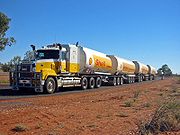
- In 1989, a trucker named "Buddo" tugged 12 trailers down the main street of Winton, QueenslandWinton, Queensland-Qantas:Winton was one of the founding towns of the Australian airline Qantas. The first board meeting was held at the Winton Club on 10 February 1921.-Waltzing Matilda:...
. - In 1993, "Plugger" Bowden took the record with a 525 hp Mack SuperLiner pulling 16 trailers, but a few months later this effort was surpassed by Darwin driver Malcolm Chisholm with a 290 t (285 LT; 320 ST), 21 trailer rig extending 315 metres (1,033 ft).
- There was some back and forth in the 1990s between Winton and Bourke, New South WalesBourke, New South Wales-Transportation:Bourke can be reached by the Mitchell Highway, with additional sealed roads from town to the north , east and south . The town is also served by Bourke Airport and has Countrylink bus service to other regional centres, like Dubbo...
, with the record finishing in Winton with 34 trailers. - In 1999, the town of Merredin, Western AustraliaMerredin, Western Australia-Economy:The agricultural land around Merredin produces 40% of Western Australia’s wheat quota. As a focal point for the region, Merredin’s local bulk handling co-operative receives and processes in excess of a million tonnes of grain every year...
officially made it into the Guinness Book of Records, when Marleys Transport made a successful attempt on the record for the world's longest road train. The record was created when 45 trailers, driven by Greg Marley, weighing 603 t (593 LT; 665 ST) and measuring 610 m (2,001.3 ft) were pulled by a KenworthKenworthKenworth is an American manufacturer of medium and heavy-duty Class 8 trucks based in Kirkland, Washington, United States, a suburb of Seattle. It is a subsidiary of PACCAR, and is also a former manufacturer of transit buses and school buses.-History:...
10x6 K100G for 8 km (5 mi). - On October 19, 2000, Doug Gould set the first of his records at Kalgoorlie, Western AustraliaKalgoorlie, Western AustraliaKalgoorlie, known as Kalgoorlie-Boulder, is a town in the Goldfields-Esperance region of Western Australia, and is located east-northeast of state capital Perth at the end of the Great Eastern Highway...
, when a roadtrain made up of 79 trailers, measuring 1018.2 m (3,340.6 ft) and weighing 1072.3 t (1,055.4 LT; 1,182 ST), was pulled by a KenworthKenworthKenworth is an American manufacturer of medium and heavy-duty Class 8 trucks based in Kirkland, Washington, United States, a suburb of Seattle. It is a subsidiary of PACCAR, and is also a former manufacturer of transit buses and school buses.-History:...
C501T driven by Steven Matthews a distance of 8 km (5 mi). - On March 29, 2003, the record was surpassed near Mungindi, New South WalesMungindi, New South WalesMungindi is a town on the border of New South Wales and Queensland in Moree Plains Shire. It possesses a New South Wales postcode. Mungindi sits on the Carnarvon Highway and straddles the Barwon River which is the border between New South Wales and Queensland...
, by a road train consisting of 87 trailers and a single prime mover (measuring 1235.3 m (4,052.8 ft) in length). - The record returned to Kalgoorlie, Western Australia, on October 17, 2004, when Doug Gould assembled 117 trailers for a total length of 1445 m (4,740.8 ft). The record nearly didn't fall, as the first prime mover's main driveshaft broke when taking off. A second truck was quickly made available, and pulled the train a distance of 1500 m (4,921.3 ft).
- In 2004, the record was again broken by a group from Clifton, QueenslandClifton, QueenslandClifton is a town in the Darling Downs region of Queensland, Australia. The lands around the town was first settled by Europeans in 1840. At the 2006 census, Clifton had a population of 1,067....
which used a standard Mack truck to pull 120 trailers a distance of about 100 metres (328 ft). - On February 18, 2006, an Australian built Mack truck with 112 semi-trailers, 1300 t (1,279 LT; 1,433 ST) and 1474.3 metre long, pulled the load 100 metres (328 ft) to recapture the record for the longest road train (multiple loaded trailers) ever pulled with a single prime mover. It was on the main road of Clifton, QueenslandClifton, QueenslandClifton is a town in the Darling Downs region of Queensland, Australia. The lands around the town was first settled by Europeans in 1840. At the 2006 census, Clifton had a population of 1,067....
, that 70-year-old John Atkinson claimed a new record, pulled by a tri-drive Mack TitanMack TitanThe Mack Titan is a heavy duty truck produced by Mack Trucks. There are two different variants of the Titan, one for the Australian market, that was first introduced in 1995 aimed at the heavy road train operators of Australia, and a 2008 model that was introduced in North America...
.
See also
- Air brake (road vehicle)Air brake (road vehicle)Air brakes are used in trucks, buses, trailers, and semi-trailers. George Westinghouse first developed air brakes for use in railway service. He patented a safer air brake on March 5, 1872. Originally designed and built for use on railroad train application, air brakes remain the exclusive systems...
- BrakeBrakeA brake is a mechanical device which inhibits motion. Its opposite component is a clutch. The rest of this article is dedicated to various types of vehicular brakes....
- B-TrainB-TrainIn the simplest terms a B-Train consists of two trailers linked together by a fifth wheel, and are up to 26 m long. The fifth wheel coupling is located at the rear of the lead, or first trailer and is mounted on a "tail" section commonly located immediately above the lead trailer axles...
- Dolly (trailer)Dolly (trailer)A dolly is a small trailer that can be coupled to a truck or trailer so as to support a semi-trailer. The dolly is equipped with a fifth wheel to which the semi-trailer is coupled...
- Fifth wheel couplingFifth wheel couplingThe fifth wheel coupling provides the link between a semi-trailer and the towing truck, tractor unit, leading trailer or dolly. Some recreational vehicles use a fifth wheel configuration, requiring the coupling to be installed in the bed of a pickup truck as a towing vehicle...
- JackknifingJackknifingJackknifing means the folding of an articulated vehicle such that it resembles the acute angle of a folding pocket knife. If a vehicle towing a trailer skids, the trailer can push it from behind until it spins round and faces backwards. This may be caused by equipment failure, improper braking, or...
- Longer Heavier VehicleLonger Heavier VehicleLonger Heavier Vehicles , also called super lorries, is a classification of large goods vehicle in the United Kingdom...
- RingfederRingfederRingfeder is the trading name of a German company based in Krefeld. The company manufactures automatic bolt coupling devices. While they are not the sole manufacturer of these devices, their name has become the universal term. Ringfeder are part of the large Swedish company, VBG, also a...
coupling devices
- Road transport in AustraliaRoad transport in AustraliaRoad transport is an essential element of the Australian transport network, and enabler of the Australian economy. Australia relies heavily on road transport due to Australia's large area and low population density in considerable parts of the country....
- Rolling highwayRolling HighwayA rolling highway is a combined transport system to transport trucks by rail....
– freight trucks by rail - Semi-trailer truckSemi-trailer truckA semi-trailer truck, also known as a semi, tractor-trailer, or articulated truck or articulated lorry, is an articulated vehicle consisting of a towing engine , and a semi-trailer A semi-trailer truck, also known as a semi, tractor-trailer, or (in the United Kingdom and Ireland) articulated truck...
– large trucks such as road trains and articulated lorries - Overland trainOverland trainIn the 1950s the LeTourneau company developed several overland trains, essentially oversized semi-trailer trucks that could travel over almost any terrain. Their intention was to be able to handle logistics needs without being dependent on local road or rail systems, allowing them to operate in...
- TransportTransportTransport or transportation is the movement of people, cattle, animals and goods from one location to another. Modes of transport include air, rail, road, water, cable, pipeline, and space. The field can be divided into infrastructure, vehicles, and operations...
External links
- Australian Road Train Association
- Australian National Heavy Vehicles Accreditation Scheme.
- Northern Territory Road Train road safety TV commercials.
- South Australian Roads road train gazette
- NSW Roads and Traffic Authority road train operators gazette
- NSW Roads and Traffic Authority Restricted Access Vehicles route map index
- NSW Roads and Traffic Authority Reflective sign standards
- U.S. department of Transportation, Federal Highway Administration, Chapter VII, Safety.
- The U.S. Department of Transportation's Western Uniformity Scenario Analysis.
- British Columbia Government Licensing Buletin 6
- British Columbia Government Licensing Buletin 41
- Roadmap of technologies able to halve energy use per passenger mile includes the dynamically coupled, heterogeneous type of roadtrain
- Road trains and electrification of transport