

Railroad police

Encyclopedia
Railroad police are different from one country to another. Their roles in some countries are not different from that of any other police agency in others they are more related to a type of security police
. They are all commonly responsible for the protection of railroad (or railway) vast networks of properties, facilities and personnel as well as public rail transit systems. Some are given extensive additional authority where other jurisdictions are more restricted.
In the United States
and Canada
, all railroad police are employed by the major Class I railroad
s, as well as some smaller ones. In other countries, this work is typically done by territorial police force
s rather than specialized agencies. In Great Britain
, railways fall under the jurisdiction of the British Transport Police
, a nation-wide transit police
force that is responsible for policing all railways and some public transit
systems.
, railway constables were given full police powers within one quarter mile of company property and vehicles. The Canadian Pacific Railway
initially relied on the Dominion of Canada Police, which later became the North-West Mounted Police
during construction of the transcontinental railroad
, but by the latter 1880s were employing their own police.
The large numbers of navvies
recruited to build the railways brought security problems for rail companies. In 1900, the CPR established its Special Service Department. It worked closely with municipal, federal, and provincial police and given a mandate to prevent and investigate pilferage, theft, vandalism, and sabotage as well as policing strikes.
The CPR police was also responsible for closely guarding Chinese workers, who were considered "detainees" and virtually treated as prisoners under the Chinese Immigration Act of 1885
. The Special Service was dissolved in 1904 following a scandal involving the business practices of a CPR Labour Department agent in Montreal
, but was resurrected in 1913 as the Department of Investigation.
Today, Canadian National (CN) and Canadian Pacific Railway (CPR) police departments are the only federal railway police services operating in Canada. Police officers for the railway are federally sworn under the Railway Safety Act. This Act allows a superior court (federal) judge to appoint a person as a police constable. These officers are employed by the railway and are in place strategically within Canada's rail infrastructure with a primary focus of reducing deaths and injuries along each railway's network of operations. These officers typically work toward investigations involving criminal and provincial violations such as traffic enforcement and accident investigations and working to further educating the public about the dangers of rail operations and consequences that can result from complacency. To note Canadian National was a crown corporation until 1994 when it was transferred from government ownership to private industry. During this time CN Police officers were part of the federal government but after transitioned to working for private industry.
The railway police federal oath of office provides the following wording (Now under the Railway Safety Act section 44(1)):
"I, ________________, Judge of the Superior Court in and for the Province of ___________, pursuant to the powers vested in me by the Canada Transportation Act, do hereby appoint ________________ to act as Constable upon and along the lines of the _______________, as prescribed by Section 158 of the said Act.
I, ________________, having been appointed a constable to act upon and along the lines of _________ Railway under the provisions of the Canada Transportation Act do swear that I am a Canadian citizen; that I will well and truly serve the legally constituted authorities in the said office as constable without favor or affection, malice or ill-will; that I will do the best of my power cause the peace to be kept and prevent all offences against the peace; and that while I continue to hold the said office I will to the best of my skill and knowledge discharge the duties thereof faithfully, according to Law."
Additionally, in Canada these police officers are also appointed or sworn provincially to provide additional police powers as it relates to each province's interest. The primary jurisdictional police are still responsible for all law enforcement in its jurisdiction and due to reduced manpower and coverage the railway police are considered a secondary response agency. Often the primary jurisdictional police are required to deal with matters that are occurring on or in relation to railway property. However, railway police will still assume jurisdiction depending on the seriousness of the incident again due to their reduced numbers and capabilities may require local police to assume control over an incident with the railway police acting in a supporting / assisting role. Railway police also support local police at incidents not in relation to the railway.
Despite that legislatively, the police force of all Mainland China should answer only to one collective central government and should be considered a single entity, their various source of funding makes them de facto local police force indeed. Therefore the railroad police of PRC can be considered as the only civil police force that under the command of an agency of central government, more precisely the MoR. Its branches distribute in parallel to the railway bureaus of MoR, and for a period of time, was considered its subsidiary, since the "railway bureau" is an entity of mixed nature: as a government agency as well as a corporation. Consequently, some railroad police agency will cover several regions of operation of provincial level. For example, the division level Tianjin railroad police force will answer to the prefecture level Beijing railroad police bureau, despite the fact that regular police force of Tianjin is collateral to its Beijing equivalence. While supervised by the Ministry of Public Security
, the force was funded exclusively by MoR itself, therefore often was criticized for protecting corporate interest under MoR. Since it is prevalent in PRC that local police force was conscripted as a private army of individuals, such criticism actually reflects the dispute between local and central government at some level.
is the term in Germany, Austria and the German-speaking parts of Switzerland for the Railroad police.
) is carried out by the Polizia Ferroviaria.
is carried out by the RPF (Railway Protection Force
).
United Kingdom
The British Transport Police
protects the rail system in Great Britain
, due to the nationalisation of the Railways in 1948, and prior to this, individual railways had their own Police forces.
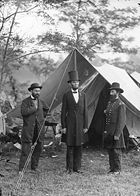 The history of railroad police in the United States traces back to the beginnings of the Pinkerton National Detective Agency
. In the mid nineteenth century, the number of U.S. Marshals was insufficient to police the railway lines sprawling across the vast frontier.
Passing through areas far removed from the protective measures available in populated centers left railroad lines and their passengers and freight vulnerable to banditry. Through his detective business, Allan Pinkerton
met George B. McClellan
, the president of the Ohio and Mississippi Railroad
and Illinois Central Railroad
, as well as its attorney, Abraham Lincoln
. With Lincoln's encouragement, Pinkerton began supplying detectives for the railroad.
Railroad contracts were subsequently a mainstay of Pinkerton's until railroad companies gradually developed their own police departments
in the years following the Civil War
. After the founding of the Brotherhood of Locomotive Engineers
in 1863, Pinkerton's and the new railroad police agencies became instrumental in crushing strikes of rail workers.
Another major concern was pilferage by employees, especially the passenger conductor, who had the greatest authority and freedom on passenger trains and collected ticket fees. Pinkerton began this work for the South Michigan Line in 1854, and on 1 February 1855, he created the North West Police Agency with $10,000 given for the cause by six anxious Midwestern railroads.
It is important to note that Section 1704 also states that this police authority is to "the extent of the authority of a police officer certified or commissioned under the laws of that jurisdiction". While a railroad police officer may have general peace officer authority in some states such as California, they are limited to the railroad's property in other states.
The status of railroad police officers varies by state, in that they are commissioned by the Governor of the state in which they reside and/or work in and they may carry both state level arrest powers and some interstate arrest powers as allowed by 49 USC 28101. Although railroad police primarily enforce laws on or near the railroad right-of-way, their police officers can enforce other laws and make arrests off of railroad property depending on the state in which they are working.
Depending upon the state or jurisdiction, railroad police officers may be considered certified police officers, deputized peace officers, or company special agents. In Virginia, for example, any railroad may file an application with the Circuit Court of any county where it operates to allow the President of the railroad to appoint members of its own police force. If approved, the railroad's police officers have the equivalent authority of the State Police
, and may act as law enforcement personnel anywhere in the Commonwealth.
Some of the crimes railroad police investigate include trespassing on the right-of-way
of a railroad, assault
s against passengers, terrorism
threats targeting the railroad, arson
, tagging of graffiti
on railroad rolling stock
or buildings, signal vandalism, pickpocketing, ticket fraud
, robbery
and theft of personal belongings, baggage or freight. Other incidents railroad police investigate include derailment
s, train/vehicle collisions, vehicle accidents on the right of way, and hazardous materials releases.
(JTTF).
Security police
In some countries, including the United States, security police are those persons, employed by or for a governmental agency, who provide police and security services to those agencies' properties....
. They are all commonly responsible for the protection of railroad (or railway) vast networks of properties, facilities and personnel as well as public rail transit systems. Some are given extensive additional authority where other jurisdictions are more restricted.
In the United States
United States
The United States of America is a federal constitutional republic comprising fifty states and a federal district...
and Canada
Canada
Canada is a North American country consisting of ten provinces and three territories. Located in the northern part of the continent, it extends from the Atlantic Ocean in the east to the Pacific Ocean in the west, and northward into the Arctic Ocean...
, all railroad police are employed by the major Class I railroad
Class I railroad
A Class I railroad in the United States and Mexico, or a Class I rail carrier in Canada, is a large freight railroad company, as classified based on operating revenue.Smaller railroads are classified as Class II and Class III...
s, as well as some smaller ones. In other countries, this work is typically done by territorial police force
Territorial police force
The phrase Territorial Police Force varies in precise meaning according to the country to which it is related, generally distinguishing a force whose area of responsibility is defined by sub-national boundaries from others which deal with the entire country or a restricted range of...
s rather than specialized agencies. In Great Britain
Great Britain
Great Britain or Britain is an island situated to the northwest of Continental Europe. It is the ninth largest island in the world, and the largest European island, as well as the largest of the British Isles...
, railways fall under the jurisdiction of the British Transport Police
British Transport Police
The British Transport Police is a special police force that polices those railways and light-rail systems in Great Britain for which it has entered into an agreement to provide such services...
, a nation-wide transit police
Transit police
Transit police are a specialized police agency or unit employed by a common carrier, which could be a transit district, railroad, bus line, other transport carrier, or the state...
force that is responsible for policing all railways and some public transit
Transit police
Transit police are a specialized police agency or unit employed by a common carrier, which could be a transit district, railroad, bus line, other transport carrier, or the state...
systems.
Canada
In Canada, the construction of railways served a similar nation-building function as it did in the U.S. and also brought new police agencies into existence. Years before ConfederationCanadian Confederation
Canadian Confederation was the process by which the federal Dominion of Canada was formed on July 1, 1867. On that day, three British colonies were formed into four Canadian provinces...
, railway constables were given full police powers within one quarter mile of company property and vehicles. The Canadian Pacific Railway
Canadian Pacific Railway
The Canadian Pacific Railway , formerly also known as CP Rail between 1968 and 1996, is a historic Canadian Class I railway founded in 1881 and now operated by Canadian Pacific Railway Limited, which began operations as legal owner in a corporate restructuring in 2001...
initially relied on the Dominion of Canada Police, which later became the North-West Mounted Police
Royal Canadian Mounted Police
The Royal Canadian Mounted Police , literally ‘Royal Gendarmerie of Canada’; colloquially known as The Mounties, and internally as ‘The Force’) is the national police force of Canada, and one of the most recognized of its kind in the world. It is unique in the world as a national, federal,...
during construction of the transcontinental railroad
Transcontinental railroad
A transcontinental railroad is a contiguous network of railroad trackage that crosses a continental land mass with terminals at different oceans or continental borders. Such networks can be via the tracks of either a single railroad, or over those owned or controlled by multiple railway companies...
, but by the latter 1880s were employing their own police.
The large numbers of navvies
Navvy
Navvy is a shorter form of navigator or navigational engineer and is particularly applied to describe the manual labourers working on major civil engineering projects...
recruited to build the railways brought security problems for rail companies. In 1900, the CPR established its Special Service Department. It worked closely with municipal, federal, and provincial police and given a mandate to prevent and investigate pilferage, theft, vandalism, and sabotage as well as policing strikes.
The CPR police was also responsible for closely guarding Chinese workers, who were considered "detainees" and virtually treated as prisoners under the Chinese Immigration Act of 1885
Chinese Immigration Act of 1885
The Chinese Immigration Act of 1885 placed a head tax on all Chinese immigrants coming to Canada, forcing them to pay a fifty dollar fee to enter the country. In 1900, the fee was raised to one hundred dollars...
. The Special Service was dissolved in 1904 following a scandal involving the business practices of a CPR Labour Department agent in Montreal
Montreal
Montreal is a city in Canada. It is the largest city in the province of Quebec, the second-largest city in Canada and the seventh largest in North America...
, but was resurrected in 1913 as the Department of Investigation.
Today, Canadian National (CN) and Canadian Pacific Railway (CPR) police departments are the only federal railway police services operating in Canada. Police officers for the railway are federally sworn under the Railway Safety Act. This Act allows a superior court (federal) judge to appoint a person as a police constable. These officers are employed by the railway and are in place strategically within Canada's rail infrastructure with a primary focus of reducing deaths and injuries along each railway's network of operations. These officers typically work toward investigations involving criminal and provincial violations such as traffic enforcement and accident investigations and working to further educating the public about the dangers of rail operations and consequences that can result from complacency. To note Canadian National was a crown corporation until 1994 when it was transferred from government ownership to private industry. During this time CN Police officers were part of the federal government but after transitioned to working for private industry.
The railway police federal oath of office provides the following wording (Now under the Railway Safety Act section 44(1)):
"I, ________________, Judge of the Superior Court in and for the Province of ___________, pursuant to the powers vested in me by the Canada Transportation Act, do hereby appoint ________________ to act as Constable upon and along the lines of the _______________, as prescribed by Section 158 of the said Act.
I, ________________, having been appointed a constable to act upon and along the lines of _________ Railway under the provisions of the Canada Transportation Act do swear that I am a Canadian citizen; that I will well and truly serve the legally constituted authorities in the said office as constable without favor or affection, malice or ill-will; that I will do the best of my power cause the peace to be kept and prevent all offences against the peace; and that while I continue to hold the said office I will to the best of my skill and knowledge discharge the duties thereof faithfully, according to Law."
Additionally, in Canada these police officers are also appointed or sworn provincially to provide additional police powers as it relates to each province's interest. The primary jurisdictional police are still responsible for all law enforcement in its jurisdiction and due to reduced manpower and coverage the railway police are considered a secondary response agency. Often the primary jurisdictional police are required to deal with matters that are occurring on or in relation to railway property. However, railway police will still assume jurisdiction depending on the seriousness of the incident again due to their reduced numbers and capabilities may require local police to assume control over an incident with the railway police acting in a supporting / assisting role. Railway police also support local police at incidents not in relation to the railway.
China, People's Republic of
The governing body of almost all railroad operations—the Chinese Ministry of Railways, who is also the owner of a great deal of the country's rail network, operates a massive police force that provides security service inside major railroad hubs and stations and outside along the railroads. Basically their jurisdiction extends to the limit of MoR property, yet occasionally the jurisdiction overlaps with local forces, in case it was an offence that occurred inside MoR facility, or related to MoR operations.Despite that legislatively, the police force of all Mainland China should answer only to one collective central government and should be considered a single entity, their various source of funding makes them de facto local police force indeed. Therefore the railroad police of PRC can be considered as the only civil police force that under the command of an agency of central government, more precisely the MoR. Its branches distribute in parallel to the railway bureaus of MoR, and for a period of time, was considered its subsidiary, since the "railway bureau" is an entity of mixed nature: as a government agency as well as a corporation. Consequently, some railroad police agency will cover several regions of operation of provincial level. For example, the division level Tianjin railroad police force will answer to the prefecture level Beijing railroad police bureau, despite the fact that regular police force of Tianjin is collateral to its Beijing equivalence. While supervised by the Ministry of Public Security
Ministry of Public Security of the People's Republic of China
The Ministry of Public Security , is the principal police and security authority of the mainland of the People's Republic of China and the government agency that exercises oversight over and is ultimately responsible for day-to-day law enforcement...
, the force was funded exclusively by MoR itself, therefore often was criticized for protecting corporate interest under MoR. Since it is prevalent in PRC that local police force was conscripted as a private army of individuals, such criticism actually reflects the dispute between local and central government at some level.
Germany, Austria and Switzerland
BahnpolizeiBahnpolizei
Bahnpolizei is the term in Germany, Austria and the German-speaking parts of Switzerland for the Railway police.-Germany:Bahnpolizei was the name of the former Railway police of West Germany and fell under the jurisdiction of the Deutsche Bundesbahn federal railway company...
is the term in Germany, Austria and the German-speaking parts of Switzerland for the Railroad police.
Italy
Policing of Italian State Railways (Ferrovie dello StatoFerrovie dello Stato
Ferrovie dello Stato is a government-owned holding which manage infrastructure and service on the Italian rail network. The subsidiary Trenitalia is the main rail operator in Italy.-Organization:Ferrovie dello Stato subsidiaries are:...
) is carried out by the Polizia Ferroviaria.
India
The protection of Indian RailwaysIndian Railways
Indian Railways , abbreviated as IR , is a departmental undertaking of Government of India, which owns and operates most of India's rail transport. It is overseen by the Ministry of Railways of the Government of India....
is carried out by the RPF (Railway Protection Force
Railway Protection Force
The Railway Protection force is an Indian Central Armed Police Force charged with protecting the Indian Railways.The strength of RPF is about 65,000.The duties of the Railway Protection Force include:...
).
United KingdomUnited KingdomThe United Kingdom of Great Britain and Northern IrelandIn the United Kingdom and Dependencies, other languages have been officially recognised as legitimate autochthonous languages under the European Charter for Regional or Minority Languages...
The British Transport PoliceBritish Transport Police
The British Transport Police is a special police force that polices those railways and light-rail systems in Great Britain for which it has entered into an agreement to provide such services...
protects the rail system in Great Britain
Great Britain
Great Britain or Britain is an island situated to the northwest of Continental Europe. It is the ninth largest island in the world, and the largest European island, as well as the largest of the British Isles...
, due to the nationalisation of the Railways in 1948, and prior to this, individual railways had their own Police forces.
History
Pinkerton National Detective Agency
The Pinkerton National Detective Agency, usually shortened to the Pinkertons, is a private U.S. security guard and detective agency established by Allan Pinkerton in 1850. Pinkerton became famous when he claimed to have foiled a plot to assassinate president-elect Abraham Lincoln, who later hired...
. In the mid nineteenth century, the number of U.S. Marshals was insufficient to police the railway lines sprawling across the vast frontier.
Passing through areas far removed from the protective measures available in populated centers left railroad lines and their passengers and freight vulnerable to banditry. Through his detective business, Allan Pinkerton
Allan Pinkerton
Allan Pinkerton was a Scottish American detective and spy, best known for creating the Pinkerton National Detective Agency.-Early life, career and immigration:...
met George B. McClellan
George B. McClellan
George Brinton McClellan was a major general during the American Civil War. He organized the famous Army of the Potomac and served briefly as the general-in-chief of the Union Army. Early in the war, McClellan played an important role in raising a well-trained and organized army for the Union...
, the president of the Ohio and Mississippi Railroad
Ohio and Mississippi Railroad
The Ohio and Mississippi Railway was a railroad operating between Cincinnati, Ohio, and East St. Louis, Illinois, from 1857 to 1893.General Ormsby M. Mitchel was a civil engineer on this project....
and Illinois Central Railroad
Illinois Central Railroad
The Illinois Central Railroad , sometimes called the Main Line of Mid-America, is a railroad in the central United States, with its primary routes connecting Chicago, Illinois with New Orleans, Louisiana and Birmingham, Alabama. A line also connected Chicago with Sioux City, Iowa...
, as well as its attorney, Abraham Lincoln
Abraham Lincoln
Abraham Lincoln was the 16th President of the United States, serving from March 1861 until his assassination in April 1865. He successfully led his country through a great constitutional, military and moral crisis – the American Civil War – preserving the Union, while ending slavery, and...
. With Lincoln's encouragement, Pinkerton began supplying detectives for the railroad.
Railroad contracts were subsequently a mainstay of Pinkerton's until railroad companies gradually developed their own police departments
Company police
Company police, also called private police, are police officers who work for a private company rather than a government agency.-United Kingdom:...
in the years following the Civil War
American Civil War
The American Civil War was a civil war fought in the United States of America. In response to the election of Abraham Lincoln as President of the United States, 11 southern slave states declared their secession from the United States and formed the Confederate States of America ; the other 25...
. After the founding of the Brotherhood of Locomotive Engineers
Brotherhood of Locomotive Engineers
The Brotherhood of Locomotive Engineers and Trainmen is a labor union founded in Marshall, Michigan, on May 8, 1863, as the Brotherhood of the Footboard. A year later, its name was changed to the Brotherhood of Locomotive Engineers, sometimes referred to as the Brotherhood of Engineers...
in 1863, Pinkerton's and the new railroad police agencies became instrumental in crushing strikes of rail workers.
Another major concern was pilferage by employees, especially the passenger conductor, who had the greatest authority and freedom on passenger trains and collected ticket fees. Pinkerton began this work for the South Michigan Line in 1854, and on 1 February 1855, he created the North West Police Agency with $10,000 given for the cause by six anxious Midwestern railroads.
Jurisdiction and authority
Some railroad police officers are certified law enforcement officers and may carry full police and arrest powers. The appointment, commissioning and regulation of railroad police under Section 1704 of the U.S. Crime Control Act of 1990, provides that: "A railroad police officer who is certified or commissioned as a police officer under the laws of any one state shall, in accordance with the regulations issued by the U. S. Secretary of Transportation, be authorized to enforce the laws of any other state in which the rail carrier owns property."It is important to note that Section 1704 also states that this police authority is to "the extent of the authority of a police officer certified or commissioned under the laws of that jurisdiction". While a railroad police officer may have general peace officer authority in some states such as California, they are limited to the railroad's property in other states.
The status of railroad police officers varies by state, in that they are commissioned by the Governor of the state in which they reside and/or work in and they may carry both state level arrest powers and some interstate arrest powers as allowed by 49 USC 28101. Although railroad police primarily enforce laws on or near the railroad right-of-way, their police officers can enforce other laws and make arrests off of railroad property depending on the state in which they are working.
Depending upon the state or jurisdiction, railroad police officers may be considered certified police officers, deputized peace officers, or company special agents. In Virginia, for example, any railroad may file an application with the Circuit Court of any county where it operates to allow the President of the railroad to appoint members of its own police force. If approved, the railroad's police officers have the equivalent authority of the State Police
Virginia State Police
Virginia State Police is a state agency, conceived in 1919 and established in 1932, that acts as the state police force for the Commonwealth of Virginia. The agency originated out of the Virginia Department of Motor Vehicles as an inspector and enforcer of highway laws...
, and may act as law enforcement personnel anywhere in the Commonwealth.
Some of the crimes railroad police investigate include trespassing on the right-of-way
Right-of-way (railroad)
A right-of-way is a strip of land that is granted, through an easement or other mechanism, for transportation purposes, such as for a trail, driveway, rail line or highway. A right-of-way is reserved for the purposes of maintenance or expansion of existing services with the right-of-way...
of a railroad, assault
Assault
In law, assault is a crime causing a victim to fear violence. The term is often confused with battery, which involves physical contact. The specific meaning of assault varies between countries, but can refer to an act that causes another to apprehend immediate and personal violence, or in the more...
s against passengers, terrorism
Terrorism
Terrorism is the systematic use of terror, especially as a means of coercion. In the international community, however, terrorism has no universally agreed, legally binding, criminal law definition...
threats targeting the railroad, arson
Arson
Arson is the crime of intentionally or maliciously setting fire to structures or wildland areas. It may be distinguished from other causes such as spontaneous combustion and natural wildfires...
, tagging of graffiti
Graffiti
Graffiti is the name for images or lettering scratched, scrawled, painted or marked in any manner on property....
on railroad rolling stock
Rolling stock
Rolling stock comprises all the vehicles that move on a railway. It usually includes both powered and unpowered vehicles, for example locomotives, railroad cars, coaches and wagons...
or buildings, signal vandalism, pickpocketing, ticket fraud
Fraud
In criminal law, a fraud is an intentional deception made for personal gain or to damage another individual; the related adjective is fraudulent. The specific legal definition varies by legal jurisdiction. Fraud is a crime, and also a civil law violation...
, robbery
Robbery
Robbery is the crime of taking or attempting to take something of value by force or threat of force or by putting the victim in fear. At common law, robbery is defined as taking the property of another, with the intent to permanently deprive the person of that property, by means of force or fear....
and theft of personal belongings, baggage or freight. Other incidents railroad police investigate include derailment
Derailment
A derailment is an accident on a railway or tramway in which a rail vehicle, or part or all of a train, leaves the tracks on which it is travelling, with consequent damage and in many cases injury and/or death....
s, train/vehicle collisions, vehicle accidents on the right of way, and hazardous materials releases.
Joint Terrorism Task Force (JTTF)
Most railroad police agencies are participants in the FBI's Joint Terrorism Task ForceJoint Terrorism Task Force
A Joint Terrorism Task Force is a partnership between various U.S. law enforcement agencies that is charged with taking action against terrorism, which includes the investigation of crimes such as wire fraud and identity theft...
(JTTF).
Railroad police agencies
- Amtrak PoliceAmtrak PoliceThe Amtrak Police is a railroad police agency that acts as the security and law enforcement agency of Amtrak, a passenger train system in the United States...
- BART PoliceBART PoliceThe BART Police Department is the police force of the San Francisco Bay Area Rapid Transit District .The BART Police Department has more than 296 police personnel, of which 206 are sworn peace officers. BART Police officers derive their powers of arrest from Section 830.33 P.C...
- BNSF Police DepartmentBNSF Police DepartmentThe BNSF Police Department is the law enforcement agency of the BNSF Railway. Its headquarters is situated in Fort Worth, Texas.-Jurisdiction:...
- Boston and Maine Railroad Police Department (subsidiary of Pan Am RailwaysPan Am RailwaysPan Am Railways, Inc. , known as Guilford Rail System before March 2006, is a holding company that owns and operates Class II regional railroads covering northern New England from Mattawamkeag, Maine to Rotterdam Junction, New York...
; also covers ex-Maine CentralMaine Central RailroadThe Maine Central Railroad Company was a railroad in central and southern Maine. It was chartered in 1856 and began operations in 1862. It operated a mainline between South Portland, Maine, east to the Canada-U.S...
territory owned by PAR) - Canadian Pacific Railway Police ServiceCanadian Pacific Railway Police ServiceThe Canadian Pacific Police Service is a private police force enforcing safety and policing along Canadian Pacific Railway properties and rail lines in Canada and the United States, including limited sections of the Milton line of GO Transit in the Greater Toronto Area.The current head of the CP...
- CN Police Service
- CSX Police Department
- Metra Police DepartmentMetra Police DepartmentThe Metra Police Department was created to protect the Metra rail system, which operates in Chicago and the Chicago metropolitan area, spanning 6 counties....
- Metro Transit PoliceMetro Transit Police‹›Metro Transit Police may refer to:*Metro Transit Police Department in Washington, D.C.*Metropolitan Transit Police of Metro Transit in Minneapolis-St. Paul...
- MTA PoliceMTA PoliceThe Metropolitan Transportation Authority Police, or MTA Police, is the police agency of New York's Metropolitan Transportation Authority, or MTA...
- New Jersey Transit Police DepartmentNew Jersey Transit Police DepartmentThe New Jersey Transit Police Department is a transit police force for the New Jersey Transit Corporation in the state of New Jersey...
- Norfolk Southern Railway Police Department
- Union Pacific Police DepartmentUnion Pacific Police DepartmentThe Union Pacific Police Department is the law enforcement agency of the Union Pacific Railroad. Its headquarters is in Omaha, Nebraska and its current Chief of Police is Dennis Jenson.-Jurisdiction and duties:...