

RAF Debden

Encyclopedia
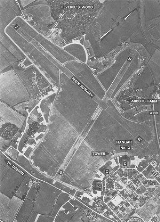
RAF Debden is a former RAF airfield
in England
. The field is located 3 miles SE of Saffron Walden
and approximately 1 mile north of the village of Debden
in North Essex
.
. One of Debden's early and most bizarre experiences was when the airfield was chosen as a location for the film "It's in the Air
" in which George Formby was to pilot a Hawker Fury
through Hangar No. 3. The rather sharper angle of the hangars at Debden built around the tarmac apron allowed free access at both ends of the end hangar. The flying for the sequence was actually done by Flying Officer R. H. A. Lee who went missing on August 18, 1940 when he was last seen ten miles north of Foulness
Point chasing three German aircraft out to sea.
Hard surface runways were laid in 1940. During the early years of World War II
it was a Sector Station, with an Operations Block for No.11 Group RAF during the Battle of Britain
. Many different RAF units were based at Debden, including 1, 17, 29, 65, 73, 80, 85, 87, 111, 157, 257, 418, 504 and 601 Squadrons.
The airfield was attacked several times during the Battle of Britain. The first air-raid sounded on 18 June 1940, although the first bombs were not dropped on the airfield until seven days later. Then, on 2 August, came a heavy attack which destroyed several buildings, killing five, to be followed by another severe raid on 31 August. During August and September, Debden fighters claimed seventy aircraft destroyed, thirty probables and forty-one damaged.
On 28 January 1941, the station was visited by King George VI and Queen Elizabeth
, and the following month by a German aircrew; it was on 4 February 1941 that a German pilot landed his aircraft and taxied to the watch office (control tower), at which point the German pilot must have realised his mistake as he took off in a hurry.
During May through into September 1942 Debden was used by No. 71
, 121
and 133
"Eagle Squadron
s" with Spitfire V
's.
. Debden was assigned USAAF designation Station 156.
With the transfer of the airfield and the entry of the United States
into the war, Americans serving in the RAF Eagle squadron
s were transferred into the American ranks, with 71, 121 and 133 RAF Eagle Squadrons becoming the 4th Fighter Group. The group was under the command of the 65th Fighter Wing of the VIII Fighter Command
. Aircraft of the group were identified by red around their cowlings and tails.
The group consisted of the following squadrons:
The 4th Fighter Group destroyed more enemy aircraft in the air and on the ground than any other fighter group of the Eighth Air Force. The group operated first with Spitfire
s but changed to Republic P-47 Thunderbolts in March 1943 and to North American P-51 Mustangs in April 1944.
On numerous occasions the 4th FG escorted B-17 Flying Fortresses and B-24 Liberator bombers that were attacking factories, submarine pen
s, V-weapon sites, and other targets in France
, the Low Countries, or Germany
. The group went out sometimes with a small force of bombers to draw up the enemy's fighters so they could be destroyed in aerial combat. At other times the 4th attacked the enemy's air power by strafing and dive-bombing airfields. They also hit troops, supply depots, roads, bridges, rail lines, and trains.
The unit participated in the intensive campaign against the German Air Force
and aircraft industry during Big Week
, 20–25 February 1944. They received a Distinguished Unit Citation for aggressiveness in seeking out and destroying enemy aircraft and in attacking enemy air bases during the period 5 March - 24 April 1944.
The 4th FG flew interdictory and counter-air missions during the invasion of Normandy
in June 1944 and supported the airborne invasion of Holland in September. They participated in the Battle of the Bulge
, December 1944-January 1945, and provided cover for the airborne assault across the Rhine
in March 1945.
In October 1944, No. 616 Squadron RAF
, the first RAF jet unit, had a detachment of Gloster Meteor
s at Debden to practise affiliation tactics with the 4th Fighter Group.
With the cessation of hostilities, the group was briefly moved to RAF Steeple Morden
in early July, then on 10 November the group was inactivated at Camp Kilmer
New Jersey
.
control on 5 September 1945. Debden became a unit of the Technical Training Commission, firstly, as the Empire Radio School then, in 1949, a Signals Division and later the Debden Division of the RAF Technical College, later being joined by a Bomb Disposal Unit and a Motor Transport Repair Unit.
On 18 October 1973 a Nissen hut, officially designated Building 210 which had been used by the 4th Fighter Group during the war was presented to the USAF to be flown to the Wright-Patterson AFB Ohio
to be re-assembled and displayed in the USAF museum.
The RAF Police Dog Unit, members of which had toured America in September 1969 and which was reviewed by H.R.H. Princess Margaret on 5 June 1973, was withdrawn from Debden in 1974, the station officially closed on 21 August 1975. The RAF Police training school had by then moved to RAF Newton in Nottingham.
and is currently home to 33 Engineer Regt
. Due to its postwar use, the airfield and technical site is almost completely intact from its World War II configuration, although the "C" type hangars made famous by Formby have now been demolished.
RAF station
A Royal Air Force station is a permanent Royal Air Force operations location. Many RAF stations are aerodromes, or airbases, being the home to one or more flying squadrons. Other RAF stations are training units, administrative units, headquarters , or carry out ground-based operational tasks...
in England
England
England is a country that is part of the United Kingdom. It shares land borders with Scotland to the north and Wales to the west; the Irish Sea is to the north west, the Celtic Sea to the south west, with the North Sea to the east and the English Channel to the south separating it from continental...
. The field is located 3 miles SE of Saffron Walden
Saffron Walden
Saffron Walden is a medium-sized market town in the Uttlesford district of Essex, England. It is located north of Bishop's Stortford, south of Cambridge and approx north of London...
and approximately 1 mile north of the village of Debden
Debden, Uttlesford
Debden is a small rural village in the Uttlesford district of Essex in the East of England.It is located 4 miles from Saffron Walden and 17 miles from Cambridge.RAF Debden is nearby and played a role in the Second World War....
in North Essex
Essex
Essex is a ceremonial and non-metropolitan county in the East region of England, and one of the home counties. It is located to the northeast of Greater London. It borders with Cambridgeshire and Suffolk to the north, Hertfordshire to the west, Kent to the South and London to the south west...
.
RAF Fighter Command
The airfield was opened in April 1937 and was first used by the Royal Air ForceRoyal Air Force
The Royal Air Force is the aerial warfare service branch of the British Armed Forces. Formed on 1 April 1918, it is the oldest independent air force in the world...
. One of Debden's early and most bizarre experiences was when the airfield was chosen as a location for the film "It's in the Air
It's in the Air
It’s in the Air is a 1938 British slapstick comedy film. It was released in the United States as George Takes the Air in 1940.- Plot outline :...
" in which George Formby was to pilot a Hawker Fury
Hawker Fury
The Hawker Fury was a British biplane fighter aircraft used by the Royal Air Force in the 1930s. It was originally named the Hornet and was the counterpart to the Hawker Hart light bomber.-Design and development:...
through Hangar No. 3. The rather sharper angle of the hangars at Debden built around the tarmac apron allowed free access at both ends of the end hangar. The flying for the sequence was actually done by Flying Officer R. H. A. Lee who went missing on August 18, 1940 when he was last seen ten miles north of Foulness
Foulness
Foulness is an island on the east coast of Essex in England, which is separated from the mainland by narrow creeks. The large island had a usually resident population of 212 people in the 2001 census, who live in the settlements of Churchend and Courtsend, at the north end of Foulness. The island...
Point chasing three German aircraft out to sea.
Hard surface runways were laid in 1940. During the early years of World War II
World War II
World War II, or the Second World War , was a global conflict lasting from 1939 to 1945, involving most of the world's nations—including all of the great powers—eventually forming two opposing military alliances: the Allies and the Axis...
it was a Sector Station, with an Operations Block for No.11 Group RAF during the Battle of Britain
Battle of Britain
The Battle of Britain is the name given to the World War II air campaign waged by the German Air Force against the United Kingdom during the summer and autumn of 1940...
. Many different RAF units were based at Debden, including 1, 17, 29, 65, 73, 80, 85, 87, 111, 157, 257, 418, 504 and 601 Squadrons.
The airfield was attacked several times during the Battle of Britain. The first air-raid sounded on 18 June 1940, although the first bombs were not dropped on the airfield until seven days later. Then, on 2 August, came a heavy attack which destroyed several buildings, killing five, to be followed by another severe raid on 31 August. During August and September, Debden fighters claimed seventy aircraft destroyed, thirty probables and forty-one damaged.
On 28 January 1941, the station was visited by King George VI and Queen Elizabeth
Elizabeth Bowes-Lyon
Elizabeth Angela Marguerite Bowes-Lyon was the queen consort of King George VI from 1936 until her husband's death in 1952, after which she was known as Queen Elizabeth The Queen Mother, to avoid confusion with her daughter, Queen Elizabeth II...
, and the following month by a German aircrew; it was on 4 February 1941 that a German pilot landed his aircraft and taxied to the watch office (control tower), at which point the German pilot must have realised his mistake as he took off in a hurry.
During May through into September 1942 Debden was used by No. 71
No. 71 Squadron RAF
No. 71 Squadron is a Royal Air Force aircraft squadron, the number has been used three times, once by the Royal Flying Corps for an Australian Flying Corps squadron, in the second world war as an Eagle Squadron and post-war as a fighter-bomber unit based in Royal Air Force Germany.-First World...
, 121
No. 121 Squadron RAF
No. 121 Squadron was a Royal Air Force aircraft squadron that during the Second World War was one of the three Eagle Squadrons manned by American volunteers.-In World War I:...
and 133
No. 133 Squadron RAF
133 Squadron RAF was one of the famous Eagle squadrons formed from American volunteers serving with the RAF during World War II.-History:133 Squadron was first formed in 1918 at RAF Ternhill. It was a training unit for the Handley Page O/400, flying the Royal Aircraft Factory F.E.2, that was...
"Eagle Squadron
Eagle squadron
The Eagle Squadrons were 3 fighter squadrons of the Royal Air Force formed during World War II with volunteer pilots from the United States...
s" with Spitfire V
Supermarine Spitfire
The Supermarine Spitfire is a British single-seat fighter aircraft that was used by the Royal Air Force and many other Allied countries throughout the Second World War. The Spitfire continued to be used as a front line fighter and in secondary roles into the 1950s...
's.
USAAF
The airfield was transferred on 12 September 1942 to the United States Army Air Force Eighth Air ForceEighth Air Force
The Eighth Air Force is a numbered air force of the United States Air Force Global Strike Command . It is headquartered at Barksdale Air Force Base, Louisiana....
. Debden was assigned USAAF designation Station 156.
With the transfer of the airfield and the entry of the United States
United States
The United States of America is a federal constitutional republic comprising fifty states and a federal district...
into the war, Americans serving in the RAF Eagle squadron
Eagle squadron
The Eagle Squadrons were 3 fighter squadrons of the Royal Air Force formed during World War II with volunteer pilots from the United States...
s were transferred into the American ranks, with 71, 121 and 133 RAF Eagle Squadrons becoming the 4th Fighter Group. The group was under the command of the 65th Fighter Wing of the VIII Fighter Command
VIII Fighter Command
The VIII Fighter Command is an inactive United States Air Force organization. Its last assignment was with the United States Air Forces in Europe, being stationed at RAF Honington, England. It was inactivated on 20 March 1946....
. Aircraft of the group were identified by red around their cowlings and tails.
The group consisted of the following squadrons:
- 334th Fighter Squadron334th Fighter SquadronThe 334th Fighter Squadron ' is a United States Air Force unit. It is assigned to the 4th Operations Group and stationed at Seymour Johnson Air Force Base, North Carolina....
(QP) (Former 71 Squadron) - 335th Fighter Squadron335th Fighter SquadronThe 335th Fighter Squadron ' is a United States Air Force unit. It is assigned to the 4th Operations Group and stationed at Seymour Johnson Air Force Base, North Carolina....
(WD) (Former 121 Squadron) - 336th Fighter Squadron336th Fighter SquadronThe 336th Fighter Squadron ' is a United States Air Force unit. It is assigned to the 4th Operations Group and stationed at Seymour Johnson Air Force Base, North Carolina....
(VF) (Former 133 Squadron)
The 4th Fighter Group destroyed more enemy aircraft in the air and on the ground than any other fighter group of the Eighth Air Force. The group operated first with Spitfire
Supermarine Spitfire
The Supermarine Spitfire is a British single-seat fighter aircraft that was used by the Royal Air Force and many other Allied countries throughout the Second World War. The Spitfire continued to be used as a front line fighter and in secondary roles into the 1950s...
s but changed to Republic P-47 Thunderbolts in March 1943 and to North American P-51 Mustangs in April 1944.
On numerous occasions the 4th FG escorted B-17 Flying Fortresses and B-24 Liberator bombers that were attacking factories, submarine pen
Submarine pen
A submarine pen is a bunker which is designed to protect submarines from air attack.The term is generally applied to submarine bases constructed during World War II, particularly in Germany and the occupied countries which were also known as U-boat pens .-Background:Amongst the first...
s, V-weapon sites, and other targets in France
France
The French Republic , The French Republic , The French Republic , (commonly known as France , is a unitary semi-presidential republic in Western Europe with several overseas territories and islands located on other continents and in the Indian, Pacific, and Atlantic oceans. Metropolitan France...
, the Low Countries, or Germany
Germany
Germany , officially the Federal Republic of Germany , is a federal parliamentary republic in Europe. The country consists of 16 states while the capital and largest city is Berlin. Germany covers an area of 357,021 km2 and has a largely temperate seasonal climate...
. The group went out sometimes with a small force of bombers to draw up the enemy's fighters so they could be destroyed in aerial combat. At other times the 4th attacked the enemy's air power by strafing and dive-bombing airfields. They also hit troops, supply depots, roads, bridges, rail lines, and trains.
The unit participated in the intensive campaign against the German Air Force
Luftwaffe
Luftwaffe is a generic German term for an air force. It is also the official name for two of the four historic German air forces, the Wehrmacht air arm founded in 1935 and disbanded in 1946; and the current Bundeswehr air arm founded in 1956....
and aircraft industry during Big Week
Big Week
Between February 20–25, 1944, as part of the European strategic bombing campaign, the United States Strategic Air Forces launched Operation Argument, a series of missions against the Third Reich that became known as Big Week. The planners intended to lure the Luftwaffe into a decisive battle by...
, 20–25 February 1944. They received a Distinguished Unit Citation for aggressiveness in seeking out and destroying enemy aircraft and in attacking enemy air bases during the period 5 March - 24 April 1944.
The 4th FG flew interdictory and counter-air missions during the invasion of Normandy
D-Day
D-Day is a term often used in military parlance to denote the day on which a combat attack or operation is to be initiated. "D-Day" often represents a variable, designating the day upon which some significant event will occur or has occurred; see Military designation of days and hours for similar...
in June 1944 and supported the airborne invasion of Holland in September. They participated in the Battle of the Bulge
Battle of the Bulge
The Battle of the Bulge was a major German offensive , launched toward the end of World War II through the densely forested Ardennes mountain region of Wallonia in Belgium, hence its French name , and France and...
, December 1944-January 1945, and provided cover for the airborne assault across the Rhine
Operation Varsity
Operation Varsity was a successful joint American–British airborne operation that took place toward the end of World War II...
in March 1945.
In October 1944, No. 616 Squadron RAF
No. 616 Squadron RAF
No. 616 Squadron was a unit of the British Auxiliary Air Force and later the Royal Auxiliary Air Force between 1938 and 1957.-Formation:...
, the first RAF jet unit, had a detachment of Gloster Meteor
Gloster Meteor
The Gloster Meteor was the first British jet fighter and the Allies' first operational jet. It first flew in 1943 and commenced operations on 27 July 1944 with 616 Squadron of the Royal Air Force...
s at Debden to practise affiliation tactics with the 4th Fighter Group.
With the cessation of hostilities, the group was briefly moved to RAF Steeple Morden
RAF Steeple Morden
RAF Steeple Morden is a former World War II airfield in England. The field was located 3½ miles W of Royston in Cambridgeshire, near the village of Steeple Morden.-RAF Bomber Command use:...
in early July, then on 10 November the group was inactivated at Camp Kilmer
Camp Kilmer
Camp Kilmer, New Jersey is a former United States Army camp that was activated in June 1942 as a staging area and part of an installation of the New York Port of Embarkation. The camp was organized as part of the Army Service Forces Transportation Corps. Troops were quartered at Camp Kilmer in...
New Jersey
New Jersey
New Jersey is a state in the Northeastern and Middle Atlantic regions of the United States. , its population was 8,791,894. It is bordered on the north and east by the state of New York, on the southeast and south by the Atlantic Ocean, on the west by Pennsylvania and on the southwest by Delaware...
.
Postwar Royal Air Force use
Debden was returned to Royal Air ForceRoyal Air Force
The Royal Air Force is the aerial warfare service branch of the British Armed Forces. Formed on 1 April 1918, it is the oldest independent air force in the world...
control on 5 September 1945. Debden became a unit of the Technical Training Commission, firstly, as the Empire Radio School then, in 1949, a Signals Division and later the Debden Division of the RAF Technical College, later being joined by a Bomb Disposal Unit and a Motor Transport Repair Unit.
On 18 October 1973 a Nissen hut, officially designated Building 210 which had been used by the 4th Fighter Group during the war was presented to the USAF to be flown to the Wright-Patterson AFB Ohio
Ohio
Ohio is a Midwestern state in the United States. The 34th largest state by area in the U.S.,it is the 7th‑most populous with over 11.5 million residents, containing several major American cities and seven metropolitan areas with populations of 500,000 or more.The state's capital is Columbus...
to be re-assembled and displayed in the USAF museum.
The RAF Police Dog Unit, members of which had toured America in September 1969 and which was reviewed by H.R.H. Princess Margaret on 5 June 1973, was withdrawn from Debden in 1974, the station officially closed on 21 August 1975. The RAF Police training school had by then moved to RAF Newton in Nottingham.
British Army
After the RAF left the site became Carver BarracksCarver Barracks
Carver Barracks is a British Army base based on the former site of RAF Debden, approximately 1 mile north of the village of Debden, in Essex.The airfield was built in 1935-37 and the runways laid in 1940. It was first occupied by the United States Army Air Forces in September 1942...
and is currently home to 33 Engineer Regt
Royal Engineers
The Corps of Royal Engineers, usually just called the Royal Engineers , and commonly known as the Sappers, is one of the corps of the British Army....
. Due to its postwar use, the airfield and technical site is almost completely intact from its World War II configuration, although the "C" type hangars made famous by Formby have now been demolished.