


Qutb-ud-din Aybak

Encyclopedia
Qutb-ud-din Aibak was a Turkic king of Northwest India who ruled from his capital in Delhi
where he built the Qutub Minar
and the Quwwat Al Islam mosque. He was of Turkic descent from central Asia, the first Sultan of Delhi and founder of the Slave dynasty
(also known as the Ghulam
dynasty) of India. He ruled for only four years, from 1206 to 1210 AD. He died while playing polo in Lahore
.
 Qutbuddin was born somewhere in the area of what is today known as Afghanistan
; he was of Turkic
descent. There are also evidence that he might be from the town of Aibak which serves as the provincial capital of Samangan Province
. While still a child he was captured and sold as a slave (ghulam). He was purchased by the chief Qazi
of Nishapur
, a town in the province of Khorasan
in northeastern Iran
. The Qazi treated him like one of his own sons, and Aibak received a very good education in all the major subjects, was a very brave warrior and an appreciable ruler and intelligent in languages including fluency in Persian
and Arabic
and training in archery and horsemanship. When his master died, his master's sons, who were jealous of Aibak, sold him to a slave merchant. Aibak was, then, finally purchased by the great General Shahabuddin Muhammad Ghauri, then governor of Ghazni
.
, an Aimak
principality, Shahabuddin Ghauri proved to be a distinguished personality of the history and managed to establish control over most of present-day Afghanistan
, Pakistan
and northern India. Under his command, Qutbuddin conquered Delhi
in 1193 after the victory in the Battles of Tarain
. As governor of northern India, Aibak was very refined and established the first verifiable Muslim administration through collection of state taxes, establishing the rule of law, equitable distribution of land and revenues to the nobles under his charge, and governance based on a mixture of locally elected representation through Mashura courts and nominated administrators on every rank to ensure the good working of the government.
Qutbuddin rose through the ranks to become the Emperor Muhammad Ghauri's most trusted general. His greatest military successes occurred while he was directly under Ghauri's guidance and leadership. Qutb was responsible for executing and consolidating Ghauri's conquests in northern India. He was left in increasingly independent charge of the Indian campaigns and the exaction of levies from the areas in India
that were under Sultan Ghauri's conquests, as after 1192 the ambitious Sultan Ghauri concentrated on Central Asia
.
In 1206, the Emperor Ghauri appointed Qutb-ud-din Aibak as his Naib us Sultanat in India at a grand darbar (reception) at Lahore, which was attended by a large majority of the nobles and dignitaries of his vast empire. It was at this occasion that Ghauri bestowed upon Qutb-ud-din the title of Aibak, meaning "Axis of the Faith".
, Pakistan
, and northern India; Shahabuddin Muhammad's Central Asian possessions had been captured by none other than the Mongol warlord, Genghis Khan
.
 The areas over which Aibak established his rule were those over which he already exercised power as Ghauri's local receiver-general of periodic exactions and levies. He did not attack other kingdoms without any reason and concentrated on the development of the existing empire. Therefore, although his formal tenure as ruler was only four years, Aibak managed to consolidate thoroughly the administrative system that was established by his predecessor and master Shahabuddin Ghauri. This was achieved despite his having to quell powerful rebellions by nobles like Taj-ud-din Ildiz and Nasir-ud-din Qubacha. Qutbuddin ruled his empire initially from the Capital Lahore
and later moved the capital to Delhi
; he is hence considered the first Muslim ruler of South Asia
.
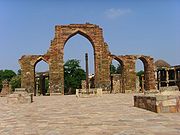
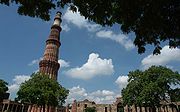
Qutbuddin Aibak was a very refined and inticrate builder. He led the constructions of the security towers, check posts, tax posts and a few of the forts in the most important cities of his empire to avoid plunderings and loots. He also initiated the construction of Delhi
's earliest Muslim
monuments, the Quwwat-ul-Islam mosque and the Qutub Minar
.
Historical records compiled by Muslim historian Maulana Hakim Saiyid Abdul Hai attest to the iconoclasm of Qutbuddin Aibak. The first mosque built in Delhi. These were completed by his successor, Iltutmish
. He patronized Nizami and Fakh-i-Mudabbir, both of whom dedicated their works to Aibak. Tazul Maasir is a work primarily dealing with Aibak.
in Lahore
on horseback (Polo
known as Chougan
in India), his horse fell and the sultan was impaled on the pommel of his saddle
. He was buried near the Anarkali bazaar
in Lahore
. Aibak's son Aram, died in 1211 CE, so Shams-ud-din Iltutmish
, another ex-slave and an outstanding ruler of Turkic
ancestry who was married to Aibak's daughter, succeeded him as Sultan of Delhi.
Aibak's tomb is located behind Anarkali Bazaar
, Lahore
today and is a famous tourist site. In the early 1970s, it was renovated at the orders of the then Prime Minister
Zulfiqar Ali Bhutto.
Delhi
Delhi , officially National Capital Territory of Delhi , is the largest metropolis by area and the second-largest by population in India, next to Mumbai. It is the eighth largest metropolis in the world by population with 16,753,265 inhabitants in the Territory at the 2011 Census...
where he built the Qutub Minar
Qutub Minar
Qutub Minar also Qutb Minar, is a UNESCO World Heritage Site. Located in Delhi, India. The Qutub Minar is constructed with red sandstone and marble, and is the tallest minaret in India, with a height of 72.5 meters , contains 379 stairs to reach the top, and the diameter of base is 14.3 meters...
and the Quwwat Al Islam mosque. He was of Turkic descent from central Asia, the first Sultan of Delhi and founder of the Slave dynasty
Slave dynasty
The Slave Dynasty or Mamluk Dynasty or Ghulam Dynasty , was directed into India by Qutb-ud-din Aybak, a Turkic general of Central Asian birth. It was the first of five unrelated dynasties to rule India's Delhi Sultanate from 1206 to 1290...
(also known as the Ghulam
Ghilman
Ghilman Ghilman Ghilman (singular ghulam describes either young servants in paradise or slave-soldiers in the Ottoman, Mughal and Persian Empires.-Islamic Theology:...
dynasty) of India. He ruled for only four years, from 1206 to 1210 AD. He died while playing polo in Lahore
Lahore
Lahore is the capital of the Pakistani province of Punjab and the second largest city in the country. With a rich and fabulous history dating back to over a thousand years ago, Lahore is no doubt Pakistan's cultural capital. One of the most densely populated cities in the world, Lahore remains a...
.
Early years
Afghanistan
Afghanistan , officially the Islamic Republic of Afghanistan, is a landlocked country located in the centre of Asia, forming South Asia, Central Asia and the Middle East. With a population of about 29 million, it has an area of , making it the 42nd most populous and 41st largest nation in the world...
; he was of Turkic
Turkic peoples
The Turkic peoples are peoples residing in northern, central and western Asia, southern Siberia and northwestern China and parts of eastern Europe. They speak languages belonging to the Turkic language family. They share, to varying degrees, certain cultural traits and historical backgrounds...
descent. There are also evidence that he might be from the town of Aibak which serves as the provincial capital of Samangan Province
Samangan Province
Samangan is one of the thirty-four provinces of Afghanistan. The province covers and has a population of approximately 313,211, as of 2006.Its capital, Samangan, is known for its ancient ruins including, notably, the Takht e Rostam...
. While still a child he was captured and sold as a slave (ghulam). He was purchased by the chief Qazi
Qadi
Qadi is a judge ruling in accordance with Islamic religious law appointed by the ruler of a Muslim country. Because Islam makes no distinction between religious and secular domains, qadis traditionally have jurisdiction over all legal matters involving Muslims...
of Nishapur
Nishapur
Nishapur or Nishabur , is a city in the Razavi Khorasan province in northeastern Iran, situated in a fertile plain at the foot of the Binalud Mountains, near the regional capital of Mashhad...
, a town in the province of Khorasan
Greater Khorasan
Greater Khorasan or Ancient Khorasan is a historical region of Greater Iran mentioned in sources from Sassanid and Islamic eras which "frequently" had a denotation wider than current three provinces of Khorasan in Iran...
in northeastern Iran
Iran
Iran , officially the Islamic Republic of Iran , is a country in Southern and Western Asia. The name "Iran" has been in use natively since the Sassanian era and came into use internationally in 1935, before which the country was known to the Western world as Persia...
. The Qazi treated him like one of his own sons, and Aibak received a very good education in all the major subjects, was a very brave warrior and an appreciable ruler and intelligent in languages including fluency in Persian
Persian language
Persian is an Iranian language within the Indo-Iranian branch of the Indo-European languages. It is primarily spoken in Iran, Afghanistan, Tajikistan and countries which historically came under Persian influence...
and Arabic
Arabic language
Arabic is a name applied to the descendants of the Classical Arabic language of the 6th century AD, used most prominently in the Quran, the Islamic Holy Book...
and training in archery and horsemanship. When his master died, his master's sons, who were jealous of Aibak, sold him to a slave merchant. Aibak was, then, finally purchased by the great General Shahabuddin Muhammad Ghauri, then governor of Ghazni
Ghazni
For the Province of Ghazni see Ghazni ProvinceGhazni is a city in central-east Afghanistan with a population of about 141,000 people...
.
Rise to power
Starting with his native GhoriGhori
Ghori also refers to a resident of Ghor Province in Afghanistan----Ghori is a small town in Pakistani Controlled Azad Kashmir, located at 34°27'0N, 73°30'0E . It lies near to the epicentre of the 2005 Kashmir earthquake....
, an Aimak
Aimak
Aymāq , also transliterated as Aimak or Aimaq, are a collection of Persian-speaking nomadic and semi-nomadic tribes. They are found throughout the north and northwest highlands of Afghanistan, immediately to the north of Herat, and in the Khorasan Province of Iran...
principality, Shahabuddin Ghauri proved to be a distinguished personality of the history and managed to establish control over most of present-day Afghanistan
Afghanistan
Afghanistan , officially the Islamic Republic of Afghanistan, is a landlocked country located in the centre of Asia, forming South Asia, Central Asia and the Middle East. With a population of about 29 million, it has an area of , making it the 42nd most populous and 41st largest nation in the world...
, Pakistan
Pakistan
Pakistan , officially the Islamic Republic of Pakistan is a sovereign state in South Asia. It has a coastline along the Arabian Sea and the Gulf of Oman in the south and is bordered by Afghanistan and Iran in the west, India in the east and China in the far northeast. In the north, Tajikistan...
and northern India. Under his command, Qutbuddin conquered Delhi
Delhi
Delhi , officially National Capital Territory of Delhi , is the largest metropolis by area and the second-largest by population in India, next to Mumbai. It is the eighth largest metropolis in the world by population with 16,753,265 inhabitants in the Territory at the 2011 Census...
in 1193 after the victory in the Battles of Tarain
Battles of Tarain
The Battles of Tarain, also known as the Battles of Taraori, were fought in 1191 and 1192 near the town of Tarain , near Thanesar in present-day Haryana, approximately 150 kilometres north of Delhi, India, between the Muslim Ghurid army led by Sultan Shahabuddin Muhammad Ghauri and the Hindu Rajput...
. As governor of northern India, Aibak was very refined and established the first verifiable Muslim administration through collection of state taxes, establishing the rule of law, equitable distribution of land and revenues to the nobles under his charge, and governance based on a mixture of locally elected representation through Mashura courts and nominated administrators on every rank to ensure the good working of the government.
Qutbuddin rose through the ranks to become the Emperor Muhammad Ghauri's most trusted general. His greatest military successes occurred while he was directly under Ghauri's guidance and leadership. Qutb was responsible for executing and consolidating Ghauri's conquests in northern India. He was left in increasingly independent charge of the Indian campaigns and the exaction of levies from the areas in India
India
India , officially the Republic of India , is a country in South Asia. It is the seventh-largest country by geographical area, the second-most populous country with over 1.2 billion people, and the most populous democracy in the world...
that were under Sultan Ghauri's conquests, as after 1192 the ambitious Sultan Ghauri concentrated on Central Asia
Central Asia
Central Asia is a core region of the Asian continent from the Caspian Sea in the west, China in the east, Afghanistan in the south, and Russia in the north...
.
In 1206, the Emperor Ghauri appointed Qutb-ud-din Aibak as his Naib us Sultanat in India at a grand darbar (reception) at Lahore, which was attended by a large majority of the nobles and dignitaries of his vast empire. It was at this occasion that Ghauri bestowed upon Qutb-ud-din the title of Aibak, meaning "Axis of the Faith".
Founding of the Delhi Sultanate
Muhammad Ghauri established the first real Muslim state in North India. Upon Sultan Ghauri's death in 1206, Qutb, after a brief power struggle, succeeded in establishing himself as ruler of the kingdom in AfghanistanAfghanistan
Afghanistan , officially the Islamic Republic of Afghanistan, is a landlocked country located in the centre of Asia, forming South Asia, Central Asia and the Middle East. With a population of about 29 million, it has an area of , making it the 42nd most populous and 41st largest nation in the world...
, Pakistan
Pakistan
Pakistan , officially the Islamic Republic of Pakistan is a sovereign state in South Asia. It has a coastline along the Arabian Sea and the Gulf of Oman in the south and is bordered by Afghanistan and Iran in the west, India in the east and China in the far northeast. In the north, Tajikistan...
, and northern India; Shahabuddin Muhammad's Central Asian possessions had been captured by none other than the Mongol warlord, Genghis Khan
Genghis Khan
Genghis Khan , born Temujin and occasionally known by his temple name Taizu , was the founder and Great Khan of the Mongol Empire, which became the largest contiguous empire in history after his death....
.
Lahore
Lahore is the capital of the Pakistani province of Punjab and the second largest city in the country. With a rich and fabulous history dating back to over a thousand years ago, Lahore is no doubt Pakistan's cultural capital. One of the most densely populated cities in the world, Lahore remains a...
and later moved the capital to Delhi
Delhi
Delhi , officially National Capital Territory of Delhi , is the largest metropolis by area and the second-largest by population in India, next to Mumbai. It is the eighth largest metropolis in the world by population with 16,753,265 inhabitants in the Territory at the 2011 Census...
; he is hence considered the first Muslim ruler of South Asia
South Asia
South Asia, also known as Southern Asia, is the southern region of the Asian continent, which comprises the sub-Himalayan countries and, for some authorities , also includes the adjoining countries to the west and the east...
.
Qutbuddin Aibak was a very refined and inticrate builder. He led the constructions of the security towers, check posts, tax posts and a few of the forts in the most important cities of his empire to avoid plunderings and loots. He also initiated the construction of Delhi
Delhi
Delhi , officially National Capital Territory of Delhi , is the largest metropolis by area and the second-largest by population in India, next to Mumbai. It is the eighth largest metropolis in the world by population with 16,753,265 inhabitants in the Territory at the 2011 Census...
's earliest Muslim
Muslim
A Muslim, also spelled Moslem, is an adherent of Islam, a monotheistic, Abrahamic religion based on the Quran, which Muslims consider the verbatim word of God as revealed to prophet Muhammad. "Muslim" is the Arabic term for "submitter" .Muslims believe that God is one and incomparable...
monuments, the Quwwat-ul-Islam mosque and the Qutub Minar
Qutub Minar
Qutub Minar also Qutb Minar, is a UNESCO World Heritage Site. Located in Delhi, India. The Qutub Minar is constructed with red sandstone and marble, and is the tallest minaret in India, with a height of 72.5 meters , contains 379 stairs to reach the top, and the diameter of base is 14.3 meters...
.
Historical records compiled by Muslim historian Maulana Hakim Saiyid Abdul Hai attest to the iconoclasm of Qutbuddin Aibak. The first mosque built in Delhi. These were completed by his successor, Iltutmish
Iltutmish
Shams-ud-din Iltutmish was the third ruler of the Mamluk dynasty of Delhi of Turkic origin. He was a slave of Qutub-ud-din-Aybak and later became his son-in-law and close lieutenant. He was the Governor of Badaun when he deposed Qutub-ud-din's successor Aram Shah and acceeded to the throne of the...
. He patronized Nizami and Fakh-i-Mudabbir, both of whom dedicated their works to Aibak. Tazul Maasir is a work primarily dealing with Aibak.
Death and succession
Sultan Qutbuddin died accidentally in 1210. While he was playing a game of poloPolo
Polo is a team sport played on horseback in which the objective is to score goals against an opposing team. Sometimes called, "The Sport of Kings", it was highly popularized by the British. Players score by driving a small white plastic or wooden ball into the opposing team's goal using a...
in Lahore
Lahore
Lahore is the capital of the Pakistani province of Punjab and the second largest city in the country. With a rich and fabulous history dating back to over a thousand years ago, Lahore is no doubt Pakistan's cultural capital. One of the most densely populated cities in the world, Lahore remains a...
on horseback (Polo
Polo
Polo is a team sport played on horseback in which the objective is to score goals against an opposing team. Sometimes called, "The Sport of Kings", it was highly popularized by the British. Players score by driving a small white plastic or wooden ball into the opposing team's goal using a...
known as Chougan
Polo
Polo is a team sport played on horseback in which the objective is to score goals against an opposing team. Sometimes called, "The Sport of Kings", it was highly popularized by the British. Players score by driving a small white plastic or wooden ball into the opposing team's goal using a...
in India), his horse fell and the sultan was impaled on the pommel of his saddle
Saddle
A saddle is a supportive structure for a rider or other load, fastened to an animal's back by a girth. The most common type is the equestrian saddle designed for a horse, but specialized saddles have been created for camels and other creatures...
. He was buried near the Anarkali bazaar
Anarkali bazaar
Anarkali bazaar is a famous bazār in Lahore, Punjab, Pakistan. It is one of the oldest surviving markets in South Asia, dating back at least 200 years...
in Lahore
Lahore
Lahore is the capital of the Pakistani province of Punjab and the second largest city in the country. With a rich and fabulous history dating back to over a thousand years ago, Lahore is no doubt Pakistan's cultural capital. One of the most densely populated cities in the world, Lahore remains a...
. Aibak's son Aram, died in 1211 CE, so Shams-ud-din Iltutmish
Iltutmish
Shams-ud-din Iltutmish was the third ruler of the Mamluk dynasty of Delhi of Turkic origin. He was a slave of Qutub-ud-din-Aybak and later became his son-in-law and close lieutenant. He was the Governor of Badaun when he deposed Qutub-ud-din's successor Aram Shah and acceeded to the throne of the...
, another ex-slave and an outstanding ruler of Turkic
Turkic peoples
The Turkic peoples are peoples residing in northern, central and western Asia, southern Siberia and northwestern China and parts of eastern Europe. They speak languages belonging to the Turkic language family. They share, to varying degrees, certain cultural traits and historical backgrounds...
ancestry who was married to Aibak's daughter, succeeded him as Sultan of Delhi.
Aibak's tomb is located behind Anarkali Bazaar
Anarkali bazaar
Anarkali bazaar is a famous bazār in Lahore, Punjab, Pakistan. It is one of the oldest surviving markets in South Asia, dating back at least 200 years...
, Lahore
Lahore
Lahore is the capital of the Pakistani province of Punjab and the second largest city in the country. With a rich and fabulous history dating back to over a thousand years ago, Lahore is no doubt Pakistan's cultural capital. One of the most densely populated cities in the world, Lahore remains a...
today and is a famous tourist site. In the early 1970s, it was renovated at the orders of the then Prime Minister
Prime Minister of Pakistan
The Prime Minister of Pakistan , is the Head of Government of Pakistan who is designated to exercise as the country's Chief Executive. By the Constitution of Pakistan, Pakistan has the parliamentary democratic system of government...
Zulfiqar Ali Bhutto.
See also
- History of IndiaHistory of IndiaThe history of India begins with evidence of human activity of Homo sapiens as long as 75,000 years ago, or with earlier hominids including Homo erectus from about 500,000 years ago. The Indus Valley Civilization, which spread and flourished in the northwestern part of the Indian subcontinent from...
- List of mausolea
- Mamluk dynasty of Delhi
- Quwwat-ul-Islam mosque