

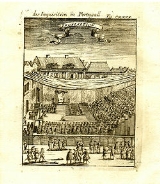
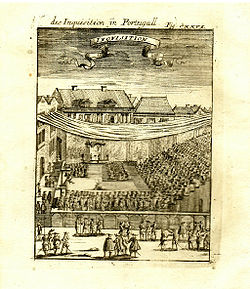
Portuguese Inquisition

Encyclopedia
Portugal
Portugal , officially the Portuguese Republic is a country situated in southwestern Europe on the Iberian Peninsula. Portugal is the westernmost country of Europe, and is bordered by the Atlantic Ocean to the West and South and by Spain to the North and East. The Atlantic archipelagos of the...
in 1536 at the request of the King of Portugal, João III. Manuel I
Manuel I of Portugal
Manuel I , the Fortunate , 14th king of Portugal and the Algarves was the son of Infante Ferdinand, Duke of Viseu, , by his wife, Infanta Beatrice of Portugal...
had asked for the installation of the Inquisition
Inquisition
The Inquisition, Inquisitio Haereticae Pravitatis , was the "fight against heretics" by several institutions within the justice-system of the Roman Catholic Church. It started in the 12th century, with the introduction of torture in the persecution of heresy...
in 1515 to fulfill the commitment of marriage with Maria of Aragon, but it was only after his death that the Pope acquiesced. This inquisition was a Portuguese analogue of the Spanish Inquisition
Spanish Inquisition
The Tribunal of the Holy Office of the Inquisition , commonly known as the Spanish Inquisition , was a tribunal established in 1480 by Catholic Monarchs Ferdinand II of Aragon and Isabella I of Castile. It was intended to maintain Catholic orthodoxy in their kingdoms, and to replace the Medieval...
.
History
The major target of the Portuguese Inquisition were those who had converted from JudaismJudaism
Judaism ) is the "religion, philosophy, and way of life" of the Jewish people...
to Catholicism
Catholicism
Catholicism is a broad term for the body of the Catholic faith, its theologies and doctrines, its liturgical, ethical, spiritual, and behavioral characteristics, as well as a religious people as a whole....
, the Conversos, also known as New Christians or Marranos, who were suspected of secretly practising Judaism. Many of these were originally Spanish Jews, who had left Spain for Portugal.
As in Spain, the Inquisition was subject to the authority of the King. It was headed by a Grand Inquisitor
Grand Inquisitor
Grand Inquisitor is the lead official of an Inquisition. The most famous Inquisitor General is the Spanish Dominican Tomás de Torquemada, who spearheaded the Spanish Inquisition.-List of Spanish Grand Inquisitors:-Castile:-Aragon:...
, or General Inquisitor, named by the Pope
Pope
The Pope is the Bishop of Rome, a position that makes him the leader of the worldwide Catholic Church . In the Catholic Church, the Pope is regarded as the successor of Saint Peter, the Apostle...
but selected by the king, always from within the royal family
Royal family
A royal family is the extended family of a king or queen regnant. The term imperial family appropriately describes the extended family of an emperor or empress, while the terms "ducal family", "grand ducal family" or "princely family" are more appropriate to describe the relatives of a reigning...
. The Grand Inquisitor would later nominate other inquisitors. In Portugal, the first Grand Inquisitor was Cardinal Henry, who would later become king. There were Courts of the Inquisition in Lisbon
Lisbon
Lisbon is the capital city and largest city of Portugal with a population of 545,245 within its administrative limits on a land area of . The urban area of Lisbon extends beyond the administrative city limits with a population of 3 million on an area of , making it the 9th most populous urban...
, Coimbra
Coimbra
Coimbra is a city in the municipality of Coimbra in Portugal. Although it served as the nation's capital during the High Middle Ages, it is better-known for its university, the University of Coimbra, which is one of the oldest in Europe and the oldest academic institution in the...
, and Évora
Évora
Évora is a municipality in Portugal. It has total area of with a population of 55,619 inhabitants. It is the seat of the Évora District and capital of the Alentejo region. The municipality is composed of 19 civil parishes, and is located in Évora District....
, and for a short time (1541 until c. 1547) also in Porto
Porto
Porto , also known as Oporto in English, is the second largest city in Portugal and one of the major urban areas in the Iberian Peninsula. Its administrative limits include a population of 237,559 inhabitants distributed within 15 civil parishes...
, Tomar
Tomar
Tomar Municipality has a total area of 351.0 km² and a total population of 43,007 inhabitants.The municipality is composed of 16 parishes, and is located in Santarém District...
and Lamego
Lamego
Lamego is a municipality in northern Portugal, with a population of 27,054 inhabitants Lamego is a municipality in northern Portugal, with a population of 27,054 inhabitants Lamego is a municipality in northern Portugal, with a population of 27,054 inhabitants (the catchment of the city of...
.
It held its first auto-da-fé
Auto-da-fé
An auto-da-fé was the ritual of public penance of condemned heretics and apostates that took place when the Spanish Inquisition or the Portuguese Inquisition had decided their punishment, followed by the execution by the civil authorities of the sentences imposed...
in Portugal in 1540. Like the Spanish Inquisition, it concentrated its efforts on rooting out those who had converted from other faiths (overwhelmingly Judaism
Judaism
Judaism ) is the "religion, philosophy, and way of life" of the Jewish people...
) but did not adhere to the strictures of Catholic orthodoxy.
The Portuguese Inquisition expanded its scope of operations from Portugal to Portugal's colonial
Colony
In politics and history, a colony is a territory under the immediate political control of a state. For colonies in antiquity, city-states would often found their own colonies. Some colonies were historically countries, while others were territories without definite statehood from their inception....
possessions, including Brazil
Brazil
Brazil , officially the Federative Republic of Brazil , is the largest country in South America. It is the world's fifth largest country, both by geographical area and by population with over 192 million people...
, Cape Verde
Cape Verde
The Republic of Cape Verde is an island country, spanning an archipelago of 10 islands located in the central Atlantic Ocean, 570 kilometres off the coast of Western Africa...
, and Goa
Goa
Goa , a former Portuguese colony, is India's smallest state by area and the fourth smallest by population. Located in South West India in the region known as the Konkan, it is bounded by the state of Maharashtra to the north, and by Karnataka to the east and south, while the Arabian Sea forms its...
, where it continued investigating and trying cases based on supposed breaches of orthodox Roman Catholicism until 1821.
Under João III, the activity of the courts was extended to the censure
Censure
A censure is an expression of strong disapproval or harsh criticism. Among the forms that it can take are a stern rebuke by a legislature, a spiritual penalty imposed by a church, and a negative judgment pronounced on a theological proposition.-Politics:...
of books, as well as undertaking cases of divination
Divination
Divination is the attempt to gain insight into a question or situation by way of an occultic standardized process or ritual...
, witchcraft
Witchcraft
Witchcraft, in historical, anthropological, religious, and mythological contexts, is the alleged use of supernatural or magical powers. A witch is a practitioner of witchcraft...
and bigamy
Bigamy
In cultures that practice marital monogamy, bigamy is the act of entering into a marriage with one person while still legally married to another. Bigamy is a crime in most western countries, and when it occurs in this context often neither the first nor second spouse is aware of the other...
. Originally aimed at religious matters, the Inquisition had an influence on almost every aspect of Portuguese life —— political, cultural, and social.
In India, the Goa Inquisition
Goa Inquisition
The Goa Inquisition was the office of the Inquisition acting in the Indian state of Goa and the rest of the Portuguese empire in Asia. It was established in 1560, briefly suppressed from 1774–1778, and finally abolished in 1812. The Goan Inquisition is considered a blot on the history of...
also turned its attention to Indian converts from Hinduism
Hinduism
Hinduism is the predominant and indigenous religious tradition of the Indian Subcontinent. Hinduism is known to its followers as , amongst many other expressions...
or Islam
Islam
Islam . The most common are and . : Arabic pronunciation varies regionally. The first vowel ranges from ~~. The second vowel ranges from ~~~...
who were thought to have returned to their original ways. In addition, the Inquisition prosecuted non-converts who broke prohibitions against the observance of Hindu
Hindu
Hindu refers to an identity associated with the philosophical, religious and cultural systems that are indigenous to the Indian subcontinent. As used in the Constitution of India, the word "Hindu" is also attributed to all persons professing any Indian religion...
or Muslim rites or interfered with Portuguese attempts to convert non-Christians to Catholicism. It was established in Goa
Goa
Goa , a former Portuguese colony, is India's smallest state by area and the fourth smallest by population. Located in South West India in the region known as the Konkan, it is bounded by the state of Maharashtra to the north, and by Karnataka to the east and south, while the Arabian Sea forms its...
in 1560 by Aleixo Dias Falcão and Francisco Marques, who occupied the palace of the Sabaio Adil Khan
Adil Khan
Adil Khan is a Norwegian dancer and actor of Punjabi/Pashtun descent. Adil came to the limelight when he won Dansefeber,...
. The coastal south Indian
Coastal South West India
Coastal South West India is a geo-cultural region in the Indian Subcontinent that spans entire Coastal South Western India. . The region was referred as Sapta Konkan region in the Skanda Purana .-Region:...
ancient Jewish Christian community of Malabar Nasranis
Syrian Malabar Nasrani
The Syrian Malabar Nasrani people, also known as Saint Thomas Christians, "'Nasrani Mappila'" and Nasranis, are an ethnoreligious group from Kerala, India, adhering to the various churches of the Saint Thomas Christian tradition...
was also persecuted in the Portuguese Inquisition. The Portuguese described the Malabar Nasranis as Sabbath keeping Judaizers and burnt their Syriac-Aramaic manuscripts at the Synod of Diamper
Synod of Diamper
The Synod of Diamper, held at Udayamperoor/Diamper, is a diocesan synod by which Latin usages were formally adopted by the Christians of Saint Thomas. It was convened on June 20, 1599, under the leadership of Aleixo de Menezes, Archbishop of Goa. Archdeacon George was forced to comply with the...
.
.jpg)
António Vieira
Father António Vieira was a Portuguese Jesuit and writer, the "prince" of Catholic pulpit-orators of his time.-Life:Vieira was born in Lisbon to Cristóvão Vieira Ravasco, the son of a mulatto woman, and Maria de Azevedo. Accompanying his parents to Brazil in 1614, he received his education at the...
in Rome, in order to put an end to the Inquisition in Portugal and its Empire. Vieira had earned the name of the Apostle of Brazil. At the request of the pope he drew up a report of two hundred pages on the Inquisition in Portugal, with the result that after a judicial inquiry Pope Innocent XI suspended it for five years (1676–81).
António Vieira had long regarded the New Christians with compassion and had urged João IV, in which he had much influence and support, not only to abolish confiscation but to remove the distinctions between them and the Old Christians. He had made enemies and the Inquisition readily undertook his punishment; his writings in favor of the oppressed were condemned as rash, scandalous, erroneous, savoring of heresy and well adapted to pervert the ignorant. After three years of incarceration, he was penanced in the audience-chamber of Coimbra, December 23, 1667, and his sympathy for the victims of the Holy Office was sharpened by his experience of its unwholesome prisons, where he tells us that five unfortunates were not uncommonly herded in a cell nine feet by eleven, where the only light came from a narrow opening near the ceiling, where the vessels were changed only once a week, and all spiritual consolation was denied. Then, in the safe refuge of Rome, he raised his voice for the relief of the oppressed, in numerous writings in which he characterized the Holy Office of Portugal as a tribunal which served only to deprive men of their fortunes, their honor and their lives, while unable to discriminate between guilt and innocence; it was known to be holy only in name, while its works were cruelty and injustice, unworthy of rational beings, although it was always proclaiming its superior piety.
In 1773 and 1774 Pombaline Reforms abolished autos-da-fé and ended the Limpeza de Sangue
Limpieza de sangre
Limpieza de sangre , Limpeza de sangue or Neteja de sang , meaning "cleanliness of blood", played an important role in modern Iberian history....
(blood cleansing) statutes and their discrimination against New Christians, the Jews that had converted to Christianity, and their descendants regardless of genealogical distance, in order to escape the Portuguese Inquisition.
The Portuguese inquisition was extinguished in 1821 by the "General Extraordinary and Constituent assembly
Constituent assembly
A constituent assembly is a body composed for the purpose of drafting or adopting a constitution...
of the Portuguese Nation" .
In 2007, the Portuguese Government
Government of Portugal
The Government is one of the four sovereignty organs of the Portuguese Republic. It is also the organ that conducts politics in general in the country and is also the superior body in public administration...
initiated a project to make available online by 2010 a significant part of the archives of the Portuguese Inquisition currently deposited in the Arquivo Nacional da Torre do Tombo, the Portuguese National Archives.
In December 2008, the Jewish Historical Society of England
Jewish Historical Society of England
The Jewish Historical Society of England was founded in 1893 by several Anglo-Jewish scholars, including Lucien Wolf, who became the society's first president. Early president of the JHSE included Hermann Adler, Joseph Jacobs, Frederick David Mocatta, and Isidore Spielmann...
(JHSE) published the Lists of the Portuguese Inquisition, in two volumes: Volume I Lisbon 1540-1778; Volume II Évora 1542-1763 and Goa 1650-1653. The original manuscripts, assembled in 1784 and entitled Collecção das Noticias, were once in the Library of the Dukes of Palmela
Duke of Palmela
The Duke of Palmela is a Portuguese title granted by royal decree of Queen Maria II of Portugal, dated from October 18, 1850, to Dom Pedro de Sousa Holstein , a Portuguese politician during the first half of the 19th Century...
and are now in the library of the Jewish Theological Seminary
Jewish Theological Seminary of America
The Jewish Theological Seminary of America is one of the academic and spiritual centers of Conservative Judaism, and a major center for academic scholarship in Jewish studies.JTS operates five schools: Albert A...
in New York. The texts are published in the original Portuguese, transcribed and indexed by Joy L. Oakley. They represent a unique picture of the whole range of the Inquisition's activities and a primary source for Jewish, Portuguese, and Brazilian historians and genealogists.
Table of sentences
The archives of the Portuguese Inquisition are one of the best preserved judicial archives of early modern Europe (with notable exception of the Goa tribunal). Portuguese historian Fortunato de Almeida gives the following statistics of sentences pronounced in the public ceremonies autos da fe between 1536 and 1794:| Tribunal | Number of autos da fe with known sentences | Executions in persona | Executions in effigie | Penanced | Total |
|---|---|---|---|---|---|
| Lisbon Lisbon Lisbon is the capital city and largest city of Portugal with a population of 545,245 within its administrative limits on a land area of . The urban area of Lisbon extends beyond the administrative city limits with a population of 3 million on an area of , making it the 9th most populous urban... |
248 (1540–1794) |
461 | 181 | 7024 | 7666 |
| Evora Évora Évora is a municipality in Portugal. It has total area of with a population of 55,619 inhabitants. It is the seat of the Évora District and capital of the Alentejo region. The municipality is composed of 19 civil parishes, and is located in Évora District.... |
164 (1536–1781) |
344 | 163 | 9466 | 9973 |
| Coimbra Coimbra Coimbra is a city in the municipality of Coimbra in Portugal. Although it served as the nation's capital during the High Middle Ages, it is better-known for its university, the University of Coimbra, which is one of the oldest in Europe and the oldest academic institution in the... |
277 (1541–1781) |
313 | 234 | 9000 | 9547 |
| Goa Goa Goa , a former Portuguese colony, is India's smallest state by area and the fourth smallest by population. Located in South West India in the region known as the Konkan, it is bounded by the state of Maharashtra to the north, and by Karnataka to the east and south, while the Arabian Sea forms its... |
71 (1600–1773) |
57 | 64 | 4046 | 4167 |
| Tomar Tomar Tomar Municipality has a total area of 351.0 km² and a total population of 43,007 inhabitants.The municipality is composed of 16 parishes, and is located in Santarém District... |
2 (1543–1544) |
4 | 0 | 17 | 21 |
| Oporto | 1 (1543) |
4 | 21 | 58 | 83 |
| Lamego Lamego Lamego is a municipality in northern Portugal, with a population of 27,054 inhabitants Lamego is a municipality in northern Portugal, with a population of 27,054 inhabitants Lamego is a municipality in northern Portugal, with a population of 27,054 inhabitants (the catchment of the city of... |
0 | 0 | 0 | 0 | 0 |
| Total | 763 | 1183 | 663 | 29611 | 31457 |
These statistics, although extensive, are not wholy complete, particularly in the case of Goa. The original documentation of this tribunal is almost entirely lost. List of autos da fe in Goa presented by Almeida has been compiled by the officials of the Inquisition in 1774, but is certainly only partial and does not cover the whole period of its activity. Some minor gaps concern also the remaining tribunals, e.g. there is no usable data about some fifteen autos da fe celebrated in Portugal between 1580 and 1640, while the records of short-lived tribunals in Lamego and Oporto (both active from 1541 until c. 1547) are yet to be studied.
See also
- Goa InquisitionGoa InquisitionThe Goa Inquisition was the office of the Inquisition acting in the Indian state of Goa and the rest of the Portuguese empire in Asia. It was established in 1560, briefly suppressed from 1774–1778, and finally abolished in 1812. The Goan Inquisition is considered a blot on the history of...
- Judeo-PortugueseJudeo-PortugueseJudaeo-Portuguese, Lusitanic, or "Lusitanico" in Judaeo-Portuguese is the generally extinct Jewish language of the Jews of Portugal.-Description:...
- Syrian Malabar NasraniSyrian Malabar NasraniThe Syrian Malabar Nasrani people, also known as Saint Thomas Christians, "'Nasrani Mappila'" and Nasranis, are an ethnoreligious group from Kerala, India, adhering to the various churches of the Saint Thomas Christian tradition...
- Synod of DiamperSynod of DiamperThe Synod of Diamper, held at Udayamperoor/Diamper, is a diocesan synod by which Latin usages were formally adopted by the Christians of Saint Thomas. It was convened on June 20, 1599, under the leadership of Aleixo de Menezes, Archbishop of Goa. Archdeacon George was forced to comply with the...
- Synod of Diamper
- Sephardic Jews
- New Christians
- ConversoConversoA converso and its feminine form conversa was a Jew or Muslim—or a descendant of Jews or Muslims—who converted to Catholicism in Spain or Portugal, particularly during the 14th and 15th centuries. Mass conversions once took place under significant government pressure...
- MarranoMarranoMarranos were Jews living in the Iberian peninsula who converted to Christianity rather than be expelled but continued to observe rabbinic Judaism in secret...
- Crypto-Jew
- AnusimAnusimAnusim is a legal category of Jews in halakha who were forced or coerced to abandon Judaism against their will, typically while forcibly converted to another religion...
- Judeo-Spanish
- Sebastião de Melo, Marquis of PombalSebastião de Melo, Marquis of PombalSebastião José de Carvalho e Melo, 1st Count of Oeiras, 1st Marquess of Pombal Sebastião José de Carvalho e Melo, 1st Count of Oeiras, 1st Marquess of Pombal Sebastião José de Carvalho e Melo, 1st Count of Oeiras, 1st Marquess of Pombal ((Marquês de Pombal, ; 13 May 1699–8 May 1782) was an 18th...
- LusophobiaLusophobiaLusophobia is a hostility toward Portugal, a nation occupying the west of the Iberian Peninsula in south-western Europe, its Portuguese people or the Portuguese language and culture. Like Lusitanic, the word derives from Lusitania, the Ancient Roman province that comprised what is nowadays Central...
- History of the Jews in the NetherlandsHistory of the Jews in the NetherlandsMost history of the Jews in the Netherlands was generated between the end of the 16th century and World War II.The area now known as the Netherlands was once part of the Spanish Empire but in 1581, the northern Dutch provinces declared independence...
- Sephardic Jews in the NetherlandsSephardic Jews in the NetherlandsAs a result of the Inquisition, many Sephardim left the Iberian peninsula at the end of the 15th century and throughout the 16th century, in search for religious freedom. Some of them found their way to the newly independent Dutch provinces: independent from the reign of Spain, Sephardic Jews from...
- Sephardic Jews in the Netherlands
- History of the Jews in Latin AmericaHistory of the Jews in Latin AmericaThe history of the Jews in Latin America dates, according to some interpretations, back to Christopher Columbus and his first cross-Atlantic voyage on August 3, 1492, when he left Spain and eventually discovered the New World...
- History of the Jews in EnglandHistory of the Jews in EnglandThe history of the Jews in England goes back to the reign of William I. The first written record of Jewish settlement in England dates from 1070, although Jews may have lived there since Roman times...
- History of the Marranos in EnglandHistory of the Marranos in EnglandThe History of Marranos in England consists of the Marranos' contribution and achievement in England.-Arrival of Marranos:Toward the middle of the 17th century a considerable number of Marrano merchants settled in London and formed there a secret congregation, at the head of which was Antonio...
- History of the Marranos in England