

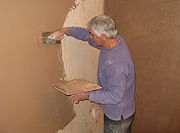
Plasterer

Encyclopedia
A plasterer is a tradesman
who works with plaster
, such as forming a layer of plaster on an interior wall or plaster decorative moldings
on ceilings or walls. The process of creating plasterwork, called plastering, has been used in building construction for centuries.
Soon a more lasting and sightly material was found and employed to take the place of mud or slime, and that perfection in the compounding of plastering materials was approached at a very remote period is made evident by the fact that some of the earliest plastering which has remained undisturbed excels in its scientific composition that which we use at the present day.
The pyramids in Egypt
contain plasterwork executed at least four thousand years ago, probably much earlier, and yet existing, hard and durable, at the present time. From recent discoveries it has been ascertained that the principal tools of the plasterer of that time were practically identical in design, shape and purpose with those used to day. For their finest work the Egyptians used a plaster made from calcined gypsum
just like plaster of Paris of the present time, and their methods of plastering on reeds resemble in every way our lath, plaster, float and set work. Hair was introduced to strengthen the stuff, and the whole finished somewhat under an inch thick.
Very early in the history of Greek architecture
we find the use of plaster of a fine white lime stucco
, such has been found at Mycenae
. The art had reached perfection in Greece more than five centuries before Christ, and plaster was frequently used to cover temples externally and internally, in some cases even where the building was of marble. It formed a splendid ground for decorative painting, which at this period of Grecian history had reached a very high degree of beauty.
s, lath nails, lime
, sand
, hair
, plaster of Paris, and a variety of cement
s, together with various ingredients to form coloring washes, et cetera.
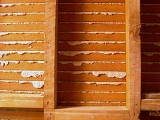
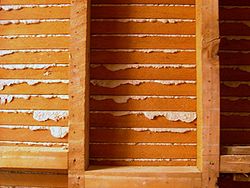 Wood lath
s are narrow strips of some straight-grained wood, generally Baltic or American fir
, in lengths of from two to four or five feet to suit the distances at which the timbers of a floor or partition are set. Laths are about an inch Lathing-wide, and are made in three thicknesses; single (1/8 to 3/16 inch thick), lath and a half (1/4 inch thick), and double (3/8-1/2 inch thick). The thicker laths should be used in ceilings, to stand the extra strain, and the thinner variety in vertical work such as partitions, except where the latter will be subjected to rough usage, in which case thicker laths become necessary. Laths are usually nailed with a space of about 3/8 of an inch between them to form a key for the plaster. Laths were formerly all made by hand. A large quantity, however, are now made by machinery and are known as sawn laths, those made by hand being called rent or riven laths. Rent laths give the best results, as they split in a line with the grain of the wood, and are stronger and not so liable to twist as machine-made laths, some of the fibers of which are usually cut in the process of sawing.
Laths must be nailed so as to break joint in bays three or four feet wide with ends butted one against the other. By breaking the joints of the lathing in this way, the tendency for the plaster to crack along the line of joints is diminished and a better key is obtained. Every lath should be nailed at each end and wherever it crosses a joist or stud. All timbers over three inches (76 mm) wide should be counter-lathed, that is, have a fillet or double lath nailed along the centre upon which the laths are then nailed. This is done to preserve a good key for the plaster. Walls liable to damp are sometimes battened and lathed in order to form an air cavity between the damp wall and the plastering.
Lathing of metal, either of wire or in the form of perforated sheets, is now extensively used on account of its fireproof and lasting quality. There are very many kinds of this material Metal made in different designs under various patents, the best known in England being the Jhilmil, the Bostwick, Lathing, and the Expanded Metal lathing. The two last-named are also widely used in America. Lathing nails are usually of iron, cut, wrought or cast, and in the better class of work they are galvanized to prevent rusting. Zinc nails are sometimes used, but are costly.
principally used for internal plastering is that calcined
from chalk
, oyster shells or other nearly pure limestone
, and is known as fat, pure, chalk or rich lime. Hydraulic limes are also used by the plasterer, chiefly for external work. Perfect slaking of the calcined lime before being used is very important as, if used in a partially slaked condition, it will "blow" when in position and blister the work. Lime should therefore be run as soon as the building is begun, and at least three weeks should elapse between the operation of running the lime and its use. Due to time constraints Hydrated Lime
mixed with plaster is normally used for modern construction. Slaking is not required if more time is allowed for finishing the surface after application which is a common practice where a quality finish is required, however in the housing industry it is often run for three days, the time it takes to prepare an average house for plastering, to achieve a lower quality cost effective finish.
is used in plaster as a binding medium, and gives tenacity to the material. Ox-hair, which is sold in three qualities, is the kind usually specified; but horsehair, which is shorter, is sometimes substituted in its stead or mixed with the ox-hair in the lower qualities. Good hair should be long, strong, and free from grease and dirt, and before use must be well beaten to separate the lumps. In America, goats' hair is frequently used, though it is not as strong as ox-hair.
The quantity used in good work is one pound of hair to two or three cubic feet of coarse stuff. Manila hemp
fiber has been used as a substitute for hair. As a result of experiments to ascertain its strength as compared with Substitutes that of other materials, it was found that plaster for hair slabs made with Manila hemp fiber broke at 195 lb (88.5 kg), plaster mixed with Sisal hemp at 150 lb (68 kg), jute
at 145 lb (65.8 kg), and goats' hair at 144 lb (65.3 kg). Another test was made in the following manner. Two barrels of mortar were made up of equal proportions of lime and sand, one containing the usual quantity of goats' hair, and the other Manila fiber. After remaining in a dry cellar for nine months the barrels were opened. It was found that the hair had been almost entirely eaten away by the action of the lime, and the mortar consequently broke up and crumbled quite easily. The mortar containing the Manila hemp, on the other hand, showed great cohesion, and required some effort to pull it apart, the hemp fiber being apparently quite uninjured. Sawdust has been used as a substitute for hair and also instead of sand as an aggregate
. It will enable mortar to stand the effects of frost and rough weather. It is useful sometimes for heavy cornices and similar work, as it renders the material light and strong. The sawdust should be used dry.
is added to two parts cement and five of sand where the walls need to block X-ray
s. When coating or rendering concrete surfaces a "splash" coat of one part cement to one of sand in liquid form is either thrown with a trowel or sprayed on the surface. This not only provides a better key for the render but prevents the porous concrete from sucking the water from it. For external work Portland cement
is undoubtedly the best material on account of its strength, durability, and weather resisting External properties. If the plaster coat needs to be particularly strong and resistant to cracking, such as the walls of a squash court
, Sizing
is mixed with the plaster before application to increase both the surface bond strength and flexibility.
The first coat of render is from 1/2 to 3/4 inches thick, and is mixed, dependant on the surface to be covered, in the proportions of from one part of cement to two of sand to one part to six of sand. A ½ shovel of Lime is often added to make the mix more pliable. After dampening the surface to be coated, two horizontal bands of render called "screeds" are applied, one at around head height and the other just above floor level, these are then marked for vertical/horizontal alignment, finished, then allowed to partially dry. In a process similar to laying concrete, the wall is then rendered to a slightly higher level than the screeds, and using a "straight edge" (screed), the Plasterer uses the screeds as guides removing the excess render and leaving a rough flat surface. For a lower cost finish or if a rough surface is specified the screeds can be dispensed with. The render is then finished with a float (a smooth flat wooden tool with handle) to fill or remove larger imperfections. For some applications where a stronger key is required the surface is scored by later use of a float with nails protruding from the base. If the render is to be the finished surface then a float with a sponge attached to the base is then used on the wall until the surface is blemish free.
For quality work, or where the wall is out of plumb requiring a large variation in render thickness, a thin "scratch" render coat is first applied then a second coat finished as described above. After around 24 hours the render has dried but before the final plaster coat is applied a trowel is used to scrape loose sand grains from the surface which would otherwise spoil the plaster finish.
The finishing or setting plaster coat which is about 3/16 inches thick is worked with a hand trowel on the surface of the rendering, which must first be well wetted. The plaster is applied in two coats to slow the drying speed of the second coat and after drying must still be wetted and worked for a time to produce a thin film of watery plaster which has the effect of "Polishing
" the finished surface.
Tradesman
This article is about the skilled manual worker meaning of the term; for other uses see Tradesperson .A tradesman is a skilled manual worker in a particular trade or craft. Economically and socially, a tradesman's status is considered between a laborer and a professional, with a high degree of both...
who works with plaster
Plaster
Plaster is a building material used for coating walls and ceilings. Plaster starts as a dry powder similar to mortar or cement and like those materials it is mixed with water to form a paste which liberates heat and then hardens. Unlike mortar and cement, plaster remains quite soft after setting,...
, such as forming a layer of plaster on an interior wall or plaster decorative moldings
Molding (decorative)
Molding or moulding is a strip of material with various profiles used to cover transitions between surfaces or for decoration. It is traditionally made from solid milled wood or plaster but may be made from plastic or reformed wood...
on ceilings or walls. The process of creating plasterwork, called plastering, has been used in building construction for centuries.
History
Plasterwork is one of the most ancient of handicrafts employed in connection with building operations, the earliest evidence showing that the dwellings of primitive man were erected in a simple fashion with sticks and plastered with mud.Soon a more lasting and sightly material was found and employed to take the place of mud or slime, and that perfection in the compounding of plastering materials was approached at a very remote period is made evident by the fact that some of the earliest plastering which has remained undisturbed excels in its scientific composition that which we use at the present day.
The pyramids in Egypt
Egyptian pyramids
The Egyptian pyramids are ancient pyramid-shaped masonry structures located in Egypt.There are 138 pyramids discovered in Egypt as of 2008. Most were built as tombs for the country's Pharaohs and their consorts during the Old and Middle Kingdom periods.The earliest known Egyptian pyramids are found...
contain plasterwork executed at least four thousand years ago, probably much earlier, and yet existing, hard and durable, at the present time. From recent discoveries it has been ascertained that the principal tools of the plasterer of that time were practically identical in design, shape and purpose with those used to day. For their finest work the Egyptians used a plaster made from calcined gypsum
Gypsum
Gypsum is a very soft sulfate mineral composed of calcium sulfate dihydrate, with the chemical formula CaSO4·2H2O. It is found in alabaster, a decorative stone used in Ancient Egypt. It is the second softest mineral on the Mohs Hardness Scale...
just like plaster of Paris of the present time, and their methods of plastering on reeds resemble in every way our lath, plaster, float and set work. Hair was introduced to strengthen the stuff, and the whole finished somewhat under an inch thick.
Very early in the history of Greek architecture
Architecture of Ancient Greece
The architecture of Ancient Greece is the architecture produced by the Greek-speaking people whose culture flourished on the Greek mainland and Peloponnesus, the Aegean Islands, and in colonies in Asia Minor and Italy for a period from about 900 BC until the 1st century AD, with the earliest...
we find the use of plaster of a fine white lime stucco
Stucco
Stucco or render is a material made of an aggregate, a binder, and water. Stucco is applied wet and hardens to a very dense solid. It is used as decorative coating for walls and ceilings and as a sculptural and artistic material in architecture...
, such has been found at Mycenae
Mycenae
Mycenae is an archaeological site in Greece, located about 90 km south-west of Athens, in the north-eastern Peloponnese. Argos is 11 km to the south; Corinth, 48 km to the north...
. The art had reached perfection in Greece more than five centuries before Christ, and plaster was frequently used to cover temples externally and internally, in some cases even where the building was of marble. It formed a splendid ground for decorative painting, which at this period of Grecian history had reached a very high degree of beauty.
Tools and Materials
In the more common operations of plastering, comparatively few tools and few materials are required, but the workman efficient in all branches of the craft will possess a very large variety of implements. The materials of the workman are lathLath
A lath is a thin, narrow strip of some straight-grained wood or other material, including metal or gypsum. A lattice, or lattice-work, is a criss-crossed or interlaced arrangement of laths, or the pattern made by such an arrangement...
s, lath nails, lime
Lime (mineral)
Lime is a general term for calcium-containing inorganic materials, in which carbonates, oxides and hydroxides predominate. Strictly speaking, lime is calcium oxide or calcium hydroxide. It is also the name for a single mineral of the CaO composition, occurring very rarely...
, sand
Sand
Sand is a naturally occurring granular material composed of finely divided rock and mineral particles.The composition of sand is highly variable, depending on the local rock sources and conditions, but the most common constituent of sand in inland continental settings and non-tropical coastal...
, hair
Hair
Hair is a filamentous biomaterial, that grows from follicles found in the dermis. Found exclusively in mammals, hair is one of the defining characteristics of the mammalian class....
, plaster of Paris, and a variety of cement
Cement
In the most general sense of the word, a cement is a binder, a substance that sets and hardens independently, and can bind other materials together. The word "cement" traces to the Romans, who used the term opus caementicium to describe masonry resembling modern concrete that was made from crushed...
s, together with various ingredients to form coloring washes, et cetera.
Laths
Lath
A lath is a thin, narrow strip of some straight-grained wood or other material, including metal or gypsum. A lattice, or lattice-work, is a criss-crossed or interlaced arrangement of laths, or the pattern made by such an arrangement...
s are narrow strips of some straight-grained wood, generally Baltic or American fir
Fir
Firs are a genus of 48–55 species of evergreen conifers in the family Pinaceae. They are found through much of North and Central America, Europe, Asia, and North Africa, occurring in mountains over most of the range...
, in lengths of from two to four or five feet to suit the distances at which the timbers of a floor or partition are set. Laths are about an inch Lathing-wide, and are made in three thicknesses; single (1/8 to 3/16 inch thick), lath and a half (1/4 inch thick), and double (3/8-1/2 inch thick). The thicker laths should be used in ceilings, to stand the extra strain, and the thinner variety in vertical work such as partitions, except where the latter will be subjected to rough usage, in which case thicker laths become necessary. Laths are usually nailed with a space of about 3/8 of an inch between them to form a key for the plaster. Laths were formerly all made by hand. A large quantity, however, are now made by machinery and are known as sawn laths, those made by hand being called rent or riven laths. Rent laths give the best results, as they split in a line with the grain of the wood, and are stronger and not so liable to twist as machine-made laths, some of the fibers of which are usually cut in the process of sawing.
Laths must be nailed so as to break joint in bays three or four feet wide with ends butted one against the other. By breaking the joints of the lathing in this way, the tendency for the plaster to crack along the line of joints is diminished and a better key is obtained. Every lath should be nailed at each end and wherever it crosses a joist or stud. All timbers over three inches (76 mm) wide should be counter-lathed, that is, have a fillet or double lath nailed along the centre upon which the laths are then nailed. This is done to preserve a good key for the plaster. Walls liable to damp are sometimes battened and lathed in order to form an air cavity between the damp wall and the plastering.
Lathing of metal, either of wire or in the form of perforated sheets, is now extensively used on account of its fireproof and lasting quality. There are very many kinds of this material Metal made in different designs under various patents, the best known in England being the Jhilmil, the Bostwick, Lathing, and the Expanded Metal lathing. The two last-named are also widely used in America. Lathing nails are usually of iron, cut, wrought or cast, and in the better class of work they are galvanized to prevent rusting. Zinc nails are sometimes used, but are costly.
Lime
The limeLime (mineral)
Lime is a general term for calcium-containing inorganic materials, in which carbonates, oxides and hydroxides predominate. Strictly speaking, lime is calcium oxide or calcium hydroxide. It is also the name for a single mineral of the CaO composition, occurring very rarely...
principally used for internal plastering is that calcined
Calcination
Calcination is a thermal treatment process applied to ores and other solid materials to bring about a thermal decomposition, phase transition, or removal of a volatile fraction. The calcination process normally takes place at temperatures below the melting point of the product materials...
from chalk
Chalk
Chalk is a soft, white, porous sedimentary rock, a form of limestone composed of the mineral calcite. Calcite is calcium carbonate or CaCO3. It forms under reasonably deep marine conditions from the gradual accumulation of minute calcite plates shed from micro-organisms called coccolithophores....
, oyster shells or other nearly pure limestone
Limestone
Limestone is a sedimentary rock composed largely of the minerals calcite and aragonite, which are different crystal forms of calcium carbonate . Many limestones are composed from skeletal fragments of marine organisms such as coral or foraminifera....
, and is known as fat, pure, chalk or rich lime. Hydraulic limes are also used by the plasterer, chiefly for external work. Perfect slaking of the calcined lime before being used is very important as, if used in a partially slaked condition, it will "blow" when in position and blister the work. Lime should therefore be run as soon as the building is begun, and at least three weeks should elapse between the operation of running the lime and its use. Due to time constraints Hydrated Lime
Calcium hydroxide
Calcium hydroxide, traditionally called slaked lime, is an inorganic compound with the chemical formula Ca2. It is a colourless crystal or white powder and is obtained when calcium oxide is mixed, or "slaked" with water. It has many names including hydrated lime, builders lime, slack lime, cal, or...
mixed with plaster is normally used for modern construction. Slaking is not required if more time is allowed for finishing the surface after application which is a common practice where a quality finish is required, however in the housing industry it is often run for three days, the time it takes to prepare an average house for plastering, to achieve a lower quality cost effective finish.
Hair
HairHair
Hair is a filamentous biomaterial, that grows from follicles found in the dermis. Found exclusively in mammals, hair is one of the defining characteristics of the mammalian class....
is used in plaster as a binding medium, and gives tenacity to the material. Ox-hair, which is sold in three qualities, is the kind usually specified; but horsehair, which is shorter, is sometimes substituted in its stead or mixed with the ox-hair in the lower qualities. Good hair should be long, strong, and free from grease and dirt, and before use must be well beaten to separate the lumps. In America, goats' hair is frequently used, though it is not as strong as ox-hair.
The quantity used in good work is one pound of hair to two or three cubic feet of coarse stuff. Manila hemp
Hemp
Hemp is mostly used as a name for low tetrahydrocannabinol strains of the plant Cannabis sativa, of fiber and/or oilseed varieties. In modern times, hemp has been used for industrial purposes including paper, textiles, biodegradable plastics, construction, health food and fuel with modest...
fiber has been used as a substitute for hair. As a result of experiments to ascertain its strength as compared with Substitutes that of other materials, it was found that plaster for hair slabs made with Manila hemp fiber broke at 195 lb (88.5 kg), plaster mixed with Sisal hemp at 150 lb (68 kg), jute
Jute
Jute is a long, soft, shiny vegetable fibre that can be spun into coarse, strong threads. It is produced from plants in the genus Corchorus, which has been classified in the family Tiliaceae, or more recently in Malvaceae....
at 145 lb (65.8 kg), and goats' hair at 144 lb (65.3 kg). Another test was made in the following manner. Two barrels of mortar were made up of equal proportions of lime and sand, one containing the usual quantity of goats' hair, and the other Manila fiber. After remaining in a dry cellar for nine months the barrels were opened. It was found that the hair had been almost entirely eaten away by the action of the lime, and the mortar consequently broke up and crumbled quite easily. The mortar containing the Manila hemp, on the other hand, showed great cohesion, and required some effort to pull it apart, the hemp fiber being apparently quite uninjured. Sawdust has been used as a substitute for hair and also instead of sand as an aggregate
Aggregate (composite)
Aggregate is the component of a composite material that resists compressive stress and provides bulk to the composite material. For efficient filling, aggregate should be much smaller than the finished item, but have a wide variety of sizes...
. It will enable mortar to stand the effects of frost and rough weather. It is useful sometimes for heavy cornices and similar work, as it renders the material light and strong. The sawdust should be used dry.
Methods
For fine plasterer's sand-work, special sands, not hitherto referred to, are used, such as silver sand or fine foundry sand, which is used when a light color and fine texture are required. In medical centres one part BariumBarium
Barium is a chemical element with the symbol Ba and atomic number 56. It is the fifth element in Group 2, a soft silvery metallic alkaline earth metal. Barium is never found in nature in its pure form due to its reactivity with air. Its oxide is historically known as baryta but it reacts with...
is added to two parts cement and five of sand where the walls need to block X-ray
X-ray
X-radiation is a form of electromagnetic radiation. X-rays have a wavelength in the range of 0.01 to 10 nanometers, corresponding to frequencies in the range 30 petahertz to 30 exahertz and energies in the range 120 eV to 120 keV. They are shorter in wavelength than UV rays and longer than gamma...
s. When coating or rendering concrete surfaces a "splash" coat of one part cement to one of sand in liquid form is either thrown with a trowel or sprayed on the surface. This not only provides a better key for the render but prevents the porous concrete from sucking the water from it. For external work Portland cement
Portland cement
Portland cement is the most common type of cement in general use around the world because it is a basic ingredient of concrete, mortar, stucco and most non-specialty grout...
is undoubtedly the best material on account of its strength, durability, and weather resisting External properties. If the plaster coat needs to be particularly strong and resistant to cracking, such as the walls of a squash court
Squash (sport)
Squash is a high-speed racquet sport played by two players in a four-walled court with a small, hollow rubber ball...
, Sizing
Sizing
Sizing or size is any one of numerous specific substances that is applied to or incorporated in other material, especially papers and textiles, to act as a protecting filler or glaze....
is mixed with the plaster before application to increase both the surface bond strength and flexibility.
The first coat of render is from 1/2 to 3/4 inches thick, and is mixed, dependant on the surface to be covered, in the proportions of from one part of cement to two of sand to one part to six of sand. A ½ shovel of Lime is often added to make the mix more pliable. After dampening the surface to be coated, two horizontal bands of render called "screeds" are applied, one at around head height and the other just above floor level, these are then marked for vertical/horizontal alignment, finished, then allowed to partially dry. In a process similar to laying concrete, the wall is then rendered to a slightly higher level than the screeds, and using a "straight edge" (screed), the Plasterer uses the screeds as guides removing the excess render and leaving a rough flat surface. For a lower cost finish or if a rough surface is specified the screeds can be dispensed with. The render is then finished with a float (a smooth flat wooden tool with handle) to fill or remove larger imperfections. For some applications where a stronger key is required the surface is scored by later use of a float with nails protruding from the base. If the render is to be the finished surface then a float with a sponge attached to the base is then used on the wall until the surface is blemish free.
For quality work, or where the wall is out of plumb requiring a large variation in render thickness, a thin "scratch" render coat is first applied then a second coat finished as described above. After around 24 hours the render has dried but before the final plaster coat is applied a trowel is used to scrape loose sand grains from the surface which would otherwise spoil the plaster finish.
The finishing or setting plaster coat which is about 3/16 inches thick is worked with a hand trowel on the surface of the rendering, which must first be well wetted. The plaster is applied in two coats to slow the drying speed of the second coat and after drying must still be wetted and worked for a time to produce a thin film of watery plaster which has the effect of "Polishing
Polishing
Polishing is the process of creating a smooth and shiny surface by rubbing it or using a chemical action, leaving a surface with a significant specular reflection In some materials polishing is also able to reduce diffuse reflection to...
" the finished surface.