


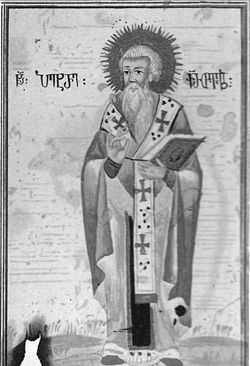
Peter the Iberian

Encyclopedia
Christianity
Christianity is a monotheistic religion based on the life and teachings of Jesus as presented in canonical gospels and other New Testament writings...
. Some have claimed that he is the author of the works written under the pen name Pseudo-Dionysius the Areopagite
Pseudo-Dionysius the Areopagite
Pseudo-Dionysius the Areopagite, also known as Pseudo-Denys, was a Christian theologian and philosopher of the late 5th to early 6th century, the author of the Corpus Areopagiticum . The author is identified as "Dionysos" in the corpus, which later incorrectly came to be attributed to Dionysius...
.
His accomplishments include founding the first Georgian monastery in Bethlehem
Bethlehem
Bethlehem is a Palestinian city in the central West Bank of the Jordan River, near Israel and approximately south of Jerusalem, with a population of about 30,000 people. It is the capital of the Bethlehem Governorate of the Palestinian National Authority and a hub of Palestinian culture and tourism...
and becoming the bishop of Gaza near Majuma. In addition to being canonized by the Georgian Orthodox Church as a saint, he is also recognized by various eastern Churches, some of which have deviated from the Chalcedonian
Chalcedonian
Chalcedonian describes churches and theologians which accept the definition given at the Council of Chalcedon of how the divine and human relate in the person of Jesus Christ...
doctrine.
Life
He was born into the royal family of the Iberian Kings and was initially named Murvan (alternatively, Nabarnugios), prince of IberiaCaucasian Iberia
Iberia , also known as Iveria , was a name given by the ancient Greeks and Romans to the ancient Georgian kingdom of Kartli , corresponding roughly to the eastern and southern parts of the present day Georgia...
. His father, King Bosmarios of Iberia, invited noted philosopher Mithradates from Lazica to take part in Murvan’s education. In 423, the prince was sent as a political hostage to Constantinople
Constantinople
Constantinople was the capital of the Roman, Eastern Roman, Byzantine, Latin, and Ottoman Empires. Throughout most of the Middle Ages, Constantinople was Europe's largest and wealthiest city.-Names:...
, where he got a brilliant education under a personal patronage of the Roman empress Aelia Eudocia
Aelia Eudocia
Aelia Eudocia Augusta was the wife of Theodosius II, and a prominent historical figure in understanding the rise of Christianity during the beginning of the Byzantine Empire. Eudocia lived in a world where Greek paganism and Christianity were still coming together...
, wife of Theodosius II
Theodosius II
Theodosius II , commonly surnamed Theodosius the Younger, or Theodosius the Calligrapher, was Byzantine Emperor from 408 to 450. He is mostly known for promulgating the Theodosian law code, and for the construction of the Theodosian Walls of Constantinople...
.
Eventually, the young prince, together with his mentor Mithradates, left the palace and escaped to make a pilgrimage to Palestine
Palestine
Palestine is a conventional name, among others, used to describe the geographic region between the Mediterranean Sea and the Jordan River, and various adjoining lands....
, where he became a monk at Jerusalem under the name of Peter. In 430, he founded his own monastery at Bethlehem
Bethlehem
Bethlehem is a Palestinian city in the central West Bank of the Jordan River, near Israel and approximately south of Jerusalem, with a population of about 30,000 people. It is the capital of the Bethlehem Governorate of the Palestinian National Authority and a hub of Palestinian culture and tourism...
(later known as the Georgian Monastery of Bethlehem). In 445, he was consecrated priest. Accompanied by Mithradates (now called John), he traveled across several countries of the Near East
Near East
The Near East is a geographical term that covers different countries for geographers, archeologists, and historians, on the one hand, and for political scientists, economists, and journalists, on the other...
and finally settled in Majuma near Gaza
Gaza
Gaza , also referred to as Gaza City, is a Palestinian city in the Gaza Strip, with a population of about 450,000, making it the largest city in the Palestinian territories.Inhabited since at least the 15th century BC,...
.
In 452, he served as bishop of Majuma for six months before some Christians were banished by the decree of the local ruler. Peter escaped to Egypt
Egypt
Egypt , officially the Arab Republic of Egypt, Arabic: , is a country mainly in North Africa, with the Sinai Peninsula forming a land bridge in Southwest Asia. Egypt is thus a transcontinental country, and a major power in Africa, the Mediterranean Basin, the Middle East and the Muslim world...
but returned to Palestine a decade later. He gained numerous followers and disciples. According to the medieval sources, he was an author of several famous religious works. However, none of them survived to be written under the name of Peter.
He died at Yavneh-Yam
Yavneh-Yam
Yavne-Yam is an archaeological site located on Israel's southern Mediterranean coast, about 15 km south of Tel Aviv. Built on eolianite hills next to a small promontory forming the sole anchorage able to provide shelter to sea-going vessels between Jaffa and the Sinai, Yavne-Yam is notable...
, port of ancient Iamnia, in 491 and was buried in his monastery near Gaza
Gaza
Gaza , also referred to as Gaza City, is a Palestinian city in the Gaza Strip, with a population of about 450,000, making it the largest city in the Palestinian territories.Inhabited since at least the 15th century BC,...
.
Biographies
- The so-called SyriacSyriac languageSyriac is a dialect of Middle Aramaic that was once spoken across much of the Fertile Crescent. Having first appeared as a script in the 1st century AD after being spoken as an unwritten language for five centuries, Classical Syriac became a major literary language throughout the Middle East from...
version originally written by Peter’s disciple John Rufus in GreekGreek languageGreek is an independent branch of the Indo-European family of languages. Native to the southern Balkans, it has the longest documented history of any Indo-European language, spanning 34 centuries of written records. Its writing system has been the Greek alphabet for the majority of its history;...
dates back to the 8th century - The so-called GeorgianGeorgian languageGeorgian is the native language of the Georgians and the official language of Georgia, a country in the Caucasus.Georgian is the primary language of about 4 million people in Georgia itself, and of another 500,000 abroad...
version originally written by Peter’s contemporary, Zacharias RhetorZacharias RhetorZacharias of Mytilene , also known as Zacharias Scholasticus or Zacharias Rhetor, was a bishop and ecclesiastical historian....
, bishop of MytileneMytileneMytilene is a town and a former municipality on the island of Lesbos, North Aegean, Greece. Since the 2011 local government reform it is part of the municipality Lesbos, of which it is a municipal unit. It is the capital of the island of Lesbos. Mytilene, whose name is pre-Greek, is built on the...
, in Greek has preserved as a manuscript of c. 13th century.
Further reading
- David Marshall Lang, "Peter the Iberian and His Biographers". Journal of Ecclesiastical History, vol. 2 (1951), pp 156–168
- Jan-Eric Steppa, John Rufus and the World Vision of Anti-Chalcedonian Culture, (Gorgias Press, 2002), xxvii + 199 pp. ISBN 1-931956-09-X
- Ernest Honigmann, Pierre l'iberian et les ecrits du Pseudo-Denys l'Aréopagite, Bruxelles, 1952 (French)
- Petre Iberi. Works, Tbilisi, 1961 (Georgian)
- Shalva Nutsubidze. Mystery of Pseudo-Dionys Areopagit, Tbilisi, 1942 (Georgian, English summary)
- Shalva Nutsubidze. Peter the Iberian and problems of Areopagitics. - Proceedings of the Tbilisi State University, vol. 65, Tbilisi, 1957 (Russian)
- A. Kofsky. "Peter the Iberian and the Question of the Holy Places," Cathedra 91 (1999), pp. 79–96 (Hebrew).