

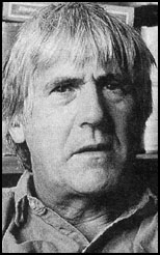
Paul Foot

Encyclopedia
Paul Mackintosh Foot was a British
investigative journalist, political campaigner, author, and long-time member of the Socialist Workers Party
(SWP). He was the grandson of Isaac Foot
, who had been a Liberal MP, and the son of Hugh Foot (who was the last Governor of Cyprus
and Jamaica and, as Lord Caradon, the British Ambassador to the United Nations
from 1964 to 1970). He was the nephew of Michael Foot
, former leader of the Labour Party
.
, then part of the British Mandate for Palestine, and spent his youth at his uncle's house in Devon, in Italy with his grandmother and with his parents (who lived abroad) in Cyprus and Jamaica. He was sent to what he described as "a ludicrously snobbish prep school, Ludgrove
[near Wokingham
in Berkshire
], and then to an only slightly less absurd public school, Shrewsbury
, in Shropshire
." Contemporaries at Shrewsbury included Richard Ingrams
, Willie Rushton
, Christopher Booker
and several other friends who would later become involved in Private Eye.
Anthony Chenevix-Trench
was his Housemaster at Shrewsbury between 1950 and 1955, a time when corporal punishment in all schools was commonplace. In adult life, Foot exposed the ritual beatings that Chevenix-Trench had given. As Nick Cohen
wrote in Foot's obituary in The Observer
:
Exposing him in Private Eye was one of Foot's happiest days in journalism. He received hundreds of congratulatory letters from the child abuser's old pupils, many of whom were then prominent in British life.
After his national service in Jamaica, Foot was reunited with Ingrams at University College
at the University of Oxford
, where he read Law, and wrote for Isis
, one of the student publications at the University.
where he met workers from shipyards and engineering who had joined the Young Socialists
. He read, for the first time, Karl Marx
, Lenin, Rosa Luxemburg
, Trotsky, and the biography of Trotsky by Isaac Deutscher
which was just being published. In Glasgow he met the 'Socialist Review' group, led by 'an ebullient Palestinian Jew' called Tony Cliff
. Cliff argued that Russia was state capitalist and that Russian workers were cut off from economic and political power as much as, if not more than, those in the West. Persuaded by what he heard and saw in Glasgow, he joined the International Socialists, organisational forerunner of the Socialist Workers Party (SWP), in 1963. "Of all the many lessons I learnt in those three years in Glasgow" he wrote later, "the one which most affected my life was a passing remark by Rosa Luxemburg. She predicted that, however strong people's socialist commitment, as soon as they are involved even to the slightest degree in managing the system on behalf of capitalists, they will be lost to the socialist cause." He wrote for Socialist Worker
throughout his career and was its editor from 1972 until 1978. He continued to write a regular column for the Socialist Worker until he died.
He spoke at thousands of meetings for hundreds of left-wing and socialist causes, frequently trying to persuade audiences of the relevance of revolutionary socialism.
. He had previously contributed articles to Private Eye since 1964 but decided, in February 1967, to take a cut in salary and join the staff of Private Eye on a full-time basis, working with its editor, Richard Ingrams
and its new, sole owner Peter Cook
. When asked about the decision later, Foot would say he could not resist the prospect of two whole pages with complete freedom to write whatever he liked. "Writing for Private Eye is the only journalism I have ever been engaged in which is pure enjoyment. It is free publishing of the most exhilarating kind." Foot got on very well with Cook, only realising after the latter's death in 1995 how much they had in common: "We both were born in the same week, into the same sort of family. His father, like mine, was a colonial servant rushing round the world hauling down the imperial flag. Both fathers shipped their eldest sons back to public school education in England. We both spent our school holidays with popular aunts and uncles in the West Country. Foot's first stint at Private Eye lasted 5 years until 1972, when he became editor of the Socialist Worker
.
Six years later he returned to Private Eye but was poached in 1979 by the editor of the Daily Mirror, Mike Molloy
, who offered him a weekly "investigative" page of his own with only one condition attached: that he was not to make propaganda
for the SWP. Foot stayed at the Daily Mirror for fourteen years, during which time Private Eye occasionally made fun of him, calling him 'Pol Fot' (a pun on the Khmer Rouge
Cambodian dictator Pol Pot
). Foot finally fell out with the new Mirror editor, David Banks
, after the death of Robert Maxwell
, and a boardroom coup that introduced a programme of "union-bashings and sackings". He left the Mirror in 1993 when the paper refused to print articles critical of their new management (in response to which, Foot distributed copies of the articles to passers-by outside the Mirror's headquarters). He then rejoined
Private Eye for a third time, with its new editor, Ian Hislop
. From 1993, he also contributed a regular column to The Guardian
.
in 1977 for the SWP and was a Socialist Alliance
candidate for several offices from 2001 onwards. In the Hackney
mayoral election in 2002 he came third, beating the Liberal Democrat candidate. He also stood unsuccessfully in the London
region for the Respect coalition in the 2004 European elections
.
, Toussaint L'Ouverture
, Louise Michel
. Many of his speeches are available on CD and on the internet.
and a detailed and brilliant study of parliamentary democracy in Britain, published posthumously, entitled The Vote.
Awards in 1972 and 1989 and campaigning journalist of the year in the 1980 British Press Awards
; he won the George Orwell Prize for Journalism
in 1995 with Tim Laxton, won the journalist of the decade prize in the What The Papers Say Awards in 2000, and the James Cameron
special posthumous Award in 2004.
His best known work was in the form of campaign journalism, including his exposure of corrupt
architect
John Poulson
and, most notably, his prominent role in the campaigns to overturn the convictions of the Birmingham Six
and the Bridgewater Four
, which succeeded in 1991 and 1997 respectively. Foot also asserted that a former British intelligence officer, Colin Wallace
, had been framed for manslaughter with a view to suppressing Wallace's allegations of collusion between British forces and Loyalist paramilitaries in Northern Ireland
during the 1970s.
Foot took a particular interest in the conviction of Abdelbaset al-Megrahi for the Lockerbie bombing, firmly believing Megrahi to have been a victim of a miscarriage of justice
at the Pan Am Flight 103 bombing trial
.
He also worked tirelessly, though without success, to gain a posthumous pardon
for James Hanratty
, who was hanged in 1962 for the A6 murder. It was a position he maintained even after DNA evidence in 1999 seemed to confirm Hanratty's guilt.
, died of a pulmonary
aneurysm
while waiting at Stansted Airport to begin a family holiday in Ireland. He was 66 years old.
A tribute issue of the Socialist Review
, on whose editorial board Foot sat for 19 years, collected together many of his articles, while issue 1116 of Private Eye included a tribute to Foot from the many people with whom he had worked. Three months after his death, on 10 October 2004, there was a full house at the Hackney Empire
in London
for an evening's celebration of his life. The following year, The Guardian
and Private Eye jointly set up the Paul Foot Award
for investigative or campaigning journalism, with an annual £10,000 prize fund.
Foot is buried in Highgate Cemetery
, London, a few yards from Karl Marx
's tomb.
Paul was a great fan of West Indian cricket (he used to say that George Headley
, no less, had taught him to bat) and a faithful follower of Plymouth Argyle FC
. He was also a classy opening batsman and a passionate golfer.
Source
Obituaries
Audio
United Kingdom
The United Kingdom of Great Britain and Northern IrelandIn the United Kingdom and Dependencies, other languages have been officially recognised as legitimate autochthonous languages under the European Charter for Regional or Minority Languages...
investigative journalist, political campaigner, author, and long-time member of the Socialist Workers Party
Socialist Workers Party (Britain)
The Socialist Workers Party is a far left party in Britain founded by Tony Cliff. The SWP's student section has groups at a number of universities...
(SWP). He was the grandson of Isaac Foot
Isaac Foot
-Early life:Isaac Foot was born in Plymouth, the son of a carpenter and undertaker, and educated at Plymouth Public School and the Hoe Grammar School, which he left at the age of 14. He then worked at the Admiralty in London, but returned to Plymouth to train as a solicitor...
, who had been a Liberal MP, and the son of Hugh Foot (who was the last Governor of Cyprus
Cyprus
Cyprus , officially the Republic of Cyprus , is a Eurasian island country, member of the European Union, in the Eastern Mediterranean, east of Greece, south of Turkey, west of Syria and north of Egypt. It is the third largest island in the Mediterranean Sea.The earliest known human activity on the...
and Jamaica and, as Lord Caradon, the British Ambassador to the United Nations
United Nations
The United Nations is an international organization whose stated aims are facilitating cooperation in international law, international security, economic development, social progress, human rights, and achievement of world peace...
from 1964 to 1970). He was the nephew of Michael Foot
Michael Foot
Michael Mackintosh Foot, FRSL, PC was a British Labour Party politician, journalist and author, who was a Member of Parliament from 1945 to 1955 and from 1960 until 1992...
, former leader of the Labour Party
Labour Party (UK)
The Labour Party is a centre-left democratic socialist party in the United Kingdom. It surpassed the Liberal Party in general elections during the early 1920s, forming minority governments under Ramsay MacDonald in 1924 and 1929-1931. The party was in a wartime coalition from 1940 to 1945, after...
.
Early life and education
Foot was born in HaifaHaifa
Haifa is the largest city in northern Israel, and the third-largest city in the country, with a population of over 268,000. Another 300,000 people live in towns directly adjacent to the city including the cities of the Krayot, as well as, Tirat Carmel, Daliyat al-Karmel and Nesher...
, then part of the British Mandate for Palestine, and spent his youth at his uncle's house in Devon, in Italy with his grandmother and with his parents (who lived abroad) in Cyprus and Jamaica. He was sent to what he described as "a ludicrously snobbish prep school, Ludgrove
Ludgrove School
Ludgrove School is an independent preparatory boarding school for about 200 boys, aged from seven or eight years to thirteen. It is situated in the civil parish of Wokingham Without, adjoining the town of Wokingham in the English county of Berkshire.-History:...
[near Wokingham
Wokingham
Wokingham is a market town and civil parish in Berkshire in South East England about west of central London. It is about east-southeast of Reading and west of Bracknell. It spans an area of and, according to the 2001 census, has a population of 30,403...
in Berkshire
Berkshire
Berkshire is a historic county in the South of England. It is also often referred to as the Royal County of Berkshire because of the presence of the royal residence of Windsor Castle in the county; this usage, which dates to the 19th century at least, was recognised by the Queen in 1957, and...
], and then to an only slightly less absurd public school, Shrewsbury
Shrewsbury School
Shrewsbury School is a co-educational independent school for pupils aged 13 to 18, founded by Royal Charter in 1552. The present campus to which the school moved in 1882 is located on the banks of the River Severn in Shrewsbury, Shropshire, England...
, in Shropshire
Shropshire
Shropshire is a county in the West Midlands region of England. For Eurostat purposes, the county is a NUTS 3 region and is one of four counties or unitary districts that comprise the "Shropshire and Staffordshire" NUTS 2 region. It borders Wales to the west...
." Contemporaries at Shrewsbury included Richard Ingrams
Richard Ingrams
Richard Ingrams is an English journalist, a co-founder and second editor of the British satirical magazine Private Eye, and now editor of The Oldie magazine.-Career:...
, Willie Rushton
Willie Rushton
William George Rushton, commonly known as Willie Rushton was an English cartoonist, satirist, comedian, actor and performer who co-founded the Private Eye satirical magazine.- School and army :William George Rushton was born 18 August 1937 in the family home at Scarsdale Villas,...
, Christopher Booker
Christopher Booker
Christopher John Penrice Booker is an English journalist and author. In 1961, he was one of the founders of the magazine Private Eye, and has contributed to it for over four decades. He has been a columnist for the Sunday Telegraph since 1990...
and several other friends who would later become involved in Private Eye.
Anthony Chenevix-Trench
Anthony Chenevix-Trench
Anthony Chenevix-Trench is best known as the Headmaster of Eton College from 1964–1970.-Family and education:He was the son of Charles Godfrey Chenevix Trench and Margaret May Blakesley...
was his Housemaster at Shrewsbury between 1950 and 1955, a time when corporal punishment in all schools was commonplace. In adult life, Foot exposed the ritual beatings that Chevenix-Trench had given. As Nick Cohen
Nick Cohen
Nick Cohen is a British journalist, author and political commentator. He is currently a columnist for The Observer, a blogger for The Spectator and TV critic for Standpoint magazine. He formerly wrote for the London Evening Standard and the New Statesman...
wrote in Foot's obituary in The Observer
The Observer
The Observer is a British newspaper, published on Sundays. In the same place on the political spectrum as its daily sister paper The Guardian, which acquired it in 1993, it takes a liberal or social democratic line on most issues. It is the world's oldest Sunday newspaper.-Origins:The first issue,...
:
Exposing him in Private Eye was one of Foot's happiest days in journalism. He received hundreds of congratulatory letters from the child abuser's old pupils, many of whom were then prominent in British life.
After his national service in Jamaica, Foot was reunited with Ingrams at University College
University College, Oxford
.University College , is a constituent college of the University of Oxford in England. As of 2009 the college had an estimated financial endowment of £110m...
at the University of Oxford
University of Oxford
The University of Oxford is a university located in Oxford, United Kingdom. It is the second-oldest surviving university in the world and the oldest in the English-speaking world. Although its exact date of foundation is unclear, there is evidence of teaching as far back as 1096...
, where he read Law, and wrote for Isis
Isis magazine
The Isis Magazine was established at Oxford University in 1892 . Traditionally a rival to the student newspaper Cherwell, it was finally acquired by the latter's publishing house, OSPL, in the late 1990s...
, one of the student publications at the University.
Early career
In 1961, Foot went to Glasgow to join the Daily RecordDaily Record (Scotland)
The Daily Record is a Scottish tabloid newspaper based in Glasgow. It had been the best-selling daily paper in Scotland for many years with a paid circulation in August 2011 of 307,794 . It is now outsold by its arch-rival the Scottish Sun which in September 2010 had a circulation of 339,586 in...
where he met workers from shipyards and engineering who had joined the Young Socialists
Labour Party Young Socialists
The Labour Party Young Socialists was the name of the youth section of the British Labour Party from 1965 until 1993. The LPYS was the most successful of the youth sections of the Labour Party in the post war period, at one point having nearly 600 branches and attendances at its national...
. He read, for the first time, Karl Marx
Karl Marx
Karl Heinrich Marx was a German philosopher, economist, sociologist, historian, journalist, and revolutionary socialist. His ideas played a significant role in the development of social science and the socialist political movement...
, Lenin, Rosa Luxemburg
Rosa Luxemburg
Rosa Luxemburg was a Marxist theorist, philosopher, economist and activist of Polish Jewish descent who became a naturalized German citizen...
, Trotsky, and the biography of Trotsky by Isaac Deutscher
Isaac Deutscher
Isaac Deutscher was a Polish-born Jewish Marxist writer, journalist and political activist who moved to the United Kingdom at the outbreak of World War II. He is best known as a biographer of Leon Trotsky and Joseph Stalin and as a commentator on Soviet affairs...
which was just being published. In Glasgow he met the 'Socialist Review' group, led by 'an ebullient Palestinian Jew' called Tony Cliff
Tony Cliff
Tony Cliff , was a Trotskyist who was a founding member of the Socialist Review Group which went on to become the Socialist Workers Party...
. Cliff argued that Russia was state capitalist and that Russian workers were cut off from economic and political power as much as, if not more than, those in the West. Persuaded by what he heard and saw in Glasgow, he joined the International Socialists, organisational forerunner of the Socialist Workers Party (SWP), in 1963. "Of all the many lessons I learnt in those three years in Glasgow" he wrote later, "the one which most affected my life was a passing remark by Rosa Luxemburg. She predicted that, however strong people's socialist commitment, as soon as they are involved even to the slightest degree in managing the system on behalf of capitalists, they will be lost to the socialist cause." He wrote for Socialist Worker
Socialist Worker
Socialist Worker is the name of several socialist/communist newspapers associated with the International Socialist Tendency...
throughout his career and was its editor from 1972 until 1978. He continued to write a regular column for the Socialist Worker until he died.
He spoke at thousands of meetings for hundreds of left-wing and socialist causes, frequently trying to persuade audiences of the relevance of revolutionary socialism.
Newspapers and magazines
In 1964, he went to work on the new Sun and into a department called Probe. The idea was to investigate and publish stories behind the news. However, the whole Probe team resigned after six months. "The man in charge turned out to be a former Daily Express City editor." Foot left to work, part-time, on the "Mandrake" column on the Sunday TelegraphSunday Telegraph
The Sunday Telegraph is a British broadsheet newspaper, founded in February 1961. It is the sister paper of The Daily Telegraph, but is run separately with a different editorial staff, although there is some cross-usage of stories...
. He had previously contributed articles to Private Eye since 1964 but decided, in February 1967, to take a cut in salary and join the staff of Private Eye on a full-time basis, working with its editor, Richard Ingrams
Richard Ingrams
Richard Ingrams is an English journalist, a co-founder and second editor of the British satirical magazine Private Eye, and now editor of The Oldie magazine.-Career:...
and its new, sole owner Peter Cook
Peter Cook
Peter Edward Cook was an English satirist, writer and comedian. An extremely influential figure in modern British comedy, he is regarded as the leading light of the British satire boom of the 1960s. He has been described by Stephen Fry as "the funniest man who ever drew breath," although Cook's...
. When asked about the decision later, Foot would say he could not resist the prospect of two whole pages with complete freedom to write whatever he liked. "Writing for Private Eye is the only journalism I have ever been engaged in which is pure enjoyment. It is free publishing of the most exhilarating kind." Foot got on very well with Cook, only realising after the latter's death in 1995 how much they had in common: "We both were born in the same week, into the same sort of family. His father, like mine, was a colonial servant rushing round the world hauling down the imperial flag. Both fathers shipped their eldest sons back to public school education in England. We both spent our school holidays with popular aunts and uncles in the West Country. Foot's first stint at Private Eye lasted 5 years until 1972, when he became editor of the Socialist Worker
Socialist Worker
Socialist Worker is the name of several socialist/communist newspapers associated with the International Socialist Tendency...
.
Six years later he returned to Private Eye but was poached in 1979 by the editor of the Daily Mirror, Mike Molloy
Mike Molloy
Mike Molloy is a British author and former newspaper editor and cartoonist.Born in Hertfordshire, Molloy studied at Ealing Junior School and the Ealing School of Art before working at the Sunday Pictorial followed by the Daily Sketch, where he began drawing cartoons...
, who offered him a weekly "investigative" page of his own with only one condition attached: that he was not to make propaganda
Propaganda
Propaganda is a form of communication that is aimed at influencing the attitude of a community toward some cause or position so as to benefit oneself or one's group....
for the SWP. Foot stayed at the Daily Mirror for fourteen years, during which time Private Eye occasionally made fun of him, calling him 'Pol Fot' (a pun on the Khmer Rouge
Khmer Rouge
The Khmer Rouge literally translated as Red Cambodians was the name given to the followers of the Communist Party of Kampuchea, who were the ruling party in Cambodia from 1975 to 1979, led by Pol Pot, Nuon Chea, Ieng Sary, Son Sen and Khieu Samphan...
Cambodian dictator Pol Pot
Pol Pot
Saloth Sar , better known as Pol Pot, , was a Cambodian Maoist revolutionary who led the Khmer Rouge from 1963 until his death in 1998. From 1976 to 1979, he served as the Prime Minister of Democratic Kampuchea....
). Foot finally fell out with the new Mirror editor, David Banks
David Banks (journalist)
David Banks is a former British newspaper editor.-Early life:He attended Boteler Grammar School in Warrington.-Career:...
, after the death of Robert Maxwell
Robert Maxwell
Ian Robert Maxwell MC was a Czechoslovakian-born British media proprietor and former Member of Parliament , who rose from poverty to build an extensive publishing empire...
, and a boardroom coup that introduced a programme of "union-bashings and sackings". He left the Mirror in 1993 when the paper refused to print articles critical of their new management (in response to which, Foot distributed copies of the articles to passers-by outside the Mirror's headquarters). He then rejoined
Private Eye for a third time, with its new editor, Ian Hislop
Ian Hislop
Ian David Hislop is a British journalist, satirist, comedian, writer, broadcaster and editor of the satirical magazine Private Eye...
. From 1993, he also contributed a regular column to The Guardian
The Guardian
The Guardian, formerly known as The Manchester Guardian , is a British national daily newspaper in the Berliner format...
.
Politics
He unsuccessfully fought the Birmingham Stechford by-electionBirmingham Stechford by-election, 1977
The Birmingham Stechford by-election, in Birmingham, on 31 March 1977 was held after Labour Member of Parliament Roy Jenkins resigned his seat following his appointment as President of the European Commission. A seat that had been solidly Labour since its formation in 1950, it was won by Andrew...
in 1977 for the SWP and was a Socialist Alliance
Socialist Alliance (England)
The Socialist Alliance was a left-wing electoral alliance in England between 1992 and 2005.In late 2005, a small group reformed with the name "Socialist Alliance", with a mutual affiliation with the larger Alliance for Green Socialism.-Origins:...
candidate for several offices from 2001 onwards. In the Hackney
London Borough of Hackney
The London Borough of Hackney is a London borough of North/North East London, and forms part of inner London. The local authority is Hackney London Borough Council....
mayoral election in 2002 he came third, beating the Liberal Democrat candidate. He also stood unsuccessfully in the London
London
London is the capital city of :England and the :United Kingdom, the largest metropolitan area in the United Kingdom, and the largest urban zone in the European Union by most measures. Located on the River Thames, London has been a major settlement for two millennia, its history going back to its...
region for the Respect coalition in the 2004 European elections
European Parliament election, 2004 (UK)
The European Parliament election, 2004 was the UK part of the European Parliament election, 2004. It was held on 10 June. It was the first European election to be held in the United Kingdom using postal-only voting in four areas. It coincided with local and London elections.The Conservative Party...
.
Orator
Foot was an extraordinary orator in the tradition of the great radicals of his generation. He was a witty and powerful speaker. His speeches were always packed and he often took on subjects linked to history and literature - ShelleyShelley
-Meaning:In many baby name books, Shelley is listed as meaning "From the meadow on the ledge" or "clearing on a bank". It is Old English in origin. As with many other names , Shelley is today a name given almost exclusively to girls after historically being male...
, Toussaint L'Ouverture
Toussaint L'Ouverture
François-Dominique Toussaint Louverture , also Toussaint Bréda, Toussaint-Louverture was the leader of the Haitian Revolution. His military genius and political acumen led to the establishment of the independent black state of Haiti, transforming an entire society of slaves into a free,...
, Louise Michel
Louise Michel
Louise Michel was a French anarchist, school teacher and medical worker. She often used the pseudonym Clémence and was also known as the red virgin of Montmartre...
. Many of his speeches are available on CD and on the internet.
Writing
Foot was an expert on the poet Shelley, and wrote a pioneering book (Red Shelley) which exalted the radical politics of Shelley's poetry. He was a bibliophile, following in the steps of his grandfather Isaac and uncle Michael. He also wrote books about the radical union leader A J CookA. J. Cook (trade unionist)
Arthur James Cook , known as A. J. Cook, was a British coal miner and trade union leader. He is remembered as one of the United Kingdom's best known miners’ leaders and a key component of the National Minority Movement around the General Strike of 1926.-Early years:A.J...
and a detailed and brilliant study of parliamentary democracy in Britain, published posthumously, entitled The Vote.
Awards and campaign journalism
Paul Foot was named journalist of the year in the What The Papers SayWhat the Papers Say
What The Papers Say is a BBC radio programme that originally ran for many years on British television.Its first incarnation was the second longest-running programme on British television after Panorama...
Awards in 1972 and 1989 and campaigning journalist of the year in the 1980 British Press Awards
British Press Awards
The British Press Awards is an annual ceremony that celebrates the best of British journalism. Established in the 1970s, honours are voted on by a panel of journalists and newspaper executives...
; he won the George Orwell Prize for Journalism
Orwell Prize
The Orwell Prize used to be regarded as the pre-eminent British prize for political writing.Three prizes are awarded each year: one for a book, one for journalism and another for blogging...
in 1995 with Tim Laxton, won the journalist of the decade prize in the What The Papers Say Awards in 2000, and the James Cameron
James Cameron (journalist)
Mark James Walter Cameron was a prominent British journalist, in whose memory the annual James Cameron Memorial Lecture is given.-Early life:...
special posthumous Award in 2004.
His best known work was in the form of campaign journalism, including his exposure of corrupt
Political corruption
Political corruption is the use of legislated powers by government officials for illegitimate private gain. Misuse of government power for other purposes, such as repression of political opponents and general police brutality, is not considered political corruption. Neither are illegal acts by...
architect
Architect
An architect is a person trained in the planning, design and oversight of the construction of buildings. To practice architecture means to offer or render services in connection with the design and construction of a building, or group of buildings and the space within the site surrounding the...
John Poulson
John Poulson
John Garlick Llewellyn Poulson was a British architect and businessman who caused a major political scandal when his use of bribery was disclosed in 1972. The highest-ranking figure to be forced out was Conservative Home Secretary Reginald Maudling...
and, most notably, his prominent role in the campaigns to overturn the convictions of the Birmingham Six
Birmingham Six
The Birmingham Six were six men—Hugh Callaghan, Patrick Joseph Hill, Gerard Hunter, Richard McIlkenny, William Power and John Walker—sentenced to life imprisonment in 1975 in the United Kingdom for the Birmingham pub bombings. Their convictions were declared unsafe and quashed by the Court of...
and the Bridgewater Four
Bridgewater Four
The Bridgewater Four was the collective name given to the quartet of men who were tried and found guilty of killing 13 year old paperboy Carl Bridgewater, who was shot in the head at close range. After 18 years their convictions were overturned...
, which succeeded in 1991 and 1997 respectively. Foot also asserted that a former British intelligence officer, Colin Wallace
Colin Wallace
John Colin Wallace is a former British soldier and psychological warfare operative who was one of the members of the 'Clockwork Orange' project, which is alleged to have been an attempt to smear a number of British politicians in the early 1970s.-Early life:...
, had been framed for manslaughter with a view to suppressing Wallace's allegations of collusion between British forces and Loyalist paramilitaries in Northern Ireland
Northern Ireland
Northern Ireland is one of the four countries of the United Kingdom. Situated in the north-east of the island of Ireland, it shares a border with the Republic of Ireland to the south and west...
during the 1970s.
Foot took a particular interest in the conviction of Abdelbaset al-Megrahi for the Lockerbie bombing, firmly believing Megrahi to have been a victim of a miscarriage of justice
Miscarriage of justice
A miscarriage of justice primarily is the conviction and punishment of a person for a crime they did not commit. The term can also apply to errors in the other direction—"errors of impunity", and to civil cases. Most criminal justice systems have some means to overturn, or "quash", a wrongful...
at the Pan Am Flight 103 bombing trial
Pan Am Flight 103 bombing trial
The Pan Am Flight 103 bombing trial began on 3 May 2000, 11 years, 4 months and 13 days after the destruction of Pan Am Flight 103 on 21 December 1988...
.
He also worked tirelessly, though without success, to gain a posthumous pardon
Pardon
Clemency means the forgiveness of a crime or the cancellation of the penalty associated with it. It is a general concept that encompasses several related procedures: pardoning, commutation, remission and reprieves...
for James Hanratty
James Hanratty
James Hanratty , a petty criminal with no history of violence, was the eighth-to-last person in the United Kingdom to be hanged after being convicted of the murder of Michael Gregsten at Deadman's Hill on the A6, near the village of Clophill, Bedfordshire, England, on 23 August 1961...
, who was hanged in 1962 for the A6 murder. It was a position he maintained even after DNA evidence in 1999 seemed to confirm Hanratty's guilt.
Death and memorials
Foot, a resident of Stoke NewingtonStoke Newington
Stoke Newington is a district in the London Borough of Hackney. It is north-east of Charing Cross.-Boundaries:In modern terms, Stoke Newington can be roughly defined by the N16 postcode area . Its southern boundary with Dalston is quite ill-defined too...
, died of a pulmonary
Human lung
The human lungs are the organs of respiration in humans. Humans have two lungs, with the left being divided into two lobes and the right into three lobes. Together, the lungs contain approximately of airways and 300 to 500 million alveoli, having a total surface area of about in...
aneurysm
Aneurysm
An aneurysm or aneurism is a localized, blood-filled balloon-like bulge in the wall of a blood vessel. Aneurysms can commonly occur in arteries at the base of the brain and an aortic aneurysm occurs in the main artery carrying blood from the left ventricle of the heart...
while waiting at Stansted Airport to begin a family holiday in Ireland. He was 66 years old.
A tribute issue of the Socialist Review
Socialist Review
The Socialist Review is the monthly magazine of the British Socialist Workers Party. As well as being printed it is also published online.-Original publication: 1950-1962:...
, on whose editorial board Foot sat for 19 years, collected together many of his articles, while issue 1116 of Private Eye included a tribute to Foot from the many people with whom he had worked. Three months after his death, on 10 October 2004, there was a full house at the Hackney Empire
Hackney Empire
The Hackney Empire is a theatre on Mare Street, in the London Borough of Hackney, built in 1901 as a music hall.-History:Hackney Empire is a grade II* listed building...
in London
London
London is the capital city of :England and the :United Kingdom, the largest metropolitan area in the United Kingdom, and the largest urban zone in the European Union by most measures. Located on the River Thames, London has been a major settlement for two millennia, its history going back to its...
for an evening's celebration of his life. The following year, The Guardian
The Guardian
The Guardian, formerly known as The Manchester Guardian , is a British national daily newspaper in the Berliner format...
and Private Eye jointly set up the Paul Foot Award
Paul Foot Award
The Paul Foot Award is an award given for investigative or campaigning journalism, set up by The Guardian and Private Eye in memory of the journalist Paul Foot, who died in 2004....
for investigative or campaigning journalism, with an annual £10,000 prize fund.
Foot is buried in Highgate Cemetery
Highgate Cemetery
Highgate Cemetery is a cemetery located in north London, England. It is designated Grade I on the English Heritage Register of Parks and Gardens of Special Historic Interest in England. It is divided into two parts, named the East and West cemetery....
, London, a few yards from Karl Marx
Karl Marx
Karl Heinrich Marx was a German philosopher, economist, sociologist, historian, journalist, and revolutionary socialist. His ideas played a significant role in the development of social science and the socialist political movement...
's tomb.
Private life
Paul Foot was married twice, to Monica Foot and Rose Foot and had a long term relationship with Clare Fermont. He had three sons and a daughter from these three relationships. His eldest son John Foot is an academic and writer, Matt Foot is a leading lawyer, Tom Foot is a journalist while Kate Foot is at school (2011).Paul was a great fan of West Indian cricket (he used to say that George Headley
George Headley
George Alphonso Headley was a West Indian cricketer who played 22 Test matches, mostly before the Second World War. Considered one of the best batsmen to play for West Indies and one of the greatest cricketers of all time, Headley also represented Jamaica and played professional club cricket in...
, no less, had taught him to bat) and a faithful follower of Plymouth Argyle FC
Plymouth Argyle F.C.
Plymouth Argyle Football Club is an English professional football club, based in Plymouth, Devon, that plays in Football League Two.Since becoming professional in 1903, the club has won five Football League titles, five Southern League titles and one Western League title. The 2009–10 season was the...
. He was also a classy opening batsman and a passionate golfer.
Quote
“Only the working masses can change society; but they will not do that spontaneously, on their own. They can rock capitalism back onto its heels but they will only knock it out if they have the organisation, the socialist party, which can show the way to a new, socialist order of society. Such a party does not just emerge. It can only be built out of the day-to-day struggles of working people.” –Why you should be a socialist (1977).See also
- Peter CookPeter CookPeter Edward Cook was an English satirist, writer and comedian. An extremely influential figure in modern British comedy, he is regarded as the leading light of the British satire boom of the 1960s. He has been described by Stephen Fry as "the funniest man who ever drew breath," although Cook's...
- Ian HislopIan HislopIan David Hislop is a British journalist, satirist, comedian, writer, broadcaster and editor of the satirical magazine Private Eye...
- Richard IngramsRichard IngramsRichard Ingrams is an English journalist, a co-founder and second editor of the British satirical magazine Private Eye, and now editor of The Oldie magazine.-Career:...
- Alternative theories of the bombing of Pan Am Flight 103
Publications
- Immigration and Race in British Politics, (1965), Harmondsworth: Penguin Books.
- The Politics of Harold Wilson, (1968), Harmondsworth: Penguin Books.
- The Rise of Enoch Powell: An Examination of Enoch Powell’s Attitude to Immigration and Race, (1969), London: Cornmarket Press, ISBN 0-7191-9017-7.
- Who Killed Hanratty?, (1971), London: Cape, ISBN 0-224-00546-4.
- The Postal Workers and the Tory offensive, (1971?), London: International Socialists.
- Workers Against Racism, (1973?), England: International Socialists.
- Stop the Cuts, (1976), London: Rank and File Organising Committee.
- Why You Should Be a Socialist: The Case For the New Socialist Workers Party, (1977), London: Socialist Workers Party, ISBN 0-905998-01-4.
- Red Shelley, (1980), London: Sidgwick and Jackson, ISBN 0-283-98679-4.
- This Bright Day of Summer: The Peasants' Revolt of 1381, (1981), London:Socialists Unlimited, ISBN 0-905998-22-7.
- Three Letters to a Bennite, (1982), London: Socialist Workers Party, ISBN 0-905998-29-4.
- The Helen Smith Story, (1983), Glasgow: Fontana, ISBN 0-00-636536-1, (with Ron Smith).
- An Agitator of the Worst Type': A Portrait of Miners' Leader A.J. Cook, (1986), London: Socialist Workers Party, ISBN 0-905998-51-0.
- Murder at the Farm: Who Killed Carl Bridgewater? (1986), London: Sidgwick & Jackson, ISBN 0-283-99165-8.
- Ireland: Why Britain Must Get Out, (1989), London: Chatto & Windus, ISBN 0-7011-3548-4.
- Who Framed Colin Wallace?, (1989), London:Macmillan, ISBN 0-333-47008-7.
- The Case for Socialism: What the Socialist Workers Party Stands For, (1990), London: Bookmarks, ISBN 0-905998-74-X.
- Words as Weapons: Selected Writing 1980-1990, (1990), London: Verso, ISBN 0-86091-310-4/0860915271.
- Articles of Resistance, (2000), London: Bookmarks, ISBN 1-898876-64-9.
- The Vote: How It Was Won and How It Was Undermined, (2005), London: Viking, ISBN 0-670-91536-X.
Source
Further reading
- "One in the Eye, Memories of Paul Foot – the Gnome years" extract published in The GuardianThe GuardianThe Guardian, formerly known as The Manchester Guardian , is a British national daily newspaper in the Berliner format...
, Saturday 1 October 2005
External links
- Paul Foot Internet Archive at Marxists.org
Obituaries
- Socialist Worker obituary
- The Guardian obituary
- The Independent obituary
- BBC obituary
- Socialist Review obituary
- Extracts from his final work The Vote, Introduction and Sisters at War
Audio
- MP3 Talks on Shelley and the Peasants Revolt by Foot
- Paul Foot on Ramsay MacDonaldRamsay MacDonaldJames Ramsay MacDonald, PC, FRS was a British politician who was the first ever Labour Prime Minister, leading a minority government for two terms....
, Part 1, Part 2 - Paul Foot Award