

John Poulson

Encyclopedia
John Garlick Llewellyn Poulson (14 April 1910 – 31 January 1993) was a British
architect
and businessman who caused a major political scandal when his use of bribery
was disclosed in 1972. The highest-ranking figure to be forced out was Conservative
Home Secretary
Reginald Maudling
. Poulson served a jail sentence, but continued to protest his innocence, claiming that he was "a man more sinned against than sinning".
county authority. Work soon began to arrive and Poulson told friends that he was "on his way". Poulson also became politically involved with the National Liberals
, although never let political differences stop him from making friends who were in charge of commissioning public buildings.
 Poulson obtained a medical exemption from wartime service in 1939. The same year he married Cynthis Sykes whose sister Lorna was married to Lord King of Wartnaby. He was thus well placed to expand his business throughout the wartime years. World War II
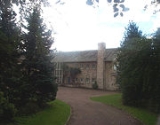
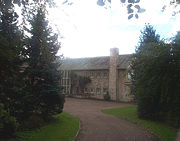
He was a workaholic and demanded the same commitment from his staff, dismissing staff who would not work his way. He had his own firm build him a house called 'Manasseh' at a cost of £60,000, helped by building contractors donating services for free in the hope of getting contracts in the future. The house won the 'Ideal Homes' House of the Year competition in 1958. When Poulson's problems caught up with him in later life, he sold the house to a young couple for just over half the build cost.
Poulson revolutionised the accepted architectural method of completing a design then handing it over for costing, planning and building. He developed a combined architecture and design practice, an all-in-one service which employed all the separate disciplines in integrated teams. This approach facilitated the development process and reduced costs. In the post war years Poulson's business boomed and by the sixties was one of the largest in Europe at the time. He was later to admit that the practice expanded "beyond my wildest dreams" and offices were opened in London
, Middlesbrough
, Newcastle upon Tyne
, Edinburgh
, Beirut
and Lagos
.
 In 1958 the National Liberal MP Sir Herbert Butcher
advised his friend Poulson to set up a servicing company to win business for his architect's practice. Poulson established Ropergate Services Ltd., named after the street in Pontefract where he was based. This company also had the advantage of reducing Poulson's tax liability considerably. The late 1950s saw a building boom as Britain had finally shaken off post-war austerity and many local authorities embarked on major building schemes. Notable among them was Newcastle upon Tyne
where dynamic leader T. Dan Smith
wanted to set his mark on the city.
Smith's desire to redevelop Newcastle attracted the attention of the construction firm Bovis
which had worked for Poulson. Bovis' managing director suggested formalising links and in February 1962 Smith was appointed as a consultant to the Poulson organisation. This connection was extremely valuable to Poulson as Smith had a network of contacts among other authorities in the north-east, many of which were also recruited as Poulson consultants. Smith's involvement with the Labour Party
reassured many Labour councillors wary of dealing with someone involved in the Conservative
-allied National Liberals.
Poulson also found a useful contact in Andrew Cunningham, a senior figure in both the General and Municipal Workers Union and the Labour Party
in north east England
. Some of Poulson's largest residential blocks were built in Cunningham's home town of Felling, County Durham
. Cunningham would later go to jail for his dealings with the architect.

 Poulson was also in a good position to win work for the nationalised industries, partly due to his having offered gifts to many civil servants when they were relatively junior and calling upon them for a return of gratitude years in the future. As an example Poulson had met Graham Tunbridge, a railway employee, during the war. After the nationalisation of British Rail
Tunbridge became estates surveyor for its Eastern Region and sent Poulson several contracts for modernisation of station-master's homes. When Tunbridge became Estates and Rating Surveyor for BR Southern Region, Poulson moved on to contracts at Waterloo station, Cannon Street station
and East Croydon station
. In return, Poulson had at first supplied Tunbridge with £25 weekly, and later loaned him a Rover car.
Another productive contact was Scottish Office civil servant George Pottinger, who in the late 1950s was put in charge of a £3 million redevelopment of Aviemore
as a winter sports complex. Poulson gave Pottinger gifts worth over £30,000 over six years, and was appointed by Pottinger as architect in charge of the Aviemore project. Pottinger also had a degree of political knowledge and skill which Poulson lacked and drafted political speeches for the "architect".
Poulson's connections with the National Liberals began to give him political advancement in the early 1960s. He was Vice-Chairman of the Executive Committee of the National Liberal Council from 1961 and frequently hosted National Liberal events in London at which he met senior government ministers, where Pottinger's speeches were impressive. He also made contact with the Labour
MP Albert Roberts
, for whom Poulson designed a house (free of charge). Roberts had useful contacts with the Portuguese
government and was offered a consultancy by Poulson at £2,500 per annum.
MP John Cordle
had extensive contacts in West Africa and after helping on several small contracts, in 1965 became a consultant to Poulson at £1,000 per annum. However, Cordle's approaches to governments in Nigeria
, The Gambia
and Libya
proved unfruitful. Cordle unwisely wrote a letter outlining everything he had done for Poulson, which was ultimately to doom his Parliamentary career.
, whom Poulson knew from his National Liberal activities. Maudling was anxious to build up a business career to keep up his income and Poulson needed a big name as Chairman of one of his companies, Construction Promotion. In 1966 Maudling accepted an offer to be Chairman for £5,000 per annum. In addition, Maudling's son Martin, who had left Oxford University
without taking a degree, went to work for another Poulson company. Poulson agreed to donate large sums of money to a charity patronised by Maudling's wife.
In return, Maudling helped to bring pressure on the government of Malta
to award a £1.5 million contract for the new Victoria Hospital on Gozo
to Poulson. In Parliament, Maudling vociferously opposed the plans of the Labour government to reduce the amount of defence spending and number of UK troops on Malta. He traded on the goodwill this created to bring extra pressure, and also changed Conservative Party policy so that overseas development assistance to Malta would be 75% grant and 25% loan instead of the even split which the Labour government had introduced.
As part of his attempts to get noticed, Poulson had become a local Commissioner of Taxes. However his own tax payments were seriously in deficit by the mid-1960s, mainly due to his extravagance on consultancies and gifts. In January 1968 the Inland Revenue
finally decided to sue Poulson; on 18 November 1968 they obtained judgment in their favour for £211,639. Poulson struggled on, but in June 1969 his staff confronted him with the fact that he was approaching bankruptcy. He attempted to recoup cash he had poured into subsidiary companies, which alerted his consultants that all was not well. Maudling and his son quietly resigned in November 1969.
On 31 December 1969 Poulson was formally removed from control of J.G.L. Poulson and Associates. On 9 November 1971 he filed his own bankruptcy petition revealing debts of £247,000. The bankruptcy hearings in Spring 1972 were assisted by Poulson's meticulous record-keeping which detailed his payments and gifts. Poulson's generosity drew the comment from Muir Hunter QC during the bankruptcy proceedings that "[i]n fact, Mr Poulson, you were distributing largesse like Henry VIII
". The bankruptcy hearing also revealed Poulson's love for a lavish lifestyle and his penchant for rubbing shoulders with senior figures in the establishment. This desire to show his financial superiority over others only served to highlight his true character as a lonely, friendless and insecure person. Interestingly, one of Poulson's biggest creditors was the Inland Revenue
to which he owed around £200,000. Whilst the Revenue were pressing Poulson for payment of this amount, he was himself presiding over debt hearings in Wakefield
in his role as a Commissioner of Inland Revenue.
It swiftly became apparent that Poulson was at the centre of a massive corruption scandal, and in July 1972, the Metropolitan Police began an investigation for fraud. This precipitated the resignation of Reginald Maudling, then Home Secretary
and notionally in charge of the police.
which was widely reported in the press, he was convicted on 11 February 1974 of fraud and jailed for five years (later increased to seven years). Sentencing him, the judge called Poulson an "incalculably evil man". For his part, Poulson denied the charges, saying "I have been a fool, surrounded by a pack of leeches. I took on the world on its own terms, and no one can deny I once had it in my fist". Many of his contacts, notably T. Dan Smith
and George Pottinger, were similarly convicted and jailed, though not the three MPs: it was found that there was a legal loophole through which Members of Parliament could not be considered as in charge of public funds. The Poulson scandals did much to force the House of Commons to initiate a Register of Members' Interests. A subsequent Select Committee inquiry which reported in 1977 found that all three had indulged in "conduct inconsistent with the standards which the House is entitled to expect from its Members". Cordle was forced to resign although the Commons then voted only to 'take note' of the Committee's report rather than endorsing it.
After serving periods in Armley Gaol
, Wakefield
and Oakham jails, Poulson was released on 13 May 1977 from Lincoln Prison
. His bankruptcy was discharged, with creditors receiving 10p in the pound, in 1980. A condition of the discharge was that half the proceeds of his autobiography would go to his creditors; the resulting book, The Price, gives his side of the corruption scandal and maintains his innocence. Only a few copies of the book remain in circulation as it was withdrawn and pulped by the publishers through fear of libel actions. Throughout the rest of his life Poulson insisted that he was simply developing advanced public relations and consulting techniques.
The trial at Leeds Crown Court lasted 52 days, and cost an estimated £1.25 million. Defending Poulson, QC Donald Herrod, said "He has nothing to live for and his abiding fear is that he will never complete his sentence because of ill health". However Donald Herrod later described his client as "hypocritical, self-righteous and perhaps something of a megalomaniac".
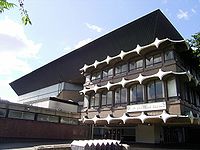
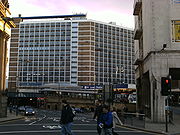
(1962) and International Pool
(1965–1968), both in Leeds
, and Forster House, Bradford
, which was demolished in 2005 as part of the Forster Square
redevelopment.
In an indirect way, Poulson did make a contribution to the UK's broadcasting culture. A special edition of the investigative ITV
series World in Action
, The Friends and Influence of John L Poulson, became a cause célèbre
in the debate about the power of Britain's television regulators to interfere with broadcast journalism
. The Poulson programme was banned by the then regulator, the ITA
, even though its members had not seen it. A furious debate followed in which newspaper
s as varied as The Sunday Times
and Socialist Worker
united in calling for an end to such "censorship
". Granada Television
, the makers of World In Action, broadcast a blank screen as a protest against the banning. There was some irony in this: the editor of World in Action was Raymond Fitzwalter who earlier, as deputy news editor of the Telegraph & Argus in Bradford, had led an investigation into Poulson's activities, which the newspaper published. Eventually, after the film was shown to the ITA, it was transmitted on 30 April 1973, three months late, and under a different title, The Rise And Fall of John Poulson.
The 1996, BBC television drama
serial Our Friends in the North
, written by Peter Flannery
, contains a character, John Edwards, who is closely based on Poulson, played by Geoffrey Hutchings
. One of the reasons the production took so long to reach the screen – Flannery had originally written it for the stage in 1982 – was the fear of the BBC
that Poulson and others fictionalised in the drama might take legal action. In the event, the deaths of Poulson and T. Dan Smith in 1993 finally allowed the production to commence.
British people
The British are citizens of the United Kingdom, of the Isle of Man, any of the Channel Islands, or of any of the British overseas territories, and their descendants...
architect
Architecture
Architecture is both the process and product of planning, designing and construction. Architectural works, in the material form of buildings, are often perceived as cultural and political symbols and as works of art...
and businessman who caused a major political scandal when his use of bribery
Bribery
Bribery, a form of corruption, is an act implying money or gift giving that alters the behavior of the recipient. Bribery constitutes a crime and is defined by Black's Law Dictionary as the offering, giving, receiving, or soliciting of any item of value to influence the actions of an official or...
was disclosed in 1972. The highest-ranking figure to be forced out was Conservative
Conservative Party (UK)
The Conservative Party, formally the Conservative and Unionist Party, is a centre-right political party in the United Kingdom that adheres to the philosophies of conservatism and British unionism. It is the largest political party in the UK, and is currently the largest single party in the House...
Home Secretary
Home Secretary
The Secretary of State for the Home Department, commonly known as the Home Secretary, is the minister in charge of the Home Office of the United Kingdom, and one of the country's four Great Offices of State...
Reginald Maudling
Reginald Maudling
Reginald Maudling was a British politician who held several Cabinet posts, including Chancellor of the Exchequer. He had been spoken of as a prospective Conservative leader since 1955, and was twice seriously considered for the post; he was Edward Heath's chief rival in 1965...
. Poulson served a jail sentence, but continued to protest his innocence, claiming that he was "a man more sinned against than sinning".
Family and early life
Poulson came from a strict Methodist family and inherited a strong faith which stressed the importance of self-help. He did badly at school and at Leeds College of Art but nevertheless was articled to a Pontefract firm of architects, Garside and Pennington. He left to start his own Architecture practice with financial backing from his father. He never became a formally qualified architect, because as he later claimed "I was too busy to complete my examinations". Poulson soon began to cultivate contacts in the local borough council and officials at the larger West RidingWest Riding of Yorkshire
The West Riding of Yorkshire is one of the three historic subdivisions of Yorkshire, England. From 1889 to 1974 the administrative county, County of York, West Riding , was based closely on the historic boundaries...
county authority. Work soon began to arrive and Poulson told friends that he was "on his way". Poulson also became politically involved with the National Liberals
National Liberal Party (UK, 1931)
The National Liberal Party, known until 1948 as the Liberal National Party, was a liberal political party in the United Kingdom from 1931 to 1968...
, although never let political differences stop him from making friends who were in charge of commissioning public buildings.
Post-war business
World War II
World War II, or the Second World War , was a global conflict lasting from 1939 to 1945, involving most of the world's nations—including all of the great powers—eventually forming two opposing military alliances: the Allies and the Axis...
He was a workaholic and demanded the same commitment from his staff, dismissing staff who would not work his way. He had his own firm build him a house called 'Manasseh' at a cost of £60,000, helped by building contractors donating services for free in the hope of getting contracts in the future. The house won the 'Ideal Homes' House of the Year competition in 1958. When Poulson's problems caught up with him in later life, he sold the house to a young couple for just over half the build cost.
Poulson revolutionised the accepted architectural method of completing a design then handing it over for costing, planning and building. He developed a combined architecture and design practice, an all-in-one service which employed all the separate disciplines in integrated teams. This approach facilitated the development process and reduced costs. In the post war years Poulson's business boomed and by the sixties was one of the largest in Europe at the time. He was later to admit that the practice expanded "beyond my wildest dreams" and offices were opened in London
London
London is the capital city of :England and the :United Kingdom, the largest metropolitan area in the United Kingdom, and the largest urban zone in the European Union by most measures. Located on the River Thames, London has been a major settlement for two millennia, its history going back to its...
, Middlesbrough
Middlesbrough
Middlesbrough is a large town situated on the south bank of the River Tees in north east England, that sits within the ceremonial county of North Yorkshire...
, Newcastle upon Tyne
Newcastle upon Tyne
Newcastle upon Tyne is a city and metropolitan borough of Tyne and Wear, in North East England. Historically a part of Northumberland, it is situated on the north bank of the River Tyne...
, Edinburgh
Edinburgh
Edinburgh is the capital city of Scotland, the second largest city in Scotland, and the eighth most populous in the United Kingdom. The City of Edinburgh Council governs one of Scotland's 32 local government council areas. The council area includes urban Edinburgh and a rural area...
, Beirut
Beirut
Beirut is the capital and largest city of Lebanon, with a population ranging from 1 million to more than 2 million . Located on a peninsula at the midpoint of Lebanon's Mediterranean coastline, it serves as the country's largest and main seaport, and also forms the Beirut Metropolitan...
and Lagos
Lagos
Lagos is a port and the most populous conurbation in Nigeria. With a population of 7,937,932, it is currently the third most populous city in Africa after Cairo and Kinshasa, and currently estimated to be the second fastest growing city in Africa...
.
Local authorities
Herbert Butcher
Sir Herbert Walter Butcher, 1st Baronet was an English Conservative and National Liberalpolitician. He sat in the House of Commons from 1937 to 1966....
advised his friend Poulson to set up a servicing company to win business for his architect's practice. Poulson established Ropergate Services Ltd., named after the street in Pontefract where he was based. This company also had the advantage of reducing Poulson's tax liability considerably. The late 1950s saw a building boom as Britain had finally shaken off post-war austerity and many local authorities embarked on major building schemes. Notable among them was Newcastle upon Tyne
Newcastle upon Tyne
Newcastle upon Tyne is a city and metropolitan borough of Tyne and Wear, in North East England. Historically a part of Northumberland, it is situated on the north bank of the River Tyne...
where dynamic leader T. Dan Smith
T. Dan Smith
Thomas Daniel Smith was a British politician who was Leader of Newcastle upon Tyne City Council from 1960 to 1965. He was a prominent figure in the Labour Party in the north east of England, such that he was nicknamed 'Mr Newcastle'...
wanted to set his mark on the city.
Smith's desire to redevelop Newcastle attracted the attention of the construction firm Bovis
Bovis Lend Lease
Lend Lease Project Management & Construction is the international project management and construction division of Lend Lease Group.-History:...
which had worked for Poulson. Bovis' managing director suggested formalising links and in February 1962 Smith was appointed as a consultant to the Poulson organisation. This connection was extremely valuable to Poulson as Smith had a network of contacts among other authorities in the north-east, many of which were also recruited as Poulson consultants. Smith's involvement with the Labour Party
Labour Party (UK)
The Labour Party is a centre-left democratic socialist party in the United Kingdom. It surpassed the Liberal Party in general elections during the early 1920s, forming minority governments under Ramsay MacDonald in 1924 and 1929-1931. The party was in a wartime coalition from 1940 to 1945, after...
reassured many Labour councillors wary of dealing with someone involved in the Conservative
Conservative Party (UK)
The Conservative Party, formally the Conservative and Unionist Party, is a centre-right political party in the United Kingdom that adheres to the philosophies of conservatism and British unionism. It is the largest political party in the UK, and is currently the largest single party in the House...
-allied National Liberals.
Poulson also found a useful contact in Andrew Cunningham, a senior figure in both the General and Municipal Workers Union and the Labour Party
Labour Party (UK)
The Labour Party is a centre-left democratic socialist party in the United Kingdom. It surpassed the Liberal Party in general elections during the early 1920s, forming minority governments under Ramsay MacDonald in 1924 and 1929-1931. The party was in a wartime coalition from 1940 to 1945, after...
in north east England
North East England
North East England is one of the nine official regions of England. It covers Northumberland, County Durham, Tyne and Wear, and Teesside . The only cities in the region are Durham, Newcastle upon Tyne and Sunderland...
. Some of Poulson's largest residential blocks were built in Cunningham's home town of Felling, County Durham
County Durham
County Durham is a ceremonial county and unitary district in north east England. The county town is Durham. The largest settlement in the ceremonial county is the town of Darlington...
. Cunningham would later go to jail for his dealings with the architect.
Nationalised industries
British Rail
British Railways , which from 1965 traded as British Rail, was the operator of most of the rail transport in Great Britain between 1948 and 1997. It was formed from the nationalisation of the "Big Four" British railway companies and lasted until the gradual privatisation of British Rail, in stages...
Tunbridge became estates surveyor for its Eastern Region and sent Poulson several contracts for modernisation of station-master's homes. When Tunbridge became Estates and Rating Surveyor for BR Southern Region, Poulson moved on to contracts at Waterloo station, Cannon Street station
Cannon Street station
Cannon Street station, also known as London Cannon Street, is a central London railway terminus and London Underground complex in the City of London, England. It is built on the site of the medieval Steelyard, the trading base in England of the Hanseatic League...
and East Croydon station
East Croydon station
East Croydon station is a railway station and tram stop in Croydon, 10.35 miles south of London Bridge in Travelcard Zone 5. It is the largest and busiest station in Croydon and the busiest in London outside Travelcard Zone 1 in terms of the number of passengers entering and exiting...
. In return, Poulson had at first supplied Tunbridge with £25 weekly, and later loaned him a Rover car.
Another productive contact was Scottish Office civil servant George Pottinger, who in the late 1950s was put in charge of a £3 million redevelopment of Aviemore
Aviemore
Aviemore is a town and tourist resort, situated within the Cairngorms National Park in the Highlands of Scotland. It is in the Badenoch and Strathspey committee area, within the Highland council area. The town is popular for skiing and other winter sports, and for hill-walking in the Cairngorm...
as a winter sports complex. Poulson gave Pottinger gifts worth over £30,000 over six years, and was appointed by Pottinger as architect in charge of the Aviemore project. Pottinger also had a degree of political knowledge and skill which Poulson lacked and drafted political speeches for the "architect".
Poulson's connections with the National Liberals began to give him political advancement in the early 1960s. He was Vice-Chairman of the Executive Committee of the National Liberal Council from 1961 and frequently hosted National Liberal events in London at which he met senior government ministers, where Pottinger's speeches were impressive. He also made contact with the Labour
Labour Party (UK)
The Labour Party is a centre-left democratic socialist party in the United Kingdom. It surpassed the Liberal Party in general elections during the early 1920s, forming minority governments under Ramsay MacDonald in 1924 and 1929-1931. The party was in a wartime coalition from 1940 to 1945, after...
MP Albert Roberts
Albert Roberts
Albert Roberts was a British Labour politician.Roberts was educated at Whitwood Technical College and worked as a mining engineer and mines inspector for the Yorkshire Safety Board 1941-51. He was elected a councillor on Rothwell Urban District Council 1937-51, serving as chair in 1948.Roberts was...
, for whom Poulson designed a house (free of charge). Roberts had useful contacts with the Portuguese
Portugal
Portugal , officially the Portuguese Republic is a country situated in southwestern Europe on the Iberian Peninsula. Portugal is the westernmost country of Europe, and is bordered by the Atlantic Ocean to the West and South and by Spain to the North and East. The Atlantic archipelagos of the...
government and was offered a consultancy by Poulson at £2,500 per annum.
Overseas work
Poulson was increasingly interested in obtaining commissions outside Britain in the mid-1960s. This required making more contacts. The ConservativeConservative Party (UK)
The Conservative Party, formally the Conservative and Unionist Party, is a centre-right political party in the United Kingdom that adheres to the philosophies of conservatism and British unionism. It is the largest political party in the UK, and is currently the largest single party in the House...
MP John Cordle
John Cordle
John Howard Cordle was a British Conservative Party politician.Cordle, the son of Ernest William Cordle, was educated at the City of London School and became managing director of E. W. Cordle and Son Ltd. in 1946. He was also a member of Lloyd's of London...
had extensive contacts in West Africa and after helping on several small contracts, in 1965 became a consultant to Poulson at £1,000 per annum. However, Cordle's approaches to governments in Nigeria
Nigeria
Nigeria , officially the Federal Republic of Nigeria, is a federal constitutional republic comprising 36 states and its Federal Capital Territory, Abuja. The country is located in West Africa and shares land borders with the Republic of Benin in the west, Chad and Cameroon in the east, and Niger in...
, The Gambia
The Gambia
The Republic of The Gambia, commonly referred to as The Gambia, or Gambia , is a country in West Africa. Gambia is the smallest country on mainland Africa, surrounded by Senegal except for a short coastline on the Atlantic Ocean in the west....
and Libya
Libya
Libya is an African country in the Maghreb region of North Africa bordered by the Mediterranean Sea to the north, Egypt to the east, Sudan to the southeast, Chad and Niger to the south, and Algeria and Tunisia to the west....
proved unfruitful. Cordle unwisely wrote a letter outlining everything he had done for Poulson, which was ultimately to doom his Parliamentary career.
Maudling
Another contact was the then Shadow Commonwealth Secretary Reginald MaudlingReginald Maudling
Reginald Maudling was a British politician who held several Cabinet posts, including Chancellor of the Exchequer. He had been spoken of as a prospective Conservative leader since 1955, and was twice seriously considered for the post; he was Edward Heath's chief rival in 1965...
, whom Poulson knew from his National Liberal activities. Maudling was anxious to build up a business career to keep up his income and Poulson needed a big name as Chairman of one of his companies, Construction Promotion. In 1966 Maudling accepted an offer to be Chairman for £5,000 per annum. In addition, Maudling's son Martin, who had left Oxford University
University of Oxford
The University of Oxford is a university located in Oxford, United Kingdom. It is the second-oldest surviving university in the world and the oldest in the English-speaking world. Although its exact date of foundation is unclear, there is evidence of teaching as far back as 1096...
without taking a degree, went to work for another Poulson company. Poulson agreed to donate large sums of money to a charity patronised by Maudling's wife.
In return, Maudling helped to bring pressure on the government of Malta
Malta
Malta , officially known as the Republic of Malta , is a Southern European country consisting of an archipelago situated in the centre of the Mediterranean, south of Sicily, east of Tunisia and north of Libya, with Gibraltar to the west and Alexandria to the east.Malta covers just over in...
to award a £1.5 million contract for the new Victoria Hospital on Gozo
Gozo
Gozo is a small island of the Maltese archipelago in the Mediterranean Sea. The island is part of the Southern European country of Malta; after the island of Malta itself, it is the second-largest island in the archipelago...
to Poulson. In Parliament, Maudling vociferously opposed the plans of the Labour government to reduce the amount of defence spending and number of UK troops on Malta. He traded on the goodwill this created to bring extra pressure, and also changed Conservative Party policy so that overseas development assistance to Malta would be 75% grant and 25% loan instead of the even split which the Labour government had introduced.
Financial trouble
Poulson's business model was initially highly successful and, at its apogee, was making an annual turnover of £1 million; he himself admitted to being a millionaire. However, it was consuming more contract work than was becoming available, and Poulson resorted to tackling these difficulties by bribing and corrupting local councillors, local authority officials and civil servants at all levels. This was an expensive strategy and Poulson later estimated that he "gave away" about £500,000 in the last few years of his involvement in the business.As part of his attempts to get noticed, Poulson had become a local Commissioner of Taxes. However his own tax payments were seriously in deficit by the mid-1960s, mainly due to his extravagance on consultancies and gifts. In January 1968 the Inland Revenue
Inland Revenue
The Inland Revenue was, until April 2005, a department of the British Government responsible for the collection of direct taxation, including income tax, national insurance contributions, capital gains tax, inheritance tax, corporation tax, petroleum revenue tax and stamp duty...
finally decided to sue Poulson; on 18 November 1968 they obtained judgment in their favour for £211,639. Poulson struggled on, but in June 1969 his staff confronted him with the fact that he was approaching bankruptcy. He attempted to recoup cash he had poured into subsidiary companies, which alerted his consultants that all was not well. Maudling and his son quietly resigned in November 1969.
On 31 December 1969 Poulson was formally removed from control of J.G.L. Poulson and Associates. On 9 November 1971 he filed his own bankruptcy petition revealing debts of £247,000. The bankruptcy hearings in Spring 1972 were assisted by Poulson's meticulous record-keeping which detailed his payments and gifts. Poulson's generosity drew the comment from Muir Hunter QC during the bankruptcy proceedings that "[i]n fact, Mr Poulson, you were distributing largesse like Henry VIII
Henry VIII of England
Henry VIII was King of England from 21 April 1509 until his death. He was Lord, and later King, of Ireland, as well as continuing the nominal claim by the English monarchs to the Kingdom of France...
". The bankruptcy hearing also revealed Poulson's love for a lavish lifestyle and his penchant for rubbing shoulders with senior figures in the establishment. This desire to show his financial superiority over others only served to highlight his true character as a lonely, friendless and insecure person. Interestingly, one of Poulson's biggest creditors was the Inland Revenue
Inland Revenue
The Inland Revenue was, until April 2005, a department of the British Government responsible for the collection of direct taxation, including income tax, national insurance contributions, capital gains tax, inheritance tax, corporation tax, petroleum revenue tax and stamp duty...
to which he owed around £200,000. Whilst the Revenue were pressing Poulson for payment of this amount, he was himself presiding over debt hearings in Wakefield
Wakefield
Wakefield is the main settlement and administrative centre of the City of Wakefield, a metropolitan district of West Yorkshire, England. Located by the River Calder on the eastern edge of the Pennines, the urban area is and had a population of 76,886 in 2001....
in his role as a Commissioner of Inland Revenue.
It swiftly became apparent that Poulson was at the centre of a massive corruption scandal, and in July 1972, the Metropolitan Police began an investigation for fraud. This precipitated the resignation of Reginald Maudling, then Home Secretary
Home Secretary
The Secretary of State for the Home Department, commonly known as the Home Secretary, is the minister in charge of the Home Office of the United Kingdom, and one of the country's four Great Offices of State...
and notionally in charge of the police.
Dénouement
On 22 June 1973 Poulson was arrested and charged with corruption in connection with the award of building contracts. Following a 52-day trial at Leeds Crown CourtLeeds Crown Court
Leeds Crown Court is the highest court in West Yorkshire, England. The buildings are situated in Westgate in Leeds city centre, adjacent to Leeds magistrates courts.-Notable cases:...
which was widely reported in the press, he was convicted on 11 February 1974 of fraud and jailed for five years (later increased to seven years). Sentencing him, the judge called Poulson an "incalculably evil man". For his part, Poulson denied the charges, saying "I have been a fool, surrounded by a pack of leeches. I took on the world on its own terms, and no one can deny I once had it in my fist". Many of his contacts, notably T. Dan Smith
T. Dan Smith
Thomas Daniel Smith was a British politician who was Leader of Newcastle upon Tyne City Council from 1960 to 1965. He was a prominent figure in the Labour Party in the north east of England, such that he was nicknamed 'Mr Newcastle'...
and George Pottinger, were similarly convicted and jailed, though not the three MPs: it was found that there was a legal loophole through which Members of Parliament could not be considered as in charge of public funds. The Poulson scandals did much to force the House of Commons to initiate a Register of Members' Interests. A subsequent Select Committee inquiry which reported in 1977 found that all three had indulged in "conduct inconsistent with the standards which the House is entitled to expect from its Members". Cordle was forced to resign although the Commons then voted only to 'take note' of the Committee's report rather than endorsing it.
After serving periods in Armley Gaol
Leeds (HM Prison)
HM Prison Leeds is a Category B men's prison, in the Armley area of Leeds in West Yorkshire, England, which opened in 1847. Leeds Prison is operated by Her Majesty's Prison Service, and is still known locally as Armley Gaol , the historical name for the prison.-History:Construction of Leeds Prison ...
, Wakefield
Wakefield (HM Prison)
HM Prison Wakefield is a Category A men's prison, located in Wakefield, West Yorkshire, England. The prison is operated by Her Majesty's Prison Service, and is the largest maximum security prison in the United Kingdom...
and Oakham jails, Poulson was released on 13 May 1977 from Lincoln Prison
Lincoln (HM Prison)
HM Prison Lincoln is a Category B men's prison, located in Lincoln, Lincolnshire, England. The prison is operated by Her Majesty's Prison Service.-History:...
. His bankruptcy was discharged, with creditors receiving 10p in the pound, in 1980. A condition of the discharge was that half the proceeds of his autobiography would go to his creditors; the resulting book, The Price, gives his side of the corruption scandal and maintains his innocence. Only a few copies of the book remain in circulation as it was withdrawn and pulped by the publishers through fear of libel actions. Throughout the rest of his life Poulson insisted that he was simply developing advanced public relations and consulting techniques.
The trial at Leeds Crown Court lasted 52 days, and cost an estimated £1.25 million. Defending Poulson, QC Donald Herrod, said "He has nothing to live for and his abiding fear is that he will never complete his sentence because of ill health". However Donald Herrod later described his client as "hypocritical, self-righteous and perhaps something of a megalomaniac".
Contribution
Among buildings designed by Poulson are the City HouseCity House
City House is a building over Leeds railway station that was built as British Railways House in 1962. The buildings were, like many other railway buildings in the UK, designed by architect John Poulson. Poulson also designed the Leeds International Swimming Pool...
(1962) and International Pool
Leeds International Pool
The Leeds International Pool often referred to as the LIP, was a swimming facility in Leeds city centre, West Yorkshire, England. The Pool was situated at the lower end of Westgate and was notable for its brutalist architecture...
(1965–1968), both in Leeds
Leeds
Leeds is a city and metropolitan borough in West Yorkshire, England. In 2001 Leeds' main urban subdivision had a population of 443,247, while the entire city has a population of 798,800 , making it the 30th-most populous city in the European Union.Leeds is the cultural, financial and commercial...
, and Forster House, Bradford
Bradford
Bradford lies at the heart of the City of Bradford, a metropolitan borough of West Yorkshire, in Northern England. It is situated in the foothills of the Pennines, west of Leeds, and northwest of Wakefield. Bradford became a municipal borough in 1847, and received its charter as a city in 1897...
, which was demolished in 2005 as part of the Forster Square
Forster Square, Bradford
Forster Square, Bradford was a square in central Bradford that disappeared in the current Broadway development, but gives its name to Bradford Forster Square railway station and a retail park.- History :...
redevelopment.
In an indirect way, Poulson did make a contribution to the UK's broadcasting culture. A special edition of the investigative ITV
ITV
ITV is the major commercial public service TV network in the United Kingdom. Launched in 1955 under the auspices of the Independent Television Authority to provide competition to the BBC, it is also the oldest commercial network in the UK...
series World in Action
World in Action
World in Action was a British investigative current affairs programme made by Granada Television from 1963 until 1998. Its campaigning journalism frequently had a major impact on events of the day. Its production teams often took audacious risks and gained a solid reputation for its often...
, The Friends and Influence of John L Poulson, became a cause célèbre
Cause célèbre
A is an issue or incident arousing widespread controversy, outside campaigning and heated public debate. The term is particularly used in connection with celebrated legal cases. It is a French phrase in common English use...
in the debate about the power of Britain's television regulators to interfere with broadcast journalism
Journalism
Journalism is the practice of investigation and reporting of events, issues and trends to a broad audience in a timely fashion. Though there are many variations of journalism, the ideal is to inform the intended audience. Along with covering organizations and institutions such as government and...
. The Poulson programme was banned by the then regulator, the ITA
Independent Television Authority
The Independent Television Authority was an agency created by the Television Act 1954 to supervise the creation of "Independent Television" , the first commercial television network in the United Kingdom...
, even though its members had not seen it. A furious debate followed in which newspaper
Newspaper
A newspaper is a scheduled publication containing news of current events, informative articles, diverse features and advertising. It usually is printed on relatively inexpensive, low-grade paper such as newsprint. By 2007, there were 6580 daily newspapers in the world selling 395 million copies a...
s as varied as The Sunday Times
The Sunday Times
The Sunday Times is a British Sunday newspaper.The Sunday Times may also refer to:*The Sunday Times *The Sunday Times *The Sunday Times *The Sunday Times...
and Socialist Worker
Socialist Worker
Socialist Worker is the name of several socialist/communist newspapers associated with the International Socialist Tendency...
united in calling for an end to such "censorship
Censorship
thumb|[[Book burning]] following the [[1973 Chilean coup d'état|1973 coup]] that installed the [[Military government of Chile |Pinochet regime]] in Chile...
". Granada Television
Granada Television
Granada Television is the ITV contractor for North West England. Based in Manchester since its inception, it is the only surviving original ITA franchisee from 1954 and is ITV's most successful....
, the makers of World In Action, broadcast a blank screen as a protest against the banning. There was some irony in this: the editor of World in Action was Raymond Fitzwalter who earlier, as deputy news editor of the Telegraph & Argus in Bradford, had led an investigation into Poulson's activities, which the newspaper published. Eventually, after the film was shown to the ITA, it was transmitted on 30 April 1973, three months late, and under a different title, The Rise And Fall of John Poulson.
The 1996, BBC television drama
BBC television drama
BBC television dramas have been produced and broadcast since even before the public service company had an officially established television broadcasting network in the United Kingdom...
serial Our Friends in the North
Our Friends in the North
Our Friends in the North is a British television drama serial, produced by the BBC and originally broadcast in nine episodes on BBC Two in early 1996...
, written by Peter Flannery
Peter Flannery
Peter Flannery is a British playwright and screenwriter. He was educated at Bath Spa University and is best known for his work while a resident playwright at the Royal Shakespeare Company in the late 1970s and early 1980s...
, contains a character, John Edwards, who is closely based on Poulson, played by Geoffrey Hutchings
Geoffrey Hutchings
Geoffrey Hutchings was a British stage, film and television actor.-Early life and career:Hutchings was born in Dorchester, Dorset, England. After attending Hardye's School, he studied French and Physical Education at Birmingham University before he became a member of the Royal Academy of Dramatic...
. One of the reasons the production took so long to reach the screen – Flannery had originally written it for the stage in 1982 – was the fear of the BBC
BBC
The British Broadcasting Corporation is a British public service broadcaster. Its headquarters is at Broadcasting House in the City of Westminster, London. It is the largest broadcaster in the world, with about 23,000 staff...
that Poulson and others fictionalised in the drama might take legal action. In the event, the deaths of Poulson and T. Dan Smith in 1993 finally allowed the production to commence.