

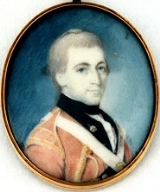
Patrick Ferguson

Encyclopedia
Major Patrick Ferguson (1744 – October 7, 1780) was a Scottish
officer in the British Army
, early advocate of light infantry
and designer of the Ferguson rifle
. He is best known for his service in the 1780 military campaign of Charles Cornwallis
, in which he aggressively recruited Loyalists and harshly treated Patriot sympathisers. Some dispute this characterization of Ferguson as pro-Patriot bias, however, and other accounts praise him for his humanity and unwillingness to follow orders he considered barbaric. Ultimately, his activities led to a militia uprising against him, and he was killed in the Battle of Kings Mountain
, where he was the only regular army officer present from either side of the conflict. His body was mistreated in the aftermath of the battle by the victorious Patriot forces before burial.
, Scotland
, on May 25 (Old Style
)/June 4 (New Style) 1744, the second son and fourth child of advocate James Ferguson of Pitfour (who was raised to the judges' bench as a Senator of the College of Justice
, so known as Lord Pitfour after 1764) and his wife Anne Murray, a sister of the literary patron Patrick Murray, 5th Lord Elibank
.
Through his parents, he knew a number of major figures in the Scottish Enlightenment
, including philosopher and historian David Hume
, on whose recommendation he read Samuel Richardson
's novel Clarissa when he was fifteen, and the dramatist John Home
. He had a large number of first cousins through his mother's family: these included Sir William Pulteney, 5th Baronet, Commodore George Johnstone, and Sir James Murray (later Murray-Pulteney).
. He served briefly in the Holy Roman Empire
with the Scots Greys
during the Seven Years' War
, until a leg ailment - probably tuberculosis
in the knee - forced him to return home. After recovering, now in peace-time, he served with his regiment on garrison duty. In 1768, he purchased a command of a company in 70th Regiment of Foot, under the Colonelcy of his cousin Alexander Johnstone, and served with them in the West Indies until his lame leg again began to trouble him.
After returning home in 1772, he took part in light infantry
training, coming to the attention of General Howe
, and developed the Ferguson rifle
, a breech-loading flintlock
weapon based on Chaumette's earlier system.
on September 11, 1777. Shortly before, he had had the chance to shoot a prominent American officer, accompanied by another in distinctive hussar dress, but decided not to do so, as he had his back to him and was unaware of his presence. He was told in hospital by a surgeon, who had been speaking to some American casualties, that General Washington had been in the area at the time. Ferguson wrote that, even if the officer were him, he did not regret his decision. However, the officer's identity remains uncertain, and the presence of the aide in hussar dress has led to suggestions that he may have been Count Casimir Pulaski. For some months, he lived under threat of amputation, and also received news of his father's death. He eventually recovered, although his right arm was permanently crippled. He resumed his career in May 1778, under the command of Sir Henry Clinton
.
In October 1778, he was sent to lead a raid to suppress privateer
s who had been seizing British ships and were based around the Little Egg Harbor River in what is known as the Battle of Chestnut Neck
. Shortly after this raid, Ferguson was notified that a detachment of Pułaski's troops was located nearby. Ferguson marched his troops to the site of the infantry outpost, which comprised fifty men a short distance from the main encampment. At first light, Ferguson ordered the bayonet charge; only five of his quarry were taken alive in what was called the Little Egg Harbor massacre
. Ferguson's own account (under the pen-name Egg-Shell) conveys his dismay at Pułaski's lack of preparations and lack of look-outs. Pułaski eventually led his mounted troops (Pułaski's Legion
) forward, causing Ferguson to retreat to his boats minus a few men that had been captured.
In 1779 Ferguson became a Major
in the 71st Foot
. In 1780, the British Army sent General Lord Cornwallis
to invade South Carolina
and North Carolina
. His mission was to defeat all American forces in the Carolinas and keep the two colonies within the British Empire. A key part of Cornwallis's plan was to recruit soldiers from local Loyalists
. To achieve this goal, General Clinton appointed Major Ferguson as Inspector of Militia
in South Carolina
. Ferguson's mission was to recruit Loyalist militia in the Carolinas and Georgia and intimidate any colonists who favoured American independence.
After winning several victories over American forces, Cornwallis occupied Charlotte, North Carolina
in the summer of 1780. He subsequently divided his army and gave command of one section to Ferguson. Ferguson's wing consisted of Loyalists he had recruited to fight for the British cause. When Ferguson publicly threatened to invade the mountains beyond the legal limit on westward settlement unless the colonists there abandoned the cause of American independence, the mountaineers organised an army to fight Ferguson at King's Pinnacle
, an isolated ridge on the North Carolina-South Carolina border. On October 7, 1780 the two armies met in the famous Battle of Kings Mountain
. The battle went badly for the Loyalists, and during the fighting, Ferguson was shot from his horse. He was dragged with his foot still in the saddle to the rebel side. When an American walked over for his surrender, he drew his pistol and shot the American as a last act of defiance. His corpse was found with eight musket holes in his body. The Patriots then stripped it of its clothes and urinated on it. He was buried near the site of his fall. It was claimed – according to Patriot accounts – that his corpse was ill-used before burial in an oxhide.
A lifelong bachelor, he was buried with one of his mistresses, 'Virginia Sal', who was also killed in the battle. In the 1920s the U.S. government erected a marker at his gravesite, which today is a part of the Kings Mountain National Military Park
, a unit of the National Park Service
.
His personal correspondence reveals a man of intelligence, humour and charm. He also wrote several articles, satirical in tone, for publication in Rivington's Royal Gazette, under the pseudonyms Egg-Shell, Memento Mori and John Bull.
He was survived by his mother, his brothers James and George, and sisters Annie, Elizabeth (Betty) (Mrs Scrymgeour-Wedderburn of Birkhill), and Jean.
In Louis L'amour's
1973 book The Ferguson Rifle, Ferguson stops by a poor family home on his way to the Battle of King's Mountain and kindly gives his personal copy of the Ferguson rifle to a boy who later carries it West. Ferguson is shown to be a gentleman who displays all the appropriate social graces to a lady (the boy's ill mother) and compassion to a family in need by giving up his personal firearm asking only that the boy keep it always, and never use it against the king. (p7)
In Steve Ressel
's 2010 novel "State Of One", Ferguson is the main antagonist against James Pariah, a former soldier under Ferguson's command during the Battle of the Brandywine in 1777. Ferguson had been resurrected as a golem
by the Leeds Witch with hopes of raising a golem army of similar soldiers, all armed with Ferguson rifle
s, to destroy the ratification of the US Constitution in September 1787. James Pariah cleaves to his old Ferguson rifle, sometimes referring to it as his wife, having modified it with special actions such as a spring-loaded knife in the stock.
Scottish people
The Scottish people , or Scots, are a nation and ethnic group native to Scotland. Historically they emerged from an amalgamation of the Picts and Gaels, incorporating neighbouring Britons to the south as well as invading Germanic peoples such as the Anglo-Saxons and the Norse.In modern use,...
officer in the British Army
British Army
The British Army is the land warfare branch of Her Majesty's Armed Forces in the United Kingdom. It came into being with the unification of the Kingdom of England and Scotland into the Kingdom of Great Britain in 1707. The new British Army incorporated Regiments that had already existed in England...
, early advocate of light infantry
Light infantry
Traditionally light infantry were soldiers whose job was to provide a skirmishing screen ahead of the main body of infantry, harassing and delaying the enemy advance. Light infantry was distinct from medium, heavy or line infantry. Heavy infantry were dedicated primarily to fighting in tight...
and designer of the Ferguson rifle
Ferguson rifle
The Ferguson rifle was one of the first breech loading rifles to be widely tested by the British military. Other breech loaders were experimented with in various commands, including earlier versions of the Ordnance rifle by Patrick Ferguson when he was in the "Fever Islands" . It was often...
. He is best known for his service in the 1780 military campaign of Charles Cornwallis
Charles Cornwallis, 1st Marquess Cornwallis
Charles Cornwallis, 1st Marquess Cornwallis KG , styled Viscount Brome between 1753 and 1762 and known as The Earl Cornwallis between 1762 and 1792, was a British Army officer and colonial administrator...
, in which he aggressively recruited Loyalists and harshly treated Patriot sympathisers. Some dispute this characterization of Ferguson as pro-Patriot bias, however, and other accounts praise him for his humanity and unwillingness to follow orders he considered barbaric. Ultimately, his activities led to a militia uprising against him, and he was killed in the Battle of Kings Mountain
Battle of Kings Mountain
The Battle of Kings Mountain was a decisive battle between the Patriot and Loyalist militias in the Southern campaign of the American Revolutionary War...
, where he was the only regular army officer present from either side of the conflict. His body was mistreated in the aftermath of the battle by the victorious Patriot forces before burial.
Early life
Patrick Ferguson was born in EdinburghEdinburgh
Edinburgh is the capital city of Scotland, the second largest city in Scotland, and the eighth most populous in the United Kingdom. The City of Edinburgh Council governs one of Scotland's 32 local government council areas. The council area includes urban Edinburgh and a rural area...
, Scotland
Scotland
Scotland is a country that is part of the United Kingdom. Occupying the northern third of the island of Great Britain, it shares a border with England to the south and is bounded by the North Sea to the east, the Atlantic Ocean to the north and west, and the North Channel and Irish Sea to the...
, on May 25 (Old Style
Old Style and New Style dates
Old Style and New Style are used in English language historical studies either to indicate that the start of the Julian year has been adjusted to start on 1 January even though documents written at the time use a different start of year ; or to indicate that a date conforms to the Julian...
)/June 4 (New Style) 1744, the second son and fourth child of advocate James Ferguson of Pitfour (who was raised to the judges' bench as a Senator of the College of Justice
Senator of the College of Justice
The Senators of the College of Justice are judges of the College of Justice, a set of legal institutions involved in the administration of justice in Scotland. There are three types of Senator: Lords of Session ; Lords Commissioner of Justiciary ; and the Chairman of the Scottish Land Court...
, so known as Lord Pitfour after 1764) and his wife Anne Murray, a sister of the literary patron Patrick Murray, 5th Lord Elibank
Patrick Murray, 5th Lord Elibank
Patrick Murray, 5th Lord Elibank . Son of Alexander Murray, 4th Lord Elibank and Elizabeth Stirling. An author and economist much respected in his own time. Member of the Cocoa Tree Club and The Poker Club. Uncle of Major Patrick Ferguson killed at the Battle of King's Mountain in 1780.In 1722...
.
Through his parents, he knew a number of major figures in the Scottish Enlightenment
Scottish Enlightenment
The Scottish Enlightenment was the period in 18th century Scotland characterised by an outpouring of intellectual and scientific accomplishments. By 1750, Scots were among the most literate citizens of Europe, with an estimated 75% level of literacy...
, including philosopher and historian David Hume
David Hume
David Hume was a Scottish philosopher, historian, economist, and essayist, known especially for his philosophical empiricism and skepticism. He was one of the most important figures in the history of Western philosophy and the Scottish Enlightenment...
, on whose recommendation he read Samuel Richardson
Samuel Richardson
Samuel Richardson was an 18th-century English writer and printer. He is best known for his three epistolary novels: Pamela: Or, Virtue Rewarded , Clarissa: Or the History of a Young Lady and The History of Sir Charles Grandison...
's novel Clarissa when he was fifteen, and the dramatist John Home
John Home
John Home was a Scottish poet and dramatist.-Biography:He was born at Leith, near Edinburgh, where his father, Alexander Home, a distant relation of the earls of Home, was town clerk. John was educated at the Leith Grammar School, and at the University of Edinburgh, where he graduated MA, in 1742...
. He had a large number of first cousins through his mother's family: these included Sir William Pulteney, 5th Baronet, Commodore George Johnstone, and Sir James Murray (later Murray-Pulteney).
Seven Years' War
He began his military career in his teens, encouraged by his uncle James MurrayJames Murray (military officer)
James Murray FRS was a British soldier, whose lengthy career included service as colonial administrator and governor of the Province of Quebec and later as Governor of Minorca from 1778 to 1782.-Early life:He was a younger son of Alexander Murray, 4th Lord Elibank, and his wife Elizabeth...
. He served briefly in the Holy Roman Empire
Holy Roman Empire
The Holy Roman Empire was a realm that existed from 962 to 1806 in Central Europe.It was ruled by the Holy Roman Emperor. Its character changed during the Middle Ages and the Early Modern period, when the power of the emperor gradually weakened in favour of the princes...
with the Scots Greys
Scots Greys
The Royal Scots Greys was a cavalry regiment of the British Army from 1707 until 1971, when they amalgamated with the 3rd Carabiniers to form The Royal Scots Dragoon Guards ....
during the Seven Years' War
Seven Years' War
The Seven Years' War was a global military war between 1756 and 1763, involving most of the great powers of the time and affecting Europe, North America, Central America, the West African coast, India, and the Philippines...
, until a leg ailment - probably tuberculosis
Tuberculosis
Tuberculosis, MTB, or TB is a common, and in many cases lethal, infectious disease caused by various strains of mycobacteria, usually Mycobacterium tuberculosis. Tuberculosis usually attacks the lungs but can also affect other parts of the body...
in the knee - forced him to return home. After recovering, now in peace-time, he served with his regiment on garrison duty. In 1768, he purchased a command of a company in 70th Regiment of Foot, under the Colonelcy of his cousin Alexander Johnstone, and served with them in the West Indies until his lame leg again began to trouble him.
After returning home in 1772, he took part in light infantry
Light infantry
Traditionally light infantry were soldiers whose job was to provide a skirmishing screen ahead of the main body of infantry, harassing and delaying the enemy advance. Light infantry was distinct from medium, heavy or line infantry. Heavy infantry were dedicated primarily to fighting in tight...
training, coming to the attention of General Howe
William Howe, 5th Viscount Howe
William Howe, 5th Viscount Howe, KB, PC was a British army officer who rose to become Commander-in-Chief of British forces during the American War of Independence...
, and developed the Ferguson rifle
Ferguson rifle
The Ferguson rifle was one of the first breech loading rifles to be widely tested by the British military. Other breech loaders were experimented with in various commands, including earlier versions of the Ordnance rifle by Patrick Ferguson when he was in the "Fever Islands" . It was often...
, a breech-loading flintlock
Flintlock
Flintlock is the general term for any firearm based on the flintlock mechanism. The term may also apply to the mechanism itself. Introduced at the beginning of the 17th century, the flintlock rapidly replaced earlier firearm-ignition technologies, such as the doglock, matchlock and wheellock...
weapon based on Chaumette's earlier system.
American War of Independence
In 1777, he went to serve in the American War of Independence with his experimental rifle corps. However, after initial success, he was shot through the right elbow-joint at the Battle of BrandywineBattle of Brandywine
The Battle of Brandywine, also known as the Battle of the Brandywine or the Battle of Brandywine Creek, was fought between the American army of Major General George Washington and the British-Hessian army of General Sir William Howe on September 11, 1777. The British defeated the Americans and...
on September 11, 1777. Shortly before, he had had the chance to shoot a prominent American officer, accompanied by another in distinctive hussar dress, but decided not to do so, as he had his back to him and was unaware of his presence. He was told in hospital by a surgeon, who had been speaking to some American casualties, that General Washington had been in the area at the time. Ferguson wrote that, even if the officer were him, he did not regret his decision. However, the officer's identity remains uncertain, and the presence of the aide in hussar dress has led to suggestions that he may have been Count Casimir Pulaski. For some months, he lived under threat of amputation, and also received news of his father's death. He eventually recovered, although his right arm was permanently crippled. He resumed his career in May 1778, under the command of Sir Henry Clinton
Henry Clinton (American War of Independence)
General Sir Henry Clinton KB was a British army officer and politician, best known for his service as a general during the American War of Independence. First arriving in Boston in May 1775, from 1778 to 1782 he was the British Commander-in-Chief in North America...
.
In October 1778, he was sent to lead a raid to suppress privateer
Privateer
A privateer is a private person or ship authorized by a government by letters of marque to attack foreign shipping during wartime. Privateering was a way of mobilizing armed ships and sailors without having to spend public money or commit naval officers...
s who had been seizing British ships and were based around the Little Egg Harbor River in what is known as the Battle of Chestnut Neck
Battle of Chestnut Neck
The Battle of Chestnut Neck was a battle fought on October 6, 1778 in New Jersey during the American Revolutionary War, at Chestnut Neck, a settlement on the Little Egg Harbor River near the present-day town of Port Republic, New Jersey.-Background:...
. Shortly after this raid, Ferguson was notified that a detachment of Pułaski's troops was located nearby. Ferguson marched his troops to the site of the infantry outpost, which comprised fifty men a short distance from the main encampment. At first light, Ferguson ordered the bayonet charge; only five of his quarry were taken alive in what was called the Little Egg Harbor massacre
Little Egg Harbor massacre
The Little Egg Harbor massacre took place on October 15, 1778, place in New Jersey, USA, during the American Revolution. The massacre took place about one week after the Battle of Chestnut Neck, a British raid aimed at suppressing privateers who used the area as a base to harass and seize British...
. Ferguson's own account (under the pen-name Egg-Shell) conveys his dismay at Pułaski's lack of preparations and lack of look-outs. Pułaski eventually led his mounted troops (Pułaski's Legion
Pulaski's Legion
Pulaski's Legion was raised on March 28, 1778 at Baltimore, Maryland under the command of Kazimierz Pułaski for service with the Continental Army during the American Revolutionary War. The Legion consisted of one troop of lancers, two troops of dragoons and 200 light infantry soldiers...
) forward, causing Ferguson to retreat to his boats minus a few men that had been captured.
In 1779 Ferguson became a Major
Major
Major is a rank of commissioned officer, with corresponding ranks existing in almost every military in the world.When used unhyphenated, in conjunction with no other indicator of rank, the term refers to the rank just senior to that of an Army captain and just below the rank of lieutenant colonel. ...
in the 71st Foot
71st Regiment of Foot, Fraser's Highlanders
The 71st Regiment of Foot was a regiment of infantry raised in 1775, during the American Revolution. The unit served in both the Northern and Southern Campaigns, and participated in many major battles including the Battle of Long Island , the Battle of Brandywine , Savannah , Briar Creek , the...
. In 1780, the British Army sent General Lord Cornwallis
Charles Cornwallis, 1st Marquess Cornwallis
Charles Cornwallis, 1st Marquess Cornwallis KG , styled Viscount Brome between 1753 and 1762 and known as The Earl Cornwallis between 1762 and 1792, was a British Army officer and colonial administrator...
to invade South Carolina
South Carolina
South Carolina is a state in the Deep South of the United States that borders Georgia to the south, North Carolina to the north, and the Atlantic Ocean to the east. Originally part of the Province of Carolina, the Province of South Carolina was one of the 13 colonies that declared independence...
and North Carolina
North Carolina
North Carolina is a state located in the southeastern United States. The state borders South Carolina and Georgia to the south, Tennessee to the west and Virginia to the north. North Carolina contains 100 counties. Its capital is Raleigh, and its largest city is Charlotte...
. His mission was to defeat all American forces in the Carolinas and keep the two colonies within the British Empire. A key part of Cornwallis's plan was to recruit soldiers from local Loyalists
Loyalist (American Revolution)
Loyalists were American colonists who remained loyal to the Kingdom of Great Britain during the American Revolutionary War. At the time they were often called Tories, Royalists, or King's Men. They were opposed by the Patriots, those who supported the revolution...
. To achieve this goal, General Clinton appointed Major Ferguson as Inspector of Militia
Militia
The term militia is commonly used today to refer to a military force composed of ordinary citizens to provide defense, emergency law enforcement, or paramilitary service, in times of emergency without being paid a regular salary or committed to a fixed term of service. It is a polyseme with...
in South Carolina
South Carolina
South Carolina is a state in the Deep South of the United States that borders Georgia to the south, North Carolina to the north, and the Atlantic Ocean to the east. Originally part of the Province of Carolina, the Province of South Carolina was one of the 13 colonies that declared independence...
. Ferguson's mission was to recruit Loyalist militia in the Carolinas and Georgia and intimidate any colonists who favoured American independence.
After winning several victories over American forces, Cornwallis occupied Charlotte, North Carolina
Charlotte, North Carolina
Charlotte is the largest city in the U.S. state of North Carolina and the seat of Mecklenburg County. In 2010, Charlotte's population according to the US Census Bureau was 731,424, making it the 17th largest city in the United States based on population. The Charlotte metropolitan area had a 2009...
in the summer of 1780. He subsequently divided his army and gave command of one section to Ferguson. Ferguson's wing consisted of Loyalists he had recruited to fight for the British cause. When Ferguson publicly threatened to invade the mountains beyond the legal limit on westward settlement unless the colonists there abandoned the cause of American independence, the mountaineers organised an army to fight Ferguson at King's Pinnacle
King's Pinnacle
King's Pinnacle is one of the two main peaks located within Crowder's Mountain State Park. The other peak is Crowder's Mountain. The park is located in the western Piedmont of North Carolina between the cities of Kings Mountain and Gastonia....
, an isolated ridge on the North Carolina-South Carolina border. On October 7, 1780 the two armies met in the famous Battle of Kings Mountain
Battle of Kings Mountain
The Battle of Kings Mountain was a decisive battle between the Patriot and Loyalist militias in the Southern campaign of the American Revolutionary War...
. The battle went badly for the Loyalists, and during the fighting, Ferguson was shot from his horse. He was dragged with his foot still in the saddle to the rebel side. When an American walked over for his surrender, he drew his pistol and shot the American as a last act of defiance. His corpse was found with eight musket holes in his body. The Patriots then stripped it of its clothes and urinated on it. He was buried near the site of his fall. It was claimed – according to Patriot accounts – that his corpse was ill-used before burial in an oxhide.
A lifelong bachelor, he was buried with one of his mistresses, 'Virginia Sal', who was also killed in the battle. In the 1920s the U.S. government erected a marker at his gravesite, which today is a part of the Kings Mountain National Military Park
Kings Mountain National Military Park
Kings Mountain National Military Park is a National Military Park near Blacksburg, South Carolina, along the North Carolina/South Carolina border...
, a unit of the National Park Service
National Park Service
The National Park Service is the U.S. federal agency that manages all national parks, many national monuments, and other conservation and historical properties with various title designations...
.
His personal correspondence reveals a man of intelligence, humour and charm. He also wrote several articles, satirical in tone, for publication in Rivington's Royal Gazette, under the pseudonyms Egg-Shell, Memento Mori and John Bull.
He was survived by his mother, his brothers James and George, and sisters Annie, Elizabeth (Betty) (Mrs Scrymgeour-Wedderburn of Birkhill), and Jean.
Cultural references
In the 1835 novel Horse-Shoe Robinson by John Pendleton Kennedy, a historical romance set against the background of the Southern campaigns in the American War of Independence, Ferguson appears and interacts with the fictional characters in the book, en route to the climactic scene in which he is killed in the Battle of Kings Mountain.In Louis L'amour's
Louis L'Amour
Louis Dearborn L'Amour was an American author. His books consisted primarily of Western fiction novels , however he also wrote historical fiction , science fiction , nonfiction , as well as poetry and short-story collections. Many of his stories were made into movies...
1973 book The Ferguson Rifle, Ferguson stops by a poor family home on his way to the Battle of King's Mountain and kindly gives his personal copy of the Ferguson rifle to a boy who later carries it West. Ferguson is shown to be a gentleman who displays all the appropriate social graces to a lady (the boy's ill mother) and compassion to a family in need by giving up his personal firearm asking only that the boy keep it always, and never use it against the king. (p7)
In Steve Ressel
Steve Ressel
Steve Ressel is an animator, comic book artist, illustrator, producer, publisher, novelist, script writer, and director. Steve directed animated series such as Invader Zim, The Wild Thornberrys, Duckman, Stressed Eric, God, The Devil and Bob, Rugrats, and others.Ressel directed and produced the...
's 2010 novel "State Of One", Ferguson is the main antagonist against James Pariah, a former soldier under Ferguson's command during the Battle of the Brandywine in 1777. Ferguson had been resurrected as a golem
Golem
In Jewish folklore, a golem is an animated anthropomorphic being, created entirely from inanimate matter. The word was used to mean an amorphous, unformed material in Psalms and medieval writing....
by the Leeds Witch with hopes of raising a golem army of similar soldiers, all armed with Ferguson rifle
Ferguson rifle
The Ferguson rifle was one of the first breech loading rifles to be widely tested by the British military. Other breech loaders were experimented with in various commands, including earlier versions of the Ordnance rifle by Patrick Ferguson when he was in the "Fever Islands" . It was often...
s, to destroy the ratification of the US Constitution in September 1787. James Pariah cleaves to his old Ferguson rifle, sometimes referring to it as his wife, having modified it with special actions such as a spring-loaded knife in the stock.
Sources
- Gilchrist, M M. Patrick Ferguson: "A Man of Some Genius", 2003, ISBN 1-901663-74-4
External links
- Find A Grave
- on-line article by his biographer M M Gilchrist
- on-line article in The Gaston Gazette highlighting Martin CJ Mongiello's work with the American Revolutionary War Living History Center to rededicate the Major Patrick Ferguson North Carolina Historical Marker in Grover, NC
- Every Insult and Indignity: The Life, Genius and Legacy of Major Patrick Ferguson