

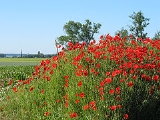
Papaveraceae

Encyclopedia
Papaveraceae, informally known as the poppy family, are an economically important family
of 44 genera
and approximately 770 species
of flowering plant
s in the order Ranunculales
. The family is cosmopolitan
, occurring in temperate
and subtropical climates, but almost unknown in the tropics
. Most are herbaceous plant
s, but a few are shrub
s and small tree
s.
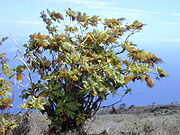
, a few species form shrubs or evergreen trees. They are lactiferous
, producing latex, which may be milky or watery, coloured or plain. All parts contain a well-developed duct system (these ducts are called "laticifers"), producing a milky latex
, a watery white, yellow or red juice.
.jpg) The simple leaves
The simple leaves
are alternate or sometimes whorled. They have petiole
s and are not enclosed by a sheath. The leaves are usually lobed or pinnatifid (i.e. consisting of several not entirely separate leaflets), or much-divided. There are no stipule
s.
The plants are hermaphroditic
and are pollinated
mostly by insect
s (even as flower nectaries are lacking; entomophilous), a few by the wind (anemophilous). There is a distinct calyx and corolla, except in Macleaya where the corolla is lacking. The flowers are medium-sized or large and they look spectacular. The terminal flowers solitary in most species. In others the terminal inflorescence
is cymose or racemose
. The flowers are odourless and regular.
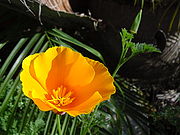 There are many stamen
s, mostly 16 to 60, arranged in two separate whorls, the outer one with stamens alternate with the petals, the inner one opposite. The gynoecium consists of a compound pistil with 2 to 100 carpels. The ovary
is superior and 1-locular. The ovary is without a footstalk (sessile) or on a short stem (stipitate).
The non-fleshy fruit
is usually a capsule
, breaking open at maturity to release the seed
s through pores (poricidal), or through the partitions between the cells (septicidal), or by means of valves (valvular). The numerous seeds are small. Their nutritive tissue (endosperm) is oily and farinose. The fruit of Platystemon is a schizocarp
.
Almost all of these plants contain alkaloid
s. Many are poison
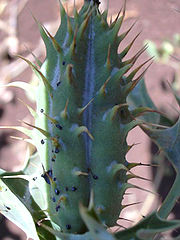
ous. The Mexican Prickly Poppy (pictured above) is poisonous if taken internally and may cause edema
and glaucoma
. Even if an animal, such as a goat
, should persist in grazing on this plant, not only will the animal suffer but so will those who drink its milk
, because the poisons are passed along in the milk.
(2003; unchanged from the APG system
of 1998) places the family in the order Ranunculales
, in the clade eudicots
. However, APG does provide for the option to segregate two families, as optional segregate. Thus, there are two possible circumscriptions:
The family sensu stricto conforms to the family as recognised by the Cronquist system
, of 1981 (Cronquist recognised Fumariaceae as separate). This comprises about 26 genera and about 250 species. The description given above applies to the family in this narrow sense.
Genera in Papaveraceae sensu stricto
The single genus transferred when Pteridophyllaceae is included in Papaveraceae is :
The 20 genera transferred when Fumariaceae is included in Papaveraceae are :
The two taxa considered subfamilies that have also been considered as separate families are the Fumariaceae
(Bercht.
& J. Presl
, 1820) and the Pteridophyllaceae (Murb.
, 1912) Nakai
ex Reveal & Hoogland
, 1991.
s, including California poppy
(Eschscholtzia californica, the California state flower), the stunning blue Himalayan poppies
(Meconopsis), several species of Papaver, and the wildflower Bloodroot
. The family also contains the opium poppy
(Papaver somniferum), which is the source of opium
and opiates, as well as poppy seed
s used in cooking
and baking
, and poppyseed oil
.
.
Family (biology)
In biological classification, family is* a taxonomic rank. Other well-known ranks are life, domain, kingdom, phylum, class, order, genus, and species, with family fitting between order and genus. As for the other well-known ranks, there is the option of an immediately lower rank, indicated by the...
of 44 genera
Genera
Genera is a commercial operating system and development environment for Lisp machines developed by Symbolics. It is essentially a fork of an earlier operating system originating on the MIT AI Lab's Lisp machines which Symbolics had used in common with LMI and Texas Instruments...
and approximately 770 species
Species
In biology, a species is one of the basic units of biological classification and a taxonomic rank. A species is often defined as a group of organisms capable of interbreeding and producing fertile offspring. While in many cases this definition is adequate, more precise or differing measures are...
of flowering plant
Flowering plant
The flowering plants , also known as Angiospermae or Magnoliophyta, are the most diverse group of land plants. Angiosperms are seed-producing plants like the gymnosperms and can be distinguished from the gymnosperms by a series of synapomorphies...
s in the order Ranunculales
Ranunculales
Ranunculales is an order of flowering plants. Of necessity it contains the family Ranunculaceae, the buttercup family, because the name of the order is based on the name of a genus in that family. Ranunculales belongs to a paraphyletic group known as the basal eudicots...
. The family is cosmopolitan
Cosmopolitan distribution
In biogeography, a taxon is said to have a cosmopolitan distribution if its range extends across all or most of the world in appropriate habitats. For instance, the killer whale has a cosmopolitan distribution, extending over most of the world's oceans. Other examples include humans, the lichen...
, occurring in temperate
Temperate
In geography, temperate or tepid latitudes of the globe lie between the tropics and the polar circles. The changes in these regions between summer and winter are generally relatively moderate, rather than extreme hot or cold...
and subtropical climates, but almost unknown in the tropics
Tropics
The tropics is a region of the Earth surrounding the Equator. It is limited in latitude by the Tropic of Cancer in the northern hemisphere at approximately N and the Tropic of Capricorn in the southern hemisphere at S; these latitudes correspond to the axial tilt of the Earth...
. Most are herbaceous plant
Herbaceous plant
A herbaceous plant is a plant that has leaves and stems that die down at the end of the growing season to the soil level. They have no persistent woody stem above ground...
s, but a few are shrub
Shrub
A shrub or bush is distinguished from a tree by its multiple stems and shorter height, usually under 5–6 m tall. A large number of plants may become either shrubs or trees, depending on the growing conditions they experience...
s and small tree
Tree
A tree is a perennial woody plant. It is most often defined as a woody plant that has many secondary branches supported clear of the ground on a single main stem or trunk with clear apical dominance. A minimum height specification at maturity is cited by some authors, varying from 3 m to...
s.
Description
The plants may be annual, biennial, or perennial. Usually herbaceousHerbaceous
A herbaceous plant is a plant that has leaves and stems that die down at the end of the growing season to the soil level. They have no persistent woody stem above ground...
, a few species form shrubs or evergreen trees. They are lactiferous
Latex
Latex is the stable dispersion of polymer microparticles in an aqueous medium. Latexes may be natural or synthetic.Latex as found in nature is a milky fluid found in 10% of all flowering plants . It is a complex emulsion consisting of proteins, alkaloids, starches, sugars, oils, tannins, resins,...
, producing latex, which may be milky or watery, coloured or plain. All parts contain a well-developed duct system (these ducts are called "laticifers"), producing a milky latex
Latex
Latex is the stable dispersion of polymer microparticles in an aqueous medium. Latexes may be natural or synthetic.Latex as found in nature is a milky fluid found in 10% of all flowering plants . It is a complex emulsion consisting of proteins, alkaloids, starches, sugars, oils, tannins, resins,...
, a watery white, yellow or red juice.
Leaf
A leaf is an organ of a vascular plant, as defined in botanical terms, and in particular in plant morphology. Foliage is a mass noun that refers to leaves as a feature of plants....
are alternate or sometimes whorled. They have petiole
Petiole (botany)
In botany, the petiole is the stalk attaching the leaf blade to the stem. The petiole usually has the same internal structure as the stem. Outgrowths appearing on each side of the petiole are called stipules. Leaves lacking a petiole are called sessile, or clasping when they partly surround the...
s and are not enclosed by a sheath. The leaves are usually lobed or pinnatifid (i.e. consisting of several not entirely separate leaflets), or much-divided. There are no stipule
Stipule
In botany, stipule is a term coined by Linnaeus which refers to outgrowths borne on either side of the base of a leafstalk...
s.
The plants are hermaphroditic
Hermaphrodite
In biology, a hermaphrodite is an organism that has reproductive organs normally associated with both male and female sexes.Many taxonomic groups of animals do not have separate sexes. In these groups, hermaphroditism is a normal condition, enabling a form of sexual reproduction in which both...
and are pollinated
Pollination
Pollination is the process by which pollen is transferred in plants, thereby enabling fertilisation and sexual reproduction. Pollen grains transport the male gametes to where the female gamete are contained within the carpel; in gymnosperms the pollen is directly applied to the ovule itself...
mostly by insect
Insect
Insects are a class of living creatures within the arthropods that have a chitinous exoskeleton, a three-part body , three pairs of jointed legs, compound eyes, and two antennae...
s (even as flower nectaries are lacking; entomophilous), a few by the wind (anemophilous). There is a distinct calyx and corolla, except in Macleaya where the corolla is lacking. The flowers are medium-sized or large and they look spectacular. The terminal flowers solitary in most species. In others the terminal inflorescence
Inflorescence
An inflorescence is a group or cluster of flowers arranged on a stem that is composed of a main branch or a complicated arrangement of branches. Strictly, it is the part of the shoot of seed plants where flowers are formed and which is accordingly modified...
is cymose or racemose
Raceme
A raceme is a type of inflorescence that is unbranched and indeterminate and bears pedicellate flowers — flowers having short floral stalks called pedicels — along the axis. In botany, axis means a shoot, in this case one bearing the flowers. In a raceme, the oldest flowers are borne...
. The flowers are odourless and regular.
Stamen
The stamen is the pollen producing reproductive organ of a flower...
s, mostly 16 to 60, arranged in two separate whorls, the outer one with stamens alternate with the petals, the inner one opposite. The gynoecium consists of a compound pistil with 2 to 100 carpels. The ovary
Ovary (plants)
In the flowering plants, an ovary is a part of the female reproductive organ of the flower or gynoecium. Specifically, it is the part of the pistil which holds the ovule and is located above or below or at the point of connection with the base of the petals and sepals...
is superior and 1-locular. The ovary is without a footstalk (sessile) or on a short stem (stipitate).
The non-fleshy fruit
Fruit
In broad terms, a fruit is a structure of a plant that contains its seeds.The term has different meanings dependent on context. In non-technical usage, such as food preparation, fruit normally means the fleshy seed-associated structures of certain plants that are sweet and edible in the raw state,...
is usually a capsule
Capsule (fruit)
In botany a capsule is a type of simple, dry fruit produced by many species of flowering plants. A capsule is a structure composed of two or more carpels that in most cases is dehiscent, i.e. at maturity, it splits apart to release the seeds within. A few capsules are indehiscent, for example...
, breaking open at maturity to release the seed
Seed
A seed is a small embryonic plant enclosed in a covering called the seed coat, usually with some stored food. It is the product of the ripened ovule of gymnosperm and angiosperm plants which occurs after fertilization and some growth within the mother plant...
s through pores (poricidal), or through the partitions between the cells (septicidal), or by means of valves (valvular). The numerous seeds are small. Their nutritive tissue (endosperm) is oily and farinose. The fruit of Platystemon is a schizocarp
Schizocarp
A schizocarp is a dry fruit that develops from multiple carpels. When mature it splits up into mericarps. Mericarps are often 1-seeded as in, for example, Malva, Malvastrum, and Sida...
.
Almost all of these plants contain alkaloid
Alkaloid
Alkaloids are a group of naturally occurring chemical compounds that contain mostly basic nitrogen atoms. This group also includes some related compounds with neutral and even weakly acidic properties. Also some synthetic compounds of similar structure are attributed to alkaloids...
s. Many are poison
Poison
In the context of biology, poisons are substances that can cause disturbances to organisms, usually by chemical reaction or other activity on the molecular scale, when a sufficient quantity is absorbed by an organism....
ous. The Mexican Prickly Poppy (pictured above) is poisonous if taken internally and may cause edema
Edema
Edema or oedema ; both words from the Greek , oídēma "swelling"), formerly known as dropsy or hydropsy, is an abnormal accumulation of fluid beneath the skin or in one or more cavities of the body that produces swelling...
and glaucoma
Glaucoma
Glaucoma is an eye disorder in which the optic nerve suffers damage, permanently damaging vision in the affected eye and progressing to complete blindness if untreated. It is often, but not always, associated with increased pressure of the fluid in the eye...
. Even if an animal, such as a goat
Goat
The domestic goat is a subspecies of goat domesticated from the wild goat of southwest Asia and Eastern Europe. The goat is a member of the Bovidae family and is closely related to the sheep as both are in the goat-antelope subfamily Caprinae. There are over three hundred distinct breeds of...
, should persist in grazing on this plant, not only will the animal suffer but so will those who drink its milk
Milk
Milk is a white liquid produced by the mammary glands of mammals. It is the primary source of nutrition for young mammals before they are able to digest other types of food. Early-lactation milk contains colostrum, which carries the mother's antibodies to the baby and can reduce the risk of many...
, because the poisons are passed along in the milk.
Taxonomy
The APG II systemAPG II system
The APG II system of plant classification is the second, now obsolete, version of a modern, mostly molecular-based, system of plant taxonomy that was published in April 2003 by the Angiosperm Phylogeny Group. It was a revision of the first APG system, published in 1998, and was superseded in 2009...
(2003; unchanged from the APG system
APG system
The APG system of plant classification is the first, now obsolete, version of a modern, mostly molecular-based, system of plant taxonomy that was published in 1998 by the Angiosperm Phylogeny Group. It was superseded in 2003 by a revision, the APG II system, and then in 2009 by a further...
of 1998) places the family in the order Ranunculales
Ranunculales
Ranunculales is an order of flowering plants. Of necessity it contains the family Ranunculaceae, the buttercup family, because the name of the order is based on the name of a genus in that family. Ranunculales belongs to a paraphyletic group known as the basal eudicots...
, in the clade eudicots
Eudicots
Eudicots and Eudicotyledons are botanical terms introduced by Doyle & Hotton to refer to a monophyletic group of flowering plants that had been called tricolpates or non-Magnoliid dicots by previous authors...
. However, APG does provide for the option to segregate two families, as optional segregate. Thus, there are two possible circumscriptions:
- Papaveraceae sensu lato, including the plants that would otherwise form the families FumariaceaeFumariaceaeFumariaceae is a family of about 575 species of herbaceous plants in 20 genera, native to the Northern Hemisphere and South Africa.-Flower shape:Plants in the fumitory family are easily recognised by their peculiar flowers with two dissimilar pairs of...
and Pteridophyllaceae. (see subfamilies) - Papaveraceae sensu stricto, excluding these plants.
The family sensu stricto conforms to the family as recognised by the Cronquist system
Cronquist system
The Cronquist system is a taxonomic classification system of flowering plants. It was developed by Arthur Cronquist in his texts An Integrated System of Classification of Flowering Plants and The Evolution and Classification of Flowering Plants .Cronquist's system places flowering plants into two...
, of 1981 (Cronquist recognised Fumariaceae as separate). This comprises about 26 genera and about 250 species. The description given above applies to the family in this narrow sense.
Genera in Papaveraceae sensu stricto
|
Meconella Meconella is a small genus of flowering plants in the poppy family. They are known generally as fairypoppies.There are about 3 species:*Meconella californica - California fairypoppy*Meconella denticulata - smallflower fairypoppy... Fairy Poppy Meconopsis Meconopsis is a genus of flowering plants in the family Papaveraceae. The species have attractive flowers and have two distinct ranges. A single species, Meconopsis cambrica , is indigenous to England, Wales, Ireland, and the fringes of Western Europe. The other 40 or so species are found in the... Blue Poppy Papaver Papaver is a genus of 70-100 species of frost-tolerant annuals, biennials, and perennials native to temperate and cold regions of Eurasia, Africa and North America. It is the type genus of the poppy family, Papaveraceae.-Description:... Poppy Creamcups Bloodroot Bloodroot is a perennial, herbaceous flowering plant native to eastern North America from Nova Scotia, Canada southward to Florida, United States... Bloodroot Stylomecon Stylomecon is a genus of annual plant in the family Papaveraceae. It has only one species, Stylomecon heterophylla, the Wind Poppy, which is native to California and north western Mexico.... Stylophorum Stylophorum is a genus of three species of herbaceous perennial plants native to woodland in eastern North America and China.Stems are bristly, and leaves are lobed and have wavy edges.... Celandine Poppy |
The single genus transferred when Pteridophyllaceae is included in Papaveraceae is :
- Pteridophyllum
The 20 genera transferred when Fumariaceae is included in Papaveraceae are :
|
Fumaria Fumaria is a genus of 50 species of annual plants, native to Europe, Africa and Asia, most diverse in the Mediterranean region, and introduced to North and South America and Australia. Fumaria indica contains the alkaloids fuyuziphine and alpha-hydrastine... Pseudofumaria Pseudofumaria is a genus of herbaceous perennial plants native to Europe, formerly included in the genus Corydalis.There are two species:*Pseudofumaria alba Lidén northwest Balkans... Sarcocapnos Sarcocapnos is a genus of at least 6 species of somewhat fleshy, cushion-forming annual to perennial plants, native to cliffs in the French Pyrenees, Spain, and north Africa.-Description:... |
Subfamilies
For discussions of subfamilies, see Carolan et al. (2006) and Blattner and Kadereit (1999): Eschscholzioideae, Papaveroideae (including Platystemonoideae), and Chelidonioideae.The two taxa considered subfamilies that have also been considered as separate families are the Fumariaceae
Fumariaceae
Fumariaceae is a family of about 575 species of herbaceous plants in 20 genera, native to the Northern Hemisphere and South Africa.-Flower shape:Plants in the fumitory family are easily recognised by their peculiar flowers with two dissimilar pairs of...
(Bercht.
Friedrich von Berchtold
Bedřich Karel Eugen Všemír Berchtold hrabě z Uherčic, , was a Czech physician and botanist.-Biography:Berchtold was born in Stráž nad Nežárkou , District Jindřichův Hradec, in the Czech Republic....
& J. Presl
Jan Svatopluk Presl
Jan Svatopluk Presl was a Bohemian natural scientist.He was the brother of botanist Karel Bořivoj Presl . The Czech Botanical Society commemorated the two brothers by naming its principal publication Preslia...
, 1820) and the Pteridophyllaceae (Murb.
Svante Samuel Murbeck
Svante Samuel Murbeck was a Swedish professor, botanist, pteridologist and explorer.He made important contributions to knowledge of the flora of North Africa , writing several articles and books, including Contributions a la connaissance de la flore du nord-ouest de I'Afrique et plus...
, 1912) Nakai
Takenoshin Nakai
was a Japanese botanist.-External links:* * * by Yong Shik Kim and Mike Maunder from CURTIS'S Botanical Magazine, Royal Botanic Gardens, Kew, UK. Vol. 15: 141-146, 1998....
ex Reveal & Hoogland
Ruurd Dirk Hoogland
Ruurd Dirk Hoogland was a Dutch explorer and naturalist, who made numerous botanical expeditions to New Guinea , Australia and Europe. He was an expert on the Cunoniaceae family....
, 1991.
Cultivation
The family is well loved for the striking flowers, with many species grown as ornamental plantOrnamental plant
Ornamental plants are plants that are grown for decorative purposes in gardens and landscape design projects, as house plants, for cut flowers and specimen display...
s, including California poppy
California poppy
The California poppy is a perennial and annual plant, native to the United States, and the official state flower of California.- Description :...
(Eschscholtzia californica, the California state flower), the stunning blue Himalayan poppies
Meconopsis
Meconopsis is a genus of flowering plants in the family Papaveraceae. The species have attractive flowers and have two distinct ranges. A single species, Meconopsis cambrica , is indigenous to England, Wales, Ireland, and the fringes of Western Europe. The other 40 or so species are found in the...
(Meconopsis), several species of Papaver, and the wildflower Bloodroot
Bloodroot
Bloodroot is a perennial, herbaceous flowering plant native to eastern North America from Nova Scotia, Canada southward to Florida, United States...
. The family also contains the opium poppy
Opium poppy
Opium poppy, Papaver somniferum, is the species of plant from which opium and poppy seeds are extracted. Opium is the source of many opiates, including morphine , thebaine, codeine, papaverine, and noscapine...
(Papaver somniferum), which is the source of opium
Opium
Opium is the dried latex obtained from the opium poppy . Opium contains up to 12% morphine, an alkaloid, which is frequently processed chemically to produce heroin for the illegal drug trade. The latex also includes codeine and non-narcotic alkaloids such as papaverine, thebaine and noscapine...
and opiates, as well as poppy seed
Poppy seed
Poppy seed is an oilseed obtained from the opium poppy . The tiny kidney-shaped seeds have been harvested from dried seed pods by various civilizations for thousands of years...
s used in cooking
Cooking
Cooking is the process of preparing food by use of heat. Cooking techniques and ingredients vary widely across the world, reflecting unique environmental, economic, and cultural traditions. Cooks themselves also vary widely in skill and training...
and baking
Baking
Baking is the technique of prolonged cooking of food by dry heat acting by convection, and not by radiation, normally in an oven, but also in hot ashes, or on hot stones. It is primarily used for the preparation of bread, cakes, pastries and pies, tarts, quiches, cookies and crackers. Such items...
, and poppyseed oil
Poppyseed oil
Poppyseed oil is an edible oil from poppy seeds . The oil has culinary and pharmaceutical uses, as well as long established uses in the making of paints, varnishes, and soaps.Poppy seeds yield 45–50% oil...
.
Symbolism
The opium poppy and corn poppy are symbols, respectively, of sleep and death. In Great Britain, Canada, the United States, and Australia the corn poppy is worn in remembrance of World War IWorld War I
World War I , which was predominantly called the World War or the Great War from its occurrence until 1939, and the First World War or World War I thereafter, was a major war centred in Europe that began on 28 July 1914 and lasted until 11 November 1918...
.
External links
- Papaveraceae in Topwalks
- Papaveraceae [sensu stricto] in L. Watson and M.J. Dallwitz (1992 onwards). The families of flowering plants.
- Papaveraceae [sensu lato] in the Flora of North America
- NCBI Taxonomy Browser [sensu stricto]
- links at CSDL
- Family Papaveraceae Flowers in Israel
- *JAMES C. CAROLAN, INGRID L. I. HOOK, MARK W. CHASE, JOACHIM W. KADEREIT and TREVOR R. HODKINSON. Phylogenetics of Papaver and Related Genera Based on DNA Sequences from ITS Nuclear Ribosomal DNA and Plastid trnL Intron and trnL–F Intergenic Spacers. Annals of Botany 2006 98(1):141-155
- Frank R. Blattner and Joachim W. Kadereit. Morphological evolution and ecological diversification of the forest-dwelling poppies (Papaveraceae: Chelidonioideae) as deduced from a molecular phylogeny of the ITS region. Plant Systematics and Evolution Volume 219, Numbers 3-4 / September, 1999 181-197