

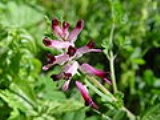
Fumariaceae

Encyclopedia
Fumariaceae is a family
of about 575 species of herbaceous
plants
in 20 genera, native to the Northern Hemisphere
and South Africa
.
There are two types of flowers. A given genus has one type or the other. Dicentra
has flowers with two planes of symmetry, and Corydalis
has flowers with one plane of symmetry (zygomorphic).
, of 2003 (unchanged from the APG system
, of 1998), does not recognize this family, not as such. However, it does
allow it to be segregated from the family Papaveraceae
, as an optional segregate. APG II, in as far as it accepts this family, places it in the order Ranunculales
, in the clade eudicots
.
Family (biology)
In biological classification, family is* a taxonomic rank. Other well-known ranks are life, domain, kingdom, phylum, class, order, genus, and species, with family fitting between order and genus. As for the other well-known ranks, there is the option of an immediately lower rank, indicated by the...
of about 575 species of herbaceous
Herbaceous plant
A herbaceous plant is a plant that has leaves and stems that die down at the end of the growing season to the soil level. They have no persistent woody stem above ground...
plants
Flowering plant
The flowering plants , also known as Angiospermae or Magnoliophyta, are the most diverse group of land plants. Angiosperms are seed-producing plants like the gymnosperms and can be distinguished from the gymnosperms by a series of synapomorphies...
in 20 genera, native to the Northern Hemisphere
Northern Hemisphere
The Northern Hemisphere is the half of a planet that is north of its equator—the word hemisphere literally means “half sphere”. It is also that half of the celestial sphere north of the celestial equator...
and South Africa
South Africa
The Republic of South Africa is a country in southern Africa. Located at the southern tip of Africa, it is divided into nine provinces, with of coastline on the Atlantic and Indian oceans...
.
Flower shape
Plants in the fumitory family are easily recognised by their peculiar flowers with two dissimilar pairs of petals. One or both of the outer petals is usually spurred, and the inner petals are connected at tip.There are two types of flowers. A given genus has one type or the other. Dicentra
Dicentra
Dicentra is a genus of 8 species of perennial herbaceous plants in the fumitory family, many with heart-shaped flowers, native to eastern Asia and North America.-Description:...
has flowers with two planes of symmetry, and Corydalis
Corydalis
Corydalis is a genus of about 470 species of annual and perennial herbaceous plants in the fumewort family , native to the temperate Northern Hemisphere and the high mountains of tropical eastern Africa...
has flowers with one plane of symmetry (zygomorphic).
Taxonomy
The APG II systemAPG II system
The APG II system of plant classification is the second, now obsolete, version of a modern, mostly molecular-based, system of plant taxonomy that was published in April 2003 by the Angiosperm Phylogeny Group. It was a revision of the first APG system, published in 1998, and was superseded in 2009...
, of 2003 (unchanged from the APG system
APG system
The APG system of plant classification is the first, now obsolete, version of a modern, mostly molecular-based, system of plant taxonomy that was published in 1998 by the Angiosperm Phylogeny Group. It was superseded in 2003 by a revision, the APG II system, and then in 2009 by a further...
, of 1998), does not recognize this family, not as such. However, it does
allow it to be segregated from the family Papaveraceae
Papaveraceae
Papaveraceae, informally known as the poppy family, are an economically important family of 44 genera and approximately 770 species of flowering plants in the order Ranunculales. The family is cosmopolitan, occurring in temperate and subtropical climates, but almost unknown in the tropics...
, as an optional segregate. APG II, in as far as it accepts this family, places it in the order Ranunculales
Ranunculales
Ranunculales is an order of flowering plants. Of necessity it contains the family Ranunculaceae, the buttercup family, because the name of the order is based on the name of a genus in that family. Ranunculales belongs to a paraphyletic group known as the basal eudicots...
, in the clade eudicots
Eudicots
Eudicots and Eudicotyledons are botanical terms introduced by Doyle & Hotton to refer to a monophyletic group of flowering plants that had been called tricolpates or non-Magnoliid dicots by previous authors...
.
Genera
There are 20 genera:
|
Dactylicapnos Dactylicapnos is a genus of frost-tender perennial or annual climbers native to the Himalayas, northern Burma, central southern China, and northern Vietnam.-Description:... (13) Dicentra Dicentra is a genus of 8 species of perennial herbaceous plants in the fumitory family, many with heart-shaped flowers, native to eastern Asia and North America.-Description:... (8) Fumaria Fumaria is a genus of 50 species of annual plants, native to Europe, Africa and Asia, most diverse in the Mediterranean region, and introduced to North and South America and Australia. Fumaria indica contains the alkaloids fuyuziphine and alpha-hydrastine... (50) Pseudofumaria Pseudofumaria is a genus of herbaceous perennial plants native to Europe, formerly included in the genus Corydalis.There are two species:*Pseudofumaria alba Lidén northwest Balkans... (2) Sarcocapnos Sarcocapnos is a genus of at least 6 species of somewhat fleshy, cushion-forming annual to perennial plants, native to cliffs in the French Pyrenees, Spain, and north Africa.-Description:... (5) |
External links
- Fumariaceae, Hypecoaceae in L. Watson and M.J. Dallwitz (1992 onwards). The families of flowering plants: descriptions, illustrations, identification, information retrieval. Version: 3 May 2006. http://delta-intkey.com.
- Flora of North America
- Flora of Pakistan
- Hypecoaceae of Mongolia in FloraGREIF