

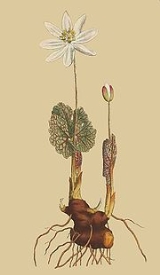
Bloodroot

Encyclopedia
Bloodroot is a perennial
, herbaceous
flowering plant
native to eastern North America
from Nova Scotia
, Canada
southward to Florida
, United States
. It is the only species in the genus
Sanguinaria, and is included in the family Papaveraceae
and most closely related to Eomecon of eastern Asia.
Bloodroot is also known as bloodwort, red puccoon root, and sometimes pauson. Bloodroot has also been known as tetterwort in America, although that name is used in Britain to refer to Greater Celandine
.
up to 12 cm across. The flower
s are produced from March to May, with 8-12 delicate white petals and yellow reproductive parts. The flowers appear over clasping leaves while blooming. Plants are variable in leaf and flower shape and have in the past been separated out as different subspecies due to these variable shapes; currently most taxonomic treatments lump these different forms into one highly variable species. Bloodroot stores sap in an orange colored rhizome
, that grows shallowly under or at the soil surface. Over many years of growth, the branching rhizome can grow into a large colony. Plants start to bloom before the foliage unfolds in early spring and after blooming the leaves expand to their full size and go summer dormant in mid to late summer. Plants are found growing in moist to dry woods and thickets, often on flood plains and near shores or streams on slopes, they grow less frequently in clearings and meadows or on dunes, and are rarely found in disturbed sites. The flowers are pollinated by small bees and flies, seeds develop in elongated green pods 40 to 60 mm in length and ripen before the foliage goes dormant. The seeds are round in shape and when ripe are black to orange-red in color. Deer will feed on the plants in early spring.
. The seeds have a fleshy organ called an elaiosome
that attracts ants. The ants take the seeds to their nest, where they eat the elaiosomes, and put the seeds in their nest debris, where they are protected until they germinate. They also get the added bonus of growing in a medium made richer by the ant nest debris.
The double flowering
forms are prized by gardeners for their large showy white flowers, which are produced very early in the gardening season. Bloodroot flower petals are shed within a day or two of pollination so the flower display is short lived. The double forms bloom much longer than the normal forms, the double flowers are made up of stamens that have been changed into petal looking like parts, making pollination more difficult.
-like benzylisoquinoline
alkaloid
s, primarily the toxin sanguinarine
. The alkaloids are transported to and stored in the rhizome
. Comparing the biosynthesis of morphine and sanguinarine, the final intermediate in common is (S)-reticuline
. A number of plants in Papaveraceae
and Ranunculaceae
, as well as plants in the genus Colchicum
(family Colchicaceae
) and genus Chondodendron (family Menispermaceae
), also produce such benzylisoquinoline alkaloids.
Plant geneticists have identified and sequenced genes which produce the enzymes required for this production. One enzyme involved is CYP80B1, which produces (S)-3'-hydroxy-N-methylcoclaurine and mendococlaurine from (S)-N-methylcoclaurine.
. Bloodroot and its extracts are thus considered escharotic.
In spite of supposed curative properties and historical use by Native Americans as an emetic, internal use is inadvisable. Although applying escharotic agents, including bloodroot, to the skin is sometimes suggested as a home treatment for skin cancer
, these attempts can be severely disfiguring. Salves derived from bloodroot cannot be relied on to remove an entire malignant tumor. Microscopic tumor deposits may remain after visible tumor tissue is burned away, and case reports have shown that in such instances tumor has recurred and/or metastasized.
In 2005, "folk healer" Dan Raber (of Georgia
, United States
) was arrested and charged with causing severe bodily harm and practicing medicine without a license for dispensing bloodroot paste to nine women with various ailments including breast cancer
, causing severe disfiguring destruction of their skin and underlying tissue (as well as failing to successfully excise their tumors). Lois March, M.D. of Cordele, Georgia, was also charged as an accomplice and had her medical license permanently revoked for her role in assisting Raber's unlicensed treatment by prescribing massive amounts of opiate pain medication to his customers in order to allow them to continue their bloodroot treatment despite the severe burning pain and disfigurement it caused.
, a premalignant oral lesion. On 24 Nov 2003, the Colgate-Palmolive Company of Piscataway
, New Jersey
, United States
commented by memorandum to the United States Food and Drug Administration that then-proposed rules for levels of sanguinarine
in mouthwash and dental wash products were lower than necessary. However, this conclusion is controversial.
Some animal food additives sold and distributed in Europe such as Phytobiotics' Sangrovit contain sanguinarine and chelerythrine. On 14 May 2003, Cat Holmes reported in Georgia Faces that Jim Affolter and Selima Campbell, horticulturists at the University of Georgia College of Agricultural and Environmental Sciences, were meeting with Phytobiotics to relate their research into commercial cultivation of bloodroot. It is also used in the mole remover Dermatend.
Bloodroot extracts have also been promoted by some supplement companies as a treatment or cure for cancer, but the U.S. Food and Drug Administration
has listed some of these products among its "187 Fake Cancer 'Cures' Consumers Should Avoid".
Bloodroot is a popular red natural dye
used by Native American art
ists, especially among southeastern rivercane basketmakers.
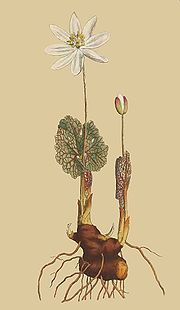 The blood of the root (when cut open) was used as a dye and was used for a herbal remedy by the native population. A break in the surface of the plant, especially the roots, reveals a reddish sap.
In physician William Cook's 1869 work The Physiomedical Dispensatory is recorded a chapter on the uses and preparations of bloodroot. described tincture
s and extraction
s, and also included at least the following cautionary report:
Greater Celandine
(Chelidonium majus), a member of the Poppy family (Papaveraceae) was used in Colonial America as a wart
remedy. Bloodroot has been similarly applied in the past. This may explain the multiple American and British definitions of "Tetterwort" in 1913.
Perennial plant
A perennial plant or simply perennial is a plant that lives for more than two years. The term is often used to differentiate a plant from shorter lived annuals and biennials. The term is sometimes misused by commercial gardeners or horticulturalists to describe only herbaceous perennials...
, herbaceous
Herbaceous
A herbaceous plant is a plant that has leaves and stems that die down at the end of the growing season to the soil level. They have no persistent woody stem above ground...
flowering plant
Flowering plant
The flowering plants , also known as Angiospermae or Magnoliophyta, are the most diverse group of land plants. Angiosperms are seed-producing plants like the gymnosperms and can be distinguished from the gymnosperms by a series of synapomorphies...
native to eastern North America
North America
North America is a continent wholly within the Northern Hemisphere and almost wholly within the Western Hemisphere. It is also considered a northern subcontinent of the Americas...
from Nova Scotia
Nova Scotia
Nova Scotia is one of Canada's three Maritime provinces and is the most populous province in Atlantic Canada. The name of the province is Latin for "New Scotland," but "Nova Scotia" is the recognized, English-language name of the province. The provincial capital is Halifax. Nova Scotia is the...
, Canada
Canada
Canada is a North American country consisting of ten provinces and three territories. Located in the northern part of the continent, it extends from the Atlantic Ocean in the east to the Pacific Ocean in the west, and northward into the Arctic Ocean...
southward to Florida
Florida
Florida is a state in the southeastern United States, located on the nation's Atlantic and Gulf coasts. It is bordered to the west by the Gulf of Mexico, to the north by Alabama and Georgia and to the east by the Atlantic Ocean. With a population of 18,801,310 as measured by the 2010 census, it...
, United States
United States
The United States of America is a federal constitutional republic comprising fifty states and a federal district...
. It is the only species in the genus
Genus
In biology, a genus is a low-level taxonomic rank used in the biological classification of living and fossil organisms, which is an example of definition by genus and differentia...
Sanguinaria, and is included in the family Papaveraceae
Papaveraceae
Papaveraceae, informally known as the poppy family, are an economically important family of 44 genera and approximately 770 species of flowering plants in the order Ranunculales. The family is cosmopolitan, occurring in temperate and subtropical climates, but almost unknown in the tropics...
and most closely related to Eomecon of eastern Asia.
Bloodroot is also known as bloodwort, red puccoon root, and sometimes pauson. Bloodroot has also been known as tetterwort in America, although that name is used in Britain to refer to Greater Celandine
Greater celandine
Chelidonium majus is a herbaceous perennial plant, the only species in the genus Chelidonium...
.
Appearance and growth
Bloodroot is a variable species growing from 20 to 50 cm tall, normally with one large, sheath-like basal multi-lobed leafLeaf
A leaf is an organ of a vascular plant, as defined in botanical terms, and in particular in plant morphology. Foliage is a mass noun that refers to leaves as a feature of plants....
up to 12 cm across. The flower
Flower
A flower, sometimes known as a bloom or blossom, is the reproductive structure found in flowering plants . The biological function of a flower is to effect reproduction, usually by providing a mechanism for the union of sperm with eggs...
s are produced from March to May, with 8-12 delicate white petals and yellow reproductive parts. The flowers appear over clasping leaves while blooming. Plants are variable in leaf and flower shape and have in the past been separated out as different subspecies due to these variable shapes; currently most taxonomic treatments lump these different forms into one highly variable species. Bloodroot stores sap in an orange colored rhizome
Rhizome
In botany and dendrology, a rhizome is a characteristically horizontal stem of a plant that is usually found underground, often sending out roots and shoots from its nodes...
, that grows shallowly under or at the soil surface. Over many years of growth, the branching rhizome can grow into a large colony. Plants start to bloom before the foliage unfolds in early spring and after blooming the leaves expand to their full size and go summer dormant in mid to late summer. Plants are found growing in moist to dry woods and thickets, often on flood plains and near shores or streams on slopes, they grow less frequently in clearings and meadows or on dunes, and are rarely found in disturbed sites. The flowers are pollinated by small bees and flies, seeds develop in elongated green pods 40 to 60 mm in length and ripen before the foliage goes dormant. The seeds are round in shape and when ripe are black to orange-red in color. Deer will feed on the plants in early spring.
Reproduction and genetics
Bloodroot is one of many plants whose seeds are spread by ants, a process called myrmecochoryMyrmecochory
Myrmecochory is seed dispersal by ants, an ecologically significant ant-plant interaction with worldwide distribution. Myrmecochorous plants produce seeds with elaiosomes, a term encompassing various external appendages or "food bodies" rich in lipids, amino acid, or other nutrients that are...
. The seeds have a fleshy organ called an elaiosome
Elaiosome
Elaiosomes are fleshy structures that are attached to the seeds of many plant species. The elaiosome is rich in lipids and proteins, and may be variously shaped. Many plants have elaiosomes to attract ants, which take the seed to their nest and feed the elaiosome to their larvae...
that attracts ants. The ants take the seeds to their nest, where they eat the elaiosomes, and put the seeds in their nest debris, where they are protected until they germinate. They also get the added bonus of growing in a medium made richer by the ant nest debris.
The double flowering
Double-flowered
"Double-flowered" describes varieties of flowers with extra petals, often containing flowers within flowers. The double-flowered trait is often noted alongside the scientific name with the abbreviation fl. pl....
forms are prized by gardeners for their large showy white flowers, which are produced very early in the gardening season. Bloodroot flower petals are shed within a day or two of pollination so the flower display is short lived. The double forms bloom much longer than the normal forms, the double flowers are made up of stamens that have been changed into petal looking like parts, making pollination more difficult.
Toxicity
Bloodroot produces morphineMorphine
Morphine is a potent opiate analgesic medication and is considered to be the prototypical opioid. It was first isolated in 1804 by Friedrich Sertürner, first distributed by same in 1817, and first commercially sold by Merck in 1827, which at the time was a single small chemists' shop. It was more...
-like benzylisoquinoline
Benzylisoquinoline
1-Benzylisoquinoline is a chemical compound, and the structural backbone of many alkaloids with a wide variety of structures, including papaverine, noscapine, codeine, morphine, apomorphine, berberine, protopine and tubocurarine.-Biosynthesis:...
alkaloid
Alkaloid
Alkaloids are a group of naturally occurring chemical compounds that contain mostly basic nitrogen atoms. This group also includes some related compounds with neutral and even weakly acidic properties. Also some synthetic compounds of similar structure are attributed to alkaloids...
s, primarily the toxin sanguinarine
Sanguinarine
Sanguinarine is a quaternary ammonium salt from the group of benzylisoquinoline alkaloids. It is extracted from some plants, including bloodroot , Mexican prickly poppy Argemone mexicana, Chelidonium majus and Macleaya cordata. It is also found in the root, stem and leaves of the opium poppy but...
. The alkaloids are transported to and stored in the rhizome
Rhizome
In botany and dendrology, a rhizome is a characteristically horizontal stem of a plant that is usually found underground, often sending out roots and shoots from its nodes...
. Comparing the biosynthesis of morphine and sanguinarine, the final intermediate in common is (S)-reticuline
Reticuline
Reticuline is a chemical compound that can be found in Lindera aggregata. It is also one of the alkaloids found in opium.-Metabolism:3'-hydroxy-N-methyl--coclaurine 4'-O-methyltransferase uses S-adenosyl methionine and 3'-hydroxy-N-methyl--coclaurine to produce S-adenosylhomocysteine and...
. A number of plants in Papaveraceae
Papaveraceae
Papaveraceae, informally known as the poppy family, are an economically important family of 44 genera and approximately 770 species of flowering plants in the order Ranunculales. The family is cosmopolitan, occurring in temperate and subtropical climates, but almost unknown in the tropics...
and Ranunculaceae
Ranunculaceae
Ranunculaceae are a family of about 1700 species of flowering plants in about 60 genera, distributed worldwide....
, as well as plants in the genus Colchicum
Colchicum
Colchicum is a genus of flowering plants containing around sixty species of perennial plants which grow from corms. It is a member of family Colchicaceae, and is native to West Asia, Europe and parts of the Mediterranean coast....
(family Colchicaceae
Colchicaceae
Colchicaceae is a botanical name of a family of flowering plants.The APG III system, of 2009 , does recognize such a family and places it in the order Liliales, in the clade monocots, and regards the family as including some two hundred species of herbaceous perennials with rhizomes or corms.The...
) and genus Chondodendron (family Menispermaceae
Menispermaceae
Menispermaceae, the botanical name for a family of flowering plants, has been universally recognized by taxonomists. Tubocurare, a neuromuscular blocker and active ingredient in curare, is derived from plants of this family....
), also produce such benzylisoquinoline alkaloids.
Plant geneticists have identified and sequenced genes which produce the enzymes required for this production. One enzyme involved is CYP80B1, which produces (S)-3'-hydroxy-N-methylcoclaurine and mendococlaurine from (S)-N-methylcoclaurine.
Bloodroot extracts are toxic to animal cells
Sanguinarine kills animal cells by blocking the action of Na+/K+-ATPase transmembrane proteins. As a result, applying bloodroot to the skin may destroy tissue and lead to the formation of a large scab, called an escharEschar
An eschar is a slough or piece of dead tissue that is cast off from the surface of the skin, particularly after a burn injury, but also seen in gangrene, ulcer, fungal infections, necrotizing spider bite wounds, and exposure to cutaneous anthrax....
. Bloodroot and its extracts are thus considered escharotic.
In spite of supposed curative properties and historical use by Native Americans as an emetic, internal use is inadvisable. Although applying escharotic agents, including bloodroot, to the skin is sometimes suggested as a home treatment for skin cancer
Skin cancer
Skin neoplasms are skin growths with differing causes and varying degrees of malignancy. The three most common malignant skin cancers are basal cell cancer, squamous cell cancer, and melanoma, each of which is named after the type of skin cell from which it arises...
, these attempts can be severely disfiguring. Salves derived from bloodroot cannot be relied on to remove an entire malignant tumor. Microscopic tumor deposits may remain after visible tumor tissue is burned away, and case reports have shown that in such instances tumor has recurred and/or metastasized.
In 2005, "folk healer" Dan Raber (of Georgia
Georgia (U.S. state)
Georgia is a state located in the southeastern United States. It was established in 1732, the last of the original Thirteen Colonies. The state is named after King George II of Great Britain. Georgia was the fourth state to ratify the United States Constitution, on January 2, 1788...
, United States
United States
The United States of America is a federal constitutional republic comprising fifty states and a federal district...
) was arrested and charged with causing severe bodily harm and practicing medicine without a license for dispensing bloodroot paste to nine women with various ailments including breast cancer
Breast cancer
Breast cancer is cancer originating from breast tissue, most commonly from the inner lining of milk ducts or the lobules that supply the ducts with milk. Cancers originating from ducts are known as ductal carcinomas; those originating from lobules are known as lobular carcinomas...
, causing severe disfiguring destruction of their skin and underlying tissue (as well as failing to successfully excise their tumors). Lois March, M.D. of Cordele, Georgia, was also charged as an accomplice and had her medical license permanently revoked for her role in assisting Raber's unlicensed treatment by prescribing massive amounts of opiate pain medication to his customers in order to allow them to continue their bloodroot treatment despite the severe burning pain and disfigurement it caused.
Commercial use of sanguinarine and bloodroot extracts
The United States FDA has approved the inclusion of sanguinarine in toothpastes as an antibacterial or anti-plaque agent. Currently, it is believed that this use may cause leukoplakiaLeukoplakia
Leukoplakia is a clinical term used to describe patches of keratosis. It is visible as adherent white patches on the mucous membranes of the oral cavity, including the tongue, but also other areas of the gastro-intestinal tract, urinary tract and the genitals. The clinical appearance is highly...
, a premalignant oral lesion. On 24 Nov 2003, the Colgate-Palmolive Company of Piscataway
Piscataway Township, New Jersey
The township consists of the following historic villages and areas: New Market, known as Quibbletown in the 18th Century, Randolphville, Fieldville and North Stelton...
, New Jersey
New Jersey
New Jersey is a state in the Northeastern and Middle Atlantic regions of the United States. , its population was 8,791,894. It is bordered on the north and east by the state of New York, on the southeast and south by the Atlantic Ocean, on the west by Pennsylvania and on the southwest by Delaware...
, United States
United States
The United States of America is a federal constitutional republic comprising fifty states and a federal district...
commented by memorandum to the United States Food and Drug Administration that then-proposed rules for levels of sanguinarine
Sanguinarine
Sanguinarine is a quaternary ammonium salt from the group of benzylisoquinoline alkaloids. It is extracted from some plants, including bloodroot , Mexican prickly poppy Argemone mexicana, Chelidonium majus and Macleaya cordata. It is also found in the root, stem and leaves of the opium poppy but...
in mouthwash and dental wash products were lower than necessary. However, this conclusion is controversial.
Some animal food additives sold and distributed in Europe such as Phytobiotics' Sangrovit contain sanguinarine and chelerythrine. On 14 May 2003, Cat Holmes reported in Georgia Faces that Jim Affolter and Selima Campbell, horticulturists at the University of Georgia College of Agricultural and Environmental Sciences, were meeting with Phytobiotics to relate their research into commercial cultivation of bloodroot. It is also used in the mole remover Dermatend.
Bloodroot extracts have also been promoted by some supplement companies as a treatment or cure for cancer, but the U.S. Food and Drug Administration
Food and Drug Administration
The Food and Drug Administration is an agency of the United States Department of Health and Human Services, one of the United States federal executive departments...
has listed some of these products among its "187 Fake Cancer 'Cures' Consumers Should Avoid".
Bloodroot is a popular red natural dye
Natural dye
Natural dyes are dyes or colorants derived from plants, invertebrates, or minerals. The majority of natural dyes are vegetable dyes from plant sources – roots, berries, bark, leaves, and wood — and other organic sources such as fungi and lichens....
used by Native American art
Native American art
Visual arts by indigenous peoples of the Americas encompasses the visual artistic traditions of the indigenous peoples of the Americas from ancient times to the present...
ists, especially among southeastern rivercane basketmakers.
Historical use of Bloodroot and derivatives
In physician William Cook's 1869 work The Physiomedical Dispensatory is recorded a chapter on the uses and preparations of bloodroot. described tincture
Tincture
A tincture is an alcoholic extract or solution of a non-volatile substance . To qualify as a tincture, the alcoholic extract is to have an ethanol percentage of at least 40-60%...
s and extraction
Extraction (chemistry)
Extraction in chemistry is a separation process consisting in the separation of a substance from a matrix. It may refer to Liquid-liquid extraction, and Solid phase extraction....
s, and also included at least the following cautionary report:
Greater Celandine
Greater celandine
Chelidonium majus is a herbaceous perennial plant, the only species in the genus Chelidonium...
(Chelidonium majus), a member of the Poppy family (Papaveraceae) was used in Colonial America as a wart
Wart
A wart is generally a small, rough growth, typically on a human’s hands or feet but often other locations, that can resemble a cauliflower or a solid blister. They are caused by a viral infection, specifically by human papillomavirus 2 and 7. There are as many as 10 varieties of warts, the most...
remedy. Bloodroot has been similarly applied in the past. This may explain the multiple American and British definitions of "Tetterwort" in 1913.