


Ottoman military band

Encyclopedia
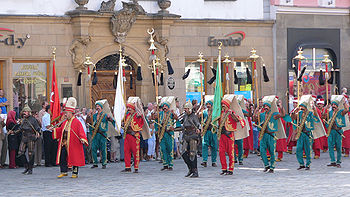
Military band
A military band originally was a group of personnel that performs musical duties for military functions, usually for the armed forces. A typical military band consists mostly of wind and percussion instruments. The conductor of a band commonly bears the title of Bandmaster or Director of Music...
marching band in the world. Though they are often known by the Persian
Persian language
Persian is an Iranian language within the Indo-Iranian branch of the Indo-European languages. It is primarily spoken in Iran, Afghanistan, Tajikistan and countries which historically came under Persian influence...
-derived word mahtar (مهتر; mehter in Ottoman Turkish) in the West, that word, properly speaking, refers only to a single musician in the band. In Ottoman, the band was generally known as mehterân (مهتران, from the Persian plural mahtarān), though those bands used in the retinue
Retinue
A retinue is a body of persons "retained" in the service of a noble or royal personage, a suite of "retainers".-Etymology:...
of a vizier
Vizier
A vizier or in Arabic script ; ; sometimes spelled vazir, vizir, vasir, wazir, vesir, or vezir) is a high-ranking political advisor or minister in a Muslim government....
or prince
Prince
Prince is a general term for a ruler, monarch or member of a monarch's or former monarch's family, and is a hereditary title in the nobility of some European states. The feminine equivalent is a princess...
were generally known as mehterhane (مهترخانه, meaning roughly, "a gathering of mehters", from Persian "house of the mahtar"). In modern Turkish
Turkish language
Turkish is a language spoken as a native language by over 83 million people worldwide, making it the most commonly spoken of the Turkic languages. Its speakers are located predominantly in Turkey and Northern Cyprus with smaller groups in Iraq, Greece, Bulgaria, the Republic of Macedonia, Kosovo,...
, the band as a whole is often termed mehter bölüğü ("mehter company [troop]"), mehter takımı ("mehter platoon"). In the West, the band's music is also often called Janissary music because the janissaries formed the core of the bands.
History
Orkhon script
The Old Turkic script is the alphabet used by the Göktürk and other early Turkic Khanates from at least the 7th century to record the Old Turkic language. It was later used by the Uyghur Empire...
. Such military bands as the mehters, however, were not definitively mentioned until the 13th century. It is believed that the first "mehter" was sent to Osman I
Osman I
Osman I or Othman I or El-Gazi Sultan Osman Ghazi, or Osman Bey or I. Osman, Osman Gazi Han), nicknamed "Kara" for his courage, was the leader of the Ottoman Turks, and the founder of the dynasty that established and ruled the Ottoman Empire...
by the Seljuk Sultan Alaeddin Keykubad III as a present along with a letter that salutes the newly formed state. From then on every day after the afternoon prayer; "mehter" played for the Ottoman ruler. The notion of a military marching band, such as those in use even today, began to be borrowed from the Ottoman Empire
Ottoman Empire
The Ottoman EmpireIt was usually referred to as the "Ottoman Empire", the "Turkish Empire", the "Ottoman Caliphate" or more commonly "Turkey" by its contemporaries...
in the 16th century. The sound associated with the mehterân also exercised an influence on European classical music, with composers such as Joseph Haydn
Joseph Haydn
Franz Joseph Haydn , known as Joseph Haydn , was an Austrian composer, one of the most prolific and prominent composers of the Classical period. He is often called the "Father of the Symphony" and "Father of the String Quartet" because of his important contributions to these forms...
, Wolfgang Amadeus Mozart
Wolfgang Amadeus Mozart
Wolfgang Amadeus Mozart , baptismal name Johannes Chrysostomus Wolfgangus Theophilus Mozart , was a prolific and influential composer of the Classical era. He composed over 600 works, many acknowledged as pinnacles of symphonic, concertante, chamber, piano, operatic, and choral music...
, and Ludwig van Beethoven
Ludwig van Beethoven
Ludwig van Beethoven was a German composer and pianist. A crucial figure in the transition between the Classical and Romantic eras in Western art music, he remains one of the most famous and influential composers of all time.Born in Bonn, then the capital of the Electorate of Cologne and part of...
all writing compositions
Turkish music (style)
"Turkish music", in the sense described here, is not music of Turkey, but rather a musical style called Alla turca that was occasionally used by European composers of the 17th and 18th centuries...
inspired by or designed to imitate the music of the mehters.
In 1826, the music of the mehters fell into disfavor following Sultan
Sultan
Sultan is a title with several historical meanings. Originally, it was an Arabic language abstract noun meaning "strength", "authority", "rulership", and "dictatorship", derived from the masdar سلطة , meaning "authority" or "power". Later, it came to be used as the title of certain rulers who...
Mahmud II
Mahmud II
Mahmud II was the 30th Sultan of the Ottoman Empire from 1808 until his death in 1839. He was born in the Topkapi Palace, Istanbul, the son of Sultan Abdulhamid I...
's massacre of the Janissary corps
The Auspicious Incident
The Auspicious Incident was the forced disbandment of the centuries-old Janissary corps by Ottoman sultan Mahmud II in June 1826....
, who had formed the core of the bands. Subsequent to this, in the mid and late 19th century, the genre went into decline along with the Ottoman Empire. In 1911, as the empire was beginning to collapse, the director of Istanbul
Istanbul
Istanbul , historically known as Byzantium and Constantinople , is the largest city of Turkey. Istanbul metropolitan province had 13.26 million people living in it as of December, 2010, which is 18% of Turkey's population and the 3rd largest metropolitan area in Europe after London and...
's military museum attempted a somewhat successful revival of the tradition, and by 1953—so as to celebrate the 500-year anniversary of the Fall of Constantinople
Fall of Constantinople
The Fall of Constantinople was the capture of the capital of the Byzantine Empire, which occurred after a siege by the Ottoman Empire, under the command of Ottoman Sultan Mehmed II, against the defending army commanded by Byzantine Emperor Constantine XI...
to the forces of Sultan Mehmed II
Mehmed II
Mehmed II , was Sultan of the Ottoman Empire for a short time from 1444 to September 1446, and later from...
—the tradition had been fully restored as a band of the Turkish Armed Forces
Turkish Armed Forces
The Turkish Armed Forces are the military forces of the Republic of Turkey. They consist of the Army, the Navy , and the Air Force...
.
Today, the music of the mehters is largely ceremonial and considered by many Turks as a stirring example of heroism and a reminder of Turkey
Turkey
Turkey , known officially as the Republic of Turkey , is a Eurasian country located in Western Asia and in East Thrace in Southeastern Europe...
's historical past. Though the majority of the pieces performed by them are newer compositions.
Today, Mehter Troop (Mehter Bölüğü) is the band of the Turkish Armed Forces
Turkish Armed Forces
The Turkish Armed Forces are the military forces of the Republic of Turkey. They consist of the Army, the Navy , and the Air Force...
and it performs at the Military Museum
Istanbul Military Museum
Istanbul Military Museum is dedicated to one thousand years of Turkish military history. It is one of the leading museums of its kind in the world. The museum is open to the public everyday except Mondays and Tuesdays....
(Askeri Müze) in Istanbul. See also: The Ministry of Culture Istanbul Historical Music Ensemble .
Structure
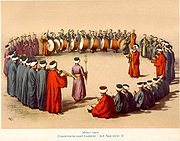
The standard instruments employed by a mehterân are the kös (a giant timpaniTimpani
Timpani, or kettledrums, are musical instruments in the percussion family. A type of drum, they consist of a skin called a head stretched over a large bowl traditionally made of copper. They are played by striking the head with a specialized drum stick called a timpani stick or timpani mallet...
), the nakare (a small kettledrum), the davul
Davul
The davul or tupan is a large double-headed drum that is played with sticks. It has many names depending on the country and region.-Names:Some names of davuls include:*tupan *davul...
(a bass drum), the zil (cymbal
Cymbal
Cymbals are a common percussion instrument. Cymbals consist of thin, normally round plates of various alloys; see cymbal making for a discussion of their manufacture. The greater majority of cymbals are of indefinite pitch, although small disc-shaped cymbals based on ancient designs sound a...
s), the kaba zurna (a bass variety of the zurna
Zurna
The zurna , is a multinational outdoor wind instrument, usually accompanied by a davul in Anatolian folk music. The name is from Turkish zurna, itself derived from Persian سرنای surnāy, composed of sūr “banquet, feast” and nāy “reed, pipe”...
), the boru (a kind of trumpet), and the cevgen (a kind of stick bearing small concealed bells
Bell (instrument)
A bell is a simple sound-making device. The bell is a percussion instrument and an idiophone. Its form is usually a hollow, cup-shaped object, which resonates upon being struck...
). The different varieties of bands are classed according to the number of instruments and musicians employed: either six-layered (altı katlı), seven-layered (yedi katlı), or nine-layered (dokuz katlı).
In the early 19th century the Vizier's personal band included nine each of drums and fifes, seven trumpets and four cymbals.
The costumes worn by the mehterân, despite wide variance in color and style, are always very colourful, often including high ribbed hats which are flared at the top and long robes wrapped in colourful silks.
Style
The sound of the Ottoman military band is characterized by an often shrill sound combining bass drumBass drum
Bass drums are percussion instruments that can vary in size and are used in several musical genres. Three major types of bass drums can be distinguished. The type usually seen or heard in orchestral, ensemble or concert band music is the orchestral, or concert bass drum . It is the largest drum of...
s, horns (boru), bells, the triangle
Triangle (instrument)
The triangle is an idiophone type of musical instrument in the percussion family. It is a bar of metal, usually steel but sometimes other metals like beryllium copper, bent into a triangle shape. The instrument is usually held by a loop of some form of thread or wire at the top curve...
and cymbals (zil
Zil
Zills, also zils or finger cymbals, are tiny metallic cymbals used in belly dancing and similar performances. They are called sājāt in Arabic. They are similar to Tibetan tingsha bells....
), among others. It is still played at state, military and tourist functions in modern Turkey by the Mehter Band and the troops that accompany.
Mehterân usually play classical Turkish music
Ottoman classical music
Ottoman classical music developed in Istanbul and major Ottoman towns from Skopje to Cairo, from Tabriz to Morocco through the palace, mosques, and sufi lodges of the Ottoman Empire. Above all a vocal music, Ottoman music traditionally accompanies a solo singer with a small instrumental ensemble...
such as peşrev, semai, nakış, cengiharbi, murabba and kalenderi. Most of the music played by mehterân is Turkish Folk Music with heroic themes from the Ottoman frontiers. Melodies and lyrics are written in Mehterhane (the house of Mehter).
The oldest extant marches were written by Nefiri Behram, Emir-i Hac, Hasan Can and Gazi Giray II in the 16th century.
Though very few of these pieces are played today in Mehter groups.
Well-known composers
| 16th century | 17th century | 18th century |
| - Nefiri Behram | - Zurnazen Edirneli Daği Ahmed Çelebi | - Hızır Ağa |
| - Emir-i Hac | - Zurnazenbaşı İbrahim Ağa | |
| - Hasan Can | - Müstakim Ağa | |
| - Gazi Giray II. | - Hammali |
"Ceddin Deden"
Though Mehter band played a variety of frontier marches, Ceddin deden is one of the best knownLyrics
Ceddin, deden, neslin, baban; x2
Hep kahraman Türk milleti.
Orduların, pek çok zaman, vermiştiler dünyaya şan. x2
Türk milleti!, Türk milleti!; x2
Aşk ile sev milliyeti,
Kahret vatan düşmanını, çeksin o mel'un zilleti. x2
which can be translated in English as:
(Seek) Your ancestors, your grandfathers, your generation, your father x2
The Turkish nation has always been valiant.
Your armies, many times, have been renowned throughout the world. x2
Turkish nation!, (O) Turkish nation!; x2
love (your) freedom passionately,
Overwhelm the enemies of your motherland, and thus shall those cursed ones suffer abjection. x2
"Yine de Şahlanıyor Aman"
LyricsGene de şahlanıyor aman
Kolbaşının yandı da kır atı.
Görünüyor yandım aman
Bize serhad yolları.
Davullar çalsınlar aman
Aman da ceng-i ceng-i de harbiyi.
Görünüyor yandım aman
Bize sefer yolları.
Gâhi sefer olur aman
Aman da sefer sefer de eyleriz.
Hazan erişince aman
Aman güzel severiz.
Gül yüzlü yari de aman
Aman da hile ile de sezeriz.
Sefersiz olamaz aman
Aman er evlatları.
See also
- Ottoman classical musicOttoman classical musicOttoman classical music developed in Istanbul and major Ottoman towns from Skopje to Cairo, from Tabriz to Morocco through the palace, mosques, and sufi lodges of the Ottoman Empire. Above all a vocal music, Ottoman music traditionally accompanies a solo singer with a small instrumental ensemble...
- Ottoman imperial anthemOttoman imperial anthemThe Ottoman Empire used anthems since its foundation in the late 13th century, but did not use a specific royal or national anthem until the 19th century. During the reign of Sultan Mahmud II, when the military and imperial band were re-organized along Western lines, Giuseppe Donizetti was invited...
- Music of TurkeyMusic of TurkeyThe music of Turkey includes diverse elements ranging from Central Asian folk music and has many copies and references of Byzantine music, Greek music, Ottoman music, Persian music, Balkan music, as well as more modern European and American popular music influences...
- Turkish music (style)Turkish music (style)"Turkish music", in the sense described here, is not music of Turkey, but rather a musical style called Alla turca that was occasionally used by European composers of the 17th and 18th centuries...
External links
- The Ministry of Culture Istanbul Historical Music Ensemble
- Ottoman military band and Europe
- TheOttomans.org: entry on the Mehterhane
- Mehter marşlari (sound recording), Istanbul: Sera, 2001?,