

Osterley Park

Encyclopedia
Park
A park is a protected area, in its natural or semi-natural state, or planted, and set aside for human recreation and enjoyment, or for the protection of wildlife or natural habitats. It may consist of rocks, soil, water, flora and fauna and grass areas. Many parks are legally protected by...
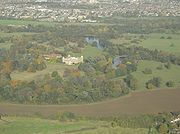
of the same name. It is in the London Borough of Hounslow
London Borough of Hounslow
-Political composition:Since the borough was formed it has been controlled by the Labour Party on all but two occasions. In 1968 the Conservatives formed a majority for the first and last time to date until they lost control to Labour in 1971. Labour subsequently lost control of the council in the...
, part of the western suburbs of London
London
London is the capital city of :England and the :United Kingdom, the largest metropolitan area in the United Kingdom, and the largest urban zone in the European Union by most measures. Located on the River Thames, London has been a major settlement for two millennia, its history going back to its...
. When the house was built it was surrounded by rural countryside. It was one of a group of large houses close to London which served as country retreats for wealthy families, but were not true country houses on large agricultural estates. Other surviving country retreats of this type near London include Syon House
Syon House
Syon House, with its 200-acre park, is situated in west London, England. It belongs to the Duke of Northumberland and is now his family's London residence...
and Chiswick House
Chiswick House
Chiswick House is a Palladian villa in Burlington Lane, Chiswick, in the London Borough of Hounslow in England. Set in , the house was completed in 1729 during the reign of George II and designed by Lord Burlington. William Kent , who took a leading role in designing the gardens, created one of the...
. The park is one of the largest open spaces in west London
London
London is the capital city of :England and the :United Kingdom, the largest metropolitan area in the United Kingdom, and the largest urban zone in the European Union by most measures. Located on the River Thames, London has been a major settlement for two millennia, its history going back to its...
, though it is marred by the presence of the M4 motorway
M4 motorway
The M4 motorway links London with South Wales. It is part of the unsigned European route E30. Other major places directly accessible from M4 junctions are Reading, Swindon, Bristol, Newport, Cardiff and Swansea...
, which cuts across the middle of it.
Elizabethan
The original building on this site was a manor houseManor house
A manor house is a country house that historically formed the administrative centre of a manor, the lowest unit of territorial organisation in the feudal system in Europe. The term is applied to country houses that belonged to the gentry and other grand stately homes...
built in the 1570s for banker Sir Thomas Gresham
Thomas Gresham
Sir Thomas Gresham was an English merchant and financier who worked for King Edward VI of England and for Edward's half-sisters, Queens Mary I and Elizabeth I.-Family and childhood:...
, who purchased the manor of Osterley in 1562.The "faire and stately brick house" was complete in 1576. It is known that Queen Elizabeth
Elizabeth I of England
Elizabeth I was queen regnant of England and Ireland from 17 November 1558 until her death. Sometimes called The Virgin Queen, Gloriana, or Good Queen Bess, Elizabeth was the fifth and last monarch of the Tudor dynasty...
visited. The stable block from this period remains at Osterley Park. Gresham was so wealthy he also bought the neighbouring Manor of Boston in 1572. His widowed stepdaughter-in-law built the present Jacobean manor house there which still stands to this day.
Child and Adam
Two hundred years later the manor house was falling into disrepair, when, as the result of a mortgage default, it came into the ownership of Sir Francis Child, the head of Child's BankChild & Co
Child & Co. is a private banking house in the United Kingdom, part of the Royal Bank of Scotland Group. It is based at 1 Fleet Street in the City of London....
. In 1761 he employed Robert Adam
Robert Adam
Robert Adam was a Scottish neoclassical architect, interior designer and furniture designer. He was the son of William Adam , Scotland's foremost architect of the time, and trained under him...
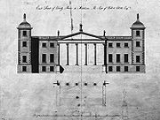
, who was just emerging as one of the most fashionable architects in England, to remodel the house. When Sir Francis died in 1763, the project was taken up by his brother and heir Robert Child, for whom the interiors were created.
The house is of red brick with white stone details and is approximately square, with turrets in the four corners. Adam's design, which incorporates some of the earlier structure, is highly unusual, and differs greatly in style from the original construction. One side is left almost open and is spanned by an Ionic
Ionic order
The Ionic order forms one of the three orders or organizational systems of classical architecture, the other two canonic orders being the Doric and the Corinthian...
pedimented screen which is approached by a broad flight of steps and leads to a central courtyard, which is at piano nobile
Piano nobile
The piano nobile is the principal floor of a large house, usually built in one of the styles of classical renaissance architecture...
level.
Adam's neoclassical interiors are among his most notable sequences of rooms. Horace Walpole sarcastically described the drawing room as "worthy of Eve
Eve
Eve is the first woman created by God in the Book of Genesis.Eve may also refer to:-People:*Eve , a common given name and surname*Eve , American recording artist and actress-Places:...
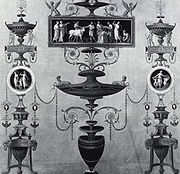
before the fall." The rooms are characterised by elaborate but restrained plasterwork, rich, highly varied colour schemes, and a degree of coordination between decor and furnishings unusual in English neoclassical interiors. Notable rooms include the entrance hall, which has large semi-circular alcoves at each end, and the Etruscan dressing room, which Adam said was inspired by the Etruscan vases in Sir William Hamilton
William Hamilton (diplomat)
Sir William Hamilton KB, PC, FRS was a Scottish diplomat, antiquarian, archaeologist and vulcanologist. After a short period as a Member of Parliament, he served as British Ambassador to the Kingdom of Naples from 1764 to 1800...
's collection, illustrations of which had recently been published. Adam also designed some of the furniture, including the opulent domed state bed, still in the house.
After Child
Robert Child's only daughter, Sarah Anne ChildSarah Fane, Countess of Westmorland
Sarah Fane, Countess of Westmorland was the only child of Robert Child, the principal shareholder in the banking firm Child & Co...
, married John Fane, 10th Earl of Westmorland
John Fane, 10th Earl of Westmorland
John Fane, 10th Earl of Westmorland KG, PC , styled Lord Burghersh between 1771 and 1774, was a British Tory politician of the late 18th and early 19th centuries, who served in most of the cabinets of the period, primarily as Lord Privy Seal.-Background:Westmorland was the son of John Fane, 9th...
in 1782. When Child died two months later, his will placed his vast holdings, including Osterley, in trust for his eldest granddaughter, Lady Sarah Sophia Fane
Sarah Villiers, Countess of Jersey
Sarah Sophia Child Villiers, Countess of Jersey , was an English noblewoman, the daughter of John Fane, 10th Earl of Westmorland and Sarah Anne Child. Her mother was the only child of Robert Child, the principal shareholder in the banking firm Child & Co...
, who was born in 1785. She married George Child-Villiers, 5th Earl of Jersey
George Child-Villiers, 5th Earl of Jersey
George Child Villiers, 5th Earl of Jersey GCH, PC , styled Viscount Grandison until 1805, was a British courtier and Conservative politician.-Background and education:...
, and thus Osterley passed into the Jersey family.
Home Guard Training Establishment
The grounds of Osterley Park were used for the training of the first members of the Local Defence Volunteers (forerunners of the Home Guard) when the 9th Earl, a friend of publisher Lord Hulton, allowed writer and military journalist Captain Tom WintringhamTom Wintringham
Thomas Henry Wintringham was a British soldier, military historian, journalist, poet, Marxist, politician and author. He was an important figure in the formation of the Home Guard during World War II and was one of the founders of the Common Wealth Party.-Early life:Tom Wintringham was born 1898...
to establish the first Home Guard training school (which Hulton sponsored) at the park in May/June 1940, teaching the theory and practice of modern mechanical warfare, guerilla warfare techniques and using the estate workers' homes, then scheduled for demolition, to teach street fighting techniques. The painter Roland Penrose
Roland Penrose
Sir Roland Algernon Penrose CBE was an English artist, historian and poet. He was a major promoter and collector of modern art and an associate of the surrealists in the United Kingdom.- Biography :...
taught camouflage techniques here, attempting to disguise the obvious charms of a naked Lee Miller
Lee Miller
Elizabeth 'Lee' Miller, Lady Penrose was an American photographer. Born in Poughkeepsie, New York in 1907, she was a successful fashion model in New York City in the 1920s before going to Paris where she became an established fashion and fine art photographer...
. Maj. Wilfred Vernon taught the art of mixing home made explosives, and his explosives store can still be seen at the rear of the house, while Canadian Bert "Yank" Levy
Albert Levy (soldier)
Albert "Yank" Levy was a soldier, military instructor and author of a manual on guerrilla warfare. He served with irregular forces in several parts of the world in the 1920s and 30's and was a significant figure at the Osterley Park training school for the British Home Guard during World War...
, who had served under Wintringham in the Spanish Civil War
Spanish Civil War
The Spanish Civil WarAlso known as The Crusade among Nationalists, the Fourth Carlist War among Carlists, and The Rebellion or Uprising among Republicans. was a major conflict fought in Spain from 17 July 1936 to 1 April 1939...
taught knife fighting and hand to hand combat. Despite winning world fame in newsreels and newspaper articles around the world (particularly in the US), the school was disapproved of by the War Office
War Office
The War Office was a department of the British Government, responsible for the administration of the British Army between the 17th century and 1964, when its functions were transferred to the Ministry of Defence...
and Winston Churchill
Winston Churchill
Sir Winston Leonard Spencer-Churchill, was a predominantly Conservative British politician and statesman known for his leadership of the United Kingdom during the Second World War. He is widely regarded as one of the greatest wartime leaders of the century and served as Prime Minister twice...
, and was taken over in September 1940 and closed in 1941, the staff and courses reallocated to other newly opened WO approved Home Guard schools.
Postwar history
In 1947 a Ministry of Works team, including architect E.T. Spashett, converted the building for use as a convalescence home for injured airmen. George Child-Villiers, 9th Earl of JerseyGeorge Child-Villiers, 9th Earl of Jersey
George Francis Child Villiers, 9th Earl of Jersey , was an English peer, the son of George Child Villiers, 8th Earl of Jersey. He gave one of the family seats, Osterley Park, to the British nation in the late 1940s....
gave the house and much of the estate to the National Trust
National Trust for Places of Historic Interest or Natural Beauty
The National Trust for Places of Historic Interest or Natural Beauty, usually known as the National Trust, is a conservation organisation in England, Wales and Northern Ireland...
in 1949. It is now open to the public, and contains most of the original furniture in excellent condition.
In popular culture
Television
- Osterley Park was originally proposed as the setting (and location) for the 1973 Doctor WhoDoctor WhoDoctor Who is a British science fiction television programme produced by the BBC. The programme depicts the adventures of a time-travelling humanoid alien known as the Doctor who explores the universe in a sentient time machine called the TARDIS that flies through time and space, whose exterior...
serial Day of the DaleksDay of the DaleksDay of the Daleks is a serial in the British science fiction television series Doctor Who, which was first broadcast in four weekly parts from 1 January to 22 January 1972.-Synopsis:...
. The name was changed to "Auderley" in the finished programme, and was renamed "Austerley" in the novel of the serial. The location eventually used was Dropmore ParkDropmore ParkDropmore Park together with Dropmore House are located along Dropmore Road, north of Burnham, Buckinghamshire, England, and is about in size. The park with its buildings have Grade I listed building status. It is one of the most important buildings in south Bucks.-Location:It is located in the...
in Buckinghamshire. - The entrance hall of the house also appeared as a room in an upmarket central London hotel in the denouement of the 2007 ITV adaptation of At Bertram's Hotel.
- Osterley Park was used as the home of billionaire Sir Peter Maxwell, for the 2006 TV pilot, 'Maxwell: Inside the Empire'.
- Chucklevision was also filmed in Osterley Park.
- The house featured in an episode of 1970s cult series The Persuaders which starred Roger Moore and Tony Curtis.
Music
- A wall in the park was used as the background to the cover picture of the 1973 WingsWings (band)Wings were a British-American rock group formed in 1971 by Paul McCartney, Denny Laine and Linda McCartney that remained active until 1981....
album Band on the RunBand on the RunBand on the Run is an album by Paul McCartney & Wings, released in 1973. It was Wings' third album. It became Wings' most successful album and remains the most celebrated of McCartney's post-Beatles albums...
.
Film
- The 1960 film The Grass Is GreenerThe Grass Is GreenerThe Grass Is Greener is a 1960 comedy film featuring an ensemble cast consisting of screen veterans Cary Grant, Deborah Kerr, Robert Mitchum, and Jean Simmons,directed by Stanley Donen...
, starring Cary GrantCary GrantArchibald Alexander Leach , better known by his stage name Cary Grant, was an English actor who later took U.S. citizenship...
, Deborah KerrDeborah KerrDeborah Kerr, CBE was a Scottish film and television actress from Glasgow. She won the Sarah Siddons Award for her Chicago performance as Laura Reynolds in Tea and Sympathy, a role which she originated on Broadway, a Golden Globe Award for the motion picture The King and I, and was a three-time...
and Robert MitchumRobert MitchumRobert Charles Durman Mitchum was an American film actor, author, composer and singer and is #23 on the American Film Institute's list of the greatest male American screen legends of all time...
, was set and partly shot at Osterley Park House. - The 2001 film Kabhi Kushie Kabhi Gham, starring Shah Rukh Khan and Kajol, the garden reunion scene.
- Osterley Park has been used for Buckingham Palace scenes, including Victoria's sitting room and anteroom, in the 2009 film The Young Victoria starring Emily Blunt and Rupert Friend.
- The 1984 film "Top Secret!Top Secret!Top Secret! is a 1984 comedy film directed by David Zucker, Jim Abrahams, and Jerry Zucker. It stars Val Kilmer , Lucy Gutteridge, Omar Sharif, Peter Cushing, Michael Gough and Jeremy Kemp. The film is a parody of the GDR era and Elvis films...
", starring Val KilmerVal KilmerVal Edward Kilmer is an American actor. Originally a stage actor, Kilmer became popular in the mid-1980s after a string of appearances in comedy films, starting with Top Secret! , then the cult classic Real Genius , as well as blockbuster action films, including a supporting role in Top Gun and a...
and Omar SharifOmar SharifOmar Sharif is an Egyptian actor who has starred in Hollywood films including Lawrence of Arabia, Doctor Zhivago and Funny Girl. He has been nominated for an Academy Award and has won two Golden Globe Awards.-Early life:...
, features Osterley as East Berlin Town Hall, when the various cultural ambassadors are presented with medals by the East German Women's Olympic Team. - In the upcoming 2012 Batman film The Dark Knight RisesThe Dark Knight RisesThe Dark Knight Rises is an upcoming epic superhero film. Based on the DC Comics character Batman, the film will be the third and final installment in Nolan's Batman film series, and is a sequel to Batman Begins and The Dark Knight...
, starring Christian BaleChristian BaleChristian Charles Philip Bale is an English actor. Best known for his roles in American films, Bale has starred in both big budget Hollywood films and the smaller projects from independent producers and art houses....
, the interior of Osterley Park mansion is used as a double for Wayne Manor.
Literature
- Osterley Park features in John BanvilleJohn BanvilleJohn Banville is an Irish novelist and screenwriter.Banville's breakthrough novel The Book of Evidence was shortlisted for the Man Booker Prize, and won the Guinness Peat Aviation award. His eighteenth novel, The Sea, won the Man Booker Prize in 2005. He was awarded the Franz Kafka Prize in 2011...
's novel The UntouchableThe Untouchable (novel)The Untouchable is a 1997 novel by the Irish author John Banville. The book is written as a roman à clef, presented from the point of view of the art historian, double agent and homosexual Victor Maskell—a character based on the life of Cambridge spy Anthony Blunt, as well as on elements from the...
.