


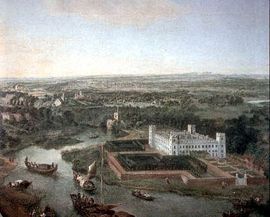
Syon House

Encyclopedia
Hectare
The hectare is a metric unit of area defined as 10,000 square metres , and primarily used in the measurement of land. In 1795, when the metric system was introduced, the are was defined as being 100 square metres and the hectare was thus 100 ares or 1/100 km2...
/800,000 m²) park
Park
A park is a protected area, in its natural or semi-natural state, or planted, and set aside for human recreation and enjoyment, or for the protection of wildlife or natural habitats. It may consist of rocks, soil, water, flora and fauna and grass areas. Many parks are legally protected by...
, is situated in west London
London
London is the capital city of :England and the :United Kingdom, the largest metropolitan area in the United Kingdom, and the largest urban zone in the European Union by most measures. Located on the River Thames, London has been a major settlement for two millennia, its history going back to its...
, England. It belongs to the Duke of Northumberland
Duke of Northumberland
The Duke of Northumberland is a title in the peerage of Great Britain that has been created several times. Since the third creation in 1766, the title has belonged to the House of Percy , which held the title of Earl of Northumberland from 1377....
and is now his family's London residence. The family's traditional central London residence was Northumberland House
Northumberland House
Northumberland House was a large Jacobean mansion in London, which was so called because for most of its history it was the London residence of the Percy family, who were the Earls and later Dukes of Northumberland, and one of England's richest and most prominent aristocratic dynasties for many...
.

History
Syon House derives its name from Syon AbbeySyon Abbey
Syon Monastery , was a monastery of the Bridgettine Order founded in 1415 which stood until its demolition in the 16th c. on the left bank of the River Thames within the parish of Isleworth, in the county of Middlesex on or near the site of the present Georgian mansion of Syon House...
, a medieval monastery of the Bridgettine Order
Bridgettines
The Bridgettine or Birgittine Order is a monastic religious order of Augustinian nuns, Religious Sisters and monks founded by Saint Birgitta of Sweden in approximately 1350, and approved by Pope Urban V in 1370...
, founded in 1415 on a nearby site by King Henry V
Henry V of England
Henry V was King of England from 1413 until his death at the age of 35 in 1422. He was the second monarch belonging to the House of Lancaster....
. The Abbey moved to the site now occupied by Syon House in 1431. In 1539, the abbey was closed by royal agents during the Dissolution of the Monasteries
Dissolution of the Monasteries
The Dissolution of the Monasteries, sometimes referred to as the Suppression of the Monasteries, was the set of administrative and legal processes between 1536 and 1541 by which Henry VIII disbanded monasteries, priories, convents and friaries in England, Wales and Ireland; appropriated their...
, and the monastic community was expelled.
In 1541 and part of the following year, Henry VIII's fifth wife, Catherine Howard
Catherine Howard
Catherine Howard , also spelled Katherine, Katheryn or Kathryn, was the fifth wife of Henry VIII of England, and sometimes known by his reference to her as his "rose without a thorn"....
, was brought to Syon for her long imprisonment. In February 1542, she was taken to the Tower of London
Tower of London
Her Majesty's Royal Palace and Fortress, more commonly known as the Tower of London, is a historic castle on the north bank of the River Thames in central London, England. It lies within the London Borough of Tower Hamlets, separated from the eastern edge of the City of London by the open space...
and executed on charges of adultery.
In the late 17th century, Syon was in the possession of Charles Seymour, 6th Duke of Somerset
Charles Seymour, 6th Duke of Somerset
Charles Seymour, 6th Duke of Somerset , sometimes referred to as the "Proud Duke". The son of Charles Seymour, 2nd Baron Seymour of Trowbridge, and Elizabeth Alington , he succeeded his brother Francis Seymour, 5th Duke of Somerset, to the dukedom when the latter was shot in 1678...
, through his wife, Elizabeth Seymour (née Percy)
Elizabeth Seymour, Duchess of Somerset
Elizabeth Percy, Duchess of Somerset , major heiress, was born Lady Elizabeth Percy, the only surviving child of the 11th Earl of Northumberland and deemed Baroness Percy in her own right. She carried the earldom of Northumberland to her son Algernon...
. After the future Queen Anne
Anne of Great Britain
Anne ascended the thrones of England, Scotland and Ireland on 8 March 1702. On 1 May 1707, under the Act of Union, two of her realms, England and Scotland, were united as a single sovereign state, the Kingdom of Great Britain.Anne's Catholic father, James II and VII, was deposed during the...
had a disagreement with her sister, Mary II (wife of William III, also known as William of Orange), over her friendship with Sarah Churchill, Countess of Marlborough
Sarah Churchill, Duchess of Marlborough
Sarah Churchill , Duchess of Marlborough rose to be one of the most influential women in British history as a result of her close friendship with Queen Anne of Great Britain.Sarah's friendship and influence with Princess Anne was widely known, and leading public figures...
, she was evicted
Eviction
How you doing???? Eviction is the removal of a tenant from rental property by the landlord. Depending on the laws of the jurisdiction, eviction may also be known as unlawful detainer, summary possession, summary dispossess, forcible detainer, ejectment, and repossession, among other terms...
from her court residence at the Palace of Whitehall
Palace of Whitehall
The Palace of Whitehall was the main residence of the English monarchs in London from 1530 until 1698 when all except Inigo Jones's 1622 Banqueting House was destroyed by fire...
and stayed at Syon with her close friends, the Somersets, in 1692. Anne gave birth to a stillborn child there. Shortly after the birth, Mary came to visit her, again demanding that Anne dismiss the Countess of Marlborough, and stormed out again when Anne flatly refused.
In the 18th century, Hugh Percy, 1st Duke of Northumberland
Hugh Percy, 1st Duke of Northumberland
Hugh Percy, 1st Duke of Northumberland, KG, PC was an Engish peer, landowner and art patron.He was born Hugh Smithson, the son of Langdale Smithson and grandson of Sir Hugh Smithson, 3rd Baronet from whom he inherited the baronetcy in 1733...
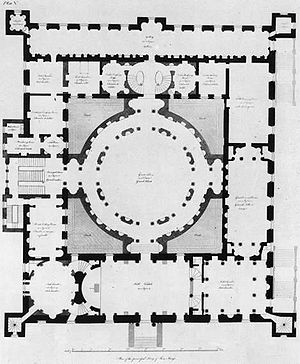
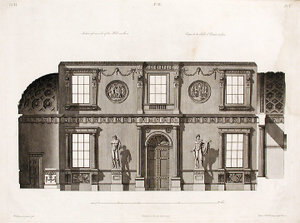
, commissioned architect and interior design
Interior design
Interior design describes a group of various yet related projects that involve turning an interior space into an effective setting for the range of human activities are to take place there. An interior designer is someone who conducts such projects...
er Robert Adam
Robert Adam
Robert Adam was a Scottish neoclassical architect, interior designer and furniture designer. He was the son of William Adam , Scotland's foremost architect of the time, and trained under him...
and landscape designer Lancelot "Capability" Brown to redesign the house and estate. Work began on the interior reconstruction project in 1762. Five large rooms on the west, south and east sides of the House, were completed before work ceased in 1769. A central rotunda, which Adams had intended for the interior courtyard space, was not implemented, due to cost.
A £600K restoration was undertaken in late 2007, primarily involving work to the roof area.
Syon Park
Syon Park borders the Thames, looking across the river to Kew Gardens, and near its banks is a tidal meadow flooded twice a day by the river. It contains more than 200 species of rare trees. Although the park and lake were designed by Capability Brown in 1760, their character today is nineteenth century. The circular pool has a copy of GiambolognaGiambologna
Giambologna, born as Jean Boulogne, incorrectly known as Giovanni da Bologna and Giovanni Bologna , was a sculptor, known for his marble and bronze statuary in a late Renaissance or Mannerist style.- Biography :...
's Mercury.
The Great Conservatory in the gardens, designed by Charles Fowler
Charles Fowler
Charles Fowler , English architect, was born at Cullompton, Devon.After serving an apprenticeship of seven years with John Powning of Exeter, he went to London in 1814, and entered the office of David Laing, where he remained until he commenced practice for himself...
in 1828 and completed in 1830, was the first conservatory to be built from metal and glass on a large scale. The conservatory appeared (as Heaven) in the original 1967 Dudley Moore
Dudley Moore
Dudley Stuart John Moore, CBE was an English actor, comedian, composer and musician.Moore first came to prominence as one of the four writer-performers in the ground-breaking comedy revue Beyond the Fringe in the early 1960s, and then became famous as half of the highly popular television...
-Peter Cook
Peter Cook
Peter Edward Cook was an English satirist, writer and comedian. An extremely influential figure in modern British comedy, he is regarded as the leading light of the British satire boom of the 1960s. He has been described by Stephen Fry as "the funniest man who ever drew breath," although Cook's...
version of Bedazzled
Bedazzled (1967 film)
Bedazzled is a 1967 British comedy film directed and produced by Stanley Donen. It was written by and stars Peter Cook and Dudley Moore. It is a comic retelling of the Faust legend, set in the Swinging London of the 1960s...
, having already featured prominently in John Boorman
John Boorman
John Boorman is a British filmmaker who is a long time resident of Ireland and is best known for his feature films such as Point Blank, Deliverance, Zardoz, Excalibur, The Emerald Forest, Hope and Glory, The General and The Tailor of Panama.-Early life:Boorman was born in Shepperton, Surrey,...
's first feature film Catch Us If You Can (film)
Catch Us If You Can (film)
Catch Us If You Can was the feature-film debut of director John Boorman...
(1965, ostensibly a vehicle for the Dave Clark Five), was shown in a dream sequence in Meera Syal
Meera Syal
Meera Syal MBE is a British comedienne, writer, playwright, singer, journalist, producer and actress. She rose to prominence as one of the team that created Goodness Gracious Me and became one of the UK's best-known Indian personalities portraying Sanjeev's grandmother, Ummi, in The Kumars at No...
's 1993 film Bhaji on the Beach
Bhaji on the Beach
Bhaji on the Beach is a 1993 film by director Gurinder Chadha with a screenplay by Meera Syal.-Plot synopsis:A diverse group of British women of South Asian descent go on a day trip to the beach in Blackpool; despite their differences—the older women are more traditional and conservative,...
, and was also the setting for the music video to The Cure's
The Cure
The Cure are an English rock band formed in Crawley, West Sussex in 1976. The band has experienced several line-up changes, with frontman, vocalist, guitarist and principal songwriter Robert Smith being the only constant member...
1984 single "The Caterpillar
The Caterpillar (song)
"The Caterpillar" is the name of a 1984 single and song written by Robert Smith and Lol Tolhurst. The song is performed by The Cure and is from their album The Top...
", directed by Tim Pope
Tim Pope
Timothy Michael Pope is a film director most famous for his music videos, having directed feature films, and for a brief pop career.-Early life and career:...
.
Henry Percy, 11th Duke of Northumberland
Henry Percy, 11th Duke of Northumberland
Henry Alan Walter Richard Percy, 11th Duke of Northumberland FRS was the son of Hugh Percy, 10th Duke of Northumberland. He was a godchild of Queen Elizabeth II.He was educated at Eton College and Christ Church, Oxford...
, who was head of the family from 1988 to 1995, was noted for planting many trees in the grounds of Syon.
In 2002, the English poet Geoffrey Hill
Geoffrey Hill
Geoffrey Hill is an English poet, professor emeritus of English literature and religion, and former co-director of the Editorial Institute, at Boston University. Hill has been considered to be among the most distinguished poets of his generation...
released a booklength poem, "The Orchards of Syon", to much acclaim. "The Orchards of Syon", focuses on the history of the region and in particular on the orchard of rare trees first planted in Syon Abbey.
Robert Altman
Robert Altman
Robert Bernard Altman was an American film director and screenwriter known for making films that are highly naturalistic, but with a stylized perspective. In 2006, the Academy of Motion Picture Arts and Sciences recognized his body of work with an Academy Honorary Award.His films MASH , McCabe and...
's 2001 film Gosford Park
Gosford Park
Gosford Park is a 2001 British-American mystery comedy-drama film directed by Robert Altman and written by Julian Fellowes. The film stars an ensemble cast, which includes Helen Mirren, Maggie Smith, Eileen Atkins, Alan Bates, and Michael Gambon...
was partly filmed at Syon House.
The London Butterfly House
London Butterfly House
The London Butterfly House was a visitor attraction in Brentford, Middlesex, England where the public could view butterflies, birds, reptiles, amphibians, insects, and arachnids....
was based in the grounds of Syon Park from 1981 until its closure on 28 October 2007 due to the Duke of Northumberland
Ralph Percy, 12th Duke of Northumberland
thumb|Portrait by [[Allan Warren]]Ralph George Algernon Percy, 12th Duke of Northumberland DL is a British peer. He is the son of Hugh Percy, 10th Duke of Northumberland and Lady Elizabeth Montagu Douglas Scott....
's plans to build a hotel complex on the land.
In 2004, planning permission was granted for the deluxe £35-million Radisson Edwardian Hotel, but this was not built. Instead, work started in December 2008 on a Waldorf Astoria hotel, which opened in March 2011.
In November 2010, the results from an archaeological dig made two years before on the site of the new hotel were reported, with the excavations uncovering the remains of a Roman village that existed in what was then the rural outskirts of Londinium
Londinium
The city of London was established by the Romans around AD 43. It served as a major imperial commercial centre until its abandonment during the 5th century.-Origins and language:...
. Artifacts uncovered included 11,500 pottery fragments, 100 coins, and pieces of jewellery. Some of finds remain unexplained, such as the discovery of skeletons "buried in ditches placed on their side". Although the skeletons date from the Roman period, this burial practice was said by the senior archaeologist to be "more suggestive of unknown prehistoric rites than Roman practice".
Syon House was one of the wealthiest nunneries in the country and a local legend recalls that the monks of Shean had a Ley tunnel
Ley tunnel
Ley tunnels are a common element of the local folklore tradition in the United Kingdom and they also occur in Europe. In Norwegian a ley tunnel-like passage is called a "lønngang" and in Swedish a "lönngång"...
running to the nunnery at Syon.
See also
- Alnwick CastleAlnwick CastleAlnwick Castle is a castle and stately home in the town of the same name in the English county of Northumberland. It is the residence of the Duke of Northumberland, built following the Norman conquest, and renovated and remodelled a number of times. It is a Grade I listed building.-History:Alnwick...
– the principal seat of the Dukes of Northumberland - Northumberland HouseNorthumberland HouseNorthumberland House was a large Jacobean mansion in London, which was so called because for most of its history it was the London residence of the Percy family, who were the Earls and later Dukes of Northumberland, and one of England's richest and most prominent aristocratic dynasties for many...
– the former central London residence of the Dukes of Northumberland
Further reading
- Syon House; The Story of a Great House – With a short guide for visitors, and with 4 (colour) plates, 2 endpaper maps (in colour), and 22 illustrations in Monochrome (The illustrations mainly relate to paintings, artefacts and the building). First published by Syon House Estate (UK) in 1950 with 48 pages and no ISBN.