


Originalism

Encyclopedia
In the context of United States
United States
The United States of America is a federal constitutional republic comprising fifty states and a federal district...
constitutional interpretation, originalism is a principle of interpretation that tries to discover the original meaning or intent of the constitution
Constitution
A constitution is a set of fundamental principles or established precedents according to which a state or other organization is governed. These rules together make up, i.e. constitute, what the entity is...
. It is based on the principle
Separation of powers
The separation of powers, often imprecisely used interchangeably with the trias politica principle, is a model for the governance of a state. The model was first developed in ancient Greece and came into widespread use by the Roman Republic as part of the unmodified Constitution of the Roman Republic...
that the judiciary is not supposed to create, amend or repeal laws (which is the realm of the legislative branch
Legislature
A legislature is a kind of deliberative assembly with the power to pass, amend, and repeal laws. The law created by a legislature is called legislation or statutory law. In addition to enacting laws, legislatures usually have exclusive authority to raise or lower taxes and adopt the budget and...
) but only to uphold them. The term is a neologism, and the concept is a formalist
Legal formalism
Legal formalism is a legal positivist view in philosophy of law and jurisprudence. While Jeremy Bentham's can be seen as appertaining to the legislature, legal formalism appertains to the Judge; that is, formalism does not suggest that the substantive justice of a law is irrelevant, but rather,...
theory of law and a corollary
Corollary
A corollary is a statement that follows readily from a previous statement.In mathematics a corollary typically follows a theorem. The use of the term corollary, rather than proposition or theorem, is intrinsically subjective...
of textualism
Textualism
Textualism is a formalist theory of statutory interpretation, holding that a statute's ordinary meaning should govern its interpretation, as opposed to inquiries into non-textual sources such as the intention of the legislature in passing the law, the problem it was intended to remedy, or...
.
Today, originalism is popular among political conservatives in the U.S., and is most prominently associated with Antonin Scalia
Antonin Scalia
Antonin Gregory Scalia is an American jurist who serves as an Associate Justice of the Supreme Court of the United States. As the longest-serving justice on the Court, Scalia is the Senior Associate Justice...
, Clarence Thomas
Clarence Thomas
Clarence Thomas is an Associate Justice of the Supreme Court of the United States. Succeeding Thurgood Marshall, Thomas is the second African American to serve on the Court....
and Robert Bork
Robert Bork
Robert Heron Bork is an American legal scholar who has advocated the judicial philosophy of originalism. Bork formerly served as Solicitor General, Acting Attorney General, and judge for the United States Court of Appeals for the District of Columbia Circuit...
. However, some liberals, such as Justice Hugo Black
Hugo Black
Hugo Lafayette Black was an American politician and jurist. A member of the Democratic Party, Black represented Alabama in the United States Senate from 1927 to 1937, and served as an Associate Justice of the Supreme Court of the United States from 1937 to 1971. Black was nominated to the Supreme...
and Akhil Amar, have also subscribed to the theory.
Originalism is a family of theories, principally:
- The original intentOriginal intentOriginal intent is a theory in law concerning constitutional and statutory interpretation. It is frequently—and usually spuriously—used as a synonym for originalism generally; while original intent is indeed one theory in the originalist family, it has some extremely salient differences which has...
theory, which holds that interpretation of a written constitution is (or should be) consistent with what was meant by those who drafted and ratified it. - The original meaningOriginal meaningIn the context of United States constitutional interpretation, original meaning is the dominant form of the legal theory of originalism today...
theory, which is closely related to textualismTextualismTextualism is a formalist theory of statutory interpretation, holding that a statute's ordinary meaning should govern its interpretation, as opposed to inquiries into non-textual sources such as the intention of the legislature in passing the law, the problem it was intended to remedy, or...
, is the view that interpretation of a written constitution or law should be based on what reasonable personReasonable personThe reasonable person is a legal fiction of the common law that represents an objective standard against which any individual's conduct can be measured...
s living at the time of its adoption would have declared the ordinary meaningPlain Meaning RuleThe Plain meaning rule, also known as the literal rule, is one of three rules of statutory construction traditionally applied by English courts...
of the text to be. It is with this view that most originalists, such as Justice Scalia, are associated.
Both of these theories share the view that there is an authority, contemporaneous with a constitution's or statute's ratification, which should govern its interpretation; the divisions relate to what exactly that authority is: the intentions of the authors or the ratifiers, or the original meaning of the text.
The primary alternative to originalism is most commonly described as the Living Constitution
Living Constitution
The Living Constitution is a concept in America, also referred to as loose constructionism, constitutional interpretation which claims that the Constitution has a dynamic meaning or that it has the properties of a human in the sense that it changes...
; this is the theory that the Constitution was written in flexible terms whose meaning is dynamic.
Origins of the term
Bret Boyce described the origins of the term "originalist" as follows:Differentiated from strict constructionism
It is often asserted that "Originalism" is synonymous with "strict constructionismStrict constructionism
In the United States, Strict constructionism refers to a particular legal philosophy of judicial interpretation that limits or restricts judicial interpretation. The phrase is also commonly used more loosely as a generic term for conservatism among the judiciary.- Strict sense of the term :Strict...
."

Textualism
Textualism is a formalist theory of statutory interpretation, holding that a statute's ordinary meaning should govern its interpretation, as opposed to inquiries into non-textual sources such as the intention of the legislature in passing the law, the problem it was intended to remedy, or...
and formalist
Legal formalism
Legal formalism is a legal positivist view in philosophy of law and jurisprudence. While Jeremy Bentham's can be seen as appertaining to the legislature, legal formalism appertains to the Judge; that is, formalism does not suggest that the substantive justice of a law is irrelevant, but rather,...
schools of thought, but there are pronounced differences between them. Justice Scalia
Antonin Scalia
Antonin Gregory Scalia is an American jurist who serves as an Associate Justice of the Supreme Court of the United States. As the longest-serving justice on the Court, Scalia is the Senior Associate Justice...
differentiates the two by pointing out that, unlike an originalist, a strict constructionist would not acknowledge that "he uses a cane" means "he walks with a cane" (because, strictly speaking, this is not what "he uses a cane" means). Scalia has averred that he is "not a strict constructionist, and no-one ought to be;" he goes further, calling strict constructionism "a degraded form of textualism that brings the whole philosophy into disrepute."
Originalism is a theory of interpretation, not construction. As Scalia has said, "the Constitution, or any text, should be interpreted [n]either strictly [n]or sloppily; it should be interpreted reasonably"; once originalism has told a Judge what the provision of the Constitution means, they are bound by that meaning—but the business of Judging is not simply to know what the text means (interpretation), but to take the law's necessarily general provisions and apply them to the specifics of a given case or controversy (construction). In many cases, the meaning might be so specific that no discretion is permissible, but in many cases, it is still before the Judge to say what a reasonable interpretation might be. A Judge could, therefore, be both an Originalist and a strict constructionist—but s/he is not one by virtue of being the other.
To put the difference more explicitly, both schools take the plain meaning
Plain Meaning Rule
The Plain meaning rule, also known as the literal rule, is one of three rules of statutory construction traditionally applied by English courts...
of the text as their starting point, but have different approaches that can best be illustrated with a fictitious example.
Suppose that the Constitution contained (which it obviously does not) a provision that a person may not be "subjected to the punishments of hanging by the neck, beheading, stoning, pressing, or execution by firing squad". A strict constructionist would interpret that clause to mean that the specific punishments mentioned above were unconstitutional, but that other forms of capital punishment were permissible. For a strict constructionist, the specific, strict reading of the text is the beginning and end of the inquiry.
For an Originalist, however, the text is the beginning of the inquiry, and two Originalists might reach very different results, not only from the strict constructionist, but from each other. "Originalists can reach different results in the same case" (see What Originalism is Not — Originalism is not always an answer in and of itself, infra); one originalist might look at the context in which the clause was written, and might discover that the punishments listed in the clause were the only forms of capital punishment in use at that time, and the only forms of capital punishment that had ever been used at the time of ratification. An originalist might therefore conclude that capital punishment in general—including those methods for it invented since ratification, such as the electric chair—are not constitutional. Another originalist may look at the text and see that the writers created a list. He would assume that the Congress intended this to be an exhaustive list of objectionable executions. Otherwise, they would have banned capital punishment as a whole, instead of listing specific means of punishment. He would rule that other forms of execution are constitutional.
The paragraph above does not give examples of Original intent vis a vis Original meaning. Using the former, the Judge would look for the letters and journals of the Founders on the subject of capital punishment. If he found that a majority expressed an aversion to it, the interpretation would be averse to capital punishment. Using Original meaning the Judge would look for the frequency of each contemporaneous form of capital punishment. If any form other than those listed was extremely rare, the decision could be averse to all capital punishment. If another form, not listed, was not rare, the decision would have to be in favor of capital punishment because reasonable persons in 1793 would so interpret the clause.
Original intent
The "original form of originalism" was known as intentionalism, or "Original intentOriginal intent
Original intent is a theory in law concerning constitutional and statutory interpretation. It is frequently—and usually spuriously—used as a synonym for originalism generally; while original intent is indeed one theory in the originalist family, it has some extremely salient differences which has...
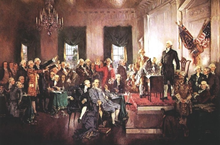
", and entailed applying laws based on the subjective intention of its authors. For instance, the authors of the U.S. Constitution would be the group of "Founding Fathers" that drafted it. The intentionalist methodology involves studying the writings of its authors, or the records of the Philadelphia Convention
Philadelphia Convention
The Constitutional Convention took place from May 14 to September 17, 1787, in Philadelphia, Pennsylvania, to address problems in governing the United States of America, which had been operating under the Articles of Confederation following independence from...
, for clues as to their intent.
There are two kinds of "intent analysis", reflecting two meanings of the word "intent". The first, a rule of common law construction during the Founding Era, is functional intent. The second is motivational intent. To understand the difference, one can use the metaphor of an architect who designs a Gothic church with flying buttresses. The functional intent of flying buttresses is to prevent the weight of the roof from spreading the walls and causing a collapse of the building, which can be inferred from examining the design as a whole. The motivational intent might be to create work for his brother-in-law who is a flying buttress subcontractor. Using original intent analysis of the first kind, we can discern that the language of Article III of the U.S. Constitution was to delegate to Congress the power to allocate original and appellate jurisdictions, and not to remove some jurisdiction, involving a constitutional question, from all courts. That would suggest that the decision was wrong in Ex Parte McCardle.
Original intent evolves
However, a number of problems inherent in intentionalism, and a fortiori when that theory is applied to the Constitution: most of the Founders did not leave discussions of what their intent was in 1787, and while a few did, there is no reason to think that they should be dispositive of what the rest thought. The theory was challenged in a string of Law reviewLaw review
A law review is a scholarly journal focusing on legal issues, normally published by an organization of students at a law school or through a bar association...
articles attacking Robert Bork
Robert Bork
Robert Heron Bork is an American legal scholar who has advocated the judicial philosophy of originalism. Bork formerly served as Solicitor General, Acting Attorney General, and judge for the United States Court of Appeals for the District of Columbia Circuit...
and the intentionalist process, prior to his abortive Senate confirmation hearing to the Supreme Court. Specifically, original intent was seen as lacking good answers to three important questions: whether a diverse group such as the framers even had a single intent; if they did, whether it could be determined from two centuries' distance; and whether the framers themselves would have supported original intent.
In response to this, a different strain of originalism, articulated by (among others) Antonin Scalia
Antonin Scalia
Antonin Gregory Scalia is an American jurist who serves as an Associate Justice of the Supreme Court of the United States. As the longest-serving justice on the Court, Scalia is the Senior Associate Justice...
, Robert Bork
Robert Bork
Robert Heron Bork is an American legal scholar who has advocated the judicial philosophy of originalism. Bork formerly served as Solicitor General, Acting Attorney General, and judge for the United States Court of Appeals for the District of Columbia Circuit...
, and Randy Barnett
Randy Barnett
Randy E. Barnett is a lawyer, a law professor at Georgetown University Law Center, where he teaches constitutional law and contracts, and a legal theorist in the United States...
, came to the fore. This is dubbed original meaning
Original meaning
In the context of United States constitutional interpretation, original meaning is the dominant form of the legal theory of originalism today...
.
Original meaning
Justice Oliver Wendell HolmesOliver Wendell Holmes, Jr.
Oliver Wendell Holmes, Jr. was an American jurist who served as an Associate Justice of the Supreme Court of the United States from 1902 to 1932...
argued that interpreting what was meant by someone who wrote a law was not trying to "get into his mind" because the issue was "not what this man meant, but what those words would mean in the mouth of a normal speaker of English, using them in the circumstances in which they were used." This is the essential precept of modern Originalism.
The most robust and widely cited form of originalism, "original meaning" emphasizes how the text would have been understood by a reasonable person
Reasonable person
The reasonable person is a legal fiction of the common law that represents an objective standard against which any individual's conduct can be measured...
in the historical period during which the constitution was proposed, ratified, and first implemented. For example, economist Thomas Sowell notes that phrases like "due process" and "freedom of the press" had a long established meaning in English law, even before they were put into the Constitution of the United States." Applying this form involves studying dictionaries and other writings of the time (for example, Blackstone's Commentaries on the Laws of England
Commentaries on the Laws of England
The Commentaries on the Laws of England are an influential 18th-century treatise on the common law of England by Sir William Blackstone, originally published by the Clarendon Press at Oxford, 1765–1769...
; see Matters rendered moot by originalism, infra) to establish out what particular terms meant. See Methodology, infra).
Justice Scalia
Antonin Scalia
Antonin Gregory Scalia is an American jurist who serves as an Associate Justice of the Supreme Court of the United States. As the longest-serving justice on the Court, Scalia is the Senior Associate Justice...
, one of the most forceful modern advocates for originalism, defines himself as belonging to the latter category:
Though there may be no evidence that the Founding Fathers intended the Constitution to be like a statute, this fact does not matter under Scalia's approach. Adherence to original meaning is explicitly divorced from the intent of the Founders; rather, the reasons for adhering to original meaning derive from other justifications, such as the argument that the understanding of the ratifiers (the people of the several States at the time of the adoption of the Constitution) should be controlling, as well as consequentialist arguments about original meaning's positive effect on rule of law.
Perhaps the clearest example to illustrate the importance of the difference between original intent and original understanding is to use the Twenty-seventh Amendment
Twenty-seventh Amendment to the United States Constitution
The Twenty-seventh Amendment prohibits any law that increases or decreases the salary of members of the Congress from taking effect until the start of the next set of terms of office for Representatives...
. The Twenty-seventh Amendment was proposed as part of the Bill of Rights
United States Bill of Rights
The Bill of Rights is the collective name for the first ten amendments to the United States Constitution. These limitations serve to protect the natural rights of liberty and property. They guarantee a number of personal freedoms, limit the government's power in judicial and other proceedings, and...
in 1791, but failed to be ratified by the required number of states
U.S. state
A U.S. state is any one of the 50 federated states of the United States of America that share sovereignty with the federal government. Because of this shared sovereignty, an American is a citizen both of the federal entity and of his or her state of domicile. Four states use the official title of...
for two centuries, eventually being ratified in 1992. An original intent inquiry would ask what the framers understood the amendment to mean when it was written; an original meaning inquiry would ask what the plain meaning of the text was in 1992 when it was eventually ratified.
Semantic Originalism
"Semantic-originalism" is Ronald Dworkin'sRonald Dworkin
Ronald Myles Dworkin, QC, FBA is an American philosopher and scholar of constitutional law. He is Frank Henry Sommer Professor of Law and Philosophy at New York University and Emeritus Professor of Jurisprudence at University College London, and has taught previously at Yale Law School and the...
term for the theory that the original meaning of many statutes implies that those statutes prohibit certain acts widely considered not to be prohibited by the statutes at the time of their passages. For example, Scalia and other originalists often claim that the death penalty is not "cruel and unusual punishment" because at the time of the Eighth Amendment's passage, it was a punishment believed to be neither cruel nor unusual. Dworkin and the semantic-originalists assert, however, that if advances in moral philosophy (presuming that such advances are possible) reveal that the death penalty is in fact "cruel and unusual", then the original meaning of the Eighth Amendment implies that the death penalty is unconstitutional. Those who deny semantic-originalism often retort either by invoking legal positivism
Legal positivism
Legal positivism is a school of thought of philosophy of law and jurisprudence, largely developed by nineteenth-century legal thinkers such as Jeremy Bentham and John Austin. However, the most prominent figure in the history of legal positivism is H.L.A...
or by arguing that, if it became a widely adopted jurisprudential theory, semantic-originalism would make it difficult to determine exactly what the law is at any given time, and thereby make the pandect ex post facto in effect.
Methodology
In "The Original Meaning of the Recess Appointments Clause", Prof. Michael B. Rappaport described the methodology associated with the "Original Meaning" form of originalism as follows:- "The task is to determine the original meaning of the language . . . that is, to understand how knowledgeable individuals would have understood this language...when it was drafted and ratified. Interpreters at the time would have examined various factors, including text, purpose, structure, and history."
- "The most important factor is the text of the Clause. The modern interpreter should read the language in accord with the meaning it would have had in the late 1780s. Permissible meanings from that time include the ordinary meanings as well as more technical legal meanings words may have had."
- "If the language has more than one interpretation, then one would look to purpose, structure, and history to help to clarify the ambiguity. Purpose, structure, and history provide evidence for determining which meaning of the language the authors would have intended."
- "The purpose of a Clause involves the objectives or goals that the authors would have sought to accomplish in enacting it. One common and permissible way to discern the purpose is to look to the evident or obvious purpose of a provision. Yet, purpose arguments can be dangerous, because it is easy for interpreters to focus on one purpose to the exclusion of other possible purposes without any strong arguments for doing so."
- "Historical evidence can reveal the values that were widely held by the Framers’ generation and that presumably informed their purposes when enacting constitutional provisions. History can also reveal their practices, which when widely accepted would be evidence of their values."
- "The structure of the document can also help to determine the purposes of the Framers. The decision to enact one constitutional clause may reveal the values of the Framers and thereby help us understand the purposes underlying a second constitutional clause."
- "One additional source of evidence about the meaning of constitutional language is early constitutional interpretations by government officials or prominent commentators. ...Such interpretations may provide evidence of the original meaning of the provisions, because early interpreters would have had better knowledge of contemporary word meanings, societal values, and interpretive techniques. Of course, early interpreters may also have had political and other incentives to misconstrue the document that should be considered." (Id. at 5-7). Historians of course reject the last point, arguing that discerning original meaning requires access to many different evidence—such as statements from many people—that the people at the time did not have access to. Furthermore most of the evidence that would clarify the original meaning has been lost—only fragments remain in the form of materials that were written down and happen to survive for hundreds of years. Whenever there is ambiguity there probably is also a paucity of evidence to resolve that ambiguity.
Philosophical underpinnings
Originalism, in all its various forms, is predicated on a specific view of what the Constitution is, a view articulated by Chief Justice John MarshallJohn Marshall
John Marshall was the Chief Justice of the United States whose court opinions helped lay the basis for American constitutional law and made the Supreme Court of the United States a coequal branch of government along with the legislative and executive branches...
in Marbury v. Madison
Marbury v. Madison
Marbury v. Madison, is a landmark case in United States law and in the history of law worldwide. It formed the basis for the exercise of judicial review in the United States under Article III of the Constitution. It was also the first time in Western history a court invalidated a law by declaring...
:
Originalism assumes that Marbury is correct: the Constitution is the "operating charter" granted to government by the people, as per the preamble to the United States Constitution
United States Constitution
The Constitution of the United States is the supreme law of the United States of America. It is the framework for the organization of the United States government and for the relationship of the federal government with the states, citizens, and all people within the United States.The first three...
, and its written nature introduces a certain discipline into its interpretation. Originalism further assumes that the need for such a written charter was derived from the perception, on the part of the Framers, of the abuses of power under the (unwritten) British Constitution
Constitution of the United Kingdom
The constitution of the United Kingdom is the set of laws and principles under which the United Kingdom is governed.Unlike many other nations, the UK has no single core constitutional document. In this sense, it is said not to have a written constitution but an uncodified one...
, under which the Constitution was essentially whatever Parliament decided it should be. In writing out a Constitution which explicitly granted the government certain authorities, and withheld from it others, and in which power was balanced between multiple agencies (the Presidency, two chambers of Congress
United States Congress
The United States Congress is the bicameral legislature of the federal government of the United States, consisting of the Senate and the House of Representatives. The Congress meets in the United States Capitol in Washington, D.C....
and the Supreme Court at the national level, and state governments
State government
A state government is the government of a subnational entity in a federal form of government, which shares political power with the federal or national government. A state government may have some level of political autonomy, or be subject to the direct control of the federal government...
with similar branches), the intention of the Framers was to restrain government, originalists argue, and the value of such a document is nullified if that document's meaning is not fixed. As one author stated, "If the constitution can mean anything, then the constitution is reduced to meaninglessness."
Function of Constitutional jurisprudence
Dissenting in Romer v. EvansRomer v. Evans
Romer v. Evans, 517 U.S. 620 , is a landmark United States Supreme Court case dealing with civil rights and state laws. It was the first Supreme Court case to deal with LGBT rights since Bowers v...
, Justice Antonin Scalia
Antonin Scalia
Antonin Gregory Scalia is an American jurist who serves as an Associate Justice of the Supreme Court of the United States. As the longest-serving justice on the Court, Scalia is the Senior Associate Justice...
wrote:
This statement summarizes the role for the court envisioned by Originalists, that is, that the Court parses what the general law and constitution says of a particular case or controversy
Case or controversy
The Case or Controversy Clause of Article III of the United States Constitution has been deemed to impose a requirement that United States federal courts are not permitted to hear cases that do not pose an actual controversy — that is, an actual dispute between adverse parties which is capable of...
, and when questions arise as to the meaning of a given constitutional provision, that provision should be given the meaning it was understood to mean when ratified. Reviewing Steven D Smith's book Law's Quandary, Justice Scalia applied this formulation to some controversial topics routinely brought before the Court:
In Marbury, Chief Justice
Chief Justice
The Chief Justice in many countries is the name for the presiding member of a Supreme Court in Commonwealth or other countries with an Anglo-Saxon justice system based on English common law, such as the Supreme Court of Canada, the Constitutional Court of South Africa, the Court of Final Appeal of...
Marshall
John Marshall
John Marshall was the Chief Justice of the United States whose court opinions helped lay the basis for American constitutional law and made the Supreme Court of the United States a coequal branch of government along with the legislative and executive branches...
established that the Supreme Court could invalidate laws which violated the Constitution (that is, judicial review
Judicial review
Judicial review is the doctrine under which legislative and executive actions are subject to review by the judiciary. Specific courts with judicial review power must annul the acts of the state when it finds them incompatible with a higher authority...
), which helped establish the Supreme Court as having its own distinct sphere of influence within the Federal Government. However, this power was itself balanced with the requirement that the Court could only invalidate legislation if it was unconstitutional. Originalists argue that the modern court no longer follows this requirement. They argue that—since U.S. v. Darby, in which Justice Stone
Harlan Fiske Stone
Harlan Fiske Stone was an American lawyer and jurist. A native of New Hampshire, he served as the dean of Columbia Law School, his alma mater, in the early 20th century. As a member of the Republican Party, he was appointed as the 52nd Attorney General of the United States before becoming an...
(writing for a unanimous Court) ruled that the Tenth Amendment
Tenth Amendment to the United States Constitution
The Tenth Amendment to the United States Constitution, which is part of the Bill of Rights, was ratified on December 15, 1791...
had no legal meaning—the Court has increasingly taken to making rulings in which the Court has determined not what the Constitution says, but rather, the Court has sought to determine what is "morally correct" at this point in the nation's history, in terms of "the evolving standards of decency" (and considering "the context of international jurisprudence"), and then justified that determination through a "creative reading" of the text. This latter approach is frequently termed "the Living constitution
Living Constitution
The Living Constitution is a concept in America, also referred to as loose constructionism, constitutional interpretation which claims that the Constitution has a dynamic meaning or that it has the properties of a human in the sense that it changes...
"; Justice Scalia has inveighed that "the worst thing about the living constitution is that it will destroy the constitution."
Matters rendered moot by originalism
Originalists are sharply critical of the use of "the evolving standards of decency"—a term which first appeared in Trop v. DullesTrop v. Dulles
Trop v. Dulles, 356 U.S. 86 , was a federal case in the United States in which the Supreme Court ruled, 5-4, that it was unconstitutional for the government to revoke the citizenship of a U.S...
—and of reference to the opinions of courts in foreign
Foreign
Foreign may refer to:*Foreign corporation, a corporation that can do business outside its jurisdiction*Foreign key, a constraint in a relational database*Foreign language, a language not spoken by the people of a certain place...
countries (excepting treaties to which the United States is a signatory, per Article II, Section 2, Clause 2 of the United States Constitution
United States Constitution
The Constitution of the United States is the supreme law of the United States of America. It is the framework for the organization of the United States government and for the relationship of the federal government with the states, citizens, and all people within the United States.The first three...
) in Constitutional interpretation.
In an originalist interpretation, if the meaning of the Constitution is static, then any ex post facto information (such as the opinions of the American
United States
The United States of America is a federal constitutional republic comprising fifty states and a federal district...
people, American judges, or the judiciaries of any foreign country) is inherently valueless for interpretation of the meaning of the Constitution, and should not form any part of constitutional jurisprudence. The Constitution is thus fixed and has procedures defining how it can be changed.
The exception to the use of foreign law is the English common law
Common law
Common law is law developed by judges through decisions of courts and similar tribunals rather than through legislative statutes or executive branch action...
, which originalists regard as setting the philosophical stage for the US Constitution and the American
United States
The United States of America is a federal constitutional republic comprising fifty states and a federal district...
common and civil law. Hence, an originalist might cite Blackstone
William Blackstone
Sir William Blackstone KC SL was an English jurist, judge and Tory politician of the eighteenth century. He is most noted for writing the Commentaries on the Laws of England. Born into a middle class family in London, Blackstone was educated at Charterhouse School before matriculating at Pembroke...
's Commentaries
Commentaries on the Laws of England
The Commentaries on the Laws of England are an influential 18th-century treatise on the common law of England by Sir William Blackstone, originally published by the Clarendon Press at Oxford, 1765–1769...
to establish the meaning of the term "due process
Due process
Due process is the legal code that the state must venerate all of the legal rights that are owed to a person under the principle. Due process balances the power of the state law of the land and thus protects individual persons from it...
" as it would have been understood at the time of ratification.
Originalism is not "the theory of original intent"
As discussed previously, Original intentOriginal intent
Original intent is a theory in law concerning constitutional and statutory interpretation. It is frequently—and usually spuriously—used as a synonym for originalism generally; while original intent is indeed one theory in the originalist family, it has some extremely salient differences which has...
is only one theory in the Originalist family of theories. Many of the criticisms that are directed at original intent do not apply to other Originalist theories.
Originalism is not conservatism
It is not accurate to say that originalism rejects change or that originalists necessarily oppose the use of "the evolving standards of decency" in determining what the Constitution ought to say; rather, originalism rejects the concept that the courts should consider what the Constitution ought to say but instead rule solely on what it does say. Originalists argue that the business of determining what the Constitution and the law ought to say is within the purview of the Congress, that changes to the law should come through the legislature, and changes to the constitution should be made per the amendment process outlined in Article V. Sometimes this approach yields results that please conservatives (see, for example, Justice Scalia's dissents in Roper v. Simmons or RomerRomer v. Evans
Romer v. Evans, 517 U.S. 620 , is a landmark United States Supreme Court case dealing with civil rights and state laws. It was the first Supreme Court case to deal with LGBT rights since Bowers v...
), and sometimes it yields results that do not (see, for example, Justice Scalia's dissents in BMW v. Gore or Hamdi v. Rumsfeld
Hamdi v. Rumsfeld
Hamdi v. Rumsfeld, 542 U.S. 507 was a U.S. Supreme Court decision reversing the dismissal of a habeas corpus petition brought on behalf of Yaser Esam Hamdi, a U.S. citizen being detained indefinitely as an "illegal enemy combatant." The Court recognized the power of the government to detain enemy...
).
Originalism is not always an answer in and of itself
Originalism is a means of constitutional interpretation, not constitutional construction; whenever "to describe [a] case is not to decide it," it can only serve as a guide for what the Constitution says, not how that text applies to a given case or controversyCase or controversy
The Case or Controversy Clause of Article III of the United States Constitution has been deemed to impose a requirement that United States federal courts are not permitted to hear cases that do not pose an actual controversy — that is, an actual dispute between adverse parties which is capable of...
. Thus, Originalists can reach different results in the same case; see, for example, United States v. Fordice
United States v. Fordice
United States v. Fordice, 505 U.S. 717 is a United States Supreme Court case that resulted in an eight to one ruling that the eight public universities in Mississippi had not sufficiently integrated and that the state must take affirmative action to change this under the Equal Protection Clause...
; McIntyre; Hamdi
Hamdi v. Rumsfeld
Hamdi v. Rumsfeld, 542 U.S. 507 was a U.S. Supreme Court decision reversing the dismissal of a habeas corpus petition brought on behalf of Yaser Esam Hamdi, a U.S. citizen being detained indefinitely as an "illegal enemy combatant." The Court recognized the power of the government to detain enemy...
, Gonzales v. Raich
Gonzales v. Raich
Gonzales v. Raich , 545 U.S. 1 , was a decision by the United States Supreme Court ruling that under the Commerce Clause of the United States Constitution, the United States Congress may criminalize the production and use of home-grown cannabis even where states approve its use for medicinal...
; National Cable & Telecommunications Assn. v. Brand X Internet Services. According to an article in The New Republic
The New Republic
The magazine has also published two articles concerning income inequality, largely criticizing conservative economists for their attempts to deny the existence or negative effect increasing income inequality is having on the United States...
, although Scalia admits that Thomas "is really the only justice whose basic approach to the law is the same as mine", the author contends that "during the court's 2003-2004 term, Scalia and Thomas voted together in only 73 percent of cases, and six other pairs of justices agreed with each other more often than Thomas and Scalia did."
Pros and cons
Note that several of the arguments for and against Originalism should be read in conjunction with alternative views and rebuttals, presented in footnotes.Arguments favoring originalism
- A constitution is approved by the authority of the people; originalism is required to maintain their sovereignty.
- If a constitution no longer meets the exigencies of a society's "evolving standard of decency", and the people wish to amendConstitutional amendmentA constitutional amendment is a formal change to the text of the written constitution of a nation or state.Most constitutions require that amendments cannot be enacted unless they have passed a special procedure that is more stringent than that required of ordinary legislation...
or replace the document, there is nothing stopping them from doing so in the manner which was envisioned by the drafters: through the amendment process. The "Living Constitution" approach would thus only be valuable in the absence of an amendmentConstitutional amendmentA constitutional amendment is a formal change to the text of the written constitution of a nation or state.Most constitutions require that amendments cannot be enacted unless they have passed a special procedure that is more stringent than that required of ordinary legislation...
process. - Originalism deters judges from unfettered discretion to inject their personal values into constitutional interpretation. Before one can reject originalism, one must find another criterion for determining the meaning of a provision, lest the "opinion of this Court [rest] so obviously upon nothing but the personal views of its members." Scalia has averred that "there is no other" criteria to constrain judicial interpretation.
- Originalism helps ensure predictability and protects against arbitrary changes in the interpretation of a constitution; to reject originalism implicitly repudiates the theoretical underpinning of another theory of stability in the law, stare decisisStare decisisStare decisis is a legal principle by which judges are obliged to respect the precedents established by prior decisions...
. - If a constitution as interpreted can truly be changed at the decree of a judge, then "[t]he Constitution… is a mere thing of wax in the hands of the judiciary which they may twist and shape into any form they please," said Thomas JeffersonThomas JeffersonThomas Jefferson was the principal author of the United States Declaration of Independence and the Statute of Virginia for Religious Freedom , the third President of the United States and founder of the University of Virginia...
. Hence, the purpose of the constitution would be defeated, and there would be no reason to have one. - If a constitution is to be interpreted in light of "the evolving standards of decency," why, in most democratic countries, should the highest authority of judicial branch, e.g. the Supreme Court in U.S., be the ones to have the final say over its interpretation? Is not the legislative branch which is elected, thereby more likely to be in touch with the current standards of decency, and therefore better placed to make such judgments? If originalism is wrong, then Marbury v. MadisonMarbury v. MadisonMarbury v. Madison, is a landmark case in United States law and in the history of law worldwide. It formed the basis for the exercise of judicial review in the United States under Article III of the Constitution. It was also the first time in Western history a court invalidated a law by declaring...
— which holding underpins judicial review of constitutionality, that is, the meaning of the constitution — was wrongly decided, and two centuries of jurisprudence relying on it is thereby on shaky ground. - Sometimes the Ninth Amendment to the United States ConstitutionNinth Amendment to the United States ConstitutionThe Ninth Amendment to the United States Constitution, which is part of the Bill of Rights, addresses rights of the people that are not specifically enumerated in the Constitution.-Text:-Adoption:When the U.S...
is cited as an example by originalism critics to attack Originalism. Self-described originalists have been at least as willing as judges of other schools to give the Ninth Amendment no substantive meaning or to treat it as surplusage duplicative of the Tenth AmendmentTenth Amendment to the United States ConstitutionThe Tenth Amendment to the United States Constitution, which is part of the Bill of Rights, was ratified on December 15, 1791...
. Bork described it as a "Rorshach blot" and claimed that the courts had no power to identify or protect the rights supposedly protected by it. Scalia held similarly: [T]he Constitution's refusal to "deny or disparage" other rights is far removed from affirming any one of them, and even afarther removed from authorizing judges to identify what they might be, and to enforce the judges' list against laws duly enacted by the people." Troxel v. GranvilleTroxel v. GranvilleTroxel v. Granville, 530 U.S. 57 , was a case in which the Supreme Court of the United States, citing a constitutional right of parents to rear their children, struck down a Washington state law that allowed any third party to petition state courts for child visitation rights over parental...
530 U.S. 57 (2000) (Scalia, J. Dissenting). Scalia's interpretation renders the Ninth Amendment entirely unenforcable and moot, which is clearly contrary to its original intent. However, this is a criticism of specific originalists—and a criticism that they are insufficiently originalist — not a criticism of originalism. The theory of originalism as a whole is entirely compatible with the Ninth Amendment. Alternative theories of originalism have been argued by Randy BarnettRandy BarnettRandy E. Barnett is a lawyer, a law professor at Georgetown University Law Center, where he teaches constitutional law and contracts, and a legal theorist in the United States...
that give the Ninth Amendment more practical effect than many other schools of legal thought do. - Contrary to critics of originalism, originalists do not always agree upon an answer to a constitutional question, nor is there any requirement that they have to. There is room for disagreement as to what original meaning was, and even more as to how that original meaning applies to the situation before the court. But the originalist at least knows what he is looking for: the original meaning of the text. Usually, that is easy to discern and simple to apply. Sometimes there will be disagreement regarding the original meaning; and sometimes there will be disagreement as to how that original meaning applies to new and unforeseen phenomena. How, for example, does the First Amendment of the U.S. constitution guarantee of “the freedom of speech” apply to new technologies that did not exist when the guarantee was codified - to sound trucks, or to government-licensed over-the-air television? In such new fields the Court must follow the trajectory of the First Amendment, so to speak, to determine what it requires, and that enterprise is not entirely cut-and-dried, but requires the exercise of judgment. But the difficulties and uncertainties of determining original meaning and applying it to modern circumstances are negligible compared with the difficulties and uncertainties of the philosophy which says that the constitution changes; that the very act which it once prohibited it now permits, and which it once permitted it now forbids; and that the key to that change is unknown and unknowable. The originalist, if he does not have all the answers, has many of them.
- If the people come to believe that the constitution is not a text like other texts; if it means, not what it says or what it was understood to mean, but what it should mean, in light of the evolving standards of decency that mark the progress of a maturing society,” they will look for qualifications other than impartiality, judgment, and lawyerly acumen in those whom they elect to interpret it. More specifically, they will look for people who agree with them as to what those evolving standards have evolved to; who agree with them as to what the constitution ought to be. If the courts are free to write the constitution anew, they will write it the way the majority wants; the appointment and confirmation process will see to that. This suggests the end of the Bill of Rights, whose meaning will be committed to the very body it was meant to protect against: the majority. By trying to make the constitution do everything that needs doing from age to age, we shall have caused it to do nothing at all.
Arguments opposing originalism
- If one is then to look at the interpretation—or, 'meaning'--which inheres at the particular time period, the question becomes: why is that reading the essential one?. Or, restated, an essential reading, then, is owing to whom? Is it owing, then, to the meaning derived by the average person at that time? The collective intent of the voters who passed it? Or is it possible that they indeed entrusted the framers with the authority to draft the constitution, i.e., that the intent of the drafters should remain relevant? Originalism faces hermeneutic difficulties in understanding the intentions of the Founding Fathers, who lived 200 years ago (original intent), or the context of the time in which they lived (original meaning). Justice Scalia accepts this problem: "It's not always easy to figure out what the provision meant when it was adopted...I do not say [originalism] is perfect. I just say it's better than anything else."
- Legal controversy rarely arises over constitutional text with uncontroversial interpretations. How, then, does one determine the original "meaning" of an originally broad and ambiguous phrase? Thus, originalists often conceal their choice between levels of generality or possible alternative meanings as required by the original meaning when there is considerable room for disagreement.
- It could be argued — as, for example, Justice BreyerStephen BreyerStephen Gerald Breyer is an Associate Justice of the U.S. Supreme Court. Appointed by President Bill Clinton in 1994, and known for his pragmatic approach to constitutional law, Breyer is generally associated with the more liberal side of the Court....
has — that constitutions are meant to endure over time, and in order to do so, their interpretation must therefore be more flexible and responsive to changing circumstances than the amendment process.
- The Ninth AmendmentNinth Amendment to the United States ConstitutionThe Ninth Amendment to the United States Constitution, which is part of the Bill of Rights, addresses rights of the people that are not specifically enumerated in the Constitution.-Text:-Adoption:When the U.S...
is the exception in that it does establish a rule of constitutional interpretation ("The enumeration in the Constitution, of certain rights shall not be construed to deny or disparage others retained by the people."). When interpreted using original intent or original meaning, it clearly protects rights which the founders had not thought to list explicitly—this could be interpreted as a direct rebuke to all Textualist or Formalist legal schools including "originalism".
- Originalism allows the "dead hand" of prior generations to control important contemporary issues to an extraordinary and unnecessary level of detail. While everyone agrees that broad constitutional principles should control, if the question is whether abortion is a fundamental right, why should past centuries-old intentions be controlling? The originalist's distinction between original meaning and original intention here is unclear due to the difficulty of discussing "meaning" in terms of specific details that the Constitutional text does not clarify.
- In writing such a broad phrase such as "cruel and unusual," it is considered implausible by some that the framers intended for its very specific meaning at that time to be permanently controlling. The purpose of phrases such as "cruel and unusual," rather, is specifically not to specify which punishments are forbidden, but to create a flexible test that can be applied over future centuries. Stated alternatively, there is no reason to think the framers have a privileged position in making this determination of what is cruel and unusual; while their ban on cruel punishment is binding on us, their understanding of the scope of the concept 'cruel' need not be.
- If applied scrupulously, originalism requires the country either to continually reratify the Constitution in order to retain contemporary standards for tests such as "cruel and unusual punishment" or "unreasonable searches and seizures," or to change the language to specifically state that these tests shall be administered according to the standards of the society administering the test. Critics of originalism believe that the first approach is too burdensome, while the second is already inherently implied.
- Originalism, as applied by its most prominent proponents, is sometimes pretext (or, at least, the "rules" of originalism are sometimes "bent") to reach desired ends, no less so than The Living Constitution. For example, Prof. Jack BalkinJack BalkinJack M. Balkin is an American legal scholar. He is the Knight Professor of Constitutional Law and the First Amendment at Yale Law School...
has averred that neither the original understanding nor the original intent of the 14th Amendment is compatible with the result implicitly reached by the Originalist Justices Thomas and Scalia in their willingness to join Chief Justice Rehnquist's concurrence in Bush v. Gore, . Furthermore, while both Scalia and Thomas have objected on originalist grounds to the use of foreign law by the court (see, respectively, Thompson v. Oklahoma, , and Knight v. Florida), both have allowed it to seep into their opinions at one time or another (see, respectively, McIntyre v. Ohio Elections Committee, and Holder v. Hall)
- Originalists often argue that where a constitution is silent, judges should not "read rights into" it. Rights implicating abortionAbortionAbortion is defined as the termination of pregnancy by the removal or expulsion from the uterus of a fetus or embryo prior to viability. An abortion can occur spontaneously, in which case it is usually called a miscarriage, or it can be purposely induced...
, sex and sexual orientationSexual orientationSexual orientation describes a pattern of emotional, romantic, or sexual attractions to the opposite sex, the same sex, both, or neither, and the genders that accompany them. By the convention of organized researchers, these attractions are subsumed under heterosexuality, homosexuality,...
equality, and capital punishmentCapital punishmentCapital punishment, the death penalty, or execution is the sentence of death upon a person by the state as a punishment for an offence. Crimes that can result in a death penalty are known as capital crimes or capital offences. The term capital originates from the Latin capitalis, literally...
are often thus described as issues that the Constitution does not speak to, and hence should not be recognized by the judiciary. Yet, the Ninth AmendmentNinth Amendment to the United States ConstitutionThe Ninth Amendment to the United States Constitution, which is part of the Bill of Rights, addresses rights of the people that are not specifically enumerated in the Constitution.-Text:-Adoption:When the U.S...
, provides that "[t]he enumeration in the Constitution, of certain rights, shall not be construed to deny or disparage others retained by the people." Original intent thus calls for just the opposite of what the text of the Constitution and "original intent" of the founders arguably affirm, creating an inconsistency in the practice of at least one branch of Originalism. The subsequent Tenth Amendment, detailing non-enumerated rights as the sole property of the states and the people, is often cited as the clarification for this inconsistency and the reason why the federal courts have no say in affirming or denying said rights per the Ninth Amendment.
See also
- Constitution in exileConstitution in exileConstitution in Exile is a controversial term that refers to the situation resulting from provisions of the United States Constitution allegedly not having been enforced according to their "original intent" or "original meaning"...
- Judicial activismJudicial activismJudicial activism describes judicial ruling suspected of being based on personal or political considerations rather than on existing law. It is sometimes used as an antonym of judicial restraint. The definition of judicial activism, and which specific decisions are activist, is a controversial...
- Legal formalismLegal formalismLegal formalism is a legal positivist view in philosophy of law and jurisprudence. While Jeremy Bentham's can be seen as appertaining to the legislature, legal formalism appertains to the Judge; that is, formalism does not suggest that the substantive justice of a law is irrelevant, but rather,...
- Living ConstitutionLiving ConstitutionThe Living Constitution is a concept in America, also referred to as loose constructionism, constitutional interpretation which claims that the Constitution has a dynamic meaning or that it has the properties of a human in the sense that it changes...
- Strict constructionismStrict constructionismIn the United States, Strict constructionism refers to a particular legal philosophy of judicial interpretation that limits or restricts judicial interpretation. The phrase is also commonly used more loosely as a generic term for conservatism among the judiciary.- Strict sense of the term :Strict...
- Intentional fallacyIntentional fallacyIntentional fallacy, in literary criticism, addresses the assumption that the meaning intended by the author of a literary work is of primary importance. By characterizing this assumption as a "fallacy", a critic suggests that the author's intention is not important. The term is an important...
External links
- The Originalism Blog
- Why Originalism Is So Popular, by Eric A. Posner, The New RepublicThe New RepublicThe magazine has also published two articles concerning income inequality, largely criticizing conservative economists for their attempts to deny the existence or negative effect increasing income inequality is having on the United States...
- Justice Scalia lecture at CUA, discussing originalism (1996)
- Justice Scalia lecture at Woodrow Wilson Center, comparing and contrasting originalism from the "living constitution" approach (2005)
- Legal Theory Lexicon entry on Originalism
- Originalism: The Lesser Evil, by Antonin Scalia (57 U. Cin. L. Rev. 849)
- An Originalism for Nonoriginalists, by Randy BarnettRandy BarnettRandy E. Barnett is a lawyer, a law professor at Georgetown University Law Center, where he teaches constitutional law and contracts, and a legal theorist in the United States...
- "Original Intent and Purpose of the Second Amendment" GunCite.com
- "Original Intent and The Free Exercise of Religion" Joseph A. Zavaletta, Jr., Esq
- "Constitutional Issues of Taxation" Original Intent.org
- Trumping Precedent with Original Meaning: Not as Radical as It Sounds, by Randy BarnettRandy BarnettRandy E. Barnett is a lawyer, a law professor at Georgetown University Law Center, where he teaches constitutional law and contracts, and a legal theorist in the United States...
- The Founders Constitution Founding-era materials
- "Judicial Activism Reconsidered", by Thomas SowellThomas SowellThomas Sowell is an American economist, social theorist, political philosopher, and author. A National Humanities Medal winner, he advocates laissez-faire economics and writes from a libertarian perspective...
- B. Wittes, "What Is 'Cruel and Unusual?'"
- Jack BalkinJack BalkinJack M. Balkin is an American legal scholar. He is the Knight Professor of Constitutional Law and the First Amendment at Yale Law School...
, Bad originalism - Jack Balkin, Scalia blowing smoke
- Ed Brayton, Balkin on "Bad Originalism"
- JustOneMinute, The NY Times finds a codebreaker
- Ed Whelan, Boiling the Frog (reviewing Cass Sunstein's Radicals in Robes)