

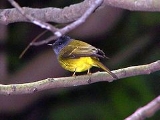
Stenostiridae

Encyclopedia
Stenostiridae, or the Fairy Flycatchers, is a family of small passerine
bird
s proposed as a result of recent discoveries in molecular systematics (Beresford et al. 2005). They are commonly referred to as stenostirid warblers.
This new clade
is named after the Fairy Warbler
, a distinct species placed formerly in the Old World flycatcher
s. This is united with the "sylvioid flycatchers": the genus Elminia (formerly placed in the Monarchinae
) and the closely allied former Old World flycatcher genus Culicicapa. (Beresford et al. 2005, Fuchs et al. 2006)
Its genera
and species
are:
Other African or Asian species might conceivably fall into this novel clade
. The tit-flycatchers (Myioparus
) are apparently true flycatchers morphologically
somewhat convergent
to Stenostira (Jønsson & Fjeldså 2006).
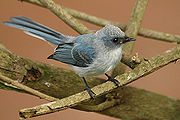 The Stenostiridae as a whole are related to penduline tits, titmice and chickadees. All these appear to be closer to the Sylvioidea
than to other Passerida
, but this is not robustly supported by the available data and they might constitute a distinct, more basal
superfamily
.(Alström et al. 2006, Beresford et al. 2005, Barker et al. 2004)
Passerine
A passerine is a bird of the order Passeriformes, which includes more than half of all bird species. Sometimes known as perching birds or, less accurately, as songbirds, the passerines form one of the most diverse terrestrial vertebrate orders: with over 5,000 identified species, it has roughly...
bird
Bird
Birds are feathered, winged, bipedal, endothermic , egg-laying, vertebrate animals. Around 10,000 living species and 188 families makes them the most speciose class of tetrapod vertebrates. They inhabit ecosystems across the globe, from the Arctic to the Antarctic. Extant birds range in size from...
s proposed as a result of recent discoveries in molecular systematics (Beresford et al. 2005). They are commonly referred to as stenostirid warblers.
This new clade
Clade
A clade is a group consisting of a species and all its descendants. In the terms of biological systematics, a clade is a single "branch" on the "tree of life". The idea that such a "natural group" of organisms should be grouped together and given a taxonomic name is central to biological...
is named after the Fairy Warbler
Fairy Warbler
The Fairy Warbler or Fairy Flycatcher is a small passerine bird. Formerly placed in the Old World flycatcher family, Muscicapidae, it is now separated with some other "odd flycatchers" as the new family Stenostiridae...
, a distinct species placed formerly in the Old World flycatcher
Old World flycatcher
The Old World flycatcher family Muscicapidae is a large family of small passerine birds mostly restricted to the Old World. These are mainly small arboreal insectivores, many of which, as the name implies, take their prey on the wing.-Characteristics:...
s. This is united with the "sylvioid flycatchers": the genus Elminia (formerly placed in the Monarchinae
Monarchinae
The Monarch Flycatchers comprise a family of passerine birds which includes boatbills, shrikebills, paradise-flycatchers, and magpie-larks....
) and the closely allied former Old World flycatcher genus Culicicapa. (Beresford et al. 2005, Fuchs et al. 2006)
Its genera
Genus
In biology, a genus is a low-level taxonomic rank used in the biological classification of living and fossil organisms, which is an example of definition by genus and differentia...
and species
Species
In biology, a species is one of the basic units of biological classification and a taxonomic rank. A species is often defined as a group of organisms capable of interbreeding and producing fertile offspring. While in many cases this definition is adequate, more precise or differing measures are...
are:
- Genus Stenostira – Fairy "Warbler" or Fairy "Flycatcher"
- Genus ElminiaElminiaElminia is a genus of bird in the flycatcher family Stenostiridae. The genus is endemic to Africa.It contains the following species:* White-tailed Blue-flycatcher * White-bellied Crested-flycatcher...
– includes Trochocercus- African Blue Flycatcher, Elminia longicauda
- White-tailed Blue Flycatcher, Elminia albicauda
- Dusky Crested-flycatcherDusky Crested-flycatcherThe Dusky Crested-flycatcher is a species of bird in the Stenostiridae family.It is found in Cameroon, Central African Republic, Republic of the Congo, Democratic Republic of the Congo, Ivory Coast, Equatorial Guinea, Gabon, Ghana, Guinea, Kenya, Liberia, Nigeria, Sierra Leone, Sudan, Tanzania,...
, Elminia nigromitrata - White-bellied Crested-flycatcherWhite-bellied Crested-flycatcherThe White-bellied Crested-flycatcher is a bird species in the family Stenostiridae; it was formerly plaed with the drongos in the Dicruridae....
, Elminia albiventris - White-tailed Crested-flycatcherWhite-tailed Crested-flycatcherThe White-tailed Crested-flycatcher is a species of bird in the flycatcher family Stenostiridae. It has a discontinuous distribution in eastern Africa. There are three subspecies, E. a. albonotata of central Kenya, and Uganda through to south west Tanzania; E. a. subvaerulea, which ranges from...
, Elminia albonotata
- Genus Culicicapa
- Grey-headed Canary-flycatcher, Culicicapa ceylonensis
- Citrine Canary-flycatcherCitrine Canary-flycatcherThe Citrine Canary-flycatcher is a species of bird in the Stenostiridae family. The term citrine refers to its yellowish colouration. It is found in Indonesia and the Philippines. Its natural habitat is subtropical or tropical moist montanes.-References:* BirdLife International 2004. . ...
, Culicicapa helianthea
Other African or Asian species might conceivably fall into this novel clade
Clade
A clade is a group consisting of a species and all its descendants. In the terms of biological systematics, a clade is a single "branch" on the "tree of life". The idea that such a "natural group" of organisms should be grouped together and given a taxonomic name is central to biological...
. The tit-flycatchers (Myioparus
Myioparus
Myioparus is a genus of bird in the Muscicapidae family.It contains the following species:* Grey-throated Tit-flycatcher * Grey Tit-flycatcher -References:...
) are apparently true flycatchers morphologically
Morphology (biology)
In biology, morphology is a branch of bioscience dealing with the study of the form and structure of organisms and their specific structural features....
somewhat convergent
Convergent evolution
Convergent evolution describes the acquisition of the same biological trait in unrelated lineages.The wing is a classic example of convergent evolution in action. Although their last common ancestor did not have wings, both birds and bats do, and are capable of powered flight. The wings are...
to Stenostira (Jønsson & Fjeldså 2006).
Sylvioidea
Sylvioidea is a superfamily of passerine birds. It is one of at least three major clades within the Passerida along with the Muscicapoidea and Passeroidea. It contains about 1300 species including the Old World warblers, Old World babblers, swallows, larks, bulbuls and perhaps the tits...
than to other Passerida
Passerida
Passerida is under the Sibley-Ahlquist taxonomy, one of two "parvorders" contained within the suborder Passeri...
, but this is not robustly supported by the available data and they might constitute a distinct, more basal
Basal (phylogenetics)
In phylogenetics, a basal clade is the earliest clade to branch in a larger clade; it appears at the base of a cladogram.A basal group forms an outgroup to the rest of the clade, such as in the following example:...
superfamily
Taxonomic rank
In biological classification, rank is the level in a taxonomic hierarchy. Examples of taxonomic ranks are species, genus, family, and class. Each rank subsumes under it a number of less general categories...
.(Alström et al. 2006, Beresford et al. 2005, Barker et al. 2004)