

Old China Trade

Encyclopedia
United States
The United States of America is a federal constitutional republic comprising fifty states and a federal district...
under the Canton System
Canton System
The Canton System served as a means for China to control trade with the west within its own country. Seen from the European view, it was a complement to the Old China Trade.-History:...
, spanning from shortly after the end of the American Revolutionary War
American Revolutionary War
The American Revolutionary War , the American War of Independence, or simply the Revolutionary War, began as a war between the Kingdom of Great Britain and thirteen British colonies in North America, and ended in a global war between several European great powers.The war was the result of the...
in 1783 to the Treaty of Wanghsia
Treaty of Wanghia
The Treaty of Wanghia , is a diplomatic agreement between the Qing Dynasty of China and the United States, signed on 3 July 1844 in the Kun Iam Temple...
in 1844. The Old China Trade represented the beginning of relations between the United States and East Asia, including eventually U.S.–China relations. The Maritime Fur Trade
Maritime Fur Trade
The Maritime Fur Trade was a ship-based fur trade system that focused on acquiring furs of sea otters and other animals from the indigenous peoples of the Pacific Northwest Coast and natives of Alaska. The furs were mostly sold in China in exchange for tea, silks, porcelain, and other Chinese...
was a major aspect of the Old China Trade.
Origins
Treaty of Paris (1783)
The Treaty of Paris, signed on September 3, 1783, ended the American Revolutionary War between Great Britain on the one hand and the United States of America and its allies on the other. The other combatant nations, France, Spain and the Dutch Republic had separate agreements; for details of...
in 1783 ceased Anglo-American hostilities after the American Revolutionary War
American Revolutionary War
The American Revolutionary War , the American War of Independence, or simply the Revolutionary War, began as a war between the Kingdom of Great Britain and thirteen British colonies in North America, and ended in a global war between several European great powers.The war was the result of the...
and subsequently freed American trade from British control. Unsurprisingly, American merchants exploited their newfound liberty, eagerly hunting all over the world for new ways to make a profit. Unfortunately for the Americans, the British, not wanting their former colonies to become a new rival in the already-existing Atlantic trade, had effectively closed their remaining Atlantic colonies, as well as those of other European nations, to American merchant vessels; British harassment or seizure of American ships trading with European Atlantic colonies was common. As a result, the American traders, now deprived of a trade that had been so essential to the American colonies before, were forced to search for ports that were less European-dominated. In their searches, they found the Chinese market.
Trade with China was by no means a new trend: since the voyage of Marco Polo
Marco Polo
Marco Polo was a Venetian merchant traveler from the Venetian Republic whose travels are recorded in Il Milione, a book which did much to introduce Europeans to Central Asia and China. He learned about trading whilst his father and uncle, Niccolò and Maffeo, travelled through Asia and apparently...
and the days of the Silk Road
Silk Road
The Silk Road or Silk Route refers to a historical network of interlinking trade routes across the Afro-Eurasian landmass that connected East, South, and Western Asia with the Mediterranean and European world, as well as parts of North and East Africa...
, the Chinese had established a tradition of trade with the West. Therefore, by the time the Empress of China
Empress of China (1783)
The Empress of China was a three-masted, square-rigged sailing ship, initially built in 1783 for service as a privateer. After the Treaty of Paris brought a formal end to the American Revolutionary War, the vessel was refitted for commercial purposes...
, the first American merchant ship to reach China, arrived in Canton in 1784, China was already engaging in an active trade with the British
United Kingdom
The United Kingdom of Great Britain and Northern IrelandIn the United Kingdom and Dependencies, other languages have been officially recognised as legitimate autochthonous languages under the European Charter for Regional or Minority Languages...
at Canton
Guangzhou
Guangzhou , known historically as Canton or Kwangchow, is the capital and largest city of the Guangdong province in the People's Republic of China. Located in southern China on the Pearl River, about north-northwest of Hong Kong, Guangzhou is a key national transportation hub and trading port...
and the Portuguese
Portugal
Portugal , officially the Portuguese Republic is a country situated in southwestern Europe on the Iberian Peninsula. Portugal is the westernmost country of Europe, and is bordered by the Atlantic Ocean to the West and South and by Spain to the North and East. The Atlantic archipelagos of the...
at Macau
Macau
Macau , also spelled Macao , is, along with Hong Kong, one of the two special administrative regions of the People's Republic of China...
. However, China, while having firm relations with Europe, was not dominated by it as the ports of the Caribbean
Caribbean
The Caribbean is a crescent-shaped group of islands more than 2,000 miles long separating the Gulf of Mexico and the Caribbean Sea, to the west and south, from the Atlantic Ocean, to the east and north...
and Atlantic were; therefore, it was an opportune destination for American merchants to establish a new trading route. For the most part, the Chinese allowed them to do so.
Upon realizing that America was its own sovereign nation, the Chinese were convinced that the Americans would not interfere with pre-existing Anglo-Chinese trade agreements since American businessmen arrived as private traders without representation from the American government. This relatively open yet somewhat indifferent attitude towards American traders allowed them to gain a grip on the Chinese market.
Growth
Mandarin (bureaucrat)
A mandarin was a bureaucrat in imperial China, and also in the monarchist days of Vietnam where the system of Imperial examinations and scholar-bureaucrats was adopted under Chinese influence.-History and use of the term:...
in China, in turn, were excited to buy these goods. The first item that tended to sell in China was Spanish bullion: American traders would devote large sums of money to buying and amassing large quantities of specie
Metal
A metal , is an element, compound, or alloy that is a good conductor of both electricity and heat. Metals are usually malleable and shiny, that is they reflect most of incident light...
for export to China. Bullion was primarily used to complement the less profitable American goods such as cheese
Cheese
Cheese is a generic term for a diverse group of milk-based food products. Cheese is produced throughout the world in wide-ranging flavors, textures, and forms....
, grain
GRAIN
GRAIN is a small international non-profit organisation that works to support small farmers and social movements in their struggles for community-controlled and biodiversity-based food systems. Our support takes the form of independent research and analysis, networking at local, regional and...
, and rum
Rum
Rum is a distilled alcoholic beverage made from sugarcane by-products such as molasses, or directly from sugarcane juice, by a process of fermentation and distillation. The distillate, a clear liquid, is then usually aged in oak barrels...
. Use of bullion eventually became considerable: over $62 million worth of specie was traded to China between 1805 and 1825. This practice, however, gradually declined after 1815, when American merchants began to participate in “chain trade” routes—buying and selling goods en route to Canton. The second major—and by far the most lucrative—American export to China was ginseng
Ginseng
Ginseng is any one of eleven species of slow-growing perennial plants with fleshy roots, belonging to the genus Panax of the family Araliaceae....
. Hailed by the Chinese as a panacea, the most potent and therefore most demanded type of ginseng, aralia quinquefolia, grew in Manchuria and the Appalachian Mountains. Ginseng would be transported from the interiors of Pennsylvania and Virginia to Philadelphia, New York, or Boston, at which point it would be shipped to China and sold for up to 250 times its weight in silver. Furs were the third-most lucrative American export to China. Searching for another type of item that could be sold to the Chinese aside from specie and ginseng, Americans soon found that the mandarins had a taste for sea otter
Sea Otter
The sea otter is a marine mammal native to the coasts of the northern and eastern North Pacific Ocean. Adult sea otters typically weigh between 14 and 45 kg , making them the heaviest members of the weasel family, but among the smallest marine mammals...
pelts, which could be inexpensively purchased from the Indians of the northwest coast of America and shipped to Canton. The Chinese mandarins’ desire for bullion, ginseng, and furs was the primary impetus for America’s initiation of trade with China: seeing the Empress of China, which had carried all three goods, returning to America rich in 1785 inspired other Americans to make similar voyages. Reasons for maintaining the China trade, however, were different.

British East India Company
The East India Company was an early English joint-stock company that was formed initially for pursuing trade with the East Indies, but that ended up trading mainly with the Indian subcontinent and China...
) no longer dominating American trade, the job of satisfying this want fell to the American merchants. Therefore, when the Empress returned home, she brought with her a large stock of outlandish Chinese goods, which her owners sold for a significant profit of $30,000—a 25% gain. Other American merchants did not take long in realizing that, while selling American specie, ginseng, and fur to the Chinese mandarins was undoubtedly profitable, selling Chinese goods in America was considerably more so. Further motivation came from the knowledge that China, as a whole, had a mercantilist-like attitude towards foreign commerce; they tended to resist the importation of foreign goods because of a mixture of the Confucian doctrine, which deprecated it, and the underlying ethnocentrism felt by the Chinese—that they did not need to actively search for trade because the inferior white barbarian states would instinctively bring it to them as a form of tribute. Because of these factors, American traders began to focus their funds on acquiring Chinese goods—a practice that the Chinese were more willing to adopt—rather than on purchasing those of America. What resulted was the flooding of Chinese tea
Tea
Tea is an aromatic beverage prepared by adding cured leaves of the Camellia sinensis plant to hot water. The term also refers to the plant itself. After water, tea is the most widely consumed beverage in the world...
s, cotton
Cotton
Cotton is a soft, fluffy staple fiber that grows in a boll, or protective capsule, around the seeds of cotton plants of the genus Gossypium. The fiber is almost pure cellulose. The botanical purpose of cotton fiber is to aid in seed dispersal....
s, silk
Silk
Silk is a natural protein fiber, some forms of which can be woven into textiles. The best-known type of silk is obtained from the cocoons of the larvae of the mulberry silkworm Bombyx mori reared in captivity...
s, rhubarb
Rhubarb
Rhubarb is a group of plants that belong to the genus Rheum in the family Polygonaceae. They are herbaceous perennial plants growing from short, thick rhizomes. They have large leaves that are somewhat triangular-shaped with long fleshy petioles...
, cassia, nankeen
Nankeen
Nankeen, also called Nankeen cloth, is a kind of pale yellowish cloth, originally made at Nanjing from a yellow variety of cotton, but subsequently manufactured from ordinary cotton which is then dyed...
s (durable, yellow cloth), floor-matting
Mat
A mat is a generic term for a piece of fabric or flat material, generally placed on a floor or other flat surface, and serving a range of purposes including:* providing a regular or flat surface, such as a mousepad....
, lacquerware
Lacquerware
Lacquerware are objects decoratively covered with lacquer. The lacquer is sometimes inlaid or carved. Lacquerware includes boxes, tableware, buttons and even coffins painted with lacquer in cultures mostly in the Eastern Hemisphere.-History:...
, fans
Fan (implement)
A hand-held fan is an implement used to induce an airflow for the purpose of cooling or refreshing oneself. Any broad, flat surface waved back-and-forth will create a small airflow and therefore can be considered a rudimentary fan...
, furniture
Furniture
Furniture is the mass noun for the movable objects intended to support various human activities such as seating and sleeping in beds, to hold objects at a convenient height for work using horizontal surfaces above the ground, or to store things...
, and porcelain
Porcelain
Porcelain is a ceramic material made by heating raw materials, generally including clay in the form of kaolin, in a kiln to temperatures between and...
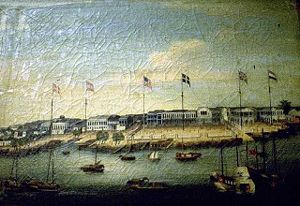
s, into America, to the extent that even those of poor social classes possessed some Chinese items—perhaps a painting of Canton harbor or a pair of trousers made out of nankeen cloth.
End
At the end of the First Opium WarFirst Opium War
The First Anglo-Chinese War , known popularly as the First Opium War or simply the Opium War, was fought between the United Kingdom and the Qing Dynasty of China over their conflicting viewpoints on diplomatic relations, trade, and the administration of justice...
in 1842, Britain and China signed the Treaty of Nanking
Treaty of Nanking
The Treaty of Nanking was signed on 29 August 1842 to mark the end of the First Opium War between the United Kingdom of Great Britain and Ireland and the Qing Dynasty of China...
, which effectively overthrew the original mercantilist system by means of forcing open the ports of Canton
Guangzhou
Guangzhou , known historically as Canton or Kwangchow, is the capital and largest city of the Guangdong province in the People's Republic of China. Located in southern China on the Pearl River, about north-northwest of Hong Kong, Guangzhou is a key national transportation hub and trading port...
, Amoy
Amoy
Xiamen, or Amoy, is a city on the southeast coast of China.Amoy may also refer to:*Amoy dialect, a dialect of the Hokkien lects, which are part of the Southern Min group of Chinese languages...
, Foochow, Ningpo, and Shanghai
Shanghai
Shanghai is the largest city by population in China and the largest city proper in the world. It is one of the four province-level municipalities in the People's Republic of China, with a total population of over 23 million as of 2010...
to British trading. Seeing that Britain could easily eliminate foreign competition in China with its new privileges and considerable trading prowess, Americans found the need to reestablish their diplomatic relations and commercial equality in China; for the past fifty-nine years, Americans had been interacting with China merely through their business transactions, without government-to-government communication. As a result, the administration of President John Tyler
John Tyler
John Tyler was the tenth President of the United States . A native of Virginia, Tyler served as a state legislator, governor, U.S. representative, and U.S. senator before being elected Vice President . He was the first to succeed to the office of President following the death of a predecessor...
sent the commissioner Caleb Cushing
Caleb Cushing
Caleb Cushing was an American diplomat who served as a U.S. Congressman from Massachusetts and Attorney General under President Franklin Pierce.-Early life:...
to negotiate a treaty in which America would receive the same privileges as Britain. Cushing, in the Treaty of Wanghsia
Treaty of Wanghia
The Treaty of Wanghia , is a diplomatic agreement between the Qing Dynasty of China and the United States, signed on 3 July 1844 in the Kun Iam Temple...
in 1844, not only achieved this goal but also won the right of extraterritoriality
Extraterritoriality
Extraterritoriality is the state of being exempt from the jurisdiction of local law, usually as the result of diplomatic negotiations. Extraterritoriality can also be applied to physical places, such as military bases of foreign countries, or offices of the United Nations...
, which meant that Americans accused of crimes in China were to be tried by American courts only. This treaty was monumental in that it laid the foundation for a more extensive and regulated American trade with China; American ships would no longer make the sporadic—and somewhat reckless—voyages to China so characteristic of the Old China trade.
Noted China Trade merchants
- William Henry AspinwallWilliam Henry AspinwallWilliam Henry Aspinwall was an American businessman.In 1832, he became president of the Howland & Aspinwall merchant firm, which had been founded by his cousin and expanded trade to South America, China, Europe, the Mediterranean, and the East and West Indies. Howland & Aspinwall owned some of the...
- George CabotGeorge CabotGeorge Cabot was an American merchant, seaman, and politician from Boston, Massachusetts. He represented Massachusetts in the U.S. Senate and as the Presiding Officer of the Hartford Convention.-Early life:...
- John Perkins CushingJohn Perkins CushingJohn Perkins Cushing , called "Ku-Shing" by the Chinese, was a wealthy Boston sea merchant, opium smuggler, and philanthropist...
- Elias Hasket DerbyElias Hasket DerbyElias Hasket Derby was among the wealthiest and most celebrated of post-Revolutionary merchants in Salem, Massachusetts, and owner of the Grand Turk, the first New England vessel to trade directly with China....
- Fanning & ColesFanning & ColesFanning & Coles engaged in the China trade from 1798 to 1815. The firm owned large sailing ships and acted as commission merchants importing $40,000 of Tea per year to New York from Canton, China. The firm also traded seal skins gathered from South America and the Pacific ocean while sailing to...
- John Murray ForbesJohn Murray ForbesJohn Murray Forbes was an American railroad magnate, merchant, philanthropist and abolitionist. He was president of both the Michigan Central railroad and the Chicago, Burlington and Quincy Railroad in the 1850s....
- Robert Bennet ForbesRobert Bennet ForbesCaptain Robert Bennet Forbes , was a sea captain, China merchant, ship owner, and writer. He was active in ship construction, maritime safety, the opium trade, and charitable activities.-Captain, opium trader and humanitarian:...
- Charles W. KingCharles W. KingCharles W. King was an American merchant in Canton, China, who is famous for having tried to open trade with Japan on the pretext of repatriating seven Japanese castaways, among them Otokichi, to their homeland in 1837 in the Morrison Incident....
- Gideon NyeGideon NyeGideon Nye was an American diplomat, art collector, and a merchant in the East India and China trade, known both for his art collection and for his writings on China....
- Joseph PeabodyJoseph PeabodyJoseph Peabody was a merchant and shipowner who dominated trade between Massachusetts and the Far East for a number of years.-Family and career:...
- Thomas Handasyd PerkinsThomas Handasyd PerkinsColonel Thomas Handasyd Perkins, or T. H. Perkins was a wealthy Boston merchant and an archetypical Boston Brahmin. Starting with bequests from his grandfather and father-in-law, he amassed a huge fortune...
- Russell Sturgis
- John Renshaw ThomsonJohn Renshaw ThomsonJohn Renshaw Thomson was an American merchant and politician from New Jersey.-Life:Born in Philadelphia, Pennsylvania, he attended the common schools in Princeton, New Jersey, and the College of New Jersey . In 1817, he went to China and became a merchant in Canton where he was United States...
- William Shepard WetmoreWilliam Shepard WetmoreWilliam Shepard Wetmore was an Old China Trade merchant and philanthropist from New England.-Early life:He was born on January 26, 1801 to Nancy Shepard and Seth Wetmore in St. Albans, Vermont...
- Abiel Abbot LowAbiel Abbot LowAbiel Abbot Low was an American entrepreneur, businessman, trader and philanthropist who gained most of his fortune from the China trade, importing teas, porcelains, and silk, and building and operating a fleet of reputable clipper ships.- Early life :Abiel Abbot Low was one of twelve children of...
See also
- Foreign relations of Imperial ChinaForeign relations of Imperial ChinaImperial China had a long tradition of foreign relations. From the Qin Dynasty until the Qing Dynasty, the Culture of China had an impact upon neighboring and distant countries, while gradually being transformed by outside influences as well....
- History of the west coast of North AmericaHistory of the west coast of North AmericaThe human history of the west coast of North America is believed to stretch back to the arrival of the earliest people over the Bering Strait, or alternately along a now-submerged coastal plain, through the development of significant pre-Columbian cultures and population densities, to the arrival...
- Paul Jones (1843 ship)Paul Jones (1843 ship)The Paul Jones was a Medford-built ship, launched in 1843, that brought the first cargo of ice to China.-Voyages:Paul Jones sailed from Boston on Jan. 15, 1843, on her maiden voyage, arriving in Hong Kong in 111 days, under captain N.B...
External links
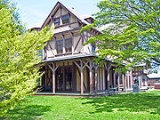
- Forbes House Museum (Milton Massachusetts) http://www.forbeshousemuseum.org/history/index.htm
- Peabody Essex Museum http://www.pem.org/