
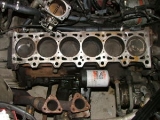
The
straight-six engine or
inline-six engine (often abbreviated
I6) is a six-cylinder
internal combustion engineThe internal combustion engine is an engine in which the combustion of a fuel occurs with an oxidizer in a combustion chamber. In an internal combustion engine, the expansion of the high-temperature and high -pressure gases produced by combustion apply direct force to some component of the engine...
with all six
cylindersA cylinder is the central working part of a reciprocating engine or pump, the space in which a piston travels. Multiple cylinders are commonly arranged side by side in a bank, or engine block, which is typically cast from aluminum or cast iron before receiving precision machine work...
mounted in a straight line along the
crankcaseIn an internal combustion engine of the reciprocating type, the crankcase is the housing for the crankshaft. The enclosure forms the largest cavity in the engine and is located below the cylinder, which in a multicylinder engine are usually integrated into one or several cylinder blocks...
. The single bank of cylinders may be oriented in either a vertical or an inclined plane with all the
pistonA piston is a component of reciprocating engines, reciprocating pumps, gas compressors and pneumatic cylinders, among other similar mechanisms. It is the moving component that is contained by a cylinder and is made gas-tight by piston rings. In an engine, its purpose is to transfer force from...
s driving a common
crankshaftThe crankshaft, sometimes casually abbreviated to crank, is the part of an engine which translates reciprocating linear piston motion into rotation...
; in vehicles where this engine is installed inclined versus vertical, it is sometimes called a
slant-six engine. The straight-six layout is the simplest engine layout that possesses both primary and secondary mechanical
engine balanceEngine balance is the design, construction and tuning of an engine to run smoothly. Improving engine balance reduces vibration and other stresses and can improve the overall performance, efficiency, cost of ownership and reliability of the engine, as well as reducing the stress on other machinery...
, resulting in relatively low manufacturing cost combined with much less vibration than engines with fewer cylinders.
Displacement range
Usually, the straight-six design is used for
engine displacementEngine displacement is the volume swept by all the pistons inside the cylinders of an internal combustion engine in a single movement from top dead centre to bottom dead centre . It is commonly specified in cubic centimeters , litres , or cubic inches...
s ranging from approximately 2 to 5 l (122 to 304.9 cuin) in
automobileAn automobile, autocar, motor car or car is a wheeled motor vehicle used for transporting passengers, which also carries its own engine or motor...
s. It is also sometimes used for smaller engines but these, although very smooth running, tend to be rather expensive to manufacture in terms of power-to-cost ratio. Since the length of an engine is roughly proportionate to the number of cylinders in one bank (plus the width of one connecting rod in a
"V" engineA V engine, or Vee engine is a common configuration for an internal combustion engine. The cylinders and pistons are aligned, in two separate planes or 'banks', so that they appear to be in a "V" when viewed along the axis of the crankshaft...
), they are inevitably physically longer than alternative layouts such as L4, V6, or V8.
The smallest production straight-six was found in the
Benelli 750 SeiThe Benelli 750 Sei is a motorcycle that was produced by Italian manufacturer Benelli from 1972 to 1978. It was the first production motorcycle with a 6-cylinder engine. The engine was based on the four-cylinder Honda CB500, but with two extra cylinders...
motorcycle, displacing 747.7 cc (0.7477 L). Honda and Mike Hailwood raced in the 1960s with the RC166 250 cc (0.25 L) six-cylinder, 24-valve
motorcycleA motorcycle is a single-track, two-wheeled motor vehicle. Motorcycles vary considerably depending on the task for which they are designed, such as long distance travel, navigating congested urban traffic, cruising, sport and racing, or off-road conditions.Motorcycles are one of the most...
engine. Though pre-
World War IIWorld War II, or the Second World War , was a global conflict lasting from 1939 to 1945, involving most of the world's nations—including all of the great powers—eventually forming two opposing military alliances: the Allies and the Axis...
engines could be quite large by modern standards — such as the Rolls Royce Silver Ghost's 7.4 L engine and the 824 cuin (13.5 L) of the 1910s
PeerlessPeerless was a United States automobile produced by the Peerless Motor Company of Cleveland, Ohio from 1900 to 1931. The company was known for building high-quality, precision luxury automobiles. Peerless' factory was located at 9400 Quincy Avenue in Cleveland...
,
PiercePierce-Arrow was an American automobile manufacturer based in Buffalo, New York, which was active from 1901-1938. Although best known for its expensive luxury cars, Pierce-Arrow also manufactured commercial trucks, fire trucks, camp trailers, motorcycles, and bicycles.-Early history:The forerunner...
, and
FageolFageol Motors was a U.S. manufacturer of buses, trucks and farm tractors.-History:The company was founded in 1916 to manufacture motor trucks, farm tractors and automobiles in Oakland, California....
, the largest modern passenger-car straight-sixes are the 4.2 L powerplants found in several
JaguarsJaguar Cars Ltd, known simply as Jaguar , is a British luxury car manufacturer, headquartered in Whitley, Coventry, England. It is part of the Jaguar Land Rover business, a subsidiary of the Indian company Tata Motors....
and
AMCsAmerican Motors Corporation was an American automobile company formed by the 1954 merger of Nash-Kelvinator Corporation and Hudson Motor Car Company. At the time, it was the largest corporate merger in U.S. history.George W...
, the 4.3 L Hemi Six, the 4.0 TVR Speed Six, the 4.0 Ford Barra, the 4.1 Chevrolet 250, the 4.2 Chevrolet Vortec 4200, 4.2 L
Toyota Land CruiserThe is a series of four-wheel drive vehicles produced by the Japanese car maker Toyota Motor Corporation. It is not related to the Studebaker Land Cruiser car produced in the US from 1934-1954....
(Diesel), 4.9 Ford, 4.5 and 4.8 Nissan, 4.8 Chevrolet, and the 5.0L of
HudsonThe Hudson Motor Car Company made Hudson and other brand automobiles in Detroit, Michigan, from 1909 to 1954. In 1954, Hudson merged with Nash-Kelvinator Corporation to form American Motors. The Hudson name was continued through the 1957 model year, after which it was dropped.- Company strategy...
H-145 (produced until 1957). As of 2009, the
Cummins B Series engineThe Cummins B Series is a family of straight-four and straight-6 diesel truck and industrial piston engines manufactured by Cummins. The B Series is known for displacing "one liter per cylinder" because of the popular straight-four and straight-six. A straight-four is also available...
used in
Dodge RamThe Dodge Ram is a full-size pickup truck manufactured by the Chrysler Group LLC. As of late 2010, it has been sold under the Ram Trucks brand. Previously, Ram was part of the Dodge lineup of light trucks...
pickup trucks displaced up to 6.7 L
The
Gipsy Six|-See also:-Bibliography:* Gunston, Bill. World Encyclopedia of Aero Engines. Wellingborough, UK: Patrick Stephens, 1986, p. 50. ISBN 0-75094-479-X.* Jane's Fighting Aircraft of World War II. London. Studio Editions Ltd, 1989. ISBN 0-517-67964-7...
and
Gipsy Queen|-Survivors:Of the 11 Gipsy Queen-powered de Havilland Doves on the British register, only two remain airworthy .-Engines on display:Preserved de Havilland Gipsy Queen engines are on public display at the following museums:*de Havilland Aircraft Heritage Centre...
, made by the
de Havilland Engine CompanyThe de Havilland Engine Company was an offshoot of the de Havilland aircraft building company, which started life as the 'Engine Division of the de Havilland Aircraft Company' in 1926 producing the famous de Havilland Gipsy aero-engine...
from 1935 until 1950, were inverted straight-six engines displacing 560.6 cubic inches (9.2 l). They were used in a variety of aircraft including the
de Havilland Dragon RapideThe de Havilland DH.89 Dragon Rapide was a British short-haul passenger airliner of the 1930s.-Design and development:Designed by the de Havilland company in late 1933 as a faster and more comfortable successor to the DH.84 Dragon, it was in effect a twin-engined, scaled-down version of the...
and the
Cierva W.9-References:-External links:*...
experimental helicopter.
Because it is a fully balanced configuration, the straight-six can be scaled up to very large sizes for heavy truck, industrial and
marineA marine engine is an engine that propels a ship or boat. Types of marine engine include:*Marine steam engine*Petrol engine or gasoline engine*Diesel engine*Steam turbine*Gas turbine-See also:*Marine propulsion*Engine room*Marine automobile engine...
use, such as the 16 l (975.6 cu in) Volvo diesel engine and the 15 L
CumminsCummins Inc. is a Fortune 500 corporation that designs, manufactures, distributes and services engines and related technologies, including fuel systems, controls, air handling, filtration, emission control and electrical power generation systems...
ISX used in heavy vehicles. The largest are used to power
shipSince the end of the age of sail a ship has been any large buoyant marine vessel. Ships are generally distinguished from boats based on size and cargo or passenger capacity. Ships are used on lakes, seas, and rivers for a variety of activities, such as the transport of people or goods, fishing,...
s, and use
fuel oilFuel oil is a fraction obtained from petroleum distillation, either as a distillate or a residue. Broadly speaking, fuel oil is any liquid petroleum product that is burned in a furnace or boiler for the generation of heat or used in an engine for the generation of power, except oils having a flash...
. The straight-six can also be viewed as a scalable modular component of larger motors which stack several straight-sixes together, e.g. flat- or V-12s, W-18s etc.
Modern trends
Historically, straight-six engines were introduced much earlier than
V6 engineA V6 engine is a V engine with six cylinders mounted on the crankcase in two banks of three cylinders, usually set at either a right angle or an acute angle to each other, with all six pistons driving a common crankshaft...
s. While the first straight-six was manufactured in 1903 by
SpykerSpyker was a Dutch car manufacturer, started in 1880 by coachbuilders Jacobus and Hendrik-Jan Spijker, but to be able to market the brand better in foreign countries, in 1903 the 'ij' was changed into 'y'...
, it was 1950 before a production V6 was introduced. V6s (unlike
crossplaneThe crossplane or cross-plane is a crankshaft design for V8 engines with a 90° angle between the cylinder banks.The crossplane crankshaft has four crankpins, each offset at 90° from the adjacent crankpins...
V8 engineA V8 engine is a V engine with eight cylinders mounted on the crankcase in two banks of four cylinders, in most cases set at a right angle to each other but sometimes at a narrower angle, with all eight pistons driving a common crankshaft....
s) had intrinsic vibration problems that were difficult to eliminate without modern computer aided design techniques. The length of the straight-six was not a major concern in the older front-engine/rear-wheel drive vehicles, but the modern move to the more space-efficient front-engine/front-wheel drive and
transverse engineA transverse engine is an engine mounted in a vehicle so that the engine's crankshaft axis is perpendicular to the long axis of the vehicle. Many modern front wheel drive vehicles use this engine mounting configuration...
(left-to-right versus front-to-back) configurations in smaller cars made the length of the V6 (one half the length of an L6 with the same bore size, plus the width of one rod) a major advantage. As a result, in recent decades automobile manufacturers have replaced most of their straight-six engines (and many of their V8s) with V6 engines;
Mercedes-BenzMercedes-Benz is a German manufacturer of automobiles, buses, coaches, and trucks. Mercedes-Benz is a division of its parent company, Daimler AG...
now uses V6 engines despite most of their lineup retaining the front-engine/rear-wheel layout.
Exceptions to the shift to V6 engines include
BMWBayerische Motoren Werke AG is a German automobile, motorcycle and engine manufacturing company founded in 1916. It also owns and produces the Mini marque, and is the parent company of Rolls-Royce Motor Cars. BMW produces motorcycles under BMW Motorrad and Husqvarna brands...
, which specializes in high-performance straight-sixes used in a lineup of front-engine/rear-wheel drive vehicles,
VolvoAB Volvo is a Swedish builder of commercial vehicles, including trucks, buses and construction equipment. Volvo also supplies marine and industrial drive systems, aerospace components and financial services...
, which designed a compact straight-six engine/transmission package to fit transversely in its larger cars, and the Australian
Ford FalconThe Ford Falcon is a full-size car which has been manufactured by Ford Australia since 1960. Each model from the XA series of 1972 onward has been designed, developed and built in Australia and/or New Zealand, following the phasing out of the American Falcon of 1960–71 which had been re-engineered...
, which still uses a straight-six configuration. Straight-sixes also continue to be commonly used in medium to large trucks, and
sport utility vehicleA sport utility vehicle is a generic marketing term for a vehicle similar to a station wagon, but built on a light-truck chassis. It is usually equipped with four-wheel drive for on- or off-road ability, and with some pretension or ability to be used as an off-road vehicle. Not all four-wheel...
s, where engine length is less of a concern. In 2002,
General MotorsGeneral Motors Company , commonly known as GM, formerly incorporated as General Motors Corporation, is an American multinational automotive corporation headquartered in Detroit, Michigan and the world's second-largest automaker in 2010...
introduced the Vortec 4200 as part of the modular straight-four, straight-five and straight-six
GM Atlas engineAtlas is a name for a family of modern inline piston engines for trucks from General Motors. The series debuted in 2002 with the Oldsmobile Bravada, and is also used in the Chevrolet TrailBlazer and Colorado and their GMC twins, the Envoy and Canyon...
line.
Balance and smoothness
An inline six engine is in perfect primary and secondary mechanical
balanceEngine balance is the design, construction and tuning of an engine to run smoothly. Improving engine balance reduces vibration and other stresses and can improve the overall performance, efficiency, cost of ownership and reliability of the engine, as well as reducing the stress on other machinery...
, without the use of a
balance shaftIn piston engine engineering, a balance shaft is an eccentric weighted shaft which offsets vibrations in engine designs that are not inherently balanced...
. The engine is in primary balance because the front and rear trio of cylinders are mirror images, and the
pistonA piston is a component of reciprocating engines, reciprocating pumps, gas compressors and pneumatic cylinders, among other similar mechanisms. It is the moving component that is contained by a cylinder and is made gas-tight by piston rings. In an engine, its purpose is to transfer force from...
s move in pairs. That is, piston #1 balances #6, #2 balances #5, and #3 balances #4, largely eliminating the polar rocking motion that would otherwise result. Secondary imbalance is avoided because an inline six-cylinder crankshaft has six crank throws arranged in three planes offset at 120°. The result is that differences in piston speed at any given point in rotation are effectively canceled.
An inline four cylinder or V6 engine without a balance shaft will experience secondary dynamic imbalance, resulting in engine vibration. As a general rule, the forces arising from any dynamic imbalance increase as the square of the engine speed — that is, if the speed doubles, vibration will increase by a factor of four. In contrast, inline six engines have no primary or secondary imbalances, and with carefully designed crankshaft vibration dampers to absorb
torsional vibrationTorsional vibration is angular vibration of an object—commonly a shaft along its axis of rotation. Torsional vibration is often a concern in power transmission systems using rotating shafts or couplings where it can cause failures if not controlled....
, will run more smoothly at the same crankshaft speed (rpm). This characteristic has made the inline six popular in some European sports-luxury cars, where smooth high-speed performance and good fuel economy are desirable. As engine reciprocating forces increase with the cube of piston mass, inline six is a preferred configuration for large truck engines.
Crankshaft design
CrankshaftThe crankshaft, sometimes casually abbreviated to crank, is the part of an engine which translates reciprocating linear piston motion into rotation...
s on six-cylinder engines generally have either four or seven
main bearingIn a piston engine, the main bearings are the bearings on which the crankshaft rotates, usually plain or journal bearings.All engines have a minimum of two main bearings, one at each end of the crankshaft, and they may have as many as one more than the number of crank pins...
s. Larger engines and diesels tend to use the latter because of high loadings and to avoid crankshaft flex. Because of the six-cylinder engine's smooth characteristic, there is a tendency for a driver to load the engine at low engine speeds. This can produce crankshaft flex in four main bearing designs where the crank spans the distance of two cylinders between main bearings. This distance is longer than the distance between two adjacent main bearings on a V6 with four mains, because the V6 has cylinder bores on opposite banks which overlap significantly; the overlap may be as high as 100%, minus the width of one connecting rod (1.00" or so). In addition, modern high-compression engines subject the crankshaft to greater bending loads from higher peak gas pressures, requiring the crankthrows to have greater support from adjacent bearings, so it is now customary to design straight-sixes with seven main bearings.
Many of the more sporty high-performance engines use the four bearing design because of better torsional stiffness (e.g., BMW small straight 6's, Ford's Zephyr 6). The accumulated length of main bearing journals gives a relatively torsionally flexible crankshaft. The four main bearing design has only six crank throws and four main journals, so is much stiffer in the torsional domain. At high engine speeds, the lack of torsional stiffness can make the seven main bearing design susceptible to torsional flex and potential breakage. Note that a
V12 engineA V12 engine is a V engine with 12 cylinders mounted on the crankcase in two banks of six cylinders, usually but not always at a 60° angle to each other, with all 12 pistons driving a common crankshaft....
can be made with the same number of crank throws as the seven main bearing straight-six, although each throw must be wide enough to accept the connecting rods of both opposing cylinders requiring either that each rod be far narrower, or that the crankshaft length be extended. Another factor affecting large straight-six engines is the front-mounted timing chain which connects any
camshaftA camshaft is a shaft to which a cam is fastened or of which a cam forms an integral part.-History:An early cam was built into Hellenistic water-driven automata from the 3rd century BC. The camshaft was later described in Iraq by Al-Jazari in 1206. He employed it as part of his automata,...
s to the crankshaft. The camshafts are also quite long and subject to torsional flex as they in turn operate valves alternately near the front of the engine and near the rear. At high engine speeds, camshafts can flex torsionally in addition to the crankshaft, contributing to valve timing for the rear most cylinders becoming inaccurate and erratic, losing power, and in extreme cases resulting in mechanical interference between valve and piston — with catastrophic results. Some designers have experimented with installing the timing chain/gears in the middle of the engine (between cylinders 3 and 4) or adding a second timing chain at the rear of the engine. Either method can solve the problem at the cost of additional complexity.
Another factor affecting the ability of the large six-cylinder engines to achieve high speed is the simple geometric reality of a relatively long stroke (undersquare) design. A straight-six is a long engine, and the designer is usually encouraged to make it as short as possible, while height is not usually a problem. Hence, the tendency to use a longer stroke and smaller bore than in a
V engineA V engine, or Vee engine is a common configuration for an internal combustion engine. The cylinders and pistons are aligned, in two separate planes or 'banks', so that they appear to be in a "V" when viewed along the axis of the crankshaft...
to achieve a given capacity. By contrast, a long-stroke V engine tends to become too wide, which encourages increasing the bore rather than the stroke to increase displacement. The typically longer stroke of the straight-six increases crank throw and piston speed, and so tends to reduce the rpm rating of the engine.
History
The first inline six was produced by Spyker in 1903. By 1909, there were some eighty manufacturers using it, 62 in Britain alone, including
DarracqAutomobiles Darracq S.A. was a French motor vehicle manufacturing company founded in 1896 by Alexandre Darracq.Using part of the substantial profit he had made from selling his Gladiator bicycle factory, Alexandre Darracq began operating from a plant in the Parisian suburb of Suresnes...
, Delaunay-Bellville, Vertex,
MMCMMC may stand for:In business:*Mail.com Media Corp., a US digital media company*Marsh & McLennan Companies, a US-based global professional services firm*Material Móvil y Construcciones...
,
White and PoppeWhite and Poppe was a Coventry based proprietary engine and gearbox manufacturer established in 1899 by Alfred James White and Peter August Poppe. White was a watchmaker and Poppe an engineer and together they produced precision parts for the automotive industry...
, Mutel, and Ford.
Continental Europe
After becoming famous in the last year of
World War IWorld War I , which was predominantly called the World War or the Great War from its occurrence until 1939, and the First World War or World War I thereafter, was a major war centred in Europe that began on 28 July 1914 and lasted until 11 November 1918...
through their production of the liquid-cooled
BMW IIIa aviation engine of straight-six layout,
BMWBayerische Motoren Werke AG is a German automobile, motorcycle and engine manufacturing company founded in 1916. It also owns and produces the Mini marque, and is the parent company of Rolls-Royce Motor Cars. BMW produces motorcycles under BMW Motorrad and Husqvarna brands...
introduced its first straight 6-cylinder automotive engine in 1933. It developed straight-six engines for the post-
World War IIWorld War II, or the Second World War , was a global conflict lasting from 1939 to 1945, involving most of the world's nations—including all of the great powers—eventually forming two opposing military alliances: the Allies and the Axis...
era by adding two cylinders to its
M10The BMW M10/M12 was a straight-4 piston engine produced from 1961 to 1987. Displacement ranged from 1499 cc to 1990 cc.The engine was designed by noted engineer and race driver Baron Alex von Falkenhausen. He was asked to design a small-displacement engine, but felt that this would be...
four-cylinder design. In 1968, it introduced a
M30The BMW M30 is an inline-6 cylinder engine built by BMW and was used in many different models since 1968. It was originally developed in the late 1960s as an extended 2.5-liter version of the robust inline four-cylinder BMW M10 first used in the 'Neue Klasse' BMW 1500, with which it shares a...
straight-six design with the same 30° slant,
overhead camshaftOverhead cam valvetrain configurations place the engine camshaft within the cylinder heads, above the combustion chambers, and drive the valves or lifters in a more direct manner compared to overhead valves and pushrods...
layout, and 100 mm bore spacing as the four. It originally intended to follow up with a V8 engine line in the early 1970s, but when the
1973 oil crisisThe 1973 oil crisis started in October 1973, when the members of Organization of Arab Petroleum Exporting Countries or the OAPEC proclaimed an oil embargo. This was "in response to the U.S. decision to re-supply the Israeli military" during the Yom Kippur war. It lasted until March 1974. With the...
hit, BMW canceled its V8 plans and concentrated on refining and enlarging its straight-six lineup. These included a smaller straight-six in 2 and 2.3 l (122 and 140.2 cuin) displacements (the
BMW M20The M20 is an inline-6 piston engine by BMW.Initially designated M60, the 12-valve, belt driven SOHC design was introduced in the 1977 BMW 520/6 and 320/6 as an entirely new design. With displacements ranging from 2.0 to 2.7 liters, it was the "little brother" to the larger BMW M30 engine. It had ...
), versions of the larger
BMW M30The BMW M30 is an inline-6 cylinder engine built by BMW and was used in many different models since 1968. It was originally developed in the late 1960s as an extended 2.5-liter version of the robust inline four-cylinder BMW M10 first used in the 'Neue Klasse' BMW 1500, with which it shares a...
up to 3.8 l (231.7 cu in) (the
S38B38The BMW M88/3 is an in line 6 cylinder piston engine. It was based on the M88/1 that was used in the BMW M1's street version, with double overhead cam and four valves per cylinder. The M88/1 was in turn based on the M49 engine which was used in the BMW 3.0CSi...
); and beginning in 1983, a series of
M21The BMW M21 was a 2.4 L diesel straight-6 engine.It was introduced in 1983 with the BMW M20 design as its basis. It was available with a turbocharger....
straight-six
diesel engineA diesel engine is an internal combustion engine that uses the heat of compression to initiate ignition to burn the fuel, which is injected into the combustion chamber...
s. In 1986, BMW introduced the
M70The BMW M70 is a V12 piston engine and featured heavily in the 7-Series and 8-Series BMWs of the late 80s and early 1990s. Models included:*1988–1994 BMW 750i*1988–1994 BMW 750iL*1991–1993 BMW 850i*1993–1995 BMW 850Ci*1994–1996 BMW 850Csi...
V12 which was essentially two 2.5 l (152.4 cu in) straight-sixes on the same crankshaft. In the mid-90's, they produced a series of straight-6's based on the M50 architecture, the ultimate of which was the 330-360 hp S54, used up to 2008. BMW offered a straight-six for their following line up
BMW 1 SeriesThe BMW 1 Series is an entry level sports car produced by the German automaker BMW since 2004. The 1 Series is unusual in its class as it features rear-wheel drive, 50:50 weight balance, a longitudinally-mounted engine and an advanced aluminum multilink suspension...
,
BMW 3 SeriesThe BMW 3 Series is a compact executive car manufactured by the German automaker BMW since May 1975. Successor to the BMW New Class, it has been produced in five different generations and in no less than five different body styles. It is BMW's best-selling model, accounting for around 30% of the...
,
BMW 5 SeriesThe BMW 5 Series is a mid-size / executive car manufactured by BMW since 1972. The car, now in its sixth generation, is sold in sedan and touring body styles....
,
BMW 6 SeriesBMW 6 Series refers to several generations of executive coupés produced by BMW.The first was the E24, being derived from the E12 & E28 5 Series 4-door sedans. The E24 launched in 1976 to replace the 3.0CS & 3.0CSi . 14 years later, in 2003, BMW released the all new E63/E64 which was available as a...
,
BMW 7 SeriesThe BMW 7 Series is a line of full-size luxury vehicles produced by the German automaker BMW. Introduced in 1977, it is BMW's flagship car and is only available as a sedan or extended-length limousine...
(Euro models), BMW X3, BMW X5, BMW X6, the retired Z3 and current BMW Z4.
Mercedes-BenzMercedes-Benz is a German manufacturer of automobiles, buses, coaches, and trucks. Mercedes-Benz is a division of its parent company, Daimler AG...
has used straight-six engines in its cars for around 100 years, starting in the first decade of the 20th century with a monstrous 10 l (609.8 cu in) engine producing 75 hp, and producing in parallel through the
World War IWorld War I , which was predominantly called the World War or the Great War from its occurrence until 1939, and the First World War or World War I thereafter, was a major war centred in Europe that began on 28 July 1914 and lasted until 11 November 1918...
years the majority of German aviation engines of straight-six layout, culminating in the
Mercedes D.IIIThe Mercedes D.III, or F1466 as it was known internally, was a six-cylinder, liquid cooled inline aircraft engine built by Daimler and used on a wide variety of German aircraft during World War I. The initial versions were introduced in 1914 at 160 hp, but a series of changes improved this to...
engine series of 1916-18 for the
LuftstreitkräfteThe Deutsche Luftstreitkräfte , known before October 1916 as Die Fliegertruppen des deutschen Kaiserreiches , or simply Die Fliegertruppen, was the air arm of the Imperial German Army during World War I...
. Before and after the merger of
DaimlerDaimler-Motoren-Gesellschaft was a German engine and later automobile manufacturer, in operation from 1890 until 1926. Founded by Gottlieb Daimler and Wilhelm Maybach, it was based first in Cannstatt...
and Benz in 1926, the combined company produced a variety of powerful straight-six engines, culminating in a 7 l (426.8 cu in) supercharged unit producing up to 300 hp. Mercedes-Benz began the post-war era by producing straight-fours, but resumed making straight-sixes in 1951 with the
M130The Mercedes Benz M130 Engine was the last and largest of the ‘mid-sized’ Single Over Head Camshaft straight-6 cylinder engines produced by Mercedes Benz. The ‘mid-sized six’ started life as the 2.2 litre M180 which was unveiled at the Frankfurt Motor show in September 1951 alongside the new...
, which were the beginning of the modern era of MB straight-sixes. Following that introduction, the company produced two lines of petrol (gasoline) straight-sixes at any one time, a small six and a larger six, in addition to its straight-fours, straight-fives, and later V8s and V12s. Although the company has used
diesel engineA diesel engine is an internal combustion engine that uses the heat of compression to initiate ignition to burn the fuel, which is injected into the combustion chamber...
s in its cars since 1934, it introduced its first straight-six
OM603The OM603 engine was a straight-6 Diesel automobile engine from Mercedes-Benz used from 1984 through 1999. The 603 saw limited use in the W124, W126 and W140 model vehicles....
a 3 l (182.9 cu in) diesel in 1985. In 1996, the company replaced its petrol straight-sixes with a series of 90°
M112The Mercedes-Benz M112 engine is a V6 automobile piston engine family used in the 2000s. Introduced in 1998, it was the first V6 engine ever built by Mercedes...
V6s, although it continued to produce diesel straight-sixes.
VolvoAB Volvo is a Swedish builder of commercial vehicles, including trucks, buses and construction equipment. Volvo also supplies marine and industrial drive systems, aerospace components and financial services...
produced straight-sixes, the
Volvo B30 engineThis B30 was a straight-6 automobile engine produced by Volvo Cars starting in 1969, and used in the company's 164 sedan from 1969 through 1975. It was also used in the Volvo C303 military vehicle. Other uses included marine, industrial and agricultural applications. It was a robust pushrod engine...
(1969–1975), also the B6304 and the B6254 engines during late 1990s. As Volvo developed
front-wheel driveFront-wheel drive is a form of engine/transmission layout used in motor vehicles, where the engine drives the front wheels only. Most modern front-wheel drive vehicles feature a transverse engine, rather than the conventional longitudinal engine arrangement generally found in rear-wheel drive and...
models, they mounted their inline-six engine
transverselyA transverse engine is an engine mounted in a vehicle so that the engine's crankshaft axis is perpendicular to the long axis of the vehicle. Many modern front wheel drive vehicles use this engine mounting configuration...
by using a short
transaxleIn the automotive field, a transaxle is a major mechanical component that combines the functionality of the transmission, the differential, and associated components of the driven axle into one integrated assembly....
package, and relocated engine-driven accessories. The 3.2 l (195.1 cu in) straight-six introduced in 2006 was only slightly longer than its straight-five, achieved by moving the camshaft drive to the back of the engine and sharing the same gear train with ancillaries mounted in otherwise unused space over top of the transmission. It was short for a straight-six and also very narrow. Volvo claims a transversely mounted inline engine leaves more crush space to protect against frontal impacts than a (shorter) transverse V6 or a longitudinally mounted inline-six.
OpelAdam Opel AG, generally shortened to Opel, is a German automobile company founded by Adam Opel in 1862. Opel has been building automobiles since 1899, and became an Aktiengesellschaft in 1929...
has also used a straight-six engine since 1930s until the early 1990s, ranging between 2.5 and 4 l (152.4 and 243.9 cuin). They powered Opel's top of the line models, including the
AdmiralThe Opel Admiral was a luxury car made by the German car manufacturer Opel from 1937 to 1939 and again from 1964 to 1977.-Admiral :...
,
KapitänThe Kapitän was the last new Opel model to appear before the outbreak of the Second World War, developed during 1938 and launched in the spring of 1939 at the Geneva motor show. The first Kapitän was available in many different body styles, the most popular one being the 4-door saloon. 2-door...
, Monza,
SenatorThe Opel Senator was a large automobile, two generations of which were sold in Europe by Opel, from 1978 until 1993. A saloon, its first incarnation was also available with a fastback coupé body as the Opel Monza and Vauxhall Royale Coupe....
,
OmegaThe Opel Omega was an executive car marketed by the German automaker Opel between 1986 and 2003 in two generations, both manufactured at Opel's Rüsselsheim, Germany plant. The first generation, the Omega A , superseded the Opel Rekord, was voted European Car of the Year for 1987, and was available...
, and
CommodoreThe Opel Commodore is an executive car produced by Opel. It is the six-cylinder variant of the Rekord with styling differences. The Commodore nameplate was used by Opel from 1967 to 1982. However, its lineage continues with the Australian Holden Commodore...
.
In 1959,
SaabSaab Automobile AB, better known as Saab , is a Swedish car manufacturer owned by Dutch automobile manufacturer Swedish Automobile NV, formerly Spyker Cars NV. It is the exclusive automobile Royal Warrant holder as appointed by the King of Sweden...
had an experimental car with two transverse straight-three engines bolted together—the
Saab Monsterthumb|250px|Saab 'Monster'The Saab Monster was an experimental car made by Saab in 1959. This project was part of Saab's work in motorsport and the need to derive more power from their two-stroke powerplant. It consisted of a 'Toreador Red' Saab 93 with all excess weight removed, including the...
.
Alfa RomeoAlfa Romeo Automobiles S.p.A. is an Italian manufacturer of cars. Founded as A.L.F.A. on June 24, 1910, in Milan, the company has been involved in car racing since 1911, and has a reputation for building expensive sports cars...
used straight-six engine in
G1 and G2The Alfa Romeo G1 was the first all-new design from Alfa Romeo after the end of the A.L.F.A. brand. Giuseppe Merosi, while into a legal action against Nicola Romeo about the takeover conditions, designed at home the drawings for both the update of the prewar 24HP into the revised 20/30ES and the...
models (1921–1923),
RLThe Alfa Romeo RL was produced between 1922-1927. It was Alfa's first sport model after World War I. The car was designed in 1921 by Giuseppe Merosi. It had a straight-6 engine with overhead valves...
model (1922–1927) and between 1925 and 1954 in
Alfa Romeo 6CThe Alfa Romeo 6C name was used on road, race and sports cars made between 1925–1954 by Alfa Romeo. 6C refers to a straight 6 engine. Bodies for these cars were made by coachbuilders such as James Young, Zagato, Touring, Castagna, and Pininfarina...
series road and racing cars, the 1500 version had one of the smallest straight-six engines (1487 cc). The last Alfa Romeo model using straight-six was
Alfa Romeo 2600The Alfa Romeo 2600 was Alfa Romeo´s six-cylinder flagship produced from 1961 to 1968. It was the successor to the Alfa Romeo 2000. It has become historically significant as the last Alfa Romeo to have been fitted with an inline six-cylinder engine having twin overhead camshafts...
(1961–1969). Despite next Alfa Romeo models being rear wheel drive vehicles Alfa switched to V6 engine, partly due to the experience gained with the six-cylinder in-line engine, causing the crankshaft torsional problems that limited the performance potential of the engine, suggested studying a unit with cylinders arranged in V developing a more compact and easily installed in an engine compartment without having to resort to long overhangs front of the car, with the same length, it would be translated as a reduction of passenger car's longitudinal axis.
United Kingdom
The straight-six was the archetypal
BritishThe United Kingdom of Great Britain and Northern IrelandIn the United Kingdom and Dependencies, other languages have been officially recognised as legitimate autochthonous languages under the European Charter for Regional or Minority Languages...
engine for sports and luxury cars for many years. Rolls-Royce used straight-six engines until changes in their design made the shorter
V8 engineA V8 engine is a V engine with eight cylinders mounted on the crankcase in two banks of four cylinders, in most cases set at a right angle to each other but sometimes at a narrower angle, with all eight pistons driving a common crankshaft....
layout more suitable.
JaguarJaguar Cars Ltd, known simply as Jaguar , is a British luxury car manufacturer, headquartered in Whitley, Coventry, England. It is part of the Jaguar Land Rover business, a subsidiary of the Indian company Tata Motors....
and other manufacturers built straight-six engines from 1935 until the 1990s.
The most prominent of these was the
Jaguar XK6 engineThe renowned Jaguar XK dual overhead camshaft inline 6-cylinder engine was introduced in 1949 and continued in manufacture until 1992. It was produced in five displacements for Jaguar passenger cars, with other sizes being made by Jaguar and privateers for racing...
, which reportedly was developed during long nights during
World War IIWorld War II, or the Second World War , was a global conflict lasting from 1939 to 1945, involving most of the world's nations—including all of the great powers—eventually forming two opposing military alliances: the Allies and the Axis...
when Jaguar founder
William LyonsSir William Lyons , known as "Mr. Jaguar", was with fellow motorcycle enthusiast William Walmsley, the co-founder in 1922 of the Swallow Sidecar Company, which became Jaguar Cars Limited after the Second World War....
and his staff were on fire watch duty in the Jaguar factory in
CoventryCoventry is a city and metropolitan borough in the county of West Midlands in England. Coventry is the 9th largest city in England and the 11th largest in the United Kingdom. It is also the second largest city in the English Midlands, after Birmingham, with a population of 300,848, although...
, and had nothing better to do than design a new engine. The result was displayed in the
Jaguar XK120The Jaguar XK120 is a sports car which was manufactured by Jaguar between 1948 and 1954. It was Jaguar's first sports car since the SS 100, which ceased production in 1940.-History:...
at the London Motor Show in 1948. The 3.4 l (207.3 cu in) twin overhead camshaft XK6 engine was highly advanced compared to previous British engines. The Jaguar XK120 and the XK-powered
Jaguar C-TypeThe Jaguar C-Type is a racing sports car built by Jaguar and sold from 1951 to 1953. The "C" designation stood for "competition"....
and
Jaguar D-typeThe Jaguar D-Type, like its predecessor the C-Type, was a factory-built race car. Although it shared the basic straight-6 XK engine design with the C-Type, the majority of the car was radically different...
, went on to score victories in races and rallies in the UK, Europe and North America. They dominated the
24 Hours of Le MansThe 24 Hours of Le Mans is the world's oldest sports car race in endurance racing, held annually since near the town of Le Mans, France. Commonly known as the Grand Prix of Endurance and Efficiency, race teams have to balance speed against the cars' ability to run for 24 hours without sustaining...
during the 1950s, where Jaguar C-Types won in 1951 and 1953, and the D-Types had three more wins in 1955, 1956 and 1957. Subsequently, fitted to
Lister Cars Lister-Jaguar, the D-type engine contributed to their success in international sportscar-racing in the late-1950s. The engine design, enlarged to 3.8 l (231.7 cu in), reached its apogee in the
Jaguar E-typeThe Jaguar E-Type or XK-E is a British automobile, manufactured by Jaguar between 1961 and 1975. Its combination of good looks, high performance, and competitive pricing established the marque as an icon of 1960s motoring...
introduced in 1961, which was capable of 150 mph (241.4 km/h). In 1964, the XK engine was again enlarged to 4.2 l (256.1 cu in), which was considered the most powerful and refined of the series. The last XK-engined Jaguar went out of production in 1986, but some XK-engined cars such as the
Daimler DS420The Daimler DS420, popularly known as the Daimler Limousine, is a large limousine produced by Daimler Motor Company between 1968 and 1992. The vehicles are used extensively as official state cars in several countries, including by the British and Danish Royal Families...
limousine were still available into 1990s. A variant of the 4.2 L engine powered some Scorpion light tanks. The XK6 engine was followed by the
AJ6 and AJ16 enginesThe AJ6 , and the similar AJ16, was an inline-6 piston engine used by Jaguar in the 1980s and 1990s. It was designed to replace the much-loved Jaguar XK6 engine, and was introduced in 1984. The AJ6 was only the third engine ever designed by the company...
. After Jaguar was acquired by Ford, these engines were replaced with the Ford Duratec-derived
Jaguar AJ-V6 engineThe Jaguar AJ-V6 engine is a specialized version of Ford's Duratec 25/30 V6. One notable addition is the use of variable valve timing, a feature also shared with Mazda's version of the engine. It is available in 2.0 L, 2.5 L and 3.0 L displacements.Jaguar's AJ-V6 engine has an...
.
Aston MartinAston Martin Lagonda Limited is a British manufacturer of luxury sports cars, based in Gaydon, Warwickshire. The company name is derived from the name of one of the company's founders, Lionel Martin, and from the Aston Hill speed hillclimb near Aston Clinton in Buckinghamshire...
used a straight-six for many years, as did
Austin-HealeyAustin-Healey was a British sports car maker. The marque was established through a joint-venture arrangement, set up in 1952 between Leonard Lord of the Austin division of the British Motor Corporation and the Donald Healey Motor Company, a renowned automotive engineering and design...
in their
Austin-Healey 3000The Austin-Healey 3000 is a British sports car built from 1959 to 1967, and is the best known of the "big" Healey models. The car's bodywork was made by Jensen Motors, and the vehicles were assembled at the BMC Abingdon works....
. The latter used an engine originally built for the
Austin Motor CompanyThe Austin Motor Company was a British manufacturer of automobiles. The company was founded in 1905 and merged in 1952 into the British Motor Corporation Ltd. The marque Austin was used until 1987...
A105 saloon.
JensenJensen Motors Ltd was a British manufacturer of sports cars and commercial vehicles, based in the Lyng – West Bromwich...
also used
AustinAustin is the capital of the U.S. state of Texas.Austin may also refer to:-In the United States:*Austin, Arkansas*Austin, Colorado*Austin, Chicago, Illinois*Austin, Indiana*Austin, Minnesota*Austin, Nevada*Austin, Oregon...
straight-six engines in their post-
World War IIWorld War II, or the Second World War , was a global conflict lasting from 1939 to 1945, involving most of the world's nations—including all of the great powers—eventually forming two opposing military alliances: the Allies and the Axis...
cars until 1962, re-engineering the
Austin SheerlineThe Austin Sheerline was a luxury car produced by Austin Motor Company from 1947 to 1954.The Sheerline was designed by Austin during World War Two but production did not begin until 1947 because of the commitment to war production...
's 4 L DS range to increase the power output.
MGThe MG Car Company is a former British sports car manufacturer founded in the 1920s by Cecil Kimber. Best known for its two-seat open sports cars, MG also produced saloons and coupés....
also used a straight-six in some pre-war cars (examples:
MG K-typeThe MG K-type Magnette was produced by the MG Car company from October 1932 to 1934.Launched at the 1932 London Motor Show, the K-Type replaced the F-Type Magna but having at first a slightly smaller capacity engine it took the name Magnette...
and
MG N-typeThe MG N-type Magnette was produced by the MG Car company from October 1934 to 1936. The car was developed from the K-Type and L-Type but had a new chassis that broke away in design from the simple ladder type used on the earlier cars of the 1930s being wider at the rear than the front and with the...
) and more recently in the MGC.
BristolBristol Cars is a manufacturer of hand-built luxury cars headquartered in Patchway, near Bristol, United Kingdom. Bristol have always been a low-volume manufacturer; the most recent published official production figures were for 1982, which stated that 104 cars were produced in that year...
produced a straight-six until 1961, based on a BMW design, that was also used by many small automakers. Prior to World War II, Riley built a number of models fitted with straight-six engines, including the Kestrel 12/6 saloon and the MPH roadster.
The compact
TriumphThe Triumph Motor Company was a British car and motor manufacturing company. The Triumph marque is owned currently by BMW. The marque had its origins in 1885 when Siegfried Bettmann of Nuremberg initiated S. Bettmann & Co and started importing bicycles from Europe and selling them with his own...
straight-six powered their high-end saloon and sports cars from the mid-1950s to the mid-1970s. It was available in 1.6 l (97.6 cu in), 2 l (122 cu in), and 2.5 l (152.4 cu in) capacities. Triumph claimed that their
TR5The Triumph TR5 was built for a 13 month period between August 1967 and September 1968 by the Triumph Motor Company in Coventry, England....
model was the first car in the UK to come with fuel injection as standard; the TR5 has a 2.5 L Triumph straight-six. Other Triumph vehicles that use the Triumph straight-six are:
- GT6
The GT6 was a 6-cylinder sports coupé built by Standard-Triumph and based on their popular Triumph Spitfire convertible. Production ran from 1966 to 1973.- Development history :...
1966-73
- Vitesse
The Triumph Vitesse was a compact six-cylinder car built by Standard-Triumph from 1962 to 1971. The car was styled by Michelotti, and was available in saloon and convertible variants....
1962–71
- The 2000 Range
The Triumph 2000 is a mid-sized, rear wheel drive automobile which was produced in Coventry by the Triumph Motor Company between 1963 and 1977. Larger-engined models, known as the Triumph 2.5 PI and Triumph 2500 were also produced.-Engine:...
1963-77
- TR6
The Triumph TR6 is a British six-cylinder sports car and the best-seller of the TR range built by Triumph when production ended in July 1976. This record was then surpassed by the TR7...
1969-76
The
Austin 1800BMC ADO17 was the model code used by the British Motor Corporation for a range of cars produced from September 1964 to 1975 and sold initially under its Austin marque as the Austin 1800. The car was also sold as the Morris 1800 and Wolseley 18/85, and later as the Austin 2200, Morris 2200 and...
range was expanded in 1972 when a 2.2 L six-cylinder version of the
BMC-In business and organizations:* Beard Miller Company, a US public accounting firm* BioMed Central, a UK-based scientific publisher* BMC , a Turkish vehicle manufacturer...
E-Series engine was installed transversely. The Austin and Morris models were called 2200 and the Wolseley version was called the Wolseley Six. Although this motor was originally designed by BMC in the 1960s it was British Leyland who completed the planned upgrade to the 1800 range when they fitted this motor. This motor then went on to be used in the same configuration on the
Leyland PrincessThe Princess is a family car that was produced in the United Kingdom by British Leyland from 1975 until 1981. The car inherited a front-wheel drive / transverse engine configuration from its predecessor, the BMC ADO17 range...
which superseded the 1800 in 1975. This motor was designed to be as short as possible so the six-cylinder would fit transversely, no water bores were between cylinders and the cylinders were too close together to allow boring; the only way to gain extra capacity was by lengthening the stroke.
The
Rover SD1Rover SD1 is both the code name and eventual production name given to a series of large executive cars made by British Leyland or BL through its Specialist, Rover Triumph and Austin Rover divisions from 1976 until 1986....
saloon used a Triumph designed straight-six of 2.3 and 2.6 l (140.2 and 158.5 cuin) capacities as its base and mid-range engines.
British sports car company
TVRthumb|right|240px|TVR No.2, the oldest surviving TVR, located at [[Lakeland Motor Museum, Newby Bridge, Cumbria]]TVR was an independent British manufacturer of sports cars. Until 2006 it was based in the English seaside town of Blackpool, Lancashire, but has since split up into several smaller...
designed its own straight-six, known as the Speed Six, which was also used in the Sagaris, with its capacity of 4 l (243.9 cu in). At 405 hp, it is the most powerful naturally aspirated straight-6 ever fitted to a regular production car.
The Rover Company used straight-sixes in many of its saloon cars. A family of straight-4 and straight-6 engines with an unusual '
Inlet-Over-ExhaustThe intake/inlet over exhaust engine, also known as F-head and pocket valve, is a valvetrain configuration used in early four-stroke internal combustion engines...
' layout were developed. Introduced in the 1930s, these engines were used with great success in Rover's post war cars (the
'P3'The Rover P3 car produced by the Rover company in 1948 and 1949 was very much an interim model.For the post-war market Rover had a new engine that had been in preparation since the late 1930s with overhead inlet and side exhaust valves. It was made in two version for the car, the "60" had a...
,
'P4'The Rover P4 series was a group of saloon automobiles produced from 1949 through to 1964 designed by Gordon Bashford. The P4 designation is factory terminology for the group of cars and was not in day-to-day use by ordinary owners, who would have said simply that they had a "Rover 90" and so on.The...
and
'P5'The Mark II version of the P5 was introduced in 1962. It featured more power from the same 3.0 L engine and an improved suspension, while dropping the glass wind deflectors from the top of the window openings which also, on the front doors, now featured "quarterlight" windows .The most...
models). The sixes were available in a variety of capacities- 2.1 l (128 cu in), 2.2 l (134.1 cu in), 2.3 l (140.2 cu in), 2.6 l (158.5 cu in) and 3 l (182.9 cu in). In 1968, Rover began offering the 2.6 L engine as an option in long-wheelbase variants of its
Land RoverThe Land Rover Series I, II, and III are off-road vehicles produced by the British manufacturer Land Rover that were inspired by the US-built Willys Jeep...
4x4. The engine remained available in the Land Rover until 1980, long after production of the other versions of the Rover IOE straight-six had stopped.
Ford UK produced a straight-six engine for the Zephyr and Zodiac range of passenger cars from the Mk1 of 1951 (2262 cc) through the Mk2 (2553 cc) and Mk3 until 1966. The straight-six was a four
main bearingIn a piston engine, the main bearings are the bearings on which the crankshaft rotates, usually plain or journal bearings.All engines have a minimum of two main bearings, one at each end of the crankshaft, and they may have as many as one more than the number of crank pins...
12
overhead valveAn overhead valve engine, also informally called pushrod engine or I-head engine, is a type of piston engine that places the camshaft within the cylinder block , and uses pushrods or rods to actuate rocker arms above the cylinder...
design with a short stroke. Rated output grew from just 65 hp in the Mk1 to 110 hp in the Mk3 Zodiac.
United States
Engines of this type were popular before
World War IIWorld War II, or the Second World War , was a global conflict lasting from 1939 to 1945, involving most of the world's nations—including all of the great powers—eventually forming two opposing military alliances: the Allies and the Axis...
in mid-range cars. Most manufacturers started building straight-six engines when cars grew too large for the inline-four engine.
After
World War IIWorld War II, or the Second World War , was a global conflict lasting from 1939 to 1945, involving most of the world's nations—including all of the great powers—eventually forming two opposing military alliances: the Allies and the Axis...
, larger cars required larger engines, and buyers of larger cars tended to prefer V8s; performance sixes such as the
Hudson HornetThe Hudson Hornet is an automobile that was produced by the Hudson Motor Car Company of Detroit, Michigan between 1951 and 1954. The Hornet was also built by American Motors Corporation in Kenosha, Wisconsin and marketed under the Hudson brand between 1955 and 1957.The first-generation Hudson...
308 CID engine were exceptions to the rule, and were not often top sellers although it became one of the hottest cars on the road and dominated stock car racing (
NASCARThe National Association for Stock Car Auto Racing is a family-owned and -operated business venture that sanctions and governs multiple auto racing sports events. It was founded by Bill France Sr. in 1947–48. As of 2009, the CEO for the company is Brian France, grandson of the late Bill France Sr...
) in the early 1950s.
After
ChevroletChevrolet , also known as Chevy , is a brand of vehicle produced by General Motors Company . Founded by Louis Chevrolet and ousted GM founder William C. Durant on November 3, 1911, General Motors acquired Chevrolet in 1918...
introduced its V8 in 1955, the straight-six became almost exclusively a base engine model pitched to economy-minded customers. Trucks (both light and heavy duty) also incorporated the straight-six until the mid-1950s, and they are still used in light trucks available today. The new wave of
compact carA compact car , or small family car , is a classification of cars which are larger than a supermini but smaller than or equal to a mid-size car...
s that started in the late 1950s provided a suitable home for straight-six designs.
The Chrysler Slant-6 engines used in the
Plymouth ValiantThe Plymouth Valiant is an automobile manufactured by the Plymouth division of Chrysler Corporation in the United States from 1960 to 1976. It was created to give the company an entry in the compact car market emerging in the late 1950s...
and
Dodge DartThe Dodge Dart is an automobile built by the Dodge division of the Chrysler Corporation from 1960-1976 in North America, with production extended to later years in various other markets. The Dart was introduced as a lower-priced, shorter wheelbase, full-size Dodge in 1960 and 1961, became a...
A-bodyChrysler's A platform was the basis for smaller rear wheel drive cars in the 1960s. These cars are sometimes referred to as A-body cars.Cars using the A platform in various markets around the world include:* 1960-1976 Plymouth Valiant...
models of the 1960s and 1970s featured a 30° inclined design to achieve a lower overall height. Originally designed to be built of aluminum, but after encountering problems in manufacturing the engines in aluminum, they were built in cast iron without changing the design to compensate for the stronger metal. Although it only had four crankshaft
main bearingIn a piston engine, the main bearings are the bearings on which the crankshaft rotates, usually plain or journal bearings.All engines have a minimum of two main bearings, one at each end of the crankshaft, and they may have as many as one more than the number of crank pins...
s instead of the seven used by its competitors, they were the same size as those on the 426 CID
Hemi V8The Chrysler Hemi engine, known by the trademark Hemi, is a series of V8 engines built by Chrysler with a hemispherical combustion chamber. Three different types of Hemi engines have been built by Chrysler for automobiles: the first from 1951–1958, the second from 1964–1971, and the third...
. The Slant-6 achieved some success in racing when engineers utilized the slant of the engine for very long intake ports to boost horsepower by tuning the intake system. After 30 years of production, it was discontinued in favor of
V6 engineA V6 engine is a V engine with six cylinders mounted on the crankcase in two banks of three cylinders, usually set at either a right angle or an acute angle to each other, with all six pistons driving a common crankshaft...
s because it was too long to mount transversely in front wheel drive cars.
Kaiser JeepKaiser Jeep was the result of the merger between the Kaiser-Frazer Corporation, an independent automaker based in Willow Run, Michigan, and the Toledo, Ohio-based Willys-Overland Company....
introduced the
Tornado straight-6The Jeep 6-230 Tornado engine was a postwar U.S. designed mass-produced overhead cam automobile engine. It was introduced in mid-year 1962 and replaced the flathead 6-226 Super Hurricane, which had been in use since 1954. It is still the only engine designed, developed, and built by Jeep and used...
for 1963. It was the first U.S. designed
mass-producedMass production is the production of large amounts of standardized products, including and especially on assembly lines...
overhead cam (OHC) automobile engine. It was robust and built for heavy-duty performance, as well as featuring the lowest specific fuel consumption of all production gasoline engines in the market at the time. However, it was complex (by 1960s standards) for civilian vehicles in the U.S., but continued to be installed in military Jeeps and was also produced through 1982 by
IKAIndustrias Kaiser Argentina S.A. or IKA was an Argentine motor company established in 1956 in Córdoba Province as a joint venture with Kaiser Motors of the United States....
in Argentina.
A "modern era" straight-six engine family was introduced by
American MotorsAmerican Motors Corporation was an American automobile company formed by the 1954 merger of Nash-Kelvinator Corporation and Hudson Motor Car Company. At the time, it was the largest corporate merger in U.S. history.George W...
(AMC) in 1964. These lighter in weight engines were used in a variety of AMC passenger and Jeep utility vehicles. American Motors also sold their straight-sixes to
International HarvesterInternational Harvester Company was a United States agricultural machinery, construction equipment, vehicle, commercial truck, and household and commercial products manufacturer. In 1902, J.P...
for powering International's "Light Line" of trucks:
ScoutsScout 80s were built between 1960 and 1965. These models were identifiable by removable sliding side windows in 1960–1961 and even some very early 1962 models, a fold-down windshield, vacuum windshield wipers mounted to the top of the windshield and an IH logo in the center of the grille...
, pickups, and Travelalls. These engines were also assembled and marketed internationally. Some markets (such as
Vehiculos Automotores MexicanosVehiculos Automotores Mexicanos S.A. was an automaker in Mexico. The original organization, a distributor for Willys-Overland vehicles, became government controlled in 1963 with American Motors Corporation holding a minority interest. The company imported and produced automobiles and light...
[VAM] in Mexico) built their own specialized versions. This engine is considered to be one of the best ever made and it received modifications and upgrades as engine control technology improved. This engine was produced continuously for 42 years (even after Chrysler's buyout of AMC in 1987) all the way through 2006. It featured a durable design with a cast iron block and cylinder head, hydraulic lifters (with non-adjustable rockers), and seven main bearings. Since AMC cars were designed to take the weight of an optional V8, AMC was able to make their straight-sixes much stronger and heavier than they needed to be. As a result, the engine blocks were so sturdy that some were used in race cars in the
Indianapolis 500The Indianapolis 500-Mile Race, also known as the Indianapolis 500, the 500 Miles at Indianapolis, the Indy 500 or The 500, is an American automobile race, held annually, typically on the last weekend in May at the Indianapolis Motor Speedway in Speedway, Indiana...
. In the 1978 race, an AMC 199 CID engine built by Navarro produced 875 hp at 8500 rpm with 80 in (2,032 mm) of manifold pressure.
FordFord Motor Company is an American multinational automaker based in Dearborn, Michigan, a suburb of Detroit. The automaker was founded by Henry Ford and incorporated on June 16, 1903. In addition to the Ford and Lincoln brands, Ford also owns a small stake in Mazda in Japan and Aston Martin in the UK...
and
General MotorsGeneral Motors Company , commonly known as GM, formerly incorporated as General Motors Corporation, is an American multinational automotive corporation headquartered in Detroit, Michigan and the world's second-largest automaker in 2010...
straight-sixes of the 1960s and 1970s were generally nondescript, except for the unusual (for the United States) OHC
PontiacPontiac was an automobile brand that was established in 1926 as a companion make for General Motors' Oakland. Quickly overtaking its parent in popularity, it supplanted the Oakland brand entirely by 1933 and, for most of its life, became a companion make for Chevrolet. Pontiac was sold in the...
six of the late-1960s. Although it was one of the few American straight-sixes of its era to be advertised as exceeding 200 hp, it wooed few performance buyers away from V8s during the
muscle carMuscle car is a term used to refer to a variety of high-performance automobiles. The Merriam-Webster dictionary defines muscle cars as "any of a group of American-made 2-door sports coupes with powerful engines designed for high-performance driving." Usually, a large V8 engine is fitted in a...
era, and was eventually discontinued in favor of a less costly but less powerful pushrod design.
American automakers found it more profitable to sell slow-speed straight-sixes as "economy" engines, and V8s as "performance" engines regardless of their horsepower potential, since big, unsophisticated, overhead valve engines were relatively cheap to manufacture, and fuel economy was not a concern prior to the
1973 oil crisisThe 1973 oil crisis started in October 1973, when the members of Organization of Arab Petroleum Exporting Countries or the OAPEC proclaimed an oil embargo. This was "in response to the U.S. decision to re-supply the Israeli military" during the Yom Kippur war. It lasted until March 1974. With the...
.
The trend after the fuel crises in the 1970s was towards smaller cars with better fuel economy. Despite this, straight-six engines became rare in American cars, although they continued to be used in trucks and vans. The decline of the straight-six was in response to the more compact size of the V6 layout. The straight-six required a longer engine compartment that was more appropriate to a larger car. The shorter V6 could be used in a shorter engine compartment and therefore fit better in a more compact car. It was also relatively easy to cut two cylinders off a V8 design to produce a V6 that could be manufactured on the same assembly line as the V8, which was convenient for American manufacturers.
JeepJeep is an automobile marque of Chrysler . The first Willys Jeeps were produced in 1941 with the first civilian models in 1945, making it the oldest off-road vehicle and sport utility vehicle brand. It inspired a number of other light utility vehicles, such as the Land Rover which is the second...
s were an exception to the trend to V6s, and began offering AMC's 258 CID, known as "High Torque," straight-sixes as a common engine option in 1972. These engines continued to receive upgrades that were advanced for their time, including the fuel-injected high-performance 4 l (243.9 cu in) version for the 1987 model-year Cherokee, Wagoneer and Comanche. In 1991, Chrysler was no longer bound by legacy AMC contracts to use engine computers from Renix and started installing Chrysler engine computers for the 4.0 L. 1991 also saw the introduction of the 4.0 L in the Jeep Wrangler YJ. In 1993, when the Wagoneer was succeeded by the Grand Cherokee, the 4.0 L engine was retained as the base option. The five millionth 4.0 L was produced in
Kenosha, WisconsinKenosha is a city and the county seat of Kenosha County in the State of Wisconsin in United States. With a population of 99,218 as of May 2011, Kenosha is the fourth-largest city in Wisconsin. Kenosha is also the fourth-largest city on the western shore of Lake Michigan, following Chicago,...
by Chrysler on 15 June 2001, autographed by the assembly workers, and donated to the Rambler Legacy Gallery. Usage of the AMC 4.0 declined in Jeep vehicles after the
Jeep CherokeeThe Jeep Cherokee is a unibody compact SUV. It shared the name of the original full-size SJ model, but without a body-on-frame chassis, it set the stage for the modern SUV. Its innovative appearance and sales popularity spawned important imitators as other automakers began to notice that this...
(in North America) was replaced by the
LibertyInspired by styling from the Dakar and Jeepster concept cars, the Liberty was intended as a replacement for the discontinued Jeep Cherokee . Three trim levels were initially offered; the top end Limited, a more rugged looking Renegade and the base Sport. All were made available with either 2WD or 4WD...
in 2002, which featured Chrysler's 3.7 l (225.6 cu in) V6 instead. It declined further after the 2005 introduction of the third generation
Jeep Grand CherokeeThe Jeep Grand Cherokee is a Mid-size SUV produced by the Jeep division of Chrysler. While some other SUVs were manufactured with body on frame construction, the Jeep Grand Cherokee has always used a unibody chassis.- Development :...
, which also used the 3.7 l (225.6 cu in) V6. The last application of the 4.0 was in the 2006
Jeep WranglerThe Jeep Wrangler is a subcompact four-wheel drive sport utility vehicle and an off-road vehicle manufactured by American automaker Chrysler, under its Jeep marque – and now in its fourth generation. It is a successor to the famous World War II 'Jeep' vehicle by way of the Willys civilian...
; for 2007, the engine was replaced with a 3.8 l (231.7 cu in) V6.
Ford used a straight-six in baseline Mustangs and in its other models for many decades. They were also found in
F-series pickupsThe F-Series is a series of full-size pickup trucks from Ford Motor Company which has been sold continuously for over six decades. The most popular variant of the F-Series is the F-150...
,
E-series vansThe Ford E-Series, formerly known as the Econoline or Club Wagon, is a line of full-size vans and truck chassis from the Ford Motor Company. The E-Series is related to the Ford F-Series line of pickup trucks. The line was introduced in 1961 as a compact van and its descendants are still produced...
, and
BroncosThe Ford Bronco is a sport utility vehicle that was produced from 1966 to 1996, with five distinct generations. Broncos can be divided into two categories: early Broncos and full-size Broncos ....
(most notably the venerable Ford 300 inline six) until 1997 when they were replaced with a V6.
In 1989, Chrysler introduced the 5.9 l (359.8 cu in)
Cummins B Series engineThe Cummins B Series is a family of straight-four and straight-6 diesel truck and industrial piston engines manufactured by Cummins. The B Series is known for displacing "one liter per cylinder" because of the popular straight-four and straight-six. A straight-four is also available...
as an option on its pickup trucks. Displacing nearly 1 L per cylinder, this straight-six turbocharged
diesel engineA diesel engine is an internal combustion engine that uses the heat of compression to initiate ignition to burn the fuel, which is injected into the combustion chamber...
was an attractive alternative to the big gasoline V8s normally used on full-sized pickups, because of its better fuel economy and nearly twice as much low-speed torque. The usual marketing cachet of competing V8s from GM and Ford was offset by the "real" truck origin of the Cummins engine because earlier GM diesel V8s derived from gasoline engines had reliability problems.
In 2001, General Motors introduced a new family of straight engines, the
AtlasAtlas is a name for a family of modern inline piston engines for trucks from General Motors. The series debuted in 2002 with the Oldsmobile Bravada, and is also used in the Chevrolet TrailBlazer and Colorado and their GMC twins, the Envoy and Canyon...
, for use in the
Chevrolet TrailBlazerThe Chevrolet TrailBlazer is a mid-size sport utility vehicle produced by the Chevrolet division of American automaker General Motors.On November 10th, 2011, General Motors officially revealed a second generation of the vehicle to be sold worldwide...
/
GMC EnvoyThe GMC Envoy is an SUV from the GMC marque of General Motors. It was introduced as a high-end version of the Jimmy for the 1998 model year, the same year the Jimmy was restyled...
. The straight-six was chosen for development because of the desirable operating characteristics of its self-balanced design.
Asia
Japanese automakers have used the straight-six since the 1960s in a wide range of vehicles. More recently though,
Nissan, usually shortened to Nissan , is a multinational automaker headquartered in Japan. It was a core member of the Nissan Group, but has become more independent after its restructuring under Carlos Ghosn ....
(the 1984 300ZX switched to V6) and Toyota have changed to V6s, saying the straight-sixes were too long and expensive to manufacture for the engine compartments in their newer vehicles. The
Nissan Skyline GT-RThe Nissan Skyline GT-R is a Japanese sports car based on the Nissan Skyline range.The first GT-Rs were produced from 1969–1973. After a 16 year hiatus since the KPGC110 in 1972, the GT-R name was revived in 1989 with the Skyline R32. This car was nicknamed "Godzilla" by the Australian motoring...
also used this layout and so had a long hood.
Toyota started with their
FThe Toyota F series engine was a series of OHV inline-6 cylinder engines produced by Toyota between 1955-1992. They are known for their high amount of torque at low RPM, massive cast iron blocks and heads and also their high reliability. The F Engine had one of the longest production runs of any...
-series engine, and later the
MToyota Motor Corporation's M family of engines were a longitudinally mounted straight-6 engine design. They were used from the 1960s through the 1990s. All M family engines were OHC designs. While the M family was born with a chain-driven single camshaft it evolved into a belt drive DOHC system...
, FZ,
GThe Toyota Motor Corporation G-family engine is a family of straight-6 piston engines produced from 1979 to present. It is notable in that only a single displacement, , was produced in this series...
, and
JZThe Toyota JZ engine family is a series of inline-6 automobile engines. A replacement for the M-series inline-6 engines, the JZ engines were 24-valve DOHC engines. The JZ engine was offered in 2.5 and 3.0 litre versions.-1JZ:...
engines, and Nissan started with their H-series, and later the L (up until 1986) of the early
Nissan Z-carThe Z-car is a series of sports cars manufactured by Nissan Motors Ltd.. The original Z was sold in October 1969 in Japan as the Nissan Fairlady Z and was sold in Japan at Nissan Exhibition dealerships that previously sold the Nissan Bluebird. It was exported as the Datsun 240Z. Since 2009 Nissan...
s, also known as Fairlady Zs, as well as the
RBThe RB engine is a 2.0–3.0 L straight-6 four-stroke petrol/gasoline engine from Nissan produced from 1980-2004. A special limited edition the LMRB26 was also built during this time by General Motors in Australia....
series engines (in the R31-R34
SkylineThe first Skyline was introduced in April 1957, by the Prince Motor Company, and was marketed as a luxury car. It featured a 1.5 L GA-30 engine producing 44 kW @ 4400 rpm. It used a de Dion tube rear suspension and was capable of 140 km/h . The car weighed around 1300 kg...
). Honda built the Honda CBX1000 motorcycle from 1978 to 1981. In the 1990s, Toyota offered straight-sixes in all their lines: the G in the Altezza (and others); the
MToyota Motor Corporation's M family of engines were a longitudinally mounted straight-6 engine design. They were used from the 1960s through the 1990s. All M family engines were OHC designs. While the M family was born with a chain-driven single camshaft it evolved into a belt drive DOHC system...
and its part-replacement, the JZ, in the
Toyota SupraThe Toyota Supra is a sports car/grand tourer that was produced by Toyota Motor Company from 1979 to 2002. The styling of the Toyota Supra was derived from the Toyota Celica, but it was both longer and wider. Starting in mid-1986, the Supra became its own model and was no longer based on the Celica...
(and others); and the F and its replacement, the FZ, in the
Land CruiserThe is a series of four-wheel drive vehicles produced by the Japanese car maker Toyota Motor Corporation. It is not related to the Studebaker Land Cruiser car produced in the US from 1934-1954....
. In the first decade of the 21st century, Toyota still offers the FZ-series, G-series, and the JZ-series engines.
The first generation of the Mitsubishi Debonair used the
KE64The Mitsubishi KE engine is a range of engines produced by Mitsubishi Motors during the 1960s and early 1970s. They were extensively used in the various Colt-branded vehicles the company produced from 1963....
and later the
Saturn 6The Mitsubishi Saturn or 4G3 engine is series of straight-4 internal combustion engines introduced by Mitsubishi Motors in 1969, along with the Astron, Orion, and Sirius. Displacement ranges from 1.2 L to 1.8 L.-4G30:...
2.0-liter straight-six engines.
In Korea, GM Daewoo's FWD
MagnusThe Daewoo Magnus is a mid-size sedan developed and manufactured by Daewoo Motors until its purchase by General Motors, and now built for GM Daewoo Auto & Technology by Daewoo Incheon Motor Company at its Bupyeong facility in South Korea. GM Daewoo and other GM divisions, as well as GMDAT stake...
(sold abroad as the Chevrolet Evanda, Chevrolet Epica, Holden Epica or Suzuki Verona) comes with a Daewoo-designed straight-six. The Daewoo engine is one of the few straight-sixes designed to be installed transversely in
front-wheel driveFront-wheel drive is a form of engine/transmission layout used in motor vehicles, where the engine drives the front wheels only. Most modern front-wheel drive vehicles feature a transverse engine, rather than the conventional longitudinal engine arrangement generally found in rear-wheel drive and...
cars, and it is an extremely short engine in its configuration.
Australia
Historically, all major manufacturers in Australia used straight-six engines.
BMC developed a straight-six engine based on the
B-seriesThe BMC B-series was a straight-4 internal combustion engine family, mostly used in motor cars, created by British company Austin Motor Company. The pre-cursor of the "B" series engine was a 1200 cc OHV engine which was used in the 1947 Austin A40 Devon. This A40 Devon engine was based on a...
engine in the late 1950s. It appeared in the
Austin FreewayThe Austin Freeway is an automobile which was developed by the Australian division of the British Motor Corporation , based on the British Austin A60 Cambridge...
and
Wolseley 24/80The Wolseley 24/80 is an automobile which was produced by British Motor Corporation from 1962 to 1965.The car was in most respect identical to the contemporary Austin Freeway, but employed different frontal treatment in order to maximise the perceived differences between the cars and therefore, it...
. Although successful in Australia, and tried successfully in the prototype MGC, the cost of retooling meant that the engine remained indigenous to Australia. In 1971, Leyland Australia replaced the
Austin 1800BMC ADO17 was the model code used by the British Motor Corporation for a range of cars produced from September 1964 to 1975 and sold initially under its Austin marque as the Austin 1800. The car was also sold as the Morris 1800 and Wolseley 18/85, and later as the Austin 2200, Morris 2200 and...
with the
Austin X6The Australian Austin Kimberley and Austin Tasman "X6" models of 1970 were a range of Leyland Australian designed front-wheel-drive sedans based on the Austin 1800 platform...
range, marketed as the Austin Tasman and
Austin KimberleyThe Australian Austin Kimberley and Austin Tasman "X6" models of 1970 were a range of Leyland Australian designed front-wheel-drive sedans based on the Austin 1800 platform...
. This car was based on the 1800s platform but had different front and rear styling and a new interior.It introduced a 2.2 L six-cylinder version of the
E-seriesThe BMC E-series engine was a straight-4 and straight-6 overhead camshaft automobile petrol engine from the British Motor Corporation . It displaced 1.5 L or 1.8 L in four-cylinder form, and 2.2 L or 2.6 L as a six-cylinder...
engine four years ahead of the UK market. It has the distinction of being the first car with a transverse front-wheel-drive straight six. The car was supposed to offer more competition to the Australian big six market but it achieved less sales than the superseded four-cylinder 1800. The E series six-cylinder in 2.6 L form (achieved using a longer stroke) went on to be used in the
Leyland P76The Leyland P76 is a large car that was produced by Leyland Australia, the Australian subsidiary of British Leyland. Featuring what was described at the time as the "standard Australian wheelbase of 111 inches", it was intended to provide the company with a genuine rival to large local models like...
and the
MarinaThe Morris Marina is a car which was manufactured by the Morris division of British Leyland in the UK throughout the 1970s, which was a period of great turbulence and difficulty for the British car industry. It was known in some markets as the Austin Marina, Leyland Marina, and Morris 1.7...
.
Chrysler had built the
Slant 6The Slant-6, known within Chrysler as the G-engine, is one of Chrysler's better known automobile engines. The engine is an inline-6 piston engine specifically designed such that the cylinders are inclined at a 30-degree angle from vertical...
in Australia, and the unique to Australia Chrysler Hemi-6 Engine. These engines, made in 215 cu in (3.5 l), 245 cu in (4 l), and 265 cu in (4.3 l) capacity, were used in the
Chrysler ValiantThe Chrysler Valiant is a passenger car which was introduced by Chrysler Australia in 1962 with production ceasing in 1981. Initially a rebadged locally assembled Plymouth Valiant from the U.S., the Valiant range was sold throughout Australia and New Zealand, as well as South Africa...
and the
Valiant ChargerThe Chrysler Valiant Charger is a muscle car introduced by Chrysler Australia in 1971. It was a short wheelbase two door coupe based on the concurrent Australian Chrysler Valiant sedan...
producing up to 320 hp. Chrysler no longer owns any factories in Australia.
Holden up until 1986 built their own straight-sixes, adapted from a
ChevroletChevrolet , also known as Chevy , is a brand of vehicle produced by General Motors Company . Founded by Louis Chevrolet and ousted GM founder William C. Durant on November 3, 1911, General Motors acquired Chevrolet in 1918...
design. A 132.5 cu in (2.2 l) unit (known as the
grey motor) was used until 1963, with a minor increase in displacement in 1960 to 138 cu in (2.3 l) when it was replaced by a newer Chevrolet based design (known as the
red engine) which was offered in different capacities. Holden engine sizes included the 138 cu in (2.3 l), 149 cu in (2.4 l), 179 cu in (2.9 l) (1964–1966), 161 cu in (2.6 l), 173 cu in (2.8 l) (1971–1984), 186 cu in (3.1 l) (1968–1971), and 202 cu in (3.3 l) (1971–1986, the largest and most popular of the series). This motor was firstly replaced by an imported RB20/30 Nissan straight-six, offered in 2 l (122 cu in) (in
New ZealandNew Zealand is an island country in the south-western Pacific Ocean comprising two main landmasses and numerous smaller islands. The country is situated some east of Australia across the Tasman Sea, and roughly south of the Pacific island nations of New Caledonia, Fiji, and Tonga...
) and 3 l (182.9 cu in) forms, until Holden's Buick designed 3.8 l (231.7 cu in) V6 replaced it outright in 1988. Holden now make and use the new global HFV6 in their local and export passenger cars.
Ford Australia has been producing straight-sixes since 1960, and is the only manufacturer in Australia to still build straight-sixes. Ford has built 144 cu in (2.4 l), 170 cu in (2.8 l), 188 cu in (3.1 l), 200 cu in (3.3 l), 221 cu in (3.6 l), 240 cu in (3.9 l), and 250 cu in (4.1 l) engines, with the 240 being called the 3.9 l (237.8 cu in), or 4 l (243.9 cu in) and the 200 being called the 3.3 l (201.2 cu in). They have been used since 1960 in the
FalconThe Ford Falcon is a full-size car which has been manufactured by Ford Australia since 1960. Each model from the XA series of 1972 onward has been designed, developed and built in Australia and/or New Zealand, following the phasing out of the American Falcon of 1960–71 which had been re-engineered...
, 1972-1981 in the
CortinaAs the 1960s dawned, BMC were revelling in the success of their new Mini – the first successful true minicar to be built in Britain in the postwar era...
, and from 2004, in the
Ford TerritoryThe Ford Territory is a crossover SUV built by Ford Australia and based on the EA169 platform of the Ford BA Falcon. It was released in April 2004. Its code name inside Ford was E265. It won the 2004 Wheels Car of the Year award, the reviewers praising car-like handling and practicality as reasons...
. The current straight-six engines in the Falcon and Territory are called the
BarraThe Barra engines are a family of straight 6s and V8s assembled by Ford Australia since 2002. The V8s are built in Windsor, Ontario by the Ford Motor Company and are shipped un-assembled to Australia. Production of the straight 6 is scheduled to continue until at least 2013...
and have a 4 l (243.9 cu in) displacement.
The high-performance division of Ford Australia,
Ford Performance VehiclesFord Performance Vehicles is the Melbourne-based, premium performance vehicle partner of automobile manufacturer Ford Australia. The company, which is as a joint venture between Prodrive and Ford Australia, has produced a range of Ford based models under the FPV brand name since April...
, produce vehicles equipped with the 4 l (243.9 cu in) 24-valve dual overhead camshaft (DOHC) turbocharged straight-six with variable cam timing, which produces 416 hp at 5,250 rpm (87.5 Hz) and 565 newton metre at 1,950 rpm (32.5 Hz) — the highest level of torque in a six-cylinder powered Australian production car.
Motorcycle use
Hondais a Japanese public multinational corporation primarily known as a manufacturer of automobiles and motorcycles.Honda has been the world's largest motorcycle manufacturer since 1959, as well as the world's largest manufacturer of internal combustion engines measured by volume, producing more than...
raced a number of straight-six engines in the
Honda RC seriesRC is the prefix adopted for the large majority of works racing motorcycles manufactured by the Honda Racing Corporation , a subsidiary of Honda of Japan.-History of the RC name:...
of
motorcycleA motorcycle is a single-track, two-wheeled motor vehicle. Motorcycles vary considerably depending on the task for which they are designed, such as long distance travel, navigating congested urban traffic, cruising, sport and racing, or off-road conditions.Motorcycles are one of the most...
s, starting with the 249 cc 3RC164 in 1964, with a bore of 39 mm, and a stroke of 34.8 mm. This became the RC165 in 1965. For 1966, bore and stroke became 41 mm and 31 mm in the RC166, continuing with the RC167 in 1967. Also in 1967, Honda raced the straight-six 297 cc RC174 in the 350 class, with bore and stroke of 41 mm and 37.5 mm.
For road use, Honda introduced the Honda CBX1000 in 1978. Kawasaki introduced the 1300 cc
KZ1300The Kawasaki Z1300 was a water-cooled six-cylinder 1300 cc Kawasaki motorcycle that was manufactured between 1979 and 1989.-History:The Kawasaki Z1300 was manufactured in several models referred to as Z1300, KZ1300, ZG1300 and ZN1300...
in 1979. Benelli introduced the
750 SeiThe Benelli 750 Sei is a motorcycle that was produced by Italian manufacturer Benelli from 1972 to 1978. It was the first production motorcycle with a 6-cylinder engine. The engine was based on the four-cylinder Honda CB500, but with two extra cylinders...
in 1976, which was later enlarged to 900 cc to become the 900 Sei.
BMW has developed a straight-six engine for motorcycle use, debuting in a concept bike in 2009, which features on the
K1600GT and K1600GTLThe BMW K1600GTL and K1600GT are motorcycles announced by BMW Motorrad in July 2010,and unveiled at the Intermot motorcycle show in Cologne in October 2010.The bikes went on sale in March 2011....
motorcycles that were launched in 2011. The 1649 cc engine is mounted
transverselyA transverse engine is an engine mounted in a vehicle so that the engine's crankshaft axis is perpendicular to the long axis of the vehicle. Many modern front wheel drive vehicles use this engine mounting configuration...
across the chassis.
Straight-six diesel engines
The straight-six in
diesel engineA diesel engine is an internal combustion engine that uses the heat of compression to initiate ignition to burn the fuel, which is injected into the combustion chamber...
form with a much larger displacement is commonly used for industrial applications. These include various types of heavy equipment, power generation, as well as
transit busA transit bus , also known as a commuter bus, city bus, or public bus, is a bus used for short-distance public transport purposes...
es or
coachesA coach is a large motor vehicle, a type of bus, used for conveying passengers on excursions and on longer distance express coach scheduled transport between cities - or even between countries...
. Virtually every heavy duty over-the-road truck employs an inline-six diesel engine, as well as most medium duty and many light duty diesel trucks. Its virtues are superior low-end torque, very long service life, smooth operation and dependability. On-highway vehicle operators look for straight-six diesels, which are smooth-operating and quiet. Likewise, off-highway applications such as
tractorA tractor is a vehicle specifically designed to deliver a high tractive effort at slow speeds, for the purposes of hauling a trailer or machinery used in agriculture or construction...
s,
marine engineA marine engine is an engine that propels a ship or boat. Types of marine engine include:*Marine steam engine*Petrol engine or gasoline engine*Diesel engine*Steam turbine*Gas turbine-See also:*Marine propulsion*Engine room*Marine automobile engine...
s, and electric generators need a motor that is rugged and powerful. In these applications, compactness is not as big a factor as in passenger cars, reliability and maintainability are much more important concerns.
As with everyday passenger vehicles, the smooth running characteristics of the straight-six engine are what make it desirable for industrial use. The straight-six is a simple engine that is in both primary and secondary balance. This means it can be scaled up to very large sizes without causing excessive vibration. Most of the engine components and accessories can be located along both sides, rather than on top of or underneath the
cylinder bankInternal combustion piston engines are usually arranged so that the cylinders are in lines parallel to the crankshaft. Where they are in a single line, this is referred to as an inline or straight engine....
s, meaning that access and maintenance is easier than on a
V engineA V engine, or Vee engine is a common configuration for an internal combustion engine. The cylinders and pistons are aligned, in two separate planes or 'banks', so that they appear to be in a "V" when viewed along the axis of the crankshaft...
in a truck or industrial configuration. In addition, a straight-six engine is mechanically simpler than a V6 or V8 since it has only one
cylinder headIn an internal combustion engine, the cylinder head sits above the cylinders on top of the cylinder block. It closes in the top of the cylinder, forming the combustion chamber. This joint is sealed by a head gasket...
and the
overhead camshaftOverhead cam valvetrain configurations place the engine camshaft within the cylinder heads, above the combustion chambers, and drive the valves or lifters in a more direct manner compared to overhead valves and pushrods...
configuration has half as many camshafts.
Toyota's straight-six diesel engines
Toyota first introduced a straight-six diesel engine in 1956, named the 1D, displacing 5.9 litres and its next iteration, the 2D displacing 6.5 litres.
Then, the popular
H- H :The H is a 3.6 L inline 6, 12 valve OHV diesel engine. Bore is 88 mm and stroke is 98 mm, with a compression ratio of 21:1...
series of straight-six diesel engines remained on the scene for nearly 23 years. The H series of engines were notable for their ruggedness, durability and power - most notably the 12H-T.
Later, in 1990, Toyota debuted the naturally aspirated engine 1HZ and the
HDThe Toyota HD is a series of Diesel engines produced by Toyota.-1HD-T:The 1HD-T is a 4.2 L straight-6 SOHC turbocharged diesel engine of direct injection design. Bore is 94 mm and stroke is 100 mm, with a compression ratio of 18.6:1...
engines. The 1HD series culminated with the EFI equipped, dual-camshaft 1HD-FTE, found among others in the Toyota HDJ100.
The Yanmar6LPA-STP marine engine is based on the Toyota 1HD-FT engine.
Others
The 5.9 and 6.7 L straight-six
CumminsCummins Inc. is a Fortune 500 corporation that designs, manufactures, distributes and services engines and related technologies, including fuel systems, controls, air handling, filtration, emission control and electrical power generation systems...
found in the
Dodge RamThe Dodge Ram is a full-size pickup truck manufactured by the Chrysler Group LLC. As of late 2010, it has been sold under the Ram Trucks brand. Previously, Ram was part of the Dodge lineup of light trucks...
and the DT series
Navistar DT EngineThe Navistar DT engine family is a line of mid-range inline-6 diesel engines. Withhorsepower ratings ranging from to , the Navistar DT engines are used primarily in medium-duty truck and bus...
of inline 6-cylinder medium-duty diesels by International Truck and Engine Corporation, are widely praised for use in the North American truck market. Caterpillar also makes engines in same displacement range for automotive, industrial and marine applications.
Diesel straight-sixes are also found in passenger cars, most notably those made by BMW. The
twin-turboTwin-turbo refers to a turbocharged engine, in which two turbochargers compress the intake charge. There are two commonly used twin turbo configurations: parallel twin-turbo and sequential twin-turbo...
M57The BMW M57 is a straight-6 diesel engine produced from 1998. It won the "2.5–3 L" category of the International Engine of the Year award for 1999 through 2002. The downgraded twin-turbocharger version won that same award in 2005 and 2006...
produces up to 272 bhp from its 3 L capacity, and it has won
International Engine of the YearThe International Engine of the Year is an annual competition for automotive industry internal combustion engines, judged by a panel of automobile journalists from around the world. It is organised by the United Kingdom's largest technical motoring, aerospace and traffic management publication...
awards.
Mercedes-BenzMercedes-Benz is a German manufacturer of automobiles, buses, coaches, and trucks. Mercedes-Benz is a division of its parent company, Daimler AG...
debuted the
OM603The OM603 engine was a straight-6 Diesel automobile engine from Mercedes-Benz used from 1984 through 1999. The 603 saw limited use in the W124, W126 and W140 model vehicles....
3 l (182.9 cu in) diesel in 1985. Nissan produced a range of straight-six diesels to be used in their vehicles. Some examples would be the
Nissan RD engineThe Nissan RD engine series is substantially similar in design to the Nissan RB engine series, except that it is only a single overhead cam six cylinder diesel engine. It was the successor to the Nissan LD and SD 6 cylinder engines and was joined by the Nissan TD engine 6 cylinder.From 1997 onwards...
, Nissan LD engine, or the
Nissan TD engineThe Nissan TD engine is a series of straight-4 and straight-6 diesel engines produced by Nissan with displacements varying from 2.3 L to 4.2 L...
, which have similar characteristics to the
RBRb or RB may stand for:In science and computing:* Rebar , also known as reinforcing steel, reinforcement steel, a common steel bar, and is used in reinforced concrete structures...
engines. However, the RD engine was designed to be quiet, efficient and smooth, so it could be fitted to a range of Nissan luxury vehicles, such as the
Nissan LaurelIn April 1968 Nissan presented its new Laurel in four-door deLuxe and Super deLuxe versions, both equipped with a 1.8 L inline-four cylinder engine and independent rear suspension. In summer 1970 a hardtop coupé joined the line-up, one year later a 2000 cc engine became available...
, and power output suffered as a result of these requirements.
External links