

Natural killer cell

Encyclopedia
Natural killer cells are a type of cytotoxic lymphocyte
that constitute a major component of the innate immune system
. NK cells play a major role in the rejection of tumor
s and cells infected by virus
es. They kill cells by releasing small cytoplasm
ic granules of proteins called perforin
and granzyme
that cause the target cell to die by apoptosis
(programmed cell death).
NK cells are defined as large granular lymphocytes (LGL) and constitute the third kind of cells differentiated from the common lymphoid progenitor
generating B
and T lymphocyte
s. They do not express T-cell antigen receptors (TCR) or Pan T marker CD3 or surface immunoglobulins (Ig) B cell receptors but they usually express the surface markers CD16
(FcγRIII) and CD56 in humans, NK1.1 or NK1.2 in C57BL/6 mice
. Up to 80% of human NK cells also express CD8
.
They were named "natural killers" because of the initial notion that they do not require activation in order to kill cells that are missing "self" markers of major histocompatibility complex
(MHC) class I
.
They are distinct from Natural Killer T cell
s.
activity and the potential for auto-reactivity, NK cell activity is tightly regulated. NK cells must receive an activating signal, which can come in a variety of forms, the most important of which are listed below.
 NK cells are cytotoxic; small granules in their cytoplasm
contain proteins such as perforin
and protease
s known as granzyme
s. Upon release in close proximity to a cell slated for killing, perforin forms pores in the cell membrane
of the target cell, creating an aqueous channel through which the granzymes and associated molecules can enter, inducing either apoptosis
or osmotic cell lysis. The distinction between apoptosis and cell lysis
is important in immunology
: lysing a virus-infected cell would only release the virions, whereas apoptosis leads to destruction of the virus inside.
NK cells are activated in response to interferon
s or macrophage
-derived cytokine
s. They serve to contain viral
infections while the adaptive immune response is generating antigen
-specific cytotoxic T cell
s that can clear the infection. Patients deficient in NK cells prove to be highly susceptible to early phases of herpes virus infection.
In order for NK cells to defend the body against viruses and other pathogens, they require mechanisms that enable the determination of whether a cell is infected or not. The exact mechanisms remain the subject of current investigation, but recognition of an "altered self" state is thought to be involved. To control their cytotoxic activity, NK cells possess two types of surface receptor
s: activating receptors and inhibitory receptors. Most of these receptors are not unique to NK cells and can be present in some T cell
subsets as well.
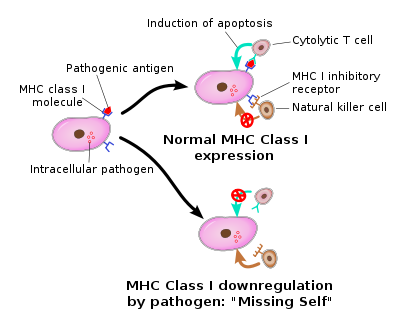
These inhibitory receptors recognize MHC class I
allele
s, which could explain why NK cells kill cells possessing low levels of MHC class I molecules. This inhibition is crucial to the role played by NK cells. MHC class I molecules consist of the main mechanism by which cells display viral or tumor antigens to cytotoxic T-cells. A common evolutionary adaption to this seen in both intracellular microbes and tumours is a chronic down-regulation of these MHC I molecules, rendering the cell impervious to T-cell mediated immunity. It is believed that NK cells, in turn, evolved as an evolutionary response to this adaption, as the loss of the MHC would deprive these cells of the inhibitory effect of MHC and render these cells vulnerable to NK cell mediated apoptosis.
NK cell receptors can also be differentiated based on function. Natural cytotoxicity receptors directly induce apoptosis after binding to ligands that directly indicate infection of a cell. The MHC dependent receptors (described above) use an alternate pathway to induce apoptosis in infected cells.
tumor cells without having been previously sensitized to them. As these discoveries were incompatible with the established model at the time, many initially considered that these observations were artifacts. However, by 1973, 'natural killing' activity was established across a wide variety of species, and the existence of a separate lineage of cells possessing this ability was postulated.
The discovery that a unique type of lymphocyte was responsible for “natural” or spontaneous cytotoxicity was made in the early 1970s by doctoral student Rolf Kiessling and post-doctoral fellow Hugh Pross, in the mouse, and by Hugh Pross and doctoral student Mikael Jondal in the human. The mouse and human work was carried out under the supervision of professors Eva Klein and Hans Wigzell, respectively, of the Karolinska Institute, Stockholm. Kiessling’s research involved the well-characterized ability of T-lymphocytes to lyse
tumor cells against which they had been previously immunized. Pross and Jondal were studying cell-mediated cytotoxicity in normal human blood and the effect of the removal of various receptor-bearing cells on this cytotoxicity. Later that same year Ronald Herberman published similar data with respect to the unique nature of the mouse effector cell.
The human data were confirmed, for the most part, by West et al. using similar techniques and the same erythroleukemic target cell line, K562. K562 is highly sensitive to lysis by human NK cells and, over the decades, the K562 51Chromium-release assay has become the most commonly used assay to detect human NK functional activity. Its almost universal use has meant that experimental data can be compared easily by different laboratories around the world.
Using discontinuous density centrifugation and, later, monoclonal antibodies
, natural killing ability was mapped to the subset of large, granular lymphocytes known today as NK cells. The demonstration that density gradient-isolated large granular lymphocytes were responsible for human NK activity, made by Timonen and Saksela in 1980, was the first time that NK cells had been visualized microscopically and was a major breakthrough in the field.
The cells were named "natural killer" because of the initial notion that they do not require activation in order to kill cells that are "missing-self" recognition ("missing-self" recognition is a term used to describe cells with low levels of MHC
class I
cell surface marker
molecules — a situation that could arise due to viral infection, or in tumors under strong selection pressure of killer T cell
s).
With the discovery of activating receptors almost two decades after the discovery of the inhibitory receptors these cells continue to be called by the same name, though “natural” no longer means the same thing. The term “natural killer” continues to be justified by:
Lymphocyte
A lymphocyte is a type of white blood cell in the vertebrate immune system.Under the microscope, lymphocytes can be divided into large lymphocytes and small lymphocytes. Large granular lymphocytes include natural killer cells...
that constitute a major component of the innate immune system
Innate immune system
The innate immune system, also known as non-specific immune system and secondary line of defence, comprises the cells and mechanisms that defend the host from infection by other organisms in a non-specific manner...
. NK cells play a major role in the rejection of tumor
Tumor
A tumor or tumour is commonly used as a synonym for a neoplasm that appears enlarged in size. Tumor is not synonymous with cancer...
s and cells infected by virus
Virus
A virus is a small infectious agent that can replicate only inside the living cells of organisms. Viruses infect all types of organisms, from animals and plants to bacteria and archaea...
es. They kill cells by releasing small cytoplasm
Cytoplasm
The cytoplasm is a small gel-like substance residing between the cell membrane holding all the cell's internal sub-structures , except for the nucleus. All the contents of the cells of prokaryote organisms are contained within the cytoplasm...
ic granules of proteins called perforin
Perforin
Perforin-1 is a protein that in humans is encoded by the PRF1 gene.- Function :Perforin is a cytolytic protein found in the granules of CD8 T-cells and NK cells. Upon degranulation, perforin inserts itself into the target cell's plasma membrane, forming a pore. The lytic membrane-inserting part...
and granzyme
Granzyme
Granzymes are serine proteases that are released by cytoplasmic granules within cytotoxic T cells and natural killer cells. Their purpose is to induce apoptosis within virus-infected cells, thus destroying them....
that cause the target cell to die by apoptosis
Apoptosis
Apoptosis is the process of programmed cell death that may occur in multicellular organisms. Biochemical events lead to characteristic cell changes and death. These changes include blebbing, cell shrinkage, nuclear fragmentation, chromatin condensation, and chromosomal DNA fragmentation...
(programmed cell death).
NK cells are defined as large granular lymphocytes (LGL) and constitute the third kind of cells differentiated from the common lymphoid progenitor
Lymphoblast
Lymphoblasts are immature cells which typically differentiate to form mature lymphocytes. Normally lymphoblasts are found in the bone marrow, but in acute lymphoblastic leukemia , lymphoblasts proliferate uncontrollably and are found in large numbers in the peripheral blood.The size is between 10...
generating B
B cell
B cells are lymphocytes that play a large role in the humoral immune response . The principal functions of B cells are to make antibodies against antigens, perform the role of antigen-presenting cells and eventually develop into memory B cells after activation by antigen interaction...
and T lymphocyte
T cell
T cells or T lymphocytes belong to a group of white blood cells known as lymphocytes, and play a central role in cell-mediated immunity. They can be distinguished from other lymphocytes, such as B cells and natural killer cells , by the presence of a T cell receptor on the cell surface. They are...
s. They do not express T-cell antigen receptors (TCR) or Pan T marker CD3 or surface immunoglobulins (Ig) B cell receptors but they usually express the surface markers CD16
CD16
CD16 is a low affinity Fc receptor.It is a cluster of differentiation found on the surface of natural killer cells, neutrophil polymorphonuclear leukocytes, monocytes and macrophages...
(FcγRIII) and CD56 in humans, NK1.1 or NK1.2 in C57BL/6 mice
Mouse
A mouse is a small mammal belonging to the order of rodents. The best known mouse species is the common house mouse . It is also a popular pet. In some places, certain kinds of field mice are also common. This rodent is eaten by large birds such as hawks and eagles...
. Up to 80% of human NK cells also express CD8
CD8
CD8 is a transmembrane glycoprotein that serves as a co-receptor for the T cell receptor . Like the TCR, CD8 binds to a major histocompatibility complex molecule, but is specific for the class I MHC protein. There are two isoforms of the protein, alpha and beta, each encoded by a different gene...
.
They were named "natural killers" because of the initial notion that they do not require activation in order to kill cells that are missing "self" markers of major histocompatibility complex
Major histocompatibility complex
Major histocompatibility complex is a cell surface molecule encoded by a large gene family in all vertebrates. MHC molecules mediate interactions of leukocytes, also called white blood cells , which are immune cells, with other leukocytes or body cells...
(MHC) class I
MHC class I
MHC class I molecules are one of two primary classes of major histocompatibility complex molecules and are found on every nucleated cell of the body...
.
They are distinct from Natural Killer T cell
Natural Killer T cell
Natural killer T cells are a heterogeneous group of T cells that share properties of both T cells and natural killer cells. Many of these cells recognize the non-polymorphic CD1d molecule, an antigen-presenting molecule that binds self- and foreign lipids and glycolipids...
s.
Activation
Given their strong cytolyticCytolysis
Cytolysis, or osmotic lysis, occurs when a cell bursts due to an osmotic imbalance that has caused excess water to move into the cell. It occurs in a hypotonic environment, where water diffuses into the cell and causes its volume to increase. If the volume of water exceeds the cell membrane's...
activity and the potential for auto-reactivity, NK cell activity is tightly regulated. NK cells must receive an activating signal, which can come in a variety of forms, the most important of which are listed below.
- CytokineCytokineCytokines are small cell-signaling protein molecules that are secreted by the glial cells of the nervous system and by numerous cells of the immune system and are a category of signaling molecules used extensively in intercellular communication...
s
- The cytokines play a crucial role in NK cell activation. As these are stressStress (biology)Stress is a term in psychology and biology, borrowed from physics and engineering and first used in the biological context in the 1930s, which has in more recent decades become commonly used in popular parlance...
molecules released by cells upon viral infection, they serve to signal to the NK cell the presence of viral pathogensVirusA virus is a small infectious agent that can replicate only inside the living cells of organisms. Viruses infect all types of organisms, from animals and plants to bacteria and archaea...
. Cytokines involved in NK activation include IL-12, IL-15, IL-18, IL-2, and CCL5.
- Fc receptorFc receptorAn Fc receptor is a protein found on the surface of certain cells - including natural killer cells, macrophages, neutrophils, and mast cells - that contribute to the protective functions of the immune system....
- NK cells, along with macrophageMacrophageMacrophages are cells produced by the differentiation of monocytes in tissues. Human macrophages are about in diameter. Monocytes and macrophages are phagocytes. Macrophages function in both non-specific defense as well as help initiate specific defense mechanisms of vertebrate animals...
s and several other cell types, express the Fc receptor (FcR) molecule (FC-gamma-RIII = CD16), an activating biochemical receptorReceptor (biochemistry)In biochemistry, a receptor is a molecule found on the surface of a cell, which receives specific chemical signals from neighbouring cells or the wider environment within an organism...
that binds the FcFragment crystallizable regionThe fragment crystallizable region is the tail region of an antibody that interacts with cell surface receptors called Fc receptors and some proteins of the complement system. This property allows antibodies to activate the immune system...
portion of antibodiesAntibodyAn antibody, also known as an immunoglobulin, is a large Y-shaped protein used by the immune system to identify and neutralize foreign objects such as bacteria and viruses. The antibody recognizes a unique part of the foreign target, termed an antigen...
. This allows NK cells to target cells against which a humoral responseHumoral immunityThe Humoral Immune Response is the aspect of immunity that is mediated by secreted antibodies produced in the cells of the B lymphocyte lineage . B Cells transform into plasma cells which secrete antibodies...
has been mobilized and to lyseLysisLysis refers to the breaking down of a cell, often by viral, enzymic, or osmotic mechanisms that compromise its integrity. A fluid containing the contents of lysed cells is called a "lysate"....
cells through Antibody-dependent cellular cytotoxicity (ADCC)Antibody-dependent cellular cytotoxicityAntibody-Dependent Cell-Mediated Cytotoxicity is a mechanism of cell-mediated immunity whereby an effector cell of the immune system actively lyses a target cell that has been bound by specific antibodies. It is one of the mechanisms through which antibodies, as part of the humoral immune...
.
- Activating and inhibitory receptors
- Aside from the Fc receptor, NK cells express a variety of receptors that serve either to activate or to suppress their cytolyticCytolysisCytolysis, or osmotic lysis, occurs when a cell bursts due to an osmotic imbalance that has caused excess water to move into the cell. It occurs in a hypotonic environment, where water diffuses into the cell and causes its volume to increase. If the volume of water exceeds the cell membrane's...
activity. These receptors bind to various ligandLigand (biochemistry)In biochemistry and pharmacology, a ligand is a substance that forms a complex with a biomolecule to serve a biological purpose. In a narrower sense, it is a signal triggering molecule, binding to a site on a target protein.The binding occurs by intermolecular forces, such as ionic bonds, hydrogen...
s on target cells, both endogenous and exogenous, and have an important role in regulating the NK cell response.
Mechanism
Cytoplasm
The cytoplasm is a small gel-like substance residing between the cell membrane holding all the cell's internal sub-structures , except for the nucleus. All the contents of the cells of prokaryote organisms are contained within the cytoplasm...
contain proteins such as perforin
Perforin
Perforin-1 is a protein that in humans is encoded by the PRF1 gene.- Function :Perforin is a cytolytic protein found in the granules of CD8 T-cells and NK cells. Upon degranulation, perforin inserts itself into the target cell's plasma membrane, forming a pore. The lytic membrane-inserting part...
and protease
Protease
A protease is any enzyme that conducts proteolysis, that is, begins protein catabolism by hydrolysis of the peptide bonds that link amino acids together in the polypeptide chain forming the protein....
s known as granzyme
Granzyme
Granzymes are serine proteases that are released by cytoplasmic granules within cytotoxic T cells and natural killer cells. Their purpose is to induce apoptosis within virus-infected cells, thus destroying them....
s. Upon release in close proximity to a cell slated for killing, perforin forms pores in the cell membrane
Cell membrane
The cell membrane or plasma membrane is a biological membrane that separates the interior of all cells from the outside environment. The cell membrane is selectively permeable to ions and organic molecules and controls the movement of substances in and out of cells. It basically protects the cell...
of the target cell, creating an aqueous channel through which the granzymes and associated molecules can enter, inducing either apoptosis
Apoptosis
Apoptosis is the process of programmed cell death that may occur in multicellular organisms. Biochemical events lead to characteristic cell changes and death. These changes include blebbing, cell shrinkage, nuclear fragmentation, chromatin condensation, and chromosomal DNA fragmentation...
or osmotic cell lysis. The distinction between apoptosis and cell lysis
Lysis
Lysis refers to the breaking down of a cell, often by viral, enzymic, or osmotic mechanisms that compromise its integrity. A fluid containing the contents of lysed cells is called a "lysate"....
is important in immunology
Immunology
Immunology is a broad branch of biomedical science that covers the study of all aspects of the immune system in all organisms. It deals with the physiological functioning of the immune system in states of both health and diseases; malfunctions of the immune system in immunological disorders ; the...
: lysing a virus-infected cell would only release the virions, whereas apoptosis leads to destruction of the virus inside.
NK cells are activated in response to interferon
Interferon
Interferons are proteins made and released by host cells in response to the presence of pathogens—such as viruses, bacteria, or parasites—or tumor cells. They allow communication between cells to trigger the protective defenses of the immune system that eradicate pathogens or tumors.IFNs belong to...
s or macrophage
Macrophage
Macrophages are cells produced by the differentiation of monocytes in tissues. Human macrophages are about in diameter. Monocytes and macrophages are phagocytes. Macrophages function in both non-specific defense as well as help initiate specific defense mechanisms of vertebrate animals...
-derived cytokine
Cytokine
Cytokines are small cell-signaling protein molecules that are secreted by the glial cells of the nervous system and by numerous cells of the immune system and are a category of signaling molecules used extensively in intercellular communication...
s. They serve to contain viral
Virus
A virus is a small infectious agent that can replicate only inside the living cells of organisms. Viruses infect all types of organisms, from animals and plants to bacteria and archaea...
infections while the adaptive immune response is generating antigen
Antigen
An antigen is a foreign molecule that, when introduced into the body, triggers the production of an antibody by the immune system. The immune system will then kill or neutralize the antigen that is recognized as a foreign and potentially harmful invader. These invaders can be molecules such as...
-specific cytotoxic T cell
Cytotoxic T cell
A cytotoxic T cell belongs to a sub-group of T lymphocytes that are capable of inducing the death of infected somatic or tumor cells; they kill cells that are infected with viruses , or are otherwise damaged or...
s that can clear the infection. Patients deficient in NK cells prove to be highly susceptible to early phases of herpes virus infection.
In order for NK cells to defend the body against viruses and other pathogens, they require mechanisms that enable the determination of whether a cell is infected or not. The exact mechanisms remain the subject of current investigation, but recognition of an "altered self" state is thought to be involved. To control their cytotoxic activity, NK cells possess two types of surface receptor
Receptor (biochemistry)
In biochemistry, a receptor is a molecule found on the surface of a cell, which receives specific chemical signals from neighbouring cells or the wider environment within an organism...
s: activating receptors and inhibitory receptors. Most of these receptors are not unique to NK cells and can be present in some T cell
T cell
T cells or T lymphocytes belong to a group of white blood cells known as lymphocytes, and play a central role in cell-mediated immunity. They can be distinguished from other lymphocytes, such as B cells and natural killer cells , by the presence of a T cell receptor on the cell surface. They are...
subsets as well.
These inhibitory receptors recognize MHC class I
MHC class I
MHC class I molecules are one of two primary classes of major histocompatibility complex molecules and are found on every nucleated cell of the body...
allele
Allele
An allele is one of two or more forms of a gene or a genetic locus . "Allel" is an abbreviation of allelomorph. Sometimes, different alleles can result in different observable phenotypic traits, such as different pigmentation...
s, which could explain why NK cells kill cells possessing low levels of MHC class I molecules. This inhibition is crucial to the role played by NK cells. MHC class I molecules consist of the main mechanism by which cells display viral or tumor antigens to cytotoxic T-cells. A common evolutionary adaption to this seen in both intracellular microbes and tumours is a chronic down-regulation of these MHC I molecules, rendering the cell impervious to T-cell mediated immunity. It is believed that NK cells, in turn, evolved as an evolutionary response to this adaption, as the loss of the MHC would deprive these cells of the inhibitory effect of MHC and render these cells vulnerable to NK cell mediated apoptosis.
Receptor types
NK cell receptor types (with inhibitory as well as some activating members) are differentiated by structure:- CD94CD94CD94 , also known as killer cell lectin-like receptor subfamily D, member 1 is a human gene....
: NKG2NKG2NKG2 also known as CD159a is an activating receptor for natural killer cells....
(heterodimers) — a C-type lectin family receptor, conserved in both rodents and primates and identifies non-classical (also non-polymorphic) MHC I molecules like HLA-E. Expression of HLA-E at the cell surface is dependent on the presence of nonamer peptide epitope derived from the signal sequence of classical MHC class I molecules, which is generated by the sequential action of signal peptide peptidaseSignal Peptide PeptidaseThe Signal Peptide Peptidase is an intramembrane aspartyl protease with the conserved active site motifs 'YD' and 'GxGD' in in adjacent transmembrane domains . Its sequences is highly conserved in different vertebrate species...
and the proteasomeProteasomeProteasomes are very large protein complexes inside all eukaryotes and archaea, and in some bacteria. In eukaryotes, they are located in the nucleus and the cytoplasm. The main function of the proteasome is to degrade unneeded or damaged proteins by proteolysis, a chemical reaction that breaks...
. Though indirect, this is a way to survey the levels of classical (polymorphic) HLA molecules. - Ly49 (homodimers) — a relatively ancient, C-type lectin family receptor; are of multigenic presence in mice, while humans have only one pseudogenic Ly49; the receptor for classical (polymorphic) MHC I molecules.
- KIR (Killer-cell immunoglobulin-like receptorKiller-cell immunoglobulin-like receptorKiller-cell immunoglobulin-like receptors , are a family of cell surface proteins found on important cells of the immune system called natural killer cells. They regulate the killing function of these cells by interacting with MHC class I molecules, which are expressed on all cell types...
s) — belong to a multigene family of more recently-evolvedEvolutionEvolution is any change across successive generations in the heritable characteristics of biological populations. Evolutionary processes give rise to diversity at every level of biological organisation, including species, individual organisms and molecules such as DNA and proteins.Life on Earth...
Ig-like extracellular domain receptors; are present in non-human primates; and are the main receptors for both classical MHC I (HLA-AHLA-AHLA-A are a group of human leukocyte antigens that are encoded by the HLA-A locus on human chromosome 6p. The HLA genes constitute a large subset of the Major histocompatibility complex of humans. HLA-A is a component of certain MHC class I cell surface receptor isoforms that resides on the...
, HLA-BHLA-BHLA-B is a human gene that provides instructions for making a protein that plays a critical role in the immune system. HLA-B is part of a family of genes called the human leukocyte antigen complex...
, HLA-CHLA-CHLA-C belongs to the MHC class I heavy chain receptors. The C receptor is a heterodimer consisting of a HLA-C mature gene product and β2-microglobulin. The mature C chain is anchored in the membrane...
) and also non-classical HLA-GHLA-GHLA-G histocompatibility antigen, class I, G, also known as human leukocyte antigen G , is a protein that in humans is encoded by the HLA-G gene....
in primates. Some KIRs are specific for certain HLA subtypes. - ILT or LIR (leukocyte inhibitory receptors) — are recently-discovered members of the Ig receptor family.
NK cell receptors can also be differentiated based on function. Natural cytotoxicity receptors directly induce apoptosis after binding to ligands that directly indicate infection of a cell. The MHC dependent receptors (described above) use an alternate pathway to induce apoptosis in infected cells.
History and discovery
In early experiments on cell-mediated cytotoxicity against tumor target cells, both in cancer patients and animal models, investigators consistently observed what was termed a "natural" reactivity, that is, a certain population of cells seemed to be able to lyseLysis
Lysis refers to the breaking down of a cell, often by viral, enzymic, or osmotic mechanisms that compromise its integrity. A fluid containing the contents of lysed cells is called a "lysate"....
tumor cells without having been previously sensitized to them. As these discoveries were incompatible with the established model at the time, many initially considered that these observations were artifacts. However, by 1973, 'natural killing' activity was established across a wide variety of species, and the existence of a separate lineage of cells possessing this ability was postulated.
The discovery that a unique type of lymphocyte was responsible for “natural” or spontaneous cytotoxicity was made in the early 1970s by doctoral student Rolf Kiessling and post-doctoral fellow Hugh Pross, in the mouse, and by Hugh Pross and doctoral student Mikael Jondal in the human. The mouse and human work was carried out under the supervision of professors Eva Klein and Hans Wigzell, respectively, of the Karolinska Institute, Stockholm. Kiessling’s research involved the well-characterized ability of T-lymphocytes to lyse
Lysis
Lysis refers to the breaking down of a cell, often by viral, enzymic, or osmotic mechanisms that compromise its integrity. A fluid containing the contents of lysed cells is called a "lysate"....
tumor cells against which they had been previously immunized. Pross and Jondal were studying cell-mediated cytotoxicity in normal human blood and the effect of the removal of various receptor-bearing cells on this cytotoxicity. Later that same year Ronald Herberman published similar data with respect to the unique nature of the mouse effector cell.
The human data were confirmed, for the most part, by West et al. using similar techniques and the same erythroleukemic target cell line, K562. K562 is highly sensitive to lysis by human NK cells and, over the decades, the K562 51Chromium-release assay has become the most commonly used assay to detect human NK functional activity. Its almost universal use has meant that experimental data can be compared easily by different laboratories around the world.
Using discontinuous density centrifugation and, later, monoclonal antibodies
Monoclonal antibodies
Monoclonal antibodies are monospecific antibodies that are the same because they are made by identical immune cells that are all clones of a unique parent cell....
, natural killing ability was mapped to the subset of large, granular lymphocytes known today as NK cells. The demonstration that density gradient-isolated large granular lymphocytes were responsible for human NK activity, made by Timonen and Saksela in 1980, was the first time that NK cells had been visualized microscopically and was a major breakthrough in the field.
The cells were named "natural killer" because of the initial notion that they do not require activation in order to kill cells that are "missing-self" recognition ("missing-self" recognition is a term used to describe cells with low levels of MHC
Major histocompatibility complex
Major histocompatibility complex is a cell surface molecule encoded by a large gene family in all vertebrates. MHC molecules mediate interactions of leukocytes, also called white blood cells , which are immune cells, with other leukocytes or body cells...
class I
MHC class I
MHC class I molecules are one of two primary classes of major histocompatibility complex molecules and are found on every nucleated cell of the body...
cell surface marker
Cluster of differentiation
The cluster of differentiation is a protocol used for the identification and investigation of cell surface molecules present on white blood cells, providing targets for immunophenotyping of cells...
molecules — a situation that could arise due to viral infection, or in tumors under strong selection pressure of killer T cell
T cell
T cells or T lymphocytes belong to a group of white blood cells known as lymphocytes, and play a central role in cell-mediated immunity. They can be distinguished from other lymphocytes, such as B cells and natural killer cells , by the presence of a T cell receptor on the cell surface. They are...
s).
With the discovery of activating receptors almost two decades after the discovery of the inhibitory receptors these cells continue to be called by the same name, though “natural” no longer means the same thing. The term “natural killer” continues to be justified by:
- a morphologyMorphology (biology)In biology, morphology is a branch of bioscience dealing with the study of the form and structure of organisms and their specific structural features....
characteristic of activated cytotoxicCytotoxicityCytotoxicity is the quality of being toxic to cells. Examples of toxic agents are a chemical substance, an immune cell or some types of venom .-Cell physiology:...
lymphocytes, e.g., large size, high protein synthesis activity in the abundant endoplasmic reticulum (ER)Endoplasmic reticulumThe endoplasmic reticulum is an organelle of cells in eukaryotic organisms that forms an interconnected network of tubules, vesicles, and cisternae...
, and preformed granuleGranule (cell biology)In cell biology, a granule is a small particle. It can be any structure barely visible by light microscopy. The term is most often used to describe a secretory vesicle.-Leukocytes:...
s - the mature state (does not require much new protein synthesisProtein biosynthesisProtein biosynthesis is the process in which cells build or manufacture proteins. The term is sometimes used to refer only to protein translation but more often it refers to a multi-step process, beginning with amino acid synthesis and transcription of nuclear DNA into messenger RNA, which is then...
and remodeling before starting to kill) - the rapid killing activity observed in freshly-isolated NK cells.
See also
- Active Hexose Correlated CompoundActive Hexose Correlated CompoundActive Hexose Correlated Compound is an alpha-glucan rich nutritional supplement produced from the mycelia of shiitake of the basidiomycete family of mushrooms, and is not an approved drug. AHCC was originally designed to lower high-blood pressure...
- GranzymeGranzymeGranzymes are serine proteases that are released by cytoplasmic granules within cytotoxic T cells and natural killer cells. Their purpose is to induce apoptosis within virus-infected cells, thus destroying them....
s - Hematopoiesis
- Immune systemImmune systemAn immune system is a system of biological structures and processes within an organism that protects against disease by identifying and killing pathogens and tumor cells. It detects a wide variety of agents, from viruses to parasitic worms, and needs to distinguish them from the organism's own...
- Immunoglobulin, e.g., Ig (above)
- InterleukinInterleukinInterleukins are a group of cytokines that were first seen to be expressed by white blood cells . The term interleukin derives from "as a means of communication", and "deriving from the fact that many of these proteins are produced by leukocytes and act on leukocytes"...
, e.g., ILx (above) - Lymphatic SystemLymphatic systemThe lymphoid system is the part of the immune system comprising a network of conduits called lymphatic vessels that carry a clear fluid called lymph unidirectionally toward the heart. Lymphoid tissue is found in many organs, particularly the lymph nodes, and in the lymphoid follicles associated...
Literature
- Cellular and Molecular Immunology by Abbul K. Abbas & Andrew Lichtman Saunders Copyright 2003
- How the Immune System Works, 2nd edition, by Lauren Sompayrac, PhD Blackwell Publishing 2003
- Immunobiology: The Immune System In Health And Disease by Janeway, Travers, Walport & Shlomchik Churchchill Livingstone Copyright 2005
- Kuby Immunology, 6th edition, by Thomas J. Kindt, Richard A. Goldsby,and Barbara A.Kuby W.H. Freeman and Company,New York
- Regulation of interferon-gamma during innate and adaptive immune response, by Schoenborn J.R., and Wilson C.B. Advances in Immunology, 96:41-101, 2007. PMID 7981204
External links
- CopeWithCytoKines Portal to definitions of NK-Cells and closely related topics
- http://www.hfea.gov.uk/fertility-treatment-options-reproductive-immunology.html Reproductive immunology and fertility treatment
- http://www.cambridgenetwork.co.uk/news/article/default.aspx?objid=58465
- Binns C (June 19, 2006), Natural Body Guards: How Your Killer Cells Get Motivated. Livescience.com. Retrieved on 2007-10-20.
- Nkcells.info - MediaWiki based information platform specializing on natural killer cells
- Large granular lymphocyte entry in the public domain NCI Dictionary of Cancer Terms