

Cluster of differentiation

Encyclopedia
The cluster of differentiation (cluster of designation) (often abbreviated as CD) is a protocol used for the identification and investigation of cell surface molecules present on white blood cells, providing targets for immunophenotyping
of cells. Physiologically, CD molecules can act in numerous ways, often acting as receptors
or ligands
(the molecule that activates a receptor) important to the cell. A signal cascade is usually initiated, altering the behavior of the cell (see cell signaling
). Some CD proteins do not play a role in cell signaling, but have other functions, such as cell adhesion
. CD for humans is numbered up to 350 most recently .
(mAbs) generated by different laboratories around the world against epitope
s on the surface molecules of leukocytes (white blood cells)
. Since then, its use has expanded to many other cell types, and more than 320 CD unique clusters and subclusters have been identified. The proposed surface molecule is assigned a CD number once two specific monoclonal antibodies
(mAb) are shown to bind to the molecule. If the molecule has not been well-characterized, or has only one mAb, it is usually given the provisional indicator "w" (as in "CDw186").
Cell populations are usually defined using a '+' or a '-' symbol to indicate whether a certain cell fraction expresses or lacks a CD molecule. For example, a "CD34
+, CD31
-" cell is one that expresses CD34, but not CD31. This CD combination typically corresponds to a stem cell
, as opposed to a fully differentiated endothelial cell. Some cell populations can also be defined as hi, mid or low(alternatively bright, mid or dim), indicating an overall variability in CD expression, particularly when compared to other cells being studied. A review of the development of T cells in the thymus uses this nomenclature to identify cells transitioning from CD4mid/CD8mid double positive cells to CD4hi/CD8mid.
, allowing cells to be defined based on what molecules are present on their surface. These markers are often used to associate cells with certain immune functions. While using one CD molecule to define populations is uncommon (though a few examples exist), combining markers has allowed for cell types with very specific definitions within the immune system.
CD molecules are utilized in cell sorting using various methods including flow cytometry
.
Two commonly used CD molecules are CD4
and CD8
, which are, in general, used as markers for helper
and cytotoxic
T cells, respectively. These molecules are defined in combination with CD3+, as some other leukocytes also express these CD molecules (some macrophages express low levels of CD4; dendritic cells express high levels of CD8). Human immunodeficiency virus (HIV) binds CD4 and a chemokine receptor on the surface of a T helper cell to gain entry. The number of CD4 and CD8 T cells in blood is often used to monitor the progression of HIV infection.
recognition.
Immunophenotyping
Immunophenotyping is a technique used to study the protein expressed by cells. This technique is commonly used in basic science research and laboratory diagnostic purpose. This can be done on tissue section , cell suspension, etc. An example is the detection of tumor marker, such as in the...
of cells. Physiologically, CD molecules can act in numerous ways, often acting as receptors
Receptor (biochemistry)
In biochemistry, a receptor is a molecule found on the surface of a cell, which receives specific chemical signals from neighbouring cells or the wider environment within an organism...
or ligands
Ligand (biochemistry)
In biochemistry and pharmacology, a ligand is a substance that forms a complex with a biomolecule to serve a biological purpose. In a narrower sense, it is a signal triggering molecule, binding to a site on a target protein.The binding occurs by intermolecular forces, such as ionic bonds, hydrogen...
(the molecule that activates a receptor) important to the cell. A signal cascade is usually initiated, altering the behavior of the cell (see cell signaling
Cell signaling
Cell signaling is part of a complex system of communication that governs basic cellular activities and coordinates cell actions. The ability of cells to perceive and correctly respond to their microenvironment is the basis of development, tissue repair, and immunity as well as normal tissue...
). Some CD proteins do not play a role in cell signaling, but have other functions, such as cell adhesion
Cell adhesion
Cellular adhesion is the binding of a cell to a surface, extracellular matrix or another cell using cell adhesion molecules such as selectins, integrins, and cadherins. Correct cellular adhesion is essential in maintaining multicellular structure...
. CD for humans is numbered up to 350 most recently .
Nomenclature
The CD nomenclature was proposed and established in the 1st International Workshop and Conference on Human Leukocyte Differentiation Antigens (HLDA), which was held in Paris in 1982. This system was intended for the classification of the many monoclonal antibodiesMonoclonal antibodies
Monoclonal antibodies are monospecific antibodies that are the same because they are made by identical immune cells that are all clones of a unique parent cell....
(mAbs) generated by different laboratories around the world against epitope
Epitope
An epitope, also known as antigenic determinant, is the part of an antigen that is recognized by the immune system, specifically by antibodies, B cells, or T cells. The part of an antibody that recognizes the epitope is called a paratope...
s on the surface molecules of leukocytes (white blood cells)
White blood cell
White blood cells, or leukocytes , are cells of the immune system involved in defending the body against both infectious disease and foreign materials. Five different and diverse types of leukocytes exist, but they are all produced and derived from a multipotent cell in the bone marrow known as a...
. Since then, its use has expanded to many other cell types, and more than 320 CD unique clusters and subclusters have been identified. The proposed surface molecule is assigned a CD number once two specific monoclonal antibodies
Monoclonal antibodies
Monoclonal antibodies are monospecific antibodies that are the same because they are made by identical immune cells that are all clones of a unique parent cell....
(mAb) are shown to bind to the molecule. If the molecule has not been well-characterized, or has only one mAb, it is usually given the provisional indicator "w" (as in "CDw186").
Cell populations are usually defined using a '+' or a '-' symbol to indicate whether a certain cell fraction expresses or lacks a CD molecule. For example, a "CD34
CD34
CD34 molecule is a cluster of differentiation molecule present on certain cells within the human body. It is a cell surface glycoprotein and functions as a cell-cell adhesion factor. It may also mediate the attachment of stem cells to bone marrow extracellular matrix or directly to stromal cells...
+, CD31
CD31
Platelet endothelial cell adhesion molecule also known as cluster of differentiation 31 is a protein that in human is encoded by the PECAM1 gene found on chromosome 17...
-" cell is one that expresses CD34, but not CD31. This CD combination typically corresponds to a stem cell
Stem cell
This article is about the cell type. For the medical therapy, see Stem Cell TreatmentsStem cells are biological cells found in all multicellular organisms, that can divide and differentiate into diverse specialized cell types and can self-renew to produce more stem cells...
, as opposed to a fully differentiated endothelial cell. Some cell populations can also be defined as hi, mid or low(alternatively bright, mid or dim), indicating an overall variability in CD expression, particularly when compared to other cells being studied. A review of the development of T cells in the thymus uses this nomenclature to identify cells transitioning from CD4mid/CD8mid double positive cells to CD4hi/CD8mid.
Immunophenotyping
The CD system is commonly used as cell markers in immunophenotypingImmunophenotyping
Immunophenotyping is a technique used to study the protein expressed by cells. This technique is commonly used in basic science research and laboratory diagnostic purpose. This can be done on tissue section , cell suspension, etc. An example is the detection of tumor marker, such as in the...
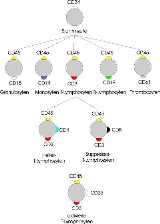
, allowing cells to be defined based on what molecules are present on their surface. These markers are often used to associate cells with certain immune functions. While using one CD molecule to define populations is uncommon (though a few examples exist), combining markers has allowed for cell types with very specific definitions within the immune system.
CD molecules are utilized in cell sorting using various methods including flow cytometry
Flow cytometry
Flow cytometry is a technique for counting and examining microscopic particles, such as cells and chromosomes, by suspending them in a stream of fluid and passing them by an electronic detection apparatus. It allows simultaneous multiparametric analysis of the physical and/or chemical...
.
| Type of cell | CD markers >- | stem cell Stem cell This article is about the cell type. For the medical therapy, see Stem Cell TreatmentsStem cells are biological cells found in all multicellular organisms, that can divide and differentiate into diverse specialized cell types and can self-renew to produce more stem cells... s |
CD34 CD34 CD34 molecule is a cluster of differentiation molecule present on certain cells within the human body. It is a cell surface glycoprotein and functions as a cell-cell adhesion factor. It may also mediate the attachment of stem cells to bone marrow extracellular matrix or directly to stromal cells... +, CD31 CD31 Platelet endothelial cell adhesion molecule also known as cluster of differentiation 31 is a protein that in human is encoded by the PECAM1 gene found on chromosome 17... - >- | all leukocyte groups |
CD45 CD45 Protein tyrosine phosphatase, receptor type, C also known as PTPRC is an enzyme that, in humans, is encoded by the PTPRC gene. PTPRC is also known as CD45 antigen , which was originally called leukocyte common antigen.- Function :The protein encoded by this gene is a member of the protein tyrosine... + >- | Granulocyte Granulocyte Granulocytes are a category of white blood cells characterized by the presence of granules in their cytoplasm. They are also called polymorphonuclear leukocytes because of the varying shapes of the nucleus, which is usually lobed into three segments... |
CD15 CD15 CD15 is a cluster of differentiation antigen - an immunologically significant molecule. CD15 is a carbohydrate adhesion molecule that can be expressed on glycoproteins, glycolipids and proteoglycans.- Function :... + >- | Monocyte Monocyte Monocytes are a type of white blood cell and are part of the innate immune system of vertebrates including all mammals , birds, reptiles, and fish. Monocytes play multiple roles in immune function... |
CD14 CD14 Cluster of differentiation 14 also known as CD14 is a human gene.The protein encoded by this gene is a component of the innate immune system. CD14 exists in two forms. Either it is anchored into the membrane by a glycosylphosphatidylinositol tail or it appears in a soluble form... + >- | T lymphocyte |
>- | CD4 CD4 CD4 is a glycoprotein expressed on the surface of T helper cells, monocytes, macrophages, and dendritic cells. It was discovered in the late 1970s and was originally known as leu-3 and T4 before being named CD4 in 1984... + >- | Cytotoxic T cell Cytotoxic T cell A cytotoxic T cell belongs to a sub-group of T lymphocytes that are capable of inducing the death of infected somatic or tumor cells; they kill cells that are infected with viruses , or are otherwise damaged or... |
CD8 CD8 CD8 is a transmembrane glycoprotein that serves as a co-receptor for the T cell receptor . Like the TCR, CD8 binds to a major histocompatibility complex molecule, but is specific for the class I MHC protein. There are two isoforms of the protein, alpha and beta, each encoded by a different gene... + >- | B lymphocyte |
CD19 CD19 B-lymphocyte antigen CD19 also known as CD19 , is a protein that in humans is encoded by the CD19 gene.- Function :... + or CD45+, CD20 CD20 B-lymphocyte antigen CD20 or CD20 is an activated-glycosylated phosphoprotein expressed on the surface of all B-cells beginning at the pro-B phase and progressively increasing in concentration until maturity.... + >- | Thrombocyte |
CD61 CD61 Integrin beta-3 or CD61 is a protein that in humans is encoded by the ITGB3 gene. CD61 is a cluster of differentiation found on thrombocytes.-Structure and function:... + >- | Natural killer cell Natural killer cell Natural killer cells are a type of cytotoxic lymphocyte that constitute a major component of the innate immune system. NK cells play a major role in the rejection of tumors and cells infected by viruses... |
CD16 CD16 CD16 is a low affinity Fc receptor.It is a cluster of differentiation found on the surface of natural killer cells, neutrophil polymorphonuclear leukocytes, monocytes and macrophages... +, CD56+, CD3- |
Two commonly used CD molecules are CD4
CD4
CD4 is a glycoprotein expressed on the surface of T helper cells, monocytes, macrophages, and dendritic cells. It was discovered in the late 1970s and was originally known as leu-3 and T4 before being named CD4 in 1984...
and CD8
CD8
CD8 is a transmembrane glycoprotein that serves as a co-receptor for the T cell receptor . Like the TCR, CD8 binds to a major histocompatibility complex molecule, but is specific for the class I MHC protein. There are two isoforms of the protein, alpha and beta, each encoded by a different gene...
, which are, in general, used as markers for helper
T helper cell
T helper cells are a sub-group of lymphocytes, a type of white blood cell, that play an important role in the immune system, particularly in the adaptive immune system. These cells have no cytotoxic or phagocytic activity; they cannot kill infected host cells or pathogens. Rather, they help other...
and cytotoxic
Cytotoxic T cell
A cytotoxic T cell belongs to a sub-group of T lymphocytes that are capable of inducing the death of infected somatic or tumor cells; they kill cells that are infected with viruses , or are otherwise damaged or...
T cells, respectively. These molecules are defined in combination with CD3+, as some other leukocytes also express these CD molecules (some macrophages express low levels of CD4; dendritic cells express high levels of CD8). Human immunodeficiency virus (HIV) binds CD4 and a chemokine receptor on the surface of a T helper cell to gain entry. The number of CD4 and CD8 T cells in blood is often used to monitor the progression of HIV infection.
Physiological functions
While CD molecules are very useful in defining leukocytes, they are not merely markers on the cell surface. While only a fraction of known CD molecules have been thoroughly characterised, most of them have an important function. In the example of CD4 & CD8, these molecules are critical in antigenAntigen
An antigen is a foreign molecule that, when introduced into the body, triggers the production of an antibody by the immune system. The immune system will then kill or neutralize the antigen that is recognized as a foreign and potentially harmful invader. These invaders can be molecules such as...
recognition.
See also
- List of human clusters of differentiation for a list of CD molecules
- Immune systemImmune systemAn immune system is a system of biological structures and processes within an organism that protects against disease by identifying and killing pathogens and tumor cells. It detects a wide variety of agents, from viruses to parasitic worms, and needs to distinguish them from the organism's own...
- Immune toleranceImmune toleranceImmune tolerance or immunological tolerance is the process by which the immune system does not attack an antigen. It can be either 'natural' or 'self tolerance', in which the body does not mount an immune response to self antigens, or 'induced tolerance', in which tolerance to external antigens can...
- Antibodies
- Leukocytes
- Signal transductionSignal transductionSignal transduction occurs when an extracellular signaling molecule activates a cell surface receptor. In turn, this receptor alters intracellular molecules creating a response...
External links
- Molecule search maintained by the Human Cell Differentiation Molecules Council (successor to the HLDA Workshops)
- Table of CD Antigens
- CD list Protein Reviews On The Web
- Yet another list of CD molecules, at PathologyOutlines.com
- Wall charts of CD molecules and other cytokines, with colors, arrows from one cell to another, from eBioscience.